In Exile, Taslima Nasrin writes about the series of events leading to her ouster from India, her house arrest, and the anxious days she had to spend in the government safe house, beset by a scheming array of bureaucrats and ministers desperate to see her gone. Without a single political party, social organization or renowned personality by her side, she had been a lone, exiled, dissenting voice up against the entire state machinery with only her wits and determination at her disposal.
These seven quotes from the book give us a glimpse into her life in the seven month period in India.


Taslima Nasrin’s book Exile is a moving and shocking chronicle of her struggles in India over a period of five months, set against a rising tide of fundamentalism and intolerance that will resonate powerfully with the present socio-political scenario.

Category: Features
articles features main category
The Tao of Life, Verse and Satire by Sanjeev Sanyal
Sanjeev Sanyal, bestselling history author of Land of the Seven Rivers, is currently the principal economic adviser to the Indian government. A Rhodes Scholar and an Eisenhower fellow, he has written extensively on economics, environmental conservation and urban issues.
His work takes him to many places and often leads to encounters with various colourful characters throughout India. You can meet them all in his latest book, Life Over Two Beers, slated to release this month marking his entry into the world of fiction and poetry.
————————————
By Sanjeev Sanyal
My latest book “Life over Two Beers” will hit the stores next week. Quite unlike my previous books, it is a collection of quirky short stories, some satirical, some with a twist in the end. And then there is the odd verse thrown in along the way. So, why this foray into the world of fiction and poetry?
It will come as some surprise to those who have read my non-fiction writings over the years that I began writing this book, in bits and pieces, a decade and a half ago. I was then a young economist working in financial markets, recently relocated to Singapore from Mumbai. My first child had just been born. Sitting in my study one hot and sunny Sunday afternoon, with the rock-band Era playing loudly in the background, I typed out my first short story on my company issue IBM Thinkpad. Nothing pre-meditated, it was just something that I wrote out just like that.
My profession as an economist requires routine writing of reports, articles and newspaper columns. However, over the next few years, I ended up typing a story here, a fragment of verse there. At some point, I had written out enough that I wondered if it could be published. So, when I first reached out to publishers circa 2005-6, it was to publish this book. The problem was that publishers were not too keen on it. As any editor or aspiring writer will tell you, it is very difficult to publish short fiction and almost impossible for poetry. The publishers persuaded me to write non-fiction. I am not complaining – it sent me on a happy journey and I will probably remain primarily a non-fiction writer. Nonetheless, the idea of publishing my short stories remained and I kept adding and updating the collection. Every time I changed laptops, I had to remember to transfer the file. Only four of my original set have found their way here but I am glad the book finally got published.
There are a several reasons that I wanted to publish this book. First, I have long felt that the art of short story writing needs to be revived. Till the middle of the 20th century, it was the dominant form of fiction writing and most well-known authors across the world practiced the art. However, by the 1970s, short fiction was replaced by the novel. Those who were once avid readers of short stories in magazines and other periodicals, I am told, moved on to television serials. As a result, the market dried up and short fiction became a poor cousin of the longer format.
I have never been convinced by this explanation. I like reading short fiction and I think others do too. People still read short stories by Tagore, Manto, Dahl, Hemingway, Doyle and Borges. Indeed, every era since the Panchatantra and the Arabian Nights has had its stories told simply and without the literary fuss of a full-fledged novel. Why not 21st century India?
The second motivation was to revive the art of satire. India has a long tradition of satire going back to ancient times. While it survives here and there in a few Indian languages (and in social media), it is sadly no longer a mainstream art form. Note that I distinguish here between first-order humor of comedy, which is alive and well, and the second-order humour of satire. Hindi and Bengali, till very recently, had a vibrant culture of satirical poetry. These seem to have somehow been replaced by the humor of comedy. Not quite the same thing.
I am a firm believer that no society can thrive unless it can occasionally mock itself. Hence, many of the stories in this collection, albeit not all, have an element of satire. I would like to clarify, nevertheless, that all the characters are fictional and any apparent similarity is merely due to the fact that satire, by its very nature, is based on a caricature of real world social mores.
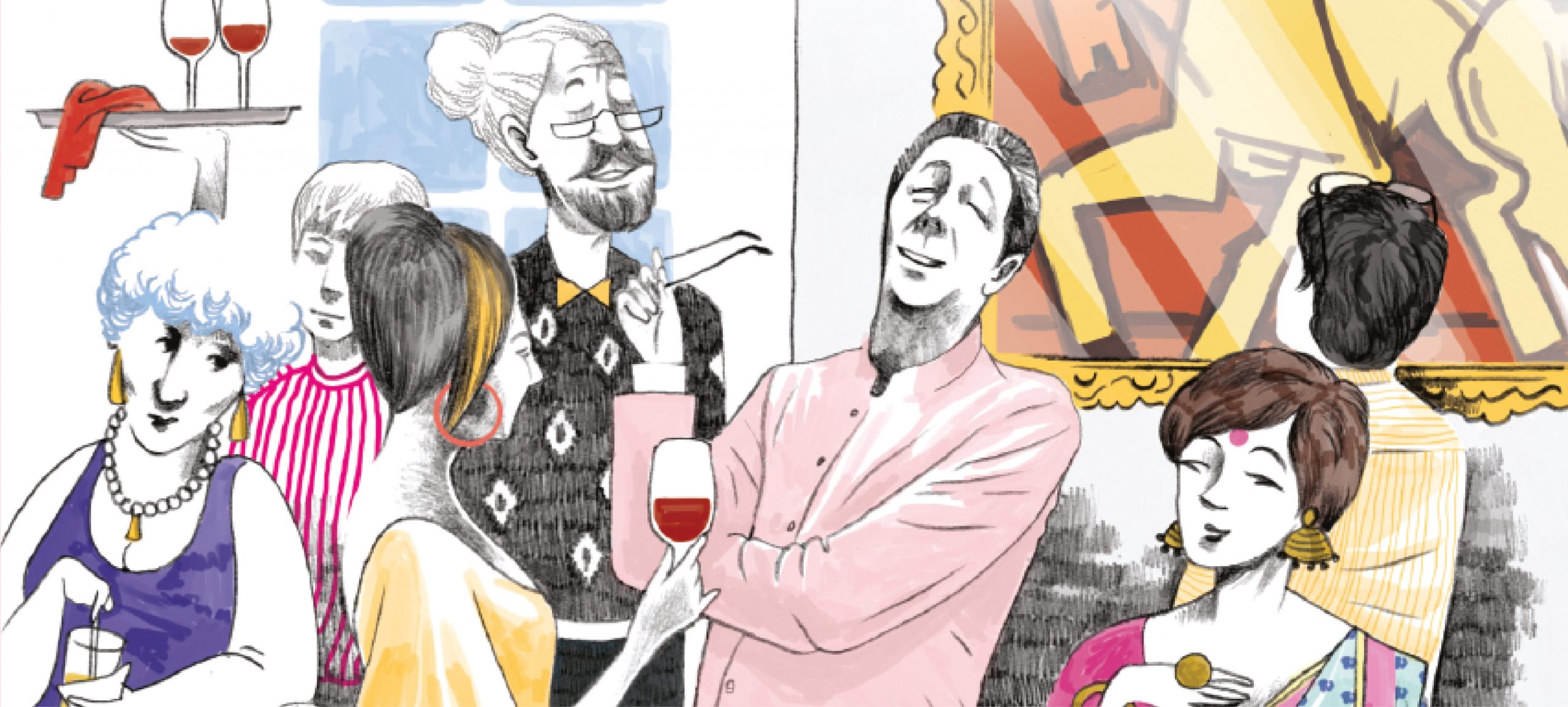
The more avid readers will probably enjoy the many hidden layers and inside jokes in the collection. For instance, there are many direct and indirect allusions to my favourite authors. No prizes for guessing who inspired the cover but the reader will be amused to know that the artist Jit depicted himself in the cast of characters!
A more serious theme that run through the book is that of intellectual openness and social mobility in its many forms. India is currently experiencing unprecedented intellectual and social churn. Any depiction of early 21st century India needs to take this into account. Thus, many of the stories depict new entrants into social and intellectual spaces, and the responses of incumbents to this change. Rather than being unduly judgemental and moralistic, the stories sketch out the opportunism, self-doubt, snobbery, and need for validation that characterizes such a churning society.
I do no not wish to burden the general reader with all the above baggage. The book should be read purely for fun at the first instance. As for me, I am glad to have finally dragged it to the finishing line. After carrying around the manuscript for years, a full draft was done by end-2016. It should normally have been published in 2017 but the editing was delayed by a full year as I took up a challenging new job. So, now that it is finally in print, I feel oddly lighter and emptier at the same time.
—————–

Five Areas Where India Has Witnessed Immense Growth In The Past Seven Decades
Has democracy in India fulfilled the aspirations of its people? Is the country secure on its external borders? Will India become an economic powerhouse?
All these and many more integral questions loom large as India completes seven decades of independence. The book, Seven Decades of Independent India, edited by Vinod Rai and Amitendu Palit, reflects on the India of yesterday, today, and tomorrow, by gathering rare and candid insights from some of the most distinguished experts, practitioners and scholars on India.
Here are five areas where India has progressed notably-


Fierce Protagonists from a Fierce Voice
Rabindranath Tagore was a key figure of the Bengal Renaissance. He started writing at an early age and by the turn of the century had become a household name. In 1913 he was awarded the Nobel Prize for Literature and his verse collection, Gitanjali came to be known internationally. His works include novels; plays; essays on religious, social and literary topics; some sixty collections of verse; over a hundred short stories; and more than 2500 songs, including the national anthems of India and Bangladesh. Tagore’s eminence as India’s greatest modern poet remains unchallenged to this day.
Here are six quotes from his books, Chokher Bali and The Home and The World that show how brave and fierce Tagore’s protagonists were.
———————————–


—————————–

Books to Keep Busy with This May
This May, Penguin brings some interesting reads to you! From books that give a glimpse into the world of Supreme Court Judges to the best-loved stories from Sudha Murty to solving murder mysteries to taking an intimate tour of online sex cultures and discovering fitness secrets of Bollywood stars, we’ve got you covered.
Let’s take a look at the list of books we have for you this May!
—————————–
1. The Lord and Master of Gujarat
The Lord and Master of Gujarat is set four years after The Glory of Patan, and unfolds at dizzying speed, abounding in conspiracies, heroism and romance. This is an epic novel in the grand tradition of Alexandre Dumas. Arguably K.M. Munshi’s best-known work, it deftly weaves state politics and battles with personal trials and tribulations into one glorious tapestry.
2. Supreme Whispers: Conversations with Judges of The Supreme Court of India 1980-1989
This book yields a fascinating glimpse into the secluded world of the judges of the Supreme Court in the 1980s and earlier.
Over the course of a decade, George H. Gadbois, Jr. met judges of the Supreme Court of India who gave him astonishing details: about what they actually thought of their colleagues, about the inner workings and politics of the court, their interactions with the government and the judicial appointments process, among many other things.
3. Devlok with Devdutt Pattanaik 3
In, Devlok with Devdutt Pattanaik 3 you will read about the various versions of the Ramayana found across Asia. There are chapters on Buddhism and Jainism and their fascinating histories. Learn where the concept of marriage comes from, the reasons behind the many riti-riwaz in Hinduism and the place of fathers and fatherhood in Indian mythology, among myriad other topics and lesser-known tales – all tackled by Devdutt in a Q&A format.
4. Murder at the Happy Home for the Aged
The inhabitants of the Happy home for the aged are first perplexed when a body is found hanging in the garden, then decide to come together to solve the murder that has suddenly brought the violence of the world into their Goan arcadia.
Patiently, and with flashes of inspiration, the unlikely detectives follow the clues and in doing so emerge from the isolated and separate worlds they had inhabited for so long.
5. Cyber Sexy
In this intrepid, empathetic and nuanced account of the sexual shopping cart that is the internet today, Richa Kaul Padte takes readers on an intimate tour of online sex cultures. From camgirls to fanfiction writers, homemade videos to consent violations, Cyber Sexy investigates what it means to seek out pleasure online.
And as for whether or not something counts as porn? You’ll know it when you see it.
6. Life Over Two Beers and Other Stories
Sanjeev Sanyal, bestselling author of Land of the Seven Rivers, returns to enthral readers with a collection of unusual stories. Written with Sanjeev’s trademark flair, the stories crackle with irreverence and wit. From the vicious politics of a Mumbai housing society to the snobberies of Delhi’s cocktail circuit, the stories in Life over Two Beers and Other Stories get under the skin of a rapidly changing India – and leave you chuckling.
7. Here, There and Everywhere: Best-loved stories of Sudha Murty
Wearer of many hats – philanthropist, entrepreneur, computer scientist, engineer, teacher – Sudha Murty has above all always been a storyteller extraordinaire. Here, There and Everywhere is a celebration of her literary journey and is her 200th title across genres and languages. Bringing together her best-loved stories from various collections alongside some new ones and a thoughtful introduction, here is a book that is, in every sense, as multifaceted as its author.
8. Laughter Yoga: Daily laughter practices for health and happiness
A practice involving prolonged voluntary laughter, laughter yoga is based on scientific studies that have concluded that such laughter offers the same physiological and psychological benefits as spontaneous laughter.
This comprehensive book by the founder of the laughter yoga club movement, Dr Madan Kataria, tells you what laughter yoga is, how it works, what its benefits are and how you can apply it to everyday life.
9. Birthing Naturally
Birthing Naturally is a comprehensive book on pregnancy wellness that aims to increase the chances of expecting mothers in giving a successful and less-stressful natural birth. This book will help you as a friend and as an antenatal caregiver so you can enjoy your pregnancy, and provide valuable tips for your postnatal period to complete your experience of motherhood.
10. Fitness Secrets of the Stars
With detailed daily workouts, diets and plans followed by Bollywood actors for specific roles, Fitness Secrets of the Stars will show you how to get in shape like your favourite movie star. The authors also provide a peek into each star’s fitness philosophy along with interesting personal anecdotes and the ways in which they motivate themselves to not only achieve great bodies but also maintain them. Whether you’re just starting your fitness journey or looking to ramp it up a notch, this book is sure to help you look like a star.
11. A Cage of Desires
Renu had always craved love and security, and her boring marriage, mundane existence somehow leads her to believe that, maybe, this is what love is all about. Maya, on the other hand, is a successful author who is infamous for her bold, erotic books.
What do these two women have in common? How are their lives intertwined?
12. Dancing with Swans: A Book Of Quotes
Words have the power to move and motivate; to inspire as well as compel one to rethink their life choices. And often, a very short phrase is enough to set one on the right path. When you read and reread every word of Dancing with Swans, each quote opens up pathways within, helping you to lead your day-to-day life in the most spiritual manner. They shall help you give each moment your Divine Best and empower you to go through whatever is in store for you gracefully.
13. Disrupt and Conquer: How TTK Prestige Became a Billion-Dollar business
In this book, the current chairman of The TTK Group, T.T. Jagannathan, along with Sandhya Mendonca, takes us through the journey of this extraordinary company which fought off bankruptcy and rose like a phoenix to become a highly profitable, successful entity.
With invaluable business lessons, decades of experience and innovation distilled in these pages, Disrupt and Conquer is a must-read for aspiring entrepreneurs, executives and business leaders.
14. The Fuzzie and the Techie: Why the Liberal Arts will Rule the Digital World
If you majored in the humanities or social sciences, you were a fuzzy. If you majored in the computer sciences, you were a techie, Scott Hartley first heard the terms ‘fuzzy’ and ‘techie’ while studying at Stanford University. This informal division has quietly found its way into a default assumption that has misled the business world for decades: that it’s the techies who drive innovation.
Scott Hartley looks inside some of today’s most dynamic new companies, reveals breakthrough fuzzy-techie collaborations, and explores how such collaborations are at the center of innovation in business, education, and government, and why liberal arts are still relevant in our techie world.
15. Born with Wings: The Spiritual Journey of a Modern Muslim Woman
Born with Wings is a powerful, moving, and eye-opening account of Daisy Khan’s inspiring journey—of her self-actualization and her success in opening doors for other Muslim women and building bridges between cultures. It powerfully demonstrates what one woman can do—with faith, love, and resilience.
16. Calling Sehmat
Inspired from real events, this is the story of a young college-going Kashmiri girl, Sehmat, who gets to know her dying father’s last wish and can do little but surrender to his passion and patriotism and follow the path he has so painstakingly laid out. It is the beginning of her transformation from an ordinary girl into a deadly spy.

5 Unbelievable Facts about the Tax Havens of the Rich and the Mighty
Paranjoy Guha Thakurta is a senior journalist. Till recently, he was the editor of the Economic and Political Weekly. Shinzani Jain is an independent researcher and law graduate from Indian Society Law College, Pune. This book, Thin Dividing Line: India, Mauritius and Global Illicit Financial Flows, looks at the India-Mauritius Double Taxation Avoidance Agreement in the global context of growing illicit financial flows.
Let’s look at 5 astounding facts about the tax havens.
——————————————————————–

In recent times, the governments of many developed and developing countries have been seeking to discourage the use of tax havens. One of the most talked-about such moves is the Base Erosion and Profit Shifting (BEPS) initiative of the Organization for Economic Cooperation and Development (OECD). The OECD is a grouping of some of the richest countries in the world.
They also stated that there was ‘no economic justification’ for tax havens’ existence, as they diminished the power of governments to collect taxes.
The Tax Free Tour, a documentary by Marije Meerman, that covers useful ground, begins by detailing the round-tripping of funds carried out by multinational companies such as Apple. The figures are startling: James S. Henry is interviewed in the film about the details of Apple’s evasion of taxes, and he claims that it sells 20 million iPads a year for about $500 each (which comes to about $10 billion) while paying Chinese labourers $800 million to make these products.
It is also common knowledge that Mauritius hosts several distinguished lawyers and accountants from India itself who help set up shell companies and hide the trail of beneficial ownership through processes known as ‘layering’ and round-tripping, wherein illicit funds are transmitted through multiple tax havens and ultimately the black money thus gets ‘laundered’ white.
On 2 October 2013, the Federal Bureau of Investigation (FBI) of the United States had arrested Ulbricht, who went by the moniker Dread Pirate Roberts. He was the elusive creator and proprietor of a huge illegal online market Silk Road. Ulbricht was a small part of a much larger network of a shadow economy. On the other hand, take the case of Jack Ma, said to be one of the richest men in the world and his brainchild, the Alibaba corporate empire. In May 2016, the net worth of the Alibaba group was $23.3 billion. His corporate conglomerate was able to become gigantic thanks to the ‘ease of doing business’ out of the Cayman Islands, a 264-sq. km British overseas territory comprising three islands located in the western Caribbean Sea south of Cuba.


Eleven Ways to Love: An Excerpt
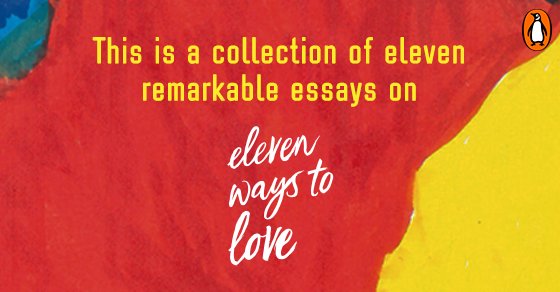
Love stories coach us to believe that love is selective, somehow, that it can be boxed in and easily defined. Eleven Ways to Love: Essays, is a collection of eleven remarkable essays that widen the frame of reference: transgender romance; body image issues; race relations; disability; polyamory; class differences; queer love; long distance; caste; loneliness; the single life; the bad boy syndrome . . . and so much more.
Here is the foreword of the book written by well-known poet Gulzar.
——————————-
Is love selective? No. There is no ideal love, and there is certainly no ideal lover. In this wonderful collection of essays on love, I welcome you to dip into eleven kinds of love: eleven individuals who have had their lives transformed by this very thing.
Here then are eleven ways to love from eleven unusual lovers. I’d like to leave you with a parting thought . . . and a poem of my own.
I have seen the wafting aroma of those eloquent eyes
Do not touch it with your hands and stamp it with a relationship
It’s just a sensation, caress it with your soul
Let love be love, do not label it.
Love is not words, love is not sounds
Love is just a silence that speaks, that hears
Love is unstoppable, love is inextinguishable
Love is a droplet of light shimmering through the ages
Something like a smile is in bloom somewhere in those eyes
Something like sunshine lingers around those eyelids
The lips don’t say a word, but numerous unspoken stories
Hover around their quivering edges
I have seen the wafting aroma of those eloquent eyes . . .
Translated by Sunjoy Shekhar
First published in 100 Lyrics by Gulzar (Penguin India, 2012)
A Day In The Life by Anjum Hasan – An Excerpt
Anjum Hasan is the author of two critically acclaimed novels- Lunatic in my Head that was shortlisted for the Crossword Book Award and Neti Neti, shortlisted for the Hindi Best Fiction Award. She has also written the short fiction collection Difficult Pleasures along with a book of poems titled Street on the Hill. Currently, she is the Books Editor at Caravan Magazine. In her latest book, A Day in the Life, Hasan gives us fourteen well-crafted short stories that provide an insight into the daily life of her characters. With protagonists like a non-conformist living by choice in a small town or a middle class woman’s bond with her maid. Hasan shows that there is an unusual charm in normal, everyday life too.
Let’s read an excerpt from the short story The Stranger from Hasan’s latest book- A Day in the Life.
______________________________________________________________________
There were no new ideas to be found in the city so I retired last year to this small town—an experiment to see if I could live in a house with a tiled roof that sometimes leaked and little storybook windows that muffled rather than let in light. Four months straight it rained with pounding urgency, bookended by two of drizzle. Sentences that I thought had no currency any more, not in the twenty-first century, still applied here, in this drenched hill town. It was a dark and stormy night. Or, The wind howled in the trees and loudly rattled the windowpanes.
One could imagine a very old place, a sparser and hardier monsoon existence hidden in the folds of the green valleys, even though they’d been killing off the vestiges in recent years— building hotels over the Christian graveyards and glassy shopping complexes where there’d been trees and empty space. Still, a few bungalows with compounds and driveways from a hundred years ago remained, and in the bazaar lots of those crooked little two -storey split-level shophouses with wooden casements, which too must have been here at least since the British, were writing in their gazetteers about who was up to exactly what business in the district. With the rain and the daily power-cuts, the Gothic mist creeping over everything all the time in season and the silence that lay over the hedgerows in the lanes away from the town centre, this was still a place where you could play at being someone else.
I’d seemed to be coasting along like everyone else in the city but was really eyeing something deeper—a love affair or a glittering friendship. I was lonely and didn’t see it. When this hit me, when I turned forty, then forty-five, and still felt unmade and unresolved, still chasing something just around the corner, I stopped. I had some money from two decades in the industry—if not scaling the heights of the corporate ladder, then not sliding down it either. Enough to ride on for a few years if I yielded all ambition, so that’s what I decided to do. Become nobody or, at least, a sincerely regular man. Cease thinking I was going to get anywhere either in the realm of intellectual achievement or human relations.
What can better aid coming down to earth than a half-forgotten small town: that stained suburban air, the permanent emanations of open sewers and busy bakeries? A whole population’s worth of people with reduced hopes, happy to cut their coats according to their cloth.
I’ve been here almost a year now, one monsoon to the next, and I have a house of three small rooms which is too big for me, a talkative cook in a burka and a target of getting through all the mouldy books in the back rows of the local library, which no one seems to have touched since circa Independence. I do try to give some kind of shape to my days—watching the blackbirds with my morning coffee; walking with the late afternoon sun when there is one; helping, because I was inveigled into it, the landlord’s middle-school-going boy and girl with their homework; just sitting around reading in the evenings as I drink brandy with hot water, or bad wine, or whisky with ice on summer nights when it’s really warm and I’m feeling like I might start to be sorry for myself. Who was it who said Proust’s pinings and dissatisfaction represented the illness of the cultivated classes in a capitalistic society? I’m trying, with the benevolent aid of my neighbourhood liquor store, to undo my cultivation and sometimes casting off these chains can hurt.
I wake up in the dark: it could be 4 a.m. or well past seven. The clacking rhythm of rain on the roof seems to be saying, I’m here to stay. Okay, I tell it. I can live with you. It’s all right to wake up in an indeterminable darkness, not knowing what day of the week it is, and no longer needing to call up the thought of the project I’m working on or dwell on the inexorable nature of modern work. I stay in bed till Amina bangs on the door. The bell’s stopped working.
____________________________________________________________________

Ramachandra Guha and some thoughts on Politics in India
Now based in Bangalore, Ramachandra Guha has previously taught at Yale, Stanford, Oslo, and the London School of Economics. His books include a collection of essays, Patriots and Partisans, Savaging the Civilized: Verrier Elwin, His Tribals, and India (1999) and Democrats and Dissenters. Guha’s awards include the Leopold-Hidy Prize of the American Society of Environmental History, the Sahitya Akademi Award, and the Padma Bhushan. His books and essays have been translated into more than twenty languages. In 2008, and again in 2013, Guha featured on Prospect Magazine’s list of the world’s most influential thinkers.
On his 60th birthday, we celebrate this iconic writer with his polemic quotes on Politics & India.
——————————


The Different Types of Divorces in Muslim Society
Almost all men and women with access to newspapers would have heard of triple talaq. Not many, though, would have heard of khula, the woman’s inalienable right to divorce. Worse, even Muslim women seem unaware of this right.
Under khula, a woman has a right similar to that of a man to dissolve the marriage. What’s more, she has to specify no grounds for effecting the divorce. She has to furnish no proof of harassment or ill treatment. Something as simple as a dislike for her husband’s looks can be reason enough for khula to take place, as proven in Islamic history.
In Till Talaq Do Us Part, Ziya Us Salam explains that the women’s right to dissolve a marriage is well protected by the Muslim Personal Law (Shariat) Application Act, 1937, and the Dissolution of Muslim Marriage Act, 1938. They, in addition, enjoy at least five other ways of getting rid of incompatible, violent or slanderous husbands. The conditions for this cover everything from dowry demands to casting aspersions on the character of the wife, or simply the inability to fulfil marital obligations.
They are as follows:
___________________________________________________________________


___________________________________________________________________