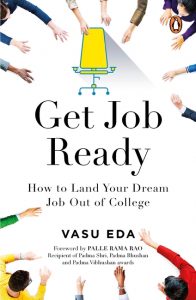
If you’re a young job aspirant and want to improve your employability skills, then Get Job Ready by Vasu Eda is a must-read for you.
However, before you go on this transformational journey, it is important to assess your current skills and identify the aspects you need to work on the most. Self-assessments can help you understand and articulate the environment and situations where you can leverage your strengths to thrive.
Be it personality development, enhancing your value system, or analyzing your interests to ensure you work in a field you’re passionate about, being self-aware is key.
Take this quiz to find out which skill you need to hone!
Which of the following is the most important to you?
A) An impressionable personality
B) Your value system
C) Communicating with others
Which of these are you intimidated by you?
A) Assertive people
B) Self-guided individuals
C) Articulate leaders
Which of these do you wish to be better at?
A) First impressions
B) Defining what you stand for
C) Understanding others
Which of these is the biggest hurdle for you?
A) Establishing your presence in a crowd
B) Articulating which values you want to integrate in your life
C) Connecting with people
5. If you could choose one superpower, which one would it be?
A) Better confidence
B) Better decision making
C) Better communication skills
Answer Key
If you chose:
Mostly As
You need to work on your personality development skills!
Mostly Bs
You need to work on your value system!
Mostly Cs
You need to work on your communication and articulation skills!
Ready to take the next step?
Get your copy of Get Job Ready by Vasu Eda to enhance your employability skills and land your dream job straight out of college!
To understand Kashmir’s timeline, its people, and the continuing dilemmas and conflicts, it’s imperative for us to navigate through the pages of history and learn about the often untold and lesser-heard stories. So, we’ve compiled a list for you to dive into Kashmir’s saga and understand in depth the experiences of the natives, the ever-evolving landscape of the region, and the crisis that exists in this paradise.
When Rooh tells Manav in a bar in New York that he ought to go to back home to the hills in Kashmir, he’s suddenly thrown into the loop of his past-a blue door, white walls and a house at the end of a lane. Soon, the seemingly small worlds in which his memories reside coalesce into a giant mass and envelop both his past and present, like dark clouds covering a brilliant blue sky.
Two young boys on the cusp of growing up, the cruelty of being a refugee in their own country, a father who is unable to come to terms with this confusing reality-an undercurrent of pain sweeps through his life. In this stream-of-consciousness novel, the protagonist, Manav, makes a physical and metaphorical journey back to Kashmir and relives the past as a part of the present. Rooh emerges as a deeply touching story of tender but broken people he meets along this journey.
Basharat Peer was a teenager when the separatist movement exploded in Kashmir in 1989. Over the following years countless young men, seduced by the romance of the militant, fuelled by feelings of injustice, crossed over the Line of Control to train in Pakistani army camps. Peer was sent off to boarding school in Aligarh to keep out of trouble. He finished college and became a journalist in Delhi. But Kashmir-angrier, more violent, more hopeless-was never far away.
In 2003, the young journalist left his job and returned to his homeland to search out the stories and the people which had haunted him. In Curfewed Night he draws a harrowing portrait of Kashmir and its people. Here are stories of a young man’s initiation into a Pakistani training camp; a mother who watches her son forced to hold an exploding bomb; a poet who finds religion when his entire family is killed. Of politicians living in refurbished torture chambers and former militants dreaming of discotheques; of idyllic villages rigged with landmines, temples which have become army bunkers, and ancient sufi shrines decapitated in bomb blasts. And here is finally the old story of the return home-and the discovery that there may not be any redemption in it.
The Country Without A Post Office || Agha Shahid Ali
Amidst rain and fire and ruin, in a land of ‘doomed addresses’, a poet evokes the tragedy of his birthplace.
The Country Without a Post Office is a haunted and haunting volume that established Agha Shahid Ali as a seminal voice writing in English. In it are stunning poems of extraordinary formal precision and virtuosity, intensely musical, steeped in history, myth and politics, all merging into Agha Shahid Ali’s finest mode, that of longing.
The Lost Rebellion is an acclaimed classic on the rise of Kashmir militancy, which chronicles how a simple call for azadi by bands of disgruntled youth was transformed within a year into a full-scale jihad against India. It dwells at length on Pakistan’s proxy war against India, exposes the US position on Kashmir and unsparingly critiques the political bungling and bureaucratic ineptitude that hamstrung the fight against insurgency.
This updated edition includes an insightful foreword by Amitabh Mattoo, a new introduction and a detailed aftermath chapter on what has transpired in the new millennium. Manoj Joshi reveals that although violence has come down drastically, there has been no closure to the nearly three-decade-old conflict. The alienation of the Kashmiris has, if anything, grown and is now manifesting itself in violent civil protest.
Raw, compelling and meticulously researched, The Lost Rebellion is a riveting account of the human drama that lies at the heart of the crisis that is Kashmir.
Rahul Pandita was fourteen years old in 1990 when he was forced to leave his home in Srinagar along with his family, who were Kashmiri Pandits: the Hindu minority within a Muslim-majority Kashmir that was becoming increasingly agitated with the cries of ‘Azadi’ from India.
The heartbreaking story of Kashmir has so far been told through the prism of the brutality of the Indian state, and the pro-independence demands of separatists. But there is another part of the story that has remained unrecorded and buried.
Our Moon Has Blood Clots is the unspoken chapter in the story of Kashmir, in which it was purged of the Kashmiri Pandit community in a violent ethnic cleansing backed by Islamist militants. Hundreds of people were tortured and killed, and about 3,50,000 Kashmiri Pandits were forced to leave their homes and spend the rest of their lives in exile in their own country.
Rahul Pandita has written a deeply personal, powerful and unforgettable story of history, home and loss.
On 5 August 2019, Suhas Munshi was returning to Srinagar from a visit to legendary poet Habba Khatoon’s relic in Gurez, when an unprecedented curfew was imposed upon Jammu and Kashmir, and Article 370 was abrogated. Through his travels and conversations with people across the Valley, Munshi tries to give a sense of what that moment has meant to the common Kashmiri.
This insightful travelogue breaks away from the clichéd view of Kashmir, one that sees it either as an earthly paradise or a living hell. It takes you to unexpected places, into the homes of poets, playwrights and street performers; to a heartwarming Christmas service with the minuscule Christian community in Baramulla; and inside the barricaded city of Srinagar’s football stadium, which is a lively refuge for the elderly and their memories of a glorious past. Over three weeks, for fear of being abandoned in harsh terrain, Munshi struggles to keep up with a group of Bakarwal nomadic shepherds as they make their way from Srinagar to Jammu over the mighty Pir Panjal mountains. And he finds a lone Pandit family living in a decrepit ghost colony in Shopian, the hub of militancy in Kashmir. This World below Zero Fahrenheit presents a portrait of a people who’ve been overshadowed by the place they live in, even as it ruminates on the idea of home and exile.
Can you imagine being confined to the four walls of your home with no internet, no social media?
Are Kashmiris really invisible to the rest of the country?
These are some of the questions two teenagers–Saumya in Delhi and Duaa in Kashmir–asked through letters they exchanged over almost three years.
Framing these letters is the detailed history and commentary provided by Divya Arya, a BBC journalist who asked them to be pen pals, which places their conversations against the backdrop of the political history and turbulent present of Kashmir and India. Postbox Kashmir takes on the challenging task of attempting to portray life in Kashmir from the perspective of the young minds growing inside it and providing a context of understanding for the young generation watching it from the outside.
As April arrives with heat, dust and a yearning gaze towards the air-conditioner, it also signals our fresh releases.
Our new books are the very thing you’ll need to cool down by the end of the day. Keep a glass of cool lemonade next to you and scroll through the list!
*
Rohzin by Rahman Abbas
Rohzin||Rahman Abbas
Mumbai was almost submerged on the fatal noon of 26 July 2005, when the merciless downpour and cloudburst had spread utter darkness and horror in the heart of the city. River Mithi was inundated, and the sea was furious. At this hour of torturous gloom, Rohzin begins declaring in the first line that it was the last day in the life of two lovers, Asrar and Hina.
The arc of the novel studies various aspects of human emotions, especially love, longing and sexuality as sublime expressions. The emotions are examined, so is love as well as the absence of it, through a gamut of characters and their interrelated lives: Asrar’s relationship with his teacher, Ms Jamila, a prostitute named Shanti and, later, with Hina; Hina’s classmate Vidhi’s relations with her lover and others; Hina’s father Yusuf’s love for Aymal; Vanu’s indulgence in prostitutes.
Rohzin dwells on the plane of an imagination that takes readers on a unique journey across the city of Mumbai, a highly intriguing character in its own right.
Nireeswaran by V.J. James
Nireeswaran||V.J. James
Is it possible for society to exist without religion? Nireeswaran, the most celebrated of Malayalam novelist V.J. James’ works, uses incisive humour and satire to question blind faith and give an insight into what true spirituality is.
Three atheists, Antony, Sahir, and Bhaskaran, embark on an elaborate prank to establish that God is nothing but a superstition. They instal a mutilated idol of Nireeswaran, literally anti-god, to show people how hollow their religion is. Their plan starts turning awry when miracles start being attributed to Nireeswaran, a man waking up from coma after twenty-four years, a jobless man ineligible for government employment getting a contract, a prostitute turning into a saint, leading hordes to turn up to worship the fake deity.
Vultures by Dalpat Chauhan
Vultures||Dalpat Chauhan
Based on the blood-curdling murder of a Dalit boy by Rajput landlords in Kodaram village in 1964, Vultures portrays a feudal society structured around caste-based relations and social segregation, in which Dalit lives and livelihoods are torn to pieces by upper-caste vultures. The deft use of dialect, graphic descriptions and translator Hemang Ashwinkumar’s lucid telling throw sharp focus on the fragmented world of a mofussil village in Gujarat, much of which remains unchanged even today.
Scars of 1947: Real Partition Stories by Rajeev Shukla
Scars of 1947||Rajeev Shukla
After more than seven decades, the burden of grief for those displaced and affected by the Partition of India in 1947 still bears heavy. The two pieces of land were carved by a mere stroke of ink on the surface of a map, but the resultant wounds ran way deeper, from one generation to the next.
This is the story of India’s independence and it cost the nation more than land, resources and lives. People on both sides of the dreaded Radcliffe line that divided India and Pakistan experienced a similar trauma. The riots, bloodbath, fear, cries for help, burning houses and the devastating displacement of millions is forever etched in memories of those who survived this nightmare. Yet, there are also some uplifting instances of the triumph, grit and determination, inspiring tales of love, kindness and the perseverance of the human spirit.
Good Innings: The Extraordinary, Ordinary Life of Lily Tharoor by Shobha Tharoor Srinivasan
Good Innings||Shobha Tharoor Srinivasan
Lily Tharoor was born in a small village in Kerala in the mid-1930s. From this humble beginning, she would live around the world, raise three global citizens, and inspire multiple generations with her drive to learn and achieve. Fiercely independent and ambitious, she pushed her children, including her son Shashi, to always think outside the box.
In Good Innings, Shobha Tharoor Srinivasan tells her mother Lily’s ‘extraordinary, ordinary’ story through a combination of personal reflections, life lessons, and philosophical insights. The result is a collection of teachable vignettes aimed to galvanize a new generation into growth and action. Every chapter starts with an anecdote which will encourage conversations and transformations in the reader’s life. Good Innings is an intimate account of the life of a beloved matriarch with a modest background and an iron will-a woman who learned from the school of life and now has lessons to share of her own.
Irrationally Rational by V. Raghunathan
Irrationally Rational||V. Raghunathan
You and your friend each have flights to catch at 8 p.m. and your destination cities are different. You decide to share a cab, but get caught in a rare traffic jam lasting several hours. You end up at the airport around midnight, and surely enough, both of you miss your flights. Now suppose the airline assistant tells you, ‘Sorry, your flight left as scheduled at 8 p.m. sharp.’ But your friend is told, ‘Oh, how very unfortunate. Your flight was almost four hours late and only just departed!’ Who feels the greater disappointment? You or your friend?
Neoclassical economics tells us that because both individuals are assumed rational, their regret levels ought to be identical since their economic consequences are identical. Behavioural economists, however, combine psychology with economics, and focus on how real people, with their cognitive biases, actually behave. Irrationally Rational takes you through the journey of such rationality-irrationality arguments, showing why economics shorn of psychology may be incomplete. It is the first book of its kind, collating the works of ten Nobel Laureates largely responsible for the rise of behavioural economics, that makes understanding behavioural economics more fun and accessible.
Phantom Plague: How Tuberculosis Shaped History by Vidya Krishnan
Phantom Plague||Vidya Krishnan
It killed novelist George Orwell, Eleanor Roosevelt, and millions of others-rich and poor. Desmond Tutu, Amitabh Bachchan, and Nelson Mandela survived it, just. For centuries, tuberculosis has ravaged cities and plagued the human body.
In Phantom Plague, Vidya Krishnan, traces the history of tuberculosis from the slums of 19th-century New York to modern Mumbai. In a narrative spanning century, Krishnan shows how superstition and folk-remedies, made way for scientific understanding of TB, such that it was controlled and cured in the West. Krishnan’s original reporting paints a granular portrait of the post-antibiotic era as a new, aggressive, drug resistant strain of TB takes over. Phantom Plague is an urgent, riveting and fascinating narrative that deftly exposes the weakest links in our battle against this ancient foe.
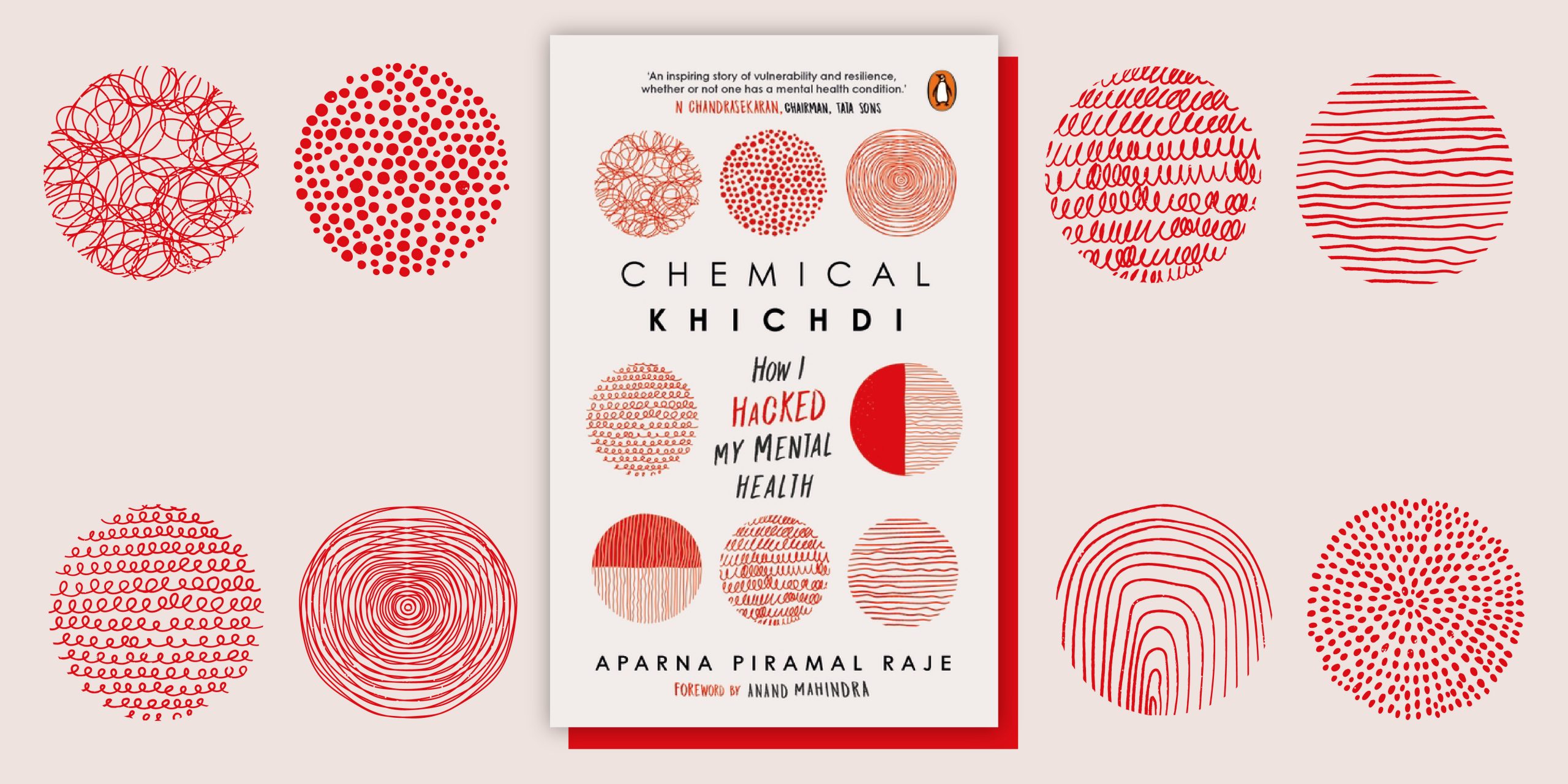
Chemical Khichdi: How I Hacked My Mental Health by Aparna Piramal Raje
Chemical Khichdi||Aparna Piramal Raje
Aparna Piramal Raje’s life looks successful. Hailing from a well-known business family, she is married, has two children, is a published author, a popular columnist with a leading daily and was the CEO of a leading furniture company.
However, only a few close friends and family members were aware that she struggled with a serious mental illness, bipolar disorder, for two decades. Also known as manic depression, bipolar disorder is characterized by extreme shifts in moods and energy levels, leading to euphoric highs and damaging lows. Now, Aparna wants to tell the story of how she learnt to come to terms with her condition.
Part memoir, part reportage and part self-help guide, Chemical Khichdi seeks to remove some of the stigma associated with a serious mental illness in an empathetic, accessible and candid way.
The Dalit Truth (Rethinking India) edited by K. Raju
The Dalit Truth (Rethinking India series)
The Dalit Truth contains a symphony of Dalit voices as they call out to the future. A multitude of Dalit truths and their battles against the lies perpetrated by the caste system are reflected in the pages of this book, pointing towards a future filled with promise and prospects for the coming generations.
This eighth volume in the Rethinking India series, published in collaboration with the Samruddha Bharat Foundation, probes the pathway to be followed by the Dalits as articulated by Ambedkar’s Constitution. The authors featured in the volume come from various fields and bring narratives of different colours, not just stories of dismay but also of possibilities. The essays offer deeper insights into social, educational, economic and cultural challenges and opportunities faced by the Dalits, the varied strategies of political parties for their mobilization and the choice to be made by the Dalits for attaining social equality.
The Whispering Chinar by Ali Rohila
The Whispering Chinar||Ali Rohila
In Charbagh, Khyber-Pakhtunkhwa, a short detour from the Grand Trunk Road that leads towards Afghanistan, stands a chinar tree in the garden of Khan Mohammad Usman Khan. Legend has it that it was planted by a saint known to the grandfather of the Khan, who had told him that the family would prosper till this tree survived. The tree has stood for generations, a silent witness to the many stories of Charbagh, its grounds held sacred until the day a bullet fired by the oldest son of the Khan hit one of its branches.
In this debut collection of interlinked stories, the banker author recounts the stories as seen by the chinar tree. In Charbagh, a village where modernity slowly creeps in, there are tales of unrequited love, of family honour and religious persecution, of patriarchy and breaking its shackles, and of what it means to belong to Charbagh in tumultuous times.
Battles of Our Own by Jagadish Mohanty
Battles of Our Own||Jagadish Mohanty
Battles of Our Own (Nija Nija Panipatha)by Jagadish Mohanty (1951-2013), was published in 1990. It is set in the coal mining area of western Odisha, where the author worked all his life. The conflict between the coal mine administration and the trade union in an industrial setting gives the novel its plot, characters and atmosphere. The conflict-ridden world of a colliery makes it an exemplar of the ‘industrial novel’ in Odia and perhaps in Indian literature. The setting of the novel makes it unique, setting it apart from the majority of mainstream Odia novels of the time, with their polite and placid settings and their themes of romance or social success.
The Penguin Book of Indian Poets: Jeet Thayil Edition
The Penguin Book of Indian Poets||Jeet Thayil
Jeet Thayil has compiled the definitive anthology of Indian poetry in English. This monumental undertaking, two decades in the making, brings together writers from across the world, a wealth of voices–in dialogue, in soliloquy, in rhetoric, and in play–to present an expansive, encompassing idea of what makes an ‘Indian’ poet. Included are lost, uncollected, or out of print poems by major poets, essays that place entire bodies of work into their precise cultural contexts, and a collection of classic black and white portraits by Madhu Kapparath. These images, taken over a period of thirty years, form an archive of breathtaking historical scope. They offer the viewer unparalleled intimacy and access to the lives of some of India’s greatest poets.
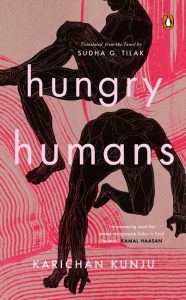
Hungry Humans by Karichan Kunju
Hungry Humans||Karichan Kunju
This translation of the groundbreaking Tamil novel Pasitha Manidam, first published in 1978, offers deep insight into the conservative and caste-conscious temple town of Kumbakonam, viewed here with dispassionately cold clarity as a society that utterly fails its own. Sudha G. Tilak deftly builds upon Karichan Kunju’s prose to expose this world, raw, real, without frills or artifice. The themes of masculinity, desire and sexuality, caged within caste and repression, all combine to give readers front-row seats to the many acts we put on for and as a community.
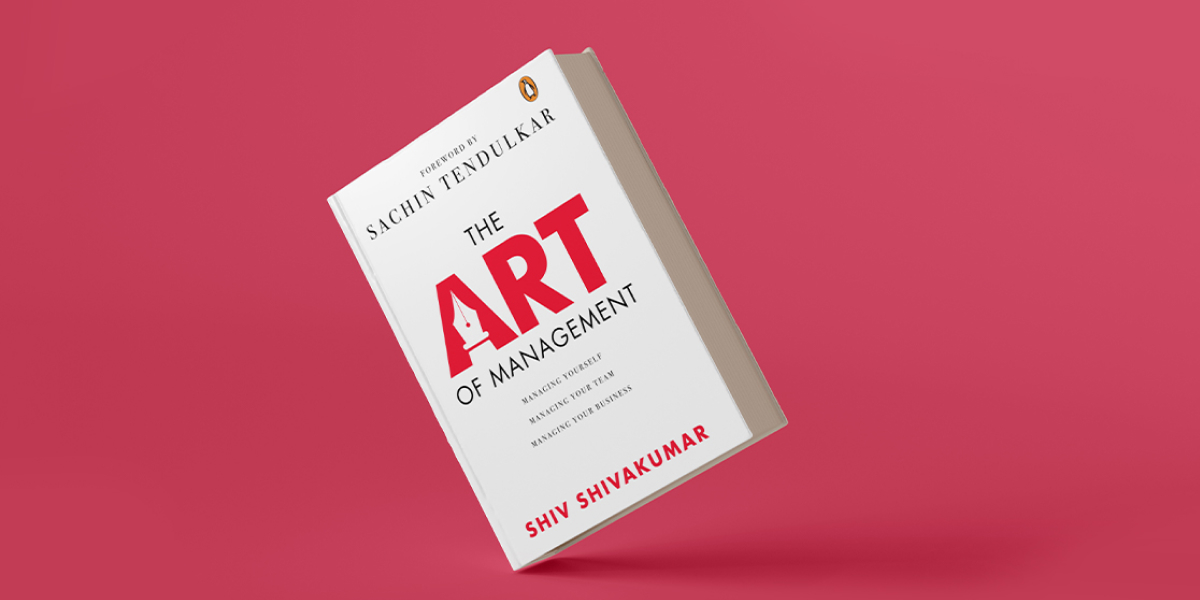
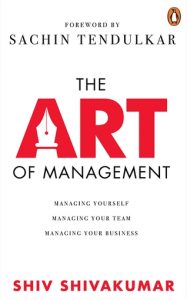
The Art of Management by Shiv Shivakumar
The Art of Management||Shiv Shivakumar
The whole discipline of career management now has three elements to it:
Managing yourself;
Managing your team; and
Managing your business
In this book, Shiv Shivakumar points out that today, unlike in the past, all the three elements are your responsibility. With in-depth interviews with top leaders across the spectrum and an insightful foreword by Sachin Tendulkar, The Art of Management is a must-read.
Made in Future: A Story of Marketing, Media & Content For Our Times by Prashant Kumar
Made in Future||Prashant Kumar
In this new age, marketers, media owners, agencies and content creators tend to struggle with the new realities of marketing. Everything they learnt while they were growing up is being challenged, and seems to be growing irrelevant against the disruptors that they face. Marketing thinking, even in some of the world’s largest organizations, is disconnected from their own ground-level executions.
Prashant Kumar, in his groundbreaking new book Made in Future, delves into the principles and applications of marketing strategy in the new age. Rich in research and great case studies, this book is an effort to bridge the two worlds of old school marketing principles and the new consumer and media behaviours.
Superpowers on the Shore by Sejal Mehta
Superpoweres on the Shore||Sejal Mehta
The Indian coastline hosts some magnificent intertidal species: solar-powered slugs, escape artist octopuses, venomous jellies, harpooning conus sea snails, to name just a few. It is as biodiverse as a forest wildlife safari, and twice as secretive. From bioluminescence and advanced sonic capabilities to camouflage and shapeshifting, these cloaked assassins are capable of otherworldly skill. Superpowers on the Shore by Sejal Mehta is a dazzling, assured look at some of the creatures with whom we share our world, our water, our monsoons, our beaches and the sandcastles therein.
Come witness the magic of our intertidal superheroes, their fragile beauty and their iridescent drama. Put on your waterproof shoes, pack a bottle of whimsy, bring your sense of wonder. And prepare to be mesmerized.
Essential Reader: Sarojini Naidu
Essential Reader:Sarojini Naidu
Sarojini Naidu was a prolific writer and speaker, publishing three collections of poetry during her life and delivered many rousing speeches throughout the freedom struggle and after India gained Independence. This book compiles her best-known work, as well as letters she wrote throughout her life to Mahatma Gandhi, Jawaharlal Nehru, Rabindranath Tagore and others, to provide a glimpse into the kind of person she was and the ideas she believed in.
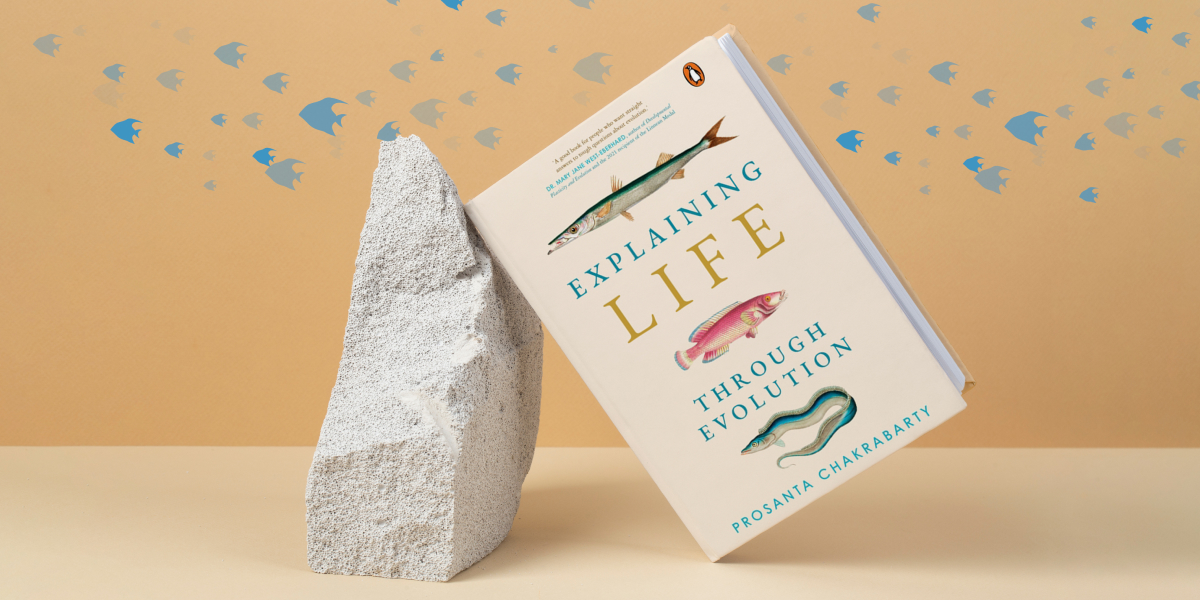
Explaining Life Through Evolution by Prosanta Chakrabarty
Explaining Life Through Evolution||Prosanta Chakrabarty
Prosanta encourages us to think of life as being like a book, one that is always in the making. What we see living around us today are just the last few pages. If we look out on to the millions of species that we share this planet with we can trace their histories, and ours, back through nearly four billion years of evolution. We can also think of all the living things around as the young leaves on an ancient and gigantic ‘Tree of Life’, all of us connected by invisible branches not just to each other, but to our extinct relatives and our evolutionary ancestors.
Evocative, comprehensive and thought-provoking, this is a book which will compel you to reimagine life.
Unstoppable by Manthan Shah
Unstoppable||Manthan Shah
Unstoppable will take you on a journey with the best and the brightest of young Indians who overcame obstacles to achieve extraordinary success and shaped the community around them.
This new-age story of success is made interesting due to the author’s narrative, stories of young overachievers in business, sports, music, academia and entertainment, research by renowned experts in the fields of neuroscience, psychology, genealogy, social sciences and leadership, and action plans that will help you define and achieve your full potential.
Pocketful O’Stories 3.0 by Durjoy Datta
Pocketful O’Stories 3.0||Durjoy Datta
ITC Engage, one of India’s leading fragrance brands is back with its much-loved bestselling series Pocketful O’ Stories 3.0 in collaboration with the bestselling romance novelist Durjoy Datta.
This year’s theme, #RomanceUnlocked captures the poignant yearning of lovers during the time of lockdown. Couples invaded the digital space and found new ways to connect and keep their romance alive. Their stories of love and longing inspired the latest edition of this series.
People were invited to submit their microtales about love in the new normal. Almost 35,000 entries were received within a month, making this edition already a huge success.
In Planning Democracy Nikhil Menon takes us into the mind of a professor and his quest to make a newly-independent India make sense through statistics. How his bright-eyed vision of straightforward calculations mutated into a complex legacy is what makes this book a must-read for history fans.
The following is an excerpt from the chapter ‘Machine Dreams’.
Planning Democracy || Nikhil Menon
*
From when he first laid eyes on an electronic computer, Mahalanobis was smitten. Amazed by its ability and convinced of its utility to his country’s development, he was soon involved in a quest to bring these machines to India; an affair that would last for most of the rest of his life. In March 1946, while on the east coast of the United States, Mahalanobis heard the scientific genius John von Neumann present a general account of a computer under development at the Institute for Advanced Study in Princeton.
The Professor broached the possibility of developing a computer in India and Von Neumann was open to working on an Indian computer the next winter, but warned that the cost of building it would be steep. Von Neumann assured Mahalanobis, however, that once the first model had been built, subsequent ones would come with a ‘moderate’ price tag—“only 30 or 40 thousand dollars.” The next month, while in New York, Mahalanobis met with statisticians from Columbia University and dropped in at the Watson Computation Laboratory. Based on these conversations he concluded that if statistics were to progress in India it was “essential to build up at least one first rate computation and calculating laboratory.” It was a matter deserving “serious attention at an early date.”
Early next year, with his country’s independence yet months away, Mahalanobis saw a digital computer in operation for the first time. During a visit to Harvard, he was given a tour of the Mark I by computer pioneer Howard Aiken, with whom he spent much of the day in conversation. The reason Mahalanobis hadn’t seen this machine on earlier trips was because “this machine was still a Navy secret.” The Professor soon proceeded to Princeton, where he renewed discussions about computing with Von Neumann. While there, Mahalanobis also made the obligatory pilgrimage to its most famous resident, Albert Einstein, who expressed hope that the transfer of power from British to Indian hands would proceed smoothly.
Increasingly occupied with national income assessment, sample surveys, and planning in India, Mahalanobis believed that computers would prove vital to addressing these questions. Digital computers could perform complex mathematical calculations at hundreds of times the speed of humans. The Professor saw that they would be of tremendous help in tabulating and processing data emanating from the National Sample Survey. Feeding this raw information into a computer, planners would be able to generate estimates and parse trends in the Indian economy in a fraction of the time it would otherwise take. Another major application for computers in the realm of planning was modeling the economy, through inter-industry input-output tables. These tables, first systematized by economist Wassily Leontief in the 1930’s, defined the interrelationship between different sectors of the economy. It was based on the understanding that one industry’s output is often the input for another. The input-output table became a widely adopted method of tracking the movement of goods and services between sectors of the economy, providing a structural snapshot of the entire economy. Leontief began using computers in developing these tables: in 1949 he entered data on forty two sectors of the U.S economy into Harvard’s Mark II, running it for fifty-six hours to create an input-output table representing the American economy. Nearly a quarter century later, Leontief would win the Nobel Prize in Economics, primarily for his work on this technique. The United States continued to conduct input-output research on a regular basis, except for a few years in the 1950s when the Eisenhower Administration had it shuttered—due to its perceived proximity to planning in communist countries.
Never burdened by any formal training in economics, Mahalanobis was instinctively predisposed toward this kind of mathematical abstraction—imagining the material life of India as a series of input-output tables. It was the distillation of a technocratic vision. But quite apart from these applications, the computer was also an object of desire, status, and fantasy. It was chased after as much for the fabulous possibilities it evoked, as the more modest capabilities it delivered. Rare, notoriously expensive, and seemingly boundless in potential, it promised the future and appeared to belong to it. The Professor salivated at the prospect.
*
Read about the surprising history of India’s Five-Year Plans in Planning Democracy, now available at your nearest bookstore.
‘Shoot for the moon. Even if you miss, you’ll land among the stars.’
This famous, often paraphrased quote from Norman Vincent Peale is an insightful look at human motivation. And author Amit Agarwal would agree with this philosophy, which resonates in his book Small Is Big.
In the following excerpt, the author explains how micro-habits are an underrated and efficient tool for achieving goals. The book is replete with practical exercises, frameworks and examples so that readers can apply this ideology in their own way.
Small Is Big || Amit Agarwal
*
You follow a habit without knowing that you are doing so, or nearly or completely involuntarily. Isn’t this worthy of reflection? Almost every moment we perform an action that we have become so accustomed to doing that we are not even aware of it. Take a moment and recall the time you sleep and wake up every day. Is there a pattern to it? What do you do right after you wake up during the first hour of the day? Do you notice a similarity in what you do every day? Don’t be surprised if you do. It is all because many of our activities are simply a matter of habit.
Small changes in habit create a domino effect. The changes may appear as just minor tweaks of your old ways, but the continuous impact they have is brilliant. So how do we create effective micro-habits? I’ll begin by sharing a straightforward, an accessible framework.
STEP 1
Choose one pillar from the following: work, personal finance, family, physical health and mental health.
STEP 2
Under that pillar, list all the problems that you are experiencing. From that list, circle the top three issues you wish to address.
STEP 3
List all the benefits you will enjoy if you manage to tackle all the problems for the pillar chosen in the preceding step. This will help you to experience the nature of your desired state. Choose the three most important benefits.
STEP 4
For each of the elements identified in Step 2 and Step 3, what is the one thing that you can START and/or STOP doing?
STEP 5
Make that change and continue repeating that action for sixty-six days until it becomes a habit.
*
Small Is Big is now available at your nearest bookstore. Get your copy of this life-changing book, now!
What comes to your mind when someone mentions the current education system, or perhaps something as abstract as curiosity. According to Alyque Padamsee, visual simulation and proactive thinking are key to unlearning and relearn what we’ve been taught since time immemorial. Instead of blindly following what we’re told, we need to step out of the confinements set by society and think for ourselves, form our own perceptions, and discover what the world has to offer without being influenced by what society dictates or expects us to do. Read this excerpt from the great Alyque Padamsee’s final tribute to the youth of India, Let Me Hijack Your Mind, co-authored by Vandana Saxena Poria!
ALYQUEISM
“Have you noticed how many American expressions are visual?
‘Hit the ground running’
‘Keep your eyes peeled’
The power of the visual is so strong, it’s amazing. Now, how can we bring visual stimulation to the classroom?”
School vs Edutainment
For years, education in this country and almost all over the world was about rote learning. And unfortunately, Britain was in India during the Victorian period. If Britain had been our rulers after the Beatles, just imagine how different life could have been. The Beatles generation disrupted the culture of Britain completely. It was an exciting time over there, where people were doing mad things that didn’t have logic. No linear thinking, but squiggly thinking, all over the place. If post-Beatles Britain had ruled India, I think India would have been quite a different place. We actually had Britain ruling over us during its worst period, at its most conventional, with, ‘Don’t answer back. Little boys should be silent and only speak when they are spoken to.’ And as for little girls . . .
We have continued in this trap, this time worshipping the false gods of education. We are still handcuffed to the old system. Education here in India is for the teacher to dictate, no questions asked. A lot has changed abroad, which I must say is very good, but most of what is being taught in Indian schools is unfortunately still very much by rote, where you learn by heart, faithfully reproduce in the examination and you pass to get your degree. Do you really want a degree that says you are nothing more than a robot? Garbage in, garbage out?
I mean look at History—these poor kids today have to learn all these dates and reel them off in the exam. They get marks for getting the dates right. BUT WHO CARES ABOUT THE DATE if they don’t understand the crux of why the war was fought or the significance of the action? History is not about dates; history says it was thanks to a man like Gandhiji that we got our independence through non-violence, which everyone said was impossible. Now how did we do that? Can we bring that teaching in?
I am saying education is for the learner to learn and not for the teacher to teach. It’s for the teacher to enthuse, and it’s for the learner to be enthusiastic enough to be able to learn on their own. That’s what education is all about.
Curiosity Did Not Kill the Cat
I get quite annoyed with this proverb, as it is not entirely accurate. Shakespeare had it right in Much Ado About Nothing, where Claudio says to Benedick, ‘What, courage, man! What though care killed a cat? Thou hast mettle enough in thee to kill care.’ In this instance, care meant worries.
So Shakespeare was saying worrisome thoughts would kill you. That is not at all the same as curiosity! I wouldn’t be surprised if those religious zealots of times gone by changed the phrase to get people to stay in line and not question religion too much! Anyway, I say, ‘Curiosity inspired the cat’, and that has proven true throughout my life. Curiosity is the best form of edutainment anywhere. Honestly, if you just keep your eyes wide open and go explore different areas, you will somehow stumble upon your passion.
If these words resonate with you, grab your copy of Let Me Hijack Your Mind and unlearn and relearn like never before!
“The greater danger for most of us is not that our aim is too high and we miss it, but that it is too low and we reach it.”
Michelangelo
According to Dr. Vivek Mansingh, one should be aspirational and think big when setting professional goals instead of worrying about the constraints that you might face while achieving them. Freeing yourself from constrained thinking is one of the most important things to achieve meaningful success in the long-run, and consistently. Read an excerpt from Dr. Vivek Mansigh’s latest release to learn more!
It’s not uncommon for people to achieve phenomenal professional success, only to find that they are mysteriously disappointed, and unhappy. This empty feeling has been reported in several studies by seemingly successful people including CEOs, government leaders, scientists, athletes, entertainers and award winners in every walk of life. In a study of CEOs of Fortune 500 companies at Yale University, many apparently highly successful professionals reported that they felt their lives were incomplete and disappointing at many levels.
Professor C. Clayton of Harvard University, author of The Innovator’s Dilemma, talks about an intriguing phenomenon. He did a study of his MBA students at Harvard. At their fifth-year reunion, they were doing fairly well: they had great spouses, jobs, houses and cars. At the tenth reunion, many had achieved professional success, but one-third reported being unhappy in life. At the twenty-fifth reunion, the situation was even more bleak. Although most people were doing well at work and financially, many had been unhappy, divorced or were grappling with relationship issues. Some had serious health issues, and some had even ended up in jail for unethical business practices.
What had gone wrong with these smart people after such a terrific start?
The answer is simple and lies buried in the nature of the goals. Possibly, they pursued single-dimensional success by chasing money or only professional success, and in doing so sacrificed other things that were important for achieving meaningful success.
Andrew Carnegie sums it up neatly: “If you want to be happy, set goals that command your thoughts, liberate your energy, and inspire your hopes.” And he did!
Carnegie, who started his career as a bobbin boy at a cotton factory earning $1.20 a week, went on to sell his company, Carnegie Steel, for some $480 million, making him one of the world’s richest men!
After selling his steel company, this petite-framed colossus, just five feet, three inches tall, retired from business and devoted himself full time to philanthropy.
He gave away some $350 million (the equivalent of billions in today’s dollars): really the bulk of his wealth. Among his philanthropic activities, he funded the establishment of more than 2,500 public libraries around the globe, donated more than 7,600 organs to churches worldwide and endowed organizations dedicated to research in science, education, world peace and other causes. Among his gifts was the $1.1 million for the land and construction costs of Carnegie Hall, the New York City concert venue that opened in 1891. He also funded the Carnegie Institution for Science, Carnegie Mellon University and the Carnegie Foundation. A lover of books, he was the largest individual investor in public libraries in American history.
I often say that if you do not make decisions about your life, someone else will. People without goals end up working for people with goals! So, it is important that you are goal driven and set your own goals.
Once you’ve set your goals, create a strategy and plan and write it down along with milestones. According to many studies, people with written goals have an 80% higher probability of achieving them. I am one of these people.
To me, success wasn’t something I would gauge by comparing against others. I strived to compete with myself after defining what meaningful success meant to me. If success to you means becoming a cricketer, singer or painter, go for it. But strive to be the best that your potential holds. It is also important to be joyful and positive while you are pursuing your goals and going through your life’s journey. According to research in positive psychology, happy, positive and joyful people have higher probability of achieving their goals and success.
If you’re looking to achieve meaningful success and set multidimensional and balanced life goals to help you attain happiness and fulfilment, grab your copy of Achieving Meaningful Success here!
What is nostalgia, after all, but an attempt to preserve that which was good in the past?
― Ruskin Bond, Roads to Mussoorie
It’s rare that an author’s writings pull the heartstrings of adults and young alike and Ruskin Bond is one such author. His writer’s pen flings fairy dust on our childhood memories, brings back our fond experiences with friends, family, and nature, and offers solace while transporting us to a new world. Bond, despite his slowed-down gait, has kept his childlike wonder alive and sprinkles it in his short stories every now and then. The characters in his books, mostly culled from the real world, are fresh, diverse, and relatable. The recollection of his indelible memories make his readers nostalgic about their own past and leave an everlasting impact on their lives.
Like us, if it’s impossible for you also to read only one book by Ruskin Bond, then scroll through this list with some of our favourites by him.
*
Writing for My Life
Writing for My Life || Ruskin Bond
If only the world had no boundaries and we could move about without having to produce passports and documents everywhere, it really would be ‘a great wide beautiful, wonderful world’, says Ruskin Bond.
From his most loved stories to poems, memoirs and essays, Writing for My Life opens a window to the myriad worlds of Ruskin Bond, India’s most loved author. Capturing dreams of childhood, anecdotes of Rusty and his friends, the Ripley-Bean mysteries, accounts of his life with his father and his adventures in Jersey and London among others, this book is full of beauty and joy-two things Ruskin’s writing is mostly known for.
With a comprehensive introduction, this is the perfect gift to all the ardent readers and lovers of Ruskin’s effervescent writing. A wide collection of carefully curated and beautifully designed stories, this book is a collector’s edition.
Words From My Window
Words From My Window || Ruskin Bond
I need a window to look at the world without; for only then can I look at the world within. A room without a window is rather like a prison cell, and the soul is inclined to shrivel up in a confined space. … Car horns, children calling to each other as they return from school, a boy selling candyfloss, several crows chasing a hawk! Never a dull moment. And the magic mountain looks on, absorbing everything.
A Handful Of Nuts
A Handful Of Nuts || Ruskin Bond
This collection of six novels sparkles with the quiet charm and humanity that are the hallmarks of Ruskin Bond’s writing. Evoking nostalgia for a time gone by; these poignant chronicles of life in India’s hills and small towns describe the hopes and passions that capture young minds and hearts; highlighting the uneasy reconciliation of dreams and destiny.
The six novels included in the collection are:
The Room on the Roof
Vagrants in the Valley
Delhi Is Not Far
A Flight of Pigeons
The Sensualist
A Handful of Nuts
A Little Book of India
A Little Book of India || Ruskin Bond
As India completes 75 years of independence, we bring to you a slice of our beloved country in the words of our favourite author, Ruskin Bond. Drawing on his own memories and impressions of this unique land, he pays homage to the country that has been his home for 84 years. Bond talks fondly about the diverse elements that make up this beautiful land-its rivers and forests, literature and culture, sights, sounds and colours. A Little Book of India is an amalgamation of the physical and spiritual attributes of our homeland, and takes you on a journey filled with nostalgia and devotion.
The Little Book of Comfort
The Little Book of Comfort || Ruskin Bond
So, do you wish to go out into the night, walke up the hill, discover new things about the night and yourself, and come home refreshed? For just as the night has the moon and the stars, so the darkness of the soul can be lit up by small fireflies – such as these calm and comforting thoughts that Ruskin Bond has jotted down for you in The Little Book of Comfort. This book will give you an opportunity to discover yourself in this post-pandemic world to become more thoughtful and to discover the art of slowing down.
Have you ever wondered what inspires the most iconic leaders you know today to build empires and legacies that last for decades?
Leadership To Last||Geoffrey Jones, Tarun Khanna
Leadership is multifaceted and multi-dimensional. It is not a linear function: it exists and thrives in every aspect of a leaders’ life, be it personal or professional. In Leadership to Last by Tarun Khanna and Geoffrey Jones, the lasting aspect of wonderful leaderships that ultimately turn into legacies is highlighted. Through several interviews with leaders, entrepreneurs, and successful visionaries which include the likes of Ratan Tata, Adi Godrej, Shabana Azmi, Ela Bhatt, Seema Aziz, Narayana Murthy, and many more!
What sets Leadership To Last apart from other books that talk about leadership is its diversity in setting and a unique interview-like approach. Through these interviews, you are transported to a completely different world, and it’s almost as if you’re in the same room as the leader you’re reading about!
Emphasizing what makes this a riveting read for people from all walks of life, the co-authors also highlight how the focus of the book is on the long durée. By selecting cases that have led to lasting institutional changes, triggered by individuals over multiple decades, the book brings out what truly helps successful leaderships become long-lasting legacies!
Divided into 7 sections that talk about different factors that help create iconic legacies, Leadership to Last also helps you understand the importance of aspects such as managing families, committing to values, innovating for impact, contesting corruption, challenging gender stereotypes, promoting inclusion, and creating value responsibly.
Finally, the learnings from comprehensive interviews of different leaders are summarized to help you understand their experiences better, while also creating a lasting impact through a skillful writing style.
Learn how great leaders leave legacies behind, and everything in between with Leadership to Last!
A lesser-known event in Indian military history, the Battle of Garibpur was fought between 21-22 November 1971. In The Burning Chaffees, Brigadier B.S. Mehta records the behind-the-scenes tension that eventually exploded into the momentous Bangladesh Liberation War, India’s tank column movement into then East Pakistan, and the victory which shook Pakistan’s confidence.
The following excerpt is an account from 20 November 1971, moments before the main conflict took place.
The Burning Chaffees || Brig. B S Mehta
*
We had barely moved out of the Battalion HQ when an urgent message came through on the radio. What we had been suspecting since the early morning now stood confirmed by the radio message, followed by the short shrill blasts from a whistle, which somebody was blowing impatiently. It was a signal, practised and rehearsed during exercises, to indicate an imminent air strike.
I elbowed my entry into one of the crowded trenches close to the Battalion HQ, as there was no way I could make it to my tank. The trench, designed for not more than three persons, was a small, ramshackle shelter with an apology for overhead cover consisting of small khaji saplings and dry twigs covered with earth to provide protection. On one side of the trench, a small aperture had been cut open through which its occupants could fire their weapons in case of a ground attack. Before I could adjust my weight on my feet, somebody inside yelled, ‘Enemy planes are coming.’ The four black dots had now grown much larger, their outline becoming more menacing. Soon, they were overhead, and started to circle over our position, to determine our defence perimeter within which they would select their targets to spell death and devastation. Their main effort was directed towards the tanks, being the more lucrative targets. Sitting inside the trench, packed like sardines, one could do nothing more than watch the aircraft, which we now recognised as the infamous Sabres. We had heard and read enough about these aircraft but all that knowledge was of no avail, since it had only acquainted us with the physical and technical features of the aircraft. What we were going to discover in the next 10 minutes or so would be its capacity for annihilation and its ability to create havoc amongst the ground troops. The cumulative effect of its monster-like presence moving around at supersonic speed, creating a blood curdling roar through its jet engines, the reverberation and echoes, plus the physical damage its cannon, bombs and strafing would create was something we would be compelled to undergo with our hearts in our mouths. While they were still high up in the sky, I ventured to count them, hoping to draw some consolation from their numbers: one, two, three, four—possibly some higher up in the sky. The Sabres were pulling up once again to gain height as by now they had completed a dry run. It would now be only a matter of moments before they swooped down, one after another, unloading their cargo consisting of bombs, cannons, machine guns, on pre-selected targets.
*
Soon to be a major motion picture, you can get your copy of The Burning Chaffees from your nearest bookstore.