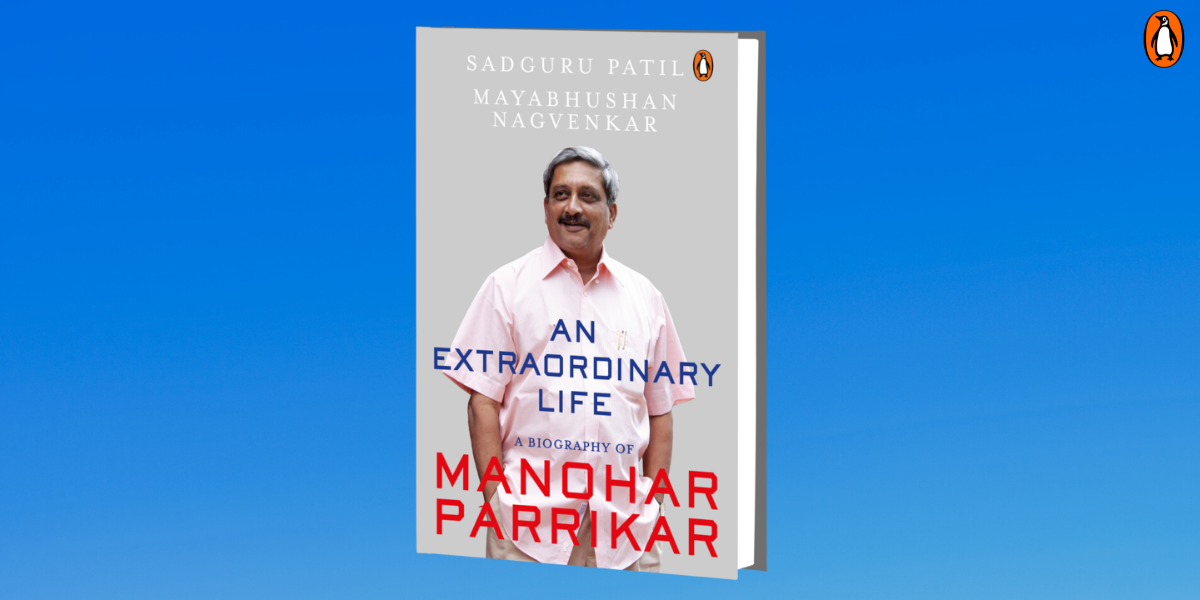
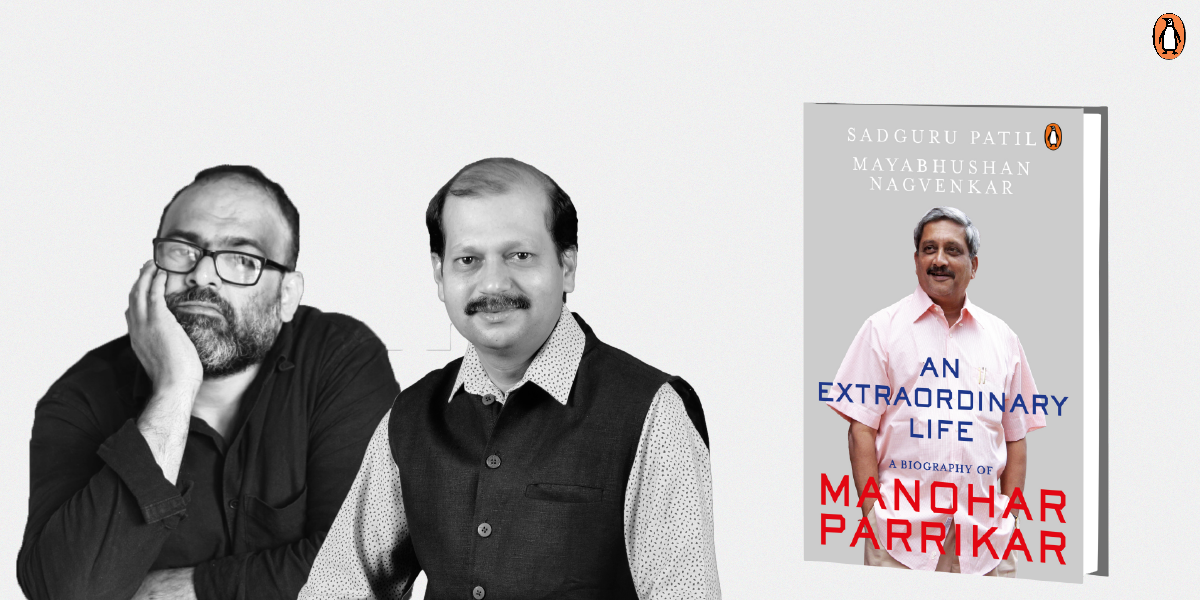
An Extraordinary Life showcases Manohar Parrikar’s rise in politics from the son of a grocery store owner in a nondescript town, a sanghachalak in Mapusa town, an Opposition MLA and leader, to a chief minister (on multiple occasions) and, finally, to a defence minister.
Over the last two decades, the exploits of one man, an IIT-Bombay alumnus, changed the way mainstream India looked at Goa and the political goings-on in the country’s smallest state.
In An Extraordinary Life, Sadguru Patil and Mayabhushan Nagvenkar explore daily battles of a gifted individual are brought to the fore as he encounters love and vices.
Alongside his public feats and persona, Parrikar was also an intriguing man with some personality quirks that contributed to his political career. We take a look at some of these below:
Finding a way out
‘Falling into trouble isn’t rare when one is young. But even at the age of eight, Manohar had the temperament to find a way out of it.
Avdhoot was nine, a year older than Manohar, when the latter fell into a deep, dry rainwater ditch near their ancestral house in Parra village. The gutter was deep enough to make Manohar’s efforts to climb out of it futile. Like in many rural homes at the time, the Parrikar household also reared a few head of cattle.
‘Manohar told me to fetch at least five bundles of straw. They weren’t too heavy, so I brought them one by one and, on his direction, threw them into the gutter. He piled them one on top of the other and managed to climb out,’ Avdhoot recalled.’
IIT-Bombay
‘A year after the release of the Amitabh Bachchan and Shatrughan Sinha–starrer Bombay to Goa, seventeen-year-old Parrikar left Goa to go to Bombay in 1973. And just like Bachchan was a superstarwaiting-in-the-wings in the S. Ramanathan film, IIT-Bombay gaveParrikar the fertile breeding ground for his personality to blossom and allowed him to come into his own.
As far as Parrikar was concerned, he was to give IIT-Bombay the privilege of having on its rolls the first IITian chief minister in India, and his hostel-mates the pleasure of better meals at the mess at that time.’
Resourcefulness and Keen Eye
‘Even his mother was often stumped by Manohar’s resourcefulness. Radhabai once had enough of her son’s brattish behaviour. So she locked him up in a room one day.
According to Walavalkar, Manohar escaped by breaking the glass windowpanes. Another time Radhabai decided to teach her younger son a lesson once again. She decided to play dead to get Manohar worked up. Avdhoot, who was nearby, saw her lying still and not responding to his call. He called out to Manohar for help. ‘I thought Aai was dead and started crying. But Manohar was obviously smarter than me. He told me not to cry because he could see Aai’s stomach moving with her breath. Her plan to rattle him was foiled,’ Avdhoot said.’
Calligraphic Skills
‘Apart from his special talent at maths, he was regularly complimented by his teachers for his immaculate handwriting, something the media also noticed decades later when his handwritten noting related to the Rafale deal as the defence minister merited a news feature story in February 2019.
‘Cursive font. Sentences so perfectly stacked you wonder if a ruler was involved. No strikethroughs. No smudged ink. A written reply by Manohar Parrikar to India’s defence secretary in 2015, accessed by ANI, would put any schoolteacher’s pet to shame,’ stated an India Today online story headlined ‘Rafale Row Rages.’
Appetite for Reading
‘When he was in school, he loved reading storybooks, instead of ‘boring’ school texts.
‘Often he would pretend that he was reading a textbook when our parents were around, but cached inside was a storybook. Once, a relative got suspicious because Manohar had been going hard at this coursebook for hours and yanked it from his hands. The hidden storybook fell out too,’ said Avdhoot.
Manohar also developed another habit early on. A habit that would hold him in good stead in his later years. Reading newspapers. So obsessed was he with reading newspapers that his parents started worrying about it.’
***
An Extraordinary Life || Sadguru Patil, Mayabhushan Nagvenkar
An Extraordinary Life showcases Manohar Parrikar’s rise in politics from the son of a grocery store owner in a nondescript town, a sanghachalak in Mapusa town, an Opposition MLA and leader, to a chief minister (on multiple occasions) and, finally, to a defence minister.
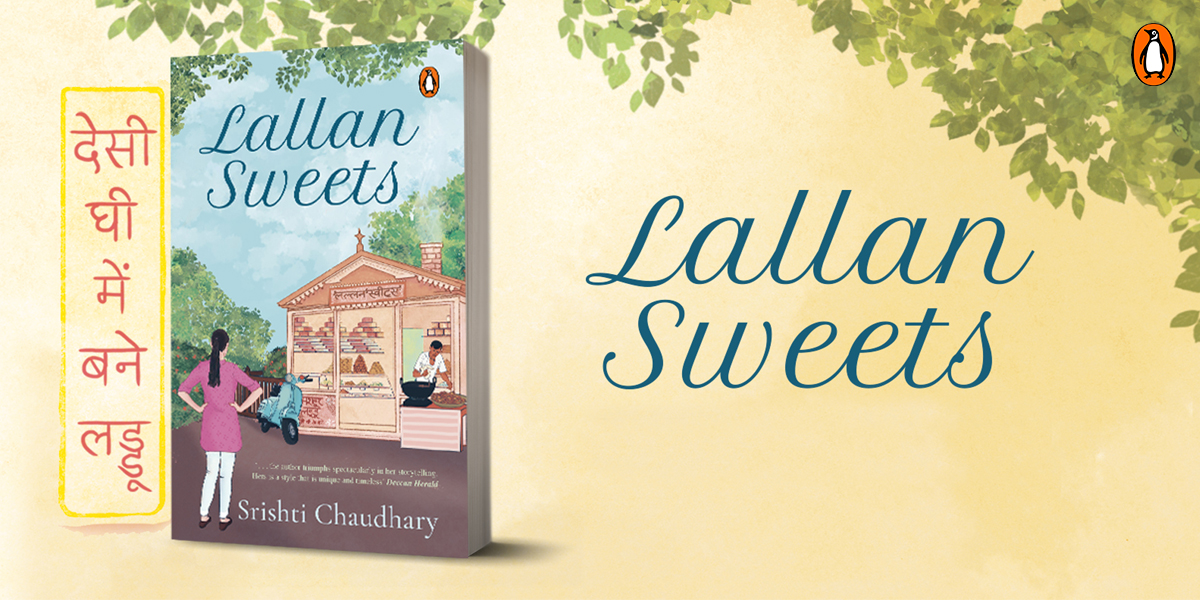
It is 1995. Tara Taneja lives in the small town of Siyaka, running Ultimate Mathematics Tuition Centre and working for Lalaji, her grandfather, at Lallan Sweets, his famous sweet shop. The laddoos sold at the shop are made using a secret family recipe that contains a magic ingredient known only to Lalaji.
When Lalaji chooses to retire, he decides that Lallan Sweets will not be inherited but earned. He devises a quest for his three grandchildren-Tara, Rohit and Mohit-to discover the magic ingredient.
Tara’s long-time crush and neighbour, fun-loving and good-natured Nikku Sabharwal, returns to Siyaka after years. Within the ensuing competition, we see Tara going through some regular challenges of womanhood – broken hearts and budding romance being at the forefront!
Find a glimpse of this in the excerpt below:
**
‘Can you imagine how things would have turned out if I had stayed here in Siyaka? I would have remained stupid, not knowing anything of the world outside.’
Affronted, I raised my eyebrows. It was classic Nikku to say something like that. ‘What do you mean? You think just because I never went away from Siyaka I am stupid?’
‘No, that’s not what I meant at all. I meant, for me, I needed to go out, I couldn’t have stayed here, I knew that I had to go out and see the world.’
I nodded at him and looked away, trying to fight off the wave of indignation that came over me. He always spoke about going out there as if the rest of us were lazy idiots tonot want to do the same as him, as if our minds were smaller.
‘You turned out completely fine, Taru Taneja,’ he said,almost as if reading my thoughts. ‘It’s a battle I had, or stillhave, with myself. I’m so proud of what you have done,building a name for yourself, Ultimate Mathematics Tuition Centre. But my mother always wanted me to go, she told meto go and make a bigman out of myself, in Delhi or Bombay.’
I still didn’t look at him, continuing to stare at the lakeinstead. It was that time in the afternoon when everything fell quiet. He looked towards me once more.
‘I’m sorry I didn’t keep in touch,’ he spoke abruptly.
I swallowed my tears. ‘You said you would call every week, but you even stopped writing nice letters after a point.’
Out of the corner of my eyes I saw him hang his head.
‘I’m really sorry.’
Of course I wasn’t going to forgive him. Years and yearsof broken promises. I simply got up and ignored whatever he said, putting on a bright smile and walking towards the Kinetic. ‘Come on now, we are yet to have the orange ice cream.’
He looked like he was going to say something, but then thought the better of it and sat behind me.
**
Lallan Sweets || Srishti Chaudhary
What will this journey bring forth for Tara and Lalaji’s grandchildren? And what exactly is the magic ingredient? Join Tara in her quest to find out!
Former Defence Minister and four-time Goa Chief Minister late Manohar Parrikar was one of the most reported personalities in India’s smallest state. But the privilege of researching for his biography ‘An Extraordinary Life: A biography of Manohar Parrikar’ gave us several fresh insights about his personality. And some lesser known nuggets too.
Listed below are ten lesser known facts about Parrikar. And no, this piece doesn’t mention his fetish for fish curry… For that nugget and more, read the book!
By Sadguru Patil and Mayabhushan Nagvenkar
Lucky number 13
Shunned and feared by many, Parrikar, a passionate contrarian, considered ‘13’ as his lucky number. Born on December 13, the number, he would often say, brought him good luck in politics. The registration plate of his last official ride, a Hyundai Santa Fe, bore the number 1313. His mobile phone numbers ended in 1313 and 131213. In 2000, he formed a government and was sworn-in as Chief Minister of Goa for the first time with the help of 13-non BJP MLAs. In 2017, he cleverly manoeuvred his way to the top post yet again with the help of… you guessed it right: 13 BJP MLAs!
Never a full term
Despite being sworn-in as Chief Minister of Goa on four different occasions from 2000-02, 2002-2004, 2012-2014 and 2017-2019, Parrikar never completed a full five-year term in office. Anxious about a revolt brewing within his government, Parrikar got the state assembly dissolved in 2002. In 2004, he was ousted by a resurgent Congress. In 2014, he was handpicked by Prime Minister Narendra Modi to join the central cabinet as Defence Minister. And in 2019, he died in office, after just two years in office as CM.
Accidental electoral debut
This fact has managed to duck attention altogether. After his initial grooming in the RSS, Parrikar’s initial role in the BJP was that of an organizer, as one of the secretaries of the party’s state unit. In 1991, BJP leader late Pramod Mahajan entrusted him with the responsibility of selecting a candidate for the North Goa Lok Sabha seat in the general elections. Parrikar could not shortlist a single credible candidate for his party, because contesting a popular election on a BJP ticket at the time was considered synonymous with certain defeat, and a poor defeat at that. With no candidate available, Mahajan directed Parrikar to contest the election. Parrikar’s defeat in the 1991 Lok Sabha polls was the only electoral loss in his political career.
Bookworm
Parrikar was known to read just about everywhere. In the front seat of his official car, in hotel lobbies, at the airport and even on the seat of his loo. He devoured books like he customarily devoured his political opposition. In 2013, at a book release event, he confessed that his house had two toilets. “I am currently reading a book on the Mahabharata. It’s in one toilet. There’s another book in the other toilet,” Parrikar said then.
Music to the soul
Amid spasms of pain while undergoing treatment for pancreatic cancer in New York, Parrikar looked to Hindustani classical singer Jitendra Abhisheki for solace. He loved to listen to Marathi bhavgeets (devotional songs) too. His favourite singers were Sudhir Phadke, Bharat Ratna Bhimsen Joshi, Pandit Abhisheki and Rahul Deshpande. Phadke’s ‘Dehachi Tejori’ (God’s vault) and Veer Savarkar’s ‘Sagara Prana Talmala’ (O Ocean, my heart is restless) topped his list of favourite songs. In his later years, he liked listening to Rahul Deshpande, whose songs were downloaded to his Ipad.
Mercedes mania
As a young businessman, when his political journey was still some distance away, Parrikar ambition was to own a Mercedes car. Once he walked the political path however, he realised that owning a Mercedes would impair public perception of him. After all he was beginning to be known for his ‘common man’ identity. So he dropped the idea altogether.
Control-freak
Parrikar’s style of governance was marked by a chronic disregard for existing administrative systems, with excessive power wrested in his person. Ministers were mere puppets in his abrasive style of governance, as Parrikar, his few handpicked bureaucrats and upper caste coterie members pulled all the strings. There was a key reason why Parrikar kept stalling his departure to Delhi as a cabinet minister. Because Modi mirrored his traits, when it came to governance-style and control. “I was a king in Goa. In Delhi, I am just one of the many princes,” Parrikar lamented to his friends.
Tech travails
For an IIT alumnus, Parrikar shied away from using new technology for communication. Apart from using a mobile phone to make and receive calls, he had no other use for the instrument. According to those close to him, accessing emails reluctantly was as far as Parrikar would go, when it came to embracing technology.
Money management
For a man, who is often lauded for planning and vision, Parrikar was pretty much financially broke when he returned to Goa, soon after passing out of IIT-Bombay and marrying Medha. He was so short on money, that his mother, Radhabai, paid some of his insurance premiums for a while.
Swachch Goa
India woke up to the ‘virtues’ of co-branding Mahatma Gandhi’s birth anniversary with a cleanliness gig, as part of Prime Minister Narendra Modi’s Swachch Bharat Mission in 2014. But the initiative was first launched by Parrikar as Chief Minister of Goa on October 2, 2002. He preferred to call it ‘Clean Offices Day’, when government servants were called to their respective offices on the national holiday and directed to spruce up the premises and immediate surroundings.
*
An Extraordinary Life || Sadguru Patil, Mayabhushan Nagvenkar
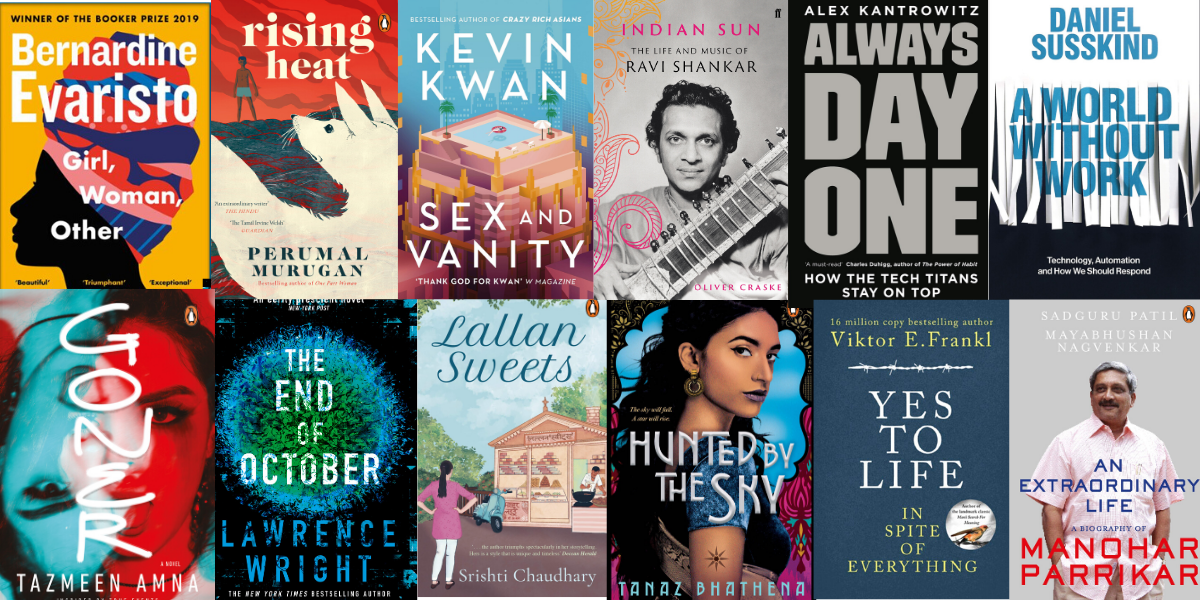
With the monsoon season coming up, there is nothing better than opening your windows and sitting down with a good book and the soothing smell and sound of rain filling your house. Don’t have a good book? We can help you with that, all you have to do is check out the bookshelf below!
An Extraordinary Life
An Extraordinary Life || Sadguru Patil, Mayabhushan Nagvenkar
Over the last two decades, the exploits of one man changed the way mainstream India looked at Goa and the political goings-on in the country’s smallest state. An Extraordinary Life traces the times of Manohar Parrikar through the informed voices of people in his life. His daily battles are brought to the fore as he encounters love and vices, showcasing his rise in politics from the son of a grocery store owner in a nondescript town, a sanghachalak in Mapusa town, an Opposition MLA and leader, to a chief minister (on multiple occasions) and, finally, to a defense minister.
*
Goner
Goner || Tazmeen Amna
She’s a young woman trying to deal with the dark and intoxicating side of life with haunting memories of an abusive ex-boyfriend, a broken family, and obvious mental health issues. Finding herself on a consistent downward spiral, she tries to grapple with her incessant attraction to all things that are bad for her, ultimately culminating in the form of a medical emergency.
With no job, months of expensive therapy, and a mystery man in her life will she be able to recover from her embarrassing wastefulness?
*
Hunted by the Sky
Hunted by the Sky || Tanaz Bhathena
Gul has spent her life running. She has a star-shaped birthmark on her arm, and in the kingdom of Ambar, girls with such birthmarks have been disappearing for years. So when a group of rebel women called the ‘Sisters of the Golden Lotus’ rescue her, take her in and train her in warrior magic, Gul wants only one thing: revenge.
Cavas lives in the tenements, and he’s just about ready to sign his life over to the king’s army to save his father who is terminally ill. As the chemistry between the two grows undeniably, he becomes entangled in a mission of vengeance, bringing Gul and Cavas together in a world with secrets deadlier than their own.
*
Rising Heat
Rising Heat || Perumal Murugan
Young Selvan’s life is no longer the same. With his family’s ancestral land sold to make way for the construction of a housing colony, his childhood has been denuded. In the ensuing years, as the pressures of their situation simmer to a boil, Selvan observes his family undergo dramatic shifts in their fortunes as greed and jealousy threaten to overshadow their lives.
*
Lallan Sweets
Lallan Sweets || Srishti Chaudhary
Tara Taneja lives in the small town of Siyaka, running a Maths Centre and working for Lalaji, her grandfather, at the famous Lallan Sweets. The laddoos sold are made using a secret family recipe that contains a magic ingredient known only to Lalaji. Choosing to retire, Lalaji decides that Lallan Sweets will be earned, devising a quest for his three grandchildren. With the help of her long-time crush and neighbor, Nikku, Tara pursues the quest to battle old secrets, family legacies, and unexpected dangers.
Will this journey bring them together or lead to a bittersweet end?
*
Girl, Woman, Other
Girl, Woman, Other || Bernardine Evaristo
Grace is a Victorian orphan dreaming of the mysterious African father she will never meet.
Winsome is a young Windrush bride, recently arrived from Barbados.
Amma is the fierce queen of her 1980s squatters’ palace.
Morgan, who used to be Megan, is blowing up on social media, the newest activist-influencer on the block.
Twelve very different people, mostly black and female, more than a hundred years of change, and one sweeping, vibrant, glorious portrait of contemporary Britain. Bernardine Evaristo presents a gloriously new kind of history for this old country: ever-dynamic, ever-expanding, and utterly irresistible.
*
Sex and Vanity
Sex and Vanity || Kevin Kwan
The iconic author of the bestselling phenomenon, Crazy Rich Asians, Kevin Kwan returns with the glittering tale of a young woman who finds herself torn between two men: the fiancé of her family’s dreams and the man she is desperately trying to avoid falling in love with. Moving between summer playgrounds of privilege, peppered with decadent food and extravagant fashion, Sex and Vanity is a truly modern love story. Here’s a daring homage to A Room with a View, a brilliantly funny comedy of manners set between two cultures.
*
Yes to Life In Spite Everything
Yes to Life In Spite of Everything || Viktor E. Frankl
Just months after his liberation from Auschwitz, renowned psychiatrist Viktor E. Frankl delivered a series of talks revealing the foundations of his life-affirming philosophy. The psychologist, who would soon become world-famous, explained his thoughts on meaning, resilience, and his conviction that every crisis contains an opportunity. Despite the unspeakable horrors in the camp, Frankl learned from his fellow inmates that it is always possible to say ‘yes to life’ – a profound and timeless lesson for us all.
*
Always Day One
Always Day One || Alex Kantrowitz
At Amazon, ‘Day One’ is code for inventing like a startup with little regard for legacy. Day Two is, in Jeff Bezos’s own words, ‘stasis, followed by irrelevance, followed by an excruciating, painful decline, followed by death.’ Through 130 interviews with insiders, from Mark Zuckerberg to hourly workers, top tech journalist Alex Kantrowitz drills down into exactly how each CEO has implemented their own radically innovative culture – and how your business, startup or team can do the same
*
A World Without Work
A World Without Work || Daniel Susskind
New technologies have always provoked panic about workers being replaced by machines. In the past, such fears have been misplaced, and many economists maintain that they remain so today. In A World Without Work, Daniel Susskind shows why this time really is different. Advances in artificial intelligence mean that all kinds of jobs are increasingly at risk and Susskind argues that machines no longer need to reason like us in order to outperform us.
*
The End of October
The End of October || Lawrence Wright
At an internment camp in Indonesia, forty-seven people are pronounced dead with acute hemorrhagic fever. When Henry Parsons–microbiologist, epidemiologist–travels there on behalf of the World Health Organization to investigate, what he finds will soon have staggering repercussions across the globe: an infected man is on his way to join the millions of worshippers in the annual Hajj to Mecca. Now, Henry joins forces with a Saudi prince and doctor in an attempt to quarantine the entire host of pilgrims in the holy city, in this race-against-time thriller that predicted it all.
*
Indian Sun: The Life and Music of Ravi Shankar
Indian Sun: The Life and Music of Ravi Shankar || Oliver Craske
Over eight decades, Ravi Shankar was India’s greatest cultural ambassador who took Indian classical music to the world’s leading concert halls and festivals, charting the map for those who followed. Indian Sun is the first biography of Ravi Shankar. Benefitting from unprecedented access to family archives, Oliver Craske paints a vivid picture of a captivating, restless workaholic, who lived a passionate and extraordinary life – from his childhood in his brother’s dance troupe, through intensive study of the sitar, to his revival of the national music scene; and from the 1950s, a pioneering international career that ultimately made his name synonymous with India.
As we collectively grapple with unprecedented challenges, crises and uncertainties, mental health struggles have become more important to address than ever. In a socially distanced world, it is easy to feel cut-off and lonely. But taking care of ourselves and our minds is priority.
As our most trusted companions, finding the right books can go a long way in us helping ourselves feel better and understand how to take care of ourselves. We reached out to some experts and authors for their recommendations for books that can help us cope with our mental health struggles.
Option B: Facing Adversity, Building Resilience, and Finding Joy by Sheryl Sandberg and Adam Grant
Option B || Sheryl Sandberg and Adam Grant
This is a wonderful book for overcoming setbacks and building resilience in these trying times
M is for Mindfulness by Carolyn Suzuki
M is for Mindfulness || Carolyn Suzuki
A book I refer to all my clients for introducing children to concepts of mindfulness.
My Age of Anxiety by Scott Stossel
My Age of Anxiety || Scott Stossel
This one is revealing memoir of life with anxiety.
*
Anjali Chhabria, Psychiatrist
With the world going through a pandemic and a resulting economic crisis, we are going to see a lot of emotional upheaval. Mental health has never been as significant as it is today. It is important that each one of us learns to pick up signs and symptoms of distress in people around us so that we can give them the necessary emotional first aid immediately.
In a time like this, I recommend reading:
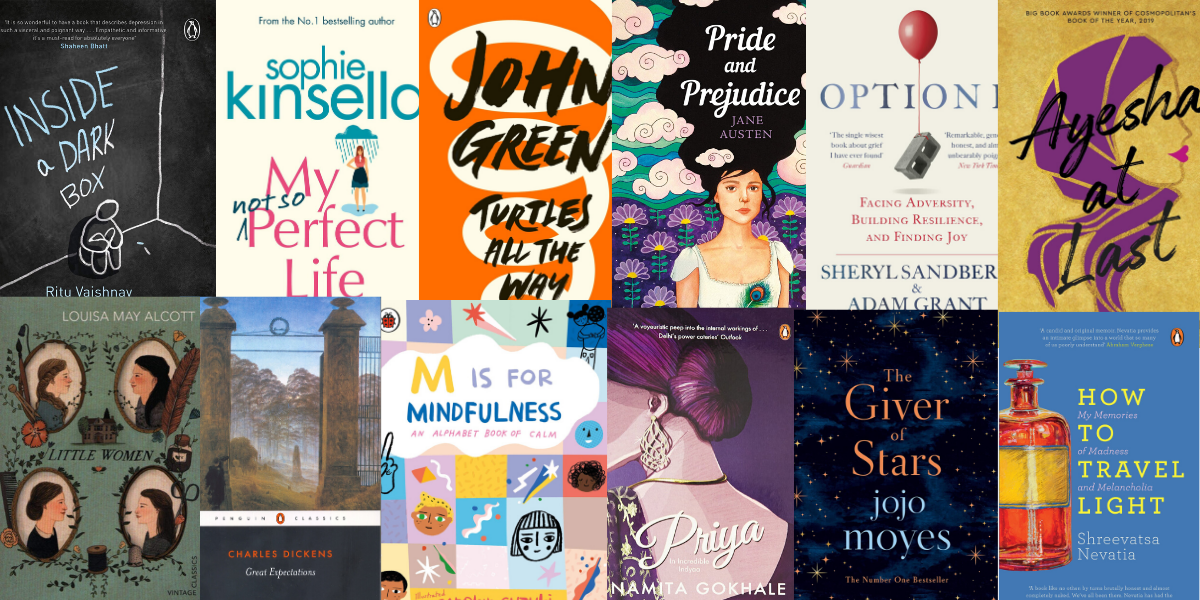
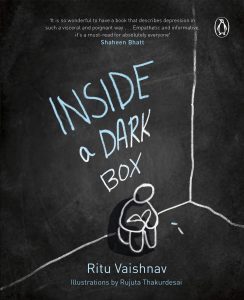
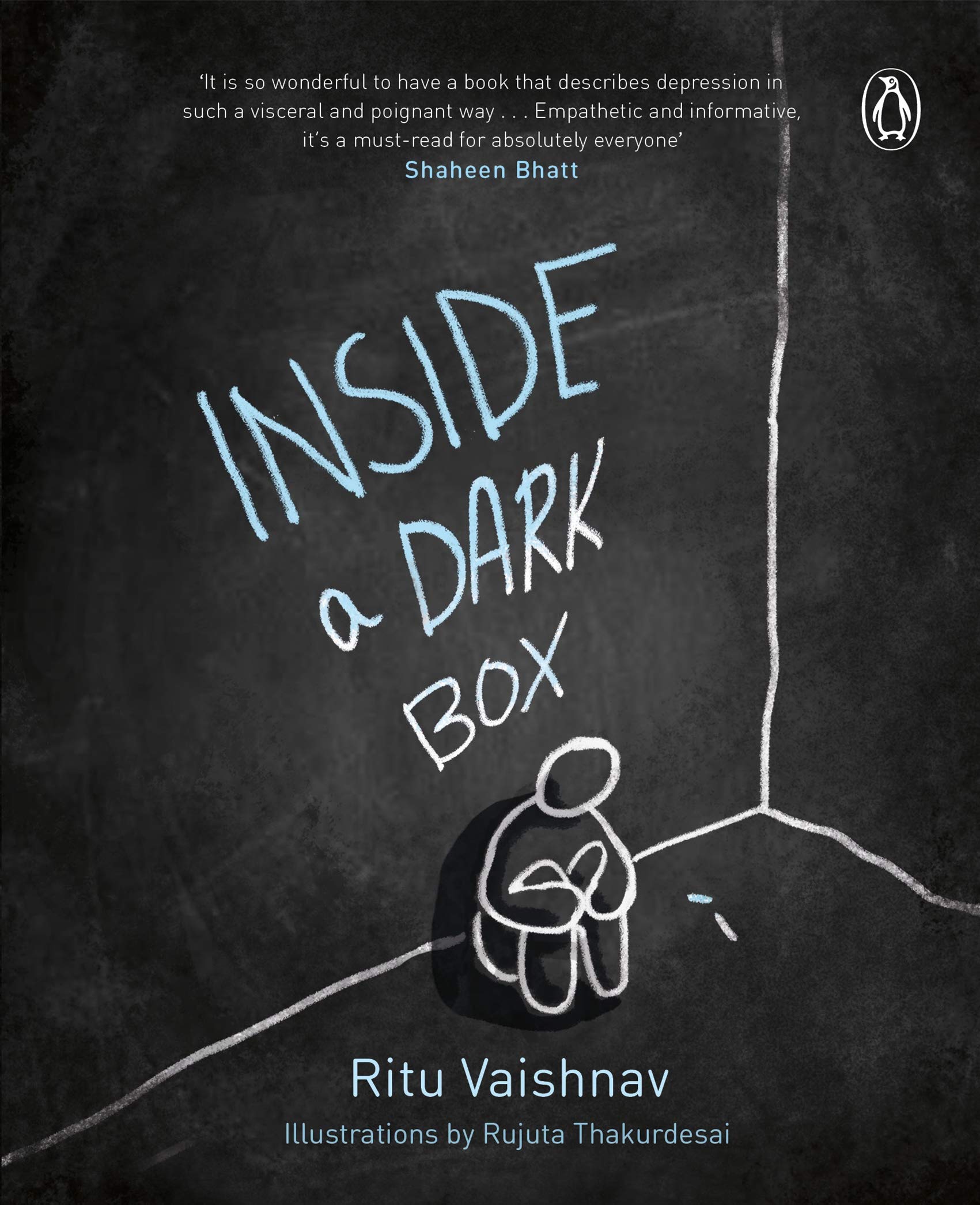
Inside a Dark Box by Ritu Vaishnav
Inside a Dark Box || Ritu Vaishnav (Author), Rujuta Thakurdesai (Illustrator)
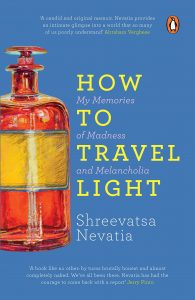
How to Travel Lightby Shreevatsa Nevatia
How to Travel Light || Shreevatsa Nevatia
*
Himanjali Sankar, Author and Editor
I wouldn’t call my recommendations essential mental health reads as much as stories that have stayed with me, because of the intensely troubled, attractive and sensitively drawn protagonists in each. From the young neurotic woman in the very powerful 1892 short story by Charlotte Perkins Gilman, ‘The Yellow Wallpaper’, to the wild and marvelous Antoinette in Jean Rhys’ Wide Sargasso Sea – a feminist, anti-colonial response to the representation of the mad woman in Charlotte Brontë’s Jane Eyre – to more recent explorations of troubled minds as with Theodore Finch (charming, volatile, wise, yet ultimately unable to help himself in a way that is both tragic and life-affirming) in All the Bright Places by Jennifer Niven. These are books that are special to me and I would love for everyone I know to read them if they haven’t done so already.
All the Bright Places || Jennifer Niven.Jane Eyre || Charlotte BronteWide Sargasso Sea || Jean RhysThe Yellow Wall-Paper || Charlotte Perkins Gilman
*
Nandhika Nambi, Author
Gone are the days where mental health was stigmatized, misunderstood, cast aside and ignored. Now, more than ever, we need to be conscious of our mental health and its undeniable importance.
What better way to delve into these pressing problems than through the pages of a book? Read to understand, read to help and read to heal. Here are my recommendations:
Turtles All the Way Down by John Green
Turtles All the Way Down || John Green
Fish in a Tree by Lynda Mullaly Hunt
Fish in a Tree || Lynda Mullaly Hunt
First, We Make the Beast Beautiful: A New Story about Anxiety by Sarah Wilson
First, We Make the Beast Beautiful: A New Story about Anxiety || Sarah Wilson
Straight Jacket by Matthew Todd
Straight Jacket || Matthew Todd
This Too Shall Pass by Milena Busquets
This Too Shall Pass || Milena Busquets (Author), Valerie Miles (Translator)
Untamed: Stop Pleasing, Start Living by Glennon Doyle
Untamed || Glennon Doyle
*
Ritu Vaishnav, Author and Journalist
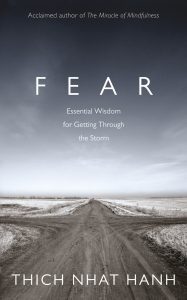
Fear: Essential Wisdom for Getting Through The Storm by Thich Nhat Hanh
Fear || Thich Nhat Hanh
This is the book that I turn to whenever I need to find some calm within. The perspective it offers might be great for your mental health too. I tend to gift this one a LOT!
How to Travel Light by Shreevatsa Nevatia
How to Travel Light || Shreevatsa Nevatia
This is a memoir about living with bipolar disorder. It talks about both depression and mania. The candour and humour keep it from turning too heavy or intense despite the subject matter.
The Bell Jar by Sylvia Plath
The Bell Jar || Sylvia Plath
This one is dark and disturbing, made even more painful by the fact that its brilliant author died by suicide shortly after it was published. This one is not for everyone, but pick it up if you can handle a hard and gut-wrenching look at the mind’s capacity to torment.
The Rabbit Listenedby Cori Doerrfeld
The Rabbit Listened || Cori Doerrfeld
I would especially recommend this picture book to those who wish to support someone going through a difficult phase. Go ahead and be their rabbit!
After the Fallby Dan Santat
After the Fall || Dan Santat
What happened to Humpty Dumpty after his great fall? This beautiful picture book talks about recovering from trauma and getting back on your feet.
*
Tazmeen Amna, Author
My life in the recent past has been extremely fast-paced. I often find myself experiencing depressive symptoms, or in an emotionally excessive hyper state. Honestly, there is no better way for me to calm myself down and feel good about myself than reading. There are certain books that smell and feel like home- they’re like a warm cup of hot chocolate, like melting marshmallows over a bonfire on a winter night!
My go-to feel-good books are Penguin Classics: Little Women, Pride and Prejudice, Great Expectations, David Copperfield.
David Copperfield || Charles DickensGreat Expectations || Charles DickensLittle Women || Louisa May AlcottPride and Prejudice || Jane Austen
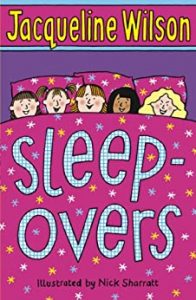
Sometimes, for fun, I read children’s fiction such as Sleepovers by Jacqueline Wilson– that book takes me back to childhood days of sincere friendships and miniscule struggles.
Sleepovers || Jacqueline Wilson (Author) Nick Sharratt (Illustrator)
Contemporary Fiction is always relatable and fun to read too; I am a fan of Namita Gokhale, (Paro: Dreams of Passion, Priya: In Incredible Indyaa), and I love me some Sophie Kinsella (My Not-So-Perfect-Life), and Jojo Moyes. I recently enjoyed Ayesha At Last by Uzma Jalaluddin too!
Ayesha at Last || Uzma JalaluddinParo || Namita GokhalePriya || Namita GokhaleMy Not So Perfect Life || Sophie Kinsella
*
Jane De Suza, Author
A Long Way Down by Nick Hornby
A Long Way Down || Nick Hornby
A hilarious, life-affirming book about four people who set out to commit suicide. An incisive look at missed opportunities, being left out and finding others like you.
Wild Child and Other Stories by Paro Anand
Wild Child || Paro Anand
Riveting stories about children’s reactions to abuse, loneliness, failure, racism. The story cores down fearlessly to issues that should be discussed with the young.
The Curious Incident Of The Dog In The Night-Time by Mark Haddon
The Curious Incident of the Dog in the Night-Time || Mark Haddon
A young teen who the world dismisses as autistic, triumphs over his disabilities to find the truth.
Em and the Big Hoom by Jerry Pinto
Em and the Big Hoom || Jerry Pinto
A brave account of a mother swayed from manic highs to lows.
Books see us. Book hear us. Books love us all equally.
We are seen by stories and heard by words.
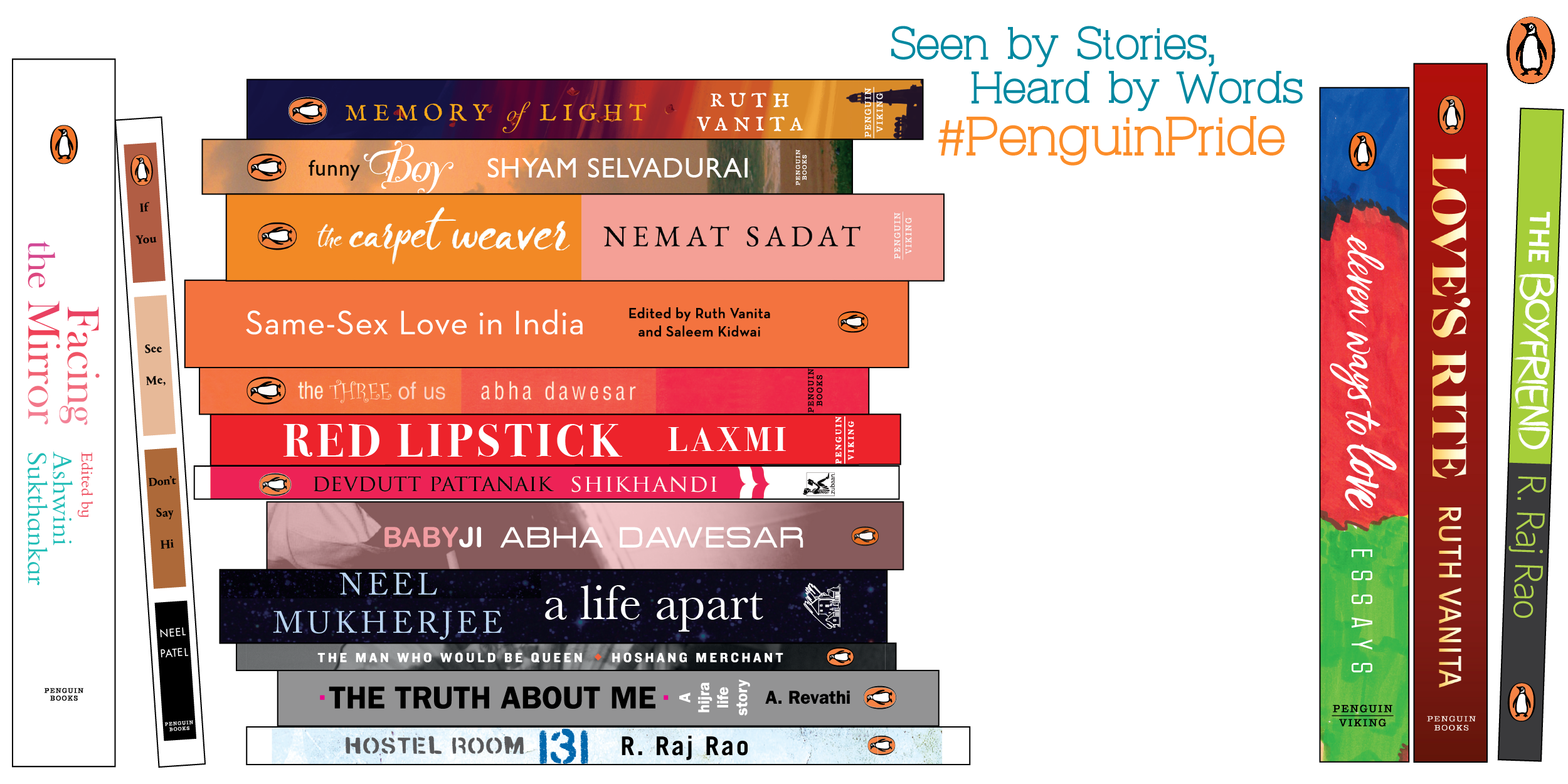
As we close Pride Month, we decided to look back at the diverse range of stories exploring gender identities, queer experience, sexuality, and love in India.
Here’s our round-up – which we hope will last well beyond June for you!
*
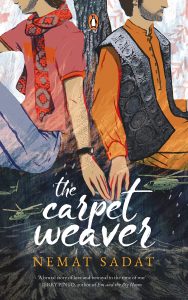
The Carpet Weaver
A love forbidden by a death penalty, and a desperate search for a place to call home.
The Carpet Weaver|| Nemat Sadat
In Afghanistan of 1977, Kanishka Nurzada, the son of a leading carpet seller, falls in love with his friend Maihan, with whom he shares his first kiss at the age of sixteen. Their romance must be kept secret in a nation where the death penalty is meted out to those deemed to be kuni, a derogatory term for gay men.
What follows is an intimate, powerful tale of a young gay man’s struggle to come of age and find love in the face of brutal persecution.
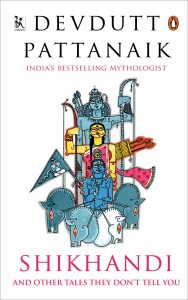
Shikhandi and Other ‘Queer’ Tales They Don’t Tell You
What constitutes male and female?
Shikhandi and Other Queer Tales They Don’t Tell You|| Devdutt Pattanaik
Queerness isn’t only modern, Western or sexual, says mythologist Devdutt Pattanaik.
A closer look at the vast written and oral traditions in Hinduism – some over two thousand years old – will tell you many overlooked tales. There’s Shikhandi, who became a man to satisfy her wife; Mahadeva, who became a woman to deliver his devotee’s child; Chudala, who became a man to enlighten her husband; Samavan, who became the wife of his male friend.
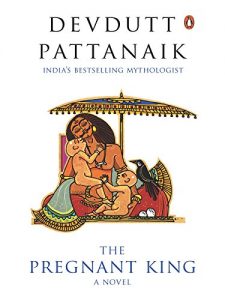
The Pregnant King
Blurring lines between men and women, sons and daughters, husbands and wives, fathers and mothers.
The Pregnant King|| Devdutt Pattanaik
‘I am not sure that I am a man,’ said Yuvanashva. ‘I have created life outside me as men do. But I have also created life inside me, as women do. What does that make me? Will a body such as mine fetter or free me?’
This is the untold story of Yuvanasha from the Mahabharata, a childless king, who accidentally drinks a magic potion meant to make his queens pregnant and gives birth to a son.
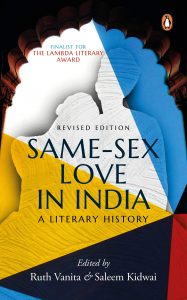
Same-sex Love in India
An incontestable history of same-sex love and desire in the Indian subcontinent.
Same-sex Love in India|| Ruth Vanita & Saleem Kidwai
Covering over 2000 years, from the Mahabharata to the late twentieth century, the book contains excerpts from stories, poems, letters, biographies and histories in fifteen languages. These trace the changing depictions of and debates around same-sex relations, illuminating their social, political and literary contexts; all works of scholarship that will shed new light on Indian culture and society.
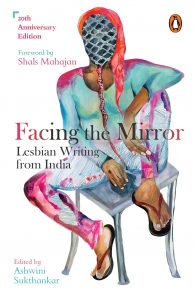
Facing the Mirror
Hidden, forgotten, distorted, and ultimately triumphant stories of the lesbian experience across India.
Facing the Mirror|| Ashwini Sukthankar
Going back as far as the 1960s, the book brings to readers a remarkable history that illuminates the blood and the tears, the beauty and the magic of the queer movement in India.
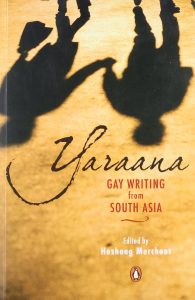
Yaraana: Gay Writing from South Asia
True meaning of ‘yaraana’ or male bonding, as an ignored facet of South Asian life and sexuality.
Yaraana || Hoshang Merchant
From Ashok Row Kavi s autobiographical piece on growing up gay in Bombay to Vikram Seth s brilliantly etched account of a homosexual relationship in The Golden Gate, the stories, poems, plays and prose extracts in this collection cover a range of literary styles, themes and sensibilities.
Apart from the pieces written originally in English, there are works translated from Hindi, Marathi, Gujarati and other Indian languages, which speak of the agony and the joy of being a man in love with other men.
The Man Who Would Be Queen: Autobiographical Fictions
Personal vignettes of hidden sexuality and love.
The Man Who Would Be Queen || Hoshang Merchant
In an unflinching autobiography, Hoshang Merchant talks about his encounters with gay and bisexual men and how he was the one who was mostly hurt and betrayed, since none of them had the courage to come out and lived their lives hiding their sexualty. He talks about all his sexual experiences, out of which, some involved love and affection, but some did not.
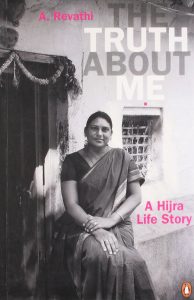
The Truth about Me: A Hijra Life Story
A hijra fighting ridicule, persecution, indignities and violence.
The Truth About Me || A. Revathi
Revathi was born a boy, but felt and behaved like a girl. In telling her life story, Revathi evokes marvelously the deep unease of being in the wrong body that plagued her from childhood. To be true to herself, to escape the constant violence visited upon her by her family and community, the village-born Revathi ran away to Delhi to join a house of hijras to find a life of dignity.
Red Lipstick
Window to a brave new world of a powerful transgender activist.
Red Lipstick || Laxmi
The world keeps taunting him as girlish but the fact is that, biologically, he is a boy. And, he is always attracted to guys. Is Laxmi both a man and a woman? Or, perhaps, neither a man nor a woman?
Struggling with such existential questions, Laxmi Narayan Tripathi, eminent transgender activist, awakens to her true self: She is Laxmi, a hijra. In this fascinating narrative Laxmi unravels her heart to tell the stories of the men–creators, preservers, lovers, benefactors and abusers–in her life.
Babyji
A subversive story of sexuality, desire, and seduction.
Babyji || Abha Dawesar
This is the story of Anamika Sharma, a spirited student growing up in Delhi. At school she is an ace at quantum physics. At home she sneaks off to her parents’ scooter garage to read the Kamasutra.
Before long she has seduced an elegant older divorcée and the family servant, and has caught the eye of a classmate coveted by all the boys. With the world of adulthood dancing before her, Anamika confronts questions that would test someone twice her age.
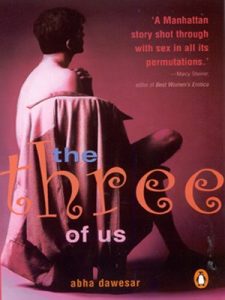
The Three of Us
An intimate exploration of bisexuality, fidelity, infidelity, and sexual passion.
The Three of Us || Abha Dawesar
When we meet Andre he’s a blank slate: a freshly minted 24-year-old college grad on his first day of work at a Manhattan-based investment bank…Within days he’s seriously boffing the sensuous Nathan, his boss’s boss, and has been seduced by the elegant Sybil, Nathan’s young wife. Before long he’s halfheartedly sleeping with the frumpy office secretary, Martha (eventually getting her pregnant). Along the way he reconnects with levelheaded Madhu, the Indian woman he dated and nearly married in college.
Dawesar creates an intricate, often hilarious story with swift, crisp prose and clean, short sentences which deliver steamy sex scenes, and passages of reflective introspection with equally engaging directness.
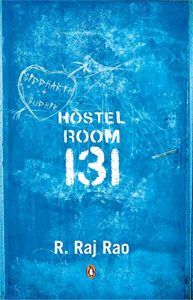
Hostel Room 131
An irreverently funny and deadpan look at India’s gay subculture.
Hostel Room 131 || R. Raj Rao
Siddharth, a twenty-three year old Bombay-born guy. His unconventional views make him a very interesting personality. He believes that in Sholay, Jai and Veeru have the hots for each other, rather than for the two heroines. One cold winter day in 1978, Siddharth meets Sudhir in Pune’s Engineering College Hostel and falls in love. In Hostel Room 131, Gaurav and Vivek, a gay pair, decide to help the protagonists fight against homophobia.
The Boyfriend
A tragi-comic gay love story from the jumbled up heart of Mumbai.
The Boyfriend || R. Raj Rao
One Saturday morning in late 1992, Yudi, a forty something gay journalist, has hurried sex with a nineteen-year-old Dalit boy in the Churchgate loo. There is nothing to set this brief encounter apart from numerous others, and Yudi returns to his bachelor’s flat and sex with strangers. But when riots break out in Mumbai, Yudi finds himself worrying about the boy from Churchgate station. He is in love.
Unsentimental and full of dry humour and wit, R Raj Rao examines with unsparing irony the realities of caste, class, religion, masculinity and the gay subculture in India.
A Life Apart
An intimate look at dislocation and alienation, outsiders and losers.
A Life Apart || Neel Mukherjee
A life apart tells two stories. Ritwik, twenty-two and orphaned, escapes from a devastating childhood of abuse in Calcutta to what he considers to be a new world, full of possibilities, in England, where he has a chance to start all over again. But his past, especially the all-consuming relationship with his mother, is a minefield: will Ritwik find the salvation he is looking for?
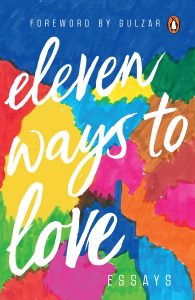
Eleven Ways to Love
A collection of eleven essays showing us that there is no such thing as ‘the love that dare not speak its name’.
Eleven Ways to Love || Sreshtha, Sangeeta, Nadika Nadja, Dhrubo Jyoti, et al.
People have been telling their love stories for thousands of years. It is the greatest common human experience. And yet, love stories coach us to believe that love is selective, somehow, that it can be boxed in and easily defined.
This is a collection of eleven remarkable essays that widen the frame of reference: transgender romance; body image issues; race relations; disability; polyamory; class differences; queer love; long distance; caste; loneliness; the single life; the bad boy syndrome . . . and so much more.
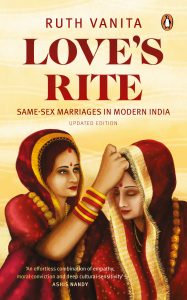
Love’s Rite: Same-Sex Marriage in India and the West
Same-sex marriage dwells not at the margins but at the heart of culture.
Love’s Rite || Ruth Vanita
This is the first book to examine the same-sex weddings and same-sex couple suicides reported in India over the last two decades. Ruth Vanita examines these cases in the context of a wide variety of same-sex unions, from 14th century narratives about co-wives who miraculously produce a child together, to 19th century depictions of ritualized unions between women, to marriages between gay men and lesbians arranged over the internet.
Funny Boy
Story of a ‘funny boy’, who prefers dressing as a girl to playing cricket with his brother.
Funny Boy || Shyam Selvadurai
In the world of his large family – affluent Tamils living in Colombo – Arjie is an oddity. But as he comes to terms with his own homo-sexuality and with the racism of the society in which he lives, Sri Lanka is plunged into civil war as fighting between the army and the Tamil Tigers gradually begins to encroach on the family’s comfortable life. Sporadic acts of violence flare into full scale riots and lead, ultimately, to tragedy.
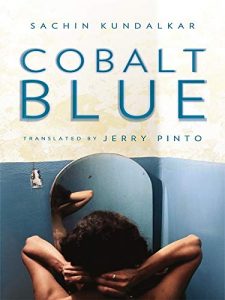
Cobalt Blue
Rapturous love and fierce heartbreak told with unsparing clarity.
Cobalt Blue || Sachin Kundalkar (Author), Jerry Pinto (Translator)
A paying guest seems like a win-win proposition to the Joshi family. He’s ready with the rent, he’s willing to lend a hand when he can and he’s happy to listen to Mrs Joshi on the imminent collapse of our culture. But he’s also a man of mystery. He has no last name. He has no family, no friends, no history and no plans for the future. The siblings Tanay and Anuja are smitten by him. He overturns their lives and when he vanishes, he breaks their hearts.
If You See Me, Don’t Say Hi
An examination and confrontation of our most deeply held stereotypes.
If You See Me, Don’t Say Hi || Neel Patel
In eleven sharp, surprising stories, Neel Patel gives voice to our most deeply held stereotypes and then slowly undermines them. His characters, almost all of whom are first-generation Indian Americans, subvert our expectations that they will sit quietly by. We meet two brothers caught in an elaborate web of envy and loathing; a young gay man who becomes involved with an older man whose secret he could never guess; three women who almost gleefully throw off the pleasant agreeability society asks of them; and, in the final pair of linked stories, a young couple struggling against the devastating force of community gossip.
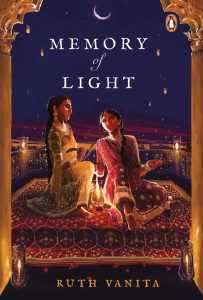
Memory of Light
Desire, distances, loss and same-sex love woven through poetry and melodies.
Memory of Light || Ruth Vanita
Preparations for King George the Third’s fiftieth birthday gala are in full swing in Lucknow. As poets and performers vie to be part of the show, Chapla Bai, a dazzling courtesan from Kashi, briefly enters this competitive world, and sweeps the poet Nafis Bai off her feet. An irresistible passion takes root, expanding and contracting like a wave of light.
Talking of Muskaan
Life, death and secrets – and the young people caught in-between.
Talking of Muskaan || HImanjali Sankar
Three classmates—her former best friend Aaliya, the hottie Prateek, and the class topper Subhojoy—talk about Muskaan, and themselves. About school, home and the larger world, the school bus and the basketball court; about secrets that become burdens. And through their stories are revealed the twists and turns that drove Muskaan to try to kill herself.
*
Which stories spoke to you this month? Share with us by dropping us a line in the comments!
Team Penguin wishes you safety, wellbeing, and pride.
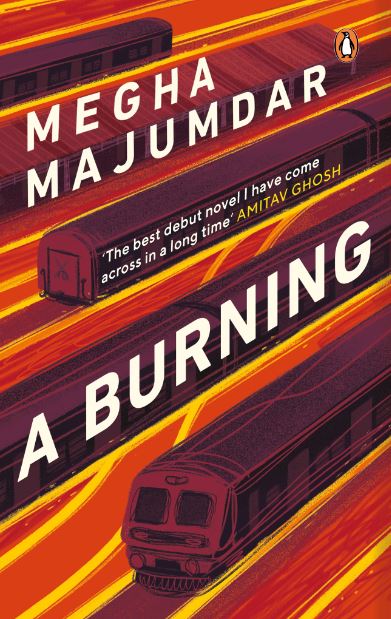
Megha Majumdar’s electrifying debut novel, A Burning, is about the cost and freedom of dreams in a world burdened with class and socio-political power-structures.
She traces the lives of three protagonists Jivan, Lovely and PT Sir – which get entangled after a terrorist attack on a train in Kolkata. The responsibilities for both Jivan’s false charges and her freedom lie in the hands of PT Sir and Lovely – who too are battling with the daily indignities of their life.
With entrenched injustices, fascism, politics of religion, and betrayals coming into play – these characters become reflective of daily human struggles in a country spinning towards extremism.
*
Jivan
‘If the police didn’t help ordinary people like you and me, if the police watched them die, doesn’t that mean that the government is also a terrorist?’
Jivan is a Muslim girl living in a slum in Kolkata. She witnesses the aftermath and carnage of a terrorist attack on a train and reshares a video on Facebook with the caption given above. Days later she is arrested for the attack and thrown into prison undoing tears of work she has spent clawing her way out of poverty.
PT Sir
‘PT Sir knows who she is. Isn’t she the ghost who begs him for mercy? Isn’t she the ghost who searches the gaze of her teacher, hoping that he might offer rescue? Maybe that is why they had the white curtain up at the court— not so that Jivan could not influence his testimony, but so that he would not have to face her.’
A gym coach, PT Sir is Jivan’s former physical education teacher who turns against out of his thirst for recognition. He embraces a political career, getting entangled in extremist politics, inextricably connecting his political rise with Jivan’s fall.
Lovely
‘Uff! Don’t make me say it, Lovely. I can’t do this marriage scene with a half man.’
Lovely is a transgender woman from the same slum as Jivan – who dreams of making it big in Bollywood and attends a local acting class. She faces day-to-day ignominies because of her gender-identity. She has a husband named Azad. Lovely has an alibi that can prove Jivan’s innocence – but it would cost Lovely everything she holds dear.
*
A Burning|| Megha Majumdar
Jivan, Lovely and PT Sir present to us an unforgettable character-arc that explores the complexities of possessing morals in today’s world. As each of them face profound obstacles and inequalities, Majumdar gives us one searing question to explore through them: Who is allowed to dream?
On 28 November 2019, Uddhav Thackeray, the Shiv Sena chief, was sworn in as the eighteenth chief minister of Maharashtra. This event marked the culmination of a high-voltage political drama that had the entire nation glued to their television sets for days on end. With no party being able to claim a majority in the assembly, President’s Rule was imposed in the state. This book takes its readers through the twists and turns of the dramatic political crisis that unfolded as Maharashtra waited for its chief minister.
What really went on behind the scenes?
With access to inside sources and private conversations, this book reveals the hitherto untold story of this political drama, with a comprehensive overview of the state’s politics in the last few decades.
Read below an excerpt from the book:
After leaving the Maha Vikas Aghadi meeting at the Nehru Centre (Worli) on 22 November 2019, Ajit Pawar arrived at his Churchgate residence. He again left the house at around 10.30 p.m. He asked his driver to stop on the way. He then asked the driver to return to his house with the car. Pawar stepped into another car and left for the western suburbs. Around the same time, Fadnavis also left his chief ministerial convoy and, in a different vehicle, arrived at the Hotel Sofitel in BKC, around midnight. Both leaders chose to avoid the public glare and media attention. They entered the five-star luxury hotel from a back door. It was an hour-long meeting. After hearing the name of Uddhav Thackeray as a possible candidate for the position of the chief minister of Maharashtra, Devendra Fadnavis panicked and informed Ajit Pawar that they had to take the oath the very next day, on 23 November 2019, at Raj Bhavan. Ajit Pawar asked him about President’s Rule and other procedures and requested Fadnavis to not be in a hurry. Ajit Pawar told Fadnavis that Sharad Pawar had given the green signal but the final discussion was yet to happen. However, according to an NCP leader who spoke with the author, Fadnavis told him that discussions could take place later.According to Fadnavis, it was of utmost importance to take the oath as soon as possible and then resolve other pending matters.
Meanwhile, Ajit Pawar had come to know that his uncle was reluctant to align with the BJP. A person close to Ajit Pawar said to this author that while planning the formation of the government with the Shiv Sena and the Congress, the state NCP president Jayant Patil’s name was finalized for the position of the deputy chief minister with the home portfolio. It was a big shock for Ajit Pawar. There seemed to be a plan afoot to systematically sideline Ajit Pawar, and to later bring in Supriya Sule as the chief minister of Maharashtra for the half term once Uddhav Thackeray’s two and a half years were over . . . It seemed like the end of Ajit Pawar’s career.
Perhaps, therefore, Ajit Pawar also panicked and decided to go ahead with what must have seemed to be his last resort—joining hands with the BJP despite his uncle’s reluctance. …
Ajit Pawar and his close aide had called the thirty-eight NCP legislators in Mumbai and had asked them to assemble at Dhananjay Munde’s bungalow in front of the Secretariat House (Mantralaya) at 12.30 a.m. Sunil Tatkare, Dhananjay Munde and Praful Patel had been kept in the loop. …While leaving their own constituencies, the NCP legislators started calling each other, mentioning that Ajit Pawar had called them for a meeting. It turned out that the other legislators who were not a part of the thirty-eight had no clue about this meeting in Mumbai. … Finally, out of thirty-eight, only fifteen NCP legislators reached Mumbai. This was perhaps the first signal that Ajit Pawar’s coup would not be a cakewalk.
The NCP chief, Sharad Pawar, got wind of this development around 12.30 or 1 a.m. on 23 November. At Raj Bhavan, the engineers had asked the sound and microphone system operators to remain there only. This news spread and there were suspicions that something was up at Raj Bhavan. The NCP legislators who were directly in touch with Sharad Pawar informed him that Ajit Pawar had called them for a meeting. However, after speaking with Sharad Pawar, many of them decided not to attend the meeting. Pawar thus had an idea about his nephew’s plans, but he remained doubtful about its success. Later, around 3 a.m., on Saturday, Pawar sought an update on how many legislators were siding with Ajit Pawar. He knew that if only these fifteen legislators went with his nephew that would not help him to form the government. The BJP had 105 seats and the support of fifteen independent legislators; it needed at least twenty-five to thirty legislators to cross the 145 mark. Ajit Pawar teaming up with the BJP would not only be a fiasco but he would also lose his credibility
As per his interview with ABP Majha, Sharad Pawar said that he went to bed late, around 3 a.m., at Silver Oak, hardly a fifteen-minute drive from Raj Bhavan. Around the same time, Devendra Fadnavis was getting ready to take the oath as chief minister of Maharashtra for a second time. As per a local television channel, around 4 a.m. in the morning, Fadnavis and his wife, Amruta Fadnavis organized a mirchi havan (a sacred ritual around a fire), which was performed by the priests from Nalkheda’s Baglamukhi temple in Madhya Pradesh. Baglamukhi is a tantric deity in Hinduism. Fadnavis was told that this same havan was performed to save the Harish Rawat government in Uttarakhand. When the Rawat government lost the majority in the house, his brother Jagdish Rawat rushed to the Baglamukhi temple to perform the mirchi havan and, eventually, apparently, Rawat was able to save his government. Since then, this temple town had become famous among politicians and businessmen. The report of the channel stated that Fadnavis was convinced that if this mirchi havan was performed by him at Varsha Bungalow, his official residence in Mumbai, he would again be chief minister of Maharashtra. Earlier also, Fadnavis had conducted the same mirchi havan on several occasions to retain the chief minister’s chair whenever it was in trouble. Once the havan was done, the tantriks were paid dakshina (donation) and they left for Madhya Pradesh; their return journey was coordinated by Prasad Lad.
It was time for Fadnavis to get ready for his second swearing-in ceremony at Raj Bhavan. Rather than choosing his favourite blue jacket, he had, as per the instructions of the tantrik, opted for the colour black to ward off evil spirits. Ajit Pawar, as leader of the NCP’s legislative party, had with him two original copies of the signatures of the fifty-four NCP legislators, in Marathi and in English. A copy of the list was handed over to Maharashtra’s chief secretary, Ajoy Mehta, who was waiting at Varsha Bungalow. As per an Indian Express report dated 2 December 2019, Mehta had been specially flown in from Delhi to expedite the Devendra Fadnavis–Ajit Pawar swearing-in ceremony on 23 November.
‘All the vitality and all the energy I have comes to me because my body is purified by fasting’
—Mahatma Gandhi
You must always turn to nature when you are sick or afflicted with disease. Nature holds all the answers, and when you align yourself with it, you heal and recover. Dry fasting is one such answer. Dry fasting is complete abstinence from food and water for a particular window during the day, followed by breaking the fast in a specific manner. This window during which one fasts is called the elimination phase, and the window during which one eats is called the building phase.
Dry fasting—or absolute fasting or Hebrew fasting— comes naturally to animals that are sick and wounded. They retire to a secluded place and fast until the body is restored to normal. it’s their natural instinct to refuse food during this time of recovery. At the most, they partake only of water and medicinal herbs. Ever seen a sick cat eat grass? The body is intelligent enough to heal. When the crisis is over, the appetite returns naturally. Humans also have fasting instincts, just like animals. but, unfortunately, when we fall sick, in most cases we fail to follow nature. We continue to eat food, even if in small amounts, and suffer because of it.
The Dry Fasting Miracle|| Luke Coutinho and Sheikh Abdulaziz Bin Ali Bin Rashed Al Nuaimi
Go back a thousand years. What did the early man do? Since food was scarce, they could only feast when they hunted—otherwise they fasted. This evolutionary adaptation has made our bodies efficient at fasting even in this era. if one observes children carefully—and even adults, for that matter—the moment they get sick or hurt, their appetite is what drops first. By switching on its healing mechanism, the body uses its natural intelligence to protect us. The appetite is lost for healing to take place as the immune system requires a lot of energy.
One of my clients, Neha Gupta, wrote to me saying that she had completed seventeen hours of fasting yesterday and thirteen-and-a-half hours today. She said she could never have imagined that she could dry-fast and that, too, with no hunger pangs, as she is known in her family as someone with no control over her appetite. She feels calmer now and more composed, with clarity of thought, but, most importantly, she says she feels happy!
The body is made up of five elements: Earth, Water, Fire, air and Ether. Fasting cleanses the element of Ether. During dry fasting, all vital forces are engaged in cleansing the body. It should be understood that the fast in itself does not bring about a new vital force but removes toxins in the body, which are the real cause of ill health. In the case of a disease, however, dry fasting is most beneficial when one practises it right from the initial stage.
Well, this is just the beginning of what dry fasting does. Read on to know more about the ancient wisdom behind the practice.
From beauty to general well-being, discover the miracle of dry fasting and the route to a new you in Luke Coutinho and Sheikh Abdulaziz Bin Ali Bin Rashed Al Nuaimi’s book, The Dry Fasting Miracle. Get your book here.
Books and stories are invaluable companions – especially to connect with and accept ourselves on a deeper, rawer level.
Times are challenging, and recent events have brought to the fore a dire need to address mental health concerns that most of us grapple with in silence and solitude. It’s crucial for us and our loved ones to know how to help and cope.
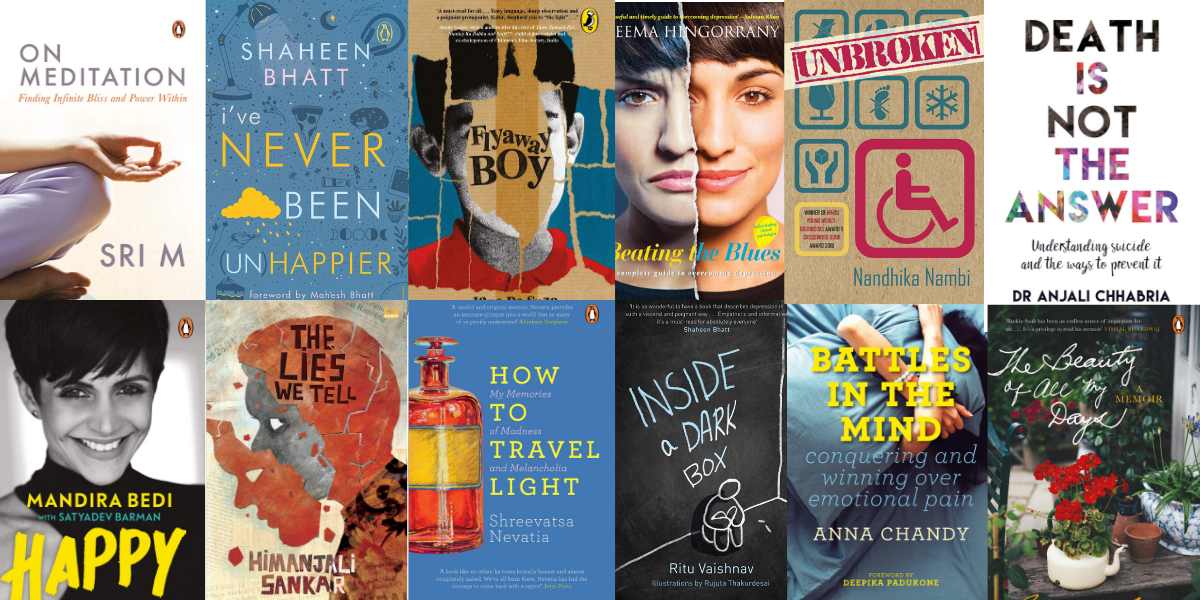
From personal stories to fictional characters that will speak to you and your struggles – scroll down below for a diverse list of books that will help you develop deep insights into your mind and your mental and spiritual health.
*
I’ve Never Been (Un)Happier by Shaheen Bhatt
I’ve Never Been (Un)Happier, Shaheen Bhatt
I don’t write about my experiences with depression to defend the legitimacy of my pain. My pain is real; it does not come to me because of my lifestyle, and it is not taken away by my lifestyle.
Unwittingly known as Alia Bhatt’s older sister and diagnosed with depression at the eighteen, this tell-all memoir is an intimate and raw look at the day-to-day experiences of living with depression.
*
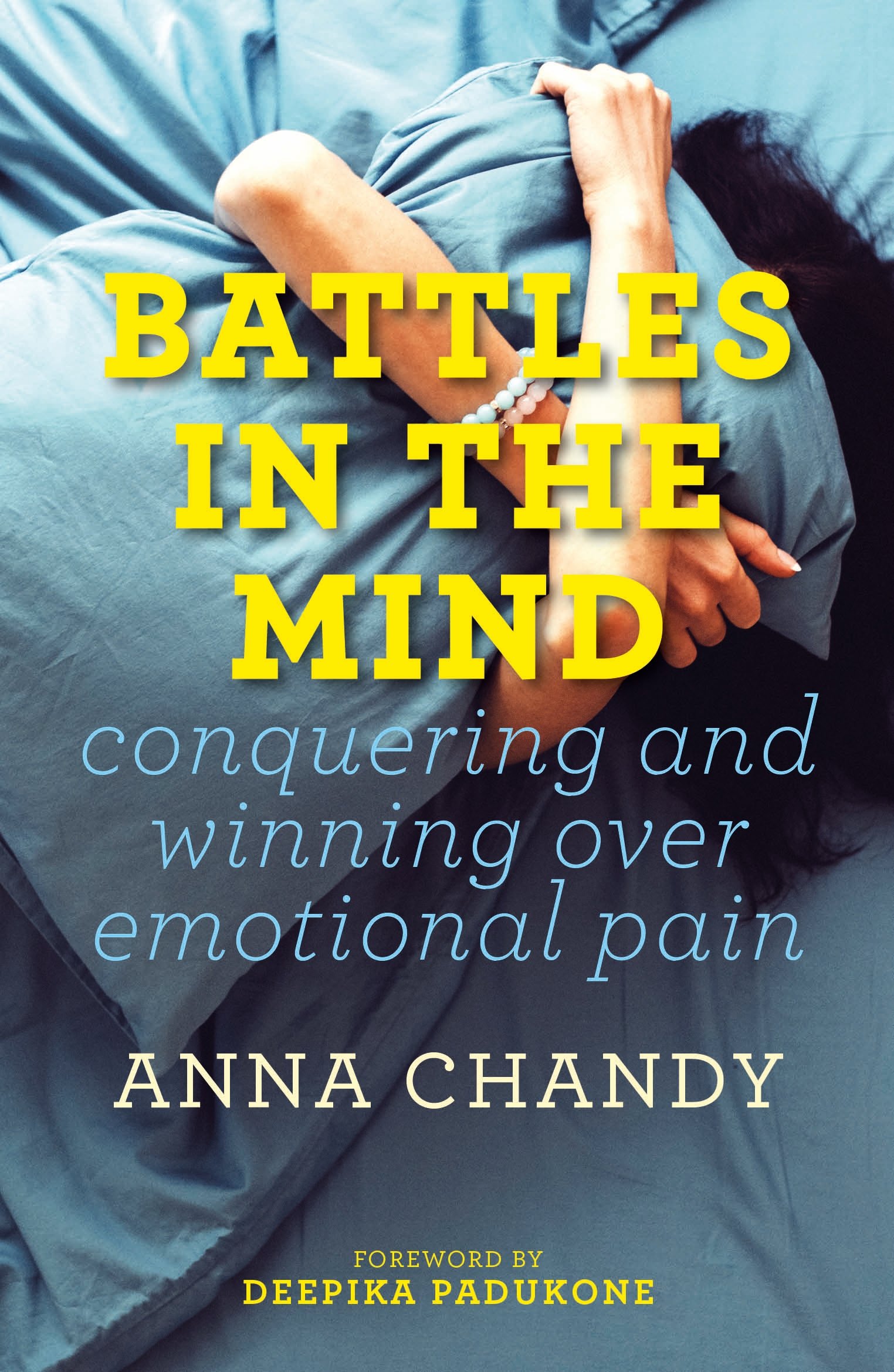
Battles of the Mind by Anna Chandy
Battles in the Mind, Anna Chandy
Our minds fight battles, trials and tribulations on a daily basis. Anna Chandy, the chair of the Live, Love, Laugh Foundation along with actress Deepika Padukone, shares here a personal story of survival through pain and lows – a story that we all can take away something from. Above all, her story teaches us to hope.
*
Death is Not the Answer by Anjali Chhabria
Death is not the Answer, Dr. Anjali Chhabria
Did you know that India is the world’s suicide capital with over 2.6 lakh cases reported every year?
From recognizing covert suicidal intentions to timely interventions – it has become more important than ever to develop insights into the minds of suicidal patients. Psychiatrist Dr. Anjali Chhabria attempts with to help thousands who are questioning the motive of their life, or dealing with grief – as well as people who have lost loved ones to suicide.
*
Beating the Blues by Seema Hingorrany
Beating the Blues, Seema Hingorrany
According to a WHO study, a mindboggling 35.9 percent of India suffers from Major Depressive Episodes (MDE). India’s leading clinical psychologist, psychotherapist, and trauma researcher Seema Hingorrany provides a comprehensive, step-by-step guide to treating depression, examining what the term really means, its signs, causes, and symptoms; and some accessible self-help techniques you can adopt to manage it in your day-to-day life.
*
On Meditation by Sri M
On Meditation, Sri M
In today’s challenging world, don’t you wish you knew how to quieten your mind and focus on yourself?
Spiritual leader Sri M breaks down the practice of meditation into a simple and easy method that any working man or woman, young or old, can practise in their everyday lives.
*
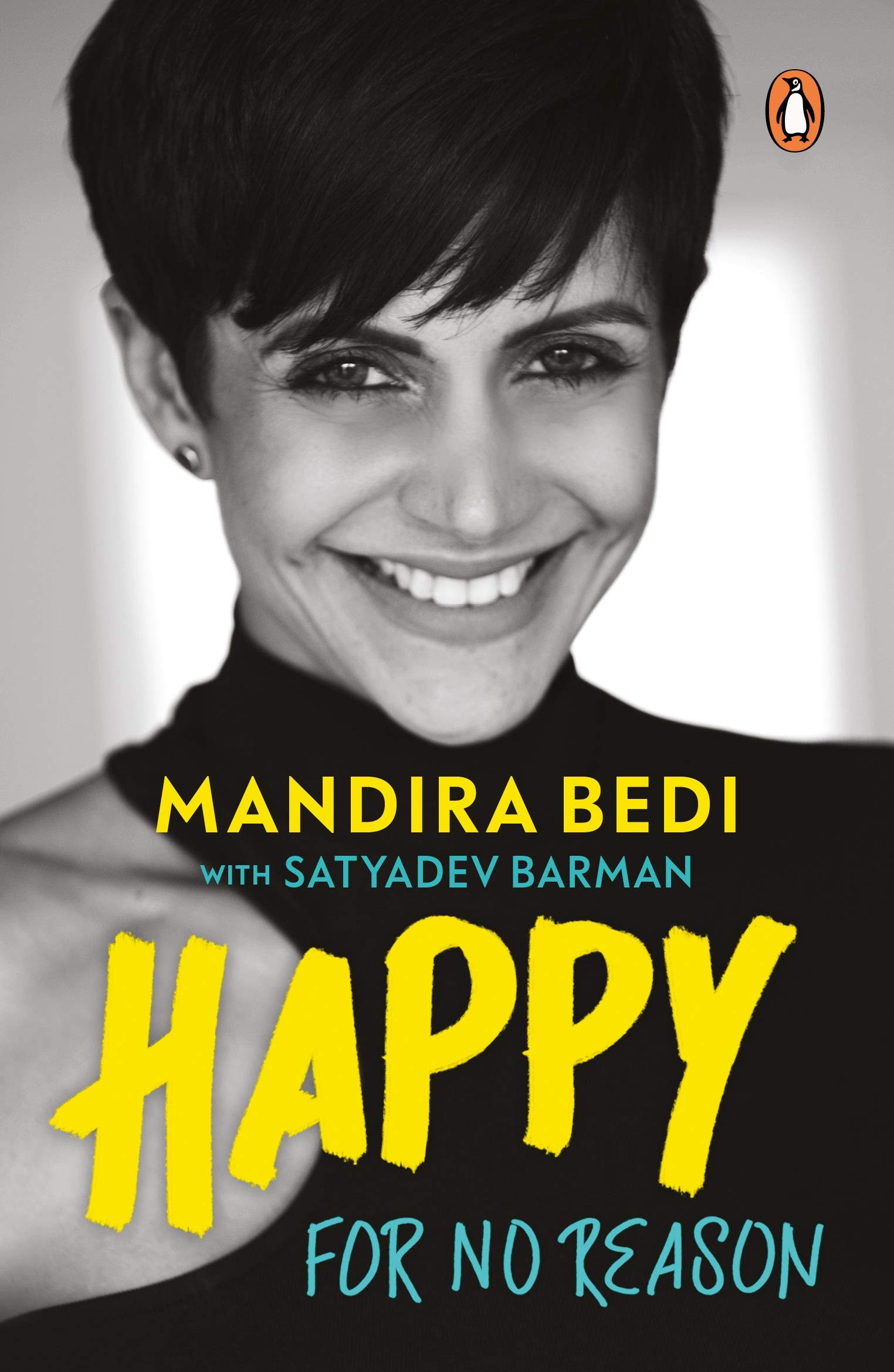
Happy for No Reason by Mandira Bedi
Happy for No Reason, Mandira Bedi
Mandira Bedi is a fitness icon. But behind the six-pack is also a snotty, complaining, can’t-get-out-of-bed-today girl who, in her own way, is still searching for true and unconditional happiness.
In her book, she invites you along on an ongoing discovery of some kind of non-scientific, non-spiritual and as-yet-non-existent formula for finding peace in everything; of how to be happy for no reason.
*
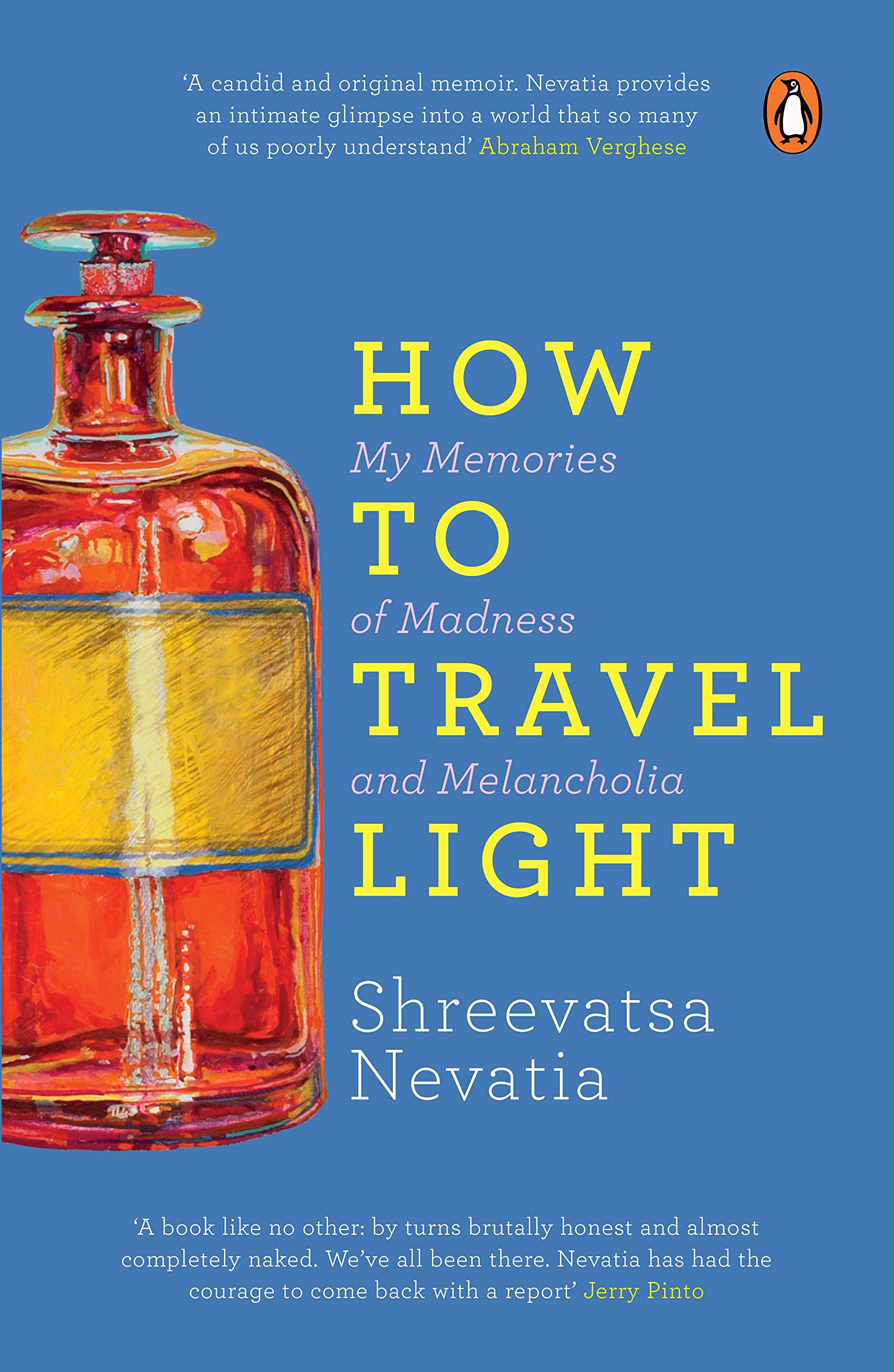
How to Travel Light by Shreevatsa Nevatia
How to Travel Light, Shreevatsa Nevatia
Diagnosed as bipolar at twenty-three, a young journalist struggles for a decade, fighting a cycle of depression, and euphoria.
In this candid, stylish journey, we visit diverse former loves and eccentric fellow sufferers; mental health institutions and Benares; his moments with Diana Eck and Deepika Padukone-and reckonings with past wounds.
*
The Beauty of Ally My Days by Ruskin Bond
The Beauty of All My Days, Ruskin Bond
‘So here I am, delving into the past like Monsieur Poirot, not to solve a mystery, but to try to understand some of the events that have helped define the sort of person I have become.’
India’s most loved storyteller embarks on a self-reflective journey alongside his readers. Each chapter of this memoir is a remembrance of times past, an attempt to resurrect a person or a period or an episode, a reflection on the unpredictability of life. Some paths lead nowhere; others lead to a spring of pure water. Take any path and hope for the best. At least it will lead you out of the shadows.
*
The Younger Ones Struggle Too
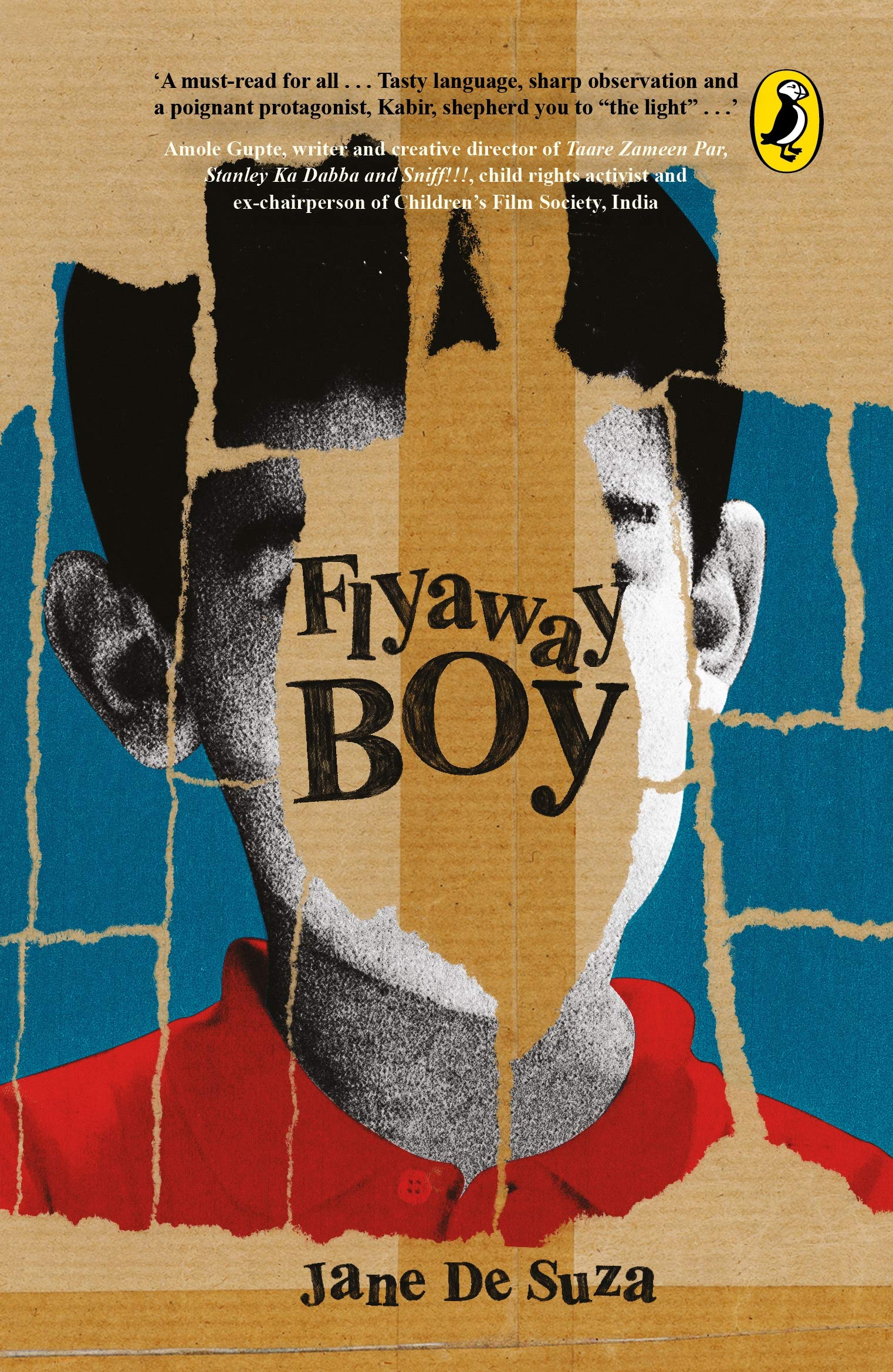
Flyaway Boy by Jane De Suza
Flyaway Boy, Jane De Suza
Spirited and powerfully imaginative, Flyaway Boy is a story about embracing everything that makes you uniquely you.
Kabir doesn’t fit in. Not in the wintry hill town, he lives in, and not in his school, where the lines are always straight. Backed into a corner with no way out, Kabir vanishes. With every adult’s nightmare now coming true, finding this flyaway boy will mean understanding who he really is.
This one is a must-read for every parent to understand, accept, and connect with their child better.
*
Inside a Dark Box by Ritu Vaishnav
Inside a Dark Box, Ritu Vaishnav
When you get trapped in darkness, finding your way out can be a long and lonely battle, especially when the war is within your own head. Here’s a peep inside a mind struggling with itself.
Powerfully illustrated and extremely accessible, Inside a Dark Box is a simple book about what depression can feel like.
*
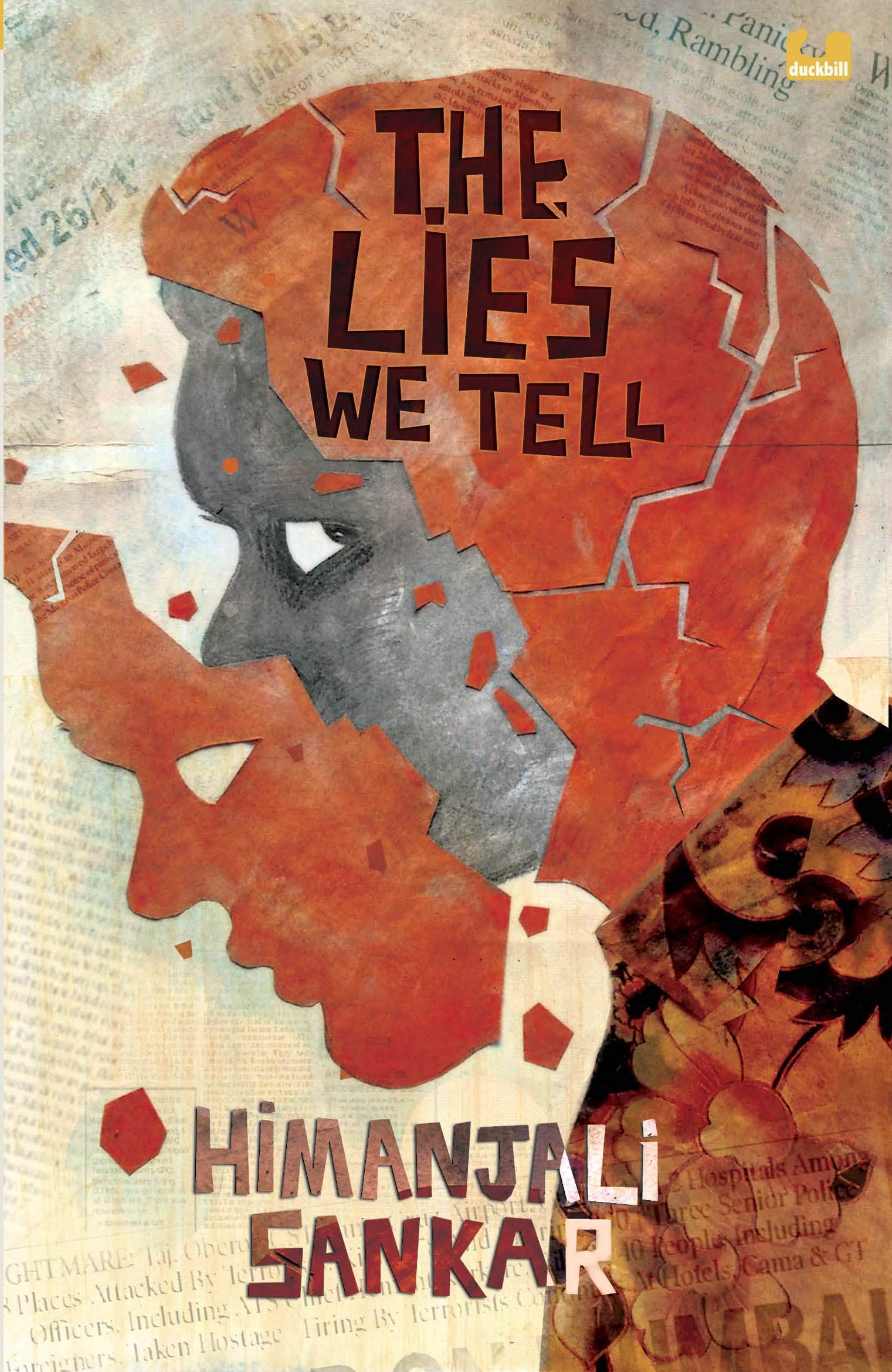
The Lies We Tell by Himanjali Sarkar
The Lies We Tell, Himanjali Sankar
Seventeen-year-old Irfan Ahmed is handsome, easy-going and deeply in love with his girlfriend, Uma. However, when Uma dumps him for his best friend, Rishi, Irfan’s life begins to unravel. Things haven’t been good at home ever since his sister left. And soon, they get worse.
when a photograph of Uma begins to circulate among their classmates, everyone suspects it’s Irfan taking his revenge on his two erstwhile best friends.
Is Irfan really going out of his mind or is there someone else out there playing games with him?
*
Unbroken by Nandhika Nambi
Unbroken, Nandhika Nambi
So okay, I’m a monster.
But look what I have to deal with–my brother is a frightened little freak, my father is selfish and ill-tempered, my mother is an ignorant doormat and my friends are just plain irritating. And I’m in a prison surrounded by them all, with nowhere to escape.
But one day, something happens … and suddenly I see what these relationships and people (however annoying) mean to me. I’ve been a monster for such a long time now, I’ve almost forgotten what it’s like to be human. Is it too late?
*
In the end, all these books and characters come together to convey a simple yet strong message – you are seen, and you are not alone. It is okay to reach out. Your mental health matters.
Team Penguin wishes you safety, health and wellbeing.