



Rakesh Mohan is the former deputy governor of the RBI. He has also served as the executive director of the IMF and secretary, Department of Economic Affairs, and Ministry of Finance. He is currently a Distinguished Fellow with Brookings India.
India underwent a major economic reform in the form of liberalization in 1991. In India Transformed, India’s top business leaders and economists come together and provide a balanced picture of the consequences of the economic reforms, initiated in 1991. They ask themselves some imperative questions: What were the reforms? What were they intended for? How have they affected the overall functioning of the economy?
Here is an exclusive excerpt from the foreword of the book, written by Strobe Talbott, the former Deputy Secretary of United States of America.
This timely, authoritative and policy-relevant volume sheds light on India’s dramatic changes over the past quarter century. That transformation has not only been a boon to the people of India, it has also contributed to the progress of the human enterprise as a whole. The world’s largest democracy is a major player on the world stage. It is certainly viewed and valued that way by my own country, the United States of America.
The economic and commercial dimension of India’s evolution is, of course, crucial. Hence, the focus of submissions in the pages that follow is political economy, financial development, trade and globalization, technology and innovation, agricultural and industrial development, and the interaction between the private and public sectors. The contributors include some of the original designers and implementers of the reform process, along with the prominent business leaders who have been the most successful builders of the economy.
There is also, thanks to the inclusion of wisdom from Shivshankar Menon, Shyam Saran and Sanjaya Baru, due attention paid to India’s foreign and security policy.
Over the course of the last half-century, I have had numerous opportunities to watch India’s evolution, first from the vantage point of a student of international relations and then for two decades as a journalist. During my eight years in government during the 1990s, I also had a chance to participate in the effort by the Indian and the US governments to put the bilateral relationship on a sounder—indeed, a transformed—footing than had been the case in the first four decades after Indian Independence. Dennis Kux captured the perception on both sides of that star-crossed backstory in the subtitle of his 1992 book, India and the United States: Estranged Democracies.
What stymied a robust bond between these two countries? After all, both had wrested their independence from British rule while adopting and adapting many of the features of British constitutional governance (minus, of course, the monarchy).
The key factor, I’ve always believed, was the Cold War.
It was approximately at the midpoint of that global schism that I first visited India forty-two years ago. I owe that enriching and informative experience to a glitch in my career as a Sovietologist.
In those days, I was a reporter for Time magazine concentrating on East–West relations and was assigned to the State Department beat. This often meant whirling around the world, coping with what seemed like a permanent case of jetlag, trying to keep up with the then secretary of state Henry Kissinger.
In October 1974, Kissinger embarked on a seven-nation diplomatic tour starting with Moscow. The Kremlin was eager to welcome the secretary of state as the personification of continuity in the US policy of détente, in the wake of Richard Nixon’s resignation and Gerald Ford’s ascension to the presidency. The Soviets, however, were not about to extend their hospitality to me. I was persona non grata because of my role in translating and editing Nikita Khrushchev’s memoirs. The material for the two volumes was surreptitiously recorded and spirited out of the country while he was under virtual house arrest, since his ouster from the leadership ten years before. The second volume, published earlier in 1974, particularly irked Foreign Minister Anatoly Gromyko, who sent a message to Kissinger’s plane over the Atlantic, denying me a visa.
After I was unceremoniously dropped off in Copenhagen during a fuelling stop, I hopscotched to New Delhi, which would be Kissinger’s second stop after Moscow.
On the personal front, my several days of free time were immensely gratifying. I made friendships that lasted for decades. I also came to know Ambassador Daniel Patrick Moynihan (whose desk officer at the State Department was none other than Dennis Kux). Moynihan’s wife, Elizabeth, took me under her wing and drove me out to—where else?—the Taj Mahal, where she was already deeply into studying the Mughal gardens.

Category: Uncategorized
Understanding Tagore’s Nationalism, An Interpretation by Ram Guha — An Excerpt
Rabindranath Tagore was born in 1861. He was the fourteenth child of Debendranath Tagore, head of the Brahmo Samaj. Their family house at Jorasanko was a hive of cultural and intellectual activity and Tagore started writing at an early age. He was a prolific writer; his works include poems, novels, plays, short stories, essays and songs. Late in his life Tagore also took up painting, exhibiting in Moscow, Berlin, Paris, London and New York. He died in 1941.
Born in Dehradun in 1958, and educated in Delhi and Calcutta, Ramachandra Guha pursued an academic career for ten years before becoming a full-time writer. He was named one of the hundred most influential intellectuals in the world by Foreign Policy and Prospect magazines.
Here’s an excerpt from the introduction of Tagore’s Nationalism written by Ram Guha.
‘Why Tagore?’ asked a brilliant young mathematician of me recently. He was referring to a newspaper column where I had spoken of Rabindranath Tagore, Mahatma Gandhi,
Jawaharlal Nehru and B.R. Ambedkar as the ‘four founders’ of modern India. ‘I can see why you singled out the other three,’ said the mathematician. ‘Gandhi led the freedom movement, Nehru nurtured the infant Indian state, Ambedkar helped write its Constitution and gave dignity to the oppressed.
But why Tagore?’ My questioner was no ordinary Indian. He comes from a family of distinguished scholars and social reformers. Like his father and grandfather before him, he had been educated at a great Western university but came back to work in India. Like them, he is well read and widely travelled, and yet deeply attached to his homeland. He fluently speaks three Indian languages. If an Indian of his sensibility had to be convinced of Tagore’s greatness (or relevance), what then of all the others?
Tagore’s reputation, within India and outside it, has suffered from his being made a parochial possession of one province, Bengal. It was in Bengali that he wrote his poems, novels, plays and songs, works that are widely read and regularly performed seven decades after his death. The poet Subhas Mukhopadhyay recalls ‘a time when the elite of Bengal fought among themselves to monopolise Tagore. They tried to seal off Tagore, cordoning him away from the [sic] hoipolloi.’ Then he adds: ‘There was another trend, serving the same purpose, but in a different way. In the name of ideology and as the sole representative of the masses, some tried to protect the proletariat from the bourgeois poet’s harmful influence!
The Bengali communists have since taken back their hostility to Tagore—now, they quote his verses and sing his lyrics with as much gusto as their (bourgeois) compatriots.
But he remains the property of his native heath alone. This geographical diminution of the man and his reputation has been commented upon by that other great world traveller and world citizen of Bengali extraction, the sitar player Ravi Shankar. In his autobiography, the musician writes that ‘being Bengali, of course, makes it natural for me to feel so moved by Tagore; but I do feel that if he had been born in the West he would now be [as] revered as Shakespeare and Goethe . . .
He is not as popular or well-known worldwide as he should be. The Vishwa Bharati are guarding everything he did too jealously, and not doing enough to let the entire world know of his greatness.’
Ravi Shankar compared Tagore to the German genius Johann Wolfgang von Goethe (1749 1832); so, before him, had the critic Buddhadeva Bose. Both men, remarked Bose, ‘participate[d] in almost everything’.Certainly, no one since Goethe worked in so many different fields and did original things in so many of them. Tagore was a poet, a novelist, a playwright, a lyricist, a composer and an artist. He had good days and bad, but at his best he was outstanding in each of these fields.
Tagore’s poems and stories are mostly set in Bengal. However, in his non-fiction, that is to say in his letters, essays, talks and polemics, he wrote extensively on the relations between the different cultures and countries of the world. Tagore, notes Humayun Kabir, ‘was the first great Indian in recent times who went out on a cultural mission for restoring contacts and establishing friendships with peoples of other countries without any immediate or specific educational, economic, political or religious aim. It is also remarkable that his cultural journeys were not confined to the western world’. He visited Europe and North America, but also Japan, China, Iran, Latin America and Indo-China.
Read the complete introduction by Ramachandra Guha in the new edition of Rabindranath Tagore’s Nationalism. Get your copy here.
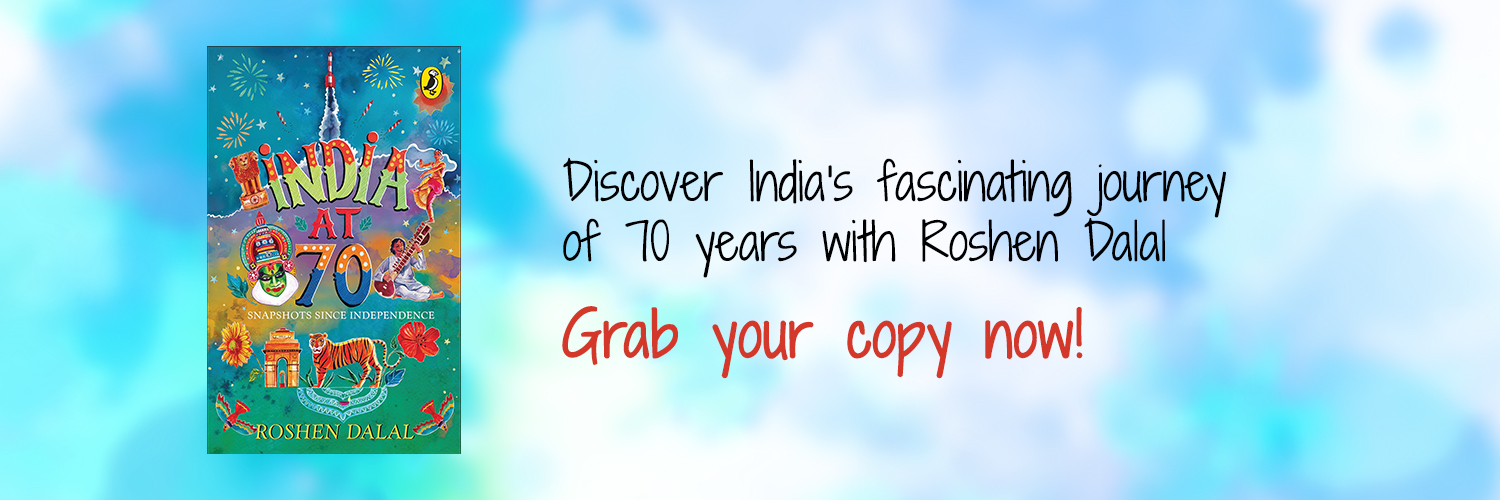
When the Journey Began: ‘India at 70’ — An Excerpt
In 2017, India’s spacecraft Mangalyaan is orbiting Mars, satellites are regularly sent into space, the economy is growing rapidly and India’s diverse art and culture is appreciated globally. And, most importantly, India is the largest democracy in the world.
The story of India as an independent nation began seventy years ago, in 1947, when the country gained independence after almost 200 years of British rule. For the first time, India became a united political entity, a nation with clearly defined boundaries. What type of country would the new India be? Would it remain united and strong?
At this time, the territory known as India consisted of eleven British provinces and some additional areas directly under British rule as well as 565 Indian states (also called princely states) where the British had overall control. The Muslim League, led by Muhammad Ali Jinnah, wanted a separate state of Pakistan, and finally it was decided that this demand would be granted. On 14 and 15 August 1947, two new nations were created, but the boundary lines between them were known only on 17 August. Pakistan was in two parts; West Pakistan was formed in the western half of Punjab while East Pakistan was created from the province of Bengal. As the lines for dividing the area were drawn on a map, districts, canals and even villages were divided.
This partition of one country into two created many problems. In the west, 10 million migrated across the new borders, and as anger arose between Muslims on one side and Hindus and Sikhs on the other, about 1 million were killed. There were other issues too, as the entire administration and all its possessions—including tables, chairs, books, musical instruments, cars, pencils and pens as well as the army, police, railways, postal services, money and other items—had to be divided.
The process of integrating the different states to form one India began before Independence. While some of the states were in the region of Pakistan, 554 states were in Indian territory. These states had different kinds of rulers. Some controlled huge areas and had vast quantities of wealth, land, buildings, money, gold, jewels, cars and elephants; others had small territories of just a few square kilometres. There were actually 425 small states. By 31 July, two types of agreements had been worked out for the Indian states to sign, by which they agreed to join India and give up some of their powers. At the time of Independence, the Constitution of India was being prepared. A constitution consists of the rules and ideas according to which a nation is governed. The Constituent Assembly, a group of people who would discuss and write India’s constitution, first met on 9 December 1946. The Constitution was ready by the end of 1949, after which India became a republic in 1950. Two years later, the first elections were held and India’s Parliament began to function. Thus, though India’s complex history dates back to the Stone Age, the year 1947 brought in great change.
This is an excerpt from the introductory chapter of Roshen Dalal’s ‘India at 70’. Get your copy here today!
8 Things You Didn’t Know About Sudeep Nagarkar
Sudeep Nagarkar is the author of eight bestselling novels, including She Swiped Right Into My Heart, It Started With A Friend Request, and All Rights Reserved For You. He is the recipient of the 2013 Youth Achievers’ Award and has been featured on the Forbes India longlist of the most influential celebrities. He also writes for television and has given guest lectures in various renowned institutes and organizations.
His latest novel, Our Story Needs No Filter is set in a socio-political milieu amidst a college campus and explores the dark side of relationships, the pursuit of power and the hypocrisy of the powerful.
Here are 8 little-known things about the bestselling author.
And as they say, the rest is history

Now you know why the stories are so relatable

More time means more books = Yay!

Aww!

That’s how he chills!

Woah!

That’s the secret behind those catchy titles!

Wow!

How many of these facts did you know about Sudeep Nagarkar? Get to know more about his new book, The Secrets We Keep here !
Why Did Gulzar Write ‘Dil Hoom Hoom Kare’ and Not ‘Dil Dhak Dhak Kare’?
“Dil hoom hoom kare” is a famous song from the film Rudaali (1993). The song beautifully captures the longing the woman feels for her lover. In the song, she describes how his love has rejuvenated her and asks him how can she hide the love which the society forbids. The sound ‘hoom hoom’ is supposed to denote the beating of the heart.
Here is why Gulzar used “hoom hoom” to denote the heartbeat against the commonly used “dhak dhak”, as told by him in the book 100 Lyrics.
The heart makes many a demand, but only one sound: ‘dhak-dhak’. Be it the heart of Madhuri Dixit, or of Shammi Kapoor. The language has kept changing with the times but the heart’s sound has always remained the same in our film songs. Particularly Hindi film songs.
Suddenly I came across this Assamese folk song where the sound the heart makes is described as ‘hoom-hoom’. I just loved it. It is much more romantic than ‘dhak-dhak’. There were some apprehensions but I insisted on using the phrase ‘hoom-hoom’ in this song, since the entire tune was based on the same Assamese folk song, only the lines changed according to the situation.
Dil hoom hoom kare (Rudaali, 1993)
Dil hoom hoom kare, ghabraaye
Ghan dham dham kare, darr jaaye
Ek boond kabhi paani ki mori ankhiyon se barsaaye
Dil hoom hoom kare, ghabraaye
Teri jhori daaroon sab sukhe paat jo aaye
Tera chhua laage, meri sukhi daar hariyaaye
Dil hoom hoom kare, ghabraaye
Jis tan ko chhua tune, us tan ko chhupaaoon
Jis man ko laage naina, voh kisko dikhaaoon
O more chandrama, teri chaandni ang jalaaye
Teri oonchi ataari maine pankh liye katwaaye
Dil hoom hoom kare, ghabraaye
Ghan dham dham kare, darr jaaye
Ek boond kabhi paani ki mori ankhiyon se barsaaye
Dil hoom hoom kare, ghabraaye…
—Gulzar
Translation:
The heart rumbles and mumbles
dark clouds of worries roar and thunder
and yet I keep yearning
for even a single drop of tears
to burst forth from my eyes
I know your touch can sprout life
in these shrivelled stumps of my existence
and in this hope I gather and preserve
all the wilted leaves of my life
Your love
that has touched my body
is difficult to hide
but your touch
that has impinged itself on my soul—
how do I bare it to you?
You are my moon, and yet
your soothing rays scorch my skin
your perch is high
and my wings freshly clipped
the heart rumbles and mumbles . . .
—Translated by Sunjoy Shekhar

Forsaken Nests —Perumal Murugan
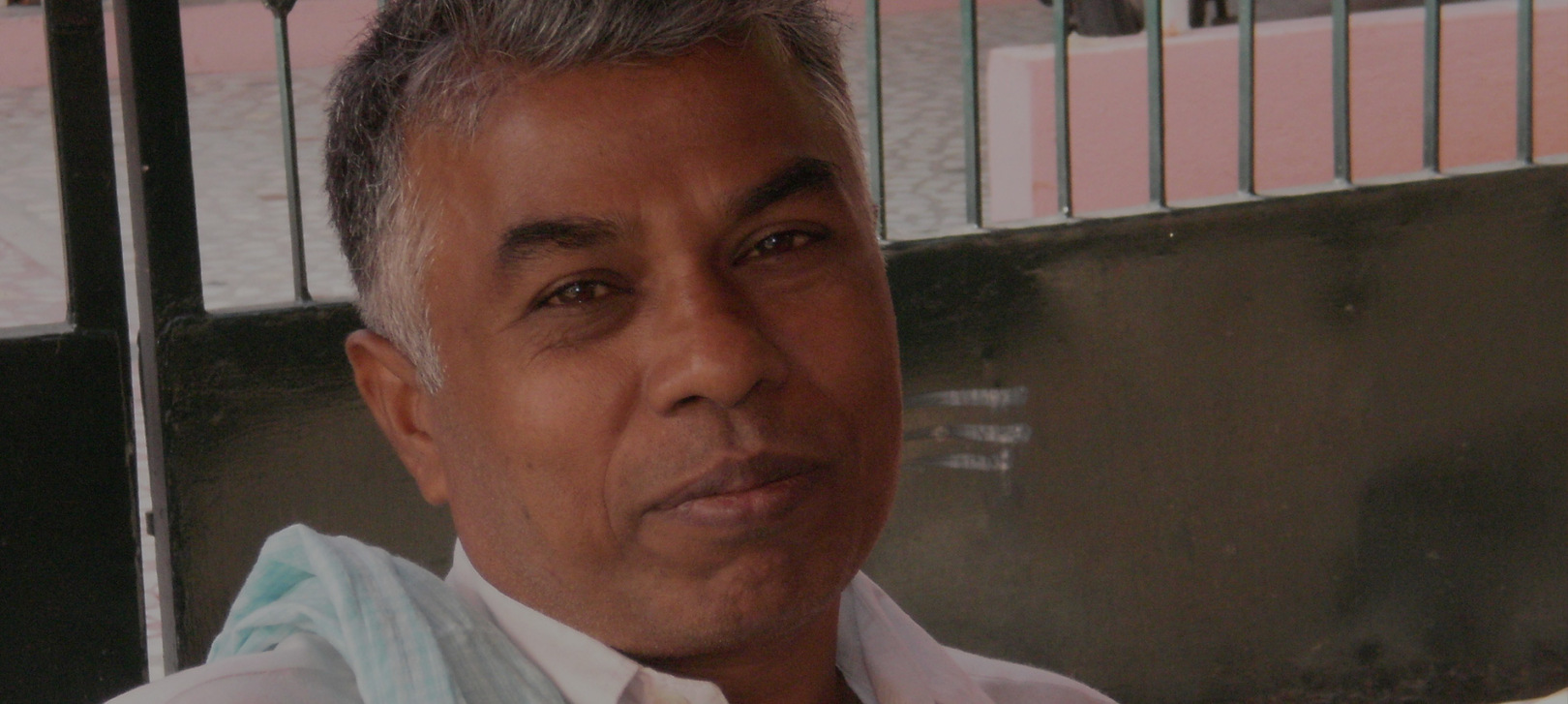
Perumal Murugan is one of the well-known names of Tamil literature. He has garnered both critical acclaim and commercial success on his writings. Many of his writings have been translated in English and have won accolades. His book ‘Seasons of the Palm’ was shortlisted for the Kiriyama Award in 2005.
Murugan, in this piece tells us what pushed him to become a writer.
My family background could not have been the reason for my becoming a writer. I was a first-generation learner. Both my parents, and their forefathers, were illiterate. After a few years of school, I taught my father how to sign. Signing, for him, meant writing his name. He would write each letter very slowly, leaving a playground of space between two letters. At first he did not know how to pronounce these letters. He took months to learn. He felt it would be beneath the dignity of his school-going sons if he were to remain an illiterate, and so he deeply desired to wipe away that shame with just his signature.
The first time he signed his name was on my report card. That day, his face shone brightly with pride. He never asked about my marks or my ranking. For him, the happiness of signing alone would suffice. My brother would forge my father’s signature, but I did not have that kind of courage. We used to call our father’s handwriting ‘hen scribbles’—like the footprints of hens that pitted the ground when they wandered about, without any discernible form or pattern. To this day, one such signature of my father’s is preserved in my tenth-standard register.
I have never had occasion to regret my being born in an illiterate family. Rather, it was an advantage. I enjoyed absolute freedom as far as my education was concerned. I was free to study; I was also free not to study. No one asked me why I studied Tamil often or told me to study mathematics instead. I alone decided the standard till which I would study. While selecting a field of study of my interest, there was no interference. Nothing can equal the joy one feels at the freedom to make one’s own decisions when young. And because I was born to unlettered parents, I enjoyed the peak of such happiness.
After completing my tenth standard, I myself decided on the branch of study I would pursue in the eleventh standard. Though I had secured more than 80 per cent in the core subjects, I opted to study Tamil literature instead of pursuing science or a technical education. My father willingly accompanied me wherever I wanted to go. If anyone asked why I wasn’t studying something else, he would simply say, ‘It’s his choice.’ This being my ‘educational background’, I cannot ascribe my interest in writing to any of my family members, including my grandparents and parents. I myself struggled and learnt to swim in the great flood. And that happiness still lingers in me today.
How the vocation of writing possessed me can be traced to my childhood. There were not many houses in the place where my family lived. Our household was just one among four on a dry, rain-fed stretch of land called ‘Mettukkaadu’. Unlike in other places, farming in the Kongu region demands more than just a few hours of work and a supervisory visit to the field once in a while. In fact, one had to struggle on the land along with the cattle, night and day. Hence families lived in single tenements on their farms. Along with our grandparents as well as two paternal uncles, we numbered four families in all, and we lived close to each other. Some other houses were also there, scattered in the distance.
I was the youngest boy among the families residing there. Those born after me were all girls. There were no playmates of my age. The difference in ages between the older boys and myself was such that I had to call them anna (elder brother) or mama (uncle). A boy playing with girls would be branded as girly and, in any case, boys looked down upon the games of girls. Hence I had to invent games and play them all by myself. I had to imagine playing and conversing with many people, and I even role-played those other people. I had a lot of uninhabited open space at my disposal. Otherwise I would withdraw into myself like a snail if anyone came near me. I barely spoke in public. I was very quiet, a good boy who did not know of mischief.
But in my lonely private terrain I was an adventurer doing all kinds of things. A circular rock in the middle of the farmlands became my regular playground. When the crops stood high and tall around me, I grew more enthusiastic about my private world. For instance, I very much liked the oyilattom—a folk dance staged during temple festivals. Of course, in the middle of a crowd, my body would freeze up; no force could loosen it. But it would become elastic once I reached the rock. The little sparrows living amid the millet crops and the big birds in the sky would move away, either in awe or in fear. However, one day, while I was dancing in my haven, a tree-climber scaling a palm tree in the vicinity happened to witness my antics. In no time he spread the word about my dancing. After that, I could not show my face in public. From then on, the rock was abandoned. That is just how bashful I was.
An unbridgeable solitude and the fictional world that I created in my private space together have propelled me towards writing. Apart from my textbooks, the magazine Rani was the only book that I got hold of by chance. ‘Kurangu Kusala’ and the children’s segment were the sections I really enjoyed. I started composing verses in line with those in the children’s segment. I sent those songs—rhyming ‘Little, little cat; beautiful cat’—to a radio station a few years later. Most of them found a place in the programme Manimalar broadcast by the Trichy Radio Station. The station would not announce in advance whose songs would be aired so I could never be sure whether my rhymes would be broadcast. And if they were aired, I had no one to share the news with. I did not reveal any of this to others for fear of being ridiculed. But these broadcasts boosted my confidence and eventually helped kindle my desire to publish.
I also had a habit of writing long stories modelled on the children’s series ‘The Secret of the Magical Mountain’ and ‘The Princess of the Hill Country’ that were published in Rani. Tunnels figured prominently in my stories. I loved the image of a shy, fearful person walking through dark tunnels all alone. I would imagine a variety of tunnels; myriad figures would appear as stumbling blocks on the way; those things were dear to my heart.
This was how I came into the world of writing. Even at a young age I could perceive writing to be a way of expressing myself. Still, I have been known as a writer in public only these twenty-five years. If I were to count my published works, there are ten novels, four collections of short stories and four anthologies of poetry. I have compiled a dictionary on the local dialect. Some collections of essays have been published; some others compiled. If all my essays get compiled, then there might be some more books.
One who journeys through my works may happen to identify certain common features. I think most of these would relate to my childhood attitude. When I take a step back and view my work from a distance, I discern that by presenting an observation that has occurred to me, perhaps I could give readers an idea of my childhood. For instance, references to the house are made here and there in my works. But the reader cannot reconstruct the house out of these references. My works don’t have elaborate descriptions of the house, nor are the house and its parts at the centre of the scheme of things. All that my writings needed was the expansive open space. The house as an entity is not suited to fill in the open space. Rather, the house could be seen as an eyesore troubling that space. This attitude can be seen at its peak in my novel Koolamadhari, where the expanse is all pervasive. My childhood idea of the house was only that of a granary—used to store the grains for a year’s requirements. Cooking and sleeping were done outside the house. Even the stove used to be outside the house. A portable charcoal oven was used for cooking during the rainy season. Sleeping took place either in the yard or in the goat pens and the mangers. Though I have become accustomed to the middle class way of life, to this day, I like the open space the most.
Birds do not inhabit nests. They build nests, out of necessity, during the reproductive season. They require the protection of the nests for laying and hatching their eggs and till the nestlings spread their wings to fly. Then the nests are abandoned—forsaken on the trees, fallen on the stones, empty holes left behind after the chicks have grown up. I feel as though my childhood dispositions lie embedded in me in the form of such deserted nests. And it feels right to say that my works encompass such nests.
Translated by: V. Premkumar
Get copies of Seasons Of the Palm, Current Show, and Pyre here.

13 Reasons Why You Should Read ‘13 Reasons Why’
After the phenomenal success of the Netflix-original series ‘13 Reasons Why’, it’s more of a reason now that you read the best-selling book 13 Reasons Why by Jay Asher. One could state 50 reasons as to why it’s important to read 13 reasons Why, however, here are 13 reasons why you shouldn’t give this book a miss.
13 Reasons Why talks about the relevant issue of high-school bullying. It opens an important, yet often neglected conversation on this subject.

The book’s central theme of suicide and mental health are explored and dealt with sensitivity. It starts a dialogue about how to identify signs of suicidal tendencies in a person and the importance of reaching out to sufferers during such situations.

The book lays emphasis on being more empathetic towards someone feeling troubled. It speaks about how one’s actions might have desolate effects on someone else even if they seem harmless.

13 Reasons Why talks about sexual harassment of all sorts – it gives an insight into how sexual abuse is not only of the physical kind but can be perpetrated through words and other ostensibly benign actions.

It starts a dialogue about important subjects such as body shaming and objectification – actions that are known to have debilitating impacts on individuals.

The story states the absolute non-negotiable nature of sexual consent of any kind.

It talks about voyeurism – the implications of how intruding into someone’s private space gives rise to paranoia and anxiety that have the potential to snowball into something bigger in future.

The novel seeks to de-stigmatise mental health issues. Through its pages, it explores the idea of opening friendlier, safer and newer spaces to discuss such issues without the fear of being judged.

How silent spectatorship or ‘fence-sitting’ in a situation might lead to unpleasant consequences – characters in 13 Reasons Why establish in more ways than one as to how important it is to speak up when required.

13 Reasons Why sheds light on the struggle of sexual abuse survivors trying to confide in someone and coming out in the open about their trauma.

It alerts parents, guardians, teachers, counsellors and the entire social ecosystem of mental health issues and the role they play in an individual’s life.

The book, through its characters, speaks of the significance of seeking help in case one feels like they are stuck in a helpless situation.

And finally, the book opens the much-needed doors to the possibility that ending one’s life during such dark phases is not the ultimate solution.

Do you feel there are the more reasons to read 13 Reasons Why? Tell us!

‘A Life of Adventure and Delight’: An Excerpt
Akhil Sharma’s works have been hailed as being “as hypnotic as those found in the pages of Dostoevsky” and a “glowing work of art” by leading publications in the world. In his new collection of short stories, ‘A Life of Adventure and Delight’, Sharma weaves eight unpredictable tales of the volatile human heart.
Here’s an excerpt from the book.
Late one June afternoon, seven months after my wedding, I woke from a short, deep sleep, in love with my husband. I did not know then, lying in bed and looking out the window at the line of gray clouds, that my love would last only a few hours and that I would never again care for Rajinder with the same urgency—never again in the five homes we would share and through the two daughters and one son we would also share, though unevenly and with great bitterness. I did not know this then, suddenly awake and only twenty-six, with a husband not much older, nor did I know that the memory of the coming hours would periodically overwhelm me throughout my life.
We were living in a small flat on the roof of a three-story house in Defense Colony, in New Delhi. Rajinder had signed the lease a week before our wedding. Two days after we married, he took me to the flat. I had thought I would be frightened entering my new home for the first time, but I was not. I felt very still that morning, watching Rajinder in his gray sweater bend over and open the padlock. Although it was cold, I wore only a pink silk sari and blouse, because I knew that my thick eyebrows, broad nose, and thin lips made me homely, and to win his love I must try especially hard to be appealing, even though I did not want to be.
The sun filled the living room through a window that took up half a wall and looked out onto the concrete roof. Rajinder went in first, holding the heavy brass padlock in his right hand. In the center of the room was a low plywood table with a thistle broom on top, and in a corner three plastic folding chairs lay collapsed on the floor. I followed a few steps behind Rajinder. The room was a white rectangle. Looking at it, I felt nothing. I saw the table and broom, the window grille with its drooping iron flowers, the dust in which we left our footprints, and I thought I should be feeling something, some anxiety, or fear, or curiosity. Perhaps even joy.
“We can put the TV there,” Rajinder said softly, standing before the window and pointing to the right corner of the living room. He was slightly overweight and wore sweaters that were a bit large for him. They made him appear humble, a small man aware of his smallness. The thick black frames of his glasses, his old-fashioned mustache, as thin as a scratch, and the fading hairline created an impression of thoughtfulness. “The sofa before the window.” At that moment, and often that day, I would think of myself with his smallness forever, bearing his children, going where he went, having to open always to his touch, and whatever I was looking at would begin to waver, and I would want to run. Run down the curving dark stairs, fast, fast, through the colony’s narrow streets, with my sandals loud and alone, until I got to the bus stand and the 52 came, and then at the ice factory I would change to the 10, and finally I would climb the wooden steps to my parents’ flat and the door would be open and no one would have noticed that I had gone with some small man.
I followed Rajinder into the bedroom, and the terror was gone, an open door now shut, and again I felt nothing, as if I were marble inside. The two rooms were exactly alike, except the bedroom was empty. “And there, the bed,” Rajinder said, placing it with a slight wave of his hand against the wall across from the window. He spoke slowly and firmly, as if he were describing what was already there. “The fridge we can put right there,” at the foot of the bed. Both were part of my dowry. Whenever he looked at me, I either said yes or nodded my head in agreement. We went outside and he showed me the kitchen and the bathroom, which were connected to the flat but could be entered only through doors opening onto the roof.
From the roof, a little after eleven, I watched Rajinder drive away on his scooter. He was going to my parents’ flat in the Old Vegetable Market, where my dowry and our wedding gifts were stored. I had nothing to do while he was gone, so I wandered in and out of the flat and around the roof. Defense Colony was Raj composed of rows of pale two- or three-story buildings. A small park, edged with eucalyptus trees, was behind our house.
Rajinder returned two hours later with his elder brother, Ashok, and a yellow van. It took three trips to bring the TV, the sofa, the fridge, the mixer, the steel plates, and my clothes. Each time they left, I wanted them never to return. Whenever they pulled up outside, Ashok pressed the horn, which played “Jingle Bells.” I was frightened by Ashok, because, with his handlebar mustache and muscular forearms, he reminded me of my father’s brothers, who, my mother claimed, beat their wives. Listening to his curses drift out of the stairwell each time he bumped against a wall while maneuvering the sofa, TV, and fridge up the stairs, I felt ashamed, as if he were cursing the dowry and, through it, me.
On the first trip they brought back two suitcases that my mother had packed with my clothes. I was cold, and when they left, I changed in the bedroom. My hands were trembling by then, and each time I swallowed, I felt a sharp pain in my throat that made my eyes water. Standing there in the room gray with dust, the light like cold, clear water, I felt sad and lonely and excited at being naked in an empty room in a place where no one knew me. I put on a salwar kameez, but even completely covered by the big shirt and pants, I was cold. I added a sweater and socks, but the cold had slipped under my skin and lingered beneath my fingernails.
Rajinder did not appear to notice I had changed. I swept the rooms while the men were gone, and stacked the kitchen shelves with the steel plates, saucers, and spoons that had come as gifts.
Get your copy of Akhil Sharma’s delightful new book here!

5 Reasons You Should Read Vikrant Khanna’s Latest Book
The Girl Who Knew Too Much is about a thirteen-year-old girl who hears about the miraculous reunion of a young woman and her dead boyfriend.
Here are 5 reasons The Girl Who Knew Too Much is your next read.
Vikrant Khanna is also the best-selling author of When Life Tricked Me and Love Lasts Forever.

It is a story about love and loss.

It is the story of hope.

Life goes on even after death.

Vikrant Khanna’s imagination of Yamaraj is pretty cool. He even calls the protagonist ‘bro’.

Ready to get your hands on the book? Tell us which part did you like the most.

The Making of Pressler Amendment— An Excerpt
As chairman of the US Senate’s Arms Control Subcommittee, Larry Pressler advocated the now-famous Pressler Amendment, enforced in 1990 when President George H.W. Bush could not certify that Pakistan was not developing a nuclear weapon. Larry Pressler was adjudged a hero in India and a ‘devil’ in Pakistan due to his stance on giving military aid to Pakistan. In his book ‘Neighbours in Arms’ Pressler provides a comprehensive account of how US foreign policy in the subcontinent was formed from 1974 till today and ends with recommendations of a new US-India alliance that could be a model for American allies in future.
Here’s an exclusive excerpt from the book.
In December 1981, a new section was added to the 1961 Foreign Assistance Act. It allowed the President to exempt Pakistan from the original Symington Amendment ‘if he determines that to do so is in the national interest of the United States’. (It is important to note that Pakistan was the only nation specifically exempted by name from these restrictions.) Almost immediately, Congress also authorized a six-year $3.2-billion package of military and economic assistance to Pakistan. I was opposed to this move, as I knew it would further encourage Pakistan to continue the development of their nuclear weapons programme.
Many of us in Congress knew that we could not trust President Zia to be honest with us about his nuclear ambitions. Everyone knew that Pakistan was continuing to acquire material and technology
to develop a bomb. Despite this fact, the Reagan administration wanted a new law that would give him a permanent waiver from the Glenn–Symington Amendment. At the time, guaranteeing Pakistan’s assistance in the fight against the Soviets in Afghanistan was more important than stopping Pakistan’s acquisition of nuclear weapons technology. The only way the administration could get Congress to go along with this permanent waiver was to include language in a new law that would punish Pakistan if it was determined that Pakistan actually possessed a nuclear weapon. This made the Glenn–Symington waiver more politically feasible to those of us in Congress who were working hard on non-proliferation issues. I was tapped to carry the ball and the Pressler Amendment was born.
My goal was to give this new amendment as much ‘teeth’ as possible. On 24 March 1984, the Senate Committee on Foreign Relations introduced an amendment offered up by California Democratic senator Alan Cranston and Senator Glenn. This first amendment stipulated that ‘no military equipment or technology shall be sold or transferred to Pakistan’ unless the President could
first certify that Pakistan did not possess nor was developing a nuclear explosive device, and that it was not acquiring products to make a nuclear explosive device. On 18 April 1984, the committee instead introduced a substitute offered by me, Maryland Republican senator Charles Mathias and Senator Charles Percy.
My former staff member, the late Dr Doug Miller, recalled that Senator Cranston’s face appeared ‘crestfallen’ when his amendment did not pass. In retrospect, while Cranston’s amendment and my
subsequent amendment were very similar, I feel his amendment would have cut off aid to Pakistan sooner. But the Republican Party was in control at the time. They wanted a Republican name on the
amendment.
The revised amendment offered by Senators Mathias, Percy and me instead tightly tied the continuation of aid and military sales to two presidential certification conditions: (1) that Pakistan did not possess a nuclear explosive device; and (2) that new aid ‘will reduce significantly the risk’ that Pakistan would possess such a device. This text was further revised with a provision offered by me, Senator Mathias and Minnesota Republican senator Rudy Boschwitz that the ‘proposed U.S. assistance [to Pakistan] will reduce significantly the risk of Pakistan possessing such a [nuclear] device’. It forced the President to affirm that increased aid was reducing the risk of Pakistan
getting nuclear weapons. I thought at the time that this was going to be impossible for any President to certify—based on Pakistan’s past behaviour and what President Reagan had assured me he would do.
The final text of Section 620E of the Foreign Assistance Act of 1961 read:
No assistance shall be furnished to Pakistan and no military equipment or technology shall be sold or transferred to Pakistan, pursuant to the authorities contained in this Act or any other Act,
unless the President shall have certified in writing to the Speaker of the House of Representatives and the chairman of the Committee on Foreign Relations of the Senate, during the fiscal year in which assistance is to be furnished or military equipment or technology is to be sold or transferred, that Pakistan does not possess a nuclear explosive device and that the proposed United States assistance program will reduce significantly the risk that Pakistan will possess a nuclear explosive device.
This text, which was signed into law by President Reagan on 8 August 1985, soon became known as the ‘Pressler Amendment’, even though I was not the only sponsor. I never referred to it as the Pressler Amendment. But when President George H.W. Bush later enforced it, the Pentagon wrote a series of worldwide memos and briefings explaining that Bush had to act in such a way towards Pakistan because of ‘Senator Pressler’s amendment’, mentioning me by name and making the amendment eponymous. It is important to understand that this legislation was passed at the request of and with the support of the Reagan administration. That is why I was so astounded when later Reagan never enforced it.
In summary, it made a law out of what had already been an official policy: our conventional arms assistance and financial aid to Pakistan would reduce the risk of nuclear proliferation. It used the power of the purse. It allowed us to pursue our communism-containment goals in the region, but it was also intended to force our leaders to proactively assert—on the record—that Pakistan was not making progress on its nuclear goals. Again, this policy seems counter-intuitive and, unfortunately, it had the opposite effect on Pakistan. And, with the help of the Octopus, Pakistan took our aid and flagrantly ignored the Pressler Amendment restrictions.
