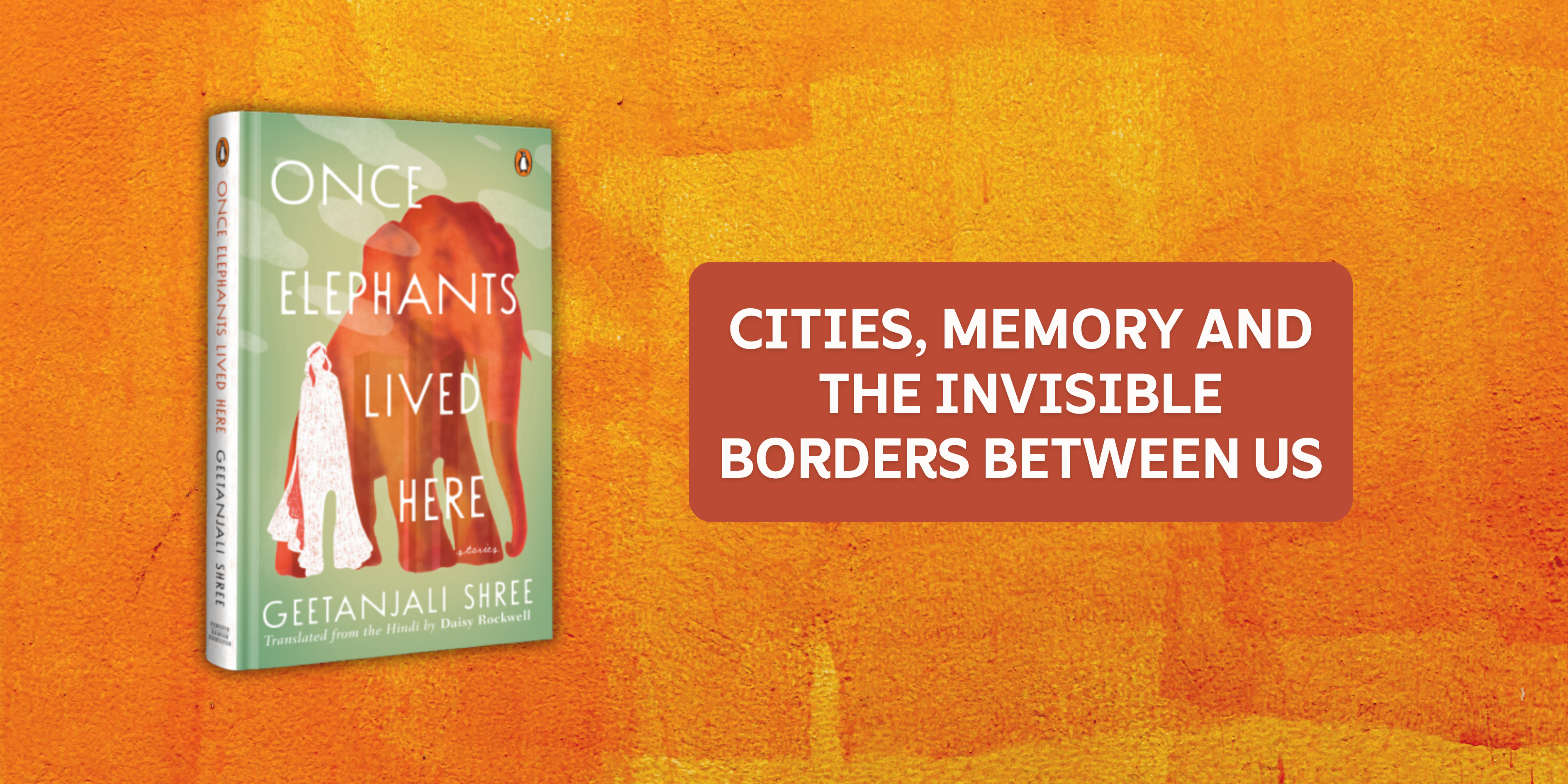
In Once Elephants Lived Here, International Booker Prize-winning author Geetanjali Shree transforms the familiar into the uncanny, using language that is lyrical, satirical, and deeply political to challenge everything we expect from a short story.
***
The riots made this city famous. Well, not the riots themselves but the glitter and glamour that most definitely resulted from the riots. Had the city not been so jammed and jumbled, chaos would not have broken out. And if chaos hadn’t broken out, there would never have been such a clean-up. The factions were divided so neatly the city shone. One faction this side of the river, one that side, and each clearly recognizable in its place. As though factories had been built on either side to manufacture each faction’s particular costumes and masks, and absolutely everyone appeared only in their respective attire. Everyone wore their assigned uniform, and everyone wore the same mask. This side wore theirs, that side wore theirs.
The outcome of this clear division was that you found yourself well protected in this city, surrounded for a great distance by your own kind. The sort of protection you feel in your own home, amongst your own pots and pans, your own familiar things. You’re pleased as you look around and see your own trees, your own fruits and vegetables, your own shit. And why wouldn’t you be? Your eyes ears nose are familiar with their fragrance and appearance, they go down easy, they slip softly over your skin.
It is certainly the case that if, due to error, or clueless bravado, or a moment of sleepwalking, you set out towards the other side, then oh my God and mercy me, this city will surely show you how tangible the feeling of vulnerability can be—how complete and how pure! Nothing penetrates it, no cloud looms over it, no smoke obscures it. Clean, pure, blank, complete, this amazing feeling of vulnerability, which will befall any traveller who might stray, changing his state and form in such a way that he’ll get goosebumps all over, his hair will jump in terror towards the sky, his eyes will roll back until they see not ahead but behind, and his gait will be divided in two as though by a knife: the upper half, a father, frightened and running; the lower half, a child, lethargic, dangling from the father’s finger, limping backwards.
But you’d only stray like this if you had a habit of sleepwalking. Generally, this city has never been afflicted with that ailment, its people crisply brisk. Yes, some foreigners do indeed visit both here and there, but their case is unique.
Unique, and linked to another of the city’s specialties. That is, the great haste with which this city has not only adopted the look of Shanghai but gone on to give it a run for its money.
What this run consists of is that all the old Sultanate and Mughal-era buildings, as well as all types of domestic-style and foreign-style vine-carved buildings are being demolished, and from their ruins have arisen blue glass-walled buildings, taller and taller still, that contain homes, offices, shopping malls, computers, escalators, fountains, hamburgers and trees that aren’t really trees. And there are roofs that slice the sky into match-thin slivers and quantities of foreigners both domestic and imported. Confounding the clean division of the city, just a bit.
This in itself is a wonder. Since it does seem that these foreign people have descended from the sky to climb down into these blue buildings, and the people below have burst from the earth, and that these, too, are two distinct streams, through which the city is becoming new-old. But it’s as though a no man’s land surrounds them, so there’s no infiltration either from here or from there, and the two streams never collide, nor tangle, nor tussle. As though they too have a joint agreement to exist separately.
So, one crop with roots in the ground, another whose soil is the sky. Each in its own way is making the city a bazaar with its respective products, and Shanghai, peering over the malls and the multinationals and this and that side of the river, and taking in everything all together, is alarmed: Until now, there was only me! Who is this surpassing me? My God, woe is me, will their name be in the Guinness Book now? And then all the foreigners will want to go to them instead of coming to me?
There was already talk that this city would now be counted among the most beautiful in the world; global estimates were projecting such outcomes.
How could it be that foreigners would not flock to such a city? Sightseers came, businesspeople came. Foreign foreigners came and desi foreigners as well. In corporate, ironed uniforms. The foreign foreigners had: pale eyes, pale hair, pale skin; the desi foreigners had: hybrid dress, hybrid diets, hybrid lifestyles, hybrid languages.