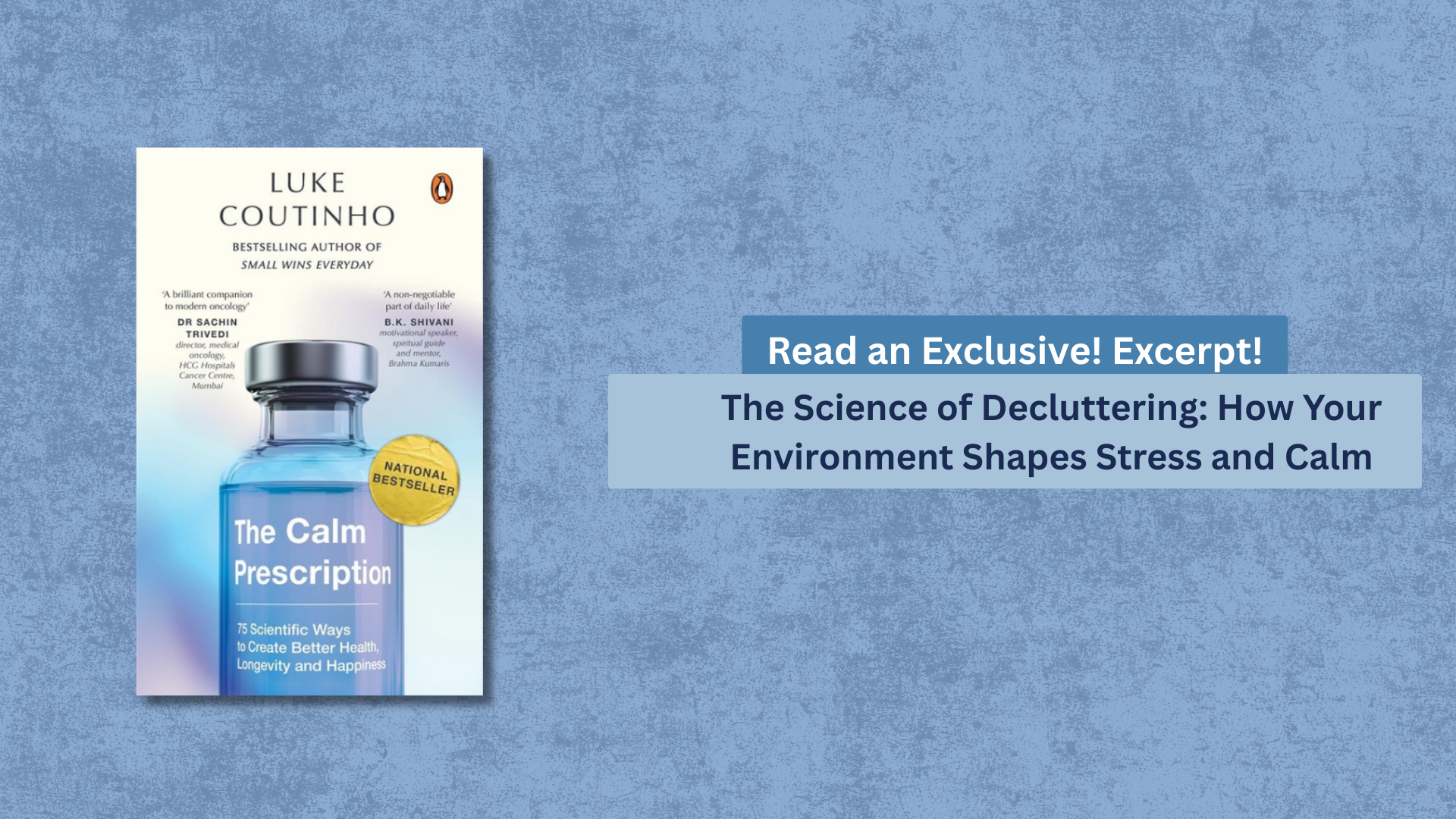
Can clearing a drawer really calm your nervous system? In this excerpt from The Calm Prescription by Luke Coutinho, discover how decluttering can lower stress and bring balance to your life.
Decluttering Your Space
Have you ever noticed how you feel when you walk into a clean, organized room as opposed to one filled with clutter? That sense of calm you experience in a tidy space is more than just an aesthetic preference; it’s a reflection of how our environment affects our nervous system. Clutter doesn’t just crowd our physical space—it can create mental chaos, triggering a stress response in our body.
The Accumulation of Clutter: Why We Hoard and Its Hidden Costs
It’s easy to accumulate things—clothes, gadgets, papers and trinkets—that we think we might need someday. These items often end up forgotten, collecting dust and taking up space. While buying new things isn’t inherently problematic, issues arise when we don’t let go of the old to make room for the new. Over time, our drawers, closets and shelves overflow with items that no longer serve a purpose but still demand our attention.
This clutter can be seen as ‘dead energy’—objects that no longer contribute to our lives but occupy mental and emotional space. Research shows that living in cluttered environments can lead to feelings of overwhelm and contribute to stress. Clutter acts as a constant visual reminder of unfinished tasks and decisions, which can become a source of anxiety, gradually overloading our nervous system. In fact, studies published on PubMed and by NCBI have found that individuals living in disorganized environments often experience higher levels of cortisol, a stress hormone known to activate the sympathetic nervous system.
How Clutter Affects Our Nervous System
The human brain constantly processes information from its environment. In a cluttered space, this influx of visual stimuli creates a form of sensory overload, requiring our brain to work harder to focus on tasks. Our attention becomes scattered, our ability to process information is compromised and we may experience mental fatigue. This phenomenon is supported by research from the Princeton Neuroscience Institute, which found that clutter competes for our attention, reducing performance and increasing stress.
When our surroundings are chaotic, our nervous system can shift into a sympathetic mode, releasing stress hormones that increase alertness, heart rate and muscle tension. Decluttering, on the other hand, allows us to shift back to the parasympathetic mode, promoting relaxation, better focus and overall well-being.
Decluttering is more than just cleaning up; it’s a practice of mindfulness that has physical and psychological benefits. Studies reveal that reducing clutter can alleviate symptoms of depression, anxiety and stress, as well as improve mood and cognition. The process of sorting and organizing can also be therapeutic. As we decide which items to keep and which to let go, we engage in reflection, acknowledging the emotional attachments we may have with certain objects. This can help us confront and release past memories, leading to emotional catharsis and growth.
Furthermore, the physical act of decluttering promotes mindful engagement with our environment. By focusing on one task at a time—whether organizing a drawer or clearing off a surface—we create space not only physically but mentally as well. This reduction in sensory input allows our brain to function more optimally, thereby reducing stress and improving our ability to concentrate.
Experts in psychology and neuroscience have noted the powerful effects of decluttering on our mental and emotional well-being. Dr Sherrie Bourg Carter, a psychologist who specializes in stress management, highlights that ‘clutter bombards our minds with excessive stimuli, causing our senses to work overtime on stimuli that aren’t necessary or important.’ This overload, she explains, ‘can lead to increased stress and difficulty focusing.’ Meanwhile, Dr Darby Saxbe, an expert on home psychology, has pointed out that ‘our homes are extensions of ourselves, and a cluttered home can create a cluttered mind, reflecting unresolved issues in our emotional lives.’
Marie Kondo, a well-known organizational consultant, also emphasizes that the process of decluttering can build joy and inner peace. By keeping only the items that ‘spark joy,’ Kondo suggests that we cultivate an environment that reflects our true selves, thus minimizing stress and bringing harmony into our lives.
Environment and Emotion: The Impact of Space on Mood and Behaviour
Our physical surroundings directly affect our emotional states. Studies show that organized environments contribute to positive emotions, while cluttered spaces are linked to negative feelings like frustration, guilt and even depression. This response can be attributed to how our brain interprets our surroundings. A clean, orderly space promotes a sense of control and stability, whereas cluttered spaces often create feelings of chaos and unpredictability.
Imagine stepping into a room filled with disorganized stacks of papers, clothing scattered around and dishes left unwashed. Compare that experience to walking into a clean, organized room where everything has its place. The latter instantly feels more calming and inviting, allowing the nervous system to settle. This soothing effect is not only psychological but physiological as well—an uncluttered environment can help lower blood pressure and slow heart rate, all of which engage the parasympathetic nervous system.
Decluttering doesn’t have to be an overwhelming task. Start small, with one drawer or a single surface. Consider this an ongoing practice rather than a one-time event. Here are a few tips to help you incorporate mindful decluttering into your life:
1. Start with a purpose: Identify why you want to declutter. Are you looking to reduce stress, improve focus or simply create more space for the things you love? Defining a purpose helps make the process intentional.
2. Work in small steps: Begin with a manageable area—a drawer, a shelf or your workspace. Small successes build momentum and make larger projects feel achievable.
3. Sort into categories: Use categories, like ‘keep’, ‘donate’ and ‘discard’, to streamline your process.
4. Consider each item’s purpose: Reflect on whether each item serves a current purpose or brings you joy. Letting go of items that no longer serve you can be liberating.
5. Practise gratitude: As you declutter, practise gratitude for the items you choose to keep and for the opportunity to create a more peaceful space. 6. Maintain the routine: Regularly set aside time to tidy and organize. Decluttering doesn’t have to be an exhausting event; it can be a calming routine that brings ongoing peace.
When we let go of things that no longer serve us, we make room for clarity, focus and growth. So, the next time you feel overwhelmed or stuck, look around your space. Decluttering may be the key to unlocking a calmer mind and a more balanced nervous system.
***
Get your copy of Rhythmic Parenting on Amazon or wherever books are sold.