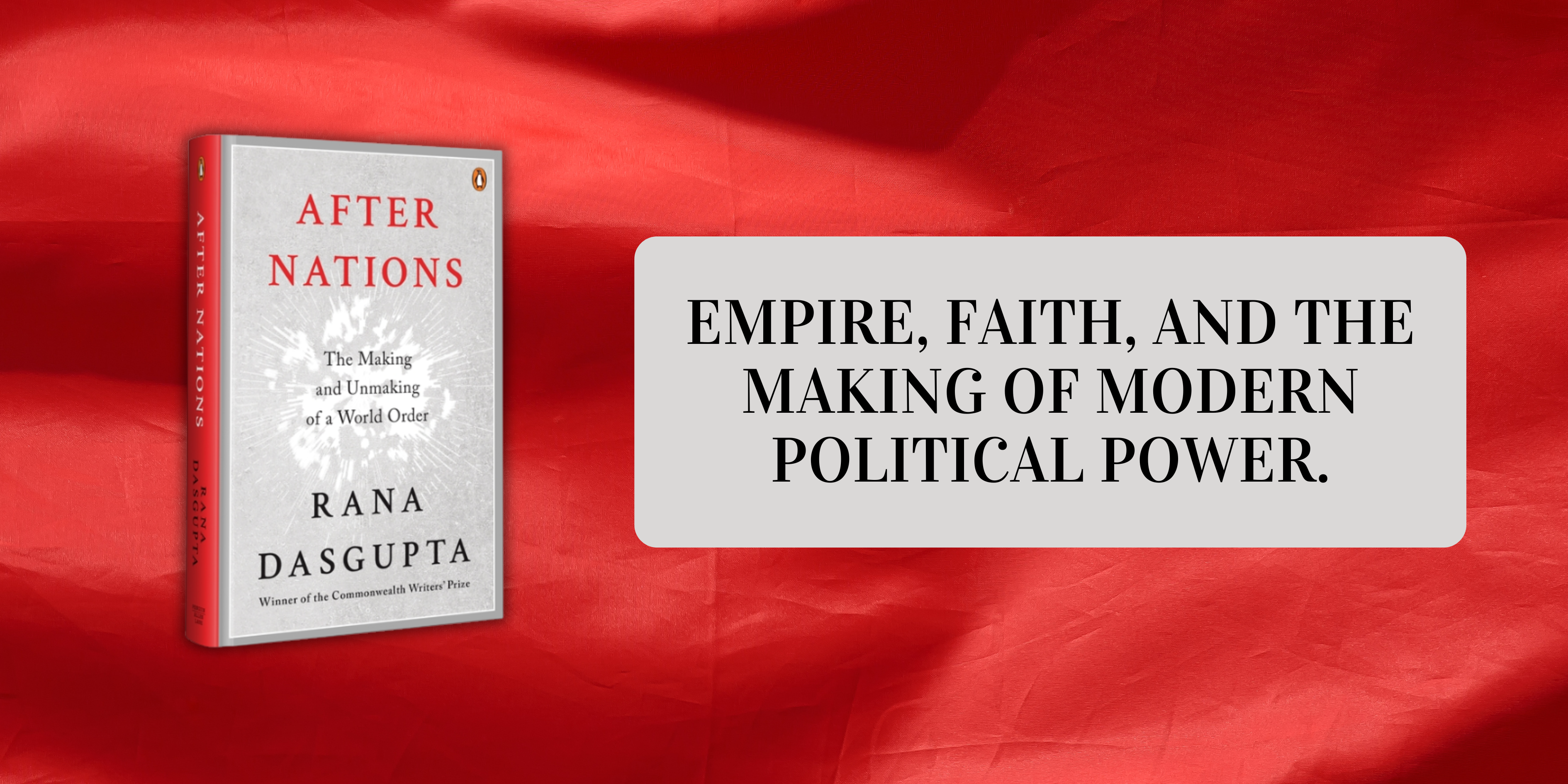
In After Nations, Rana Dasgupta begins not with borders or ballots, but with a crown of thorns. Through empire and theology, he traces how sacred authority laid the foundations of the modern nation-state.
***
In 1238, King Louis IX of France paid 135,000 livres tournois – more than half his kingdom’s revenue – to acquire the most valuable object in the world: the crown of thorns worn by Christ on his way to the crucifixion. With this purchase, Louis acquired a tangible claim on Christ’s celestial majesty, and magnified the aura of his own, golden, diadem. We may begin a theological history of the nation-state from here.
The crown was already withered and ancient, and it had passed through many ordeals. After Christ’s execution twelve centuries before, so Catholic tradition had it, the Romans had buried the crown on the site – the hilly wasteland outside Jerusalem called Golgotha or Calvary – along with the cross and other instruments of his torture. Hoping to discourage Christian outlaws from excavating and venerating these relics, they had piled boulders over the area, but pilgrims flocked nonetheless, their numbers increasing with the years. In the 130s, as a final deterrent, the emperor Hadrian sealed the sites of Christ’s death and burial by
building a temple to Venus on the hill.
Christianity’s fate took a dramatic turn when the emperor Constantine converted to the faith in 312. The imperial coinage was emblazoned with the chi-rho symbol revealed to him in a vision (‘Under this sign,’ shone Christ’s words in the sky, ‘you will conquer’), and the emperor himself began to superintend and standardise a religion that had mutated into many local variants. He summoned the First Council of Nicaea, where a grand assembly of bishops, priests and deacons arrived from all over Europe, West Asia and North Africa to resolve their doctrinal disputes, and so create a unified statement of belief (the Nicene Creed) for all the empire’s Christians. He also set about identifying Christianity’s holy sites and relics: he built the first basilica of St Peter where the latter had been buried in Rome, and, in about 325, sent his mother, Helena, backed with funds from the imperial treasury, to visit the holy sites of Palestine. ‘When the empress beheld the place where the Saviour suffered,’ wrote the historian Theodoret of Cyrrhus in the 440s, ‘she immediately ordered the idolatrous temple which had been there erected to be destroyed, and the very earth on which it stood to be removed.’ Buried underneath were three wooden crosses, one of which was revealed, by its miraculous healing powers, to be the actual instrument of Christ’s crucifixion.
Helena founded several churches in Palestine to house pieces of this ‘True Cross’. Most spectacular was the Church of the Holy Sepulchre, built on the site of the earlier temple of Venus, for which Constantine himself sent instructions to the bishop of Jerusalem: ‘Take every necessary care, not only that the basilica itself surpass all others; but that all its arrangements be such that this building may be incomparably superior to the most beautiful structures in every city throughout the world.’
Private devotion, quite clearly, was not his only consideration. Constantine was battling an ongoing imperial crisis, which the emperor Diocletian (r. 284–305 CE) had previously tried to solve by dividing the empire among four rulers. Constantine declared war on the so-called ‘tetrarchy’: between 306 and 324, he subdued his rivals and submitted Rome, once again, to a single emperor. He also introduced a number of administrative reforms – including moving the capital from Rome to a new metropolis in Byzantium dubbed ‘Constantinople’ – designed to preserve it from further disintegration. His theological innovations were part of the same project. Christianity had arisen as a critique of worldly power and money, to be sure; but it also inaugurated a new kind of universal citizenship that was especially productive for a large and diverse empire. Christ had dismissed folkish divisions; he rejected priestly privilege and the exclusion of the ‘impure’ (tax collectors, prostitutes, adulterers). He also rejected ethnic superstition (St Paul would write, ‘Here there is no Gentile or Jew, circumcised or uncircumcised, barbarian, Scythian, slave or free, but Christ is all, and is in all’). For him, human beings were metaphysically equal citizens of a universal ‘kingdom of Heaven’ administered by a single, benign, transcendental, male godhead. The ultimate truth and justice of this kingdom would be
revealed only in the end-times – but Christ’s ‘modern’ conception of citizenship was not merely otherworldly. In this life, too, he instructed his followers to give up parochial taboos and conform their practices to ‘global’ society.
***
Get a copy of After Nations from Amazon or wherever books are sold.