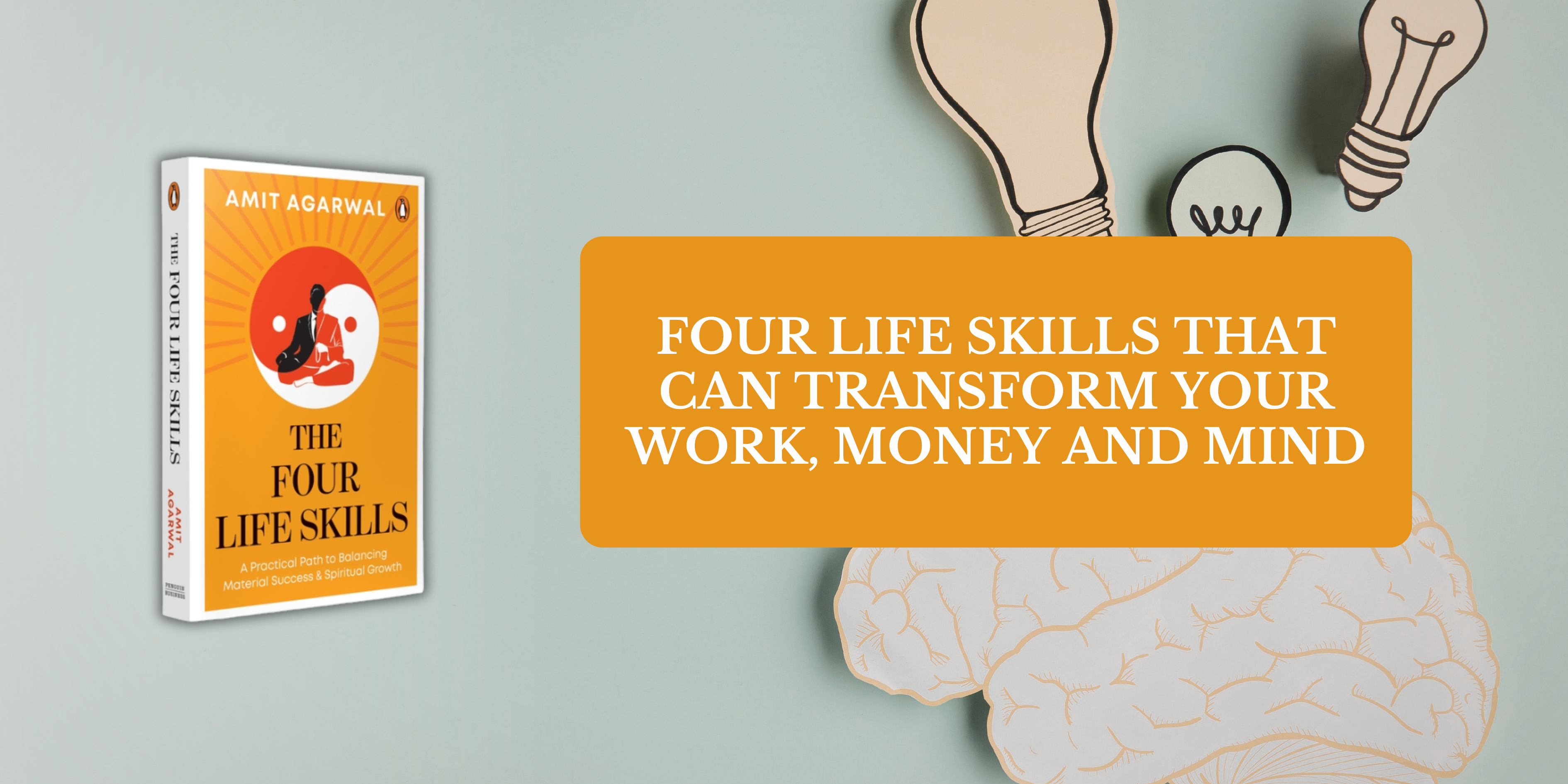
True balance in life lies not just in mastering a profession, but in developing the life skills that nurture the mind, body and spirit. In The Four Life Skills, Amit Agarwal examines the everyday skills that help us navigate life beyond degrees, jobs and professional success.
***
Typically, the word ‘education’ is used to mean learning. Sometimes, you may also come across the word ‘skill’ being used instead. However, the phrase ‘life skill’ is used sparingly. So, when I talk about the four ‘life skills’ that are essential for striking a balance between material success and spiritual growth, what exactly am I referring to? Moreover, how are these life skills any different from other skills that we can learn? Let us begin by outlining the differences between a ‘life skill’ and a ‘skill’.
Simply explained, life skills are essential competencies required for efficiently dealing with challenges in various situations and environments in our everyday lives. In contrast, a skill simply refers to expertise in a particular domain. The former is a broader concept; cultivating life skills will contribute to spiritual, mental, emotional and physical well-being and result in an improvement in the quality of life. The latter refers to specializing in a niche. So while computer programming, financial analysis, culinary arts, creative writing and graphic designing are examples of skills, life skills include critical thinking, decisionmaking abilities, building and sustaining meaningful interpersonal relationships, practising empathy and gratitude, time management and the ability to manage difficult emotions.
If you observe, the education system is geared more towards building skills rather than life skills. Schools create the foundation for college by offering streams such as humanities, science and commerce. Numerous college and university courses teach law, business administration, engineering, finance, medicine, marketing, hospitality and literature. Why is this so? This is because schools and colleges primarily cater to the job market, which will give you money and the ability to lead a good life. Now, think back to your own schooling—were life skills like empathy, public speaking, nutrition, personal finance or meditation ever part of the curriculum?
While specializing in skills is essential for employment, honing life skills is a much more critical aspect of personal development.
So, now the question arises: Which life skills will help us the most when it comes to marrying spirit and matter? There are four:
• Sales
• Mindfulness
• Personal Finance
• Nutrition
At the confluence of spiritual growth and material success is mastery of these four life skills. By harnessing their power, we can create a wonderful balance in every aspect of our lives. As you will see, they are deeply interconnected; without one, the others cannot reach their fullest potential. Now, let’s understand why each life skill is directly connected to your ability to enjoy a holistic life.
Sales
There are nearly 8.1 billion people in this world and if you think about it, each person is in the process of trying to sell an idea, a product or a service. Consider the following examples:
A sales director is giving a software demonstration to her prospective clients.
A financial planner advises his clients on which asset classes to choose from based on their risk profile.
Concerned parents are telling their teenager why constantly being on the phone can negatively impact his studies.
A twenty-four-year-old boy is about to propose to his girlfriend.
A forty-five-year-old is thinking about quitting his job and becoming a freelancer.
Can you identify the common thread in the aforementioned situations? They all involve connecting with people and influencing them to make a decision, a process I call the CID framework. Look around and you will begin to notice how thoughts contain the seed of an idea and, at every moment, we are selling that idea to a person, group or organization that will best serve its interests. So many times, like in the case of the forty-fiveyear-old weighing his options, we become both the buyer and seller of the product, convincing ourselves of the pros and cons of a decision.
In our various roles, we are selling either a product, a service or an idea. Thus, we all are in sales and hence sales is a life skill. As you begin to harness it, you will begin to communicate effectively both personally and professionally.
***
Get a copy from Amazon or wherever books are sold!