





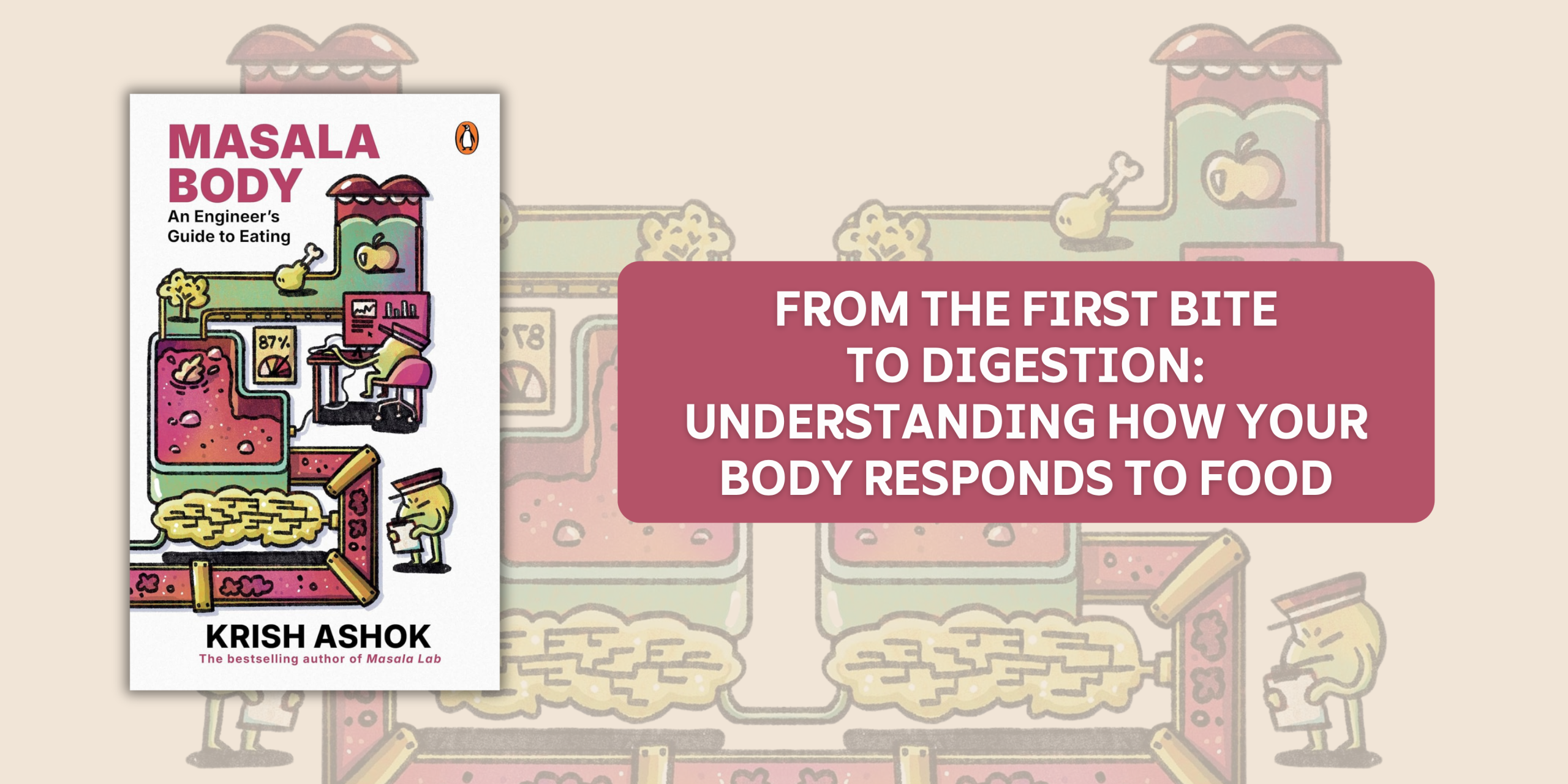
In Masala Body, Krish Ashok unpacks the science of how our bodies process food, separating nutritional facts from popular myths and showing us how to make sense of the countless claims we encounter about what we eat.

***
You’re about to take the first bite of perfectly layered biryani. Channelling my inner five-star menu writer: each grain of basmati rice glistening with ghee, tender pieces of chicken nestled between aromatic layers, the complex perfume of saffron, cardamom, cinnamon and star anise rising with the steam. You’ve been looking forward to this moment all day.
Over the next twenty seconds, receptors will sample it, teeth will grind it, saliva will begin digesting the rice, and more than twenty muscles will route it past your airway to prevent choking. You will notice mainly whether the cook got the salt right.
Your mouth isn’t just where eating begins; it is where your food starts becoming you.
1.1: The Security Checkpoint
That first mouthful hits your tongue and, within a fraction of a second, taste receptors begin sending information to your brain. The report is crude but fast: Salt? Present. Sourness? Mild. Sweetness? Some. Umami? Plenty. Bitterness? Familiar. Nothing immediately alarming. Proceed with consumption. Your tongue cannot tell whether the meal contains enough protein or is free of toxins, but it can detect a small set of chemical cues that helped your hunter-gatherer ancestors decide whether something was worth swallowing. Being too picky tended to make you unpopular with your mates.
Taste buds didn’t evolve for your enjoyment—enjoyment is the UI your brain built on top of a much older system for finding energy, sodium and amino acids, and for avoiding a few things that would have killed you. Sweet, sour, salty, bitter and umami are five broad chemical signals, not a comprehensive laboratory report on whether your lunch is good for you.
Sweet receptors respond to sugars, one of your body’s most readily available sources of energy. Most of the carbohydrate in basmati rice is starch, which does not taste especially sweet until salivary amylase begins cutting it into smaller molecules. Sour receptors detect acidity. Acidity can signal unripe fruit, fermentation or spoilage, but while your tongue alone cannot identify which, a combination of smell, memory and context do the interpretation.
Salt receptors respond mainly to the presence of sodium in food with impressive sensitivity. Your body needs sodium to maintain blood pressure and enable nerve transmission, but too much will kill you as will too little. The perfectly seasoned dish triggers just enough salt receptor activation to signal ‘useful mineral, pleasant concentration, keep eating’. Umami is the real surprise. This fifth taste, discovered barely over a century ago, detects breakdown products that provide a quick signal of protein availability.
Umami responds chiefly to free glutamate, often amplified by nucleotides (the same family of molecules your cells use to carry energy and to build RNA) released as animal and plant cells break down. These compounds frequently accompany protein-rich or fermented foods, making umami a useful hint of what may be in the meal. It acquired a scientific name because the Japanese chemist Kikunae Ikeda noticed that kombu dashi (soup made from seaweed) had a savouriness the four textbook tastes could not explain. In 1908, he isolated glutamate from the seaweed and founded a company to sell its sodium salt with a name that translates to ‘Essence of Taste’ (Aji no moto). When your tongue encounters the rich, savoury depth of well-cooked chicken and caramelized onions, umami receptors are providing early indication of the presence of protein in food. It’s no coincidence that umami-rich foods like aged cheeses, mushrooms and long-cooked meats like nihari taste deeply satisfying. That’s because your brain has evolved to get excited about potential protein in the meal.
The sodium salt Ikeda sold is monosodium glutamate, which makes the restaurant sign reading ‘No MSG’ one of the stranger promises in the food business. It is the same molecule already sitting free in tomatoes, soy sauce, dried prawns and nearly everything fermented or slow-cooked that an Indian kitchen produces—it is the reason a tomato and onion masala cooked down for forty minutes tastes like considerably more than tomatoes and onions. Your umami receptors have no mechanism for asking where a glutamate ion came from. The original fear of MSG can be traced back to a 1968 letter to the New England Journal of Medicine that connected the additive to a post-meal headache after a Chinese dinner. Was there any evidence? No. Racism? Yes. A kitchen advertising no MSG while ladling tomato purée over grilled paneer is offering a claim its own food cannot support.
Bitter receptors? They are less like a poison laboratory and more like a smoke alarm: fast, useful and prone to crying wolf. Some poisons are bitter. Some are not. Coffee, methi and dark chocolate set off the alarm without requiring evacuation. This is why acquired tastes exist, and why it’s hard to get kids to eat healthy but bitter things. Your brain can learn that mild bitterness from turmeric or black pepper correlates with familiarity and safety, not danger. Although I personally draw the line at bitter gourd, a beastly pockmarked package of galaxy-scale bitterness that I can tolerate only in the Bengali dish, shukto.
Your tongue contains several thousand taste buds, each one a microscopic cluster of 50–100 specialized receptor cells distributed across the tongue and parts of the palate and throat. Despite what you might have learned in school about ‘taste maps’, every region of your tongue can detect every basic taste, though sensitivity varies slightly across areas. Remember that old diagram showing sweet receptors only on the tip of your tongue? It’s based on an overinterpretation of early-twentieth century German research that has since been thoroughly debunked. In 1901, the German scientist David Hänig reported small differences in sensitivity across the tongue. Four decades later, the psychologist Edwin Boring replotted the data, and generations of textbooks somehow converted gentle gradients into sovereign territories with lines of control: Sweetland at the tip, Bitterstan at the back and Sour Pradesh on the sides.
These taste receptor cells replace themselves every seven to ten days, which explains why you can recover your sense of taste after burning your tongue with hot chai or damaging it during illness. Unlike many other sensory systems that deteriorate with age, taste can remain remarkably resilient throughout life, assuming the cellular replacement machinery stays healthy.
***