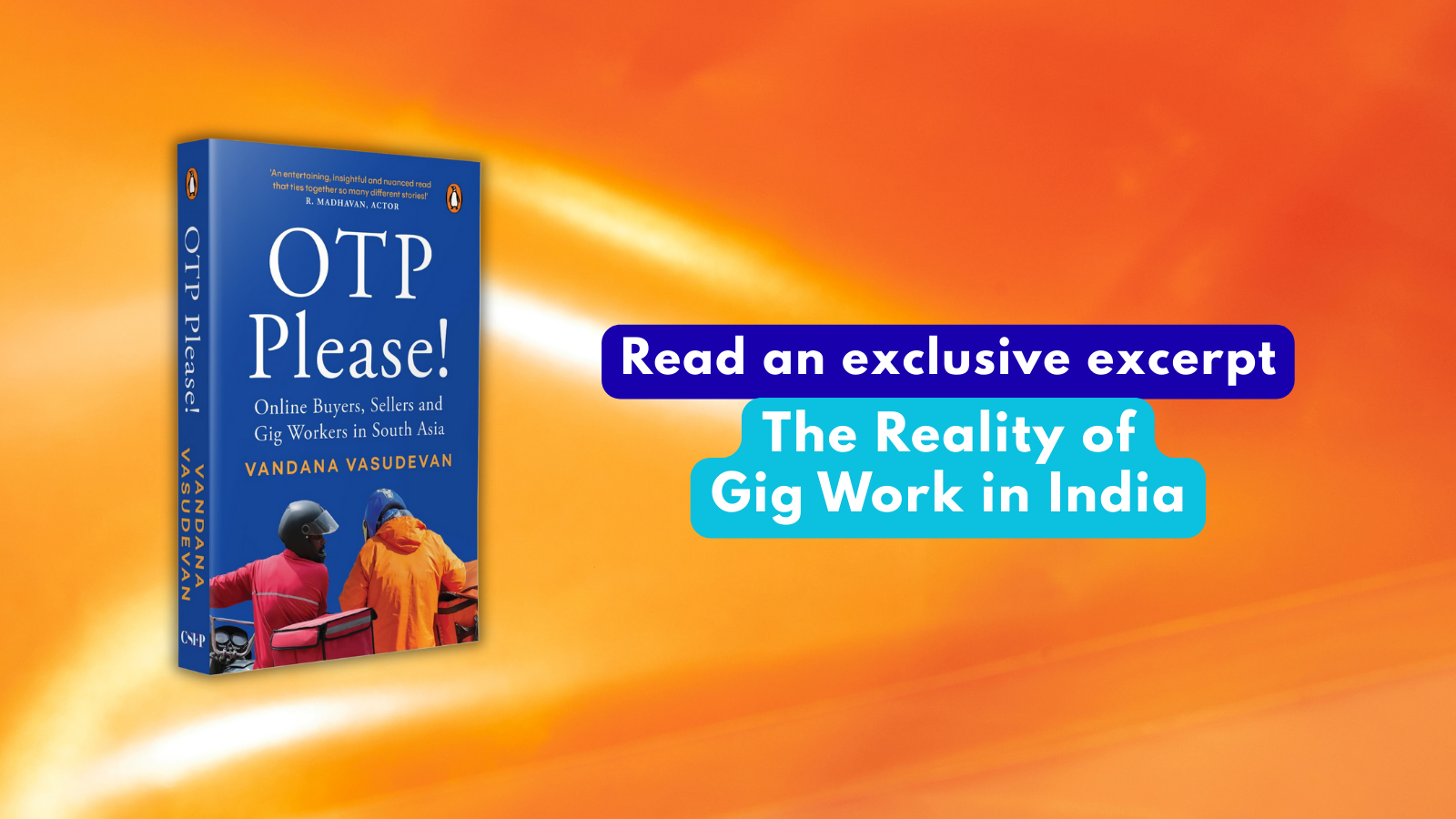
India’s gig economy is often celebrated for creating jobs – but what happens when the apps stop paying, the incentives disappear, and the workers start protesting? In this excerpt from OTP Please, Vandana Vasudevan captures the voice of an Uber driver whose rise and fall mirrors the fate of gig workers across India.
***
The amaltas trees in B.K. Dutt Colony, New Delhi, are spilling over with boughs of golden flowers in the harsh June sun. This colony is like an impostor between Lodhi Colony and Jor Bagh, posh areas home to high-ranking bureaucrats and retired corporate honchos. This is a modest enclave where the recently formed government of independent India had given Partition refugees subsidized houses. It has the standard elements of old-style Delhi colonies—a park, a Mother Dairy booth and low-rise residential buildings. A street-side temple happily encroaches on the road.
I have come to meet Kamaljeet Gill, national secretary of the Indian Federation of App-based Transport Workers (IFAT) and president of the Sarvodaya Drivers Association of Delhi (SDAD).
Kamaljeet’s house is a 1BHK (one bedroom-hall- kitchen) home on the third and last floor of a building, which, if it were in Mumbai, would be called a chawl. He is an imposing, swarthy man with a thin moustache and a slicked-back ponytail. We sit in a living space illuminated by a dull tube light. Under the gaze of departed family elders whose photos stare down at us, Kamaljeet tells me how he acquired the reputation of a troublemaker who has been banned from working for all leading ride-hailing companies.
He begins by giving me some background. ‘I became a cab driver twenty-three years ago. These foreign companies like Uber started coming in 2013 and found that this country is full of greedy people. I consider Ola a foreign company because its money is from abroad, even if the founder is Indian. So, knowing our greed, they gave all the drivers an Apple iPhone for every car that enrolled and about Rs 5000 as a joining bonus. Some fleet owners enrolled ten cars and got ten Apple iPhones plus cash. Business started rolling in. They used to pay us Rs 2 a minute for waiting, Rs 100 as base fare and Rs 15/km. The commission was also low. Clients and drivers were happy with this nice, new service. People from the company used to call us the previous night and ask sweetly, “Will you be working tomorrow?” Uber gave us the phones, so they said we should log in to the app for ten hours, and whether we get orders or not, we’ll pay Rs 1800 a day. Uber just bought us all, and Ola followed the same pattern.’
In December 2014, two years after the Nirbhaya incident,1 a twenty-seven-year-old woman was raped by an Uber driver leading to the cab aggregator’s ban in the national capital.2 During the ban, Uber had kept giving money to all the drivers enlisted previously.
‘How much?’ I ask, expecting it to be a subsistence amount for drivers to tide over the loss in income.
‘What can I say,’ replies Kamaljeet, a little bashfully. ‘I had two cars, so I used to get Rs 25,000 in my bank account weekly. Drivers were making a cool one lakh in 2014, just sitting at home. And we would also make more money driving for Ola, which was paying handsomely.’
When Uber returned to Delhi roads in January 2015, it lowered the rates from Rs 10/km to Rs 6/km. Payment per trip went from Rs 400 per trip to Rs 375 three weeks later, then finally to Rs 350 per trip by the start of 2015. Then, they stopped paying per trip, counting only for the number of kilometres covered. In September 2015, about fifty drivers vandalized Uber’s Gurgaon office. Kamlajeet who was at the vanguard of the disruption says, ‘An FIR was filed and I was locked up with some others for a day in Sector 29 Gurgaon police station.’
Media reports between 2014 and 2017 about drivers protests confirm that payments to drivers fell dramatically in those years as the ride-hailing companies found their feet in the market and felt assured that they would have a steady supply of drivers. One report in the Guardian has a driver in Delhi complaining that Uber used to pay Rs 2000 as a per-day incentive if they completed a dozen trips, but this was cut back to just once a week for doing forty to fifty rides and they hiked their commission from 20 per cent to 25 per cent by end December 2016.
February 2017 was Kamaljeet’s moment. Joined by another union, he led 300 drivers in a protest in Jantar Mantar demanding that the Rs 6/km rate be increased because metered taxis charged Rs 16/km and autorickshaws charged Rs 8/km. ‘How can we survive on Rs 6/km after paying the mandatory 20 per cent cut to the company and 5 per cent as tax?’ he said to the press, which covered the protest because it inconvenienced city dwellers. Kamaljeet went on a day’s hunger strike at the venue.
‘I became a famous man after that protest! The Delhi High Court has passed a restraining order against me saying I can’t go anywhere close to the offices of these cab companies. You’re sitting next to a celebrity!’ he laughs. Indeed, in April 2017, the Delhi High Court issued a perpetual injunction against union leaders from stopping other drivers to work with Uber, staging dharnas (protests) and causing violence outside Ola and Uber offices.
***
Get your copy from Amazon or wherever books are sold!