





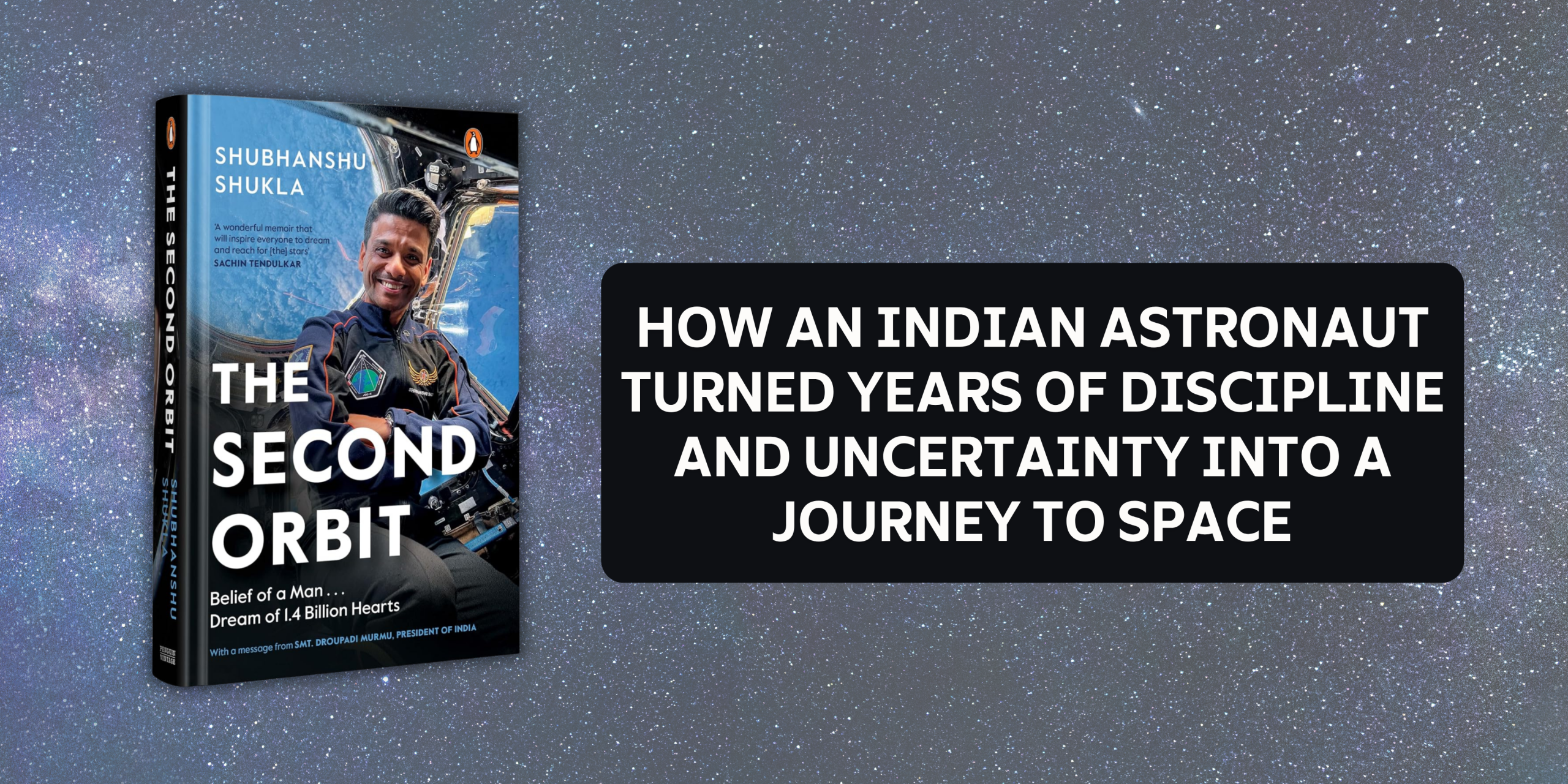
In The Second Orbit, Shubhanshu Shukla takes readers beyond the launchpads and headlines, into the deeply personal journey of becoming an astronaut—where years of discipline, uncertainty and belief culminate in one life-changing phone call.

***
There’s a peculiar physics to the days before significant travel. Time doesn’t flow normally. It compresses and dilates simultaneously, hours vanishing like water through cupped hands while individual moments stretch into strange elasticity. The universe, it seems, has little patience for leisurely goodbyes.
My final three days before departure operated under this distorted chronology. Seventy-two hours to compress an entire life into luggage allowances and administrative boxes. Pack belongings for a year’s absence, not just clothes and necessities but the careful curation of what parts of yourself you’ll carry into this new existence. Put the house in order, which is a euphemism for ensuring that life continues smoothly in your absence, that the machinery of daily existence won’t grind to a halt simply because you’ve stepped away from it. Complete endless administrative formalities, paperwork that governments and institutions demand as tribute before releasing you to pursue your dreams. And perhaps most challenging: mentally prepare yourself to leave, to say goodbye not just to people but to a version of yourself that will cease to exist the moment you board that flight. Three days for all of this.
Three days that have dissolved in memory into a single undifferentiated blur, like watching a film on fast-forward, where you catch impressions rather than details. Faces appear and vanish. Conversations happen but their specific words evaporate. Tasks get completed though you can’t quite remember the sequence. It’s all there in memory, somewhere, but merged into one continuous stream of motion and momentum.
And yet, and here’s the mysterious grace that governs these transitions—everything fell into place. It always does, somehow. The chaos resolves. The impossible checklist gets checked. The bags get packed, the forms get filled, the goodbyes get said. Not because you’re particularly organized or efficient but because departure creates its own gravity, pulling everything into alignment through sheer inevitability.
My flight was scheduled for 3 a.m., that particular hour that belongs to neither the night nor morning—when the world exists in suspension between yesterday and tomorrow. An ungodly time, really, chosen not by human preference but by the algorithmic optimization of airline scheduling systems that care nothing for sentiment or convenience.
I had made up my mind. There would be no airport farewells, no bleary-eyed goodbyes under fluorescent lights, no forced smiles hiding the weight of what was left unsaid. I wanted our parting to happen the way all sacred things should—at home, in the warmth of familiar walls, where every corner holds a memory and every room breathes with the life we have built together.
And, if I am being honest with myself, I was also protecting something deeply selfish and deeply necessary—the image of my family I wanted to carry across the miles. Not their tired faces at the departure gate, waving behind a rope of strangers. I wanted to carry them, the way my wife laughs with her whole face, the way my son sleeps with his arms flung wide like he owns the world. I wanted the last picture in my heart to be of home as it truly is, not home performing its goodbye.
So I rose early. And I found her already awake.
She hadn’t slept. Of course she hadn’t.
She sat in that quiet, not dramatically, not demanding comfort, just present. Carrying everything and saying nothing. I sat beside her holding my coffee.
And then I began to speak because silence frightened me more than the journey ahead.
I talked about the electricity bill, the school fees, the dates she needed to remember, the neighbour who would check in, the bank account, the passwords. I was reciting logistics like a man trying to prove he had thought of everything, as if planning could be a substitute for staying.
She let me go on for a while. Then, gently, the way she always reins me in, she said: ‘Stop with the logistics. It will all get done.’
And just like that, the words dried up.
We sat together in the hush of that early hour, no television, no phones, just the sound of the house settling into its own stillness. And in that silence, somehow, everything that needed to be said was said. More passed between us in those wordless minutes than in all my frantic planning. She knew. I knew. Some goodbyes don’t need sentences.
When the time came, I stood at the door of my son’s room. He was asleep, arms sprawled, lost in some dream only children are lucky enough to have. I leaned over and kissed his forehead softly, so softly, the way you touch something you are terrified of waking, terrified of losing.
He didn’t stir.
I picked up my bag. My wife walked me to the door. She straightened my collar, as if sending you off well-pressed is how she holds you together when she can’t hold you at all.
I stepped outside.