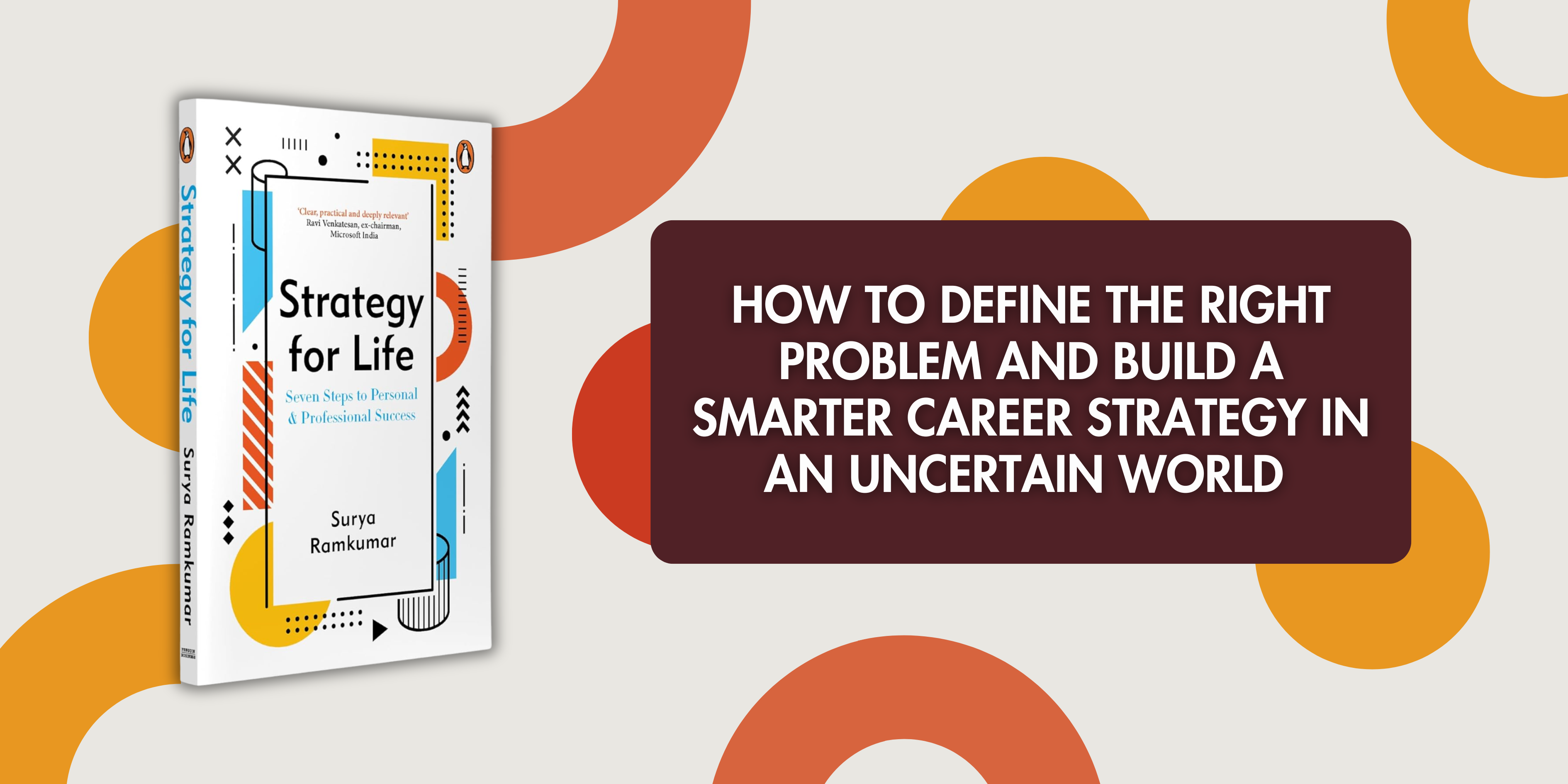
In Strategy for Life by Surya Ramkumar, a simple yet powerful idea takes centre stage: the biggest obstacle to success is often not a lack of solutions, but a failure to identify the real problem worth solving.

***
‘Is my career about to disappear?’
This question haunts professionals across countless industries today. Samir, a thirty-two-year-old radiologist with ten years of experience and multiple responsibilities that include a mortgage, school fees and recurring family health expenses, is sitting at his workstation reviewing chest X-rays when he receives an article forwarded by a colleague: ‘AI System Outperforms Radiologists in Tumor Detection’.
He feels a knot in his stomach.
The mixed messages he has been receiving from the hospital management, the radiology webinars he attends and his lived experience create an unsettling dissonance he is unable to resolve. On the one hand, he is looking forward to the technological advances that would make his job easier, ‘take out the routine tasks, leaving the human to inject creativity and unique value,’ as one webinar host put it. On the other hand, he is swamped with more work than ever, the productivity increases that the new technology promised never quite kicking in. While the ambient threat of redundancy looms in the background, he tries to focus on the things that he can control on any given day.
‘How do I compete with AI?’ he asks himself, spending nights learning about machine learning algorithms and wondering if he should change specialties. But his attempts to solve this ill-defined problem leave him more anxious and confused.
Is his problem really about competing with AI in its current form? Is that something he can reasonably solve, and even if he were to solve it, wouldn’t the next technological advance be just around the corner? Will it materially change his life? And is it even a path that aligns with his skills and capabilities?
Samir’s situation illustrates a common challenge: when facing uncertainty about our futures, whether from technological disruption, economic shifts or personal transitions, we often rush to address symptoms rather than root causes or jump to narrow solutions without understanding the true nature of our challenges.
Trying to ‘master AI’ gives Samir the illusion of progress. But in the long run, he is running on a treadmill where technological advances are always one step ahead, and the latent anxiety remains ever present.
In a world where the horizons appear hazier than ever, we need a new approach, one that considers the ambiguity and uncertainty of our times yet utilizes our unprecedented agency in setting our own path. The first step of that approach starts with accurately identifying and defining the problem in a systematic way.
The Promise of a Problem
Every strategy starts with a problem. An invading king that you want to defend against. An opposing team with more talented players than yours. A competitor with more resources than you. All examples of problems that could lead to strategies, and thus to success. Yet even those who know the utility of a well-defined problem often struggle to get the first steps of a strategy right.
Based on a recent survey of venture capitalists and unicorns, McKinsey summarized the main factors that differentiated a successful unicorn from the other start-ups. One of these factors, very simply, was, solve something. Too often, the report went on to say, founders start with an idea or a product and then try to find a market. But the really successful ones are able to identify and solve a problem that matters. The same is true for each one of us.
In a world of positive thinking, we don’t always like to think of problems. Euphemistically, we may call them challenges or opportunities, but in my opinion, the best way to figure out what to do is to figure out the most vexing problem that you need solved and attack it head-on.
What is unique about a problem versus an opportunity, a passion or a purpose? A problem is a pain point that is hard to ignore. It cannot be described as a role or a job opening. It addresses something that matters to you, which is not easily solved.
Let’s say you have been working for several years, and you know your job inside out. You feel that you have trained and helped many new employees, but somehow that elusive promotion to a managerial role keeps slipping between your fingers. It may be tempting to fixate on getting yourself a job as a manager. But getting a job as a manager is not a problem. Being in a job where you don’t feel fully utilized and recognized is a problem. This reframing helps you articulate a wider range of solutions, rather than the narrowly defined possibility of getting promoted to a specific role.
The other wonderful thing about problems is that they have an uncanny ability to focus resources. People like opportunities, of course, but the human brain responds much better to an urgent and pressing problem. If you have observed teams at play or at work, crises often have a way of bringing them together in ways a new growth opportunity cannot. In the throes of crises, people forget their differences, debates abate and we are more willing to get into action mode. And deliberate action is exactly what we are after.