





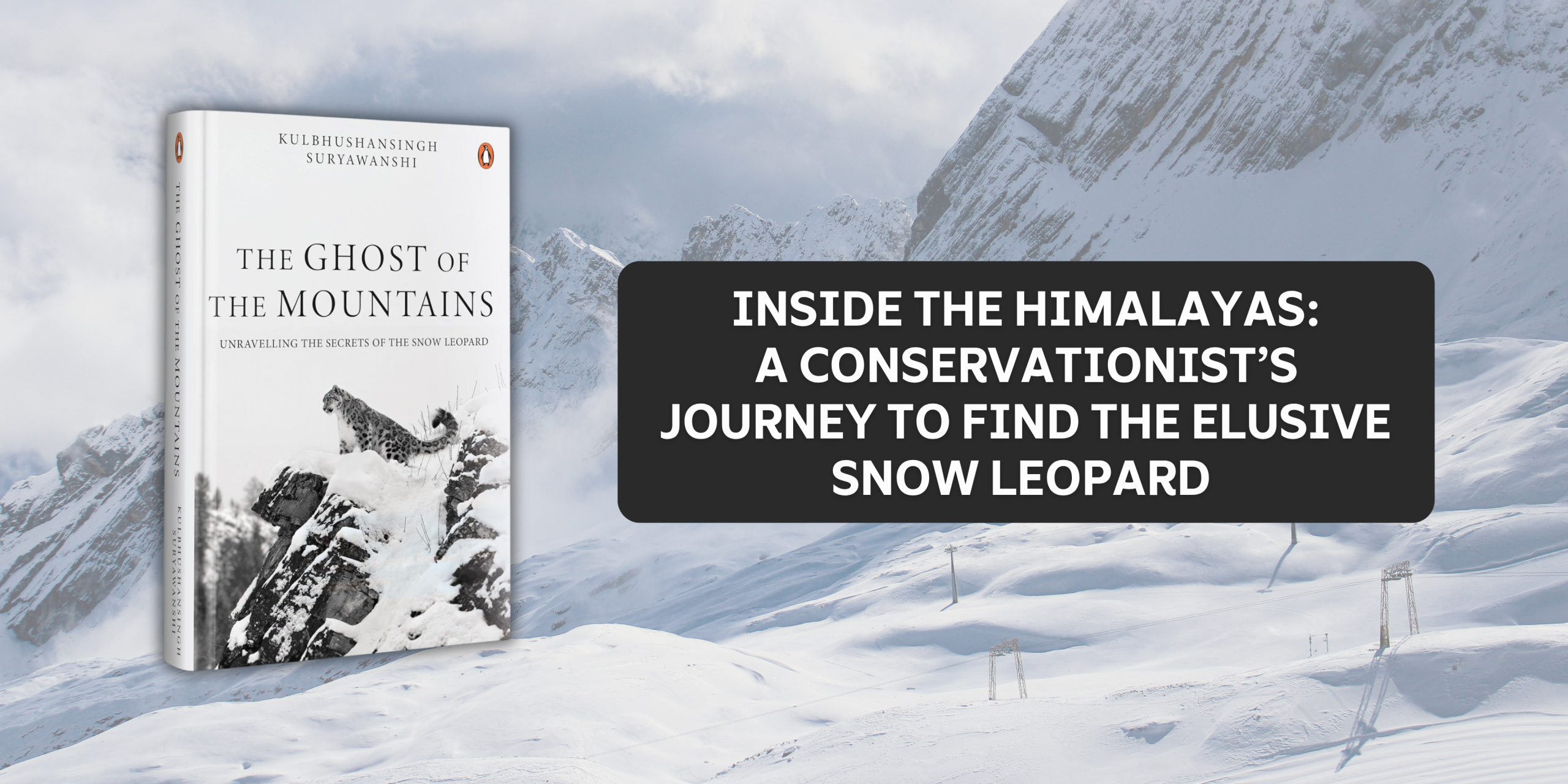
What begins as one young researcher’s determination to find a snow leopard becomes a decades-long journey through the Himalayas, wildlife research and conservation. The Ghost of the Mountains by Kulbhushansingh Suryawanshi takes readers into the wild, unpredictable world of one of the planet’s most elusive big cats—and the people working to protect it.
***
‘You will never see a snow leopard,’ said a professor when I sought advice on my master’s research project. ‘And you won’t get enough data to write your thesis.’
As a Wildlife Biology and Conservation student at the National Centre for Biological Sciences in Bangalore, the thesis I was due to present in 2008 was to be my gateway to a career in wildlife research. Modelled on American Ivy League universities, with acres of green lawns, air- conditioned research laboratories and cafeterias that serve cappuccino, the NCBS is one of India’s leading institutes in biological systems research, studying everything from molecules to entire ecosystems. I had found my way into this elite scientific institution through hard work and a talent for wandering the wilderness, but now I was struggling to journey through the door I wanted to open – the one labelled ‘snow leopard’.
‘Your idea of studying predator–prey relationships between snow leopards and blue sheep in the Himalaya is very good,’ said another faculty member, ‘but you should do this research with the tiger and the deer instead, and work here in South India. Besides, it will be 40 degrees below zero during the winter and you are from one of the hottest parts of India, so how will you handle the Himalayan winter?’
Some of this was true. Only a handful of researchers – mainly from Western countries – had ever studied snow leopards in the wild, and they often struggled to back up their research claims with adequate data from the field.
It was also true that I had grown up in the heat, in a village in the central Indian state of Maharashtra, near the famous UNESCO heritage site of the twenty- nine Buddhist caves cut into the cliffs at Ajanta between the second and fourth centuries BC. My village often gets to over 40º C, and the hot summers of my childhood were spent eating mangoes and swimming in wells. I had grown up listening to my grandmother tell the story of the Last Tiger of Ajanta. This tiger had killed a cow on the outskirts of my village, and my grandmother recounted in great detail how my grandfather stayed up in a cowshed near the carcass and shot the tiger on a full-moon night. My father was a little boy then and remembers sitting next to the dead tiger, measuring his height against the length of the ferocious animal. My grandmother would end the story on a sad note, saying that was the last time any one saw a tiger near our village. I grew up regretful of the outcome but tried to maintain a proud feeling that my grandfather had helped the village. The suggestion that I should study the tiger had resonance.
But I felt a calling to the Himalaya. I had been obsessively drawn to vertical surfaces since I was 15. Be they boulders, hillsides or buildings, I had to find a route to climb them. As a teenager I spent every waking moment thinking about how I could find my way to the Himalaya and be among the ‘real mountains’. Living in the mountains, hiking without a destination and climbing was the dream – not to set records but simply to be with myself exploring my great passion. Doing my master’s thesis in the Himalaya could locate me in the mountains for good. I knew I could handle the Himalayan winters. At 19, I had trained at one of the best mountaineering schools in Asia, and I could hold my own on icy slopes. During the NCBS’s summer break, after the second semester of my current course, I had also interned with an organization working on snow leopard research and conservation, and I was confident I would gather enough data to complete my thesis. What I lacked, given an upbringing which emphasized an unquestioning respect for my elders, was the courage to say this to my professors.
The final decision would be made at the proposal defence seminar, a gruelling annual ritual at the end of the third semester at which students presented their research plans to an audience composed of professors and practising conservationists. If a student’s idea was accepted, they would get the funding and permission to research at the proposed field site for six months. I had decided to propose researching the snow leopard’s prey species, rather than the cat itself, in the hope that this would sound more achievable. I included a photograph of myself climbing an icy Himalayan peak to convince them that I could handle the winter cold. When I walked up to the lectern and the lights in the seminar hall dimmed, with faculty members and students leaning back in their seats to listen to my proposal, the voice ringing in my ears was that of a friend. She had told me that some people in the audience would support my plan simply for its audaciousness.
***