Publish with Us

Follow Penguin

Follow Penguinsters

Follow Penguin Swadesh

Why You Need to Read About the New Rules of Business

As the business-world becomes increasingly dynamic, innovative, and experimental – the benchmarks for brand-building are changing. Playing by a set rulebook is no longer enough. There are new (and higher) expectations now, and with them come new rules of doing business.

From learning to prioritize employees’ well-being to investing in products that can do their own marketing – the market today has gradually dismantled the old rules and installed new ones in their place.

Author Rajesh Srivastava has brought together over three decades of his corporate and academic experience and the result is his debut book, The New Rules of Business, to present compelling anecdotes and insights about new age companies like Netflix, Amazon, and Uber to explore how and why they have made it big in the market.

In an age of entrepreneurship, this book is a must-read for people across careers and professions. We list down some of the reasons that make this such a relevant read today.

To Keep Up with New Age Companies

New age companies, Uber and Ola, Netflix, Amazon Prime and Hot Star, Amazon and Flipkart are dismantling the old rules of business and installing new rules in their place.
It is the age of innovative entrepreneurship, and to be able to take any step forward in the business-world, it is imperative to keep up with the names disrupting and revolutionizing the industries today.

This book presents compellingly-written anecdotes and case-based insights, which makes it highly accessible and readable even for layreaders.

*

To Identify Irrelevant ‘Old’ Rules

What triggered the collapse of Nokia? Not a competitor from the handset industry. It was iPhone introduced by Apple, which was from a different industry.

The market is no longer following the ‘old’ rules, as seen in the case of Nokia. New age competitors are indirect, invisible & from cross industry.

If you continue to operate your business using ‘old’ rules, then it would be equivalent to using rotatory phones in an era of smart phones, you run the risk of a Nokia-like fate.

*

To Arm Yourself with Newly Minted Rules to Take on the World!

In our careers – entrepreneurial or otherwise – we are constantly faced with business challenges. Most of us search for the answers in the areas ‘lit’ by our current level of knowledge.

But more often than not, the solution may very well lie outside of it.

This book will introduce you to the newly minted rules of business. Armed with them, you can feel inspired and confident to take on business challenges and come up with trumps and out-of-the-box solutions.

*

The Rules are Relevant for All – Veterans and Beginners

All the points above make it evident that new and upcoming entrepreneurs can benefit a lot by making themselves aware of new rules and challenges of the market today. But, what about veterans and experienced businesspeople? What new tools, techniques and frameworks can this book teach me?

This book is a must-read for veterans and beginners alike – simply because the rules of business have well and truly changed. And even though the challenges might be by and large the same, the solutions for satisfactorily resolving them have changed.

This book will introduce you to new thoughts, ideas, tools, techniques, and frameworks which will help you come up with impactful answers to business challenges.


Creativity, knowledge, and out-of-the-box thinking have become crucial factors for potential and prospective customers today. Just being a brand is not enough, you have to be a ‘cool’ brand to make customers truly happy. The New Rules of Business presents relevant insights into all these facets.

Deemed Public Issue or Doomed Investment? An Extract From ‘Going Public’

Upendra Kumar Sinha has contributed significantly to shaping India’s capital markets. He has been the guiding force behind reforms to protect the rights of investors and make stock exchanges more secure. Under his leadership, SEBI successfully fought a long legal battle with Sahara, and led the crackdown on other institutions which conducted unauthorized deposit collections.

Reiterating the importance of joint efforts of the government and regulatory bodies, Sinha in Going Public writes, ‘When there is a crisis or the financial stability is at stake, the government and the regulators have to mutually reinforce each other.’

Read on for a glimpse of how companies lure investors-

In spite of clear legal provisions, many companies have deliberately resorted to raising funds from hundreds of thousands of members of the public by taking recourse to the private placement route even though it was restricted for issue made to less than fifty subscribers. The maximum number of subscribers in a private placement has now been enhanced to 200 under the Companies Act, 2013. The main intention of companies that violate this rule has been to mislead investors and avoid stricter public scrutiny. Subscribers are denied full information about the true financial condition of the company and its actual business. They are not aware how much money is being raised, how many subscribers there are, the duration of the issue, or the corporate purpose for it. In addition, there is often a strong push from agents and salesmen. Investors are often duped into making these investments without any idea about the risk factors, or the remedy or guarantee available to them in case of refund or redemption.

In most cases, the preferred instrument is debt instead of equity. Generally, debentures or bonds (both terms are used interchangeably) are issued as these contain provisions of an assured rate of interest. People find these assurances very attractive. The rates of interest offered are very high so that these debentures can be easily sold. Several complications can be built into these instruments. A debenture can be convertible into equity, either partially or fully. The conversion into equity shares can take place at the option of the investor, compulsorily after a period or be linked to an event in future, such as the share prices of the company crossing a certain band. But, instead of highlighting these complications, agents push the instrument on the strength of the high rate of interest being offered.

Although many companies have taken recourse to it, the Sahara case is the biggest example in the country of a deemed public issuance. The surprising fact, however, is that neither SEBI nor any other government agency such as the RBI or MCA raised any red flag about such a large amount of money being raised from the public in utter violation of the law. Had Sahara Prime City Ltd (a group company) not decided to list on the stock exchange and thereby be forced to make disclosures to SEBI regarding its group entities such as Sahara India Real Estate Corporation Ltd (SIRECL) and Sahara Housing Investment Corporation Ltd (SHICL), the matter would never have come to light. It is also significant that the process of issuing these optionally fully convertible debentures (OFCDs) started around the same time as the RBI placed severe restrictions on the working of Sahara India Financial Corporation Ltd (SIFCL), a non-banking finance company of the group. SIFCL had been asked by the RBI not to raise any fresh deposits from the public and to close all existing deposits and reduce its public liability to nil in a given time frame. It is no coincidence that around the same time, these new instruments were issued by two companies of the Sahara group.

According to their own admission, the net amount raised by the two companies was more than Rs 24,000 crore from more than three crore investors.


Upendra Kumar Sinha is known to have been the longest-serving chief of SEBI. He also served as the chairman and managing director of UTI Mutual Fund and was head of the Capital Markets division in the Ministry of Finance. In his candid and historically important memoir Going Public, Sinha reminisces on his journey through India’s changing financial landscape.

To know more, read Going Public!

A Diwan with Foresight- An Excerpt from ‘The Magnificent Diwan’

The Magnificent Diwan by Bakhtiar K. Dadabhoy waxes eloquent about Hyderabad’s truly magnificent Diwan, Sir Salar Jung I. A Diwan with a foresight who was one of the firsts to establish an organized system of government in Hyderabad, Jung restored its prosperity and developed its resources to such an extent that the nizam’s dominions were as orderly as any other part of India. 

Reintroduced to a generation that doesn’t have an inkling about him, Dadabhoy in the introduction of the book writes –

To understand Salar Jung, we must understand that his most dominant sentiment was devotion to the nizam. He did not hesitate to oppose the nobles of the court, and to reform every department of the disorganized administration, because he realized that the strength of the ruler lay in the firmness of the administration. His loyal attitude during the Mutiny was but a part of this well-considered policy. Throughout his career, the mainspring of his policy was the interest of his master, the nizam. His loyalty to the British, notwithstanding his childhood influences, sprang from a deliberate conviction that the maintenance of British authority was the best pledge of safety to the dynasty he served so faithfully. At the risk of his own popularity, and often at the risk of his own life, he refused to align with fanatics. For the nizam’s sake, he bore the humiliation he received from the British which resulted from his persistence on the restoration of Berar. He bore with meekness the frequent indignities to which he was exposed in the palace, and waged a constant and unequal battle against fanatics and other malcontents. Till Afzal-ud-Daula’s death, Salar Jung had never left Hyderabad, a fact which makes his administrative reforms still more remarkable, since they were accomplished in spite of the opposition of a capricious nizam, and hostile nobility. His strong individuality, firmness and caution gave him an ascendancy in Hyderabad which no previous diwan had attained.

The difficulties he faced, unusually trying and complicated in themselves, were compounded by the fact that he was never able to rely on the support of the court because he was identified with a policy of reform which threatened vested interests. Imbued with a liberal education and outlook thanks to the English influence in his formative years, Salar Jung honestly believed in the superiority of British administration. He adopted the fundamentals of British principles of administration in his reforms which covered almost every sphere of activity: land revenue, police, judiciary, administration and education. Sir Richard Temple, who was resident in 1867, believed that Salar Jung, as a man of business and in matters of finance, had no rival among Indian ministers. European influences had greatly moulded his thinking, and Temple recognized that he was a great imitator. Whatever improvement the British government introduced, he would sooner or later adopt, to good effect.

It is no surprise that British influence preponderated, since apart from his own predilections, he was encouraged and advised by successive residents who wanted to foster good government, not only in Britain’s own interest, but for a principle as well. Carrying ‘civilization’ to India was both an imperial necessity and a mission of pride in the nineteenth century.


To read more about Sir Salar Jung I’s reign, check out his biography, The Magnificent Diwan. We’d love to know what you think!

Meet Bijli, Mehar’s bicycle!

Unfair by Rasil Ahuja is a wonderful fictional tale of determination and finding comfort and assurance in friendships. It celebrates self-love, accepting oneself and having body confidence. Meet two best friends, Lina and Meher who are ready to break all the biases and prejudices the society puts on those having dark skin tone in this delightful excerpt!

**

‘I’m leaving!’ I shout. To no one in particular. ‘Whaaaat? What? Where are you going?’ Daadi shouts back. She’s lying on the sofa, a hot water bottle resting on her ample belly.

‘Lina’s house, Daadi!’ Oof!

‘You told Ekta?’

‘Yes, Daadi, I called Mama at the clinic.’ ‘When you’ll be back?’

‘Next year!’ I grumble, pushing against the front door. Maybe India’s RAW should hire Daadi as an interrogator.

The sound of the door slamming muffles my grandmother’s high-pitched ‘Oye, listen! The sun is high. Don’t come back black!’

I roll my eyes. Daadi says the weirdest things sometimes.

I grab my bicycle by the handlebars and yank it out from under the carport. It flashes in the afternoon sun.

That’s how I got the idea of naming her Bijli.

Not very creative, but it works.

Bijli’s not exactly my first bike, but she is my first real bike. I outgrew training wheels at the age of eight and only because I had to. Our neighbours had grown old and were tired of watching me learn riding on a bike so small that my knobby knees would hit my chin every time I pushed down on the pedals. They took pity on me and gifted me their granddaughter’s old bike.

So that was actually my first bike. Too big for training wheels but small enough that if I fell, the ground wouldn’t be too far. Safety comes first in my book. I mean, why take unnecessary risks?

But that’s old news.
Bijli is new. Bijli is blue. Bijli is electric.
I wash and buff her every morning. Yep, every single morning since my parents gave her to me two weeks ago—an early birthday gift, they claimed. But an entire ten months early? I guess they noticed my still knobby knees were reaching my chin again.

A whole lot of dos and don’ts accompanied this early birthday gift.

‘No biking on main roads,’ Mama had said.

‘No biking on any roads during rush hour,’ Papa had chimed in.

‘When isn’t there traffic in Delhi, Papa?’ I’d asked.

‘You know what we mean, Meher.’ My mother shushed me with a stern tone. ‘Just bike in open and safe areas. No isolated or dark places. Got it?’

Front cover of Unfair
Unfair || Rasil Ahuja

I got it, I got it. But where are the large open spaces? I mean, maybe Nehru Park or Lodhi Gardens. But that’s only possible on weekends when one of my parents can drive me there because they won’t let me bike there alone.

And that brings me to another problem. The new car is too small to hold Bijli. Only our ready-to-croak- any-second SUV is big enough for anything.

It’s no secret that Basanti—may she have a long life—is possibly the more favoured child in our family. I once caught Papa trying to wrap his long arms around her, like a hug, if you can actually hug a car.

He wasn’t even embarrassed when I caught him in the act.

Auditions are on for the seventh grade annual play. Lina sets her heart and sights on the lead role, but the drama teacher seems to think Lina isn’t the right shade for the part. Meher finds maths far more interesting, and less dramatic, than Macbeth. When her extroverted BFF, Lina, suddenly becomes distraught and withdrawn, Meher tries to figure out what she may have done wrong, but things just don’t seem to add up.

~

Step into the world of Unfair to know more about Meher, and meet Lina as they go through life in the seventh grade!

Can Spirituality Take Us Towards True Liberation?

In his third book in the Spiritual Power series, author Gian Kumar delves deep into questions that bother us throughout our lives on the fundamental existence of God.  He unravels the complex issues that we remain entangled in till we become aware of the power of spiritual awakening. Gian Kumar writes, ‘To be spiritual is purely an internal relationship with oneself. It is how to make the mind consciously experience, realize and transform from one level to another.’

Spiritual Power: God and Beyond answers some of the most intricate and elusive questions known to man and in the process offers deeply meaningful life lessons that will enable you to unshackle your mind.

Read on for 5 lessons from the book that can change your perspective towards life:

Duality is the essence of life

An enlightened being has the power to rise above the eternal pursuit of desires and accept all that is good in life with the bad.

Can attitude alter our perception of life?

‘A positive attitude should be developed not by choice or selection in self-interest, but by an effortlessly balanced approach under awareness in any situation. A sense of appreciation settles, and you understand that the basic cause of all fears is nothing but your thoughts rising from your attachments and the means taken to attain those desires.’

Awareness is a weapon against negativity

The human mind is vulnerable to negative forces such as lust, greed, envy and jealousy that raise their ugly head in our relentless quest for more and better material pleasures.

Can these forces be vanquished?

Even strong efforts to think positively will only suppress those inner feelings of negativity, without eliminating them. Spirituality claims that you only need to become constantly aware and conscious of both positive and negative, and you shall effortlessly disengage from your negative urges.

Life affirming choices lead us to success

The imminent transition of the world of commerce, from a wholly material dimension towards a spiritually enriched corporate culture, can create a thriving work force.

How can we create a more evolved work space?

‘It is not your machines, stock, or computers that are your real assets; it is the people behind them who are the prime resource to drive them. It is your investment in social and environmental responsibility that enriches your material life, helping you to evolve and transform into wholeness, which in turn reflects your superiority over competitors.’

Life is all about this moment  

Seeking happiness in the future creates a distance from the ‘witnessing-self’ that lives and breathes in the present moment as the experiential mind. Looking inward to meet this self is a firm step outside the boundaries of the physical body.

Can we govern the wayward thoughts that disrupt our present?

 ‘If you wish to know how to be devoid of unnecessary thoughts, first get to know more about your own thoughts, because there is no such thing as a thoughtless mind. Awareness and consciousness both require thoughts to interpret their presence. Both insist that the mind be more in the present, rather than in the past or future.’

Change is essential to evolution

Blindly following outdated traditions can create a divide between man and God and in order to awaken to the essence of this relationship, man must find God, guru and the self within.

Can we awaken to our own God?

Nothing is fixed in the world. Everything changes, expands and evolves. We too need to evolve from antiquated religious scriptures and traditions into a more fluid and dynamic spiritual humanism.


Reflected in this deeply insightful and informative volume is author Gian Kumar’s approach to the inherent confusion and chaos underlying religion.  Spiritual Power: God and Beyond details a life defining move towards spirituality which not only offers a sanctuary of peace but also empowers the seeker to move away from the rigidity of archaic practices.

Read Spiritual PowerGod and Beyond to tap into the hidden power source within you!

Feeling the Exam Blues? Crack The Boards with the Help of this Guide

Mathematics is an integral part of our life but many think of it as a boring subject that has to be studied in school or college. In their latest boxset Improve Memory and Maths Skills, Aditi and Sudhir Singhal not only make mathematical principles fun and easy-to-learn but also show a different a side to this subject – a side that can help us improve our concentration skills and increase our attention span. The boxset also includes a manual that will help you memorize anything and explore the immense power of your memory.

Read to know more about how you can tackle the math monster:
Many teachers wonder what magic they can perform to make their kids like the subject. But the fact is it all depends on what you think about the subject and how you present it to students, both children and adults. If a teacher introduces a concept by saying ‘today we are going to start a new topic and it is very difficult. You need to pay attention, otherwise they won’t understand’, those students who find maths difficult automatically switch off, thinking they won’t be able to understand today’s topic. And the students who like the subject also tend to get a little stressed, which is not an ideal mindset for establishing a solid foundation. Instead, if a topic is introduced by saying, ‘Today we are going to learn something very interesting, which I feel you all will enjoy doing,’ and some activity or storytelling accompanies it, then everyone can get involved.

During interaction with students and teachers over the years, we[Aditi and Sudhir Singhal] have realized that whether one fears maths or loves it depends on how well a person understands it. If someone scores well in maths, they start liking it. But if they give wrong answers, they develop a fear of the subject, believing that maths is difficult.

The main factors that contribute to this fear are:

  • Clarity of concepts –When a concept is not clear, the child or adult makes mistakes repeatedly, losing confidence and eventually giving up.
  • Lack of practice – If someone understands the concept but doesn’t practice it enough, then he/she is not going to retain it for a longer time. Through practice, one is able to understand the patterns involved in the procedure and develops strong pathways in brain which are required to accomplish a particular task.
  • Wrong beliefs and messages – Every time a child hears a parent, older sibling, grandparent saying ‘Maths is very difficult’, it makes them think if their elders feared the subject, then it must indeed be very difficult to master, feeding their fear of the subject.
  • Not able to relate it with daily life situations – Most students are unclear about the significance of the topics covered during their maths class. Often, they do not see a connection between the topics taught and real-world problems.

To remove the fear of maths, we need to shift our focus from remembering procedures or formulae to understanding them with proper reasoning. First of all, maths should not be treated as just a subject you need to study to get marks in exams. Rather, the emphasis should be on knowing the beauty and importance of maths in daily life. In the present education system, upto eight standard, maths curriculum is focused on calculation skills involving mainly long procedures and formulae. That’s why, with time, students start losing interest in it as they think calculations can easily be done using calculators and mobiles. The remedy for this is for school-level maths to be more related to day-to-day situations. The emphasis should be more on developing mathematical thinking and problem solving skills of a child rather than just working on calculations. Apart from teaching the procedures to solve a particular problem, understanding of why we are using that procedure should also be taught. In short, we need to add the why along with the how to solve a given task or problem.


Students can improve their maths skills by practicing the following strategies:

  • Solve challenging puzzles, playing Sudoku, or playing chess. This will help exercise the brain and develop thinking skills.
  • Practice maths regularly, doing at least 3 questions daily.
  • Instead of using calculators, try to do calculations mentally.
  • Don’t hesitate to ask questions.
  • Use Vedic math to make your calculations fast and easy.
  • Try to relate maths problem with day-to-day situations.


Aditi Singhal is an international memory trainer, author, motivational speaker, counsellor and Vedic Math expert. Sudhir Singhal is a dynamic trainer, author, motivational speaker and counsellor. Both of them hold the Guinness World Record for conducting the largest mathematics class. Their latest boxset Improve Memory and Maths Skills contains the best tips and tricks and is meant for all age-groups students, teachers, and parents. Guaranteed to improve your mathematics and memory skills, these books are must-reads for competitive exams, maths enthusiasts and puzzle aficionados.

Get cracking the boards season by getting your hands on this boxset.

New Year, New Books for The Young Ones!

Start off the new year with a bang by inculcating the habit of reading. Let your child discover the wonders of reading with the help of these wonderful new books. Read an essential handbook for every student, discover tales of evil witches, meet a forgotten hero and more, this January.

Here is a list of all the books you can read with your young ones this month:

The Constitution of India for Children 

What is celebrated on 26th January is at the heart of our democracy-the magnificent Constitution of India.

The document didn’t only lay down the law but united India with a vision that took two years, eleven months and seventeen days to realise. Subhadra Sen Gupta captures the many momentous occasions in Indian history that led to its making in The Constitution of India for Children. Populated with facts and dotted with cheerful illustrations, this book provides answers to innumerable questions asked over the years.


Journey to the Forbidden City

Nineteenth-century Tibet was an unknown entity.

It was next to impossible for a white man to enter this territory. And so was chosen an intrepid Indian explorer from the mountains of Kumaon-Nain Singh Rawat. Trekking across this country, he risked life and limb and donned innumerable clever disguises as he surveyed the vast expanses and identified countless villages and people. His eventful and often arduous travels led to his name being permanently engraved in the annals of Indian exploration.

Puffin Classics: Timeless Tales from Marwar 


Giving a new lease of life to his writings, Timeless Tales from Marwar is a handpicked collection of folk tales from the everlasting works of Detha’s celebrated Batan ri Phulwari meaning ‘Garden of Tales’. Collected and written over the span of nearly fifty years, this fourteen-volume assortment of Rajasthani folk stories earned him the moniker-the Shakespeare of Rajasthan.


Discover India: Monuments of India 

Who built Fatehpur Sikri to be the capital of his empire? What is the thousand-year-old temple in Thanjavur called? Who painted the murals at Ajanta and Ellora?

Discover the answers to all these questions and more with Mishki and Pushka. Join them as Daadu Dolma takes them–and you!–on a whirlwind tour of some of India’s most beautiful and awe-inspiring monuments.

Discover India – Food, Culture and People of India

There’s possibly no other country in the world that’s as diverse as India. Thanks to its colourful history and influx of people from all over the world, India is today a glorious mix of religions, cultures, and traditions.

Why does India have so many languages? What is ‘Indian’ food? How do people celebrate special occasions? Find out all about India’s culture, food and people in this exciting book.

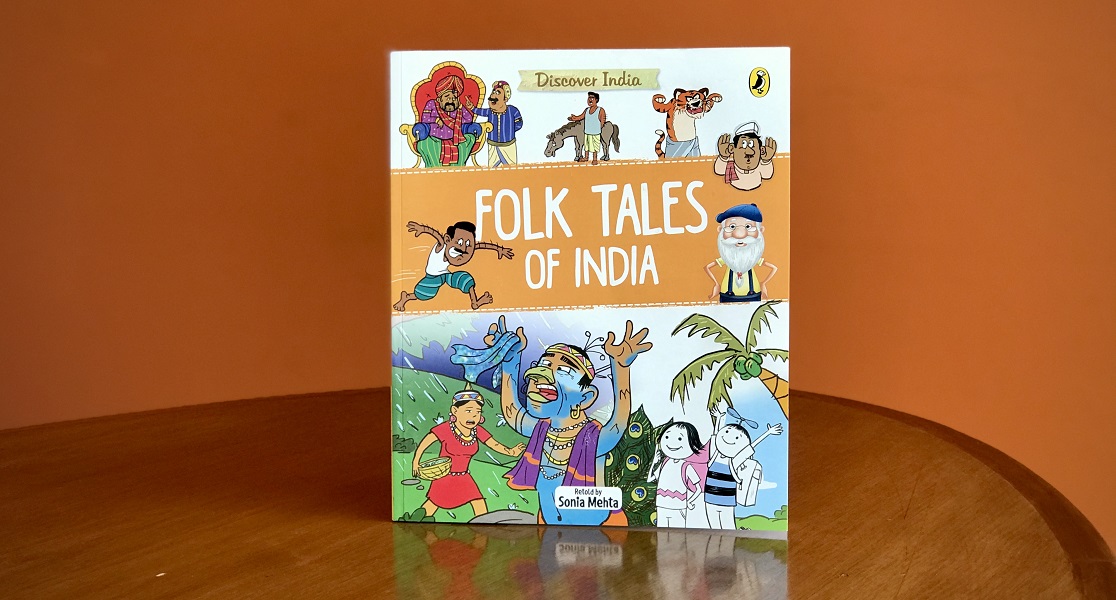
Discover India: Folk Tales of India 

Have you heard about Janba and Janai and their incredible generosity?

Do you know the story of the tiger who married a young woman?

From Madhya Pradesh to Mizoram, Kerala to Maharashtra, Indians have for centuries had a treasure trove of folk stories to tell. Join Mishki, Pushka and Daadu Dolma to read these stories and several more traditional tales from across India!

How Can We Unlock Growth?

Today is an age of experimental and innovative entrepreneurship. Business strategy is changing fast, and so are customers’ expectations. It is more imperative than ever to keep up.

As the business-world becomes increasingly competitive (and creative), treating your customers is no longer enough. There are new rules that have emerged, including taking care of employees. Happy employees make happy customers, and happy customers tend to be loyal.

‘The New Rules of Business’ by Rajesh Srivastava presents insights and anecdotes to explore how businesses can grow in the new-age world. Find out how growth and success is an achievable milestone, even if you are new to the field, in an excerpt below.

**

Pivot to Unlock Growth

Business history is littered with examples of the initial strategy of an enterprise invariably failing. Successful enterprises don’t give up when their initial strategy proves ineffective. They pivot as many times as required, till they hit upon a successful strategy: either by chance, through superlative thinking or from a competitor’s mistake or by sheer luck. Once the successful strategy is discovered, the enterprise drops anchor.

Implied in this approach is an axiom: it is unwise to put all resources—financial and non-financial—into the initial strategy. Enterprises should hold back sufficient resources for subsequent strategic pivots they might have to undertake along the way till the successful one is identified. An enterprise, therefore identifies and places a bet on the best initial strategy and invests sufficient resources to make it a success. But it also holds back enough resources in case the initial strategy does not work out and the enterprise has to pivot to arrive at another strategy.

Enterprises that ignore the pivot strategy could make mistakes at a great cost to themselves and their shareholders.

Are there examples of enterprises that have embraced the pivot strategy to lay the foundation for business success?

Wikipedia

Wikipedia1 leads the list. It ‘pivoted’ its way to becoming the world’s largest collaborative, free encyclopaedia. In March 2000, Jimmy Wales, the founder of Wikipedia, launched an online encyclopaedia and called it ‘Nupedia’. As was the norm then, he assembled an advisory board of experts to mentor this project. They in turn developed an intensive acceptance and editing process that included multi-step peer review process to control the content of the articles.

After twelve months, merely twelve articles were written, despite many contributors evincing interest. The strategy of having experts to control and drive the project was clearly not working. Wales needed to pivot, and quickly.

In 2001, a second free online encyclopaedia was launched where anyone could contribute. It was called Wikipedia. It operated on the principles of software industry where a collaborative approach was followed. Work released at the earliest possible opportunity and refined subsequently. This process is called ‘beta testing’. Leading software companies are in a state of perpetual beta: they are striving for continuous improvements. A leading proponent of this strategy is Google.

80 per cent ready. And then based on user feedback, it keeps improving the software, live.

Wikipedia too released the earliest possible version of an article, letting several people work simultaneously to rapidly refine it. The new pivot got traction and Wikipedia, as we know it, was born. Nupedia, which decided to remain rigid and not pivot, shut shop in 2003.

**

Author Rajesh Srivastsava brings to this book three decades of corporate experience to present advice that is both accessible and actionable.

Feed your entrepreneurial spirit by getting a copy of the book today!

Meet J. Krishnamurti- The Teacher Who Showed Us the Way Within

In a world teeming with ordinary men there is sometimes an extraordinary soul that streaks across the horizon like a shooting star. J. Krishnamurti was a man who stood tall at the other end of the spectrum. While wars raged across the world over religious differences, he spoke about renouncing all religion. When people were frantically pushing forward in the race towards their aspirations, Krishnamurti made them pause and look within. Drawing young listeners towards his perspective as well as inspiring the elderly, he travelled the world and connected with many through his talks and books. In 1961, Aldous Huxley- one of his many renowned admirers- wrote that listening to Mr. Krishnamurti was ”like listening to the discourse of a Buddha.”

Read on the know 10 things about the man who changed the way we look at life-

  1. Jiddu Krishnamurti was born on May 22, 1895 in Madanapalle, a small town west of Chennai, to devout Brahmin parents. His father, Jiddu Narayania, was a Theosophist associated with the Madras office of the Theosophist Society.


  1. In 1909, at the age of fourteen, J. Krishnamurti became the protege of Annie Besant, a political and social reformer who also served as the president of the Theosophist Society. This development changed the course of Krishnamurti’s life as Besant proclaimed him a saviour or World Teacher and took the young protege to England where he was educated privately and groomed for the role of World Teacher.


  1. Krishnamurti experienced life in different ways while receiving his education in England and at the Sorbonne in Paris as he travelled in Europe and the United States with Annie Besant.


  1. In 1911, Mrs. Besant founded the World Order of the Star of the East with Mr. Krishnamurti at its helm. His early visits to New York in the 1920’s sparked controversy as the city’s tabloids created sensational stories about the ‘saviour’ and his zealous followers.


  1. It was in 1929 that J. Krishnamurti broke away from the order and awakened to his mission to set human beings ”absolutely, unconditionally free.” He rejected the notion that a cult leader could take people towards salvation and in light of this belief, decided to disband the organization.


  1. In another life-altering move, Krishnamurti renounced all organized religions and ideologies based on the belief that prescribed teachings obstructed self-awareness and consequently took people away from self- knowledge.


  1. A revered teacher and philosopher, J. Krishnamurti maintained physical discipline with a vegetarian diet and regular practice of yoga. A teetotaller and non-smoker, he dressed in Western suits or traditional Indian wear according to his surroundings as he travelled the world giving talks and inspiring renowned leaders and thinkers.


  1. Krishnamurti established the principal Krishnamurti Foundation in 1969 in Ojai, a resort town in California, and took on the responsibility of being chairman of the board. The foundation also operated the Oak Grove School where students received training in regular academic subjects while being encouraged to think independently.


  1. Krishnamurti’s message to the world was based on an emphatic pursuit of unflinching self-knowledge. He believed that people must take up the challenge of exploring within themselves to understand their own psyche. It was this self- knowledge, unadulterated with external influences of religion, society and politics that, he believed, would change society for the better.


  1. Despite his failing health, J. Krishnamurti continued to share his philosophy with the world till the age of 90 when he lost his battle against cancer and breathed his last at his residence at the Krishnamurti Foundation in Ojai on 17th February 1986.

In his books, J. Krishnamurti delved deep into the tangled net of ideas, organizational beliefs and psychological mindsets in which humanity is caught. In his three-volume series on Commentaries on Living with over fifty essays in each volume, Krishnamurti explores topics as diverse as knowledge, truth, fulfillment, meditation, love, effort, seeking life and death and education.


About Rethinking India: Why the Series is Relevant for Today’s India

India is a richly diverse country. To celebrate diversity, it has become important to accommodate equally diverse ideas and visions of what India means as a nation.

Editors Ashis Nandy and Aakash Singh Rathore have taken a step towards this through a fourteen-volume series titled Rethinking India. The series is a highly relevant narrative in today’s times to revisit our idea of a ‘nation’.

The series is a byproduct of numerous working groups coming together to critically rethink social, economic and political spaces to encourage a transformative spirit. Over 400 of India’s foremost academics, activists, professionals and policymakers have come together to constructively engage in this process.

What are some of the challenges that the series brings to light? We take a look:

Government pays lip service to values our Constitution was founded upon

Our Constitution, as the preamble so eloquently attests, was founded upon the fundamental values of the dignity of the individual and the unity of the nation, envisioned in relation to a radically egalitarian justice.

The government policy however, merely pays lip service to egalitarian considerations, while the actual administration of ‘justice’ and implementation of laws are in fact perpetuating the opposite: illegality, criminality, corruption, bias, nepotism and injustice of every conceivable stripe. The rapid rise of social intolerance and manifold exclusions (along the lines of gender, caste, religion, etc.) whittle down and even sabotage an inclusive conception of citizenship, polity and nation.

Most basic constitutional principles under attack

All the public institutions that were originally created in order to fight against dominance and subservience are in the process of subversion, creating new hierarchies instead of dismantling them, generating inequities instead of ameliorating them.

The uprising against those who merely pay lip service

There are in fact new sites for sociopolitical assertion re-emerging. There are new calls arising for the reinstatement of the letter and spirit of our Constitution, not just normatively (where we battle things out ideologically) but also practically (the battle at the level of policy articulation and implementation). They witness the wide participation of youth, women, the historically disadvantaged in the process of finding a new voice, minorities, members of majority communities, and progressive individuals all joining hands in solidarity.


A series like Rethinking India not only brings such structural problems to light, but also propose disruptive solutions to each of the pressing challenges that we collectively face.

Inputs have been organized and assembled from jan sunwais (public hearings) and jan manches (public platforms) that have been conducted across several states. These ideas have also been discussed and debated with leaders of fourteen progressive political parties, in an effort to set benchmarks for a future common minimum program.

The series begins a conversation that we’d want each and every civilian of this country to be a part of.

The inaugural volume of the series is titled Vision for a Nation: Paths and Perspectives, and champions the idea of a plural, diverse, inclusive and prosperous India.


error: Content is protected !!