Publish with Us

Follow Penguin

Follow Penguinsters

Follow Penguin Swadesh

Six Things We Learn About the Creative Process From Ramanujan

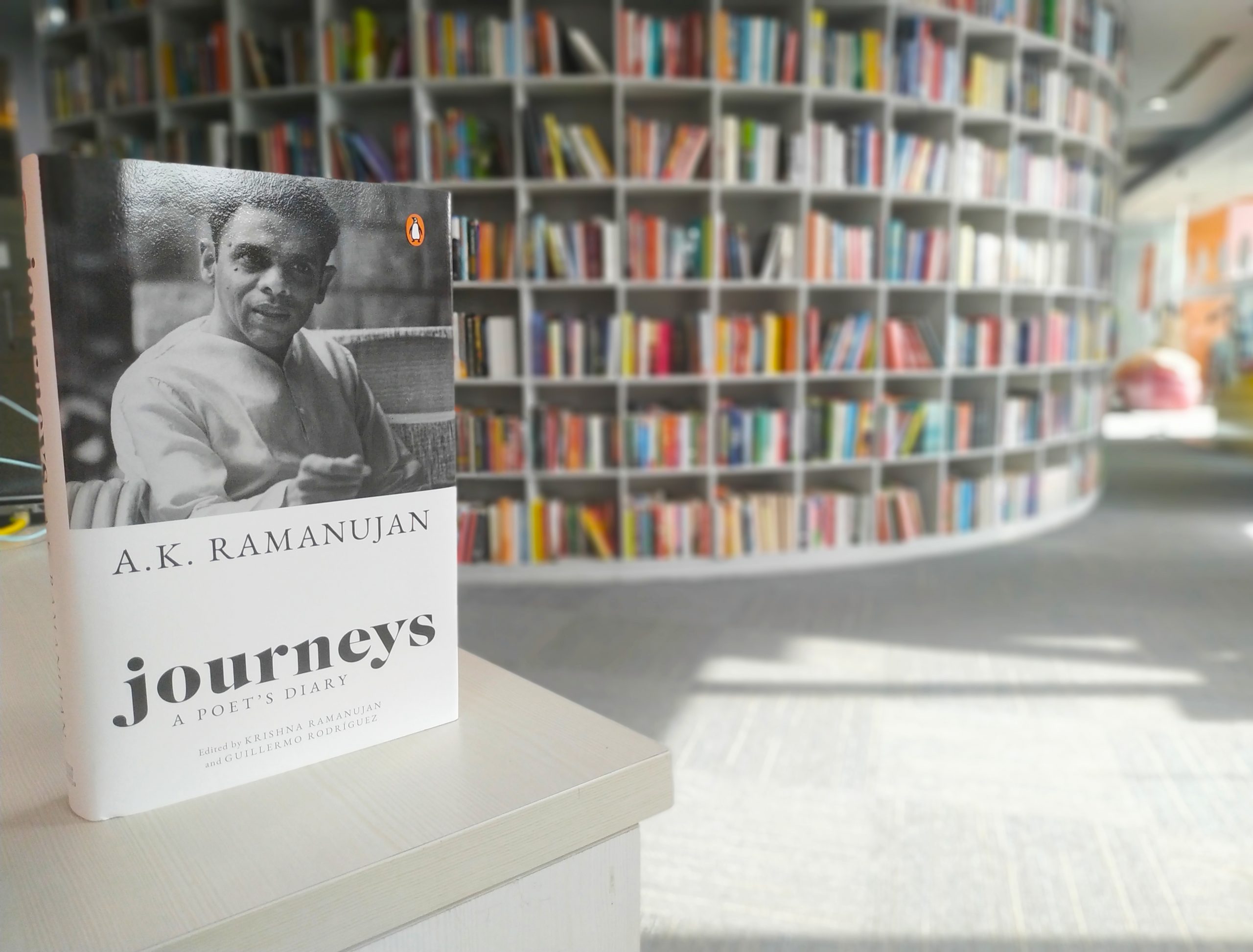
The A.K. Ramanujan Papers, stored since 1994 at the Special Collections Research Center at the Joseph Regenstein Library, University of Chicago, contain hundreds of catalogued files ordered chronologically from 1944 to 1993 in seventy-one boxes. Since 2014 an additional set of personal diaries and journals, kept in series V of the Papers, became accessible to researchers. The book Journeys: A Poet’s Diary includes literary entries from A.K. Ramanujan’s travels, his thoughts on writing, poetry drafts, and dreams. His diaries and journals served as fertile ground where he planted the seeds for much of his published work.

Here are some noteworthy facts about Ramanujan’s creative process!


Ramanujan viewed keeping a diary as part of his creative process; the entries provided a permanent repository for otherwise transient ideas, observations and language.

Ramanujan revised and re-read his notes and diaries now and again in a continuous dialogue with the past and himself; ideas, images and concepts were re-circulated and redistilled.

In all of his work, especially his poetry and translations, Ramanujan was very scientific – as a trained linguist – and almost obsessed with language and form.

He recorded scenes and anecdotes of people and his life. Between entries, he jotted quotes from writers and artists.

By recording his inner and outer life, he preserved experiences for later use; by practising verse, he honed a craft. This was the fertile ground where the seeds of his published work were planted.

He was a writer at work observing the minutiae of life, the ‘ordinary mysteries’; and at the same time the thinker struggling with the larger issues of human relations – psychologies, and our understanding of body and spirit.


Edited by Krishna Ramanujan and Guillermo Rodríguez, Journeys offers access to Ramanujan’s personal diaries and journals, providing a window into his creative process.

Chanakya and the Art of War-Excerpt

Each and every one of us wants to become successful. We aim to fight and win in businesses, careers, relationships and, ultimately, in life. However, most of us fail to reach our full potential because of various speed breakers.

In Chanakya and the Art of War, Radhakrishnan Pillai decodes the war secrets of Chanakya as relevant to our personal and professional lives. Be it an army fighting enemy soldiers across the border, the police encountering internal challenges, a politician who wants to win an election, or the common man fighting for survival, Chanakya has a plan for every situation. In the game of life, Chanakya teaches you the winning strategies by putting into practice the Art of War.

Here is an excerpt from the book:


We are constantly at war.

It may be an external war—at our workplaces, our homes, amongst friends, relatives and/or with the government and its systems.

It may be an internal war—inside our heads, with time, with decisions, with what is right and what is wrong.

This is unavoidable when we live in a world full of different people and different views. From the day we are born to the day we die, the external or internal wars will continue. From womb to tomb, we will always face difficult choices.

After a point, everyone realizes that they cannot walk away from such wars. Everyone has to fight—some win, some lose. This is where the difference in our attitude towards the war becomes known. We either accept defeat, or fight on to emerge a winner.

Most of us often compromise and give up. It is a good feeling, although temporary, that there was no bloodshed, that we avoided facing an extreme situation. But later, when we sit down and analyse, we realize that we have actually lost the war in the name of compromise.

The problem continues to exist. Sooner than later, it re-emerges in a different way. The quick-fix of compromise is temporary in nature because we have not fixed the leak. The tooth now requires an extraction. That one rotten apple has already spoilt the whole bunch.

We must make sure we win the war once and for all, rather than be under the illusion that a compromise has closed the issue.

The art of winning a war can be learnt by understanding some rules and then applying them in a practical manner to real-life situations. There are various formulae and techniques. Just because we have never been exposed to a war does not mean the ‘art of war’ is not meant for us.

Swami Tejomayanandaji, the spiritual giant from Chinmaya Mission, says: ‘If you don’t stand up for something, you will fall for everything.’

True that.

Are we all just living a life of compromise and adjustment? Have we become so weak that we cannot even voice our views? Have we forgotten the skills of negotiations and strategy?

Let us not simply allow life to happen to us, let us make life happen according to our wishes. We can decide what we want, and yes, we can emerge a winner. The good news is that there is a method and a system to do this.

It starts with building some basic leadership qualities. Yes, the answer lies here.

Leaders are strong men and women who stood up with conviction, squared their shoulders and faced the challenges that came their way. They were the only hope when others around them felt hopeless. They had nothing else but tremendous will power. World history is never complete without the stories of such great leaders from various nations and backgrounds. Initially, they were ordinary people, but their extraordinary leadership qualities made them shine in situations that were challenging and difficult.

Today, the life stories of such leaders guide us. They inspire us. They bring hope and possibilities. They are the guiding beacons of societies. Their stories must be told to our children. They should be discussed at dinner tables, their books should be read by all, and more research should be done on these great men and women.

Emerging as a winner in war is not just the work of the military and armed forces. It can be part of our basic nature. If every individual is taught the art of war, she/ he will be better equipped to focus on the means and the ends towards which they are working so hard. Winning a war requires many skills. Studying our opponent, understanding human psychology, the right timing and place, keeping motivation levels up—all these and more.

If we master the art of war, we can be successful in every field of life.


Chanakya and the Art of War  draws upon lessons from the great teacher, philosopher and strategist Chanakya’s masterpiece, Arthashastra, which can help us overcome those speed breakers to become innovative and influential and realize our true potential. AVAILABLE NOW.

6 Lines By Toni Morrison That Are Important For The 21st Century

Mouthful of Blood is structured in three parts and these are heart-stoppingly introduced by a prayer for the dead of 9/11, a meditation on Martin Luther King and a eulogy for James Baldwin. The author  Toni Morrison’s Nobel lecture, on the power of language, is accompanied by lectures to Amnesty International and the Newspaper Association of America. She speaks to graduating students and visitors to both the Louvre and America’s Black Holocaust Museum. She revisits The Bluest Eye, Sula and Beloved; reassessing the novels that have become touchstones for generations of readers.

Here are some path-breaking lines from her new book, that will get you thinking!


“We live in a world where justice equals vengeance. Where private profit drives public policy. Where the  body of civil liberties, won cell by cell, bone by bone, by the brave and the dead withers in the searing heat of ‘all war, all the time’”

“Writers are among the most sensitive, most intellectually anarchic, most representative, most probing of artists. The writer’s ability to imagine what is not the self, to familiarize the strange and to mystify the familiar- all this is the test of her or his power.”

“Complicity in the subjugation of race and class accounts for much of the self-sabotage women are prey to, for it is straight out of that subjugation that certain female-destroying myths have come.”

“The course of time seems to be narrowing to a vanishing point beyond which humanity neither exists nor wants to. It is singular, this diminished, already withered desire for the future.”

“Dream the world as it ought to be,imagine what it would feel like not to be living in a world loaded with zero-life weapons manned by people willing to lose them, develop them, or store them for money, or power, or data,but never for your life and never for mine.”

“The mind really is a palace. Not only for its perception of symmetry and the outrageously beautiful, but also because it can invent, imagine and most importantly, it can delve.”


 Mouth Full of Blood is a powerful, erudite and essential gathering of ideas that speaks to us all.

Queens of Crime – An Excerpt

Dysfunctional families, sexual abuse, sheer greed and sometimes just a skewed moral compass. These are some of the triggers that drove the women captured in these pages to become lawbreakers.

Queens of Crime demonstrates a haunting criminal power that most people do not associate women with. The acts of depravity described in this book will jolt you to the core, ensuring you have sleepless nights for months.

Based on painstaking research, these are raw, violent and seemingly unbelievable but true rendition of India’s women criminals.

Here’s an excerpt from the first chapter!

——————————————————————————–

The Drug Queen Of Mumbai

Back in Siddharth Nagar, her sons on either side, she wondered which door to knock on first. Four of her five brothers were married and living in their own rooms. She decided to stay in the room of her brother who was serving time in jail for murder. Two of her other brothers had served jail sentences for the same murder, but they were out now. Another brother, who had been arrested initially but had had nothing to do with the crime, had committed suicide in jail in protest.

She knocked on the door, the awkwardness of the moment weighing her down. The door, which led to a small eight-by-eight- foot room, was opened by her brother’s wife, Sumiti.

‘Didi! What a pleasant surprise! Welcome,’ her sister-in law greeted her and pulled the children into an embrace. She had been married for just a few months and didn’t have any children of her own.

Sumiti was quick to realize that something was amiss. After serving them tea, she said, ‘Didi, I’m with you. You don’t have to say anything.’

Her affection brought tears to Shantidevi’s eyes. ‘Thank you.’

The next morning, her sister-in-law left the house early, before Shantidevi woke up. But she had prepared a kadai full of poha for the three of them. Shantidevi woke her children up, helped them bathe outside using the bucket of water that had been kept ready for them, and then all of them ate gratefully.

That evening, Shantidevi asked her sister-in-law, ‘Can I get work here?’

Sumiti nodded. ‘I’ve already spoken to a lady in one of the apartment complexes not far from here. She will give you two hundred rupees for two hours. I’ll get you more houses to work in within a week.’

Shantidevi thanked her again. She was grateful because now she could earn her own money. It was the economic empowerment that she needed.

Soon, Shantidevi was working in three houses and was able to move into her own room in the same chawl. Now that she was earning Rs 600, she could hire a room for Rs 300. Her life was unremarkable for the next year. She was barely able to make ends meet with the meagre salary that

she earned. Her husband never bothered to check if she was all right. He was so heartless, thought Shantidevi, that he didn’t even inquire about the children. The lack of money started to pinch her. But what could an uneducated woman like her do?

One day, something unexpected happened. As she was walking back home along the Worli Sea Face after work, she felt weak and decided to stop for a few minutes at a bus stop nearby to catch her breath. She sat on the metal bench, held the pillar for support and closed her eyes. It is just weakness, she thought, and will pass soon. It did, and after a minute or so when she opened her eyes, she found that a man seated at the far end of the bench was staring at her.

She was about to give him a mouthful to nip whatever he had in his mind in the bud, but the man spoke first, ‘Sister, the world can be cruel. Are you feeling better now?’

His voice calmed her down, as did the fact that he had addressed her as ‘sister’. She nodded and wondered if she should get up and be on her way.

But before she could, the man spoke again, ‘And in Mumbai, there is only one god. Do you know who that is?’

‘Ganpati bappa.’

He laughed and then, his face turning serious, said, ‘No, the real god is money, cash, rupiya.’

The man was crazy, thought Shantidevi.

‘If you have the money, everything is great. But if you don’t have the money, you live the life of an insect in this city.’

A grasshopper flew out of nowhere and landed near his feet. The man raised his Kolhapuri chappal and stamped on it. ‘This guy here had no money, so I ended his life.’

She smiled for the first time. The man was right. She said, ‘But for money you need an education. Insects are uneducated.’

‘Says who? What if I told you that the man who lives on the tenth floor of this building,’ he paused and pointed towards a posh building behind them before continuing, ‘in flat number 1002, is uneducated and yet he is rich.’

‘That’s a lie.’

‘That’s not a lie, sister. I work for that man, which is why I know.’

Shantidevi got up and walked towards him. She sat on a bench three feet from him, saying, ‘How is that even possible, brother? Tell me about him.’

Little did Shantidevi know that this conversation would change her life.


Grab your copy of Queens of Crime today!

An Excerpt from ‘The English Maharani’ on Queen Victoria’s Bicentenary

The English Maharani by Miles Taylor charts the remarkable effects India had on Queen Victoria as well as the pivotal role she played in India. Drawing on official papers and an abundance of poems, songs, diaries and photographs, Taylor challenges the notion that Victoria enjoyed only ceremonial power and that India’s loyalty to her was without popular support. On the contrary, the rule of the queen-empress penetrated deep into Indian life and contributed significantly to the country’s modernisation, both political and economic.

As the world commemorates Queen Victoria’s bicentenary today, here’s an excerpt from the book:


Victoria and Albert collected Indian exhibits of their own in the early 1850s, in the form of adopted royal children. There were two: Princess Gouramma, daughter of Chikka Virarajendra, the Raja of Coorg (Kodagu), and the Maharaja Duleep Singh, who been taken into custody by the British in 1849. Queen Victoria was godmother to many infants, including the African American Sara Bonetta in 1851, and, from New Zealand, the son of a Maori chief, who was baptised Albert Victor Pomare at Buckingham Palace in 1863. Her Indian adopted children received special treatment. Both were welcomed almost as new siblings, their acceptance into the royal home marked by rituals of conversion and depiction. Princess Gouramma arrived at the court via the Basel mission in Mysore. Persuaded by the mission, the Raja of Coorg negotiated with the East India Company to have his daughter, then aged eleven, brought up in England, under the guardianship of the queen. In exchange he hoped for the return of his wealth, seized by the British in 1834. He had already used his children as bargaining chips. Another daughter had married Jung Bahadur, the chief minister of Nepal in 1850. Gouramma was brought over from India by Mrs Drummond, the wife of a retired major in the Bengal cavalry, and came to Buckingham Palace at the beginning of June. As the terms were agreed about her adoption, the queen showed off Gouramma to her own children, and commissioned Franz Winterhalter to paint her portrait. The queen watched the sitting and made her own sketches of the Indian princess. Gouramma also played with the royal children. At the end of the month she was christened in the chapel of Buckingham Palace. The Archbishop of Canterbury performed the service, Lord Hardinge and James Hogg (of the East India Company) were Gouramma’s sponsors and, with all the royal family in attendance, the queen led Gouramma to the font, naming her Victoria. Controversy flared after the baptism, when her father objected that Gouramma’s guardian, Mrs Drummond, was not of sufficiently high social standing and claimed that he had been misled into the wardship of his daughter. As a compromise Gouramma remained looked after by Mrs Drummond but at the homes of various families with connections to the Government of India, such as the Hoggs, the Hardinges and the Woods. Her father’s grudge against his treatment by the Company continued until his death in 1859, whilst Gouramma eventually married a lieutenant colonel, John Campbell, and with him she had a daughter of her own, Edith.Queen Victoria celebrated the little princess Gouramma as a Christian convert from the east. Winterhalter’s portrait shows Gouramma in her Indian clothes: a fitted blouse, pleated sari with a wide embroidered pallu, gathered by a gold belt. She is heavily jewelled with an elaborate headpiece. In her hand she holds a small Bible. The queen also commissioned the sculptor Carlo Marochetti to capture the moment of Gouramma receiving her crucifix, executed in pale marble. The queen then had the bust painted to enhance Gouramma’s facial features. An almost identical pattern was repeated with Duleep Singh. He arrived at Buckingham Palace two years after Gouramma, in the summer of 1854. As an eight- year- old boy, Duleep Singh had been taken into the care of the British forces under Henry Hardinge, who pitied the plight of the ‘beautiful boy’. Dalhousie was far less sympathetic to Duleep Singh, ‘a brat begotten of a bhistu – and no more the son of old Ranjeet than Queen Victoria’. Nonetheless after the surrender of the Punjab in 1849 Dalhousie authorised the boy to be placed into the guardianship of Sir John Login, former surgeon at the British residency in Lucknow, and his wife, Lena. As temporary governor of the citadel at Lahore, Login was in charge of the dispersal of the Lahore treasury. Duleep Singh proved one piece of booty over which he was especially careful. Whilst his mother was exiled to Kathmandu, the young maharaja was taken to Fatehgarh for his safety, and there began his western education with the Logins, converting to Christianity in 1853. The switch of faith surprised many, including Dalhousie. In the meantime, arrangements were made for what portion of the Lahore treasury would be kept for the prince, for the costs of his maintenance in England, with some set aside for the construction of a tomb for Ranjit Singh at Amritsar. By the time Duleep Singh arrived in London, he was a well- groomed fifteen- year- old, with good English and refined manners, as the queen noted. Just as she had with Gouramma, she sat and watched Winterhalter paint Duleep on successive days, as well as sketching him when he joined the family at Osborne. Winterhalter’s portrait is a grandiose full- length study, depicting Duleep as a proud Sikh ruler, richly dressed, adorned with pearls, a sheathed sword in his right hand, and a temple in the background. One small detail hints at his conversion. Around his neck is a miniature portrait of Queen Victoria, the very same one that had been given to Ranjit Singh by Lord Auckland in 1839. Two years later, as she had done with Gouramma, Queen Victoria commissioned a bust from Marochetti of Duleep, and had it coloured, although was disappointed with the result. As well as sketching Duleep Singh, the queen kept a record of their conversations that summer. She went over the details of the narrative of his life, getting him to confirm some of the awful events – in particular, the murder of his uncle, Sher Singh, astride an elephant while Duleep was his passenger – and she questioned him about his conversion to Christianity and the ostracisation he had suffered from his family as a result. In an ironic twist she revealed to Duleep Singh some of her own souvenirs of the Punjab. She showed him Charles Hardinge’s sketches of him as a small boy, and let him see the Koh- i-Noor, which he was allowed to stroke. But she ensured that he did not view the captured Sikh arms on the terrace. Her fondness for Duleep was clear, but there was also a certain wallowing in his submissiveness. Passing on her congratulations for his sixteenth birthday she noted he ‘would have come of age, had we not been obliged to take the Punjab’.Duleep Singh returned to stay with the royal family at Windsor and Osborne again over the next two years, and on each occasion the queen was able to observe the progress of his education under the guidance of the Logins. Some of this took a conventional form. There was a lot of hunting and shooting in the Scottish Highlands, and a tour to Europe at the end of 1858. Other episodes in the grooming of the maharaja reflected Prince Albert’s enthusiasms. He was taken on a tour of the sites of Staffordshire in March 1856, including a descent down a pitshaft, and later that year attended the Birmingham cattle show and helped set up a refuge home for Indian lascars. He joined a volunteers regiment in 1859, and once he left London in 1859 to live at Mulgrave House, near Whitby, he represented the queen at various local functions. By the time he was a young adult, Duleep Singh was pining for the Punjab. To the consternation of Queen Victoria, he remained close to his mother. Duleep yearned to return to India, and finally travelled there in 1861, bringing his mother back with him to England, only for her to die two years later. He made another trip to India to scatter her ashes, and passing through Cairo on his return he met and married Bamba Müller, a young woman of German and Abyssinian descent who lived in the American mission there. They settled down to country life on a Norfolk estate, raising a family of six children, the first of whom, Victor Albert Duleep Singh, born in 1866, became the queen’s latest godson. Duleep Singh’s frustrations in forced exile in England radicalised him, and by the 1880s he was planning to renounce his Christianity, return to India and claim his succession as Sikh leader. He sought allies for his restitution as far as Cairo and Moscow, and finally died in Paris in 1893, separated from his homeland and from his family. For much of his life Duleep Singh proved a headache for the British government at home and in India, and on occasion he was a major strategic risk. Despite his reputation as a pampered prince, he remained a credible focal point for Sikh nationalism throughout his lifetime. For all his justifiable resentment against the British, Duleep Singh was considered an intimate member of the queen’s extended royal family until his death. From the marriage of Princess Vicky in 1858 through to the funeral of Prince Leopold in 1884, he attended every major royal ceremony, including the funeral of Prince Albert in 1861 and the thanksgiving for the recovery of the health of the Prince of Wales in 1871. On each occasion he sat on one side of the queen (her own children were on the other) along with the other foreign princes, mostly those from the smaller German states who were related to Victoria and Albert. Queen Victoria’s own dedication to Duleep rarely wavered. She defended him from suspicion that his loyalties lay elsewhere during the Indian rebellion of 1857–8. In 1868 she pressed Disraeli’s government to make further provision for Duleep Singh’s growing family, although that had not been part of the original terms under which he was included in the civil list (the public funds used to finance the royal family). Even in 1886, once his machinations with Russia were known, and she conceded that he was ‘off his head’, she still insisted that the government look after his family properly, in the event of his not returning to Britain. There was a final meeting between the queen and the maharaja in Grasse in the south -east of France in March 1891, two years before he died. Queen Victoria’s obsession with these two young exiles in the mid-1850s defies simple explanation. She undoubtedly had a genuine sympathy for the Indian royals whom her own government had done so much to displace. It extended to the old as well as the young. The same year that Duleep Singh came to the court, she had an audience with Prince Ghulam Mohammed, the last living son of Tipu Sultan, who had come to London to argue the case for ongoing support for his own sons and any descendants they might have. To support his claims Prince Ghulam republished the history of Tipu, already reasonably well known. The queen noted in her journal her respect for Prince Ghulam’s quiet dignity as he went about his appeals, whilst observing that had Tipu survived then all might have turned out very differently. Her magnanimity always came from belonging to the winning side. There was also a strong element of mothering. Tipu was widely depicted as a neglectful father. Queen Victoria’s wrath against Duleep’s mother and also her contempt for the Raja of Coorg betrayed the same indignation over poor parenting, the very reversal of the patriarchal household that she and Albert had developed around their own children. Her own maternal instinct was more than matched by Prince Albert’s vision of a princely confederation that might include his own sons, as well as the minor German princes and Duleep Singh. They were of royal blood after all. After his death, Victoria remained loyal to Albert’s dynastic aspirations, with her inclusion of all the princes in all the family ceremonies thereafter. Particularly in the case of Duleep, there was also a heavily romanticized appreciation of Sikhs and Sikhism, fuelled by the first- hand accounts from the battlefield and also by travel literature popularised by various German and English writers in the 1840s. As a war- like but conquered people, there was not a little vanity and conceit contained in the way in which the royal family not only captured Duleep in his Sikh finery, but also appropriated it for themselves. Most telling of all, the addition of these young India royals to the court represented the high- water mark of Queen Victoria’s evangelical aspirations for India. This can be seen in the rituals around conversion, that is to say, Gouramma’s baptism at the Palace, and Duleep being made to recount the trials he suffered surrounding his own conversion. It is also evidenced in the portraits and busts that the queen commissioned of the two, depictions emphasising their racial difference, whilst at the same time detailing the tokens of their new allegiance to a western monarch and to a Christian god. Here was Christianity in India making rapid strides at her very feet. Three days after she introduced Gouramma and Duleep Singh to each other for the first time, she wrote to Lord Dalhousie, saying how she approved of their future marriage (it never happened), and also how she hoped that the growing network of railways in India would ‘facilitate the spread of Christianity which has hitherto made very slow progress’. The Bible and the steam engine –religion and industry: for all their curiosity about the east, Victoria and Albert understood India from a largely western perspective. The year of rebellion, 1857–8, changed all that.


Get your copy of The English Maharani on Queen Victoria’s 200th birthday!

6 Lines by Ruskin Bond that will make you smile

Ruskin Bond’s stories have never failed to thrill us and make us laugh. Our growing up years would not have remained the same had it not been for Bond’s hilarious anecdotes.

Here are 6 Ruskin Bond quotes that made us laugh out loud:


Ruskin Bond’s characters always try to do some good… 

Mrs Fisher took one look at the bundle in my arms and let out a shriek. ‘What have you brought here, Bond?’
‘A baby, ma’am. I think it’s a girl. Do you want to adopt it?’

Thick As Thieves

*

The characters are always very talented… whether others appreciate those talents is up for debate

“He went down the lane, trumpeting away, and one or two people shouted at him to ‘Stop that horrible noise!’ Thus he made his way down the next lane, where he was even less welcome and the dogs ran away with their tails between their legs.”

– Ranji the Music Maker

*

Characters do not hesitate to take their pranks to the next level

“On one occasion Grandfather drove Granny to the bank without her recognizing him, that too in a tonga with a white pony.Granny was superstitious about white ponies and avoided them as far as possible. But grandfather, in his tonga driver’s disguise, persuaded her that his white pony was the best behaved little pony in the world.”

The Parrot Who Wouldn’t Talk and Other Stories 

*

Despite their young age the characters are very sensible.

“Suddenly I saw a big male bird emerge from a thicket about a hundred yards away. He stood still and stared at me for a few moments; then, expanding his wings and with his tail erect, he came bounding towards me. Believing discretion to be the better part of valour (at least in that particular situation), I turned and ran towards the fence.”

Panther’s Moon and Other Stories 

*

The adults may not be as sensible as the children….

“Granny should never have entrusted Uncle Ken with the job of taking me to the station and putting me on the train for Delhi. He got me to the station all right, but then proceeded to put me on the wrong train!”

White Mice

*

Ghosts may not be friendly but grandparents don’t mind them.

“‘…Grandfather says he has seen them(ghosts) many times,when he has passed through the ruins late at night. He has seen them playing in the moonlight.’
‘Wasn’t he frightened?’
‘No. Old people don’t mind seeing ghosts.’”

The Wind on Haunted Hill


Ruskin Bond’s latest book Coming Round the Mountain: In the Year of Independence is yet another look at the past, in particular one memorable year, 1947, during which a lot happened to Ruskin and those around him. The book is AVAILABLE NOW!

The Journey of Jugaad 3.0 – an Interview with the Author!

Based on hundreds of interviews, as well as the author’s consulting work within companies, Jugaad 3.0 Hacking the Corporation will prove that every organization’s best chance, to survive and become better than ever, lies within itself. Against the decidedly progressive, action-oriented, and above all restless backdrop of disruption, the DNA of established business is starting to realign. It’s the beginning of a groundswell that has started to make lean entrepreneurship a core competency within big business.

We had a chat with the author, Simone Ahuja. Read all about it below!


What was your favorite part while writing this book? Any particular interview was very interesting/enlightening?

My favorite part of writing is always interviewing intrapreneurs and innovation leaders. This allows for a more authentic and compelling story since I learn from their real experiences, victories, and challenges, and compare notes with experiences I’ve been through with my clients. It’s the anthropologist in me that likes to access practitioners from various backgrounds, and then synthesize and analyze the information they share to help others solve similar issues. My readers come from a diverse range of backgrounds, so it was important for me to provide interviews from an equally diverse range of fields.

One of my favorite interviews was with L’Oreal chemist, Balanda Atis, and Stanley Black and Decker’s PR manager, Sarah Wyndham. They demonstrated key characteristics of successful intrapreneurs (including passion and purpose, being frugal and managing ambiguity) to drive their innovations forward. Both intrapreneurs knew that they could not create their vision alone, so they “enlisted” others in a win-win collaboration to push their ideas into reality since the DIY methodology calls for curiosity, humility, a willingness to experiment and deep collaboration.


One piece of advice for a budding intrapreneur?

Definitley to partner with others. Finding mentors and sponsors in crucial in the innovation process since they can provide intrapreneurs with valuable lessons, networking opportunities, and varied perspectives. High-quality mentors and sponsors can take an intrapreneur to the next level of success because of their previous experience and resources, the air cover they can provide, the doors they can open, and the fingerprints they may be able to help keep off of your initiative. 


 What was your writing routine for this book?

I started this book by searching for intrapreneurs across the world and across industries. We then took deep dives into their journeys to understand their successes and barriers to intrapreneurship until I was fully immersed. Finally, I began to synthesize and analyze my interview data which is what resulted in the principals that I share in Jugaad 3.0.

 Any challenges you faced while writing this particular book?

Writing a book is all consuming and I had two births this year: the birth of this book and the birth of my daughter, Zara. Writing can be an immersive process, so it’s a challenge while also working and raising my two-month-old daughter alongside my 4 and a half-year-old son. This year has been extraordinarily busy and exciting, but these births made my priorities were very clear.  Anything superfluous easily fell to the wayside.


 How was it different from writing Jugaad Innovation?

Writing this book was quite a different experience for me since I wrote this one on my own. My editors and publishers supported me immensely, but in the end, it came down to my judgment and decision making – and at times that can be a lonely road! Being a solo author was unlike writing with co-authors; I enjoyed the camaraderie and collaboration of writing Jugaad Innovation, but I also fully enjoyed the experience of writing this book on my own, especially because it is so closely linked to my work and solving a problem (moving ideas through to execution) faced by so many of my clients.


Jugaad 3.0 Hacking the Corporation offers a spectrum of carefully crafted archetypes to help people see themselves in this trend and allow organizations identify the innovators in their midst.

6 Uproariously Bizarre Situations Sudha Mahalingam Found Herself In!

Putting one’s foot into one’s mouth might seem like an impossible feat of contortion requiring complex manoeuvring skills. How and when the author, Sudha Mahalingam, acquired and honed these enviable skills is of less interest than the fact that she has managed to deploy them time and time again, during her peregrinations through sixty-five countries in the past quarter of a century. And the consequences have ranged from the embarrassing to the confounding, the costly to the inconvenient, and occasionally, to the downright dangerous.

Punctuating her droll stories with breathtaking descriptions and stunning photographs in her book, The Travel Gods Must Be Crazy, Sudha invites readers on an unexpected and altogether memorable tour around the world!

Here are some whacky experiences that defined Sudha Mahalingam’s journeys:

When Sudha found herself locked all alone on top of a minaret, in Yazd

“When I find my way down the spiral staircase, the heavily carved wooden door is shut and seems to be padlocked from outside. I start shouting and pounding on the door hoping someone is still outside. There is no response. Only a sinister silence. Panic begins to well up in me. The prospect of spending the night on the ledge of the minaret under a starry sky may sound romantic in retrospect, but I was terrified. Besides, it was getting chilly too.”

 When an AK-47 was pointed at her son, in Israel

“We see a CCTV camera above our heads just outside the fortified gate. The voice belongs to Israeli security and she is actually yelling at my eighteen-year-old son, asking him to take off his cap so that she can see his face. But even after he does that, she is not satisfied. ‘Where are you from and what is your business?’ calls out the disembodied voice. Terrified, I reply meekly. ‘We are from India.’ She is not satisfied. She barks again, asking us to hold out the first page of our passports to the CCTV camera. Which we do with alacrity just in case the finger on the trigger of the AK-47 on the rafter above got a bit itchy! And troop out hastily when the gate opens, thoroughly shaken, to mingle and disappear into the crowds on the Israeli side of the fence.”

 When hygiene and the call-of-nature were at loggerheads, on Irrawaddy River

“The journey takes all of twelve languorous hours during which you loosen up completely. The only thing that is tightly wound up is your bladder, swelling to capacity and threatening to burst. The two toilets on the deck can put skunks to shame; they dare you to approach them, and naturally, you dare not.”

 When she slept at a railway platform, in Rome

“Around midnight, I am rudely woken by a few limbs tripping over me. There is a mad rush for the station gates as the limbs and backpacks reassemble and head out in haste. Roma Termini closes at midnight and everyone is shooed out. I too stumble my way out of the station and am promptly mobbed by waiting tout with offers of beds for the night. The rate starts at €120 for a night—depends on your level of desperation.”

 When she travelled with a king cobra

“We are travelling with a live, 11-foot-long king cobra, rudely interrupted in its quest for a mate. The bag in which it is coiled up is made of cotton cloth and nothing more. Its fangs can easily reach out to lacerate and inject its infamous venom into any limb that strays close enough.”

 When she was the only vegetarian at a dinner table, in Beijing

“My Chinese neighbour expertly plunges his chopsticks and delicately picks out some gooey squid and stuffs it into his mouth without spilling a drop. Then he uses the same chopsticks to pick up the bok choy and the lotus stem one after the other. So do the others, all of whom seem to be enjoying their meal immensely even as I sit holding my breath to escape the unfamiliar aroma wafting from the dishes. The tips of their chopsticks plunge alternately into the fish, meat and the vegetables with equal ease. This is interspersed with shouts of ‘ganbay!’ as the diners tip tiny glasses of rice wine to wash down the meal. No one even notices that I am the only one not eating.”


Get your copy of The Travel Gods Must Be Crazy today!


STOP what you’re doing and ask yourself: How are you?

How much time do you set aside for yourself, in a day? With our busy schedules, most of us are so busy worrying about events in our fast-paced lives, that we forget to acknowledge the most important thing here: ourselves.

Today, sit back and reflect on your inner-self. How are you, really?

It is with this spirit that we’ve put together quotes from some of our favourite books on self-help and self-love. Take a look!


Prep Your Bookshelf! New Books Coming Your Way!

Summer has finally arrived and so have longer, sunny days, that beckon you to rejuvenate your senses with an all-new reading list to look forward to! Here are some new launches that will help you sail smoothly in this scorching heat.

A glance at some eagerly awaited books, which will be out soon!

Awakening Bharat Mata


The rise of the Bharatiya Janata Party (BJP) was much more than an ordinary electoral phenomenon: it brought to the fore two contrasting views of nationhood: between those who saw modern India in terms of secular republicanism and on the other hand were those who sought to blend technological modernity with the country’s Hindu inheritance.

This collection is an attempt to showcase the phenomenon of Hindu nationalism in terms of how it perceives itself. Many of the concerns that drive the Indian Right are located in the country’s nationalist culture. In trying to locate some of the ideas, attitudes and beliefs that define the Indian Right, Awakening Bharat Mata also seeks to identify the nature of Indian conservatism and identify its similarities and differences with political thought in the West.

A Human’s Guide to Machine Intelligence

Through the technology embedded in almost every major tech platform and every web-enabled device, algorithms and the artificial intelligence that underlies them make a staggering number of everyday choices for us: from what products we buy to where we decide to eat, from how we consume our news to whom we date and how we find a job. We’ve even delegated life-and-death decisions to algorithms-judgments once made by doctors, pilots, and judges. In A Human’s Guide to Machine Intelligence, Kartik Hosanagar surveys the brave new world of algorithmic decision making and reveals the potentially dangerous biases to which they can give rise as they increasingly run our lives. He makes the compelling case that we need to arm ourselves with a better, deeper, more nuanced understanding of the phenomenon of algorithmic thinking.

Human’s Guide to Machine Intelligence is an entertaining and provocative look at one of the most important developments of our time and is a practical user’s guide to this first wave of practical artificial intelligence.

Delhi Darshan

Giles Tillotson provides a fascinating account of Delhi’s built heritage, from the traces of the earliest settlements at Indraprastha, through the grand legacies of the Delhi Sultans and the great Mughals to the ordered symmetries of Lutyens’ Delhi and the towering skyscrapers of Gurgaon. Filled with quirky details and original insights, as well as a section on important monuments, this is a lively and informed account of the many fascinating twists and turns in the national capital’s built history and an original reflection on the many transformations of its urban landscape.

The King of Kings

A mysterious emissary arrives in the port city of Bhrigukachchh. He has been sent by King Jaysinhdev of Patan with a secret message for Kaak, the valiant chieftain of the city. The king seeks to urgently enlist Kaak’s help in conquering the kingdom of Junagadh. However, Kaak has also received crucial summons from two others: Leeladevi, the firebrand princess whose marriage to Jaysinhdev Kaak himself facilitated; and Ranakdevi, the queen of Junagadh.

Caught in a web of conflicting loyalties, Kaak must navigate a treacherous terrain of political machinations where the slightest misstep could lead to grave consequences-where even he will not emerge unscathed.

K.M. Munshi’s magnificent conclusion to his beloved Trilogy, The King of Kings is a panoramic epic filled with adventure and intrigue, and a timeless classic with a nuanced insight into human nature and the complex links between statecraft and violence.

Cities and Canopies


Native and imported, sacred and ordinary, culinary and floral, favourites of various kings and commoners over the centuries, trees are the most visible signs of nature in cities, fundamentally shaping their identities. Trees are storehouses of the complex origins and histories of city growth, coming as they do from different parts of the world, brought in by various local and colonial rulers. From the tree planted by Sarojini Naidu at Dehradun’s clock tower to those planted by Sher Shah Suri and Jahangir on Grand Trunk Road, trees in India have served, above all, as memory keepers. They are our roots: their trunks our pillars, their bark our texture, and their branches our shade. Trees are nature’s own museums.

Drawing on extensive research, Cities and Canopies is a book about both the specific and the general aspects of these gentle life-giving creatures.

Defining India

From Amartya Sen to Aamir Khan, Raghuram Rajan, Sachin Tendulkar, His Holiness the Dalai Lama, Pranab Mukherjee, Arun Jaitley, Nirmala Sitharaman and Sania Mirza among others, in this book eminent journalist Sonia Singh opens a window to the myriad worlds of these stalwarts, who share their idea of India in freewheeling conversations. Chatty, candid and amazingly gripping these 15 interviews uncover the pivotal moments in their lives that have become defining moments in the history of the nation.

The Brotherhood in Saffron

Tracing the growth of the Rashtriya Swayamsevak Sangh (RSS) since its formation in the mid-1920s, the authors examine its ideology and training system. As the first significant book on its internal workings, this book is the prequel to RSS: A View to the Inside. It was for the first time in this book that readers received a glimpse into the inner workings of the RSS. Three decades later, the RSS is one of the most significant cultural organizations in India, making this book a powerful and important read.

The Young and the Restless

The 2014 Lok Sabha elections saw the involvement of India’s youth like never before. They were debating inside classrooms, sitting for dharnas on the street, having conversations in offices and on social media. The election in 2014 saw 150 million young voters—and the highest number of first-time voters in India.

And yet, the average age of our parliamentarians is sixty-three. Our leaders are almost four decades older than the average twenty-five-year-old.

In The Young and the Restless, Gurmehar Kaur, student activist and author of Small Acts of Freedom, follows the journeys of eight youth leaders, their aspirations for the country’s youth, their aspirations for themselves and, most importantly, their aspirations for the nation. She explores whether their politics only mimics that of the older party leaders or if they have the ideas, passion and motivation of the demographic they represent.

The Satapur Moonstone

India, 1922. A curse seems to have fallen upon the royal family of Satapur, a princely kingdom tucked away in the lush Sahyadari mountains, where both the maharaja and his teenage son have met with untimely deaths. The state is now ruled by an agent of the British Raj on behalf of Satapur’s two maharanis, the dowager queen and her daughter-in-law.

When a dispute arises between the royal ladies over the education of the young crown prince, a lawyer’s counsel is required to settle the matter. Since the maharanis live in purdah, the one person who can help is Perveen Mistry, Bombay’s only female lawyer. But Perveen arrives to find that the Satapur Palace is full of cold-blooded power play and ancient vendettas.

Too late she realizes she has walked into a trap. But whose? And how can she protect the royal children from the palace’s deadly curse?

Kidnapped

In 2016, approximately ten people were abducted every hour in India. Of them, six were children. Kidnapping is a crime where it is possibility to save the victim, which makes its treatment and results unique. Documenting ten cases of child abduction from across the country, Arita Sarkar investigates the bone-chilling details of the disappearance of each child. She delves into the trauma that the victims’ families went through, as they waited in the hope that their children would return.

This book brings to life investigations by the police, eyewitness accounts and the perspectives of the accused, recreating each case in painstaking detail. Some of the victims you read about will never come home, but their stories will stay with you.

 Queens of Crime: True Stories of Women Criminals From India

Dysfunctional families, sexual abuse, sheer greed and sometimes just a skewed moral compass. These are some of the triggers that drove the women captured in these pages to become lawbreakers.

Queens of Crime demonstrates a haunting criminal power that most people do not associate women with. The acts of depravity described in this book will jolt you to the core, ensuring you have sleepless nights for months.
Based on painstaking research, these are raw, violent and seemingly unbelievable but true rendition of India’s women criminals.

 Muhammad Bin Tughlaq

When his father dies, Prince Jauna Khan succeeds to the throne of Delhi as Muhammad bin Tughlaq. His reign will prove to be epic and bloody, but unsurpassed in splendour, innovation and defeat. A formidable strategist and remarkable scholar, the Sultan will go down in history for his brutality as well as his brilliance, unfairly remembered only as a cruel tyrant who might have been raving mad. His high-flown aspirations and grandiose ambitions may have met with crushing failure, but even so, Tughlaq was a great hero of the fourteenth century, albeit a tragic and fatally flawed one. In this fictional retelling, Anuja Chandramouli, one of India’s best mythology writers, reimagines Muhammad bin Tughlaq’s life and times in incredible detail to bring to life the man behind the monarch.

 All You Need to Know About Parenting

As parents, we all face fear and doubt about bringing up children. It helps to have a guide who can prepare and take us through every single aspect of the formative years. You can rely on All You Need to Know about Parenting to be your guide, best friend and window into this world, knowing you’re not the only one who’s on this incredibly difficult but also rewarding journey. From the day you step into the hospital and welcome your baby to the time they become toddlers, this book will help you develop your parenting instinct.

With practical, handy tips on topics such as introducing a sleep schedule, travelling with a child, weaning and advice on raising two children together, this book will see you through every sleepless night and temper tantrum.

99 Not Out!


Longevity along with wellness is a process of moving towards a higher equilibrium of physical, mental and emotional well-being to lead a long and fulfilled life, while preventing disease. This book explains the principles that govern each type of well-being: physical, nutritional and emotional-mental, and shares tips on how we can engage each principle to live longer. Finally, and critically, it explains the role stress plays in undermining the wellness equilibrium, and what we can do to heal from stress and prevent its accumulation from hampering our life’s journey.

While ageing and death are inevitable consequences of being alive, there are behavioural practices that can slow down the ageing process while keeping disease at bay. The book acknowledges that to be fully present in our lives and enjoy it without suffering, we need to be proactive and do the groundwork to prevent illnesses before they occur. It shares evidence-based practices-Ayurveda, yoga and Western medicine-that promote longevity, while keeping our bodies healthy and our minds alert.

Chanakya and the Art of War

Each and every one of us wants to become successful. We aim to fight and win in businesses, careers, relationships and, ultimately, in life. However, most of us fail to reach our full potential because of various speed breakers. Chanakya and the Art of War draws upon lessons from the great teacher, philosopher and strategist Chanakya’s masterpiece, Arthashastra, which can help us overcome those speed breakers to become innovative and influential and realize our true potential.
Author of the bestselling Inside Chanakya’s Mind, Radhakrishnan Pillai decodes the war secrets of Chanakya as relevant to our personal and professional lives. Be it an army fighting enemy soldiers across the border, the police encountering internal challenges, a politician who wants to win an election, or the common man fighting for survival, Chanakya has a plan for every situation. In the game of life, Chanakya teaches you the winning strategies by putting into practice the Art of War.

Love Knows No LoC

Zoya, a twenty-five-year-old Pakistani pop star, meets emerging Indian cricketer Kabeer while he is on tour in the country to play a match to promote Indo-Pak friendship.

One thing leads to another and soon Kabeer and Zoya are inseparable. As their love for each other grows stronger, Zoya leaves Pakistan to be with Kabeer, only to return a few months later following a misunderstanding.
In Pakistan, Zoya is gloomy and sulking, rethinking her connection with Kabeer.
In India, a confused Kabeer is still hopeful of meeting Zoya.

As their relationship is put to the test in the wake of mounting tensions between the two countries, they both stumble across a long-buried truth that will forever change the course of their lives.

error: Content is protected !!