Publish with Us

Follow Penguin

Follow Penguinsters

Follow Penguin Swadesh

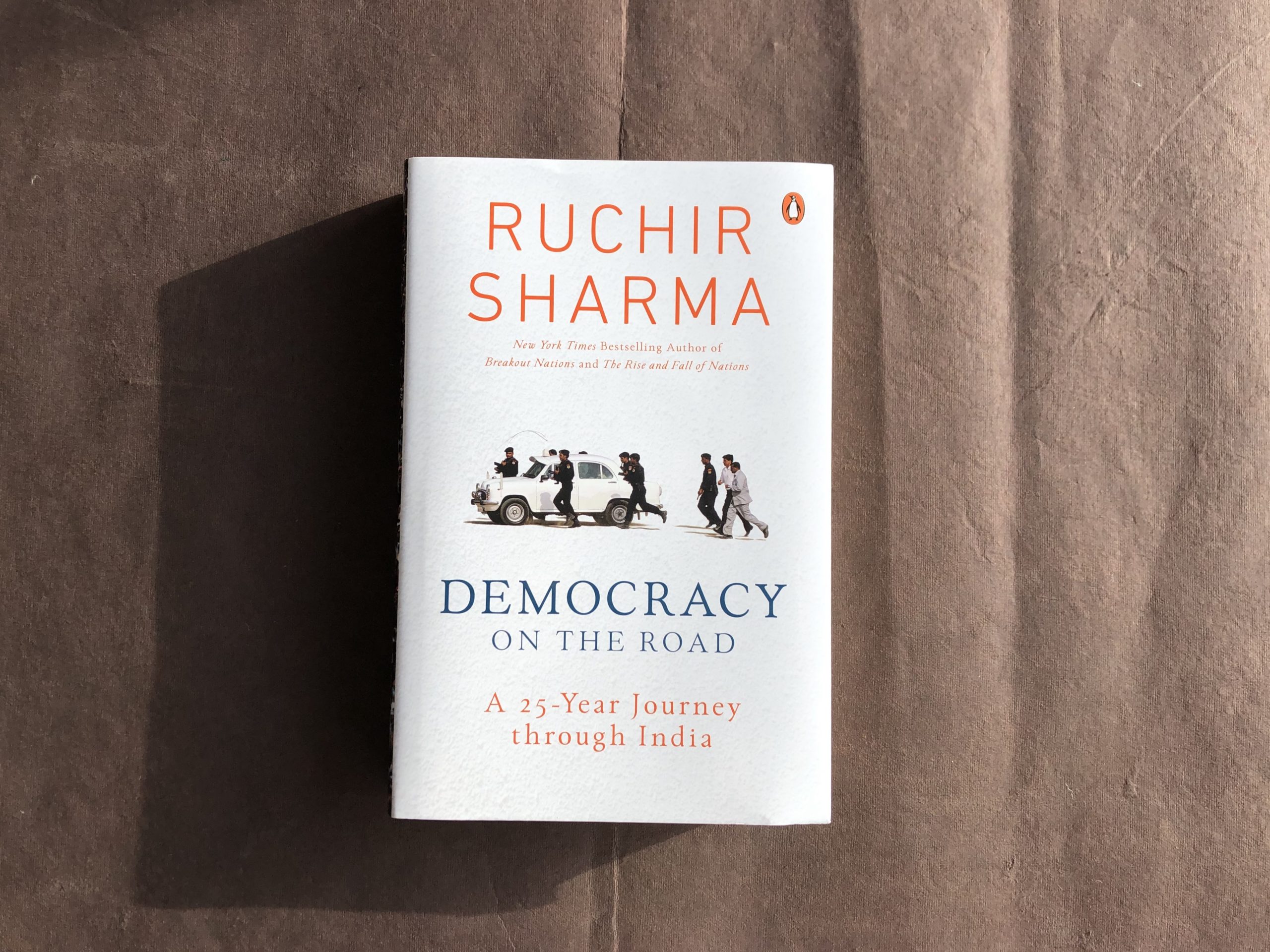
Of Marxists and Mamata – an excerpt from Ruchir Sharma’s ‘Democracy on the Road’

On the eve of a landmark general election, Ruchir Sharma offers an unrivalled portrait of how India and its democracy work, drawn from his two decades on the road chasing election campaigns across every major state, travelling the equivalent of a lap around the earth.

Here is an excerpt from Ruchir Sharma’s book, Democracy on the Road that talks about the power packed campaign led by Mamata Banerjee in May 2011.


Leading the opposition charge was Mamata Banerjee, a Bengali Brahmin who split from the Congress to form her own party in 1998 and had been railing against Marxist ‘tyranny’ for years, mostly to no avail. The Tata conflict, and a second deadly government attempt to acquire agricultural land in and around Nandigram in the district of Purba Medinipur, had given Mamata’s campaign against Marxist rule new momentum and credibility.

We saw Mamata for the first time at a rally in Kolkata, where she sprang out of the helicopter and race-walked past party supporters, a big boss in a diminutive frame, dressed austerely in a white sari with a blue border. Her bearing broadcast immediately that she had no time for the usual campaign greetings; she was a one-woman dynamo running a lifelong crusade, eager to topple communism yesterday.

A poet herself, Mamata promised not only to restore English instruction but also to bring back the poetry of Bengal greats such as Rabindranath Tagore and Kazi Nazrul Islam, and the stories of Bengal heroes like ‘Binoy, Badal and Dinesh’, which the Marxists had expunged as too bourgeois, and replaced with party-approved literature. While English is an aspirational language all over India, perhaps only in Bengal could a politician campaign on promises to restore local poetry to the school curriculum.

She promised that under her All India Trinamool Congress (TMC)—the ‘party of the marginalized’—things would be different. Bengal would have modern schools, colleges and health clinics, with no proof of party loyalty required for access. Non-party members would no longer have to travel out of state for medical treatment. Her campaign slogan promised ‘poriborton’, the Bengali spin on ‘parivartan’ or change. As interesting as what Mamata said was what she didn’t say. Neither the Congress nor the BJP had cracked 7 per cent of the vote in recent Bengal elections, and they hardly bore mention in Mamata’s speech. The caste and religious undercurrents that drive much of Indian politics barely surfaced either, since Bengal was divided mainly between Marxist party members and everyone else. Tapping popular frustration with thirty-four years of Marxist rule, Mamata’s party won in resounding fashion, taking 184 of the 294 state assembly seats, and she became the new chief minister. The Marxists finished a distant second….

Economic growth had picked up at least moderately since the communists departed. Infant mortality was falling. Construction was booming all over the capital, spilling into the outskirts. Amit Mitra, state finance minister under Mamata, told us investment was flowing into cement and fertilizer plants, small- and medium-size companies were growing rapidly and that Tata had begun to expand again in the state.

When Mamata came to power in 2011, she had fired police officials who did not toe her party line, and harassed critics who posted mocking cartoons of her on social media. She was seen as erratic, volatile, an autocrat who brooked no challenge within her own party. Mamata’s writ still ran large, but she was settling down and opening up, as the Marxists fell into disarray. During the last campaign, Mamata had refused to meet us because some of our companions had ties to leading Marxists in Delhi, but this time she called them up to the stage before a Kolkata rally and greeted them warmly.

As Mamata went on the offensive there were flashes of the old paranoia, and over the course of the campaign she would attack everyone from Modi and the media to the Election Commission and the security apparatus for conspiring against her. Her crowds lapped it up. As soon as her Kolkata rally ended and Mamata made it past her security cordon, she was mobbed by supporters, young and old, who wanted to kiss her hand, touch her feet, or receive her blessings.

Over this five-week campaign, Mamata would claim to walk 1000 kilometres in the sweltering heat of April and May to address more than 160 meetings, and while the numbers were implausible, her energy and her centrality to the TMC were not in question. The joke in Kolkata was that ‘there is only one post in the TMC and Mamata holds it. Everyone else is a lamppost.’ She was running a highly centralized government in which her word was the only one that really mattered, yet she was delivering enough to ordinary people to win them over. Many said Mamata had executed on her promises to improve roads and electricity. She had offered subsidies to bring down the price of wheat, vegetables and rice, which were selling for a few rupees per kilo. She had also given free bicycles to girls as an incentive and means to get to school, and offered wedding subsidies to young women.

In the end the TMC won easily. After five straight terms under Marxist party leaders, Bengal may simply not have been ready to throw out Mamata after one. Her personal charisma prevailed over the imploding Marxists and their opportunistic alliance with the Congress. She had mellowed, growing open enough to industry to win business support, remaining generous enough with the public purse to win votes from the poor.

Mamata was also riding the growing wave of voter support for single leaders, whose unmarried status seemed to confirm their claims of all-in devotion to public service. Among India’s twenty one most populous states, there were no unmarried chief ministers in 1988, but by 2016 there were seven, including Mamata, seemingly lifted by growing voter distaste for nepotism inside political parties, and the corruption that flows naturally from running parties as a family business. Mamata had in fact remained far more ascetic in her personal tastes than many other supremos. Even as chief minister she lived in her small ancestral home in the Kolkata neighbourhood of Kalighat. Passing by the home we were stunned to see it in a state of decay with a dilapidated grey tiled roof and rotting bamboo shafts—a stark contrast to the sandstone palaces Mayawati had built for herself in UP. Mamata’s image as a single leader with no taste for diamonds had made her largely impervious to the corruption charges that so often topple Indian governments, and helped her secure this second term.


Democracy on the Road takes readers on a rollicking ride with Ruchir and his merry band of fellow writers as they talk to farmers, shopkeepers and CEOs from Rajasthan to Tamil Nadu, and interview leaders from Narendra Modi to Rahul Gandhi.
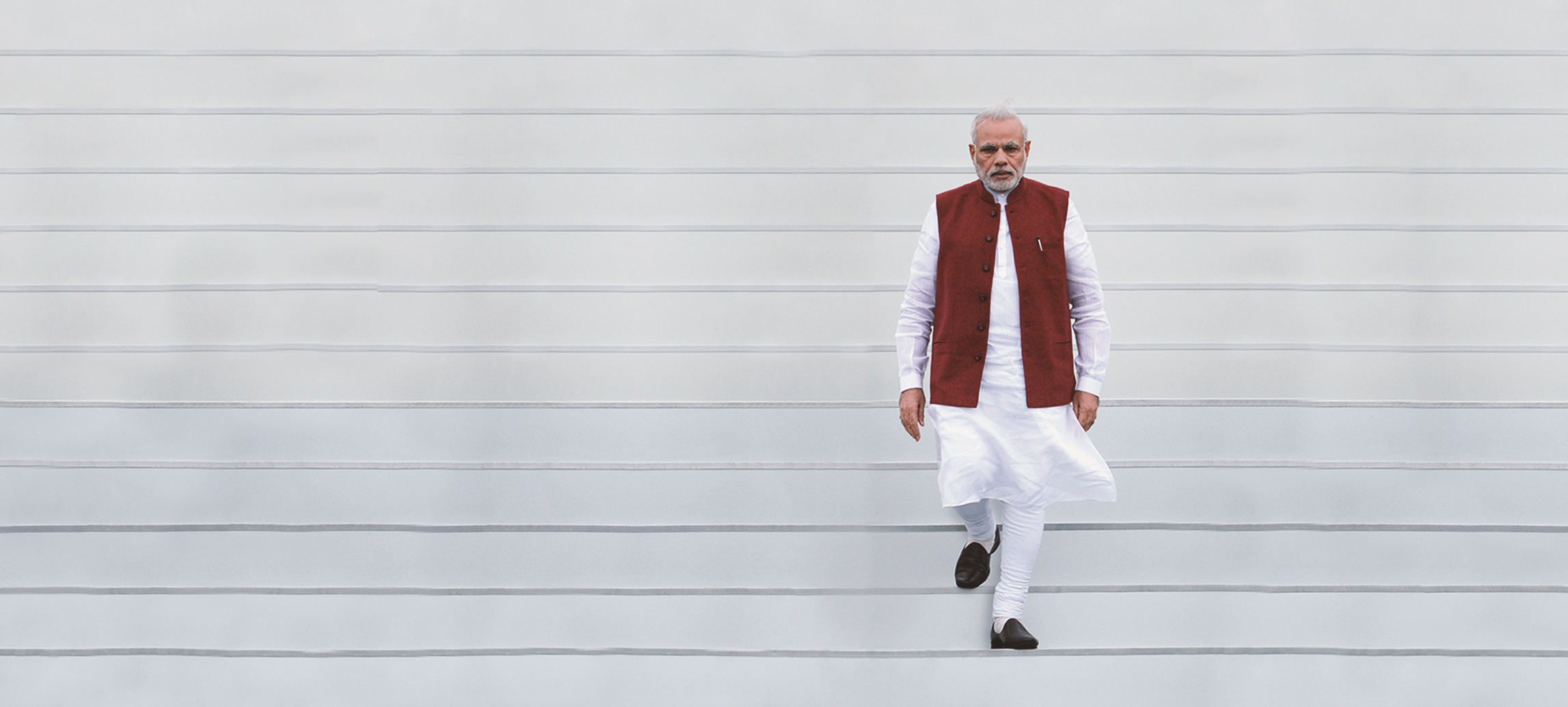

The Great Disappointment of the ‘Modifesto’: Ten Facts Proving that ‘Achche Din’ Remain a Distant Dream

As the National Democratic Alliance (NDA) government completes its current term ahead of the General Elections 2019, it is time to evaluate its performance, specifically in terms of its management of the economy.

Salman Anees Soz—international development expert, economic and political commentator and consultant at the World Bank, conducts a critical assessment of five years of the brand of economics Prime Minister Narendra Modi has championed, often referred to as ‘Modinomics’. The Great Disappointment takes a look at the rhetoric of the 2014 ‘Modifesto’ that actively denied the achievements of previous governments and announced that a government led by Narendra Modi would match their cumulative performance within its first term.

Brought into power with the biggest political mandate in almost three decades, did the NDA government succeed in gainfully transforming India’s economic trajectory or did it squander a once-in-a-generation opportunity?

A realistic look at GDP growth under Modinomics is not very promising

The 2016–17 survey notes that ‘GDP growth slipped from 7.7 per cent in the first half of 2016–17 to 6.5 per cent in the second half. Quarterly real GDP growth also shows a deceleration in the third and fourth quarters relative to the first two quarters. The slowdown in these indicators predated demonetization but intensified in the post-demonetization period.’ What that survey could not have predicted is that in the following quarter, economic activity slowed and the growth rate slumped to 5.7 per cent, the slowest pace in three years.

The much-touted tax reform failed to hold up structurally

Early on, the GST’s technology infrastructure could not keep up with the volume of transactions, and the government once again seemed unprepared for the scale of reform. It was demonetization redux and gave another major opportunity to the government’s critics to paint it as incompetent. Yashwant Sinha said that the GST ‘would make a fine Harvard University case study of everything that was wrong with the rollout of a tax reform’.

The agricultural crisis worsened in the last five years

Agricultural exports declined from US$42 billion in 2013– 14 to US$38 billion in 2017–18. They were lower in the intervening period. Agricultural imports went up by about 50 per cent during this time Interestingly, investment in agriculture (measured by gross capital formation as a share of agricultural GDP) fell from 17.7 per cent in 2013–14 to 15.5 per cent in 2016–17.

While the decline in global crude oil prices caused a reduction in fiscal deficit, oil prices for consumers in India are higher than ever

An analysis by the Mint newspaper showed that ‘almost the entire reduction of about 0.6% of the gross domestic product (GDP) in India’s fiscal deficit between FY14 and FY16 could be attributed to the sharp fall in crude prices’.  The current account balance improved. The government liberalized diesel prices sooner than anticipated on account of this sharp decline. However, instead of passing on the benefits of lower crude prices to consumers, the government retained much of the gain through progressively higher excise duties on petroleum products.

In many cases, the Modi government allegedly simply renamed its predecessor’s schemes

According to an analysis by the Quint, an online news site, the Modi government renamed nineteen out of twenty three schemes started by its predecessor, the UPA government. For example, the famous Jan Dhan Yojana is the new name of an existing scheme Basic Savings Bank Deposit Account (BSBDA). Swachh Bharat Abhiyan was originally Nirmal Bharat Abhiyan while the RGGVY (rural electrification) became DDUGJY.

One of the most touted ‘benefits’ of demonetization has evidently not materialized

There is no concrete evidence to indicate that demonetization led to a significant decline in terrorism. In fact, Prasenjit Bose, an economist, found that ‘total fatalities in terrorism-related violence in India have hardly seen any significant decline in 2017 (data till August 2017) compared to the two previous years, with violence in Jammu and Kashmir actually witnessing an escalation’.

Demonetisation has not shown a drastic increase in either direct tax collection or in the number of taxpayers

 Wilson quotes CBDT (Central Board of Direct Taxes) data to show that ‘there was an 11.6% growth in the number of income taxpayers in 2013–14, without any demonetisation. It then fell to 8.3% and 7.5% in next two years but increased to 12.7% in 2016–17 but again fell to 6.9% in 2017–18. So, the trend shows that there was no dramatic increase in the number of taxpayers.’ Wilson also notes that growth in direct taxes was much higher during the UPA’s ten years (average 20.2 per cent) as opposed to the Modi government’s four-year average growth of only 12 per cent.

Modi’s pitch to India’s youth was clear—if they voted for him, he would get them a job. Unfortunately, ground realities present a depressing picture

Total employment fell from 48.04 crores in 2013–14 to 46.76 crore in 2015–16. The failure to create jobs is becoming the biggest political challenge for the Modi government. There are constant reports in the media about the challenging jobs situation in India. The government’s response has been to latch on to questionable data on job creation to argue that India does not have an employment problem.

 The Pradhan Mantri Kaushal Vikas Yojana (PMKVY) scheme, the centrepiece of Skill India, has had negative reviews

The Sharada Prasad Committee, set up by the skill development ministry to review the performance of various sector skill councils, came out with negative reviews of the PMKVY. The committee noted that ‘no evaluation was conducted of PMKVY 2015 to find out the outcomes of the scheme and whether it was serving the twin purpose of providing employment to youth and meeting the skill needs of the industry before launching such an ambitious scheme’. In various stakeholder consultations, the committee reported that ‘all of them said in one voice that the targets allocated to them were very high and without regard to any sectoral requirement. Everybody was chasing numbers without providing employment to the youth or meeting sectoral industry needs.’

 The figures used to tout India’s GDP growth have come under the scanner after a suspicious change in methodology

India’s GDP data has been under the scanner ever since the CSO changed the methodology for calculating economic output in 2014–15. Most analysts were surprised after the publication of the new GDP series. Even the government’s chief economic adviser, Arvind Subramanian, and the then Governor of the RBI, Raghuram Rajan, cast doubt on the new CSO data. According to the Economist, investors  ‘roundly disbelieve India’s growth figures’.


Grab your copy of The Great Disappointment today!


Quotes from Marlon James’ ‘Black Leopard, Red Wolf’

Tracker is a hunter, known throughout the thirteen kingdoms as one who has a nose – and he always works alone. But he breaks his own rule when, hired to find a lost child, he finds himself part of a group of hunters all searching for the same boy.

Drawing from African history and mythology and his own rich imagination, Marlon James weaves a tapestry of breathtaking adventure though a world at once ancient and startlingly modern.

From his book are these seven quotes to give you an essence of the book.


Bi oju ri enu a pamo.

Not everything the eye sees should be spoken by the mouth.”

~

“Life is love and I have no love left. Love has drained itself from me, and run to a river like this one.”

~

“You ever see a man who doesn’t know he’s unhappy, Leopard? Look for it in the scars on his woman’s face. Or in the excellence of his woodcraft and iron making, or in the masks he makes to wear himself because he forbids the world to see his own face. I am not happy, Leopard. But I am not unhappy that I know.”

~

“A man will suffer misery to get to the bottom of truth, but he will not suffer boredom.”

~

“Truth is truth and nothing you can do about it even if you hide it, or kill it, or even tell it. It was truth before you open your mouth and say, That there is a true thing.”

~

“When kings fall they fall on top of us.”

~

“I am content with much. This world never gives me anything, and yet I have everything I want.”


Against the exhilarating backdrop of magic and violence, Marlon James explores the fundamentals of truth, the limits of power, and excesses of ambition, and our need to understand them all. Get a copy of Black Leopard, Red Wolf here!

A Feast for Rats, by Rabindranath Tagore

The Puffin Book of Holiday Stories contains a great collection of stories of brave adventures, hilarious misadventures, boisterous families, intimate friendships and facing fears that is sure to keep you entertained during your break. It features tales penned by some of the finest children’s authors, including Ruskin Bond, Sudha Murty, Paro Anand, Subhadra Sen Gupta, Nayanika Mahtani, Himanjali Sankar and more.

Here is an extract from the book, the short story titled A Feast for Rats by Rabindranath Tagore, translated by Radha Chakravarty


‘This is unfair!’ the boys complained. ‘We refuse to be taught by a new pundit.’

The new punditmoshai they were expecting was named Kalikumar Tarkalankar.

After the holidays, the boys were returning to school by train from their respective homes. One of them, a witty fellow, had composed a poem about the new pundit, called ‘Kalo Kumror Balidan’ (the sacrificial death of the black pumpkin), which all of them were reciting at the top of their voices. Just then, an old gentleman boarded the train at Arkhol station. With him he carried his kantha-wrapped bedding roll, two or three earthen handis sealed with rags, a tin trunk and a few bundles. A tough- looking boy, known to everyone as Bichkun, called out: ‘There’s no room for you here, old man. Go find another carriage.’

‘It’s too crowded,’ the old man replied. ‘There’s no room anywhere. I’ll just take this little corner; I won’t bother you at all.’ With these words, he left the bench to them and moved to a corner of the floor, where he spread out his bedding.

‘Baba,’ he asked the boys, ‘where are you all going, and for what purpose?’

‘To perform a sraddha,’ Bichkun declared. ‘A funeral ceremony.’

‘Whose sraddha is it?’ the old man enquired. ‘Kalo-Kumro-Tatka-Lanka’s’ was the reply. The boys chorused in a loud, sing-song chant:

‘Kalo-Kumro-Tatka-Lanka, black-pumpkin-green- chilli,
We’ll teach you a lesson and make you look silly!’

The train halted at Asansol. The old man got off to have a bath. As soon as he returned to the carriage afterwards, Bichkun warned him: ‘Don’t remain in this carriage, sir!’

‘Why, may I ask?’
‘It’s infested with rats.’

‘Rats! How’s that possible?’

‘Just look at the mess they made when they got into those handis of yours.’

The gentleman found that the handi full of sugary kodmas was now completely empty, and the one containing khoichur had not a grain left in it.

‘And they even ran off with whatever was inside your rag bundle,’ Bichkun added.

That bundle had contained four or five ripe mangoes from his garden.

‘The rats are famished, I see,’ remarked the gentleman with a faint smile.

‘No, no, it’s their nature to devour things even if they’re not hungry,’ replied Bichkun.

The boys laughed uproariously. ‘Yes, moshai,’ they guffawed, ‘if there had been more, they’d have eaten it up as well.’

‘I made a mistake,’ the gentleman observed. ‘Had I known there would be so many rats travelling together in the train, I would have carried some more stuff.’

The boys were disheartened to find that the old man did not lose his temper in spite of so much teasing. If he had been provoked, it would have been fun.

The train stopped at Burdwan. It would halt there for about an hour, to switch tracks.

‘Baba,’ said the gentleman, ‘I won’t trouble you any more. There will be room for me in another compartment.’

‘No, no, that won’t do. You must travel in the same coach as us. If there’s anything left inside your bundles, we will guard it together, all of us. Nothing will be lost.’

‘All right,’ the gentleman assented. ‘Get into the carriage, all of you. I’ll join you in a little while.’

So the boys got into the carriage. A little later, the sweet seller’s cart came and halted before their compartment, accompanied by the gentleman. Handing a paper bag to each of the boys, he said: ‘Now there will be no shortage of food at the rats’ feast.’

‘Hurrah!’ shouted the boys, jumping up in glee. The mango seller also arrived there, with his basket of mangoes.

There was no dearth of mangoes either, at their feast.

‘Tell us,’ the boys asked the gentleman, ‘where are you going? What will you do there?’

‘I am going in search of work,’ he replied. ‘I’ll get off wherever I find work.’

They clapped their hands, all of them, and said: ‘Come to our school then.’

‘Why would your authorities want to keep me?’

‘They must. We won’t let Kalo-Kumro-Tatka- Lanka set foot in our neighbourhood.’

‘You have put me in a difficult position, I must say! What if the secretary doesn’t approve of me?’

‘He must approve—or else we shall all leave the school.’

‘All right, then take me with you.’

The train arrived at their station. The secretary was there in person. Seeing the old man, he cried: ‘Welcome, welcome, Tarkalankar-moshai! Your house is ready and waiting.’ With these words, he bowed at the old man’s feet to offer his respects.


A version of this story first appeared in The Land of Cards: Stories, Poems and Plays for Children. Grab your copy of The Puffin Book of Holiday Stories!

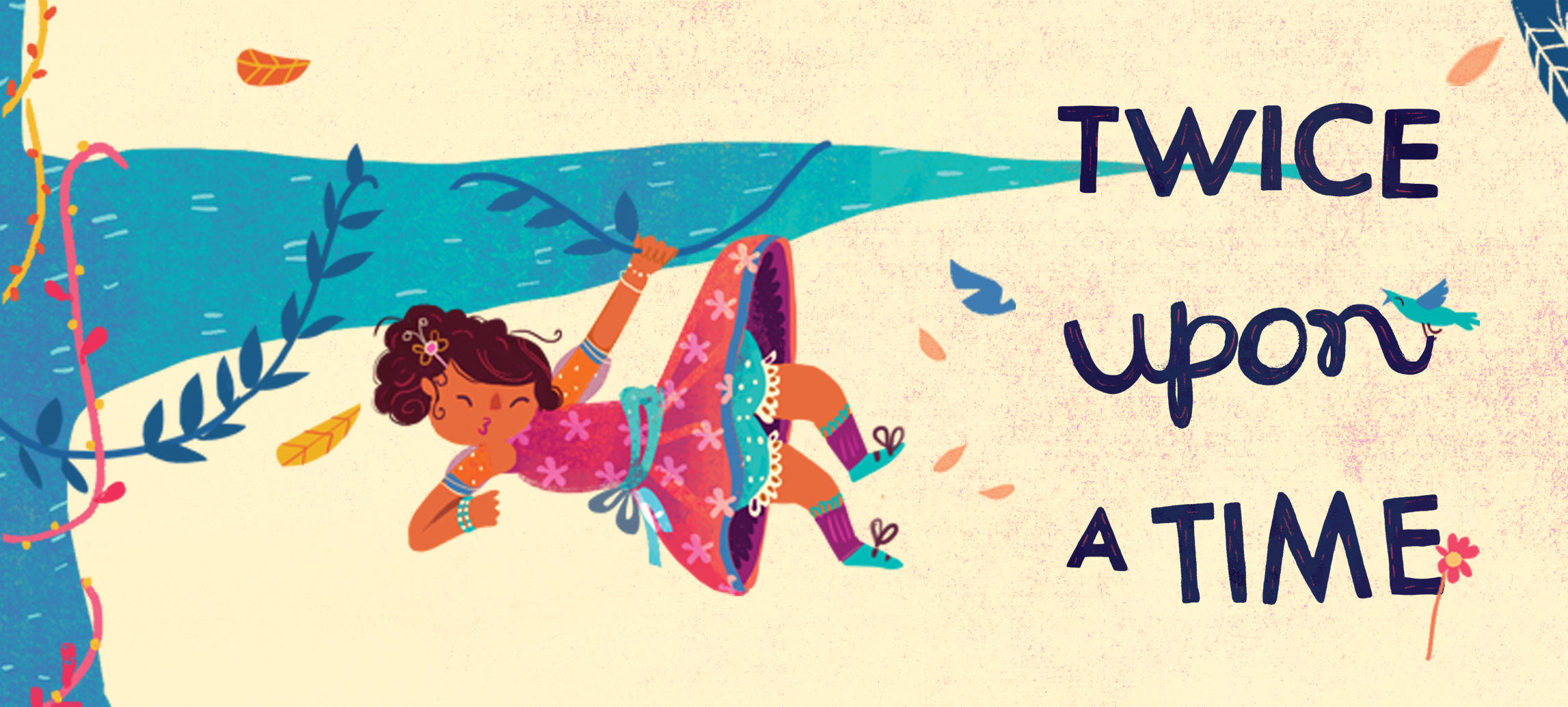
Meet the Two Spunky Princesses of ‘Twice upon a Time’

‘All princess stories are the same!’ But not this one. This is a story about two girls. Keya just happens to be a princess. Nyla just happens to be a tomboy. Both, as it turns out, just want to be themselves. When Princess Keya quits and Nyla shows up to replace her, two worlds collide. Together the girls ruffle dresses and feathers; break vases and traditions; fight dragons and boredom; grow roses and revolutions.

Here is a look at the two lovable characters of Twice Upon a Time!

Meet Princess Keya:

Princess Keya is the definition of everything pristine and perfect. Princess Keya does princessy things like any princess anywhere: She sings, dances, wears pink at all times. She throws tea parties, she embroiders, she crochets.  She can join her hands in a namaste more exquisite than a lotus bud, admire the roses in her garden and, oh yes, she bakes too. While she may not know what she wants from her life, she only knew what she didn’t want! Which is the crowd of people at her heels all day, pinning her back, pressing her legs or carrying her parasol! She wants to achieve great, heroic things such as planting a flag upon a mountaintop or trussing up the sails of a ship at the height of a storm. She wants to travel far, far away, where no one can tell her to eat, sleep or sit still.


Meet Nyla:

Nyla is a bubbly and effervescent girl with a rare indomitable spirit. Beneath the rough exterior, she is an innocent child who loves the colour pink as it reminds her of flowers and sunsets. Nyla wants to eventually make her parents proud of her and see her for the girl she is. Reading the newspaper is one of her favourite things to do. But normally disturbed by her brothers and their antics, she struggles to read and find her personal space. Dared by her brothers in a silly challenge, Nyla soon finds her way to becoming a real princess!


Boisterous, over the top and wicked funny, Twice Upon a Time is the perfect princess book for girls who have outgrown princesses.


Spring has Sprung! Books to read this April

Spring, a lovely reminder of how beautiful change can be! So try a new book, a new author: something out of the ordinary. As nature changes around you, bring a change within yourself by giving your mind and soul a new type of narrative to look forward to.

Penguin presents a new list of books this April. Take a look!

Journeys: Pages from My Diaries

Edited by Krishna Ramanujan and Guillermo Rodríguez, Journeys offers access to Ramanujan’s personal diaries and journals, providing a window into his creative process. It will include literary entries from his travels, his thoughts on writing, poetry drafts, and dreams. His diaries and journals served as fertile ground where he planted the seeds for much of his published work.


Rajneeti: A Biography of Rajnath Singh

A two-term President, Singh saw the elevation of Narendra Modi as the partys PM candidate and delivered BJPs biggest elections victory in 2014. Since then, as Indias Home Minister, he has ushered in a new phase in the countrys security where both internal and external threats have been minimised. Drawing from a vast amount of research and in-depth interviews, Gautam Chintamanis engaging narrative reveals for the first-time a politician who never shied away from doing the right thing.


The City and the Sea

Called the novelist of the newsroom, Raj Kamal Jha cleaves open India’s tragedy of violence against women with a powerful story about our complicity in the culture that supports it. This is a book about masculinity – damaging and toxic and yet enduring and entrenched – that begs the question: What kind of men are our boys growing up to be?


Re-forming India: The Nation Today

India’s social and political landscape has, in recent times, witnessed many significant transformations. This book offers a wide-ranging review of how India has, over the last few years, fared on the most critical dimensions of our collective life-politics, economy, governance, development, culture and society.


Ib’s Endless Search for Satisfaction

In this journey of sadness and self-reflection, Ib tranforms into an ordinary man from an ordinary boy and along the way, tries to figure out life and understand himself. In this audacious debut that is insightful, original and deeply disturbing, Roshan Ali’s play of language is nothing less than masterful.


Autumn Light: Season of Fire and Farewells

After his first year in Japan, almost thirty years ago, Iyer gave us a springtime romance for the ages, The Lady and the Monk; now, half a lifetime later, he shows us a more seasoned place-and observer-looking for what lasts in a life that feels ever more fragile.


Carpenters and Kings

Carpenters and Kings is a tale of Christianity, and equally, a glimpse of the India which has always existed: a multicultural land where every faith has found a home through the centuries.


Siyasi Muslims: A story of political Islams in India

We seldom debate to find pragmatic answers to these queries. Examining the everydayness of Muslims in contemporary India, Hilal Ahmed offers an evocative story of politics and Islam in India, which goes beyond the given narratives of Muslim victimhood and Islamic separation.


The Travel Gods Must be Crazy: Wacky Encounters in exotic lands

Punctuating her droll stories with breathtaking descriptions and stunning photographs, Sudha invites readers on an unexpected and altogether memorable tour around the world!


The Tiger and the Ruby: A Journey to the Other Side of British India

In 1841, Nigel Halleck left Britain as a clerk in the East India Company. He served in the colonial administration for eight years before leaving his post, eventually disappearing in the mountain kingdom of Nepal, never to be heard from again.
A century-and-a-half later, Kief Hillsbery, Nigel’s nephew many times removed, sets out to unravel the mystery.


The Doctor and the Saint: Caste, Race and Annihilation of Caste, the Debate between B.R. Ambedkar and M.K. Gandhi

In The Doctor and the Saint, Roy exposes some uncomfortable, controversial, and even surprising truths about the political thought and career of India’s most famous and most revered figure. In doing so she makes the case for why Ambedkar’s revolutionary intellectual achievements must be resurrected, not only in India but throughout the world.


The Lost Decade (2008-2018): How the India Growth Story Devolved into Growth Without a Story

India is not the star it was in 2008 and in effect, the ‘India growth story’ has devolved into ‘growth without a story’. The Lost Decade tells the story of the slide and examines the political context in which the Indian economy failed to recover lost momentum.


Once Upon a Curfew

It is 1974. Indu has inherited a flat from her grandmother and wants to turn it into a library for women. Her parents think this will keep her suitably occupied till she marries her fiancé, Rajat, who’s away studying in London.
When the Emergency is declared, Indu’s life turns upside down. Rana finds himself in trouble, while Rajat decides it’s time to visit India and settle down. As the Emergency pervades their lives, Indu must decide not only who but what kind of life she will choose.


Dare Eat That

From using sign language to haggle over ant eggs in Bangkok to being hungry enough to eat a horse in Luxembourg, from finding out the perfect eel to barbecue to discovering the best place to source emu eggs in India, Dare Eat That explores their journey to eat every species on earth, at least once!


House of Stars

Kabir follows the most beautiful girl he has ever seen into a mall. But there are gunshots and screams as terrorists storm inside after fleeing an operation gone wrong. Kabir and Diya find themselves trapped, along with other hostages. The terrorists make their demands and announce that until they are met, one person will die every hour. The situation begins to spiral out of control.  Held hostage by fate, looking death in the face, it could be Kabir and Diya’s last chance at love.


The Secrets We Keep

Rahul, an intelligence officer on a secret mission, is undercover at a major’s house. In the process, he falls in love with the major’s daughter, Akriti, unknowingly putting her in danger. To protect her, Rahul decides to hide her at his parents’ house. However, estranged from his family for years, he must first make amends with them.


Mahadev

A little girl asks who Shiva is and it is the beginning of a family journey through stories and incidents across the expanse of Shivbhumi-all the way from the mystical Mount Kailash to the fabled Ocean of Milk and the netherworld. Writing in the Harikatha style of traditional storytelling, Renuka Narayanan builds a unique narrative to draw the reader into the loving, giving world of Mahadev.


Where Will Man Take Us?: The bold story of the human technology is creating

This is a new world we are walking into. And the man who began this journey won’t be the man who ends this journey. Where Will Man Take Us? explores the changes technology is bringing about in us-as a society and as a species. What will the next generation turn into, what will it be like, how will the new Adam and Eve live and love?


Do Better with Less: Frugal Innovation for Sustainable Growth

Packed with over fifty case studies, Do Better with Less offers six proven principles that Indian entrepreneurs and businesses can use to co-create frugal solutions in education, energy, healthcare, food and finance that are highly relevant to India and the world.
This book is India’s guide to claiming global leadership in frugal innovation.


Dawood’s Mentor

In Dawood’s Mentor, Dawood meets Khalid and they eventually forge an unlikely friendship. Together they defeat, crush and neutralize every mafia gang in Mumbai. Khalid lays the foundation for the D-Gang as Dawood goes on to establish a crime syndicate like no other and becomes India’s most wanted criminal.

Welcome the Season of Spring with these Enjoyable New Stories!

Are you looking for some new summer reads for your little one? Worry not, as we have got you covered! Here is an interesting mix of books to entice your child to spend vacation days with a book in hand. Another epic summer vacation is in tow with our brand new launches!

The Jungle Radio

The Jungle Radio

When curious little Gul hears some strange sounds coming from her radio, she follows the musical clues into . . . an Indian jungle! On her walk, she finds feathered friends who TWEET, TAPP and TALK. There are some who howl and hoot, and others who play the flute. With a KEE here and a KAW there, Gul discovers songs everywhere!

Om the Gnome and the Chanting Comb

Om the Gnome and the Chanting Comb

When a gnome called Om receives a shiny comb on his birthday, little does he know that he’s going to learn an important lesson. Om the Gnome and the Chanting Comb unpacks the magic behind the beautiful sound of OM through words and illustrations that are both exquisite and inclusive. Read this book out loud to help your young ones feel light and free.


Reignited 2: Emerging Technologies of Tomorrow

Reignited 2

This groundbreaking book will provide young readers with a whole new world of ideas, inspiration and inputs from pioneers in fields that have shaped the world, helping them think out of the box and make a difference in the future. A must-have guidebook for all budding scientists who are looking to change the world through careers in science and technology!


Sunrise, Moonrise

Sunrise, Moonrise

Travel with the sun and the moon in this heartfelt picture book to find out how people from different cultures and faiths pray. Read Sunrise, Moonrise aloud to spark a discussion with your young ones about the meaning of prayer and what it can do for us.


The Puffin Book of Holiday Stories: An Anthology

The Puffin Book of Holiday Stories

This great collection of stories of brave adventures, hilarious misadventures, boisterous families, intimate friendships and facing fears is sure to keep you entertained during your break. Featuring tales penned by some of the finest children’s authors, including Ruskin Bond, Sudha Murty, Paro Anand, Subhadra Sen Gupta, Nayanika Mahtani, Himanjali Sankar and more.


Phenomenal Phonics (Fun with English)

Phenomenal Phonics (Fun with English)

Learning what sound goes with what letter can help you rhyme and make listening to and speaking in English a whole lot of fun. This book is jam-packed with fun activities for you to learn and practise listening and speaking using the right letter sounds.


Popular Proverbs (Fun with English)

Popular Proverbs (Fun with English)

A proverb a day keeps you healthy, wealthy and wise, or so they say. Proverbs are full of wisdom, but they can sometimes be a bit odd and funny too! This book is jam-packed with fun activities for you to learn and practise using proverbs.


Incredible Idioms (Fun with English)

Incredible Idioms (Fun with English)

Idioms are great! They’re funny and sometimes silly, and make language so much more interesting to read and listen to. Get ready to find out all about idioms on different themes like animals, clothes, food and colour. This book is jam-packed with fun activities for you to learn and practice using idioms.


Perfect Punctuation (Fun with English)

Perfect Punctuation (Fun with English)

Punctuation is just a big word for a lot of little dots and dashes! If you’ve ever been confused by commas, semicolons, colons, periods and all the rest, get ready to learn how easy they can be. This book is jam-packed full of great activities for you to learn and practise using punctuation. For ages 7+.


Wondrous Words (Fun with English)

Wondrous Words (Fun with English)

Words, words, words. Words that sound the same and mean different things or mean the same thing but sound different; words that are noises and words that have silent letters…there are just so many different kinds of words in English! This book is jam-packed with fun activities for you to learn and practise using new and interesting words.


Fantastic Figures of Speech (Fun with English)

Fantastic Figures of Speech (Fun with English)

Do you find figures of speech somewhat flummoxing? Don’t worry, alliteration, metaphor, simile, personification and all the rest are just different ways of making language entertaining to read and write. This book is jam-packed with fun activities for you to learn and practise using figures of speech.

Aspects of Shiva that we can use in our Daily Life

Shiva led a life of contradictions, unmitigated wonder and beauty. When faced with difficulties, he had to tread gently, take a deep look into himself, sometimes go against his inherent nature, and change, when need be.

In the earliest and rather scant appearances, Shiva seems to have been a marginalized deity among the pantheon of gods, and yet he has become one of the most ubiquitous.

The Reluctant Family Man is a study of reflection, introspection and the necessity for taking responsibility through the life of Shiva.

Here are some aspects of Shiva’s life that we can use in our daily life.


Sati is Shiva’s first spouse, and with both his spouses, he has memorable exchanges and dialogue, illustrating the caring, sharing, quarrelling and forgiveness evident in these associations.

~

The salubrious nature of marital squabbling is shown constantly in Shaivic myths. The fights are remarkable,where both parties threaten, browbeat and try to convince each other so that they can, eventually, come to a rapprochement.

~

Shiva challenges conventionally prescribed gender norms and the patriarchal notion of a man having to always appear strong and resolute. Instead, he weeps copiously, wretchedly mourning his dead wife without caring what the world might think. His vulnerability and pathos are on full display.

~

What is pleasantly surprising is the fact that Shiva can handle such a strong, almost insouciant wife (Parvati). In fact, Shiva is the only god who has an outspoken wife and perhaps the only deity who does not try to be dominant. Only a self-confident male can coexist with such a female.

~

Loving spouses can repeatedly challenge each other if the marital relationship is to serve the function of promoting the mental growth of partners. Shiva and Parvati certainly don’t believe in the silent treatment that many couples have been guilty of from times immemorial. If something troubles them, they address it right away.

~

Through Shiva’s attitude towards his wives, we can see him managing his ego. He is the great yogi, the great knower, and although he knows how to play supreme lord and master to an adoring Parvati, he also knows how to give in when she is his spouse and submit totally to her in her form as Devi.

~

Do not put all your eggs in one basket. Have your own independent relationships other than the one you share with your partner. Shiva is known to go off with his cronies and partake of a relaxing hallucinogen, and indulge in ‘alone time’ and meditation. Parvati has her friends, Jaya and Vijaya, who help her in her ablutions and other aspects of life. They both also have their own ‘portfolios’ in the celestial world and keep very busy, away from each other. They give each other, as they say in today’s times, ‘space’.

~

In a rather unique manner, Shiva epitomizes balance in his life choices, because not only is he Mahayogi, an ascetic, he is also Shankara, the beneficent married one. He balances two opposites.


In The Reluctant Family Man, Nilima Chitgopekar uses the life and personality of Shiva-his self-awareness, his marriage, his balance, his detachment, his contentment-to derive lessons that readers can practically apply to their own lives.

5 Things You Need to Know About GST’s Impact on the Common Man

On 1 July 2017, Goods and Services Tax (GST) became a reality. The government hailed it as the biggest tax reform of independent India which would herald a new freedom for the nation and unify it with ‘One Nation One Tax’. Some of the claims made by the government were that GST would bring about ease of doing business; increase tax collection; lower inflation; increase GDP growth by 1-2 per cent; and check the black economy.  More than a year later, we have more questions than answers.
Why did the economy slow down? Is the government likely to collect more taxes? Why have prices continued to rise? Why has Malaysia withdrawn GST?

It turns out that problems with GST are both transitional and structural. To correct for these there have been a few hundred notifications and orders from the government which have added to the confusion.
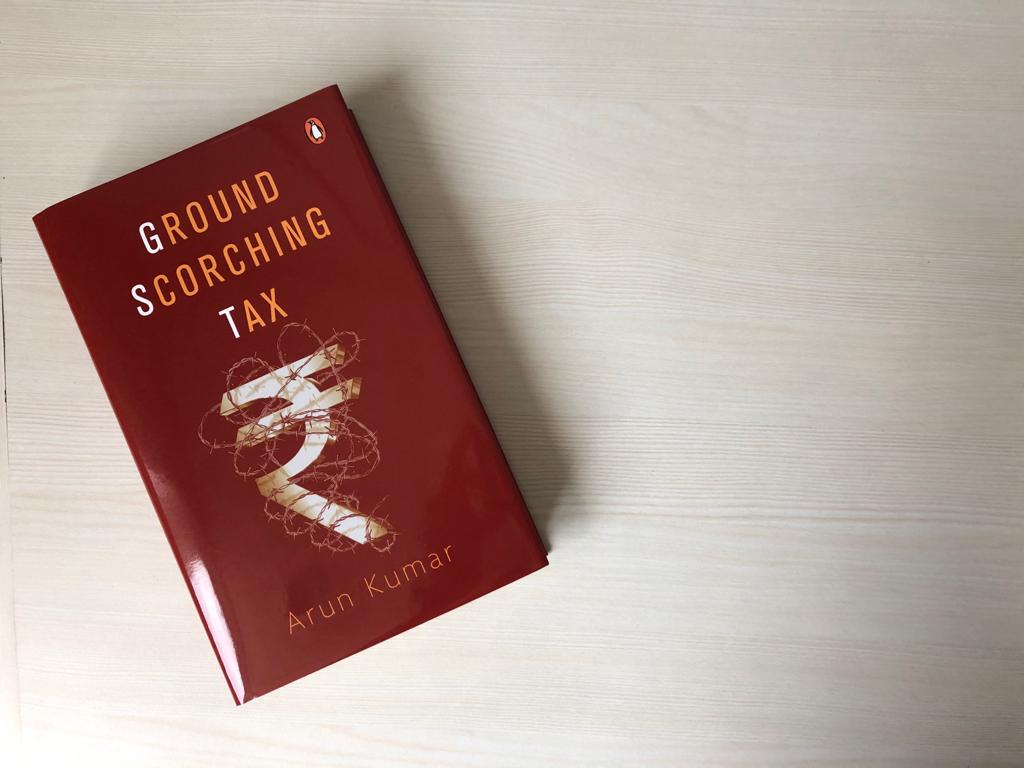
In Ground Scorching Tax, well-known economist and India’s leading expert on the black economy, Arun Kumar systematically and lucidly explains the reality behind GST, demystifying this complex tax for ordinary citizens.

Known for not pulling any punches, the author explains why GST is truly a ‘ground scorching tax’ and  a double-edged sword for the common man, why it will increase inequality across sectors and regions, why it will hurt small businesses – everything the government does not want you to know.

He also proposes an alternative which will convert this tax into a `Ground Nourishing Tax’.

Read on to learn how the common man is affected by the ‘Ground Scorching Tax’


The unorganized sector employs the vast majority of the workforce so the setback caused to this sector by the GST renders a large number of people unemployed and lowers the overall real wage rate

GST and digitization accelerate this ongoing process of marginalization of the unorganized sectors. As pointed out in the previous section, marketization marginalizes the weak in the market—it favours the large over the small businesses. While in economic terms this may seem to be ‘efficient’ with growth being fuelled by the large scale sector, it leads to growing inequality which has political and social implications. Since it is the unorganized sector that employs the vast majority of the work force, any setback to this sector leads to growing under employment and crisis in the lives of these people. With the growth of the organized sector, while wage rate may rise, employment available declines since the large and medium sectors are far more automated than the small sectors. Thus, the overall wage received by workers would fall. The purchasing power of those employed in the unorganized sectors and of workers as a whole would decline. (p. 186)

 ~

Small businesses are financially affected by not being able to receive or offer Input Tax Credit.

The concern for the small suppliers led to their being exempted from registration under GST. So, suppliers with turnover of up to Rs 20 lakh have been exempted. But they will not be able to get input credit (ITC) and if they sell to any other business they cannot offer ITC. A very big disadvantage indeed. Similarly, those with a turnover between Rs 20 lakh and Rs 1 crore will fall under the Composition Scheme and will neither get ITC nor be able to offer ITC. They would also not be able to make inter-state sales. Further, the tax that they should have paid under GST but did not pay since they are exempt will have to be paid by the business purchasing from them. This is the reverse charge mechanism (RCM). Thus, the purchasers’ cost would go up. (Pp. 103-4)

(Subsequently, due to changes announced, units with turnover up to Rs.40 lakh are exempt from registration and the limit for Composition Scheme has been raised to Rs.1.5 crore)

~

Some of the GST rates are higher than the rate they were paying under the earlier system which has increased prices and expenses for the common man

The GST rate on goods and services have been fixed close to the rate they were already paying under the old regime. So, if some good was being taxed at the rate of say, 15 per cent then it was moved largely to 18 per cent under GST. Most services were at the rate of 15 per cent and that has increased to 18 per cent. This has proved to be inflationary. (p. 104)

 ~

Since indirect taxes are applied on goods and services consumed, they affect all sections of society unlike direct taxes which are collected from those who are well off and can afford to pay it. Indirect taxes are also regressive as they typically result in the impoverished sections paying a greater proportion of their income then the well off. The overwhelming focus on GST and indirect taxes as opposed to direct taxes is antithetical to the interests of the common man.

It was argued that indirect taxes are stagflationary while direct taxes are the opposite and hence more desirable. Thus, it would have been more desirable for the nation to collect more of direct taxes than indirect taxes. In 2005, the UPA I government had also talked of the need to introduce the direct tax code (DTC) to reform direct taxes. However, little headway has been made in that direction. The emphasis has been on GST and collecting more of indirect taxes—indicating a political bias. It was also shown that indirect taxes tend to be regressive while the direct taxes can be progressive. Thus going for more collection of indirect taxes increases the regressive component of India’s tax system. It also does not put greater pressure to tackle the black economy and collect more of direct taxes. Again this benefits the elite sections of society. They can continue to earn large sums of incomes through the black economy on which they do not have to pay taxes. (p. 172)

 ~

 The local bodies have been deprived of their sources of revenue from taxation under the new regime.

As some of the important sources of revenue of local bodies (like Octroi and entertainment tax) have been absorbed in GST, they needed to be also provided with independent source of revenue. This has not happened. There is no mention of devolution to the local bodies. It is not clear whether the Centre or the states are to pass on a share of the resource. (p.190)


In Ground Scorching Tax, well-known economist Arun Kumar explains the reality behind GST.

Eight Inspirational Intrapreneurs from ‘Jugaad 3.0’

DIYer n. A disrupt-it-yourselfer; a Jugaad 3.0 innovator; an employee who acts and behaves more like an entrepreneur in the context of an established organization

Dr. Simone Ahuja – consultant, author, speaker and entrepreneur, is the CEO of Blood Orange where her mission is to empower innovators in large organizations and mobilize them with entrepreneurial tools for a single purpose: to transform the corporate culture from the inside out using design and lean principles. In Jugaad 3.0 Hacking the Corporation, she shifts the focus from ‘entrepreneurs’ to ‘intrapreneurs’, the incredible ‘corporate hackers’ who tap into and around the bureaucratic machinery surrounding them to advance their projects. Or we could call them ‘constructive disrupters’,since today’s intrapreneurs often seriously challenge existing business from product offering to business model, yet they do it actively from the inside and, by doing this, help keep the enterprise viable.

Based on hundreds of interviews, as well as the author’s consulting work within companies, Jugaad 3.0 Hacking the Corporation identifies the competencies these corporate hackers possess. It also offers a spectrum of carefully crafted archetypes to help people see themselves in this trend and allow organizations identify the innovators in their midst.

Read on to learn more about eight inspirational intrapreneurs whose passion and innovation transformed organizations from within-


Balanda Atis —As a chemist formulating mascara at L’Oréal USA, she set her sights on formulating foundations that did not look ashy on darker skins.

“Although Atis and her colleagues were not freed from doing their day jobs, L’Oréal gave the trio access to a lab. Fuelled by passion and purpose, they produced and tested foundation samples on their own time. Lacking opportunities for data collection, they tagged along on trips to existing conferences and fairs across the country, collecting skin tone measurements from thousands of women of colour. The big breakthrough came when Atis discovered they could work with an existing colour compound. Ultramarine blue was seldom used in cosmetics and difficult to work with, but it allowed them to create richer, deeper shades without the muddy finish that was so common in existing darker foundations. Atis and her tiny team succeeded in satisfying a massive customer need that had existed for generations.”


Ravi Ramaswamy— He led the innovation team behind the Efficia ECG100 an easy to use ECG after realizing that resource-constrained settings needed medical systems should not only be easy to buy but also easy to use and did not require expensive specialized training.

“The prototype exceeded everyone’s expectations. What is now a diagnostic-quality electrocardiogram started with the team’s purchase of an off-the-shelf mobile device. Any Android phone or tablet could act as the user interface after the simple installation of an app. The team’s energies went into making an ECG acquisition box that was just as compact (the finalproduct weighed fewer than ten ounces) and intuitive to use. ‘We worked on it for about six to eight months,’ Ramaswamy recalled, before asking for a meeting with Philips Healthcare’s business unit leader. After hearing the idea and trying out the prototype, the executive said: ‘This is a fantastic product. It’s going to be the pathway to the future.’ Ramaswamy reported that ‘from then on, there was no looking back. We had the complete support of the business unit in terms of driving this model.’”


TOYOTA US TEAM—They worked on the margins of Toyota’s organization to redevelop the Toyota Avalon.

“Take the wholesale redevelopment of the 2013 Toyota Avalon. Led by designers and engineers working far from the company’s Japanese headquarters, the initiative was culture defying for Toyota. When the US-based team told their story to industry analyst Mark Phelan, they stressed that they ‘worked in the margins of Toyota’s playbook, following the old adage that it’s better to beg forgiveness than permission’”


Doug Dietz—After seeing the discomfort of young children getting CT scans, he developed the GE Adventure Series—which involves turning dark, scary CT scanning tunnels into inviting storybook hideaways for young patients.

“First, it was by visiting a customer’s facility—the paediatric oncology department of a major hospital—that industrial designer Doug Dietz recognized a customer problem crying out for a better solution. He tells the story of how he had just finished working on a CT design project and thought he’d done a wonderful job. He was very proud of himself, and in 2005 he went to one of the hospitals where the equipment was being installed for the first time. But it only took an hour of observation for him to realize how reductively he had pursued his mission. The first people he watched interacting with the new machinery were a family with a young child. The child was so terrified by the machine that she needed to be sedated. Dietz had to be there to get that the key to better outcomes—including better image capture, higher machine utilization and better patient experience—was decreasing the need for sedation. It wasn’t just about making machines more capable; it was about making children—and families—more comfortable.”


Lars Kolind—His spaghetti organization at Oticon allowed employees across the board to choose projects according to their skills or as an opportunity to develop new skills, and share equal responsibility for projects.

“Going back even further to 1990, an executive named Lars Kolind arrived at the Danish company Oticon with a bold new structural idea he called ‘the spaghetti organization’. If you think about the clean boxes and lines on the traditional command and- control organization chart, and then you think about what happens to those lines in a Holacratic or Hollywood system, you see where he got his metaphor. To the great surprise of the engineers working on Oticon’s innovative hearing aids, asvwell as all its functional groups from finance to sales and from HR to PR, Kolind in one fell swoop did away with everyone’s job title and moved them all from their accustomed offices and desks too. Most important, he told them that it was up to them now to decide where their talents could be best applied. No one would be assigned to projects where they would receive topdown mandates from project bosses.”

 
Kishore Biyani—His innovative intra-organization recruitment to create more ‘Kishore Biyanis’ for leadership roles.

“In January 2016, he put the call out across his organization for applicants interested in those leadership roles. Already, this was unusual, since the recruiting did not look outside FCL’s walls: this was a campaign, called Ban Jao Biyani, run wholly within the organization. More interesting still, having received 450 applications from employees, he and his team then ‘shortlisted’ fifty applicants, and put them through a boot camp where they were ‘trained on management aspects and asked to present a business plan for the brand they had bid for’. This was, in effect, the kind of competition some organizations today host for proposed innovation projects—but in this case, it was not intrapreneurial ideas but the intrapreneurs themselves who were being chosen for further development and investment.”


SHARMILA SAHA AT Mindtree—Mindtree’s programme

‘5 X50’ chose five intrapreneurial projects, each of which was judged to have the potential to grow to $50 million in revenues. The five were carefully selected through a competitive process and the winning teams were given the full support of an incubator-style experience of mentoring and resource provision.

“A quick win from that programme was a new line of business: Mindtree’s Digital Surveillance unit, launched in 2013. The team behind it, led by Sharmila Saha, was driven by the new market demand for better public-space surveillance technology in the wake of high-impact terrorist attacks, seen on a global scale by the 11 September 2001 attacks in the United States and the Mumbai attacks of 26 November 2008. It saw that potential clients like US Homeland Security were struggling with conventional CCTV feeds, which required hours of tedious monitoring, and thought it could come up with next-generation capabilities. Prior to the 5 X 50 initiative announcement, Saha and four colleagues had been working for half a year on the concept, which features audio-video analytics and real-time updates. Winning the competition meant that Mindtree invested about $1.5 million (about Rs 9 crore) to incubate it to the point where it was ready for its first client, the Bangalore City Traffic Police.”

Babak Forutanpour—He found himself the accidental founder of a movement Qualcomm. The group acquired a name—FLUX, for ‘forward-looking user experience’.

“This is what Babak Forutanpour was up against as a software engineer at Qualcomm circa 2004. Once he was onboarded and unpacked his laptop, he realized there was no suitable place to bring a new idea to have it vetted and considered for development. ‘No one was listening, and my boss didn’t even want to brainstorm,’ he recalled. Eventually he was so desperate for a sounding board that he pulled together a ‘little biweekly luncheon’ with like-minded people outside his usual circle. ‘If nothing else,’ he figured, they could all ‘eat a ham sandwich with someone interesting’. But that initial group quickly decided to go beyond the sandwich and try to accomplish something more substantial together. In short order they came up with a cool new technical solution for reducing ambient noise. After a thorough vetting of prototypes by subject-matter experts, a patent that eventually produced real value for Qualcomm was applied for and awarded.”


For more, get a copy of Jugaad 3.0!

error: Content is protected !!