Publish with Us

Follow Penguin

Follow Penguinsters

Follow Penguin Swadesh

Journey through India’s Diversity with these 10 Penguin Books!

Step into the world of India’s most powerful stories with Penguin. Through these 10 books, you’ll meet individuals who have broken barriers, stood up against injustice, and shown remarkable strength. These stories highlight the diversity of experiences in India, offering a glimpse into the lives, struggles, and victories of those often overlooked. Discover voices that challenge stereotypes, confront injustices, and inspire change in our society.


Keedajadi/कीड़ाजड़ी
Keedajadi/कीड़ाजड़ी || Anil Yadav

क्या आप जानते हैं कि पिंडर घाटी कहाँ है, जोती कौन है, वहाँ की ज़िन्दगी, धाराएँ और ऊँचाइयाँ कैसी हैं?
क्या आप जानते हैं कि पर्वतारोहण के रोमांच भरे खेल का रास्ता किन लोगों की पीठ पर से होकर गुज़रता है?
एक आदमी पहाड़ की बिन बिजली.सड़क.मोबाइल वाली घाटी में प्राइमरी के बच्चों को पढ़ाने जाता है जो दानपुरी बोली और हिन्दी भाषा के बीच पड़ने वाले जंगल में फँसे हुए हैं। यहाँ फसले हँसिया युग से पहले के औज़ारों से काटी जाती हैं, मुसाफ़िरों के भूत दर्द से फटते पैर सेंकने के लिए नमक और गरम पानी मांगने आते हैं, बादल मासिक.धर्म के कारण फटते हैं, भगवान भक्त को अपना मोबाइल नम्बर दे जाते हैं, बच्चे थाली में बैठकर बर्फ़ पर स्कीईंग करते हैं, जवान अपने खेत नहीं पहचानते और सपने, मैदानों के जैसी बराबर ज़मीन पर चलने के आते हैं।
तीन ग्लेशियरों के तिराहे पर बसी इस घाटी में भटकते हुए वह धीरे.धीरे कीड़ाजड़ी निकालने वालों, आदिम पर्वतारोहियों, स्मगलरों, दलालों, अनवालों और जागरियों के संसार में खो जाता है। वह हैरान आँखों से देखता है कि कामेच्छा, ‘विकास’ की लीला वहाँ भी रच सकती है जहाँ पहुँचने में सरकारें भी झेंपती हैं।
अनिल यादव का एक ट्रैवलॉग वह भी कोई देस है महराज दस साल पहले आया था। अब पिंडर नदी के धगधग प्रवाह जैसा यह दूसरा . . .


Dalit Crorepati 15 Prernadayak Kahaniyan
Dalit Crorepati 15 Prernadayak Kahaniyan || Milind Khandekar

ये कहानियाँ बताती हैं कि कैसे एक समय टूटी हुई निब बदल पाने में अक्षम अशोक खाड़े की कंपनी दास ऑफशोर आज बॉम्बे हाई में तेल निकालने वाले कुएँ के प्लेटफॉर्म बनाती है। किस तरह कल्पना सरोज ने बंद पड़ी मुंबई की कमानी ट्यूब्स को मुनाफे में ला दिया। कभी मजदूरी करने वाले आगरा के हरी किशन पिप्पल अस्पताल चलाते हैं, और अहमदाबाद की सविताबेन कोलसावाला टाइल्स बनाती हैं, जबकि भावनगर के देवजीभाई मकवाना फिलामेंट यार्न। दलित करोड़पति में ऐसे 15 लोगों की कहानियाँ हैं, जिन्होंने पिछले कुछ सालों में करोड़ों का कारोबार खड़ा कर लिया है। उनकी कहानियाँ यह दिखाती हैं कि उन्होंने कैसे रोड से करोड़ों तक का सफर तय किया। ये कहानियाँ हैं—संघर्ष और सफलता की, सीमाओं के बंधन और उनके टूटने की, जाति और पूँजीवाद की। ये हमें उस जातीय भेदभाव के बारे में भी बताती हैं, जो रोजमर्रा के शहरी जीवन में समाज के सबसे निचले पायदान पर खड़े लोगों को झेलना पड़ता है। ये उनकी ताकत, साहस और लगन के बारे में बताती हैं, जो सारी रुकावटों के बावजूद ऊपर उठ सके और उन लोगों के लिए एक मिसाल बन गए, जिनमें आगे बढ़ने और सपने देखने का साहस है। —सुरिंदर जोधका समाजशास्त्री, जेएनयू.


Omprakash Valmiki ki Yaadgari Kahaniyan
Omprakash Valmiki ki Yaadgari Kahaniyan || Omprakash Valmiki

स्त्री को पुरुष समाज कितना भी कमज़ोर समझे, लेकिन वह कमज़ोर नहीं है। ओमप्रकाश वाल्मीकि ने अपनी कहानियों में ऐसी ही अदम्य साहस से परिपूर्ण स्त्रियों का चित्रण किया है। वाल्मीकि जी की कहानियों में सिर्फ दलित चिंतन ही नहीं है बल्कि स्त्री शोषण, अत्याचार आदि पर भी उनकी लेखनी उतनी ही पैनी है, जितनी दलित शोषण और चिंतन को लेकर। अपनी कहानियों के माध्यम से वाल्मीकि जी ने समाज तथा परिवार में हो रहे स्त्री शोषण का बहुत ही बारीकी से चित्रण किया है। इनकी कहानियों में स्त्री पात्रों तथा उनके शोषण को पढ़कर ऐसा लगता है कि ये स्त्री चरित्र सिर्फ वाल्मीकि की कहानियों का ही प्रतिनिधित्व नहीं करतीं, बल्कि हमारे समाज की अधिकांश स्त्रियों का प्रतिनिधित्व करती हैं। जो हमेशा इस समस्या से टकराती है। यह समस्या हमारे समाज में कोढ़ की तरह है जो दिन पर दिन घटने के बजाय बढ़ती जा रही है। हम 21वीं सदी के प्रांगण में प्रवेश तो कर गए हैं लेकिन स्त्री के प्रति हमारा जो नज़रिया है वह आज भी पुरातन वाला है। समाज के नज़रिए का प्रतिरोध करती वाल्मीकि जी की ये यादगारी कहानियॉं अपने आपमें बेजोड़ हैं।


The Truth About Me
The Truth About Me || A Revathi, REVATHI A

Revathi was born a boy, but felt and behaved like a girl. In telling her life story, Revathi evokes marvellously the deep unease of being in the wrong body that plagued her from childhood. To be true to herself, to escape the constant violence visited upon her by her family and community, the village-born Revathi ran away to Delhi to join a house of hijras. Her life became an incredible series of dangerous physical and emotional journeys to become a woman and to find love. The Truth about Me is the unflinchingly courageous and moving autobiography of a hijra who fought ridicule, persecution and violence both within her home and outside to find a life of dignity.


Seeing Like A Feminist
Seeing Like A Feminist || Menon Nivedita, Nivedita Menon

THE WORLD THROUGH A FEMINIST LENS
For Nivedita Menon, feminism is not about a moment of final triumph over patriarchy but about the gradual transformation of the social field so decisively that old markers shift forever. From sexual harassment charges against international figures to the challenge that caste politics poses to feminism, from the ban on the veil in France to the attempt to impose skirts on international women badminton players, from queer politics to domestic servants’ unions to the Pink Chaddi campaign, Menon deftly illustrates how feminism complicates the field irrevocably.
Incisive, eclectic and politically engaged, Seeing like a Feminist is a bold and wide-ranging book that reorders contemporary society.

A Brief History of the Present
A Brief History of the Present || Hilal Ahmed

A Brief History of the Present attempts to go beyond the obvious to rethink the role of minorities, specifically Muslims, in the ‘New India’ that has revealed itself since 2014. By diving deep into the complexities of Muslim identity and its role in everyday life while at the same time viewing the Muslim communities through a historical lens, the author attempts to provide a far more accurate picture of Indian Muslims than what is perceived currently.

Terminal 3: A Graphic Novel set in Kashmir
Terminal 3: A Graphic Novel set in Kashmir || Debasmita Dasgupta

It’s August 2019 and Khwab Nazir is waiting to board the plane at Terminal 3 of New Delhi International Airport. Set to represent India at an international jiu-jitsu tournament, Khwab nervously looks towards her unknown future. She also reflects on her complicated past-of growing up against the insurmountable difficulties of life in Kashmir.

Between happiness and emptiness, desire and grief, penance and peace-Khwab has endured. She has a dream that life will be a paradise, one day. Breathing against the backdrop of conflict, Terminal 3, is the story of the everyday people striving to live their dreams in the Valley.


Bipathu and a Very Big Dream
Bipathu and a Very Big Dream || Anita Nair

When school reopens in the village of Kaikurussi after the pandemic lockdown, nine-year-old Bipathu makes new friends-Madama, a blind lady who has moved to the village, Maash, a neighbour, Rahul, a boy who loves football as much as she does, and Duggu, a rescued puppy. When Madama gifts Bipathu’s brother Saad, a special needs child, a pair of braces, Bipathu starts believing in the power of the universe. So, when Suleiman, the class bully, roughs up Rahul to prevent him from training for the football match selections, Bipathu looks to the universe for help.
While Bipathu and Saad, along with Duggu, help Rahul ace up his game, will her own dream of playing football ever come true?

When Blackbirds Fly (Not Our War series)
When Blackbirds Fly (Not Our War series) || Hannah Lalhlanpuii

Life is sweet growing up in Aizawl, with his family and friends, and all the narrator wants is a peaceful life. But the independence movement in Mizoram means that regardless of what he wants, he is drawn inexorably into a world where everyone has to choose where they stand …
Set in the initial stages of the two-decade-long struggle for Mizoram’s independence and against the backdrop of the 1966 bombing of Aizawl, this stunning debut novel is an universal story of how individual dreams and lives are shattered when larger conflicts arise.


Unfair
Unfair || Rasil Ahuja

Auditions are on for the seventh grade annual play. Lina sets her heart and sights on the lead role, but the drama teacher seems to think Lina isn’t the right shade for the part. All Lina wants is a #FAIRCHANCE to try out for the role. Will narrow-minded Miss Deepa derail Lina’s dream?

Meher finds maths far more interesting, and less dramatic, than Macbeth. When her extroverted BFF Lina suddenly becomes distraught and withdrawn, Meher tries to figure out what she may have done wrong, but things just don’t seem to add up. Will their friendship fade or will Meher find a solution to this problem and score #FRIENDSHIPGOALS?

Check Your August Book Cart – Here’s What’s New!

As the monsoon rains sweep across India, August arrives not just with showers but with the spirit of freedom and celebration. This month, as we commemorate India’s Independence, there’s a delightful collection of new books perfect for cozying up indoors. Whether you’re in the mood for exciting thrillers, inspirational self-help, or simply want to experience the magic of romance, these new releases have something for every reader.

Celebrate the monsoon and the spirit of independence with a good book!

Naam, Namak, Nishan 2
Naam, Namak, Nishan 2 || Anurakshat Gupta, Arnabh Sengupta, Hitesh Mahato,

Did you know that an IAF officer commanded the Ghana Air Force as its first air chief?
Or that the Teen Murti Memorial honours Indian soldiers from the princely states of Jodhpur, Hyderabad and Mysore who fought in World War I?
Or that an iconic Indian military vehicle’s name is actually an acronym honouring its city of origin?
Or that a British lady anthropologist once led an intelligence-gathering guerrilla unit in the North-east and was called the ‘Queen of the Nagas’?

Find out the answers to these and more in Naam, Namak, Nishan 2, the much-awaited sequel to Naam, Namak, Nishan—India’s first quiz book on Indian military trivia that connects the Indian Armed Forces to more topics, exploring trivia in new, engaging formats. Written by a team of quizzer-doctors from the Armed Forces Medical College, Pune, this is military history like you’ve never read before.

A Brief History of the Present
A Brief History of the Present || Hilal Ahmed

A Brief History of the Present attempts to go beyond the obvious to rethink the role of minorities, specifically Muslims, in the ‘New India’ that has revealed itself since 2014. By diving deep into the complexities of Muslim identity and its role in everyday life while at the same time viewing the Muslim communities through a historical lens, the author attempts to provide a far more accurate picture of Indian Muslims than what is perceived currently.


A Woman on a Suitcase
A Woman on a Suitcase || Shazaf Fatima Haider

Newly married Seema Hyderi is tired of being thrown out of her husband’s house. Now, sitting on her suitcase after a third eviction, she has a choice to make: obey her husband and submit, or listen to her instinct and leave forever.

The consequences of her decision will take Seema on a journey: from a world of unloving mothers and manipulative matchmakers to new avenues filled with anxiety, exploration and pleasure. In delightful prose filled with wicked humour and immense pathos, Haider takes Seema and her suitcase on a rollercoaster ride from Karachi to London and back again.


Bird Milk and Mosquito Bones
Bird Milk and Mosquito Bones || Priyanka Mattoo

Priyanka Mattoo was born into a wooden house in the Himalayas, as were most of her ancestors. In 1989, however, mounting violence in the region forced Mattoo’s community to flee. The home into which her family poured their dreams was reduced to a pile of rubble.

Mattoo never moved back to her beloved Kashmir—because it no longer existed. She and her family just kept packing and unpacking and moving on. In forty years, Mattoo accumulated thirty-two different addresses, and she chronicles her nomadic existence with wit, wisdom, and an inimitable eye for light within the darkest moments.


From Chaos to Calm
From Chaos to Calm || Gauranga Darshan Das

From Chaos to Calm by spiritual guru Gauranga Darshan Das is an enlivening journey designed to help you break free from the shackles of chaos. With a global reputation for insightful wisdom and authorship of over thirty-five illuminating books, Gauranga Darshan Das unveils a transformative road map drawn from the timeless teachings of the Bhagavad-Gita, revealing 108 life-enriching practices.


India’s Near East
India’s Near East || Avinash Paliwal

This book scripts a new history of India’s eastward-looking diplomacy and statecraft. Narrated against the backdrop of separatist resistance within India’s own northeastern states, as well as rivalry with Beijing and Islamabad in Myanmar and Bangladesh, it offers a simple but compelling argument. The aspirations of ‘Act East’ mask an uncomfortable truth: India privileges political stability over economic opportunity in this region. In his chronicle of a state’s struggle to overcome war, displacement and interventionism, Avinash Paliwal lays bare the limits of independent India’s influence in its near east.


Jamsetji Tata
Jamsetji Tata || Harish Bhat, R Gopalakrishnan

Jamsetji Tata pioneered modern Indian industry. He has been a key catalyst in the economic growth and development of the country.
From Empress Mills to the Iron and Steel Plant, from the establishment of Indian Institue of Science to the building of the Taj Mahal Hotel, Jamsetji’s vision made India stand tall. In this carefully researched account, R Gopalakrishnan and Harish Bhat provide insights into the entrepreneurial principles of Jamsetji that helped create such a successful and enduring enterprise.


Poles Apart
Poles Apart || Aditya Sondhi

Poles Apart is a unique and original investigation of the comparative roles of the military, to study their influences on the growth of democracy in the two nations. The book highlights the divisive outcomes of military coups on Pakistan’s democratic trajectory while also closely analysing potential scenarios in India when the army could have gone astray, but chose to stay apolitical.


Ravana’s Lanka
Ravana’s Lanka || Sunela Jayewardene

Demonized as he was after his death, the reign of King Ravana of Lanka, and his ancestors, the powerful Mayuranga, has long been obscured and shrouded in myth. Once, their kingdom is believed to have reached beyond the shores of the island, capturing lands across the seas—a kingdom of that magnitude was never seen again on Lanka. In a bid to shed light on this lost era, Sunela Jayewardene travelled through Sri Lanka, and listened to the storytellers and poets, researched Sri Lanka’s folklore, sifted through race and religion . . . to stitch together a history of a forgotten landscape.

This remarkable, vivid book is the story Sunela learnt of King Ravana and the kingdom that he lost.


Shaping the Future of Work
Shaping the Future of Work || Chandrasekhar Sripada

This book not only addresses the challenges of building an inclusive human capital framework for India but also highlights some unconventional ideas around work and models of employment which can create this much-needed inclusion. It is imperative that we adapt and shape the future of work possibilities around flexibility. By doing so, we can considerably address India’s jobs and employment challenges.


Shiva
Shiva || Nityanand Charan Das

Lord Shiva, the most mystical and enigmatic deity of the Vedic pantheon, remains the most popular and yet, the least understood personality.
From being the destroyer to the most compassionate, being the personification of anger to the one who is easily pleased, living a life of complete detachment from the material to blessing his worshipers with material opulence, he remains a perfect puzzle to most.
Lord Shiva is often depicted in deep meditation, symbolizing transcendence and inner peace. With his third eye, he represents wisdom and insight, capable of both annihilating ignorance and bestowing enlightenment. As the lord of renunciation, he challenges devotees to transcend worldly attachments and embrace spiritual ascension. Yet, he is also the benevolent protector, offering solace and guidance to those in need.


Strategic Conundrums
Strategic Conundrums || Rajiv Sikri

Strategic Conundrums: Rethinking India’s Foreign Policy focuses on India’s immediate and strategic neighbourhood. It also looks at important issues like energy security, economic diplomacy, the interaction between defence and diplomacy, and foreign policy institutions. A unique feature of the book is that it combines the perspectives of a historian, a diplomat and a scholar. With many new out-of-the-box ideas and policy suggestions, it makes a valuable contribution to the ongoing debate on foreign policy within India’s strategic community.


The Art of Laziness
The Art of Laziness || Library Mindset

Do you constantly feel unmotivated to work on your dreams?

If the answer is yes, then this book is for you. Laziness stops us from enjoying the little time we have. It doesn’t help you accomplish your goals. It stops you from starting anything new. It makes your life miserable.

This book will teach you:

How to overcome laziness
How to stop procrastination
How to improve your productivity


The Big Book of Odia Literature
The Big Book of Odia Literature || Manu Dash

With a literary history spanning centuries, the languages of Odisha have found myriad expression in prose, poetry, mythology, history, and politics.
The Big Book of Odia Literature goes where very few have dared—into a history of language, literature and song that can be traced back all the way to the tenth century.
In this careful curation, The Big Book curates essays, stories, poems, and plays that have defined the culture of a state and a people. A first of its kind, the volume is for lovers of linguistic history and literary traditions.


The Book of Compassion
The Book of Compassion || His Holiness the Dalai Lama, Kailash Satyarthi, Pooja Pande

In the post-pandemic world, His Holiness the Dalai Lama and children’s rights activist Kailash Satyarthi thrashes out the idea to cultivate compassion and why honest concern for others is the key factor in improving our day-to-day lives. From inequalities to injustice to climate change, the influence of Gandhi to ancient Indian and Tibetan knowledge system, importance of education for children, and the idea of an interconnected world, among others, in The Book of Compassion two globally renowned spiritual and moral leaders reveal their vision for a globalized compassion that promotes freedom, joy and inner peace.

Candid, anecdotal and absolutely unputdownable, this book is your perennial source of courage, compassion and wisdom.


The Satvic Revolution
The Satvic Revolution || Subah Saraf, Harshvardhan Saraf

If you are looking for a practical guide to help you achieve peak health, increased energy in your day, optimal weight and a calm mindset even amidst chaos, then The Satvic Revolution is for you.

Authors Subah and Harshvardhan, co-founders of the Satvic Movement, battled chronic diseases for many years. After trying all available solutions with no success, they turned to natural health wisdom. They adopted seven life-changing habits, using which, they were able to fully heal themselves. In this book, they share these with you.

These habits draw from the best of both worlds―ancient wisdom and modern science. While the first four elevate your physical health, the last three focus on deeper aspects that are often overlooked―your mental and spiritual health.


The Right Guy
The Right Guy || Tarun Vikash

Dhruv meets Avni in college and falls head over heels in love with her. But he never musters the courage to confess his love fearing that she would reject him. They graduate from college and go their separate ways.
Four years later, Dhruv is in Goa with his family on vacation. As luck would have it, Avni is in the same hotel as Dhruv. Will Dhruv tell her how he feels, all these years later? And will Avni reciprocate his love or has she already found her perfect someone?
Based on a true story, The Right Guy is a heartwarming story about finding the courage to express love, knowing the other person may not feel the same way. It’s about taking chances and maybe, just maybe, finding the right guy along the way.


The Power of Ignored Skills
The Power of Ignored Skills || Manoj Tripathi

Do you want to know how the skills we tend to ignore play a significant role in our success? How did scientific observations lead to important inventions? How did the Suez Canal help Mumbai become a business hub? How do world leaders use communication skills to achieve their objectives? How do MNCs use the power of purpose to connect with customers and employees? Why is India left behind in the economic race? And how did fire help humans become wiser?

Through various examples and stories, all the above questions are answered in The Power of Ignored Skills. This book not only highlights problems but also offers solutions for some of the most complex challenges. With more than fifty examples and case studies, this book is a handy resource for a student, a learner or anyone climbing the corporate ladder.


The DMK Years
The DMK Years || R Kannan

The DMK’s pioneering public distribution system and welfare populism have been a model for other states. Of late, the party has touted its ‘Dravidian Model’ of development as a viable national alternative. Its renewed emphasis on Tamil cultural nationalism and cooperative federalism aims to counter the current majoritarian political narrative.

Yet, seventy-five years later, the DMK is more than ever under assault from caste and ultra-nationalist elements and persisting charges of unjust enrichment and dynastic politics.

At this pivotal moment in history, as the ethos of Indianness is being redefined, veteran political observer and commentator R. Kannan explores the trajectory of the DMK and its future direction. Drawing on a substantial body of first-hand accounts, The DMK Years narrates the story of the party objectively and in its entirety, making this volume essential to understanding the contours of Tamil Nadu politics.


The Smart and the Dumb
The Smart and the Dumb || Vishal Vasanthakumar

Education achieves many things—it pulls people out of poverty, enables socio-economic mobility and promises a route to dignity. But what does education mean to different people, what does it do and whose needs are being met by education?

Even as globalization and formal education have established themselves as unquestionable truths, only a privileged few have cornered its benefits. In this process, education is being reconceived and its promises are being rewritten. Today, there clearly is more to education than going to school, getting credentials and getting a job.

This book is an attempt to capture what this ‘more’ is, by exploring education’s connections to caste, class and gender and understanding how they affect the promise of education. In documenting the fractured realities of the many children who want guns for Christmas and the psychological trauma of conflict in Manipur, how a ban on toddy-tapping affects educational choices in Tamil Nadu or why a grandmother chose to get her fifteen-year-old granddaughter married to a seventeen-year-old truck driver in rural Rajasthan and many such stories, this book attempts to paint a portrait of the political and cultural processes that affect education.


Tilak
Tilak || Vaibhav Purandare

Hailed as ‘Lokmanya’ or ‘One Revered by the People,’ Tilak transformed India’s fight for freedom from polite discourse to a mass uprising. His fierce writings, relentless activism, and controversial stances earned him the title ‘enemy of the British government’ from the Raj, which saw him as its greatest threat. And at a time the British were undermining Indian self-esteem and dismissing Indians as ‘uncivilized heathens,’ Tilak argued powerfully and relentlessly that there was much of enormous value in India’s past, its culture, heritage and civilization, awakening Indians to a sense of their own identity. This definitive biography traces Tilak’s journey from his early days in Konkan to his influential role across India, highlighting his battles against the British, imprisonments, and commitment to Swaraj.

The Best New Children’s Books to Grab this August!

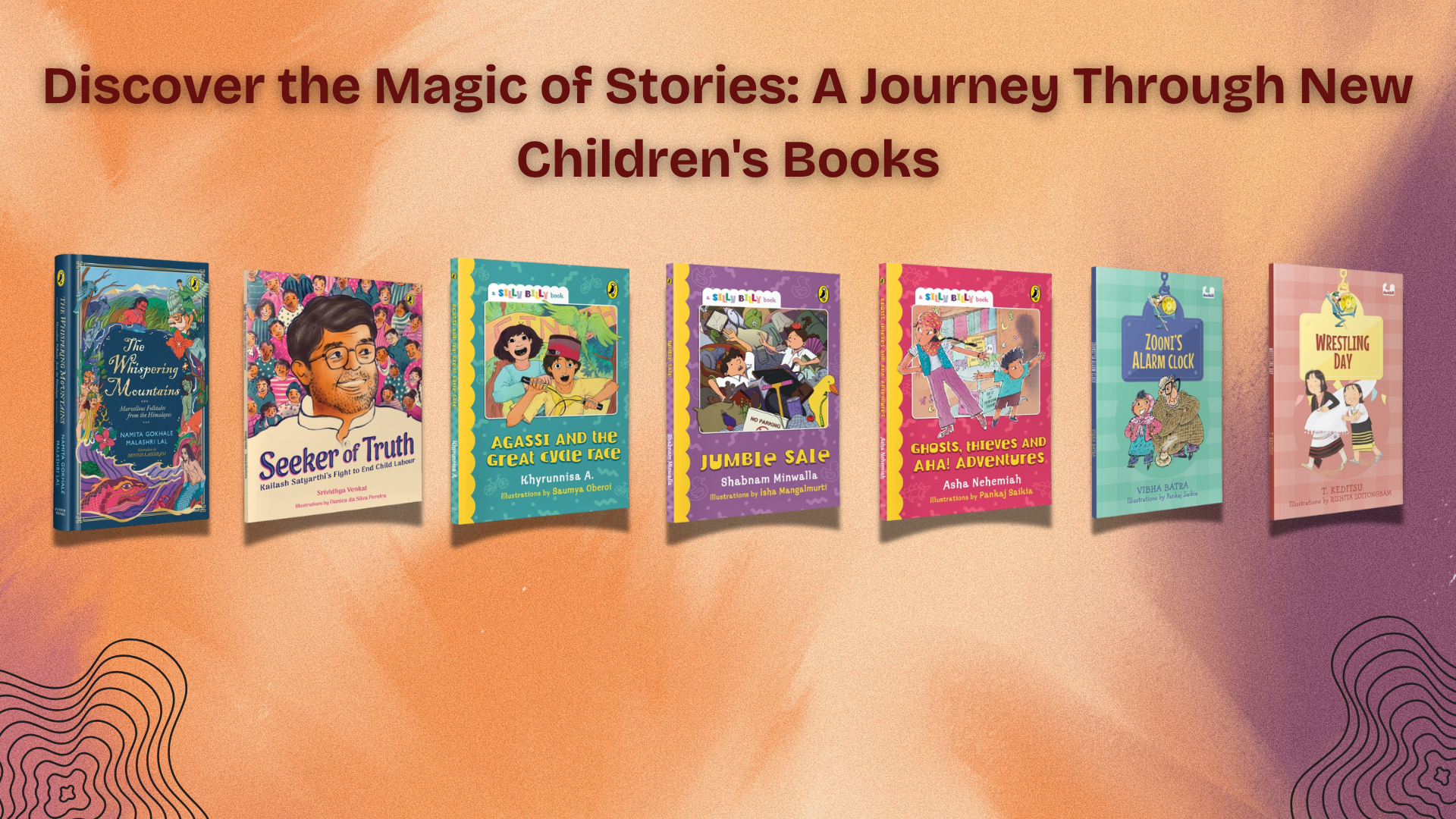
August is finally here, and it’s bringing a bunch of exciting new children’s books! This month’s releases are packed with fun stories and adventures that are sure to keep young readers hooked. Looking to refresh your child’s bookshelf? Scroll down to find the perfect new read for them!


Men of Steel
Men of Steel || Tanushree Podder

From the frigid heights of the Himalayas to the scorching deserts of the west and the humid wetlands in the east, India’s borders mirror the nation’s diversity. Amidst these rugged landscapes, Indian soldiers battle not only the enemy but also the unforgiving terrain.

Within these pages, meet extraordinary heroes like Captain Neikezhakuo Kenguruse, Captain Keishing Clifford Nongrum, and Lance Naik Albert Ekka. Their valour, akin to that of Lieutenant Arun Khetarpal, Naik Digendra Kumar and Major Sandeep Unnikrishnan, forever serves as a guiding light, inspiring us with courage and resilience.


Baloo's Big Win
Baloo’s Big Win || Mamta Nainy, Saumya Oberoi

‘Does anyone really win when not everyone gets to play?’

Right from his childhood, Baloo loved cricket. But he lived at a time when the rules of the game weren’t fair. Despite being a great bowler, he wasn’t allowed on the team because he was from a lower caste. Not one to give up easily, Baloo worked hard and was eventually picked to play on the team. But even after this, he wasn’t allowed to mix freely with his teammates.

Could Baloo overcome this obstacle and change the game of cricket?


Grandpa’s Bag of Stories | An illustrated collection of timeless tales from India’s favourite storyteller, perfect for read along | Ages 8 and up
Grandpa’s Bag of Stories || Sudha Murty

Join Anoushka, Krishna, Meenu and Raghu along with Ajja-Ajji on their adventure to Mayawati, a beautiful hilly region in Uttarakhand. Little do they know their trip will be filled with unexpected magic as, this time, their dear Ajja becomes their new storyteller. Amidst snow-capped mountains and towering deodar trees, Ajja weaves tales of kings and princesses, mermaids and bitter gourds, imparting wisdom and compassion along the way.

As the children explore the mountains, they make new friends, learn about Pahadi folk traditions, marvel at breathtaking sunsets and travel to various destinations.

From the bestselling author of Grandma’s Bag of Stories and Grandparents’ Bag of Stories, Sudha Murty, comes another collection of immersive, captivating and sensorial tales with an exciting new twist!


A Melody in Mysore (Series: Songs of Freedom)
A Melody in Mysore || Shruthi Rao

Mysore, 1932

The rest of India is ablaze with the fervour of the freedom movement, but Mysore remains tranquil under the maharaja’s benevolent rule. For twelve-year-old Leela, the movement feels distant, just words in the pages of newspapers—until Malathi Akka moves into her neighbourhood, bringing with her thrilling ideas, new perspectives, and . . . a gramophone!

As Leela gets swept up by the winds of change, it dawns on her that participation in the freedom struggle can take on forms she hasn’t even imagined . . .

The Songs of Freedom series explores the lives of children across India during the struggle for independence.


Rebellion in Ranchi (Series: Songs of Freedom)
Rebellion in Ranchi || Swati Sengupta

Ranchi district, 1915

Sibu’s life is changing as the Oraons who live in the forests of Chota Nagpur, are slowly moving to the Tana Bhagat movement, where they begin to protest the injustices that the zamindars and the British Raj perpetrate on the Adivasis. And by stories of German Baba, who will help defeat the British in the Great War and bring freedom to the Oraons and to India.

Yet, though the Tana Bhagats follow the path of non-violence, violence is rearing its head in the world around them . . .

The Songs of Freedom series explores the lives of children across India during the struggle for independence.

The Moment that Changed Everything : Aakash Meets Mr. Khanna

Straight from the writer of Om Shanti Om comes Secrets Within—a thriller that will keep you up all night. Meet Aakash, a visionary architect, who lands a dream project to redesign a grand mansion for the wealthy Mr. Khanna. But behind the mansion’s opulent facade lies a web of secrets and hidden agendas.
 

Read this exclusive excerpt to find out about Aakash’s fate when he meets Mr. Khanna for the first time.


Secrets Within
Secrets Within || Mushtaq Shiekh

***

Suddenly, the door opened and a well-groomed man, standing at about 6 feet and dressed in a black suit, with neatly combed hair and shiny black shoes, entered the conference room. As he sat down at the other end of the table, Aakash kept looking at the door, waiting for it to work around its hinges to open and close as more people poured in. The door stayed shut. It was just him and the wellgroomed man. The man cleared his throat, alerting Aakash to begin his presentation. The presentation was slightly shaky at the beginning, but Aakash found his confidence as the slides passed. He had forgotten about the swollen cheek, the receptionist and the wall he felt pushed against. The weirder bit came in when the well-groomed man did not respond immediately to the presentation. It took him about fifteen minutes of silence and mental calculations to announce, ‘Good work.’


‘So, how do we proceed?’


‘We have to meet the boss now. He would like to have a word with you before the contract is signed.’


The information surprised Aakash. He said, ‘I thought you were . . .’


‘I am not sure how relevant your thoughts are, Mr Aakash. Now if you could kindly follow me,’ said the well-groomed man curtly.


Aakash had always had a problem with authority, but he surprised himself by following the man’s instructions. He followed him out of the conference room as he passed by the receptionist, who smiled at him, and got into the lift. The lift stopped and they walked to the office driveway. They waited in silence with Aakash itching to ask questions about their commute. Before he could ask, a limousine pulled over in front of them. Aakash was so intimidated by the size of the car that it left his mouth open. The chauffeur opened the back door of a shiny imported Cadillac for an awestruck Aakash. The luxury interiors of the car gave him goosebumps—the velvet-laden seats were so soft on the skin that it lured him to sleep before he could explore the endless features of the car. His sleep was barely disturbed by the sun as the window shades were pulled up. By the time Aakash woke up, he couldn’t tell where he was. He turned to the left, right and back for a glimpse of the location.


It was just a long road with landscaped areas on both sides. Aakash was only able to occasionally spot an old sculpture on the verge of falling apart at sparse distances. Where were they taking him? He frantically looked for identifying markers and found none. An hour later, the driver pulled the door open. Outside, another surprise awaited him. A massive structure from ages ago stood in front of him that could easily pass for a castle from the past. The multi-storey structure had been done with stone, lending to the castle feel. He couldn’t gauge more details from outside as the well-groomed man rushed him into the interiors, where he was further hurried to a lift. Aakash was certain that the flooring was marble and that he had caught sight of a couple of valuable art pieces on the wall. He couldn’t imagine what they intended to do with rebuilding an already magnificent house.


The well-groomed man barely gave Aakash any time to enjoy the prized possessions while Aakash had lost count of the doors they passed. A double door opened to a darkly lit room, except for the middle. The billiards table was extremely well-lit from an angular source of light. Aakash heard the noise of the ball hitting the solid wood and falling into a pocket.
 

‘He is here,’ announced the well-groomed man for the benefit of the gentleman who had been playing the game with devout concentration. The man stood
at about 5’ 8’’, had a lean body type and was dressed in a crisp white shirt with the sleeves pulled up and black trousers.


‘Hello, Mr Aakash.’


‘Hello, Mr Khanna.’


‘Been hearing good things about your presentation,’ said Mr Khanna as he arranged his billiard sticks neatly on to the holder.


‘Thank you. I would love to show it again to you personally,’ replied Aakash in an eager-to-please voice and reached for his laptop.


‘That would not be necessary, Mr Aakash.


You should reserve the presentations for the ones who are willing to be pleased by numbers, figures and stats.’


Aakash was slightly perplexed.


‘Numbers are about profits and losses. What I am looking at is something which falls above profits and losses. I am looking for something for people to
marvel at. Like Gatsby.’


‘You have a place that already rivals Gatsby’s, sir.’


Mr Khanna chuckled at the compliment. ‘You should reserve your flattery, Mr Aakash.’


Aakash felt a little lame at his compliment being shot down mercilessly.


‘I am confident that the money offered in the contract is more than what the task demands, so I would like to put forth a caveat before we sign our
contract.’


A catch? That sounded bad. A catch has never been a good thing, thought Aakash to himself.


‘You will be given our garden area and the terrace that overlooks it to give us an idea of what you are capable of.’


That did not sound like a catch. Aakash agreed immediately, ‘Absolutely, sir! I am sure that my work will not leave you looking for another architect.’

***

Get your copy of Secrets Within by Mushtaq Sheikh on Amazon or wherever books are sold.

Can Matchmaker Jia Find Her Own Happily Ever After?

When love, family, and ambition intertwine, craziness and magic are bound to follow. In Swati Hedge’s Match Me If You Can, pub owner Jaiman Patil is smitten with journalist Jia Deshpande, who loves to play matchmaker. As their lives get more tangled, Jaiman’s feelings for Jia grow stronger, and her matchmaking efforts start causing chaos. In Mumbai, though, happily-ever-afters are never far away.


Read this exclusive excerpt to find out what’s really going on!


Match Me If You Can
Match Me If You Can || Swati Hedge

***

The Patils’ and Deshpandes’ lives were so intertwined that when the time had come to name Jia, a year after his best friend’s son was born, Papa simply took the first three letters of Jaiman’s name and scrambled them up to create “Jia.”


It didn’t stop there. Papa and Mr. Patil became business partners, raking in millions in profits throughout Jia’s and Jaiman’s teen years, until Mr. Patil decided to start something of his own and went to America to set up the new industrial business. That was right around when Jaiman was moving to Pune, a few cities away, for college. After Mr. and Mrs. Patil left, and then Jia too, for journalism school in London, Jaiman became a permanent part of the Deshpande family.
Jia would return to India during winter break to find Jaiman mixing plum cake batter in the kitchen, throwing his head back and laughing at one of Papa’s corny dad jokes. He would pause to check if Mamma’s glass of wine needed refilling, and ask Jia’s sister, Tanu, about her latest legal clients. He’d usher Jia over to the kitchen counter and show her pictures of all his weekend getaways with the Deshpandes, which happened every other Saturday, since his college was only a three-hour drive from Mumbai. It was surprising to see how easily he had made his way into her family’s hearts. So much so that when Mamma’s cancer took her away over five years ago, right after Diwali, after Jia had graduated and returned to Mumbai for good, Papa brought Jaiman along with them to scatter Mamma’s ashes in the sea. When Tanu broke down as those ashes disappeared into the waves, it was Jaiman’s shoulder she cried on.


“So how was work today?” Jaiman prodded, and Jia looked up from the tomato sauce dripping from her fork onto the plate.


“It was all right.” Jia shrugged as she helped herself to more lasagna. “I pitched the new matchmaking column to my boss last week, but Monica still needs more convincing that I’m the best person to run it.”


“Oh, wow.” Jaiman raised a thick brow. “Sounds like a big responsibility. But there’s nothing Jia Deshpande can’t do when she sets her mind to it.” He winked at her before swallowing his next bite.


Jia ignored the rush of hormones that flooded her body at his wink and the way his tongue darted out to lick the side of his lip. It was hard to be mad at Jaiman for taking over her life when he was this . . . nice. No wonder everyone in her family loved him.


She let out the smallest of sighs and returned to the rest of the lip-smacking lasagna sitting on her plate. “Maybe I’ll make lunch for you tomorrow, Papa,” she mused aloud with the next bite.


“The chicken breasts I bought during my last grocery run won’t stay fresh for too long.”


Papa shook his head. “Don’t worry, Jaiman used them for lunch today. You should have been there!”

“Yum,” Jia agreed, resisting the urge to roll her eyes. Papa interrupted her train of thought by speaking up. “Jaiman also took me to the doctor this afternoon. My chest was hurting so bad, I was sure it was a heart attack.”


Jia didn’t react. This had happened three times so far. No, not an actual heart attack scare. Papa’s unwarranted trips to the cardiologist.
“But then it turned out it was just gas!” Papa chortled. “Just like last month!”


The only person Papa hadn’t seen for his presumed illnesses was a therapist. The one kind of professional who could actually help him, Jia believed. He had kept the grief of Mamma’s death to himself for five long years now, allowed it to manifest in unhealthy ways, like imagined sickness and fretting over every little thing. Perhaps it was his coping mechanism—assume every minor problem was a dangerous illness, so that it could be detected early, unlike Mamma’s cancer.


Jia hoped she might, someday, set Papa up with someone wonderful who would ground him into reality and bring him some peace. But knowing her father, knowing how devoted he’d been to Mamma, it was unlikely to happen. Maybe falling in love wasn’t a choice, but working on nurturing that love within a relationship absolutely was. And it was a choice Papa wouldn’t be willing to make with anybody except Mamma.


After dinner, as she was putting her plate in the sink—the housekeeper would do the dishes in the morning—Jaiman sidled up beside her, the citrusy scent of his cologne heavy in the air. Jia didn’t understand how a man could smell this good the entire day. It should be illegal. She turned to him, arms folded, trying not to visibly inhale.


“Good job on the lasagna.” He grinned at her. “Thanks. I have to get back to the pub now. Do you want to join me? I could use your help taste-testing  some new drinks.”


Jia’s gaze went to the wall clock hanging in the living room across from the open kitchen. It was just past ten, and although it would have been smarter to spend the rest of her night brainstorming ways to convince Monica, maybe a cocktail or two wouldn’t
hurt.


It was Friday night, after all. “Sure,” she said finally.


***

Get your copy of Match Me If You Can by Swati Hedge on Amazon or wherever books are sold.

Get Ready to Transform Your Life with these 10 Indian Laws of Happiness

What if the secret to happiness was hidden in ancient wisdom? In The Four Purusharthas by Héctor García and Francesc Miralles, you’ll find just that! This exclusive excerpt reveals the 10 Indian Laws of Happiness, blending timeless principles with modern living. Discover how prosperity, virtue, love, and freedom can guide you to a life brimming with joy and fulfillment.

Let the journey to your happiest self begin!


The Four Purusharthas
The Four Purusharthas || Héctor García, Francesc Miralles

In order to live in accordance with purushartha and to have a fulfilling life, there are four areas – known as the four purusharthas – that we need to cultivate:


ARTHA (PROSPERITY)
is what you need to do to sustain your life. It is about bringing prosperity to yourself, your family and your community. In a modern sense it is about your job, your career, your financial security and wealth in general.


You can ask yourself:
What do I need to sustain my life?
What can bring wealth to me
and my loved ones?


DHARMA (VIRTUE)
is a word that has many meanings. It includes the moral values, duties, rights, and virtues that each individual pursues in order for harmony to prevail in the world and in order to realize one’s true nature.


You can ask yourself:
What does the world need from me?
Why do I exist?


KAMA (LOVE)
refers to the pleasures of the senses and the enjoyment of what is beautiful in life. It is also about desires, emotions, and love.


You can ask yourself:
What do I love doing? What do I want?


MOKSHA (FREEDOM)
means self-realisation, liberation and freedom. In some schools of thought we reach a state of moksha when we are free from death and rebirth. In others it means simply being in a state in which you have the freedom to work on actualising your true self.


You can ask yourself:
Who am I? Who am I in the truest sense?


You might already know what your purpose in life is, or you might not yet know. If you already know, this book provides a blueprint for living in accordance with your purushartha. If you don’t yet know, it will give you the tools to start the adventure of knowing yourself better and discovering your purpose.


THE TEN INDIAN LAWS OF HAPPINESS

1. LIVE ACCORDING TO THE FOUR PURUSHARTHAS
When in doubt, in times of trouble or when you are feeling lost, come back to review your lifestyle through the lenses of the four purusharthas, or goals of human life: kama (love), dharma (virtue), artha (prosperity) and moksha (freedom).


2. LEARN FROM THOSE WHO KNOW
It can be a teacher, a guru, a book, anything that inspires you and takes you beyond yourself. Human beings may have a beginning, but they have no end. Your horizon ends wherever you set your sights.


3. LET GO OF EVERYTHING YOU DON’T NEED
Follow the example of the sadhus (the holiest people on Earth, according to Hinduism) and dare to travel light, knowing that there is nothing important that you could lose. Wherever you go, you are with yourself. What more could you need?


4. CREATE YOUR OWN ASHRAM
Your life project needs an inner circle that will empower you, especially when hard times come and hope wanes. Choose your fellow travellers well.


5. LIVE MINDFULLY
Whether through meditation, yoga or flow, live whatever you are doing fully. Eliminate distractions. Dare to be present with a single thing that contains the whole Universe.


6. KNOW YOURSELF
‘Who am I?’ This is the question that Ramana Maharshi, a guru venerated all over India and the West, made his disciples ask themselves to cultivate their fourth purushartha (moksha). Are you bold enough to explore yourself?


7. PUT AN END TO VICIOUS CYCLES
Cultivating the first purushartha (dharma) will allow you to stop repeating the errors holding you back. Do what is right and be generous with the world and with yourself, and good karma will flood your life with light.
 

8. BREATHE!
Your energy, your serenity, and the days given to you to enjoy all depend on the air that enters and leaves your lungs. Practice pranayama, the area of yoga dedicated to breathing and breath control. Your life literally depends on it!


9. FEED YOUR BODY, MIND AND SPIRIT
Everything is connected, so none of these should be neglected. Nourish yourself with Ayurveda, the system of traditional Indian medicine focused on balancing energy in the body to prevent illness, practice tantra and yoga, calm your mind – and set out on a path to paradise.


10. LIVE IN THE MOMENT
We spend 80 percent of our time thinking about the past and the future. Invest your energy in the present, which is the home of happiness.


***

Get your copy of The Four Purusharthas by Héctor García and Francesc Miralles wherever books are sold.

You Won’t Believe What Lies Beneath The Somnath Temple – Revealed!

Step into the heart-pounding adventure of The Somnath Cipher by Priyanka Pathak Narain, where journalist Pia Jani and her childhood friend Aditya Narayan are drawn into a high-stakes quest. As they race against time to decode ancient mysteries linked to the legendary Somnath Temple, they must stay ahead of a dangerous enemy who will do anything to keep the secret hidden.
 

Read this exclusive excerpt and experience the excitement of Da Vinci Code meets Indiana Jones first-hand!

The Somnath Cipher
The Somnath Cipher || Priyanka Pathak Narain

***

31 December 2020, 8.40 a.m.
Somnath, India


Eighty-seven hours to go


Nila Shukla examined the eager faces of her art restoration students— all of them brandishing the Somnath tweet and short report written by Pia Jani last night.


How on earth had that girl got a hold of the story so fast?


‘Professor, what structure lies under there?’ one demanded. The premonition of danger that had settled in her since she saw the GPR investigation results on the computers was growing with each passing hour, taking a deeper hold.


‘Do you think it was this temple that Mahmud of Ghazni looted?’ asked another.


‘Will you be involved with the ASI dig?’ shouted someone in the back.


‘What do you think is there under Site-4?’ yelled another. ‘What does targeted objects mean?’


Nila winced. Site-4 again. The presence of non-linear, localized, targeted objects.


What had Ved been thinking, trying to obfuscate his report with such inanity? For those who knew anything, such an attempt would only draw attention. Still, it was done. And the time to avoid attention was over. The spotlight was on it and now everything depended on what she chose to do.


For the first time in her life, it had come down to action. What she chose to do.


Raising her palm overhead, Nila smiled, as though delighted by their interest in the find. ‘Tell me, can any of you tell me the exact number of times this Somnath temple has been razed in the hopes of finding its treasure?’


‘Seven!’


‘More! Ghazni alone raided it seventeen times!’


Six!’


‘Four!’


The class was laughing along with her.


‘All wrong! Ghazni raided India seventeen times—not Somnath. That’s a misconception. Let’s count and get our history right. There are three temples of antiquity at Somnath mentioned in texts: a golden temple built by Somraj in Satyug, which is the first Age of the World, the silver one made by Ravana in the Second Age of the World called Tretayug, and the sandalwood one made by Krishna during Third Age of the World—the Dwaparyug.


‘Then we come to the fourth and last age of Kalyug. In the last 2000 years, we have had six recorded reconstructions of this temple. The first of these was when the Pashupati cult was headquartered in Somnath at the beginning of the Christian era. Six hundred years later, Raja Maitre rebuilt the crumbling temple. Then came the Islamic invasions into the Deccan when Governor Al-Junayd attacked it. Nag Bhat II reconstructed it using red stone not much later than AD 800. This was the third reconstruction of the Christian era and also the building that would face the fateful attack of Ghazni, the ferocious Islamic plunderer.


‘On 6 January 1026, Mahmud of Ghazni arrived in Prabhas region and pillaged the Somnath shrine. Fifty thousand men—armies gathered from many small kingdoms—died defending it.’


‘Did he loot the treasure?’


‘Yes. He had already looted Mathura before this in AD 1018. He knew all about the fabulous wealth of the temples,’ replied Nila.


‘He had attacked Mathura?’


‘Yes. One of his seventeen attacks on India. During that raid, Mahmud wrote of the Vasudeva temple that “If anyone wished to construct a building like this, it would take 200 years with the most experienced and able workmen and cost hundred thousand thousand red dinars.”


‘And how much is that in modern times?’


‘Thirty billion dollars,’ replied Nila to gasps and a sudden hush. In the silence, she continued speaking softly.


‘Mahmud grudgingly admired the Vasudeva temple and then ordered the temple to be burnt with naphtha and fire—levelled to the ground. The work of an estimated two centuries was reduced to smoke and ashes.


No one spoke for a long while. Finally, a young woman in the back asked softly. ‘Is it true that he broke the Somnath idol too?’


‘Yes. Four pieces,’ she said.


‘It is true he took the pieces to Ghazni?’


‘Yes.’


‘He put the pieces of the idol on the steps leading to the mosque?’


‘Yes. One on the doorway to the mosque, one on the doorway to his palace and two were sent to Mecca and Medina.’


Gasps in the back of the classroom. ‘What a savage!’


‘He’s been called that and many other things for those actions,’ said Nila.


‘Is it true he was cursed for it?’ asked a thoughtful student in the front. Nila, who had a long memory for faces, struggled to remember names belonging to those faces.


‘Well, after the sacking of Somnath, he reached the Gujarat– Rajasthan border. There, he was told that two kings, Govindaraja Chauhan and Raja Parmar Bhoja, were moving to intercept him. The alliance of these two kings had once defeated him in an earlier invasion, so Ghazni was eager to avoid them.’


‘Did he?’


‘Did he what?’


‘Succeed in avoiding them?’


‘Yes. Yes, he did. He marched home through the Thar desert—a march that nearly killed him and wiped out most of his army.’


‘That’s good to know,’ chimed one.

***

Get your copy of The Somnath Cipher by Priyanka Pathak Narain on Amazon or wherever books are sold.

Top 6 Sneaky Signs of ‘Corporate Fekus’ at Your Workplace

Ever felt like your MBA classes were preparing you more for a trivia night than the boardroom? Enter The Practical MBA by Sandeep Das — the book that bridges the gap between textbook theory and real-world hustle. From decoding the characters known as ‘Corporate Fekus’ to mastering the skills that truly count in the real business world, this book is your crash course in surviving (and thriving) in today’s cutthroat corporate jungle.


Read this exclusive excerpt to learn how to outwit the office ‘Fekus’ and turn your career into a blockbuster!

The Practical MBA
The Practical MBA || Sandeep Das

***

Raghavan, a senior professional, seems to be successful at work but poke a level down—there seems to be distrust in his team with consistent underperformance, stress and a deep sense of misery at his place of work. However, his bosses absolutely love him.


Welcome to the age of the Corporate Feku.


It is never easy to work with someone who is always building a narrative, either to hide his underperformance or put someone down or to overcome a deep sense of personality complex. The associated stress, shame, guilt and general misery can be overwhelming for most people. However, such people tend to be successful at their place of work. They are blessed with deep political acumen along with the right blend of sociopathic and narcissistic attributes. Following are some key traits of the Corporate Feku.


1. Always Builds a Narrative, Often a Fake One
The Corporate Feku barely performs on most business metrics. However, what they are good at is elevating their role and positioning it as something very big. They will often associate their roles with words including radical, industry defining, path breaking, transformative, undoing years of poor work. In addition, before every critical board meeting, they are capable of building a fake narrative of a beautiful future to take people’s attention away from the existing gloom and doom.


2. Always Creates the Right Impression
In addition to building a fake narrative, a tactic that is often employed by the Corporate Feku is to carefully manage his own impression. The age-old adage of coming five minutes before your boss and leaving five minutes after your boss is carefully implemented. In addition, there is a conscious display of rigour when very senior professionals are involved. When his bosses are around, the day starts at 7 am and goes well until midnight. When nobody seems to be around, Pooja Hegde’s pictures on Instagram are consciously devoured over.


.3. No Respect for Diversity
The Corporate Feku will drive to ascertain domination in the area of thought leadership. Whatever idea or efficiency improvement his team or his peers might come up with, he will always retort with a ‘I had already thought of it earlier’. It is an altogether different problem that very little seems to have been done by him to take care of that idea. An associated corollary employed by the Corporate Feku is the lack of respect for women. Although they will proclaim themselves to be champions of gender diversity, they will often pass snide comments about their make-up, facial expressions, lack of seriousness, dressing sense, waistlines.


4. Psychologically Manipulates His Team Every Day
The Corporate Feku, blessed with a high emotional quotient and sociopathic skills, is immensely competent at manipulating his people to work for him without question. A combination of shaming, humiliation, putting people down along with an occasional praise is generously employed to make his people always seek validation for themselves. The classical behavioural psychology that is often employed is the Stockholm syndrome, where the victim tends to sympathize and cheer on his/her perpetrator. One of the most common ways to shame people is to ask them to do a job which is 2–3 levels below their hired level. Another way to drive requisite behaviour is to reward people who blindly support you even if they are underperformers.


5. No Respect for Anybody’s Personal Life
A narrative that elevates the Corporate Feku’s job is built on making his team work brutal hours. Most of the Corporate Feku’s team would be working very long hours with limited personal downtime. Such a conscious creation of work and never-ending reviews is carefully crafted to create a perception of industry defining work to everybody else. The focus is often on quantity of work rather than an element of quality or efficiency. In case of any grievance aired, the retort
is immediate, ‘when I was your age, I would only work and do nothing else.’


6. Creates Interpersonal Tension in His Team
The way to build incredible loyalty among disgruntled emotionally manipulated workers is to create interpersonal tension within them. In case a direct subordinate doesn’t agree to your targets allocated, call up the subordinate’s subordinate and get him to say yes. Then force the subordinate to agree and give him feedback on his people management skills that people under him are extremely unhappy and have complained against him. An additional way is to say something controversial about a team member in someone else’s presence and if he diplomatically avoids it, consciously play that comment in that teammate’s name on other public forums.


In behavioural psychology, such animalistic behaviour stems from deep-rooted inferiority complex, either due to a lack of formal education or a ghastly firing from the previous job. The ruckus at work is carefully crafted as a conscious display of power. This behaviour can go on for decades without any check or balance. It is difficult for companies to diagnose or counsel such behaviour especially in countries like India where upward feedback is largely symbolic. However, the best course of action for any company is to relieve such characters once they have been suspected of such behaviour.


In case you are stuck working with someone who resembles the above character sketch, may God bless you. The Corporate Feku is singlehandedly responsible to build a work culture which is bland at best and toxic at worst.

***

Get your copy of The Practical MBA by Sandeep Das on Amazon or wherever books are sold.

Fans Are Freaking Out Over Novoneel Chakraborty’s New Rom-Com!

Novoneel Chakraborty, known for his nail-biting thrillers with intricate twists, dark plots, and strong female protagonists, has often been dubbed the Sidney Sheldon of India. In an unexpected yet delightful shift, he surprises his fans by venturing into a romantic comedy with Remember Me As Yours. Combining the suspenseful mastery of Sheldon with the romantic flair of Jane Austen, this new book offers a unique blend of love and excitement.


Read this exclusive excerpt to experience Chakraborty like never before as he brings laughter and love to his storytelling.


Remember Me As Yours
Remember Me As Yours || Novoneel Chakraborty

***

‘Let’s meet at an OYO room,’ he had said over the phone. Nityami swallowed a lump in her throat. She knew what the connotation of an OYO room was. Though she was actually a virgin, she had told Raghav a lie that she had a boyfriend with whom she had been intimate. Nityami realized by now that it was all right to tell a guy about one boyfriend, or else she would run the risk of being interpreted as boring. More than one, and the boy would run the risk of feeling threatened
and also judge her character. Thus, she had told Raghav only about one imaginary boyfriend. The truth was, she never had a boyfriend. From the time she felt her hormones handholding her into puberty, she had a crush on one boy in school. The crush eventually turned into such an intense fixation that Nityami thought she would just remain in love with him, and he would never know it. The power of unreciprocated love. It can numb the sensible part of your brain for quite some time. For Nityami, it remained so until she turned twenty-three.


Looking around, she realized she too deserved a boyfriend. She knew someone must have been made for her; it was just that she didn’t think seeking him out would be such heartachingly hard work that even by twenty-seven, she wouldn’t be successful in finding THE man for her. There were plenty of options for the trending NATO (NotAttached-To-Outcome) dating amongst youngsters, but Nityami wasn’t exactly looking for that. That was till she met Raghav via Bumble a month ago. Their connection seemed to run at top gear. They met, they conversed, they liked each other; he told his parents first, then she told her parents and now, a month after their first date at a café, the families had locked a date for the engagement in the coming week and the wedding seven months later. It all happened so fast that Nityami didn’t know how to react. Perhaps that’s how life operates, she told herself. A long dry spell and then so much rain that you didn’t know whether to enjoy it or run for cover.


Standing in front of her bedroom mirror, Nityami knew she didn’t want to screw this up. If Raghav had called her to an OYO room, she knew he probably wanted to check their sexual compatibility. And rightly so. Though she wasn’t experienced enough to even understand what sexual compatibility was, going by what she heard from her experienced friends, all she knew was if the guy could go for more than half an hour, then it was a green light. One final look at her eyebrows and she convinced herself that nothing could be done now. Instead of him discovering it, Nityami thought, she would point out the faux pas herself when she met him in an hour. He probably wouldn’t mind it so much then.


Nityami was dressed casually but that was going to change. She always used to dress casually to go out of her house because she didn’t want her parents to know she was going out on a date. On date-days, she used to reach a nearby mall well before time, change, put on some make-up and then visit the café or restaurant to meet her date. And before coming back home, she would pretend in front of the guy that she was waiting for her Uber. When he left, she would invariably go back to the mall, change and finally head home. It would spare her all the unnecessary questions her parents would have asked otherwise. Even though they were involved in Raghav’s case, she still couldn’t tell her parents she was going to an OYO room with him. Nityami left the house saying she was going to meet a college friend.


That too triggered a set of questions from her mother:

Which college friend?

What is she doing now?

Is she married?

Kids?

How is her marriage going?

Is she settled here or abroad?


Nityami knew if the answers were negative, her mother would still be filled with a weird positivity. She would be convinced that her daughter wasn’t the only one suffering in the world. This time, before her mother could even ask who the friend was, Nityami left, saying her Uber had arrived.


During her Uber auto ride from the mall to the OYO hotel, Nityami suddenly started feeling nervous. She had never been naked in front of a man. And she didn’t have the perfect figure. She was slightly plump but thankfully, she had a good basal metabolic rate (BMR) so the fat was well distributed. She could feel gooseflesh thinking about what would happen in the room from the time she would enter it. Until that time, she had found Raghav very comfortable to be around. He never asked any awkward questions like the other guys she’d dated, nor did he have a condescending sense of humour where he belittled her and her attempts to be a working professional. Raghav didn’t have any problem with her working after marriage. Thinking about Raghav, she started fantasizing about what they would do. Would they simply begin smooching, strip each other and talk only after they were done? Like she had seen in so many Hollywood
films? Or would they converse a little, have some food and drink . . . Nityami remembered she had lied to him that she had never drunk alcohol. She did drink socially but the pressure of a ‘correct’ girl was something she started feeling when she entered the dating scene with marriage in mind. Casual dating didn’t have those pressures, but the guys who were in the dating scene for marriage wanted a ‘correct’ girl. And a correct girl meant she shouldn’t have any bad habits. Bad habits as defined by men, of course.


Nityami reached the OYO hotel.
‘Are you inside?’ she WhatsApped him on entering the lobby. Raghav was supposed to message her after he reached. He hadn’t.


‘Yes,’ the response came. It was a three-star hotel. Nothing fancy. Nityami walked up to the reception, gave them her Aadhaar card, which they photocopied and gave the original back to her. Nityami looked around for the elevator. She took it and stepped out on to the first floor. Next, she looked for room number 106. As she stood in front of the door, she took a deep breath. Something unprecedented would have happened by the time she came out of the room.


***

Want to know what happens next?

Get your copy of Remember Me As Yours by Novoneel Chakraborty on Amazon or wherever books are sold.

7 Audiobooks to Cure Your Rainy Day Blues!

Stuck in traffic during the rainy July days? Audiobooks are your perfect companion! As the monsoon showers pour down and traffic slows to a crawl, there’s no better way to pass the time than getting lost in a great story. So whether you’re cozy at home listening to the rain or navigating through the wet streets, these 7 audiobooks will keep you entertained and make the time fly by.


World's Best Girlfriend
World’s Best Girlfriend || Durjoy Datta

‘When he turns, I see his eyes. There’s a sense of surety in them, a sense of danger, a sense of entitlement and definitely, arrogance.’

Daksh and Aanchal meet under improbable circumstances in the most unlikely of places—a posh resort in the Andamans. While Aanchal is fighting hard to escape the shackles of a lower middle-class existence, Daksh is aimless and unsure of what his future holds. Strangely, they are drawn to each other.

‘My gaze drifts to her exposed back, and the tiny knot that secures her shimmering choli in place. Emotions of anger mix with a strange desire in me.’

Four years later, when they meet again, Daksh’s world has crumbled around him. The burden of caring for his sick father and six-year-old sister has left him with little time for anything else. Yet, despite their diverging paths, Daksh and Aanchal find themselves reconnecting in unexpected ways. Their mutual attraction deepens.

Till now, fate has been pushing them together, but what will happen when they decide to take matters into their own hands? Will life be as they’ve imagined, or will destiny take even that away from them?


Mrityunjay
Mrityunjay || Parakh Om Bhatt

PRESENT DAY, BHARAT

Renowned archaeologist Sudhir Arya dies mysteriously the night before Diwali. His grandson, Vivaan, comes to his hometown to perform the last rites. Here, he gets a phone call that sets him off on a puzzling journey as he discovers thousand-year-old secrets and shocking facts about his identity.

1026 CE, PRABHAS KSHETRA

Sultan Mahmud Ghaznavi has attacked the first jyotirlinga of Lord Mahadev: Somnath. Did he seek the temple’s treasures? Or was he looking for a Puranic heirloom of Sanatan Dharma, the mystery of which has been buried under layers of time?

470 CE, ARAB LAND

Yogi Matsyendranath awakens the kundalini energy of his army through the ritual of Aatma Jaagran as it takes on terrifying, evil entities tasked with protecting the greatest mystery of the Kaliyuga.

SATYUGA, ARYAVARTA

Through yagnas, bloody sacrifices and mantras prohibited in the Vedas, Devi Anishtatri, the goddess of malevolence, is invoked. She appears in her most ferocious form and grants a boon so potent it could change the fate of the universe.

What is the link between Aryavarta, Arab Land and Prabhas Kshetra?

What is the vicious boon that threatens to change the fate of the cosmos?

The ultimate battle of Kaliyuga is about to begin . . .


A Bird On My Windowsill
A Bird On My Windowsill || Manav Kaul

In Manav’s world, memories are like little birds perched upon the windowsill of time. In his world there are no boundaries between thoughts and reality. In his world the past and the present form a mirror that disintegrates into the memory of a single day…

Known for writing silences and articulating dreams, in this book Manav sifts through the past, delves into the present and talks about all the creative impulses, writing, directing theatre and acting that have made him who he is. Through his poetry and prose, he creates vignettes of his life, a long-lost love, his interactions with people as he travels, his favourite authors and their writings, almost as if he’s trying to weave a world for the audience as well.

Beautifully symbolic, this book is a rich tapestry of thoughts and feelings, of todays and tomorrows, of being alone and seeking loneliness.


The Naga Warriors 1
The Naga Warriors 1 || Akshat Gupta

To prepare for the future, our ancestors created the Naga sadhus―a clan of warriors for the protection of Dharma, as proclaimed by Adi Guru Shankaracharya in the eighth century. This sect of Shiva devotees has stood firm, living selflessly and fighting fearlessly. For centuries, they have died the death of heroes, serving and saving Dharma and the temples.

In the year 1757, 111 Naga sadhus borrowed the majestic weapons of the idols of their gods. Fueled by their belief in Lord Shiva, they gathered an invincible courage to protect the temples of Gokul. They stood as an indestructible wall, led by Ajaa, a fearless Naga warrior, against the Afghan army of 4000 men, a cavalry of 200 horses and 100 camels, and 20 cannons. The brutal Afghan army was led by Sardar Khan, the most ruthless commander of Emperor Ahmed Shah Abdali, ill-famed for the demolition of temples and building a history of genocide in Bharat.

The fight continues. This is the Naga warrior’s commitment to courage and determination. This is the clash of Shiva devotees against the devils that lie under men’s skin. This is the Battle of Gokul.


The Roof Beneath their Feet
The Roof Beneath their Feet || Geetanjali Shree

In this beautifully crafted novel, roofs have a special place; they are meant for wild things, for romance and for play, they are places to dry pickles and grains while exchanging gossip about quiet caresses. But above all, they are realms of freedom.

In The Roof Beneath their Feet, Chachcho and Lalna use their roofs to build a friendship that transcends time and memory. Suddenly one day, Lalna has to leave, to return only after Chachcho’s passing. Amidst rumors and gossip in the neighborhood, Chachcho’s nephew tries to piece together his memories of the two women, one of whom is his mother. The truth he is searching for could destroy him forever, but to not find out is no longer an option. A story of twists and turns, The Roof Beneath Their Feet, translated from the original Hindi by Rahul Soni, is easily one of the best contemporary novels you have found in a long time.


The Descendants
The Descendants || Laksh Maheshwari, Ashish Kavi

When a fiery meteor lands on the Somvanshi estate, Jay and his mentor Kaka are the first to find it, and Jay is mesmerized by the element he finds in the orb. Using his family-owned Vantra Labs, of which he is the CEO, Jay carries out extensive research into the material, along with his team of brilliant scientists. He names the material, the black element.

Little does he know the chain of events that he is about to set off. Directed by the strings of fate, Jay is heading towards the truth concealed in family legend and a prophecy that can be traced back to the times of the Mahabharata war.

When Jay realizes the supernatural possibilities that the black element is capable of, he is determined to use it for the greater good. But, as history has shown, when there is power in the wrong hands, greed takes prominence and compassion takes a back seat.

Amid a succession of heists, ploys, twists, tragedies and discoveries, will Jay be able to see the true picture? Will he understand the balance between fate and free will and how they can amalgamate to fulfil his purpose? Will he realize the prophecy? And is all of this simply history repeating itself?


All That Sizzles
All That Sizzles || Sakshama Puri Dhaliwal

A spicy meet-cute that will delight your rom-com palate!

Wedding planner Tanvi Bedi is all fired up about her latest project, the $100 million wedding of a media heiress. The only hitch is her high-profile client’s wishlist chef, Nik Shankar. Weddings are a complete no-no for Nik, but there must be something—or someone—he can’t resist.

Nik Shankar’s lifelong dream of inheriting his ancestral home is in jeopardy due to his estranged grandfather’s absurd caveat—Nik must get married to claim the property. When Tanvi storms into his office, an inconceivable solution presents itself: Nik will craft the wedding if Tanvi pretends to be his fiancée.

What starts as a recipe for disaster whips up into a delectable feast of simmering chemistry and fiery passion. But as the line between fake and real blurs, Tanvi and Nik must confront their inner demons before their charade goes up in smoke.

error: Content is protected !!