




Bihar Diaries narrates the thrilling account of how Amit Lodha arrested Vijay Samrat, one of Bihar’s most feared ganglords, notorious for extortion, kidnapping and the massacre of scores of people.
The book follows the adrenaline-fuelled chase that took place across three states during Amit’s tenure as superintendent of police of Shekhpura, a sleepy mofussil town in Bihar.
Here is an excerpt from the book:
———————————————————————
My back and hip started hurting all of a sudden. ‘Shit,’ I grumbled before getting into the blue Gypsy.
I asked my driver to take me to the Kasar police station.
An unshaven man, his skin darkened by constant exposure to the sun, was waiting for me just outside the police station. Ranjan Kumar, the former SHO of Kasar police station, had been put under suspension by the Police HQ. It seemed as if he had aged a decade in the last week. The second massacre had taken place in his jurisdiction. I hobbled out of the Gypsy and somehow managed to stand straight. Ranjan was in civil clothes, because a policeman is not allowed to wear the uniform when suspended. He was in the police station to hand over charge of the maalkhana, the police depository, and all the cases.
Ranjan saluted me by whipping to attention, impressing mewith his sense of discipline even in adversity. I feebly managedto return the salute.
I signalled to my bodyguard and my driver to leave–Ineeded to talk privately to Ranjan. Barely able to control mypain, I stood by the bonnet of the Gypsy. Ranjan was a little tense. Why would the SP come to see a disgraced, suspended SI?
‘Ranjan, I want to know the exact reason for the massacre ofRam Dular and his family, every single detail.’
‘Sir, I don’t know much about it. It happened out of theblue.’
‘I know that Krishna and Raju had beaten up Lakha a fewdays ago. The murder of five of Vijay’s men was the tippingpoint. That angered Vijay enough for him to commit the cold-blooded murder of Ram Dular’s family. Look, the governmenthas posted me and the DIG here only to arrest Vijay Samrat. Itis our top priority. You have to help me in this mission.’
‘But, sir, what can I do? I am just an ordinary SI, that too,suspended,’ a resigned Ranjan muttered.
‘Ranjan, I know your competence. You’re a very capableofficer with an excellent network of spies. And I know that youare on good terms with Raju and Krishna.’
‘No, no, sir. Why would I know shady characters like Rajuand Krishna?’ Ranjan denied vehemently.
‘I have been in the service long enough to know thatcertain people have to be developed as sources. If not a criminalbackground, these people will at least have dubious antecedents. I, too, have engaged such people to get information aboutcriminals in my previous postings. Come on, do you think anormal, decent person would become a police informer?’
Ranjan kept staring at the ground, unwilling to speakfurther.
It was time for me to come up with an ace.
‘Ranjan, you are under suspension. Strict disciplinary actionwill be taken against you. Your career is at stake. If you help menab Vijay Samrat, I promise you that I will get your suspensionrevoked and you will get your job back. With full honours.’
Ranjan’s eyes lit up for the first time. I knew that he wasshort of money and his wife was suffering from depression.People around him had changed after his fall from grace. Who could know that better than me? I had gone through almost thesame experience just a while ago.
‘Okay, sir, I am with you. I hate Vijay Samrat anyway andI know your reputation of standing by your subordinates. Tellme, what can I do for you?’
I just smiled and made a call to M.A. Hussain, the IG of theBhagalpur zone. A strict, no-nonsense but idiosyncratic officer,he was known for taking tough stands.
‘Sir, this is AmitLodha, calling from Shekhpura. Yes, sir,I’m on the job. I assure you that Vijay Samrat will be behindbars soon. Sir, I would be very grateful if you would accede to one request. I’m going to use the service of one officer to catchVijay. In the times to come, I might require a favour for him.’
M.A. Hussain listened to me intently. There was a longpause.
‘Okay, Amit. I hope the favour you are seeking won’t bebigger than the arrest of Vijay.’
‘Certainly not, sir. Quite a trivial matter.’ I smiled asHussain disconnected the line. Both Ranjan and I knew thatM.A. Hussain was a man of his word. Reputation travels fast inpolice circles.
‘I want to meet Raju and Krishna. Get them to my house ina day or two,’ I told Ranjan.
‘Sir, are you sure? I mean, they have dubious reputationsand your meeting them might sully your image.’
‘I know it’s a risk. But I have no choice. Loha hi lohe ko kaat sakta hai (Only iron can cut iron)!’
The Best Five People to Party with in Lahore: Meet the Outrageous Cast of Goodbye Freddie Mercury

Lahore is burning. General elections are right around the corner. The summer city rages with the drug-fueled parties of the oblivious, the rich and famous, while campaign posters and rally cries dominate the airwaves.
Nadia Akbar’s audacious debut novel, Goodbye Freddie Mercury shows a dark, rarely seen side of Lahore with intriguing, layered characters. Meet the main cast of this book below:
Bugsy:
Bugsy, a rock RJ and host of the nation’s top English radio show is young, charming and fabulous. Seeking more than wealth and fame, he is a true music-lover. However, he performs a dangerous favour for an old friend that plunges him into the dark recesses of desi politics.

Nida:
A young college student desperate to escape the oppressive atmosphere of her traditional family home and her conservative college, she throws herself recklessly into the drug-addled arms of Omer Ali. Still mourning the death of her brother, she enters a brand new world of decadence where the most important thing she will discover is herself.

Omer Ali:
Son of the prime minister’s right-hand man, labelling him as the boy who has it all would be an understatement. When you are a rich heir, life is a party and Omer lives up to that. With no career goals, it’s all about drugs, alcohol and girls for Lahore’s bad boy.

Aliya:
Bugsy’s girlfriend but not his love interest has all the makings of a rich diva: think manicured nails, blow dried hair, exquisite sarees, and unlimited cash. She thrives on gossip and isn’t always welcoming toward newcomers entering her clique of Lahore’s finest and the richest friends.

Faisal:
Bugsy’s best friend, Faisal is rich and has a heart of gold. Humble, modest and true to himself, he is ready to go a long way to create change, especially in Pakistani politics.


Contract Terms Are Common Sense – An excerpt

It is crucial for managers to understand the terms of the contract that they work with. This exceedingly effective guide helps readers explore and master the many terms and conditions set up for conducting businesses. The book makes the subject readily accessible by employing easy-to-understand and discover-yourself techniques.
Akhileshwar Pathak is a professor of business law at IIM Ahmedabad. He holds a doctorate in law from the University of Edinburgh, UK, and an LLB from Delhi University. His areas of interest are corporate law and the globalization and liberalization of India.
Let’s read an excerpt from the book here.
Ticket, Vouchers and Receipts
Case: wrong show
A person approached the ticket booking counter of a cinema theatre in a multiplex. A display had announced the ticket prices and show timings. A gold ticket was for Rs 250. When his turn came, the man told the booking clerk the film he wanted to see: ‘Two tickets, gold, Rs 250 tickets, 3–6 show.’ The clerk announced: ‘Yes, sir.’ The clerk printed the tickets. The customer gave Rs 500 and the clerk the tickets. The customer put the tickets in his pocket and left.
It was show time. The film started but it was not the one he had bought the ticket for, but another popular film! He was startled. The attendant in the theatre informed him that there was a technical problem and instead, another film was being screened. The customer protested and demanded a refund from the theatre. The theatre refused to give him any refund. The theatre manager asked him for his tickets and showed the terms written on them:
If the theatre is not able to screen a film due to technical reasons or otherwise, it will screen another film and there will be no refund for the ticket holders.
The customer protested that he did not know of the terms. The theatre persisted that these were the printed terms and binding on the parties. The customer insisted on getting a refund. Let us analyse the formation of the agreement between the theatre and the customer in the language of the offer and the acceptance and application of the printed terms on the ticket.
Who offered? Who accepted?
When was the agreement formed?
Did the ticket come before or after the formation of the agreement?
Are the terms a part of agreement between the parties?
The customer offered when he asked for the tickets. The store accepted when the attendant declared: ‘Yes, sir.’ A contract got formed at that point of time. The terms on the ticket came after the agreement was formed! The terms should not be binding. The answer is slightly nuanced. With the expansion of railways, steamers and cloakrooms in the last century, issuing of tickets became prevalent. When disputes arose, the ticket issuers contended that everyone knew that there were terms on the tickets. Thus, they contended that the terms were implied in the offer of the customer. The courts could not dismiss the point. However, they reasoned that the customer did not expect unreasonable and harsh terms. So these terms would not bind unless notice was given of them. Therefore, harsh and unreasonable terms are not binding unless notice is given of them. Terms that are reasonable and ordinary bind the parties even if they come after the contract is formed. Further, terms that are beneficial to the customer are binding as the ticket issuer has full notice of it and the customer has no objection to it. We could now appraise whether each of the terms on the ticket issued by the theatre would be binding or not. The terms read:
Avail of the 30 per cent discount on a large bucket of popcorn.
Suitcases and big baggage are not allowed inside the theatre. Kindly leave them with the theatre security.
If the theatre is not able to screen a film due to technical reasons or otherwise, it will screen another film and there will be no refund for the ticket holders.
The first term is binding as it is beneficial to the customer. The second term is also binding as it is ordinary and reasonable. The third term is not as it is harsh and onerous. In numerous consumer contracts, tickets and receipts are issued and the principle finds application. This includes dry cleaners, repair stores and shops. It finds application in most commercial contracts.
A business contract is formed on the phone or by email or through signed forms and documents. Later, invoices, receipts or vouchers are raised or goods delivered with delivery notes. These acknowledge a contract that is formed earlier. The documents sent contain terms. The same principle applies to these terms. Ordinary and reasonable terms would bind while the harsh and onerous terms will bind only if notice is given of them. An interesting case on the theme is Interfoto Picture Library Ltd. v. Stiletto Visual Programmes Ltd. 2 A contract was made on the phone for use of photos in transparencies. A bag of transparencies was delivered with a delivery note. The delivery note had several terms. It required that all the transparencies were to be returned within fourteen days. A holding fee of £5 per day for each transparency was to be charged for retaining them for longer than fourteen days. The customer did not read the terms. The photos were not used. The bag was put aside and forgotten. The customer was raised a bill for £3783 in holding charges. The court held this to be a harsh and onerous condition and not binding as notice of it was not given at the time of delivery.
There is something that leaves one uncomfortable. It will always be contentious whether the terms are onerous or not. Further, if the terms were ordinary, they will end up binding, even if one did not know of it or wanted it, merely because the other party issued an invoice, ticket or voucher. What can be done to prevent this post-contract intrusion? Put a term in the contract itself that nothing coming later will be binding. To neutralize the ticket terms, a term to this effect is added in contract documents. It reads:
The contracting parties will not be bound by any voucher, invoice, receipt, packing list, delivery note or printed conditions that impose a term at variance with or supplemental to the contract.
Case: past practices
A customer had taken his car to a garage three times in the past four years. Every time, as a part of the contract for servicing the car or carrying out repairs, the garage required him to sign a form that exempted it from all liabilities for any damage to the car. This time, the car got stalled in the middle of the road. The customer called up the garage. The garage sent him assistance. The mechanic towed the car to the garage and the customer took a taxi to his office. There was a fire in the garage and the car got damaged. The garage, this time, had not got any papers signed by the customer. The garage claimed that the terms exempting it from liability are implied as it was a past practice between the parties. There is undoubtedly a contract between the parties for repair of the car. Should the past practices, that the garage is not liable for the damages, be incorporated in the contract?
An answer can be that the terms are implied in the contract. The point then is how long and frequent should the past dealings be for these to be implied in the contract. The courts, thus, came to formulate that the past dealings must be invariant and long enough for these to be implied. They are most stringent in applying this criterion. Only in rare cases has a court implied past dealings in contracts. Thus, past dealings are inadequate means of incorporation of terms into a contract. These should never be relied upon.

What's your Ideal Fitness Book-Match?

The Communist Manifesto- An Excerpt

Since the Manifesto was first written in 1848 by Marx and Engels, the text has only grown more influential and relevant. It has been banned,censored,burned and declared ‘dead’ but is still required reading in several courses. The Communist Manifesto is an extensively researched edition that provides an authoritative introduction with the full text of the Manifesto.
This year celebrates Karl Marx’s 200th birth anniversary. Grab this edition that explains Marxism in a nutshell in a reader-friendly format.
Here is an excerpt from the book:
———————————————————————————————————————————————
Life under capitalism is a rat race not only inside the workplace, but out of it as well. In a society constantly on the move, social relations are turned upside down. Capitalism encourages greed, competition, and aggression. It degrades human relations so that they are frequently based on little more than “naked self-interest” and “callous ‘cash payment’”. While its supporters prattle on endlessly about “family values,” capitalism itself rips families apart.
The bourgeois clap-trap about the family and education, about the hallowed co-relation of parent and child, becomes all the more disgusting, the more, by the action of modern industry, all family ties among the proletarians are torn asunder, and their children transformed into simple articles of commerce and instruments of labor. (II.45)
Vast numbers of people are thus denied a truly human existence.
Capitalism’s ceaseless drive to expand not only destabilizes all social relations; sooner or later, it also undermines the conditions for economic growth itself.Marx and Engels argue that capitalism increasingly exhibits a tendency to run out of control—it is a system in which highly destructive economic crises are unavoidable and that has thus become fundamentally irrational.
Modern bourgeois society, with its relations of production, of exchange and of property, a society that has conjured up such gigantic means of production and of exchange, is like the sorcerer who is no longer able to control the powers of the nether world whom he has called up by his spells.(I.27)
In a world threatened by pollution, global warming, and the destruction of ecosystems as the result of uncontrolled capitalist growth, this image perhaps has a special resonance. At the beginning of the twenty-first century, the search for profits threatens to destroy everything in its path, including the natural environment.
The Manifesto does not contain a fully worked-out economic theory—Marx was later to provide that in Capital—but it does provide a description of recurring capitalist crises, which, once again, fits the modern world remarkably well.
For many a decade past, the history of industry and commerce is but the history of the revolt of modern productive forces against modern conditions of production, against the property relations that are the conditions for the existence of the bourgeoisie and of its rule. It is enough to mention the commercial crises that by their periodical return put on its trial, each time more threateningly, the existence of the entire bourgeois society. In these crises a great part not only of the existing products, but also of the previously created productive forces, are periodically destroyed. (I.27)
The periodic crises that the Manifesto describes have continued to plague capitalism ever since, despite repeated claims that they have become a thing of the past.

13 Books to Pick Up this World Day for International Justice

“Human progress is neither automatic nor inevitable… Every step toward the goal of justice requires sacrifice, suffering, and struggle; the tireless exertions and passionate concern of dedicated individuals.” -Martin Luther King, Jr.
In an effort to recognize the emerging system of international criminal justice, and to acknowledge it, we celebrate July 17 as the World Day for International Justice. On the occasion, we went through our bookshelves to bring forth 13 Legal books, you must take a look at.
10 Judgements That Changed India by Zia Mody

This book presents a compilation of 10 essays on some of the most influential judgments’ that were passed by the Supreme Court of India and proved to be life-altering for the common man and the democracy of the nation.
India’s Legal System: Can it Be Saved? by Fali S. Nariman

In lucid and accessible language, Fali S. Nariman discusses key social issues such as inequality and affirmative action, providing real cases as illustrations of the on-ground situation.This frank and thought-provoking book offers valuable insights into India’s judicial system and maps a possible road ahead to make justice available to all.
On Balance by Leila Seth

The first woman Chief Justice of a High Court in India, the first woman Judge of the Delhi High Court, the first woman to top the Bar examinations in London: Leila Seth has led a full life. In this autobiography, Leila talks about its joyous as well as its difficult moments.
The Case That Shook India by Prashant Bhushan

On 12 June 1975, for the first time in independent India’s history, the election of a prime minister was set aside by a High Court judgment. The watershed case, Indira Gandhi v. Raj Narain, acted as the catalyst for the imposition of the Emergency. Based on detailed notes of the court proceedings, The Case That Shook India is both a legal and a historical document of a case that decisively shaped India’s political destiny.
Republic of Rhetoric by Abhinav Chandrachud

Exploring the legal and political history of India, from the British period to the present, Republic of Rhetoric examines the right to free speech and it argues that the enactment of the Constitution in 1950 did not make a significant difference to the freedom of expression in India.
The Dramatic Decade – Landmark Cases of Modern India by Indu Bhan

some cases have impacted the collective conscious of the entire nation. But There was a lot that happened inside the courts during these trials which has remained hidden from public view. The Dramatic Decade is a collection of these stories. The book gives the reader a ringside view of what happened both inside and outside the courts.
The Hanging of Afzal Guru and the Strange Case of the Attack on the Indian Parliament by Arundhati Roy

On 13 December 2001, the Indian Parliament was attacked by a few heavily armed men. Fifteen years later, we still do not know who was behind the attack, nor the identity of the attackers. This reader brings together essays by lawyers, academics, journalists and writers who have looked closely at the available facts and who have raised serious questions about the investigations and the trial of Afzal Guru, was hanged to ‘satisfy’ the ‘collective conscience’ of society
Legal Eagles: The Story of the Top Seven Indian Lawyers by Indu Bhan

Indian judicial system has garnered worldwide fame through its historical and remarkable judgements and the hard work of its judges and lawyers rarely catches the glaze of common public. Legal Eagle tries to bridge this gap. Indu Bhan’s ‘Legal Eagles: Stories of top seven Indian lawyers’ traces the story of the top seven lawyers in India.
The Man Before The Mahatma: M.K. Gandhi, Attorney At Law by Charles Disalvo

At the age of eighteen, a shy and timid Mohandas Gandhi leaves his home in Gujarat for a life on his own. At forty-five, a confident and fearless Gandhi, ready to boldly lead his country to freedom, returns to India. What transforms him? The law, the man before the Mahatma is the first biography of Gandhi’s life in the law.
The Rebel: A Biography of Ram Jethmalani by Susan Adelman

In The Rebel, A Biography of Ram Jethmalani, Susan Adelman, a longtime friend, presents the most updated, authentic and detailed account of Ram Jethmalani’s life. Peppered with personal accounts, unknown facets of his life and insider titbits, the book reveals the man behind the larger than life persona of Ram Jethmalani.
Opening Doors: The Untold Story of Cornelia Sorabji, Reformer, Lawyer and Champion of Women’s Rights in India by Richard Sorabji

British historian Richard Sorabji’s book Opening Doors: The Untold Story of Cornelia Sorabji, Reformer, Lawyer and Champion of Women’s Rights in India is the riveting story of a woman who was intellectually courageous and physically daring at a time when women of this category were far and few. This tale is about a genuinely – remarkable lady, one who was a beauty with brains and ambitious too.
Legal Confidential : Adventures Of An Indian Lawyer by Ranjeev Dubey

Rookie lawyer Ranjeev C. Dubey slogs his way through the corridors of Delhi’s trial courts and realizes that the legal system is anything but fair. In this dark, racy memoir, the now-well-known corporate lawyer exposes the world of the black robes with his trademark wit and leaves you wanting more.
Breaking Up : Your Guide to Getting Divorced by Mrunalini Deshmukh, Fazaa Shroff

Divorce is usually painful and complex. Breaking Up: Your Guide to Getting Divorced, answers every question you might have on the subject. Mrunalini Deshmukh is one of India ‘s top divorce lawyers. She and her associates have handled some of the most high-profile cases in the country. Using their twenty years of experience and expertise, they have put together this book on understanding divorce law.

Book of Rachel- An excerpt

Esther David writes about Jewish life in India and personally illustrates her books. Book of Rachel, her latest book, is a captivating tale of a woman’s battle to live life on her own terms. Continuing the saga of the unique Bene Israel Jews in India, it adds to Esther David’s reputation as a writer of grace and power.
The book follows Rachel who lives alone by the sea. Her children have long migrated to Israel as have her Bene Israel Jew neighbours. Taking care of the local synagogue and preparing exquisite traditional Jewish dishes sustain Rachel’s hope of seeing the community come together again at a future time.
Here is a recipe from Rachel’s kitchen that you should try –
————————————————————————————–
METHI BHAAJI
Ingredients: methi or fenugreek leaves, potatoes, onions, garlic, oil, red chilli powder, coconut, salt
Method: Take two fresh bouquets of methi, cut root ends, pluck leaves, wash well and soak in a large bowl of water, changing water frequently to get rid of residue. When washed clean, drain methi leaves and keep aside.
Slice three onions, chop six cloves garlic and fry till golden brown in two tablespoons oil. Add one large potato peeled and cubed. When potato is almost done, mix well with methi leaves, chilli powder and salt. Cover the pan and cook on slow fire in its own liquid till cooked. Add a heaped tablespoon of freshly grated coconut.
Methi is a bitter herb and coconut helps reduce the bitterness.
Cook on slow fire, till the vegetable absorbs the oil. Serve hot with chapattis.
Optional: Use jaggery instead of grated coconut.
Variation: Vegetables like gavar or cluster beans, french beans, snake gourd, dudhi or marrow, tindla and padval can be cooked in the same way.
A sprig of fenugreek is used as karpas or the bitter herb in the Pessach platter if parsley is not available. Methi has medicinal values and is known to cure constipation. A plain bitter soup made with methi leaves is supposed to have medicinal value when taken early in the morning on an empty stomach. A few methi seeds, soaked and swallowed whole, are also known to cure many ailments.
Whenever Rachel made methi, she missed Jacob. He loved methi and when he was in India he lived on it. Rachel called him methi-mad. And, just for him, she had a patch of methi growing in her backyard. Rachel never understood how Jacob had developed a taste for this bitter herb, which was disliked by the rest of the family. She wondered whether it had anything to do with his thumb-sucking habit as a child.
Soon after Rachel had weaned Jacob from her breast to the milk bottle, he had taken to sucking his thumb. This continued and Rachel was worried when he was four years old and still sucking his thumb. She was ashamed. His habit made her miserable, especially when they went to the synagogue. For no reason at all she felt all eyes were on Jacob. Even if they did not say anything, she felt the women were laughing at her. Rachel would nudge Jacob, whisper veiled threats, scold him and even bandage his hand. Jacob would sulk as they walked to the synagogue, watching his mother with big watery eyes, ready to burst into tears.
Jacob would sit next to his mother in the synagogue, hiding his bandaged hand in the folds of her sari. He felt insulted but suffered till he could bear it no longer. The prayers were long and his mother kept her eyes averted. Besides, she had not hugged him even once. The sobs collected in his chest and he needed his thumb.

Is your child down with FIFA fever? We’ve got friends to keep them company

As the final match of the FIFA World Cup approaches, we’re getting more and more excited! To keep the excitement going, we’ve put together a list of our friends from the world of Puffin who are into football as well!
Here are excerpts from two books they feature in, that your child is bound to love. Let’s read football!
Chintamani Dev Gupta a.k.a Chintu from Lost in Time
As the twenty-two players faced each other and shook hands before the kick-off, I could have sworn the IPS team’s striker in front of me gave me a death stare. I looked away coolly, instead watching the referee, a tall man with unnaturally huge biceps, come forward for the toss. The coin was flipped and both teams were stationed by the captains in their positions. It was now or never. I had been anticipating this moment for such a long time.
I could feel the tension balled up in my stomach, coursing down my arms, in every muscle of my body. Then I heard the piercing whistle. We will win this fight, I told myself. And I was in action, powerfully flitting from side to side to guard my post.
The first half of the game was uneventful, neither team having been able to score. A substitute on the IPS team, who was called in after half-time, ended up playing way better than the key player and made us rather anxious. A few free kicks that went wide and some throw-ins later, the score still remained unchanged. The match had now come down to its last ten minutes. With neither team having a goal on the scoreboard, it was still anyone’s game. We just had to find a way to break the deadlock.
To top that, the IPS striker had come way too close to scoring a few goals in the second half, and I could almost feel the pressure weighing me down like a millstone. Five minutes on the clock and he was going for it yet again. The crowd erupted wildly over the striker as he slowly made his way across the field, skillfully dribbling past our agitated defenders almost halfway from the centre line. Uh-oh, my mates were struggling. I knew it was time to brace myself. Now it was up to me. Very slowly, I bent my knees and locked my hands close to each other, my shin guards digging into my skin. My ears were ringing with the roars of exhilaration and anticipation from the audience.
In an unhindered moment, almost at the edge of the penalty box, my opponent bent backward ever so slightly and, with a powerful instep kick, shot the ball to the left. I just couldn’t gauge where it was headed for half a second, as it burst from a jumble of stomping feet. Would it swing out and miss the bar? No! It might just make it! Simultaneously I dived to the side, my hands outstretched desperately.
The microseconds slowed down, the past, the present and the future all coming together as I soared towards the hurtling ball. I stretched every muscle of my body and steeled every nerve, until I was slicing through the air like a bird, a bee, a butterfly. Like a boy who had flown through the air before. I could feel someone, something, lifting me higher and higher until the tip of my middle finger kissed tough leather and I became one with the goal. I was the goal.
We won.
Amar Kishen a.k.a. Butterfingers from Goal, Butterfingers
A nervous Jayaram tried to instil confidence in his team. ‘We need not one but two goals. Get them!’ He replaced Kishore and Arun with Pratyush and Ujjal. The double substitution paid off as Ghana began to dominate the match. Argentina was content to sit back and try to hold on to its lead. As time ticked by, Ghana was still looking for that elusive goal, despite the best efforts of Jayaram who, in frustration at not finding an opening, began to attempt shots whenever he found himself with the ball. Tempers began to fray when Arjun received a pass from Ajay and shot it past Visudh to score what he thought was the equalizer; unfortunately it was called offside. Arjun began to argue fiercely with Mr Sunderlal and stopped only after Jayaram intervened.
As the game got rough, Dipankar of Argentina pulled Arjun’s hair hard and brought him down, then tripped and fell over him. Arjun landed on his injured hand and took full advantage of that by holding his hand and stomach in turn and writhing in pain. Mr Sunderlal looked a little suspicious, but Arjun continued to moan. Showing Dipankar a yellow card, Mr Sunderlal awarded Ghana a penalty that was neatly converted by Jayaram. After that, in spite of vigorous forays by the forwards of both teams, no goals were scored. Argentina came pretty close to going ahead but Amar brought off a spectacular save, jumping high and tipping the ball away.
When it was full time, the two teams were locked at 2–2, and it was time for the penalty shoot-out. With the ‘vuvuzelas’ providing plaintive and jarring background music, Ishaan took the first penalty for Argentina, kicking the ball high into the right corner while Amar, judging wrongly, went to the left. Next Jayaram, after taking his time, took the kick, missed and hit the crossbar. ‘Oh no!’ said Kiran, dismayed. ‘Wearing Gyan on his shirt and missing a penalty like him!’ A roar went up from Argentina’s supporters while Jayaram just sat down, face in hands until Abdul gently led him away. But the next shot from Milosh was beautifully saved by Amar who, smartly anticipating the direction this time, fell over the ball and saved it. Arjun was given the ball and in an audacious move that had everyone gasping in disbelief, turned quickly and did a backflick penalty kick that luckily for him found the net.
Arya took the next penalty and slipped as she was about to kick, causing the ball to roll to a stop before the goal line. Shoulders hunched, she forlornly joined her team and burst into tears. Ujjal’s kick was fast and furious and Visudh just couldn’t get to it. Hitesh who took the next penalty sent the ball high to a corner of the goal. Amar didn’t have a chance. It was Ghana’s turn next and Pratyush’s shot was in. Visudh himself came to take his team’s fifth penalty. His team huddled around him and there was a hush around the grounds. If he missed, Ghana would win. Jayaram went to talk to Amar. Visudh took careful aim and kicked it beautifully over Amar’s head but Amar bounced high as if he had anti-gravity paste on his shoes and got the tip of one finger to it. Though he hurt his finger badly, the ball’s trajectory got altered and it rolled out of harm’s way. Ghana had won the World Cup!

James Bond: How It All Began!

M laid down his pipe and stared at it tetchily. ‘We have no choice. We’re just going to bring forward this other chap you’ve been preparing. But you didn’t tell me his name.’
‘It’s Bond, sir,’ the Chief of Staff replied. ‘James Bond.’
The sea keeps its secrets. But not this time.
One body. Three bullets. 007 floats in the waters of Marseille, killed by an unknown hand.
It’s time for a new agent to step up. Time for a new weapon in the war against organised crime.
This is the story of the birth of a legend, in the brutal underworld of the French Riviera.
Let’s read an excerpt from the book here-
——————————————————————————————————————————————–
‘In the last transmission he made, a week before his death, 007 said he had concrete evidence.’
‘What sort of evidence?’
‘Unfortunately, he didn’t say. If 007 had one fault, it was that he liked to keep his cards close to his chest. In that same transmission, he mentioned that he had arranged to meet someone who could tell him exactly what she was up to – but once again, he didn’t tell us who it was.’ Tanner sighed. ‘The meeting took place at the basin of La Joliette and that was where he was killed.’
‘He must have left notes – or something. Have we been to his house?’
‘He had an apartment in the Rue Foncet and the French police searched it from top to bottom. They found nothing.’
‘Perhaps the opposition got there first.’
‘It’s possible, sir.’
M tamped down his pipe with a thumb that had, over the years, become immune to the heat of the smouldering tobacco. ‘You know what surprises me in all this, Chief of Staff? How could 007 allow himself to be shot at close range in the middle of a crowded city? Seven o’clock in the evening, in the summer months . . . it wouldn’t even have been dark! And why wasn’t he carrying his weapon?’
‘I was puzzled by that,’ Tanner agreed. ‘I can only assume he must have been meeting someone he knew, a friend.’
‘Could he have actually met with Madame 16 herself? Or could she have found out about the meeting and intercepted it?’
‘Both those thoughts had occurred to me, sir. The CIA have people out there and we’ve been trying to talk to them. In fact the whole area is crawling with security services of one sort or another. But so far . . . nothing.’
The heavy, sweet smell of Capstan Navy Flake hung in the air. M used the pipe to punctuate his thoughts. The age-old ritual, the lighting and the relighting, gave him time to consider the decisions that had to be made.
‘We need someone to look into what happened,’ he went on. ‘This business with the Corsicans doesn’t sound particularly pressing. If there are fewer drugs coming out of France, that’s something to be grateful for. But I’m not having one of my best agents put down like a dog. I want to know who did this and why and I want that person removed from the field. And if it turns out that this woman, Sixtine, was responsible, that goes for her too.’
Tanner understood exactly what M was saying. He wanted an eye for an eye. Somebody had to be killed.
‘Who do you want me to send? I’m afraid 008 is still out of action.’
‘You’ve spoken to Sir James?’
‘Yes, sir.’ Sir James Molony was the senior neurologist at St Mary’s Hospital, Paddington and one of the few men who knew M both socially and professionally. Over the years he had treated a number of agents for injuries, including stab wounds and bullet wounds, always with complete insouciance and discretion. ‘It’s going to be another few weeks.’
‘And 0011?’
‘In Miami.’
M laid down the pipe and stared at it tetchily. ‘Well, then we have no choice. We’re just going to bring forward this other chap you’ve been preparing. It’s been on my mind to expand the Double- O Section anyway. Their work is too important and right now we’ve got one injured, another one dead . . . we need to be prepared. How is he doing?’
‘Well, sir, he managed his first kill without any difficulty. It was that Kishida business. The Japanese cipher man.’
‘Yes, yes. I read the report. He’s certainly a good shot and he kept his nerve. At the same time, though, firing a bullet into the thirty-sixth floor of a New York skyscraper doesn’t necessarily prove anything. I’d like to see how he works at closer quarters.’
‘We may very well find out,’ Tanner replied. ‘He’s in Stockholm now. If all goes well, he’ll be reporting back in the next twenty-four hours. I already have his fitness report, his medical and psychological evaluations. He’s come through with flying colours and, for what it’s worth, I like him personally.’
‘If he gets your recommendation, that’s good enough for me, Chief of Staff.’ M frowned. ‘You didn’t tell me his name.’
‘It’s Bond, sir,’ the chief of staff replied. ‘James Bond.’

The Three Ghosts your Child will Love!
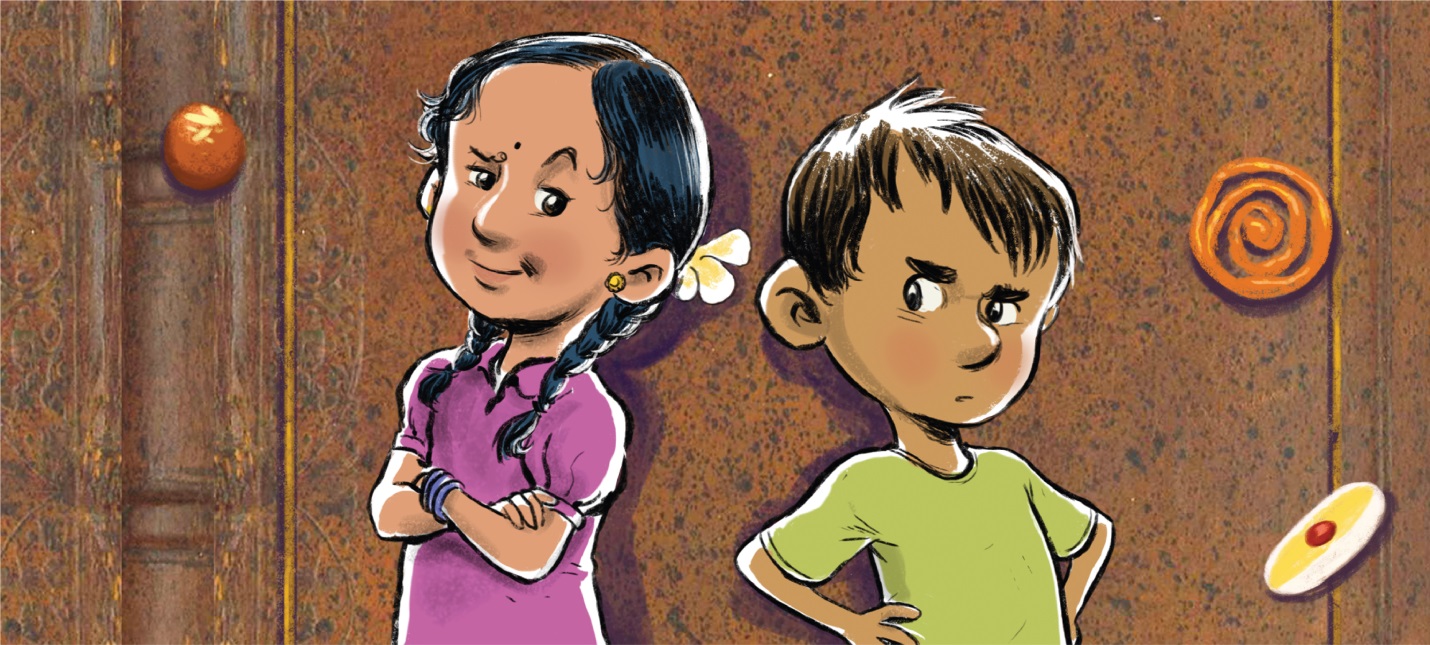
The Curious Case of the Sweet and Spicy Sweetshop by Nandini Nayar is a spooky story packed with curious characters, a hilarious hero and a super-fun plot. While reading this book, your child will be in for a double treat- witnessing witty family relations and discovering the magical world of sweets!
Most ghosts are super scary but here are 3 ghosts your child will absolutely love:
Bhagwandas Mithaiwala
Plump man with hair cut short, Bhagwandas was dressed in a full sleeved shirt in his portrait. While looking at the portrait, this was a man, Laddoo thought, who probably enjoyed eating the sweets he made and sold. The post-master and Bhagwandas were best friends. The postmaster remembered Bhagwandas as a cheerful man, with cheeks like his famous gulab jamuns and a voice as thick and caramelly as the best sugar syrup!
 Ramcharandas Mithaiwala
Vishnu’s grandfather, Ramcharandas was a serious looking man. A man with curly grey hair, that clustered around his head, he had a droopy moustache over his lips and looked serious. He was famous for being incredibly suspicious! He was convinced that people were trying to steal his recipes. So he built the sweetshop— without a single window. He wanted to make sure that not even a whiff of the fragrance of the sweets could escape the room.
 Girijakumar Mithaiwala
Vishnu’s great-grandfather was a thin man with a melancholy expression on his face. He was the one who set up the sweet shop. He built his house and the sweetshop under it because he believed that no sweet maker should live far away from his shop.
