



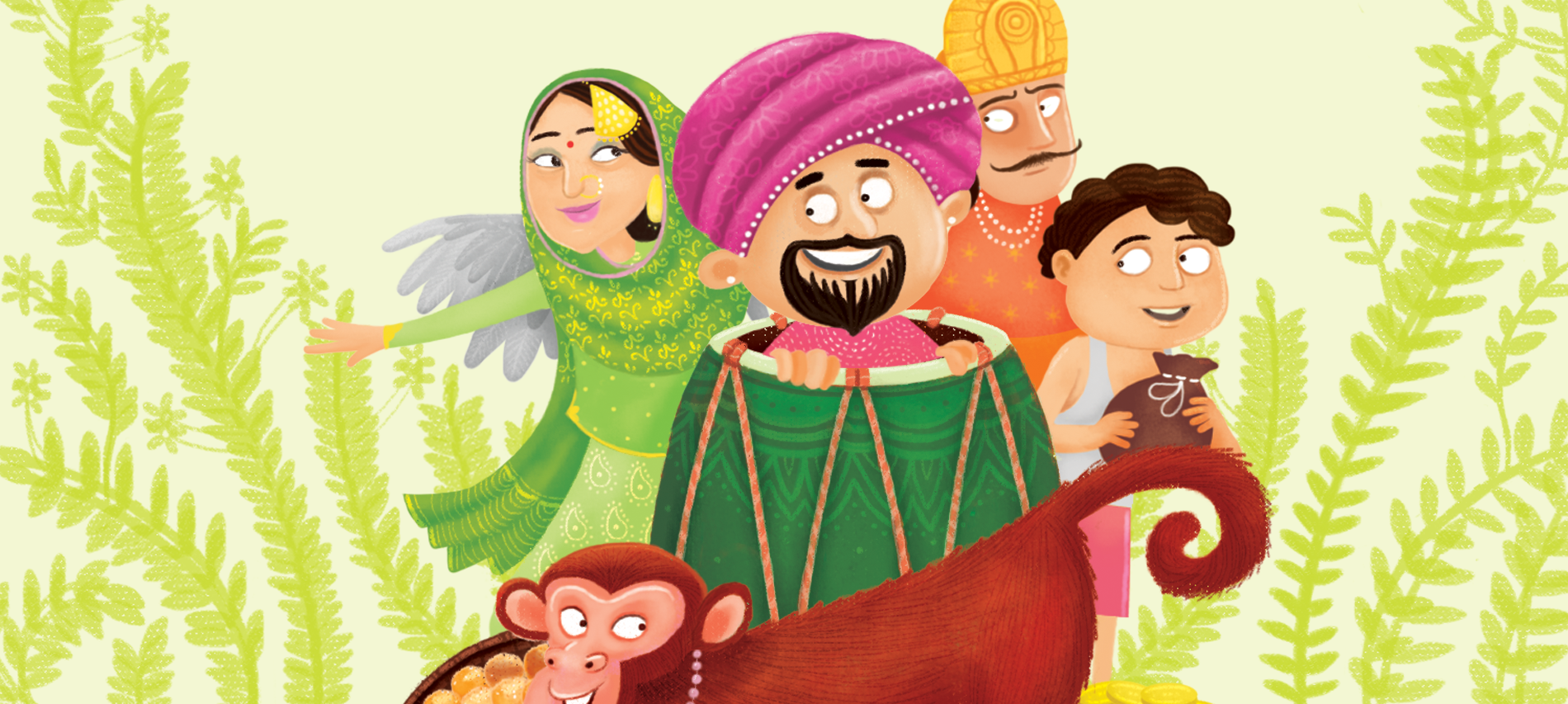
‘I will tell the king there are no supermen in this village’: ‘The Magic Drum and Other Favourite Stories’ — An Excerpt
We learned our first stories much before we learned to read. Our parents and grandparents sat us on their laps and took us to wondrous lands of kind kinds and clever, talking animals who taught a valuable lesson silently.
A brilliant collection of such beautiful, heartwarming stories by Sudha Murty that she grew up on as a child, ‘The Magic Drum and Other Favourite Stories’ is sure to take you down nostalgia lane and fascinate your child on a warm, lazy afternoon.
Here’s a snippet from the book about men from a small village who thought they could outsmart everyone else!
The Supermen
The men of Suvarnanagari were very lazy. They only liked to gossip and tell each other tall tales. As soon as the sun rose, the men would tuck into a hearty breakfast and start gathering in groups. Then they would spend the rest of the day telling each other impossible stories. They came back home only at lunch and dinner time.
Suvarnanagari had fertile land all around it, and if the men had spent even a little time in the fields, they would have reaped wonderful crops. But as they did nothing, all responsibilities ended up on the shoulders of the women, who had to slave the whole day. They cooked, cleaned, sent the children to school, worked in the fields, took the crops to the market—in short, they did everything. One day, the tired women got together and decided the men needed to be taught a lesson. Someone suggested writing to the king, who was known to be just and kind, about their problem. So a letter was written and sent off. The women went back to their work, but kept a sharp lookout to see if the king would send any help. But many days passed, and slowly the women began to lose hope. After all, why would the king of such a vast empire be concerned about the plight of a few women in a tiny village like theirs?
A month passed by and soon it was a full-moon night. The men ate their dinners and, because it was so beautiful and well-lit outside, they gathered again to chat and boast. That night, they were trying to prove to one another that they were capable of performing the most impossible tasks. As they sat talking, and the stories flew around, a tall and handsome stranger joined them. Seeing his noble features and intelligent eyes, each man wanted to prove himself better than the others and impress him.
One said, ‘I knew the map of our kingdom even before I left my mother’s womb. As soon as I was born, I ran to the capital and met the king. My mother had such trouble bringing me back home!’
Everyone was impressed with this story. But not to be outdone, a second man said, ‘So what is so great about that? When I was just a day old, I could ride a horse. I sat on a big horse and rode all the way to the king’s palace. He received me with a lot of love and we had the most delicious breakfast together.’ At the thought of food, everyone got dreamy-eyed and the story was greeted with a round of applause.
Now a third man said, ‘Huh! That’s nothing. I sat on an elephant when I was a week old and had lunch with the king in his palace.’
Before the admiring murmurs could die down, a fourth one said, ‘I was a month old when I flew like a bird and landed in the king’s garden. He picked me up lovingly and even let me sit with him on his throne.’
While everyone seemed to be awed by these stories, the stranger spoke up. ‘Do you four men know the king very well?’
‘Of course we do!’ they replied together. ‘Our king knows and loves us. In fact, he is proud to have supernatural beings like us in his kingdom.’
The stranger looked thoughtful. ‘That makes my task so much easier . . . You see, I work in the king’s court. Some time back, the king had called four supermen to the city in order to repair a large hole in the city walls. As you know, we use the largest, toughest stones for building these walls, and they could be lifted and put in place only by these supermen. The four asked to be paid in gold bars and the king gave them the money. But that night itself they disappeared from the palace. I have been wandering the kingdom ever since, looking for them. The king has ordered me to find the four men and bring them back to the capital to finish the work. They will also have to return the gold they ran away with. It looks like my search has finally ended. I will take you four to the king, along with the gold you stole from him . . . And I shall be the rich one now.’
By the time the stranger finished telling this amazing story, the men’s faces had turned ashen. What trouble had their lies landed them in? Together they dived at the stranger’s feet.
‘Save us!’ they wailed. ‘Those were all lies. We are just a bunch of lazy men. If you forget our stories, we promise to stop telling lies and do some honest work.’
The stranger smiled. ‘So be it. I will tell the king there are no supermen in this village. Only hardworking, ordinary men and women.’
That night itself he left the village, and the women were sure they saw a happy twinkle in his eyes as he rode away on a handsome, white horse, fit to belong to the king’s stables!
While you keep digging up more from your childhood’s collection, grab a copy of this fascinating book!
And while you’re at it, don’t forget to pre-order a copy of the master storyteller’s newest book soon to hit bookstores!

Reasons That Will Make You Pick ‘The Golden House’ As Your Next Read

Salman Rushdie is a maestro when it comes to literature. His books enrich and push the boundaries of our imagination. His latest novel, The Golden House´ is another stellar addition to his already magnificent bibliography.
The Golden House is the story of the powerful Golden family, told from the point of view of their neighbor Rene. Copiously detailed and sumptuously inventive the novel is a modern epic of love and terrorism, loss, and reinvention.
Here are some reasons why you should make it your next read.
The novel captures the current political climate

The formula for a perfect read.

Lucky 13!

The switch of the year!

Intrigued? Tell us what do you like most about Rushdie’s writings.

5 Reasons Why Army Life is Good Life

Life of an Army official as we know is one of hardship, and their turbulent affair with unknown danger and hazards is something not unheard of. Rachna Bisht Rawat’s Shoot.Dive.Fly presents a multidimensional picture of Army officials and their life. She debunks the myth that an Army officer is a man with a gun who lives on the borders of the country, cut off from the rest of civilization, and waiting for war to begin. What we don’t know is that life can be amazing for an Army official too.
Here are 5 reasons which elaborate why Army is amazing
When you get to fly around

Motivation and encouragement all the way

Lieutenant Mohammad Haseeb Khan’s message to those considering a career in the Army

The recognition that Army offered her

Army Life offers you to defy gender norms and touch the sky

Get to know more about the Army life and its thrilling experience in Rachna Bisht Rawat’s book Shoot Dive Fly

6 Times Every Indian Woman Could Relate to Mrs Funnybones

Twinkle Khanna’s Mrs Funnybones has successfully sent readers into laughing fits ever since it first hit bookshelves. A hilarious, yet critical look into our lives and everyday world, Mrs Funnybones often shows us how even a celebrity faces the same dilemmas and woes like all of us do!
Here are 6 instances from Twinkle Khanna’s best-seller which are sure to strike a chord with every Indian woman!
The holy triumvirate in every Punjabi home

A woman’s everyday struggle with all kinds of stains

Because naps are the secret to a happy life

The ‘karwa’ truth?

It’s not a tug-of-war, but a constant war inside one’s head!

The piece of advice one gets without fail but absolutely does not need

Are you having major deja-vu yet?

Making of a CEO, An Excerpt

Sandeep Krishnan is an adjunct professor at IIM Bangalore. His book ‘Making of a CEO’ found its genesis in a popular course he taught at IIM Bangalore, where the students interviewed and analyzed twenty CEOs to learn how they charted a clear path to the top. The book explores nuances of leading in different contexts like start-ups, large corporations, family businesses, educational institutions, not-for-profits, public sector and the government.
Here’s an excerpt from the book.
The chief executive officer (CEO) epitomizes the organization. The organization’s existence and its future are defined by the role the CEO plays. The CEO is the ultimate decision maker and can often be defined as a combination of a chief operations, marketing, finance, people and communications officer apart from the other key roles. The success or failure of the organization is often directly attributed to the CEO. At one level, the CEO is also the chief decision officer.
Great CEOs leave their footprints behind. They have the ability to transform businesses and even change the way society operates. Bill Gates changed the way the world works with Microsoft. Steve Jobs changed the way the world designs gadgets with Apple. N.R. Narayana Murthy of Infosys paved the way and showed how corporations can share their wealth with employees in India. Dhirubhai Ambani, founder of Reliance, showed how an entrepreneur can start from scratch to create an empire. Larry Page and Sergey Brin, co-founders of Google, changed the way the world searches for information. It is amply clear that every CEO has a unique opportunity to leave behind an enduring legacy.
In this book, the word CEO is sometimes used synonymously with positions such as managing director and chairman if the incumbent is also, in many ways, handling the operating role of running the company. Research shows that the role of a CEO is becoming more significant and often has a more direct impact on the company’s performance. With the environment of organizations becoming more dynamic and competitive, it is the top management’s strategy led by the CEO that can steer the company towards sustained growth. A CEO also shapes the culture of the organization—either sustaining or changing it. An interesting example of this would be of the ex-chairman of IBM, Louis V. Gerstner, who is credited for its turnaround. Gerstner revived the ailing IBM by pulling the levers of its culture, changing the attitude towards teamwork, providing solution to the customers, integrating different business units, changing the measurement of results, and improving communication with external and internal stakeholders. In the end, it is a well-known fact that Gerstner got IBM to dance!
There are leaders in corporates, NGOs, government and public sectors who have made a tremendous impact. There are great examples of public servants heading government enterprises and making a lasting impact on society. In India, E. Sreedharan illustrated how a government servant can influence society by high levels of effectiveness. He is credited with the successful execution of key projects that helped the Indian public. This includes the Konkan Railway, a 741-kilometre line that connected Mumbai to Mangaluru. As per Wikipedia, ‘With a total number of over 2,000 bridges and 91 tunnels to be built through this mountainous terrain containing many rivers, it was the biggest and perhaps the most difficult railway engineering project in the Indian subcontinent at the time.’ He was then entrusted with another key project: to develop the metro lines for urban transport in the National Capital Region (NCR), called the Delhi Metro. The success of the project gave E. Sreedharan a new name: ‘Metro Man’. The ability to lead and make a difference in the society has made E. Sreedharan one of the most successful CEOs that India has seen in the recent past.
Verghese Kurien, known as the Father of the White Revolution, made a tremendous mark on the cooperative movement in the country. He is credited with establishing Amul and the National Dairy Development Board (NDDB). Kurien was able to bring dairy farmers into the fold, changing the dairy supply chain of the country. His ability to organize the cooperative movement, first in Gujarat through Amul and then later to replicate the experiment across the country through NDDB, points to a leader who could articulate a vision and execute it to make a large-scale institution.

Addressing Nellie, An Excerpt from Derek O’Brien’s Essay in ‘Left, Right, and Centre’

Nidhi Razdan’s ‘Left, Right and Centre: The Idea of India’ celebrates the diverse cultural and political terrains that India comprises of. The book is a collection of essays from distinguished voices from various walks of life, upholding aspects of the nation lesser explored, and even lesser heard of.
In Derek O’Brien’s essay, ‘Addressing Nellie’, the politician and television personality revisits the memories of his grandmother and his ancestors who had been through the horrors of the Partition. As a part of the Anglo-Indian community, O’Brien brings forth the voices of those who have rarely been spoken about in the popular discourse of the subcontinent’s traumatic history.
Here’s an excerpt from his essay.
Each year, on 15 August, I find myself thinking of my great grandmother—my father’s paternal grandmother. Nellie Bella Biswas, as she was named when born to a Bengali-Christian family with homes in Jalpaiguri in north Bengal and Maniktala in north Kolkata, formed part of my earliest memories. She died in 1969, when I was just a schoolboy. Even by then she had come to represent an influential figure for me—the familiar matriarch, caring but firm, who taught the three of us, my brothers and me, to speak Bengali.
To my young mind, Nellie Bella Biswas—or Nellie Bella O’Brien as she became on marrying the descendant of an Irish settler in India—symbolized history. She was a walking, talking monument of history. To my innocent eyes, she seemed to stand for Mother India: a venerable and iconic figure who shed a silent tear in August 1947 as one country became two nations, and a composite society was split forever.
Nellie cried in August 1947, she cried every day from 1947 to 1969. She cried for the line in the sand that Partition drew. She cried for Patrick, her firstborn, her beloved son, who stayed on in Lahore . . .
For obvious reasons, the narrative of Partition has been written in terms of the subcontinent’s Hindus and Muslims. Christians have had only a small role in this drama. Anglo Indians—the community I belong to and which makes up a minuscule section of India’s Christians—have not even had a walk-on part.
Yet Partition had a dramatic impact on my extended family. My paternal grandfather, Amos, was one of the three brothers. The eldest of them, Patrick, was a civil servant who worked in Lahore and Peshawar, and served as a private secretary to Sir Olaf Caroe and later Sir George Cunningham, governors of the North-West Frontier Province in the tumultuous days leading up to August 1947. Much of the rest of the family, including my father and grandfather, were in Kolkata (or Calcutta, as it was then called).
One day, without quite realizing the implications, these members of the O’Brien family became citizens of separate countries. Patrick, the brother who had stayed on in Pakistan, had a large family. Two of his daughters were married to fighter pilots of what was at the time the Royal Indian Air Force. In 1947, they were either alotted or chose different nations.
Within months India and Pakistan were at war. It was a conflict that tore apart my father’s cousins, daughters of Patrick. One of them was with her father in Pakistan. Her husband was a fighter pilot in the Pakistan Air Force, her sister’s husband a fighter pilot in the Indian Air Force.
Night after night she stayed up, wondering if her husband would come home or if her brother-in-law in India was safe, or if these two men so dear to her, comrades and friends in the same air force till only a few weeks earlier, would aim for each other in the eerie anonymity of the skies. Her sister in India went through the same trauma. Patrick comforted his daughter. In another country, Nellie comforted her granddaughter.
Thankfully, neither man died in that war, but a distance emerged. Father and daughter, sister and sister, cousin and cousin, my Indian grandfather and his Pakistani brother—they lost touch with each other.

5 things Messi and Neymar Have Done Off Field

Motivation and determination drove Messi and Neymar to achieve what the world bestowed. Their accomplishment on the pitch is well known to lovers of football. The contribution made by them transcends the boundary of the pitch – and reaches people who require them the most. The football idols have contributed tremendously to those who are deprived of basic needs and wants.
Here are a few contributions they have made off the field.


Know these footballers more in Luca Caioli’s biographies of Lionel Messi and Neymar Jr.
Through the Past into the Future, An Excerpt from Yashwant Sinha’s Essay in ‘Left, Right, and Centre’

India’s magnificent plurality can not be contained in a homogenous sentence that favours only one side of the scale. Taking up this monumental challenge is Nidhi Razdan’s ‘Left, Right and Centre: The Idea of India’ that celebrates every aspect of the country, since its Independence 70 years ago.
In his essay ‘Through the Past into the Future’, Former Finance Minister, Yashwant Sinha, talks about the way forward despite all the major roadblocks a country of teeming billions faces every day. In spite of the many governments India has seen since its Independence, and in spite of all that it has achieved, Sinha highlights the pressing concerns that still keep the nation from being the superpower it deserves to be.
Here’s an excerpt from his essay.
It is debatable whether India has achieved all it should have in the seventy years since independence. On the one hand, we have sent the Mangalyaan to explore the planet Mars. Our space agency is capable of launching more than a 100 satellites together. We lead the rest of the world in information technology. Yet, there are hundreds if not thousands of villages which lack the basic amenities of life like an all-weather road, potable drinking water, proper sanitation and health facilities or proper schools. Unemployment continues to be a major problem.
Every government claims to have done its best to solve these problems yet they refuse to go away. Governments are always short on resources; the tax base does not expand despite inspector raj. Only the poor and the innocent are caught and the rich and famous get away. Millions of cases are pending in courts, the jails are full of undertrial prisoners, many of them having spent the maximum jail term which their crime may have merited. There are many ills from which we suffer today. We have miles to go before we rest. But what is the goal that we must set for ourselves for the remaining decades of this century and what are the means by which we can achieve it?
India must strive to reach the top of the league of nations— the top two or three in the world. That is our destiny and we must fulfil it. To arrive there, we must eradicate the bane of poverty, misery and deprivation in our society at the soonest. It is not difficult to achieve this goal.
Our two-pronged strategy should consist of high and sustained economic growth of around 8 per cent per annum for the next twenty years or so and a direct attack on poverty and deprivation. In an uncertain global scenario where globalization is on the retreat and economic nationalism is coming to the fore, we must depend on our own demand, our own resources and our own people to achieve the desired growth rate.
We have massive unmet demand in our economy. Our country is crying out for modern infrastructure. We must build lakhs of kilometres of roads of all kinds, national highways, state highways and rural roads, to connect our country and its people. We need irrigation works especially of the medium and the minor kind to irrigate our still-parched fields. We need all kinds of power, renewable and thermal, to light up our homes, irrigate our fields and run our factories. We need new towns and cities to provide for the population migrating from the rural areas into modern urban centres and to relieve the pressure on farmland and the villages, as well as the existing overcrowded and choking cities. Then, there is the issue of connectivity of these places with modern means of communication like railways and air services, telecom and fast Internet services.
Many more universities are needed and also other centres of excellence. Similarly new research facilities in science and technology are required to meet our growing needs. There is so much to do that the list can go on endlessly. All these activities will contribute to economic growth and generate employment. There will be no dearth of resources. People will always be ready to pay for the services they receive provided they are of quality and are uninterrupted. Resistance comes only when the services supplied are of poor quality and their regular supply is disrupted.
Our Constitution has given primacy to the individual not to the village. I do not know whether that is the reason for the neglect of the village. In the process the individual has also suffered. Is it possible, for a change, to accord primacy to the villages in our country and for the political class to take a vow that the improvement in the quality of the people living in them shall be the first charge on the nation’s resources?
A survey should be conducted in all the villages to find out what is lacking there in terms of basic amenities. We should then prepare time-bound plans to provide them with what they need in a pointed, directed manner much in the way in which the doctors treat cancer patients with radiation. In this way, we shall achieve our goal of improving the life of our fellow citizens within the same resources. Liberation of Indian villages from their wants must be our new battle cry.
Underlying all these activities on the nation building front is the need for political and governance reforms. I have already stated above how politics in this country reached its nadir with criminalization and the use of money power in the elections. Some improvement has taken place but a lot remains to be done. A beginning must be made with the democratization of political parties. Internal democracy within most political parties is becoming increasingly rare. Stricter laws, to be enforced by the Election Commission with the threat of de-recognition, are needed to force political parties to abide by these laws and rules.

The Idea of an Ever-ever Land, An Excerpt from Shashi Tharoor’s Essay in ‘Left, Right, and Centre’

Senior journalist Nidhi Razdan’s ,‘Left, Right and Centre: The Idea of India’ captures the country in its essence as a melting pot of cultures and histories
Former bureaucrat and current Member of Parliament, Shashi Tharoor, in his essay ‘The Idea of an Ever-ever Land’ talks about how any truism can never hold good for a country as plural as India.
Here’s an excerpt from Tharoor’s essay.
Just thinking about India makes clear the immensity of the challenge of defining what the idea of India means. How does one approach this land of snow peaks and tropical jungles, with twenty-three major languages and 22,000 distinct ‘dialects’ (including some spoken by more people than Danish or Norwegian), inhabited in the second decade of the twenty-first century by over a billion individuals of every ethnic extraction known to humanity? How does one come to terms with a country whose population is nearly 30 per cent illiterate but which has educated the world’s second-largest pool of trained scientists and engineers, whose teeming cities overflow while two out of three Indians scratch a living from the soil? What is the clue to understanding a country rife with despair and disrepair, which nonetheless moved a Mughal emperor to declaim, ‘if on earth there be paradise of bliss, it is this, it is this, it is this . . .’? How does one gauge a culture which elevated non-violence to an effective moral principle, but whose freedom was born in blood and whose independence still soaks in it? How does one explain a land where peasant organizations and suspicious officials once attempted to close down Kentucky Fried Chicken as a threat to the nation, where a former prime minister once bitterly criticized the sale of Pepsi-Cola ‘in a country where villagers don’t have clean drinking water’, and which yet invents more sophisticated software for the planet’s computer manufacturers than any other country in the world? How can one determine the future of an ageless civilization that was the birthplace of four major religions, a dozen different traditions of classical dance, eighty-five major political parties and 300 ways of cooking potato?
The short answer is that it can’t be done, at least not to everyone’s satisfaction. Any truism about India can be immediately contradicted by another truism about India. It is often jokingly said that ‘anything you can say about India, the opposite is also true’. The country’s national motto, emblazoned on its governmental crest, is ‘Satyameva Jayate’: Truth Alone Triumphs. The question remains, however, whose truth? It is a question to which there are at least a billion answers, if the last census hasn’t undercounted us again.
But that sort of an answer is no answer at all, and so another answer to those questions has to be sought. And this may lie in a simple insight: the singular thing about India is that you can only speak of it in the plural. There are, in the hackneyed phrase, many Indias. Everything exists in countless variants. There is no single standard, no fixed stereotype, no ‘one way’. This pluralism is acknowledged in the way India arranges its own affairs: all groups, faiths, tastes and ideologies survive and contend for their place in the sun. At a time when most developing countries opted for authoritarian models of government to promote nation building and to direct development, India chose to be a multiparty democracy. And despite many stresses and strains, including twenty-two months of autocratic rule during the 1975 Emergency, a multiparty democracy—freewheeling, rumbustious, corrupt and inefficient, perhaps, but nonetheless flourishing—India has remained.
One result is that India strikes many as maddening, chaotic, inefficient and seemingly ‘unpurposeful’ as it muddles its way through the second decade of the twenty-first century. Another, though, is that India is not just a country, it is an adventure, one in which all avenues are open and everything is possible. ‘India,’ wrote the British historian E.P. Thompson, ‘is perhaps the most important country for the future of the world. All the convergent influences of the world run through this society . . . There is not a thought that is being thought in the West or East that is not active in some Indian mind.’
Just as well a Brit said that, and not an Indian! That Indian mind has been shaped by remarkably diverse forces: ancient Hindu tradition, myth and scripture; the impact of Islam and Christianity; and two centuries of British colonial rule. The result is unique. Many observers have been astonished by India’s survival as a pluralist state. But India could hardly have survived as anything else. Pluralism is a reality that emerges from the very nature of the country; it is a choice made inevitable by India’s geography and reaffirmed by its history.
Pluralism and inclusiveness have long marked the idea of India. India’s is a civilization that, over millennia, has offered refuge and, more importantly, religious and cultural freedom to Jews, Parsis, several varieties of Christians and, of course, Muslims. Jews came to Kerala centuries before Christ, with the destruction of their First Temple by the Babylonians, and they knew no persecution on Indian soil until the Portuguese arrived in the sixteenth century to inflict it. Christianity arrived on Indian soil with St Thomas the Apostle (Doubting Thomas), who came to the Kerala coast some time before 52 ce and was welcomed on shore by a flute-playing Jewish girl. He made many converts, so there are Indians today whose ancestors were Christian well before any Europeans discovered Christianity. In Kerala, where Islam came through traders, travellers and missionaries rather than by the sword, the Zamorin of Calicut was so impressed by the seafaring skills of this community that he issued a decree obliging each fisherman’s family to bring up one son as a Muslim to man his all-Muslim navy! This is India, a land whose heritage of diversity means that in the Kolkata neighbourhood where I lived during my high school years, the wail of the muezzin calling the Islamic faithful to prayer routinely blends with the chant of mantras and the tinkling of bells at the local Shiva temple, accompanied by the Sikh gurdwara’s reading of verses from the Guru Granth Sahib, with St Paul’s cathedral just round the corner.

5 Ruskin Bond Quotes we’ve Written in Our Journal

Remember the last time you stood and quietly watched the rain patter on the empty streets? Remember the last time you watched a snail lazily drag itself across the grass?
It is hard to find time to appreciate the smaller things in life, and that is precisely where Ruskin Bond’s book Words From the Hills helps us. In the hustle and bustle of our everyday lives, the words from this specially designed journal come as a breath of fresh air, bringing with them the philosophy and legacy of the wonderful author.
Here are 5 quotes from Ruskin Bond we all must have thought of writing in our journals.


Which quote are you going to write in your journal?
