



Margaret Noble arrived at India’s shores in the late nineteenth century, took the vows of a brahmacharini and devoted the rest of her life to the cause of India. She was enchanted by Swami Vivekananda but their vows of celibacy kept her from expressing her feelings for him. Regardless, she went on to worship him, making her heart and mind work in tandem.
Here are six times Sister Nivedita faced a struggle between her heart and mind.
Nivedita was filled with an overwhelming sense of devotion and love for Swami Vivekananda

Nivedita’s love for her King, astonished many

For Sister Nivedita, Swami Vivekananda’s visit to London was a divine intervention

For Sister Nivedita, being close to her King was all that mattered

She felt guilty for ignoring her family but she couldn’t help it

Going against her impulsive nature, Sister Nivedita vowed to practice the wisdom of restraint as advised by her dear Guru

Tell us which aspect of Nivedita’s love for her King astonished you the most.

Understanding Strategic Positioning
Three key principles underlie strategic positioning.
- Strategy is the creation of a unique and valuable position, involving a different set of activities: Strategic position emerges from three distinct sources:
- serving few needs of many customers (Jiffy Lube provides only auto lubricants)
- serving broad needs of few customers (Bessemer Trust targets only very high-wealth clients)
- serving broad needs of many customers in a narrow market (Carmike Cinemas operates only in cities with a population under 200,000)
- 2. Strategy requires you to make trade-offs in competing—to choose what not to do. Some competitive activities are incompatible; thus, gains in one area can be achieved only at the expense of another area. For example, Neutrogena soap is positioned more as a medicinal product than as a cleansing agent. The company says “no” to sales based on deodorizing, gives up large volume, and sacrifices manufacturing efficiencies. By contrast, Maytag’s decision to extend its product line and acquire other brands represented a failure to make difficult trade-offs: the boost in revenues came at the expense of return on sales.
- Strategy involves creating “fit” among a company’s activities. Fit has to do with the ways a company’s activities interact and reinforce one another. For example, Vanguard Group aligns all of its activities with a low-cost strategy; it distributes funds directly to consumers and minimizes portfolio turnover. Fit drives both competitive advantage and sustainability: when activities mutually reinforce each other, competitors can’t easily imitate them. When Continental Lite tried to match a few of Southwest Airlines’ activities, but not the whole interlocking system, the results were disastrous.
Employees need guidance about how to deepen a strategic position rather than broaden or compromise it. About how to extend the company’s uniqueness while strengthening the fit among its activities. This work of deciding which target group of customers and needs to serve requires discipline, the ability to set limits, and forthright communication. Clearly, strategy and leadership are inextricably linked.
This is an excerpt from HBR’s 10 Must Reads (On Strategy). Get your copy here.
Credit: Abhishek Singh
India Transformed — An Excerpt
Rakesh Mohan is the former deputy governor of the RBI. He has also served as the executive director of the IMF and secretary, Department of Economic Affairs, and Ministry of Finance. He is currently a Distinguished Fellow with Brookings India.
India underwent a major economic reform in the form of liberalization in 1991. In India Transformed, India’s top business leaders and economists come together and provide a balanced picture of the consequences of the economic reforms, initiated in 1991. They ask themselves some imperative questions: What were the reforms? What were they intended for? How have they affected the overall functioning of the economy?
Here is an exclusive excerpt from the foreword of the book, written by Strobe Talbott, the former Deputy Secretary of United States of America.
This timely, authoritative and policy-relevant volume sheds light on India’s dramatic changes over the past quarter century. That transformation has not only been a boon to the people of India, it has also contributed to the progress of the human enterprise as a whole. The world’s largest democracy is a major player on the world stage. It is certainly viewed and valued that way by my own country, the United States of America.
The economic and commercial dimension of India’s evolution is, of course, crucial. Hence, the focus of submissions in the pages that follow is political economy, financial development, trade and globalization, technology and innovation, agricultural and industrial development, and the interaction between the private and public sectors. The contributors include some of the original designers and implementers of the reform process, along with the prominent business leaders who have been the most successful builders of the economy.
There is also, thanks to the inclusion of wisdom from Shivshankar Menon, Shyam Saran and Sanjaya Baru, due attention paid to India’s foreign and security policy.
Over the course of the last half-century, I have had numerous opportunities to watch India’s evolution, first from the vantage point of a student of international relations and then for two decades as a journalist. During my eight years in government during the 1990s, I also had a chance to participate in the effort by the Indian and the US governments to put the bilateral relationship on a sounder—indeed, a transformed—footing than had been the case in the first four decades after Indian Independence. Dennis Kux captured the perception on both sides of that star-crossed backstory in the subtitle of his 1992 book, India and the United States: Estranged Democracies.
What stymied a robust bond between these two countries? After all, both had wrested their independence from British rule while adopting and adapting many of the features of British constitutional governance (minus, of course, the monarchy).
The key factor, I’ve always believed, was the Cold War.
It was approximately at the midpoint of that global schism that I first visited India forty-two years ago. I owe that enriching and informative experience to a glitch in my career as a Sovietologist.
In those days, I was a reporter for Time magazine concentrating on East–West relations and was assigned to the State Department beat. This often meant whirling around the world, coping with what seemed like a permanent case of jetlag, trying to keep up with the then secretary of state Henry Kissinger.
In October 1974, Kissinger embarked on a seven-nation diplomatic tour starting with Moscow. The Kremlin was eager to welcome the secretary of state as the personification of continuity in the US policy of détente, in the wake of Richard Nixon’s resignation and Gerald Ford’s ascension to the presidency. The Soviets, however, were not about to extend their hospitality to me. I was persona non grata because of my role in translating and editing Nikita Khrushchev’s memoirs. The material for the two volumes was surreptitiously recorded and spirited out of the country while he was under virtual house arrest, since his ouster from the leadership ten years before. The second volume, published earlier in 1974, particularly irked Foreign Minister Anatoly Gromyko, who sent a message to Kissinger’s plane over the Atlantic, denying me a visa.
After I was unceremoniously dropped off in Copenhagen during a fuelling stop, I hopscotched to New Delhi, which would be Kissinger’s second stop after Moscow.
On the personal front, my several days of free time were immensely gratifying. I made friendships that lasted for decades. I also came to know Ambassador Daniel Patrick Moynihan (whose desk officer at the State Department was none other than Dennis Kux). Moynihan’s wife, Elizabeth, took me under her wing and drove me out to—where else?—the Taj Mahal, where she was already deeply into studying the Mughal gardens.

6 Quotes by Lee Child To Fill Your Hearts With A Sense Of Adventure
James D. Grant, popularly known by his pseudonym Lee Child, is a British author widely known and admired for his thriller novels, especially his Jack Reacher series. His books are power-packed, taking you on some epic adventures.
Here are six quotes by Lee Child that will make you feel adventurous:
Always!

Are you afraid of death?

Never!

The road of non-violence is paved with wisdom

Do you feel the same?

Do you also have a favourite Lee Child quote? Tell us.

Trump and Modi: Strangely Silent on the US-India Nuclear Deal
By Larry Pressler
Larry Pressler was the chairman of the US Senate’s Arms Control Subcommittee and advocated the now-famous Pressler Amendment. His book Neighbours In Arms provides a comprehensive account of how US foreign policy in the subcontinent was formed from 1974 till today and ends with recommendations of a new US-India alliance that could be a model for American allies in future.
Here’s a piece written by him on the US-India nuclear deal.
When I first visited India in 1965, I was enthralled by the people, the food, the heat and the colours. The plight of its poor moved me. As a graduate student in the Rhodes Scholar programme at Oxford University in England, I was looking for material to complete a doctorate in philosophy and made a brief visit to New Delhi. There, I spent three to four days during a term break in December.
On a low budget, I travelled by rail. The trains were crowded and the passengers were noisy and boisterous. It was such a contrast to the quiet and subdued cross-country train rides in the United States. I ate whatever my modest budget allowed, and remember enjoying my first taste of idli in southern India. Enveloped by the country’s spirit, I found the whole experience exhilarating.
But I also witnessed the long-term impact of foreign occupation and the devastating effects on its poverty-stricken people. I later saw the same negative impact of long-term foreign intervention in Vietnam. In India, there didn’t seem to be as strong a sense of national pride as I have witnessed in many other countries. At the time, I blamed it on colonialism. But, fifty years later, I also wonder if extreme poverty, corruption and the burden of the old caste system play a large role as well. Of course, the country’s lack of reliable electricity also keeps the population in a type of permanent Dark Ages—pun intended.
Consequently, I was highly encouraged when I learnt that, along with members of the US Congress, President George W. Bush and Prime Minister Manmohan Singh had agreed in July 2005 to a nuclear deal to bring electricity to the mass population. The US–India nuclear agreement would allow the United States to supply India with nuclear fuel for civilian power generators. In exchange, India agreed to institute international safeguards on its nuclear reactors to prevent them from being used for military purposes. The negotiations, surprisingly, had been conducted in almost total secrecy. Highly controversial, the agreement ended the United States’ three-decade ban on nuclear trade of any kind with India without requiring the country to join the Nuclear Non-Proliferation Treaty (NPT) or to dismantle its nuclear weapons programme.
An idealist, especially in the field of international development, might look at this deal as a great victory for the people of India, as the mass population would finally get reliable and clean electricity. In a country where 300 million of its citizens have no electricity and millions more have unreliable electricity, the US–India nuclear agreement—if implemented—could significantly improve the quality of life for more than a billion people.
To development specialists, the US–India nuclear agreement could be a godsend. Nearly 30 per cent of India’s population lives below the poverty line and 75 per cent earns less than 5000 rupees per month. The residents of the state of Bihar are among the most impoverished people in the world, with more than 70 per cent of its population suffering in extreme poverty. An ample and reliable supply of electricity will increase productivity in states like Bihar. More light in homes and in workplaces results in greater activity. This increased productivity will lift up those living in the most abject poverty in India. That is what proponents of the nuclear agreement must state as its main objective. It is a worthy humanitarian goal. But, thus far, the architects of this deal and its advocates have failed to reinforce it.
My love for India and its people is heartfelt. That is why I am so passionate about the transformative effects nuclear power can have on its citizens. If properly implemented, the US–India nuclear agreement could bring electricity, an improvement in the standard of living, and some level of dignity for many poor Indians. The poor are the ones who need the nuclear agreement the most, but so far this deal has just been a shuffling of millions of dollars between governments, arms dealers, consulting firms and lobbyists. Almost a decade after the deal was approved, not one nuclear power plant has even started construction.
Why hasn’t this happened? Importantly absent from the deal was a requirement forcing India to join the NPT and adhere to all its requirements. The Nuclear Non-Proliferation Treaty, enacted in 1970, extracted a bargain between nuclear weapons states and non-nuclear weapons states. Nuclear weapons states promised to use their nuclear capability only for peaceful purposes in exchange for a promise from non-nuclear weapons states not to pursue nuclear weapons in any form. The US–India nuclear agreement essentially gave India a waiver from the NPT, in an attempt to build a closer relationship with India and counter the rising threat of its powerful neighbour, China. This has antagonized many nuclear non-proliferation advocates, who see this move as a type of ‘nuclear double standard’. Many foreign policy experts claim that the special exemptions the US is giving India have done irreparable damage to global non-proliferation efforts. I tend to agree that we have executed an ‘about face’ on non-proliferation, but I believe it is necessary to get nuclear power for the Indian people.
It took nearly three years for both countries to approve the final agreement, which was signed by the then Indian external affairs minister, Pranab Mukherjee, and his counterpart, the then secretary of state, Condoleezza Rice, on 10 October 2008. Since it is not a treaty and merely an exchange of statements, we must accept the fact that it is not enforceable. Both sides are depending on the goodwill of the other for implementation. The publicly stated purpose of the agreement is to build nuclear plants in India to supply electricity to the country. In actuality, the United States’ primary goal with this deal was, selfishly, an economic one. The US–India nuclear agreement was primarily an arms trade deal. While it certainly was intended to allow nuclear suppliers entry into India, it also opened up vast new trade opportunities between the United States and India for many other industries. So far, the defence industry is the only industry that has enjoyed significant gains from the nuclear deal. This was not a quid pro quo, but the deal did open the doors wide for significantly more arms deals, notably C-130 and C-17 transport aircraft, and joint military exercises with India. This deal is simply a pathway to justify an escalation in arms sales between the two countries. Indeed, Stephen Cohen, a Senior Fellow from the Brookings Institute and an India expert, said that India will be ‘one of the largest markets for defense equipment in the coming two decades’.
President Obama continued the trend started by President Bush and further opened up arms trade between our two countries. In 2009, the Boeing Company won a contract for a $2-billion order for P-3 Orion maritime reconnaissance aircraft. Lockheed Martin secured a $1-billion contract for more C-130 transport aircraft. In 2010, President Obama pledged $5 billion of military equipment to India, making the US one of India’s top three military suppliers. Further efforts were made to loosen antiquated restrictions on technology transfer and to relieve onerous oversight controls. In 2013, the then secretary of defense, Ashton Carter, announced that India would be admitted into the coveted ‘Group of Eight’, the US allies that share the most sensitive technology details—without any export controls.
In 2014, analysts from the military trade publication Jane’s Defense said that India had become the largest foreign buyer of US weapons (only to be outbought by the Saudis in 2015). In 2015, President Obama and Prime Minister Modi announced new partnerships between our countries to jointly develop military jet engine technology and aircraft carrier design. President Obama said publicly that forging deeper ties between our two nations was a primary foreign policy objective for his administration. What he did not say is that these deep ties are mostly military ones. My nation’s new president, Donald Trump, seems poised to build on and reinforce this military relationship and take an even stronger stance against India’s rival, the rogue nation of Pakistan. Indeed, when Prime Minister Modi visited Washington in June of this year, the Trump Administration announced the approval of a $2 billion sale of unarmed drones to India, which raised the hairs on the necks of the Pakistani military and ISI. He also has appointed Lisa Curtis to be the Senior Director for South and Central Asia at the National Security Council. She is a veteran foreign policy expert who has recommended a much more punitive approach to Pakistan. And President Trump has made no apologies for his hard line against Muslim terrorists. Sadly, however, during Prime Minister Modi’s recent visit to Washington, there was no mention of the construction of any nuclear power plants. Their conversation (at least publicly) was strangely silent on this topic.
The US–India nuclear agreement was a good first step towards making India a key global ally. However, the deal has not even begun to achieve its full potential. I fear it never will.

How DMK changed the politics of Tamil Nadu under Annadurai
Conjeevaram Natarajan Annadurai, or Anna (elder brother), as he is affectionately called by his followers, became the Chief Minister of Tamil Nadu at the age of 58. This was the first electoral success for his party, Dravida Munnetra Kazhagam (DMK) and it marked the pinnacle of his political life.
R. Kannan’s biography Anna: The Life and Times of C. N. Annadurai sheds light on how DMK, under Anna’s glorious regime, changed the politics of Tamil Nadu forever.
Here are a few instances from R. Kannan’s book that show us how C. N. Annadurai became ‘Anna’:
The birth of Dravidian politics in Tamil Nadu — a defining moment in Indian political history

The foundation stone for DMK is laid on definitive lines of social justice and reform

Clear guidelines were laid for the principles on which DMK was to work in the days to come

A holistic approach, inclusive of minorities and issues of importance, was adopted by Anna’s party since the beginning

The party was in support of indigenous industries which always faced the peril of extinction

The life and times of the political stalwart have been beautifully captured in the words of writer R. Kannan in his biography, Anna: The Life and Times of C. N. Annadurai. Get your copy today!
Understanding Tagore’s Nationalism, An Interpretation by Ram Guha — An Excerpt
Rabindranath Tagore was born in 1861. He was the fourteenth child of Debendranath Tagore, head of the Brahmo Samaj. Their family house at Jorasanko was a hive of cultural and intellectual activity and Tagore started writing at an early age. He was a prolific writer; his works include poems, novels, plays, short stories, essays and songs. Late in his life Tagore also took up painting, exhibiting in Moscow, Berlin, Paris, London and New York. He died in 1941.
Born in Dehradun in 1958, and educated in Delhi and Calcutta, Ramachandra Guha pursued an academic career for ten years before becoming a full-time writer. He was named one of the hundred most influential intellectuals in the world by Foreign Policy and Prospect magazines.
Here’s an excerpt from the introduction of Tagore’s Nationalism written by Ram Guha.
‘Why Tagore?’ asked a brilliant young mathematician of me recently. He was referring to a newspaper column where I had spoken of Rabindranath Tagore, Mahatma Gandhi,
Jawaharlal Nehru and B.R. Ambedkar as the ‘four founders’ of modern India. ‘I can see why you singled out the other three,’ said the mathematician. ‘Gandhi led the freedom movement, Nehru nurtured the infant Indian state, Ambedkar helped write its Constitution and gave dignity to the oppressed.
But why Tagore?’ My questioner was no ordinary Indian. He comes from a family of distinguished scholars and social reformers. Like his father and grandfather before him, he had been educated at a great Western university but came back to work in India. Like them, he is well read and widely travelled, and yet deeply attached to his homeland. He fluently speaks three Indian languages. If an Indian of his sensibility had to be convinced of Tagore’s greatness (or relevance), what then of all the others?
Tagore’s reputation, within India and outside it, has suffered from his being made a parochial possession of one province, Bengal. It was in Bengali that he wrote his poems, novels, plays and songs, works that are widely read and regularly performed seven decades after his death. The poet Subhas Mukhopadhyay recalls ‘a time when the elite of Bengal fought among themselves to monopolise Tagore. They tried to seal off Tagore, cordoning him away from the [sic] hoipolloi.’ Then he adds: ‘There was another trend, serving the same purpose, but in a different way. In the name of ideology and as the sole representative of the masses, some tried to protect the proletariat from the bourgeois poet’s harmful influence!
The Bengali communists have since taken back their hostility to Tagore—now, they quote his verses and sing his lyrics with as much gusto as their (bourgeois) compatriots.
But he remains the property of his native heath alone. This geographical diminution of the man and his reputation has been commented upon by that other great world traveller and world citizen of Bengali extraction, the sitar player Ravi Shankar. In his autobiography, the musician writes that ‘being Bengali, of course, makes it natural for me to feel so moved by Tagore; but I do feel that if he had been born in the West he would now be [as] revered as Shakespeare and Goethe . . .
He is not as popular or well-known worldwide as he should be. The Vishwa Bharati are guarding everything he did too jealously, and not doing enough to let the entire world know of his greatness.’
Ravi Shankar compared Tagore to the German genius Johann Wolfgang von Goethe (1749 1832); so, before him, had the critic Buddhadeva Bose. Both men, remarked Bose, ‘participate[d] in almost everything’.Certainly, no one since Goethe worked in so many different fields and did original things in so many of them. Tagore was a poet, a novelist, a playwright, a lyricist, a composer and an artist. He had good days and bad, but at his best he was outstanding in each of these fields.
Tagore’s poems and stories are mostly set in Bengal. However, in his non-fiction, that is to say in his letters, essays, talks and polemics, he wrote extensively on the relations between the different cultures and countries of the world. Tagore, notes Humayun Kabir, ‘was the first great Indian in recent times who went out on a cultural mission for restoring contacts and establishing friendships with peoples of other countries without any immediate or specific educational, economic, political or religious aim. It is also remarkable that his cultural journeys were not confined to the western world’. He visited Europe and North America, but also Japan, China, Iran, Latin America and Indo-China.
Read the complete introduction by Ramachandra Guha in the new edition of Rabindranath Tagore’s Nationalism. Get your copy here.
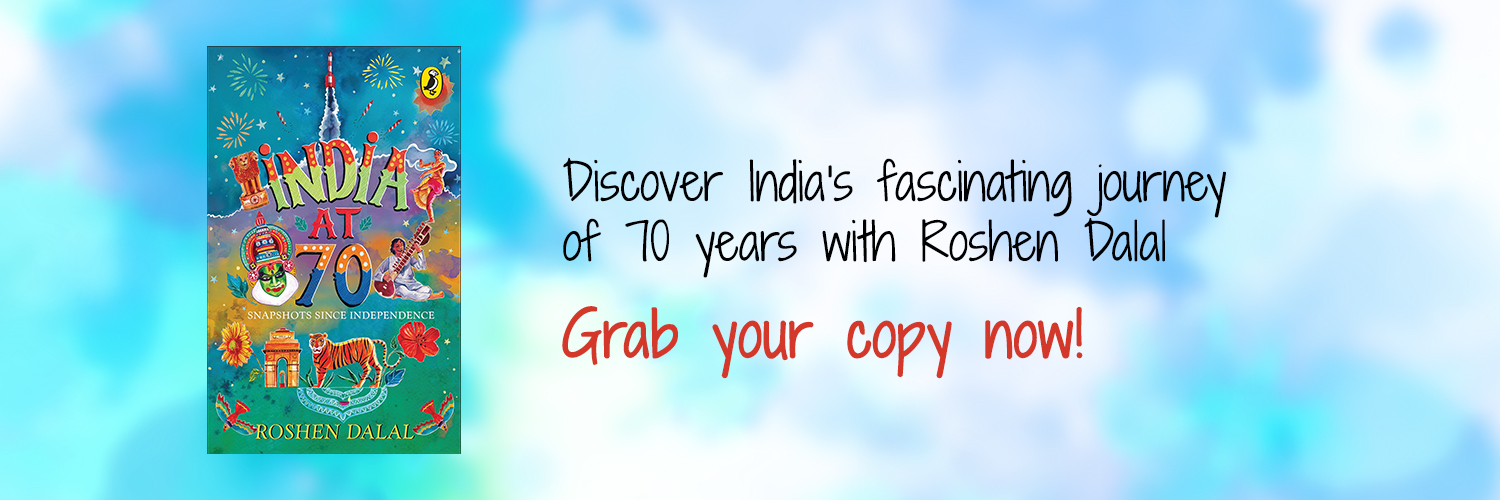
When the Journey Began: ‘India at 70’ — An Excerpt
In 2017, India’s spacecraft Mangalyaan is orbiting Mars, satellites are regularly sent into space, the economy is growing rapidly and India’s diverse art and culture is appreciated globally. And, most importantly, India is the largest democracy in the world.
The story of India as an independent nation began seventy years ago, in 1947, when the country gained independence after almost 200 years of British rule. For the first time, India became a united political entity, a nation with clearly defined boundaries. What type of country would the new India be? Would it remain united and strong?
At this time, the territory known as India consisted of eleven British provinces and some additional areas directly under British rule as well as 565 Indian states (also called princely states) where the British had overall control. The Muslim League, led by Muhammad Ali Jinnah, wanted a separate state of Pakistan, and finally it was decided that this demand would be granted. On 14 and 15 August 1947, two new nations were created, but the boundary lines between them were known only on 17 August. Pakistan was in two parts; West Pakistan was formed in the western half of Punjab while East Pakistan was created from the province of Bengal. As the lines for dividing the area were drawn on a map, districts, canals and even villages were divided.
This partition of one country into two created many problems. In the west, 10 million migrated across the new borders, and as anger arose between Muslims on one side and Hindus and Sikhs on the other, about 1 million were killed. There were other issues too, as the entire administration and all its possessions—including tables, chairs, books, musical instruments, cars, pencils and pens as well as the army, police, railways, postal services, money and other items—had to be divided.
The process of integrating the different states to form one India began before Independence. While some of the states were in the region of Pakistan, 554 states were in Indian territory. These states had different kinds of rulers. Some controlled huge areas and had vast quantities of wealth, land, buildings, money, gold, jewels, cars and elephants; others had small territories of just a few square kilometres. There were actually 425 small states. By 31 July, two types of agreements had been worked out for the Indian states to sign, by which they agreed to join India and give up some of their powers. At the time of Independence, the Constitution of India was being prepared. A constitution consists of the rules and ideas according to which a nation is governed. The Constituent Assembly, a group of people who would discuss and write India’s constitution, first met on 9 December 1946. The Constitution was ready by the end of 1949, after which India became a republic in 1950. Two years later, the first elections were held and India’s Parliament began to function. Thus, though India’s complex history dates back to the Stone Age, the year 1947 brought in great change.
This is an excerpt from the introductory chapter of Roshen Dalal’s ‘India at 70’. Get your copy here today!
5 Different Versions of Yama Raj in World Mythology
We are surrounded by diverse cultures, religions and beliefs. But going through the different mythologies in the world, we often find many similarities. Deities of one kind can be found in various forms among different cultures.
In Hindu Mythology, Yama Raj is regarded as the lord of the death. Similarly, in other cultures the deities of death take a different personification.
Here are 5 different versions of Yama Raj in different cultures.
Santa Muerte

Hades

Dis Pater

Anubis

King Yan

How many of these gods of death did you know of? Tell us.

Things You Did Not Know About Author and Philanthropist, Sudha Murty
With an ordinary upbringing like most of us, Sudha Murty’s life took extraordinary turns against all odds due to her courage and, determination and will to succeed in life.
Here are a few facts about Sudha Murty that you may have not known before.


Sudha Murty leads with example and shows us that absolutely nothing in life is unachievable, as long as one has the heart to do it.
