



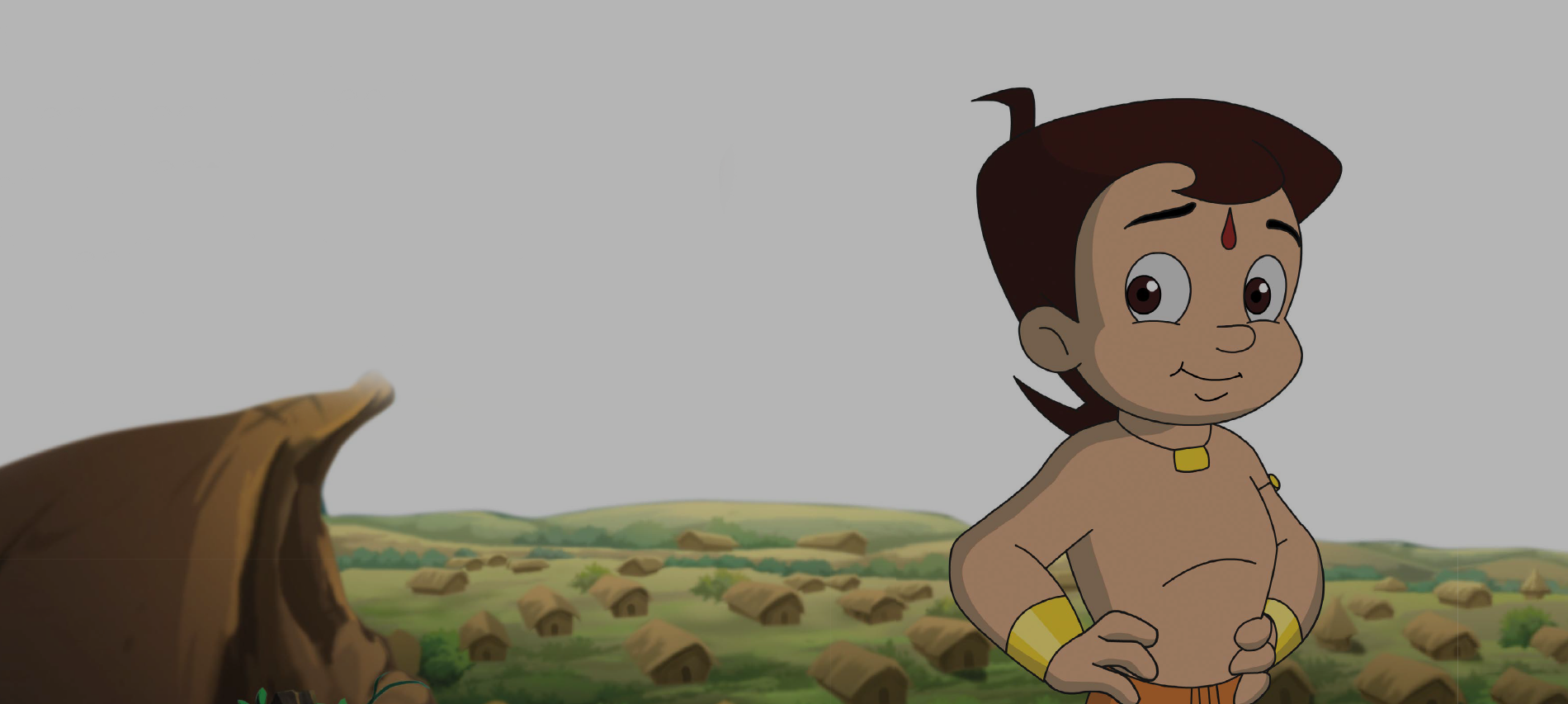
Is your little bundle of joy going to start school soon? Have you been looking for books that will ease them into this new phase of life? The Chhota Bheem series by DK Books, is where your search ends. The series is a set of four books, ideal for kids between 4-6 years. It aims to enrich your kid’s general knowledge and also inculcate a fondness for reading.
Here are 5 ways in which your child can enjoy the series:
Easy-To-Read Text
The book series aims to educate and entertain your little one through illustrations and easy-to-read-text. Combining familiarity of the much loved characters with educational content adds to your tot’s understanding.

Increase General Awareness
The series covers topics such as types of transport, animals, seasons, and the concept of party. Like the TV series, the books will make your little one aware of things which they see around them every day. The storytelling format in the books will let them have as much fun as they have while watching an episode.

Engage in Fun Activities
Learning becomes easier when you’re having fun! The books also contain activities like crafting a paper boat or making lemonade which incorporate fun learning for your child, thereby increasing their attention span and enabling them to fare better at school.

Improve Cognitive Skills
Apart from helping children develop the habit of reading, the books focus on improving their thinking and analytical skills, achieving this through word search, spot the difference, solve the maze, etc. The analytical skills come into play when your kid is learning subjects like mathematics and science.

Respect for the Environment
In the light of the on-going climate change, the series aims to make the children aware of their surroundings. The books cover topics such as climate change and endangerment of animals. These topics will help you instill in your child, respect for the environment and its gifts.

Are you ready to see your kid set off on an exciting journey of learning? Tell us what they think of the books.

8 Books by Jo Nesbo You Should Definitely Read

Jo Nesbo is a Norwegian crime novelist with awards such as Riverkey Prize and Glass Key Award to his name. Nesbo is primarily known for his Harry Hole series and the Doctor Proctor series of children’s books. He is also the author of several stand-alone novels, including Headhunters which was adapted into a film in 2011.
Here are 8 books by Jo Nesbo that will keep any reader on the edge of their seats:
Knife

The latest installment in the Harry Hole series. In his new book , Knife, Harry Hole is about to face his darkest case yet. The first killer he put behind bars is out to get him. Harry is responsible for the many years Finne spent in prison but now he’s free and ready to pick up where he left off.
When Harry wakes up with blood on his hands, and no memory of what he did the night before, he knows everything is only going to get worse . . .
The Bat

This is the first installment of the Harry Hole series. Inspector Harry Hole of the Oslo Crime Squad is dispatched to Sydney to observe a murder case. The victim is a twenty-three-year-old Norwegian woman who is a minor celebrity back home. Never one to sit on the sidelines, Harry befriends one of the lead detectives and one of the witnesses, as he is drawn deeper into the case. As they circle closer and closer to the killer, Harry begins to fear that no one is safe, least of all those investigating the case.
The Bat won the Riverkey Prize and Glass Key Award.
Blood On Snow

Written under the pseudonym of Tom Johansen, Blood on Snow revolves around Olav Johansen, a cold-blooded killer with a heart of gold. Olav is a fixer for a high-profile crime kingpin in 1970s Oslo. He easily takes care of anyone who causes trouble for his boss. But he is more complicated than he seems. Olav’s latest job puts him at the pinnacle of his trade, but it may become his greatest mistake.
The Son

The Son is about Sonny Lofthus who has been in prison for almost half his life: serving time for crimes he didn’t commit. Years earlier Sonny’s father, a corrupt cop, took his own life rather than face exposure. When Sonny discovers a shocking truth about his father’s suicide, he makes a brilliant escape and begins hunting down the people responsible for his and his father’s demise. But he’s also being hunted, and by enemies too many to count. Who will get to him first, and what will he do when he’s cornered?
Headhunters

Roger Brown is a corporate headhunter, and he’s a master of his profession. At an art opening one night he meets Clas Greve, who is not only the perfect candidate for a major CEO job, but also, perhaps, the answer to his financial woes. But when he breaks into Greve’s apartment to steal a painting that has been missing since World War II, Brown realizes that Clas Greve may turn out to be the worst thing that’s ever happened to him.
The Snowman

In the seventh installment of the Harry Hole series, the detective traces a killer who makes his own rules and he’ll break his pattern just to keep the game interesting. With brilliantly realized characters and hair-raising suspense, international bestselling author Jo Nesbo presents his most chilling case yet—one that will test Harry Hole to the very limits of his sanity.
Police

Harry Hole, with his brilliant insights and dedication to his job, saved numerous lives in Oslo. But what happens when Harry is in no position to protect his loved ones in the face of a terrible danger. In this tenth installment of the Harry Hole series, the detective fights against a killer who lures and kills anyone who is or has been a part of the force.
The Redbreast

The third entry to the Harry Hole series, The Redbreast has Harry investigating neo-Nazi in Norway. Having caused an embarrassment in the line of duty, Harry Hole is tasked with surveillance duties. When a rare and unusual gun fires off, followed by the discovery of a former soldier’s dead body, Harry tries to see the connection between the two cases. The Redbreast touches upon Norway’s involvement in Second World War. It won the Norwegian Booksellers’ Prize in 2000 for best novel of the year.
Intrigued yet? Tell us what you think of Jo Nesbo’s works in the comments below.
The Legal Eagle – An Excerpt

Harish Salve’s name ranks amongst the brightest legal luminaries of India. After an illustrious career of nearly two decades as a Supreme Court lawyer, he served as the Solicitor General of India from 1999 to 2000. A highly sought-after practising lawyer, his client list includes corporate bigwigs like Ratan Tata, Tina Ambani and Lalit Modi, as well as powerful politicians like Mulayam Singh Yadav and Prakash Singh Badal, and also Bollywood actor Salman Khan. He represented Vodafone in the well-known tax case with the Indian government which was finally decided in Vodafone’s favour. He was the counsel of choice for Mukesh Ambani’s Reliance Industries Limited in big-ticket cases like the Krishna Godavari Basin gas dispute and for Ratan Tata in a privacy petition concerning the Niira Radia tapes, as well as for the Delhi Police in the case for its midnight raid over Baba Ramdev’s rally at Ramlila Maidan. Besides representing his high-profile clients, Harish Salve has offered his pro bono services several times as amicus curiae to assist the Supreme Court in cases mostly relating to the preservation of the environment.
It’s a special day when I hear from the country’s pre-eminent lawyer, confirming our meeting in early August in Delhi at his office at ‘White House’ on the premium Bhagwandas Road, a stone’s throw away from the Supreme Court and India Gate in the Lutyens Bungalow Zone. I am excited to meet Harish Salve, though thankfully not for legal reasons!
There are guards posted outside his sixth-floor office. As you go past the reception desk, of the three doors that open into the reception area, the one on the extreme right is Harish’s chamber. It’s elegantly done in dark mahogany wood and expectedly has a wall-to-wall library stacked with gilded books as the backdrop to his revolving black chair. His large glass-top work desk and the set-up around it take up almost one-third of the space.
From a reputed family, with his grandfather being a successful criminal lawyer and father, N.K.P. Salve, a well-known Congress politician of his time, I imagine that Harish would have had success served to him on a platter and I share my view with him up front.
‘Contrary to what you think,’ he says, ‘I had what you may call “a lower-middle-class” upbringing. I come from a life of simplicity and grew up in a house full of relatives. My mother’s elder brother took sanyas (became an ascetic) and left home. His children were virtually brought up by my parents. My mausi (maternal aunt) also lived with us. So my elder sister, five of my cousins, my mausi and I used to sleep in the big living room, with the only bedroom in the house occupied by my parents.’ Harish was brought up by the same mausi, who was a professor of philosophy in a women’s college. Every night, she would put him to bed and read something to him. It was a very down-to-earth upbringing. Sports for Harish in his childhood meant playing football with kids from the chawls behind their house. As he says, ‘So even though I went to a very good school in Nagpur, there was so much learning we had on the football field of different aspects of life while intermingling with children from different backgrounds.’
After school, he chose to do his undergraduation in commerce and joined his father’s chartered accountancy firm for articles. Harish’s father was a practising chartered accountant before he joined politics. He and his partner had a small firm with an annual turnover of about Rs 5 lakh. Remembering those times, Harish says, ‘During my first year of college, I used to travel by bicycle in the sweltering heat of Nagpur.’ Colleges started in the month of March when day temperature in Nagpur is usually above 40 °C and burning. ‘I would come back, have lunch and then leave for office.’ As the peak summer months approached, the temperature would go up to 45 °C and Harish would cycle to office earlier in the morning. ‘There were times when we would be required to go to some factories in the afternoons and do an audit. I remember we used to take a wet towel and put it around our heads to avoid heat stroke and then cycle some 8 kilometres to reach the place,’ he says. ‘The so-called “big entertainment” in college and years after that was to go to a local dairy and have coffee or to go to Hanuman Mandir and have samosas. I usually stayed up the nights and studied. We would go to the railway station and eat at the dhabas there.’ That’s how Harish grew up. He credits these experiences for teaching him some very important values, making sure he’s never lost touch with that part of his life.
‘You switched from commerce to law. How did that happen? Did you complete your chartered accountancy?’
‘The moment I completed my graduation I joined CA, but found it very boring. Though the course was good, I knew that I would not stay in the audit and accountancy field. I was more interested in law and taxation. I completed CA only because it became a matter of prestige. Everyone said, “Yeh toh Salve sahab ka beta hai, ye thodi karega CA” (He is Mr Salve’s son, so he will not do CA) and my reaction was, “Ab toh pass karke chhodunga” (Now I will qualify and prove myself).’ Harish qualified for CA, and within two months gave up his certificate of practice to enrol at the bar. His father was very upset, but Harish was very clear that he wanted to be a lawyer. He had been a (Nani) Palkhivala fan from the age of fourteen as his father’s firm used to consult Mr Palkhivala on taxation matters, and Harish got the opportunity to interact with him a few times on cases wherein his father involved him. Harish thoroughly enjoyed income tax and learnt a lot from Nani, and gradually made up his mind that if he had to pursue taxation, it would be as a lawyer. The time had come for him to chase his dream.
Keen to know more about his relationship with his father, I ask, ‘You completed law from Government Law College, Nagpur, in 1980, and by then you had also managed to complete a couple of years’ internship with a law firm operating out of Nagpur and Mumbai, as well as acquiring the precious experience of working with Nani Palkhivala on the famous Minerva Mill case. Later, Nani recommended that you work as a junior with Soli Sorabjee who was then the Solicitor General of India based in Delhi. At that time, your father was the deputy leader of the Congress in Parliament under the prime ministership of Indira Gandhi and soon went on to hold other important portfolios in the Central cabinet—as minister of state for information and broadcasting (I&B), then minister of state with independent charge for steel and mines. How did the relationship pan out between the father and the son in terms of propriety—you as a budding lawyer and your father as an influential politician?’
‘My father joined politics when I was ten years old. All I have seen is a downslide in the quality of my life from the time he joined politics. His income went down and things didn’t change right through to the time I was doing my CA. I remember my mother telling me, “You cannot eat meat every day.” This is how it was even when my father was a member of Parliament (MP). Though he steadily grew in terms of his political stature, it didn’t translate into financial gains. The sense of righteousness was very strong in him, so he made sure that the boundaries between our professions remained concrete. When my father was inducted as a minister in the Central cabinet in the 1980s, I never attended a single official party. I went to his office only once when he was in the I&B ministry because he wanted me to sign some papers. For several years after my father was the minister of power, I didn’t know that his office was in Shram Shakti Bhawan.’
It was only much later when, as Solicitor General, Harish went to Shram Shakti Bhawan for a meeting with Suresh Prabhu—who was the minister of power then in Atal Bihari Vajpayee’s cabinet—regarding the Dabhol case that he realized that it was his father’s office!
‘When my father was the minister of steel, he called me up one day and said that he wanted to know how much work I had got from the Steel Authority of India in the last year. I totalled it, and it came to about Rs 3000 when I had a practice running into some Rs 40 lakh at that time. When he became the minister of power, he called me and told me that he did not want me to work for any public sector units that came under his ministry.’ Harish assured him he would not and at the same time brought to his father’s attention how there were a bunch of third-grade lawyers whom ministers patronized and that they should be barred from appearing. ‘I ended up becoming the cause for a rumpus that followed in the ministry,’ chuckles Harish and adds, ‘It was only once that I worked for the ministry of power, and then too, instead of getting any benefit, I ended up giving free advice to the government.’
‘You imbibed taxation and law from your family environment. What about politics? Have you ever considered joining politics?’
‘My personal view is that there are two kinds of reactions when you see power and politics very closely—you love it or hate it. I hate it.’ Harish is clear that he has never even considered the idea of joining politics. As a student of public affairs and law, he likes following politics and understanding it because it is important—not in its narrow partisan sense but as an important part of governance.
‘As a renowned constitutional lawyer, what are your observations on India as of today—the way the country is being managed and where it is headed?’
Harish ponders briefly and then very eloquently expresses his key concerns about Indian polity. He cautions and remarks, ‘I think right now India is going through a very negative mindset and if we don’t realize this soon enough and do something about it, we are going to pay a very dear price for it. We have, from about 2011 onwards, created an impression that everybody in power is corrupt, everyone who has a car is a crook, everyone who lives well is a crook. We must realize that India’s biggest fault line is between the haves and the have-nots. In the power game of politics, instead of taking hard decisions for development, people are being pitted as rich or poor—us versus them. In this way, we are gradually cultivating complete disrespect for our constitutional institutions.’
Harish’s analysis is that we are being misled by a wealth-hungry media. The media decides who is corrupt and who is not, and we basically assume if a person is rich and influential, he/she must be corrupt. The reality is that governance comes from institutions, and wealth comes from private capital. By giving them a bad name today, Harish believes we are sawing at the edifice of democracy. This trend is alarming and nothing, nothing appears to be above partisan politics—whether it’s land acquisition, foreign direct investment (FDI), or even the Naga Accord. Not blaming any one political party for it, he points out that everybody does it, with politicians attending to their personal interest first and functioning with a ‘to hell with the nation’ attitude.
However, he acknowledges that we still have a lot of very fine politicians and conscientious MPs, having known them well. ‘There are a lot of lower-middle-class MPs who live in two-bedroom flats and go back to do some good work in their constituencies. But you’ll never hear about those people. On the other hand, if one person makes some communally sensitive statement, it immediately makes for front-page news,’ he says.

Six Quotes by Paula Hawkins that’ll Enthrall Any Reader

A former journalist, Paula Hawkins started writing romcom fiction under the name Amy Silver, writing four novels including Confessions of a Reluctant Recessionista.
After the bestseller The Girl on the Train, Hawkins returns with Into the Water, a twisting read that hinges on the deceptiveness of emotion and memory.
Here are a few quotes from The Girl on the Train and Into the Water, that’ll enthrall any reader.


Enthralled yet? Let us know what you think of Paula Hawkins’ works in the comments below.

5 Lesser-Known Books by Ruskin Bond that You Must Read

Ruskin Bond has written a string of unforgettable tales – stories about nature and animals, and the bond formed between humans and the wild. As we celebrate Ruskin Bond’s 83rd birthday, here are some of his lesser-known great writings.
Vagrants in the Valley
This book catches up with our favourite Rusty as he plunges not just into the cold pools of Dehra but into an exciting new life, dipping his toes into adulthood. At once, thrilling and nostalgic, this heart-warming sequel is Rusty at his best as he navigates the tightrope between dreams and reality, all the time maintaining a glorious sense of hope.

The Day Grandfather Tickled a Tiger
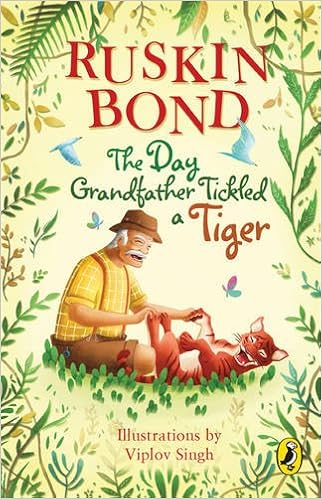
Grandfather had brought home Timothy, the little tiger cub, from the forests of the Shivaliks. Timothy grew up to be a friendly tiger, with a monkey and a mongrel for company. But some strange circumstances lead grandfather to take Timothy away to a zoo. Will they ever meet again? This a heart-warming story of love and friendship!
Rusty Runs Away
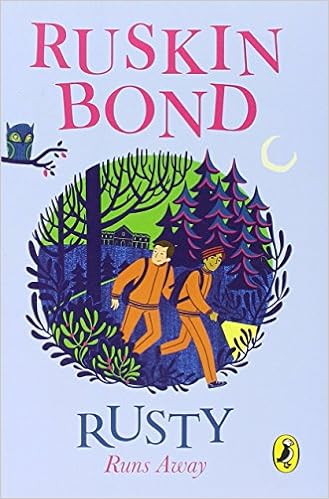
Rusty’s world is turned topsy-turvy when his father and grandmother pass away in quick succession. The twelve-year-old is sent away to boarding school by his guardian, Mr Harrison. Restlessness, coupled with an ambition to travel the world, compels him to run away from his rather humdrum life at school. But the plan fails, and he is soon back in Dehra, with his strict guardian. Rusty is now seventeen. He rebels and leaves home again, this time for good.
The Tree Lover
His mesmerizing descriptions of nature and his wonderful way with words—this is Ruskin Bond at his finest. Read on as Rusty tells the story of his grandfather’s relationship with the trees around him, who’s convinced that they love him back with as much tenderness as he loves them.

Dust on the Mountain
When twelve-year-old Bisnu decides to go to Mussoorie to earn for his family, he has no idea how dangerous and lonely life in a town can be for a boy on his own. As he sets out to work on the limestone quarries, with the choking dust enveloping the beautiful mountain air, he finds that he longs for his little village in the Himalayas.

Which is your favourite Ruskin Bond story? Tell us as we celebrate the bond of stories with Mr Bond!
10 Lessons from Lilly Singh’s Book, “How To Be A Bawse”

Lilly Singh is a multi-faceted comedian, entertainer and now an international bestselling author. In her book, HOW TO BE A BAWSE: A Guide to Conquering Life, Lilly teaches readers how to be their own bawse, a person who exudes confidence and reaches goals. Inspired by hilarious and honest stories from Lilly’s own experiences, this book proves that there are no shortcuts to success and becoming a bawse requires handwork and dedication.
Here are 10 of our favorite lessons from Lilly (aka Superwoman) in How To Be A Bawse:


Tell us how are you conquering life.

The Boy Who Loved — An Exclusive Excerpt

1 January 1999
Hey Raghu Ganguly (that’s me),
I am finally putting pen to paper. The scrunch of the sheets against the fanged nib, the slow absorption of the ink, seeing these unusually curved letters, is definitely satisfying; I’m not sure if writing journal entries to myself like a schizophrenic is the answer I’m looking for. But I have got to try. My head’s dizzy from riding on the sinusoidal wave that has been my life for the last two years. On most days I look for ways to die—the highest building around my house, the sharpest knife in the kitchen, the nearest railway station, a chemist shop that would unquestioningly sell twenty or more sleeping pills to a sixteen-year-old, a packet of rat poison—and on some days I just want to be scolded by Maa–Baba for not acing the mathematics exam, tell Dada how I will beat his IIT score by a mile, or be laughed at for forgetting to take the change from the bania’s shop.
I’m Raghu and I have been lying to myself and everyone around me for precisely two years now. Two years since my best friend of four years died, one whose friendship I thought would outlive the two of us, engraved forever in the space– time continuum. But, as I have realized, nothing lasts forever. Now lying to others is fine, everyone does that and it’s healthy and advisable—how else are you going to survive the suffering in this cruel, cruel world? But lying to yourself? That shit’s hard, that will change you, and that’s why I made the resolution to start writing a journal on the first of this month, what with the start of a new year and all, the last of this century.
I must admit I have been dilly-dallying for a while now and not without reason. It’s hard to hide things in this house with Maa’s sensitive nose never failing to sniff out anything Dada, Baba or I have tried to keep from her. If I were one of those kids who live in palatial houses with staircases and driveways I would have plenty of places to hide this journal, but since I am not, it will have to rest in the loft behind the broken toaster, the defunct Singer sewing machine and the empty suitcases.
So Raghu, let’s not lie to ourselves any longer, shall we? Let’s say the truth, the cold, hard truth and nothing else, and see if that helps us to survive the darkness. If this doesn’t work and I lose, checking out of this life is not hard. It’s just a seven-storey drop from the roof top, a quick slice of the wrist, a slip on the railway track, a playful ingestion of pills or the accidental consumption of rat poison away. But let’s try and focus on the good.
Durga. Durga.
12 January 1999
Today was my first day at the new school, just two months before the start of the tenth-standard board exams. Why Maa– Baba chose to change my school in what’s said to be one of the most crucial year in anyone’s academic life is amusing to say the least—my friendlessness.
‘If you don’t make friends now, then when will you?’ Maa said. They thought the lack of friends in my life was my school’s problem and had nothing to do with the fact that my friend had been mysteriously found dead, his body floating in the still waters of the school swimming pool. He was last seen with me. At least that’s what my classmates believe and say. Only I know the truth.
When Dada woke me up this morning, hair parted and sculpted to perfection with Brylcreem, teeth sparkling, talcum splotches on his neck, he was grinning from ear to ear. Unlike me he doesn’t have to pretend to be happy. Isn’t smiling too much a sign of madness? He had shown the first symptoms when he picked a private-sector software job over a government position in a Public Sector. Undertaking which would have guaranteed a lifetime of unaccountability. Dada may be an IITian but he’s not the smarter one of us.
‘Are you excited about the new school, Raghu? New uniform, new people, new everything? Of course you’re excited! I never quite liked your old school. You will make new friends here,’ said Dada with a sense of happiness I didn’t feel. ‘Sure. If they don’t smell the stench of death on me.’ ‘Oh, stop it. It’s been what? Over two years? You know how upset Maa–Baba get,’ said Dada. ‘Trust me, you will love your new school! And don’t talk about Sami at the breakfast table.’ ‘I was joking, Dada. Of course I am excited!’ I said, mimicking his happiness.
Dada falls for these lies easily because he wants to believe them. Like I believed Maa–Baba when they once told me, ‘We really liked Sami. He’s a nice boy.’ Sami, the dead boy, was never liked by Maa–Baba. For Baba it was enough that his parents had chosen to give the boy a Muslim name. Maa had more valid concerns like his poor academic performance, him getting caught with cigarettes in his bag, and Sami’s brother being a school dropout. Despite all the love they showered on me in the first few months after Sami’s death, I thought I saw what could only be described as relief that Sami, the bad influence, was no longer around. Now they use his name to their advantage. ‘Sami would want you to make new friends,’ they would say. I let Maa feed me in the morning. It started a few days after Sami’s death and has stuck ever since.
Maa’s love for me on any given day is easily discernible from the size of the morsels she shoves into my mouth. Today the rice balls and mashed potatoes were humungous. She watched me chew like I was living art. And I ate because I believe the easiest way to fool anyone into not looking inside and finding that throbbing mass of sadness is to ingest food. A person who eats well is not truly sad. While we ate, Baba lamented the pathetic fielding placement of the Indian team and India’s questionable foreign policy simultaneously.
‘These bloody Musalmans, these filthy Pakistanis! They shoot our soldiers…

Devdutt Pattanaik on Mothers

Mothers have been an important mainstay in epics, folk tales and mythologies for generations. Today, as we celebrate Mother’s Day, here is an exclusive excerpt on mothers from Devdutt’s Devlok 2.
A mother gives birth to a child. But did god give birth to the mother or did a mother give birth to god?
As interesting as the question is, the answer too is not simple. In a temple, the space where a god’s image is kept is known as garbha griha; that is, god is residing inside the garbha. Garbha means womb. Whose womb is this? A temple itself has been seen as a woman, a mother. Spiritually, Prakriti is everyone’s mother. Prakriti has given birth to sanskriti (culture). God’s mother is also Prakriti.
The Rigveda has this interesting sentence that Daksha gave birth to Aditi and Aditi gave birth to Daksha; that is, the father created the mother and the mother created the father. When you go way back in the past, the division between father and mother collapses. With god, this concept does not hold because god is swayambhu—he has given birth to himself; he is his own mother. Two words are used often in the Puranas – Yonija (born of the womb) and Swayambhu (who gives birth to self). God is always swayambhu, but his avatars are yonija; they experience birth and death. For instance, Ram is an avatar, so he is born and dies. He has a mother, Kaushalya. Krishna, likewise, has a mother, Devaki. Shiva is swayambhu.
In Tantra parampara, where goddesses are given a lot of importance, the stories and folk tales speak of how in the beginning of the world there was only a devi/Prakriti called Adi Maya Shakti. She gave birth to three eggs from which were born Brahma, Vishnu and Shiva. She is therefore called Triamba (one who gave birth to three children). This does not happen in puranic stories. In Shakt parampara, god does have a mother. In Vaishnav parampara, god gives birth to himself; and he creates the world and its creatures from himself. In Shaiva parampara, Shiva gives birth to himself; he is swayambhu, doesn’t have a mother, but gives birth to all mothers.
Devi is sometimes called a kumari (virgin) and sometimes mata (mother). How is that?
Christianity has a concept of the virgin mother who is Jesus’s mother. The word kumari, in India and in the world, does no necessarily mean virgin. It means a woman who is independent, who has no husband, and no man has a right over her. She has no ties and is completely liberated. So she is both mata and kumari, that is, an independent mother. Her hair is always depicted untied, to symbolize her freedom. No one can have dominance over Prakriti.
In Vaishnodevi or Kal Bhairav temples, the story is that of Bhairav wanting to have a relationship with the goddess; the goddess refused and cut off his head. ‘You cannot control me.’ Kal Bhairav then becomes her guard. In another story, when Brahma’s fifth head wanted a right over her, Bhairav cut off his head. Such are the violent stories associated with kumari.
The symbolic meaning could be that man’s ego prevents a devi from becoming a kumari, which is why he gets cursed or gets his head cut off. These are spiritual, metaphysical topics.
Shiva was swayambhu, but who was his son Karitkeya’s mother—Parvati or Ganga?
In Shiv Puran, the story is that after their marriage, Shiva says he has no need for a child. He says, ‘I am swayambhu, anadi, anant, without beginning or end; I will never die. So why do I need children?’ Devi says, ‘But I want children; I want to be a mother.’ An interesting conflict arises here. When Shiva is about to offer his seed, all gods and goddesses say that Shiva’s seed cannot be accommodated in just one womb; it should be placed in many wombs. The story goes that his seed is so hot that no one can touch it. First is is given to Vayu, wind, in the beliefe that he’ll be able to cool it down, but he fails. Vayu gives the seed to Agni, fire, who too cannot hold it. He passes it on to Ganga and her waters starts boiling. The reed forests (Sara-vana) near the river start burning. From the ash of those reeds, a child emerges. In some stories, it is six children who emerge. As the infants start crying, Krittika nakshatra, constellation of six stars, descend from the sky as the childrens’ mothers and feed them milk. Finally, Gauri, Shiva’s wife, joins the six children together. That child is Kartikeya, also called Shanmukha, or one with six heads.
The question arises, the father of the child is Shiva, but who is the mother? Vayu, Agni, Ganga, Sharavan, Krittika, Parvati all stake a claim. So, he has many mothers. Shiva’s seed has thus gone to many yonis; it shows that the child is so powerful, he cannot be born of just one womb. Kartik means son of Krittika. In the south, he is called Sharavanan, son of Sharavan. In images, he is sometimes shown along with six or seven matrika, mothers.
What is Ganesh’s story? Who is his mother?
In stories, although Shakti wants to become a mother, the gods don’t want her to give birth in the normal way. If the child is born from her yoni, it’ll be so powerful that it will defeat Indra, the king of the gods. So, Shiv-Shakti’s children are not born from Parvati’s yoni. Kartikeya is born of Shiva’s seed, from many yonis. Ganesh is born from the scrapings of Parvati’s body. Again, he is ayonija.
The story is that Parvati goes to Shiva, asking him to give her a child. He says he is not interested as he’s immortal. She tells him she’ll make it herself; she’s the goddess, after all. She first collects the scrapings (mull) of her skin, mixed with the applied chandan and haldi. Then she makes a doll of it and gives it life. In Vamana Purana, it is said the child’s name ‘Vinayak’ comes from ‘bina nayak’ (without a man); there are other stories about the word’s origin too. Shiva does not like the way Parvati has birthed her child, as he cannot recognize her image in it, so he cuts off its head. Parvati starts weeping, and insists he bring back the child to life. So Shiva gives him an elephant head and that’s how Ganesh is born. Again, it is ayonija.
In the Mahabharat, we see many ambitious mothers who want their sons to be king.
In the Puranas, the stories have more of a spiritual, intellectual concern, while in the Ramyan and Mahabharat, the focus is on wealth and property. For this reason, the men go to war, and the women want their sons to grow up and be victorious. This is presented in a fascinating way in the Mahabharata. When Shantanu wants to marry Satyavati, she first attaches a condition that her son inherit Shantanu’s kingdom. She claims she is securing her child’s future. Is that the real reason or does she want the high position of a rajmata (queen mother)?
There is also a competition between Gandhari, Kunti and Madri. When Gandhari is pregnant, she hears that Kunti has given birth to a son. Although Gandhari was pregnant from before, Kunti used her mantra to have Yudhisthir without the nine-month period. Gandhari gets so upset, she beats her belly with a stick. The mass that emerges from her belly is cold as iron. When Vyas creates 100 children from this mass, Gandhari is happy, because now she has more children than Kunti. Kunti begets two more children and uses up the power of her mantra. She gives the mantra to Madri who uses it once and calls Ashvin Kumar and gets the twins, Nakul and Sahdev. Pandu asks Kunti to let Madri use the mantra once more as she herself had used it thrice, but Kunti refuses. She fears that if Madri were to produce twins again, she’d have more children, and therefore more importance, than her. In the Mahabharat, this rivalry has been subtly depicted.
What about the mothers in the Ramayana?
Kaikeyi’s story is the most well known. When she had saved Dashrath’s life during a dev-asura battle, he had promised her two boons. The day before his eldest son, Ram’s, coronation, she throws a tantrum and demands her boons. She asks that Bharat be made king instead of his first-born Ram, and that he send Ram into vanvas (life in the forest) for 14 years. Ram’s mother, Kaushalya, is pained and asks Kaikeyi why she had to be so cruel to a son who’d treated her like his own mother.
An interesting aspect of this story is that when Dashrath marries Kaikeyi, he does not have any children. The astrologer says that Kaikeyi will definitely have a son. At that time, Dashrath promises her that her son would become king. So, in a way, Kaikeyi is only asking for what is rightfully her due. It’s like a court case, a settling of an agreement, where the lines are not clear. Whether Kaikeyi is ambitious or merely asking for her right is hard to say.
Krishna is called Devakinandan and Yashodanandan. Who was his mother?
There are some who believe that Krishna is not an avatar (of Vishnu’s) but himself an avatari—from whom avatars emerge. Others see him as an avatar. But he is born from Devaki’s womb, so he is yonija and experiences death. Mausala Parva in Mahabharat describes Krishna’s death. He is born from Devaki’s womb in Mathura, but is raised by Yashoda in Gokul. So he has two mothers – birth/blood mother and milk mother.
In folk songs, Krishna is asked who his real mother is—Devaki who has birthed him or Yashoda who has raised him? Krishna replies, do you think my heart is so small that it cannot contain more than one mother? I can handle both. But the question is who has the maternal right over him? Who is to answer that—it’s a complex world. The story suggests that relationships are not built by blood alone. Another aspect is that Devaki is a princess, while Yashoda is a milkmaid. So Krishna’s claim that both are his mothers shows that he has a relationship with the palace dwellers as well as cowherds, with the city as well as the village. He is large-hearted and this is why Krishna is associated with love.
In Puranas, is there a story of single mothers?
Bhagwat Puran has a story of Devahuti whose husband is Kardam rishi who says he doesn’t really want to have children, but has been told by his ancestors that he won’t achieve moksha (liberation from life and death) until he has children. But he doesn’t want any part in raising that child. Devahuti agrees to raise the child alone, and the child grows up to be Kapil muni who develops the Sankhya philosophy. It is also well known that Sita raises Luv and Kush on her own. Shakuntala too raises her son Bharat by herself in the forest, without the support of her husband.
Is there a story in our Puranas where a father plays the role of a mother?
When apsaras have children, they abandon them. Shakuntala’s mother Menaka had abandoned her in the jungle, and Shakuntala was raised by Kanva rishi who is like a single father. When Sita goes back to her mother, and disappears inside earth, she leaves her children behind with Ram who becomes a single father.
This is an excerpt from Devdutt Patnaik’s Devlok 2.

First Stories: A Mother’s Day Tribute to the First Storyteller of Our Lives
A mother is usually our first friend in this world and our first storyteller! From bedtime stories to explaining the world to us, mothers fulfil our most passionate curiosity – the desire to be told stories.

And we loved her most.
We held her hands and walked to the bookshop – ogling at the colourful editions, leafing through them, and falling in love with the smell of new books – for the first time ever!
 Her smile did hug us!
Sometimes, when we wouldn’t eat, she would distract us with the world of stories, nourishing us: body and soul
 Just like the Runaway Bunny’s mum.
And when night befell, we would snuggle next to her with a good book. Her storytelling voice gently guiding us into our world of dreams!
 Bliss.
This Mother’s Day, join us in celebrating the first storyteller of our lives.
Do you remember the first story you ever heard from your mum that you would like to share? We would love to know!
*
5 Badass Mothers in Literature

To call mothers a superhero will be an understatement (we are pretty sure they wear an invisible cape). Just like our real-life moms, mothers in literature also pull of some great tasks with breathtaking ease. Whether they are trying to protect the protagonists or just do a great job at raising them, we can’t help but look up to them.
So, here are five badass mothers:
Hester Prynne, The Scarlet Letter

Hester Prynne, in 17th century, did what other ladies in that era couldn’t even imagine doing i.e. live an independent life while raising a child on her own. Even though punished by her Puritan neighbours, she refuses to give out the names of her lover and their daughter. Deemed as an outcast then, she’d be considered a heroine today, like many of our moms.
Raksha, The Jungle Book

She is the fiercest mother we know. She cared for Mowgli as much as she did for her cubs. When Shere Khan threatened the pack to give up Mowgli, she proclaimed as his protector. Foster or not, a mother is a mother.
Mariam, A Flight of Pigeons

Mariam is an indomitable lady with a charm. Despite being at Javed Khan’s house in the times of turmoil, she refuses his proposition to marry her daughter Ruth. She does not give into the adversity of her circumstances but takes a chance with faith, saving her daughter’s life in the end.
Rosa Hubermann, The Book Thief

Rosa Hubermann is Liesel’s foster mother who has a “wardrobe build”, sharp tongue and a no-nonsense attitude. She does laundry for the wealthier households to help her family financially. She also never got fazed by anybody, not even Nazis during World War II. She is a mom who uses cuss words to show affection.
Marmee, Little Women

Runs the household by herself, raises four daughters, becomes their counsellor and role model, Marmee did it all. She also teaches them and nurtures them to become strong, inspirational women while keeping each of them true to their individuality. If Marmee isn’t a badass mother, we don’t know who is.
Do you know any more names that should be on this list? Tell us.