No more fodder for gender-restricted roles, parenting is now a joint venture and for the good. But even while our idea of parenting changes, the truth is that babies are still the same. So how do we fill this gap?
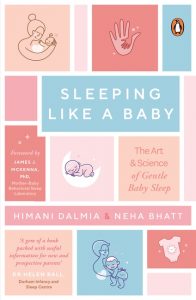
Sleeping Like A Baby shows various examples of modern parenting problems with simple, priority-driven solutions. There’s even a section on travelling with babies in-flight! This particular excerpt deals with the perils of parents who want to keep up the momentum of their social life without compromising on their baby’s sleep.
Sleeping Like A Baby || Neha Bhatt & Himani Dalmia
*
Some families are more social than others and have varying degrees of obligations and priorities. Depending on your situation and family dynamic, here are some tips you could use to tweak your social life which allow you to let down your hair while also keeping the baby’s sleep routine front and centre:
Choose well
In the first few years, accept social invitations that are truly important to you and offer some leeway in terms of time and day.
Become the host
Move the party to your house. Put the baby to bed, press play on the white noise, keep the baby monitor next to you and hang out with your friends and family.
Pivot
Accept that your social life will change after having a baby, and that’s a good thing. It means everyone is growing up, not just the baby! Request friends and family to be flexible and accommodate celebrations at a time in the day that are baby-friendly. And while your outings may seem severely limited in the first year or so, once the baby moves to a one nap routine (at around 15-18 months) it gets a lot easier to plan visits.
Take turns
If there are invitations you do not want to decline that clash with your baby’s sleep routine, take turns to go. You attend one while your spouse goes to the next one, or one that is more important to either one of you.
Get your me-time
Once your baby’s routine has settled down, go out with your friends while your partner does bedtime and bridges sleep cycles. For this to happen successfully, involve your partner in baby sleep from Day 1.
Create your ‘outing’ at home
If it’s hard to go out or you just feel too exhausted to leave home, staying in can be just as fun. Snuggle up with the latest Netflix movie or your favourite book, a tub of popcorn and your beverage of choice once your baby is down for the night. Now that the COVID-19 pandemic has made virtual parties legitimate social events—go right ahead and organize your own Zoom gatherings.
It’s all a phase
Hitting pause on late-night socializing pays off in the end, we promise you. Sticking around to help baby sleep at night rather than taking her out with you when it’s her bedtime results in a well-rested child who grows to love her sleep because she is in touch with her internal cues and feels safe and cared for. As she grows, you will be able to socialize more without compromising on her sleep.
Find your tribe
In the time of social media, it’s easy to find a tribe of your kind of parents who are happy to create fun social experiences that suit baby routines. Reach out to them! Take turns to plan gatherings that work for everyone, especially the kids. We did the same and not only have we had a ton of meaningful conversations and boisterous fun, but we also made friendships to last a lifetime.
Dial down wedding worries
Weddings are not typically baby-friendly events. Try and book a room at the venue where the baby can take a nap, or fall asleep for the night with a caregiver while you attend the wedding and can go back to the room if she needs you.
*
A true balm for parenting and baby sleep woes, Sleeping Like A Baby is now available at every bookstore near you.
“A good beginning is half the journey.”- Pranjal Kamra
Investonomy||Pranjal Kamra
You’ve heard of the stock market before, and you might even have thought of investing in it. But something has always stopped you, an itch that has always held you back. According to the National Stock Exchange (NSE), there are 1.2 crore active investors in India, a country of 138 crore people, as of 2021. This means that the Indian stock market is severely untapped. Investing, contrary to popular belief, is more than just a numbers game. In fact, investing gives you more insight into human behaviour than any other field. Investonomy is your ultimate guide to investing in the Indian stock market and helping your wealth-creation journey through equity investment!
Leveraging experience
When it comes to investing, be it in the stock market or otherwise, investors who have been in the game for a long time have the upper hand. Essentially, experience is of paramount importance in the investing world. However, Investonomy can help you bridge this time gap and invest like a pro from day one. Through meaningful insights, it not only explains modern value investing principles but also unveils certain secrets of the stock market. This is something that usually takes years of experience to uncover. Through Investonomy, you can reach your personal wealth goals with ease , regardless of whether or not you’ve invested before!
Understanding popular strategies
Smart investing is crucial to make it big in the stock market. While there are a plethora of investment strategies available for you to choose from, it isn’t as simple as it seems. Understanding popular investment strategies and choosing the most suitable one for your investment goals is a hefty task. Investonomy explains these strategies in detail and helps you make the right pick, effortlessly. Time is money, and with Investonomy, you will be able to chart your investment plan to boost your wealth creation journey!
Decoding the psychology behind investing
The stock market is more than numbers, and smart investing often involves understanding the psychology behind how and why people invest. Stock market investment is for anyone who has the willingness and patience to learn the art of investing. Unlike in science, there is no fixed formula in stock investment to make profits, nor can you control the key factors to get your desired outcome. Stock market investment is an art that needs to be learnt with experience and knowledge. Hence, you need a comprehensive guide like Investonomy, to help you navigate the complexities of the stock market and help you get the best returns in the long run.
Investonomy is a roadmap to convert your love–hate relationship with the stock market into an unshakeable bond. Get your copy and start your investment journey today!
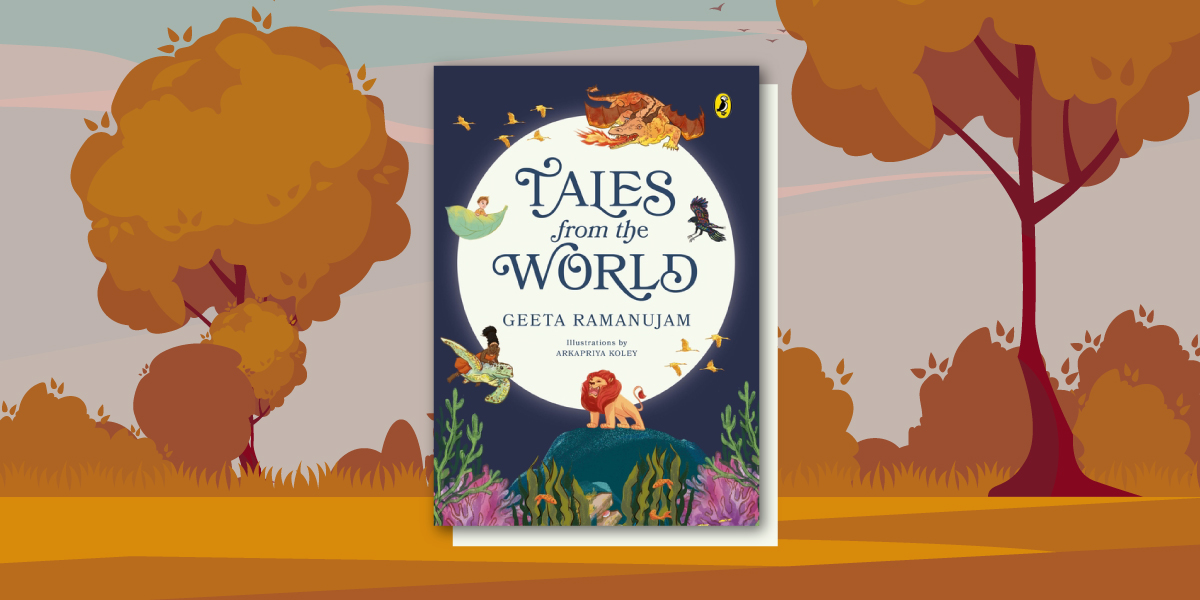
Geeta Ramanujam’s Tales from the World will take you on a long journey and introduce you to many fascinating characters. Collected from storytellers on snow-capped mountains, and in eerie forests, opulent palaces and countries near and far, the captivating folk tales in Tales from the World have mesmerized old and young alike. Travel along with this imaginative storyteller and author as she shares peculiar myths and incredible trivia from around the world in this beautifully illustrated volume of twenty tales from Russia, Japan, France, Tibet, India, Korea, Scotland and more.
Let’s read an excerpt from the book about a story from Russia.
*
Tales from the World || Geeta Ramanujam
Just after the world was created, filled with its trees and mountains and birds, God created a young maiden called Lindu, and left all the birds in her charge. She lived with her father Uko at the very edge of the world, between the sky and Earth. Lindu had the powers to recognize the song of each bird and sing them too. She knew where the birds had flown in autumn, and sent each flock on its way.
Lindu cared for the birds tenderly; she was a godmother to them. She knew how to direct winds to assist the birds as they flew to their destinations. She set fierce dust storms upon hunters who tried to kill her birds or hunt them down. It was not surprising that all the world loved her, those who dwelt in the sky most of all.
The North Star wished to marry Lindu and drove up to her father’s palace in a dusky coach drawn by six black horses. Adorned in a silver cloak and crown in shades of silver, he came bearing ten fine presents for Lindu and drove gracefully through the gates of Uko’s palace to ask for her hand.
However, Lindu was not very fond of the North Star. ‘Why don’t you want to marry me?’ inquired the disappointed North Star. ‘Well, I like to move and travel whereas you just stay fixed in one place in the sky. You are the watchtower of heaven.
Please, sir, return to your place, for I cannot accompany you there.’ Now, the moon decided to take his chances and drove to the palace in a beautiful coach of silver with six grey horses made of clouds. Dressed in white robes and a crown filled with white dewdrops, he presented her with twenty presents and said, ‘Lindu, will you be my wife?’
‘You change your face too often, moon, and that does not suit me,’ she said. The moon waned and returned to the night sky.
‘Well,’ thought the sun, ‘perhaps Lindu might like my bright gold face.’
The sun arrived in a beautiful coach of gold, led by gold and red horses, and rode through dusk to the forest where Lindu was taking care of her birds. Lindu walked up to him, bowed her head and said, ‘I know what you are thinking. I am sorry, but I love change. I love the changing seasons, the climate, the winds and anything that is not constant. You are so precious and graceful, but you have to be vigilant and cannot change at all. That might not suit me, sir.’
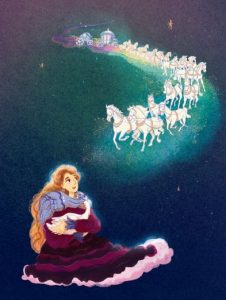
The sun too rode away into the purple-pink sky, disappointed and sad. Now, the Northern Light had been watching each suitor drive away disappointed and decided to ask for Lindu’s hand himself, confident that he’d be triumphant. He emerged from his home at midnight, his beautiful colours lighting up the night sky. He’d crafted a coach with diamonds, which was drawn by a thousand white horses. He wore a rainbow cloak and a crown made of gems from the sea. Behind him was another coach filled with gold, silver, pearls and gifts for Lindu. He looked radiant as he left an indigo, purple, blue and pink trail across the sky on his way to Uko’s palace.
‘Lindu,’ he called out, ‘if you marry me, you will not have to follow me like a shadow. You will not have to travel the same path as the others. You can set out anytime you wish and rest when it pleases you. Would you like to be my bride?’ He bent down on his knees to ask for Lindu’s hand.
So, what do you think Lindu said? Lindu’s choice was made.
It was agreed that the wedding would take place when the birds flew south. The wedding day was announced, and guests from the four corners of the sky and Earth arrived to bless the couple.
The torrential winds brought Lindu her silvery bridal veil and the Frost King wove her laces so fine, they had to be stored in cold blocks of ice for safekeeping. Birds from all over brought her robes the colours of butterfly wings. For her feet, she got sandals made of thick clouds and decorated with petals fallen from flowers. The weaver birds stitched them together and hid them under the cotton tree. Back to his home in the midnight land went the Northern Light, knowing that Lindu loved him best.
Everything seems rosy for the little and young ones, for they experience happiness and love in infinite ways. So why limit their imagination and definition of love?
Let them celebrate this month of love with their pets, friends, parents, grandparents, objects, plants, books, or even their toys. While they do so, introduce them to our personally-curated list of fascinating titles that tell some amazing and fun stories. Exploring different forms of love—our stories will bring your kids, little cousins, nieces and nephews happiness and knowledge.
So, choose some of their next-favourites from this list!
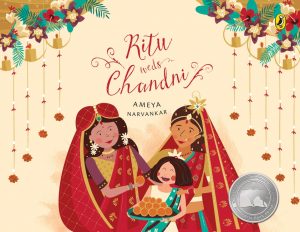
Ritu Weds Chandni
Ritu Weds Chandni || Ameya Narvankar
Ayesha is excited to attend her cousin Ritu’s wedding. She can barely wait to dance at the baraat! But not everyone is happy that Ritu is marrying her girlfriend, Chandni.
Some have even vowed to stop the celebrations. Will Ayesha be able to save her cousin’s big day?
Centering Ayesha’s love for her cousin as much as it showcases Ritu and Chandni’s love for each other, this warm-hearted story celebrates the power of young voices to stand up against prejudice and bigotry.
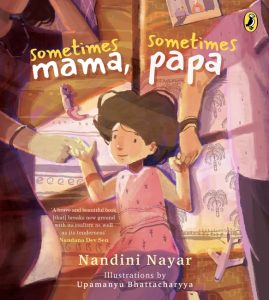
Sometimes Mama, Sometimes Papa
Sometimes Mama, Sometimes Papa || Nandini Nayar
For children and changing families who have two unique homes. Peek into the simplest solutions for understanding one of life’s most difficult moments–separation.
When Keya’s parents stopped living together, unusual things happened.
Keya became the only girl in her class with two homes.
‘Where will you live?’
‘Who will you live with?’
‘Sometimes Mama,’ Keya said, ‘sometimes Papa!’
This heart-warming story with comforting pictures reassures young readers that parents, whether alone or together, are always there for them.
Mama and Papa are always wonderful together.
Perhaps, they will be wonderful separately too?
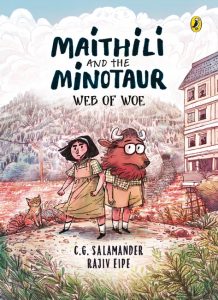
Maithili and the Minotaur
Maithili and the Minotaur || C.G. Salamander
What if our world was a lot more? Filled with unknown creatures-some friendly, some scary.
An outcast to the world of humans, Maithili lives in the outskirts of a magical wilderness. But as she makes new friends in the realm of monsters, she must learn to be careful. Because some monsters are just like humans: mean, nasty and out for blood.
Perfect for fans of Hilda and Arthur and the Golden Rope, join Maithili and the Minotaur on their very first adventure in an outlandish world where nothing is as it seems.
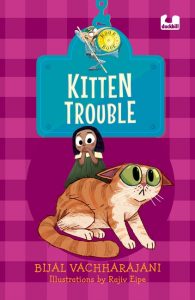
Kitten Trouble
Kitten Trouble || Bijal Vachharajani
Sani is terrified of animals-dogs, cats, cows. But her mother has just brought home an orange-white furball.
What is Sani to do?
Kitten Trouble is a part of the Hook Books series. These books are for very young readers, aged five and above. The books work well for reading out loud to kids or for young readers just starting to read by themselves. Written by some of the best-known writers for children, and illustrated in exuberant colour by some of India’s most-loved illustrators, these stories are set largely in non-urban settings. Hawaldar Hook is the endearing mascot of the Hook Books. Each book includes short and fun language exercises at the end.
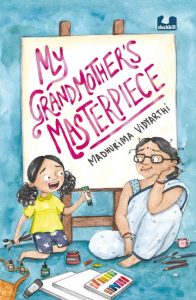
My Grandmother’s Masterpiece
My Grandmother’s Masterpiece || Madhurima Vidyarthi
‘This is the story of how my grandmother became a famous artist. It happened somewhere between my seventh and eighth birthdays, so she was really old and also a grandmother, and I didn’t know she was an artist. And, of course, she was not famous. And then she was both, all at once.’
For Nini, Minima is just her normal everyday grandmother. So when Minima suddenly shows an interest in doing something new, Nini is not sure that she likes it. After all, a grandmother’s first job is being a grandmother, isn’t it?
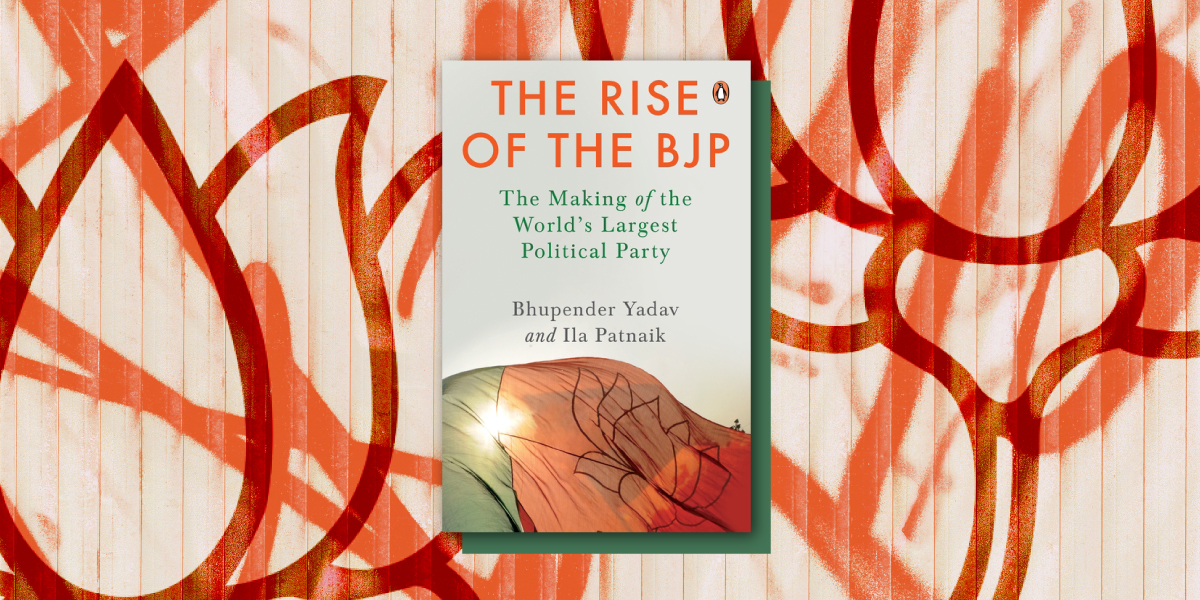
In The Rise of the BJP, co-authors Bhupender Yadav and Ila Patnaik chart the journey of how BJP came into existence and established itself as one of the most powerful political parties. It delves into the political strategies and the organizational design that made the party successful and drove the transformation.
Let’s read this excerpt to understand BJP’s position in the government, starting from 1996 and how it eventually rose to becoming the single-largest party.
*
The Rise of the BJP || Bhupender Yadav, Ila Patnaik
After the fall of the Vajpayee government, thirteen parties came together as the ‘United Front’ to form a government with the support of the Congress from the outside. The new administration started with H.D. Deve Gowda as the Prime Minister, on 1 June 1996. The coalition depended on Congress support. However, the Congress began to soon feel uncomfortable with the decisions of the Deve Gowda administration. For one, Gowda showed a lack of interest in post-poll adjustments in the run-up to the 1996 UP state elections. Further, he announced the creation of Uttarakhand as a separate state in his Red Fort speech on 15 August 1996, without consulting the Congress. He was also unhelpful towards the Congress leaders who had pending cases against them with the agencies. Issues such as these led to a change of heart in the Congress and the party withdrew its support to the Deve Gowda government.
On 11 April 1997, Gowda had to face a floor test after the Congress withdrew support. When Gowda spoke during the floor debate, he referred to Kesari’s prime ministerial ambitions, describing the Congress president Sita Ram Kesari as an ‘old man in a hurry’. As expected, the Gowda government lost the trust vote by 292 to 158 votes.
After Gowda was voted out, Congress supported another coalition, and a new Prime Minister was sworn in. Inder Kumar Gujral, who was foreign minister in Gowda’s government, became the Prime Minister, again with outside support of the Congress. However, Gujral’s term was also short-lived. Following a hung Assembly in the Uttar Pradesh elections of 1996, a powersharing agreement had been reached between the BJP and BSP in April 1997. It was decided that for the first six months, BSP leader Mayawati would be the state’s chief minister and for the next six months, Kalyan Singh from the BJP would head the state.
However, during Kalyan Singh’s tenure, the BSP decided to withdraw its support due to disagreement over certain issues. This led to considerable friction and some violence in the streets, which prompted the BJP government led by Kalyan Singh to call for a vote of confidence. In response to BSP’s decision, BJP state leader Rajnath Singh announced that if the BSP wanted to withdraw its support, it could do so. He was optimistic about the BJP winning the vote of confidence as it was the single-largest party in the state.
Prime Minister Gujral responded to this by recommending the imposition of President’s Rule in the state. In a rare act of autonomous decision-making by the office of the President, President K.R. Narayanan did not act on this; he asked the government to review its recommendation. To avoid a confrontation with the President, the United Front government was forced to reverse its decision to dismiss the Kalyan Singh government. While most allies in the United Front agreed that a confrontation was best avoided, the Congress wanted the BJP government to go. The Congress felt that the BJP was gaining ground in Uttar Pradesh and could become the major force in the state. In stark opposition to the Congress party, prime minister Gujral did not want President’s Rule to be imposed in UP. However, as his government was in place with the Congress’s support, his decision not to dismiss the BJP government in UP made the collapse of his government imminent.
It was, however, the investigation into Rajiv Gandhi’s assassination that brought the coalition government led by I.K. Gujral to a premature end. The inquiry commission’s report on the assassination of Rajiv Gandhi, led by Justice Milap Chandra Jain, said that the conspiracy to assassinate Rajiv Gandhi had a connection to the DMK. The Jain Commission report concluded that the DMK had provided sanctuary to the Liberation of Tamil Tigers Eelam (LTTE) and was thus an accomplice in the assassination. These explosive findings triggered a chain reaction that shattered reputations, forced realignments and brought down Gujral’s fragile government. When the Gujral government did not dismiss the DMK from the Cabinet, despite these allegations, Congress president Sita Ram Kesari announced the withdrawal of support from the government. Gujral’s time as prime minister lasted eleven months.
In his resignation letter, Gujral wrote, ‘. . . My Council of Ministers and I hereby submit our resignation from my Government. In my communication to the Congress President [Kesari], I have said that it is unfair and unethical to tarnish the fair name of a party only because the Jain Commission’s Interim Report—without any substantiated data—has chosen to blame the party and, I say with sadness, the entire Tamil people . . . My Council of Ministers and I hereby submit our resignation.’
…
Mid-term Lok Sabha elections were held in 1998. The BJP built on its growing success in elections and scaled up its methods. A large-scale mobilization of voters had been accomplished through numerous yatras at the national stage and within many states. By this time, measurement of the populace through polls had become an important activity, both within the media and as an information system to support decision making in election campaigns. The BJP brought in greater professionalism to do the number crunching in order to chalk out winning strategies.
The results were consistent with the long journey of the BJP towards growing influence.
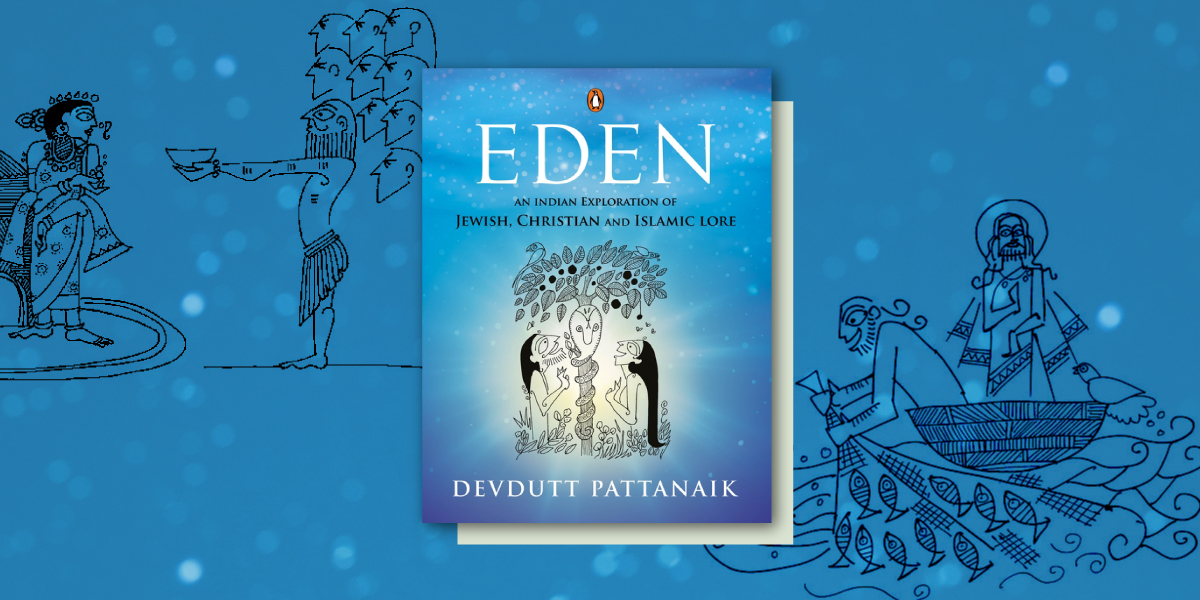
Mythology is often regarded as the sacred history of humankind, with elements of mystery, human nature, and supernatural elements rolled into enrapturing tales and stories. Myths are intrinsic to every culture’s existence and being, and often become bedtime stories that are passed down from generation to generation to keep that culture alive and roaring. Devdutt Pattanaik is no stranger to myths, and with Eden, he has explored the vast world of Abrahamic lores and myths uniquely through an Indian prism.
What are Abrahamic Lores?
Eden||Devdutt Pattanaik
Abrahamic lores, derived from the word ‘Abraham’, consist of monotheistic religions that strictly worship one God. These include three of the biggest religions in the world: Judaism, Islam, and Christianity. There are mentions of ‘Abraham’, the one true God, in scriptures of these religions throughout history, be it in the Torah, the Bible, or the Quran. Abrahamic lores remarkably bring together these three contrasting religious beliefs with a series of common and entrancing elements. These include believing in a paternal, judging, and completely external God, to which humans and living beings are subordinate. Another common theme that is consistent throughout these religious texts is the longing for salvation or transcendence which can only be achieved by pleasing God. Abrahamic lores often have prophets, beginning with God creating the world, and ending with the resurrection of the dead and a final judgement.
Eden: Retelling Monotheism through an Indian Prism
Eden spotlights how the same lores have different retellings in three of the world’s most dominant faiths in the modern era. The similarities between the scriptures of these three religions and the obsession with ‘one truth’ have, in fact, created inter-religious rivalries, instead of unification. These lores also reflect the plethora of insecurities we have as human beings and instigate a much-needed sense of empathy to heal the wounds we earn while constantly fighting these battles.
“In the beginning, there was nothing but God.
God has no form or name.
But God existed-conscious and sentient.
Humans refer to God in the masculine,
but that reveals the inadequacy of the human language.
God is neither male nor female, neither human nor animal,
neither plant nor mineral, neither wave nor particle.
God is beyond it all, an entity uncontained
by measurement or word
Before creating the world,
God gave seven things:
God’s law, God’s throne, Heaven to the right,
Hell to the left, God’s sanctuary, an altar with
the name of the first and final prophet who
would tell all about God and God’s law,
and a voice that kept chanting,
“Come back, children of humans.”
Written by veteran mythologist Devdutt Pattanaik, Eden introduces readers to the many captivating tales of angels, demons, prophets, patriarchs, judges and kings. It also retells stories from Mesopotamian, Egyptian and Zoroastrian mythologies that influenced Abrahamic monotheism over time.
Get your copy and delve into the fascinating and captivating world of Abrahamic lores today!
As soon as February begins, there’s a nip in the air, something that the weatherman can’t quite comprehend. Cities turn into the sets of La La Land and romance brews in every café. Some people have even speculated to witness moonlight during the day.
For those who detest this month of love and hibernate their way through it or for those who are hopeless romantics, we have a pile of new and fresh, off-the-press, beautiful books releasing that all of us can hold in our hands this February! This pile has fiction, adventure, culture, biographies, music and more! A bit of everything to fill each day of your month with something extraordinary!
Looking for a home in your bookshelves and hearts, here they are:
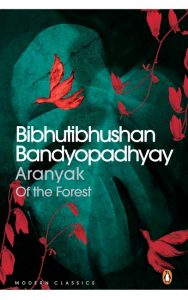
Aranyak || Bibhutibhushan Bandhopadhyay
Aranyak
Bibhutibhushan Bandopadhyay
Translated from the Bengali by Bhaskar Chattopadhyay
Aranyak, written in 1939, is a famous Bengali novel by Bibhutibhushan Bandyopadhyay based on his long and arduous years in northern Bihar. There he came into contact with a part of the world that, even now, remains unknown to most of us. ‘Aranyak’ literally means ‘Of the Forest’. This novel explores the simple and heart-warming story of a man who gets a job as an estate manager in Bihar, and slowly falls in love with the beautiful and tranquil forest around him. The dichotomy of urban and rural life comes alive, reflecting the great love that human beings and nature can share, one that Bandyopadhyay experienced in his heart. Written by one of the greatest Bengali authors, this haunting novel is rooted in guilt and sadness but also tremendous beauty.
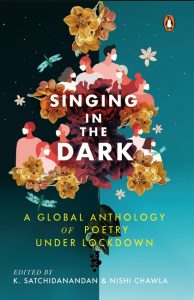
Singing in the Dark
Singing in the Dark
K. Satchidanandan, Nishi Chawla
Singing in the Dark brings together the finest of poetic responses to the coronavirus pandemic. More than a hundred of the world’s most esteemed poets reflect upon a crisis that has dramatically altered our lives, and laid bare our vulnerabilities. The poems capture all its dimensions: the trauma of solitude, the unexpected transformation in the expression of interpersonal relationships, the even sharper visibility of the class divide, the marvellous revival of nature and the profound realization of the transience of human existence. The moods vary from quiet contemplation and choking anguish to suppressed rage and cautious celebration in an anthology that serves as an aesthetic archive of a strange era in human history.
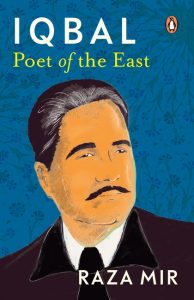
Iqbal || Raza Mir
IQBAL
Raza Mir
Also known as the ‘Poet of the East’, Allama Muhammad Iqbal earned a doctorate in philosophy from the Ludwig-Maximillian University at Munich, and wrote his most evocative poems in Urdu, a language that was not his mother tongue. His funeral was attended by 70,000 people, which included colonialists and freedom fighters, socialist atheists and Islamic fundamentalists, Indian nationalists and Muslim Leaguers, reflecting his ability to defy categorization.The book is a relatively short volume that introduces Iqbal to the millennial generation. It is written in a relatively contemporary language, similar to Ghalib: A Thousand Desires. A bulk of the book will comprise a temporal and intellectual biography of Iqbal, while the rest will include a detailed discussion of one of Iqbal’s poems, a translation of some of his well-known poems, and a sampling of some of his famous verses.
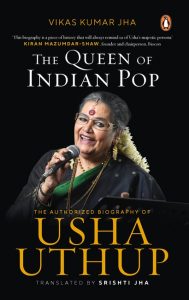
The Queen of Indian Pop || Usha Uthup
The Queen of Indian Pop
Vikas Kumar Jha
In this vivid biography, which was originally written in Hindi, Vikas Kumar Jha captures the entire arc of Uthup’s career in music. From her childhood days in Mumbai and her first gigs singing with jazz bands in Chennai’s glitzy nightclubs to her meteoric rise as India’s musical sensation and her philanthropic work, Jha covers it all and manages to weave a narrative that is colourful, inspiring and bound to keep any reader engrossed till the end. This pitch-perfect English translation, by Srishti Jha, offers the reader a front-row seat to the life and times of the inimitable Usha Uthup.
Annus Horribilis || Avinab Datta-Areng
Annus Horribilis
Avinab Datta-Areng
Annus Horribilis is concerned with the violence of thinking, alone. The voices in these poems move through relationships, family, friendship, external disintegration, the labour of loving, being loved and of caring, where they are constantly confronted with the familiar turning foreign, the quotidian becoming a scene of absolute hostility, and where a word otherwise spoken easily becomes incommunicable. The book grapples with a (habitually futile) desire to communicate what should only be communicable-looking for some friend in language-that won’t lead to misunderstanding or, worse, silence. It searches for a language in which thought might survive and perhaps even reach out towards others.
Beguiled by Ruchika Soi
Beguiled
Ruchika Soi
A true story, Beguiled starts with Gitanjali meeting Randeep Singh Taneja at a farm party in Delhi. He called himself ‘Randy’. He flirted with her; she resisted. She was a single mother, a divorcee, and Randy was five years younger. They became friends, went for walks in Lodhi Garden, had coffee in Khan Market, and he asked her hand in marriage. She refused, he beguiled her, they fell in love, and she said yes.
The couple moved to London and this is where the first signs of trouble began. Away from all that was familiar to her, Gitanjali began to notice that Randy was not all that declared to be. Random phone calls from women who claimed to either be his wife or his girlfriend, a child who called him ‘Papa’, photographs of Randy with other women, multiple cell phones…and for all this he had reasonable explanations that left her with no room for doubt. Gitanjali thought she knew her husband. That is until she hadn’t opened his cell phone and found out about the many lives he was leading across the world.
Beguiled is a dark and gripping story about a marriage gone wrong.
The Hidden Hindu || Akshat Gupta
The Hidden Hindu
Akshat Gupta
Prithvi, a twenty-one-year-old, is searching for a mysterious middle-aged aghori (Shiva devotee), Om Shastri, who was traced more than 200 years ago before he was captured and transported to a high-tech facility on an isolated Indian island. When the aghori was drugged and hypnotized for interrogation by a team of specialists, he claimed to have witnessed all four yugas (the epochs in Hinduism) and even participated in both Ramayana and Mahabharata. Om’s revelations of his incredible past that defied the nature of mortality left everyone baffled. The team also discovers that Om had been in search of the other immortals from every yuga. These bizarre secrets could shake up the ancient beliefs of the present and alter the course of the future. So who is Om Shastri? Why was he captured? Board the boat of Om Shastri’s secrets, Prithvi’s pursuit and adventures of other enigmatic immortals of Hindu mythology in this exciting and revealing journey.
Destiny’s Child || Raghu Palat and Pushpa Palat
Destiny’s Child
Raghu Palat, Pushpa Palat
This is an intimate account of the extraordinary life of Parukutty Nethyaramma, who went on to become one of the most powerful rulers of the Kingdom of Cochin.
At the age of fourteen, her marriage thrust her into a hostile world. Taking on her detractors, Parukutty stubbornly and fearlessly forged ahead to become a voice none could gainsay. Despite a seventeen-year age gap, she had built a special, unshakable bond with her husband. When he was crowned the sovereign ruler of Cochin, she vowed to support and protect his position throughout her life. Theirs was an enviable partnership of two incredible equals who together went on to break many traditional norms. At a time when women were relegated to the shadows, Parukutty travelled with her husband, participated in important discussions, and even went on to rule as his proxy. She became a force to be reckoned with in her own right.
The Millennial Yogi || Deepam Chatterjee
The Millennial Yogi
Deepam Chatterjee
‘How do I fight? I see failure at every juncture,’ said Jay.
‘If we divide our life the way we sort laundry, we will never find peace,’ replied Vini.
Jayshankar Prasad, or Jay, has had a shady-yet-mercurial rise in his journey as an entrepreneur, but he has little idea as to what is around the corner. On the other hand, Vini, a mystic monk, has already been there, and knows what it is like to have it all and then lose it in an instant. Greed . . . power . . . money . . . are all transitory.
In a serendipitous twist of fate, Jay crosses paths with the enigmatic Vini and thus begins a cathartic and transformative journey. The Millennial Yogi is the zeitgeist parable for anyone searching for meaning and purpose in life. With prose that is both photographic and profound, Deepam Chatterjee has crafted an extraordinary tale of loss, redemption and the fight for one’s soul in an increasingly materialistic world.
Savarkar || Vikram Sampath
Savarkar: A Contested Legacy from A Forgotten Past
The Complete 2-Volume Biography of Savarkar
Vikram Sampath
As the intellectual fountainhead of the ideology of Hindutva, which is in political ascendancy in India today, Vinayak Damodar Savarkar is undoubtedly one of the most contentious political thinkers and leaders of the twentieth century. From the heady days of revolution and generating international support for the cause of India’s freedom as a law student in London, Savarkar found himself arrested, unfairly tried for sedition, transported and incarcerated at the Cellular Jail, in the Andamans, for over a decade, where he underwent unimaginable torture.
Decades after his death, Savarkar continues to uniquely influence India’s political scenario. An optimistic advocate of Hindu-Muslim unity in his treatise on the 1857 War of Independence, what was it that transformed him into a proponent of ‘Hindutva’? What was it that transformed him in the Cellular Jail to a proponent of ‘Hindutva’, which viewed Muslims with suspicion?
This two-volume biography series, exploring a vast range of original archival documents from across India and outside it, in English and several Indian languages, historian Vikram Sampath brings to light his life and works.
Something I’m Waiting To Tell You || Shravya Bhinder
Something I’m Waiting To Tell You
Shravya Bhinder
After nearly losing the love of his life to a terrible accident, Ronnie realizes how much he loves Adira and what an idiot he had been to hurt her. What’s more, her overprotective mother now takes care of her, and does not like Ronnie being anywhere near her daughter.
He’s going through hell-unable to go back in time and fix things, unable to say what he missed saying to her, ‘I love you . . .’
All he wants now is a second chance, to trace his steps back into a loving relationship and win Adira over. It will not be easy because life is tough; love, even tougher.
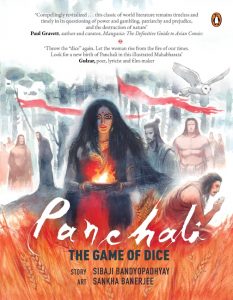
Panchali || Sibaji Bandyopadhyay and Sankha Banerjee
Panchali
The Game of Dice
Sibaji Bandyopadhyay, Sankha Banerjee
A fascinating illustrated rendition of the all-consuming Mahabharata … A spectacular show of words and images dealing with love and death, loyalty and duplicity, conflict and concord, and much more …
Impelled by elemental forces of death, destruction and creation, Panchali, with electrifying visuals cinematically construed, reaches its climax: two consecutive games of dice. Marred by deceit, treachery and trickery, and fuelled by obsession, passion and rage, the gambling episode provides the preface to the coming, all-consuming Mahabharata war.
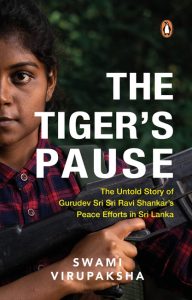
The Tiger’s Pause || Swami Virupaksha
The Tiger’s Pause
The Untold Story of Gurudev Sri Sri Ravi Shankar’s Peace Efforts in Sri Lanka
Swami Virupaksha
As the fourth phase of the twenty-six-year-long civil war in Sri Lanka was about to begin, Gurudev Sri Sri Ravi Shankar, founder of the Art of Living, visited the island nation with a singular aim: to bring peace to its citizens while trying to mediate between Prabhakaran, leader of the Liberation Tigers of Tamil Eelam (LTTE), and the government. The Tiger’s Pause chronicles Gurudev’s time in a highly strung country and also offers an exclusive look into the final chapters of Sri Lanka’s deadly conflict.
Swami Virupaksha, who spent nine years in the country expounding the Art of Living courses and organizing Gurudev’s visits, expertly charts the enormous hope of the Tamil and Sinhalese people against overwhelming misery. In prose that is both concise and empathetic, Swami Virupaksha gives readers a sweeping view of Gurudev’s endeavours towards a ceasefire agreement, and the ups and downs of a country’s quest for peace. The Tiger’s Pause is the narrative of the Sri Lankan people, and gives us a sense of what it takes to understand and address a shared trauma.
The Stone Tower || Riaz Dean
The Stone Tower
Riaz Dean
A path traversed by caravans laden with silk, spices and much more besides, the old Silk Road influenced trade, religions, cultures and economies across Europe, Asia and far beyond.
In his latest book, Riaz Dean blends the best of this region’s history and geography with ancient cartography to solve a 2,000-year-old riddle that has perplexed scholars for centuries: Where was the Stone Tower that the great geographer Claudius Ptolemy had written about? This highly significant but now-lost landmark represented the midpoint and thumping heart of the Silk Road, as merchant caravans plied their wares between the Occident and the Orient.
The $Ten Trillion Dream by Subhash Chandra Garg
The $Ten Trillion Dream
The State of the Indian Economy and the Policy Reforms Agenda
Subhash Chandra Garg
India rightly aspires to be an upper-middle-income economy with its vast workforce gainfully employed
to have a decent standard of living. This, however, is a challenging proposition as India continues to
grapple with major economic policy issues. This book discusses the present state of India’s economy. It thematically explores the critical policy issues India faces today and suggests reforms for India to become a $10-trillion economy by the mid-2030s. The book presents a wide-angled and comprehensive view of the state of the Indian economy. It analyses India’s macroeconomy in the light of its evolution since Independence and covers the performance of the Indian economy on macro parameters of growth, inflation, monetary management, credit management, foreign capital inflows, fiscal management and other important macroeconomic fundamentals. Covering major sectors of the economy, such as agriculture, industry and services, the book also captures India’s progress towards becoming a digital economy.
This book will be an adept lifetime mentor faithfully by your side to guide you through various stages of life. It guides you in achieving meaningful success including tremendous professional success through multidimensional and balanced life goals, which are the key to happiness and fulfilment. The book first focuses on defining the person you aspire to be through a step-by-step process to define your aspirational life goals. Then it guides you in becoming the best version of yourself and worthy of realizing your aspirations. The ideas shared are relevant to people of ages fifteen years onwards, from high school students to early and senior professionals to CEOs. It also includes insights from exclusive interviews with Ratan Tata, Narayan Murthy, Kiran Majumdar-Shaw, Sadhguru, John Chambers, Dr Devi Shetty, Rahul Dravid, Prakash Padukone, Vinita Bali, Vani Kola, and more. These distinguished people have achieved amazing success by passionately pursuing their goal-based journeys and have underlined the ideas shared in the book.
Bose || Chandrachur Ghose
Bose
Chandrachur Ghose
There are not many Indian heroes whose lives have been as dramatic and adventurous as that of Netaji Subhas Chandra Bose. That, however, is an assessment of his life based on what is widely known about him. These often revolve around his resignation from the Indian Civil Service, joining the freedom movement, to be exiled twice for over seven years, throwing a challenge to the Gandhian leadership in the Congress, taking up an extremist position against the British Raj, evading the famed intelligence network to travel to Europe and then to Southeast Asia, forming two Governments and raising two armies and then disappearing into the unknown. All this in a span of just two decades.
Now, new information throws light on Bose’s intense political activities surrounding the revolutionary groups in Bengal, Punjab, Maharashtra and United Provinces, his efforts to bridge the increasing communal divide and his influence among the splintered political landscape; his outlook and relations with women; his plunge into the depths of spirituality; his penchant for covert operations and his efforts to engineer a rebellion among the Indian armed forces. With this new information, what appeared to be dramatic now becomes more intense with plots and subplots under one man’s single-minded focus on freeing the motherland and envisioning its development in a new era.
Pacey, thought-provoking and absolutely unputdownable, Bose: The Untold Story of an Inconvenient Nationalist will open a window to many hitherto untold and unknown stories of Netaji Subhas Chandra Bose.
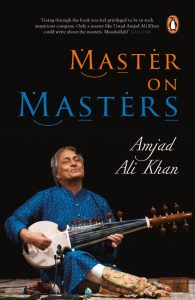
Master on Masters || Amjad Ali Khan
Master on Masters
Amjad Ali Khan
Veteran musician and sarod maestro Ustad Amjad Ali Khan writes a deeply personal book about the lives and times of some of the greatest icons of Indian classical music. Having known these stalwarts personally, he recalls anecdotes and details about their individual musical styles, bringing them alive.
Twelve eminent musicians of the twentieth century appear in the book – Bade Ghulam Ali Khan, Amir Khan, Begum Akhtar, Alla Rakha, Kesarbai Kerkar, Kumar Gandharva, M.S. Subbulakshmi, Bhimsen Joshi, Bismillah Khan, Ravi Shankar, Vilayat Khan and Kishan Maharaj. In writing about them, Amjad Ali Khan transcends the Gharana and north-south divide, and presents portraits of these great artists that are drawn with affection, humour and warmth.
Investonomy || Pranjal Kamra
Investonomy
The Stock Market Guide That Makes You Rich
Pranjal Kamra
Are you inspired by billionaires around the world but think becoming a billionaire is too far out of your reach?
Are you confused about the behaviour of the stock market and the implications of investing in it?
Are you actually scared of investing in the stock market? If yes, then Investonomy is a must-read for you! Investonomy not only explains modern value investing principles but also unveils certain secrets of the stock market. It busts popular myths and misconceptions as well. A thorough reading of this book will enable you to chart your own investment plans, and soon, you’ll be all set for your personal wealth-creation journey through equity investment. Investonomy is an initiative to empower existing, as well as potential, investors like you.
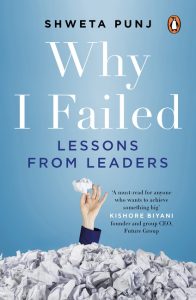
Why I Failed by Shweta Punj
Why I Failed
Lessons from Leaders
Shweta Punj
Fail! And we are stamped for life. Don’t we try and run from failure all our lives? But, ‘spontaneous doing has to go through failures’. Acknowledging failure is singularly the most difficult thing to do. It takes tremendous courage to come out and say, yes, I failed. Shweta Punj chronicles sixteen leaders who have celebrated their failure as much as their success. Each story is an anatomy of failure. So whether it was the difference between ‘need’ and ‘want’ that led Abhinav Bindra to miss that winning shot, or whether it was a suicide attempt that pushed Sabyasachi Mukherjee into fully realizing his potential-these stories will encourage you to look at failure differently.
Healed || Manisha Koirala
Healed
How Cancer Gave Me a New Life
Manisha Koirala
Healed is the powerful, moving and deeply personal story of actor Manisha Koirala’s battle against ovarian cancer. From her treatment in the US and the wonderful care provided by the oncologists there to how she rebuilt her life once she returned home, the book takes us on an emotional roller-coaster ride through her many fears and struggles and shows how she eventually came out triumphant.
Today, as she completes six years of being cancer-free, she shares her story-one marked by apprehensions, disappointments and uncertainties-and the lessons she learnt along the way. Through her journey, she unravels cancer for us and inspires us to not buckle under its fear, but emerge alive, kicking and victorious.
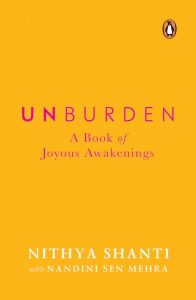
Unburden || Nithya Shanti, Nandini Sen Mehra
Unburden
A Book of Joyous Awakenings
Nithya Shanti, Nandini Sen Mehra
Playful Principles for Conscious Living
What if, to lead our most fulfilling life, there was nothing to acquire, nothing to accomplish, nothing to master? What if we are already home, already whole, already complete? What if, all that is needed, is to gently set down the burden?
Unburden is an invitation to examine ideas, identities and concepts that bind and limit us. We begin to access the power and potency that comes from trusting the silence underlying all thoughts and experiences.
In Nithya Shanti’s inimitable voice, discover profound teachings, simply told. Nithya shares anecdotes, exercises for self-discovery and pointers for awakening, through a distillation of timeless wisdom and contemporary discoveries, along with his own innovations from decades of intensive teaching and practice.
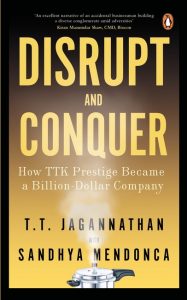
Disrupt and Conquer || T.T. Jagannathan, Sandhya Mendonca
Disrupt and Conquer
How TTK Prestige Became a Billion Dollar Company
T.T. Jagannathan, Sandhya Mendonca
The TTK Group was founded in 1928 in Chennai (then Madras) by T.T. Krishnamachari, who later became a Union minister and held the portfolios of finance, industry and commerce for close to fifteen years.
In this book, the current chairman T.T. Jagannathan, along with Sandhya Mendonca, takes us through the journey of this extraordinary company which fought off bankruptcy and rose like a phoenix to become a highly profitable, successful entity.
Like a phoenix, the group and its constituent companies, have risen from the ashes, many times over, to stand tall and proud. This is the story of a journey that began with early success and experienced catastrophic disasters, and set about turning its fortunes around in stunning comebacks, time and again.
With invaluable business lessons, decades of experience and innovation distilled in these pages, Disrupt and Conquer is a must-read for aspiring entrepreneurs, executives and business leaders.
Everything Is Out of Syllabus || Varun Duggirala
Everything Is Out of Syllabus
An Instruction Manual for Life
Varun Duggirala
Life seldom comes with an instruction manual or a guidebook. It’s often messy and unpredictable too. While our education may prepare us for situations covered within its set syllabus, most of life happens outside this realm and this leaves us grappling with questions around work, life and everything in between.
Hence, this book.
Varun Duggirala has survived and thrived in a system that throws curveballs at us without the tools to actually overcome them. In Everything Is Out of Syllabus, he offers answers to important questions like:
What is the true meaning of success? How can one become more creative and think outside the box?
How can we connect with people, including ourselves? And much more.
Most importantly, he tells readers what are the skills one needs to master to live a more fulfilled life that is optimized for happiness.
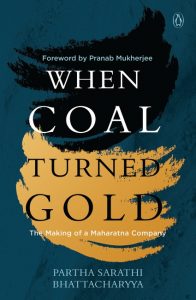
When Coal Turned Gold || Partha Sarathi Bhattacharyya
When Coal Turned Gold
The Making of a Maharatna Company
Partha Sarathi Bhattacharyya
Coal India Ltd (CIL) contributes to about 82 per cent of India’s coal production. In When Coal Turned Gold, former chairman and managing director of CIL, Partha Sarathi Bhattacharyya, tells the story, warts and all, of how he dealt with the Dhanbad coal mafia, how he changed the way the industry was perceived, how he dealt with the trade unions and the government and, most importantly, how he was able to script one of the greatest success stories the country had ever seen.
With this immense list, our love for books seems like one that’ll last forever. The perfect love story, what do you think?
Don’t our little readers feel that it was only a few days ago that they were celebrating the New Year and now they are welcoming the month of February? Well, we definitely relate with them.
We are here to give our young friends company with some of our best books that are sure to take them for a fun-filled, adventurous, and simply amazing ride. With stories about historical sites, interesting people, brilliant artist, struggles for independence and long, eventful journeys will provide kids a wholesome reading experience.
So, let’s dive into the list of our latest releases!
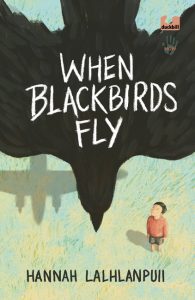
When Blackbirds Fly
When Blackbirds Fly || Hannah Lalhlanpuii
Ages: 10+ years
Life is sweet growing up in Aizawl, with his family and friends, and all the narrator wants is a peaceful life. But the independence movement in Mizoram means that regardless of what he wants, he is drawn inexorably into a world where everyone has to choose where they stand…
Set in the initial stages of the two-decade-long struggle for Mizoram’s independence and against the backdrop of the 1966 bombing of Aizawl, this stunning debut novel is an universal story of how individual dreams and lives are shattered when larger conflicts arise.
My Grandmother’s Masterpiece
My Grandmother’s Masterpiece || Madhurima Vidyarthi
Ages: 8+ years
‘This is the story of how my grandmother became a famous artist. It happened somewhere between my seventh and eighth birthdays, so she was really old and also a grandmother, and I didn’t know she was an artist. And, of course, she was not famous. And then she was both, all at once.’
For Nini, Minima is just her normal everyday grandmother. So when Minima suddenly shows an interest in doing something new, Nini is not sure that she likes it. After all, a grandmother’s first job is being a grandmother, isn’t it?
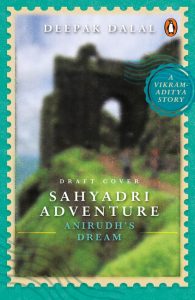
Once upon a time, there were fields in the city of Mumbai. Panthers roamed the forests of Malabar Hill and the occasional tiger could still be spotted, swimming the harbour or prowling the fringes of the city. The sea flooded the channels that separated the seven islands of the city. And on one of the islands stood a Fort, guarded by cannons that bristled from black ramparts.
Vikram, Aditya and their friends Anirudh and Chitra no idea of the existence of this Fort. But in a cave, on a windswept mountain in the Sahaydris, Anirudh has a dream. He dreams of a boy named Irfan who once lived in this Fort. He dreams of a city long lost and a friendship both transformative and life-affirming.
Journey to the Sahyadris in the first part of this riveting tale where history meets adventure in one of the most beautiful locales of India.
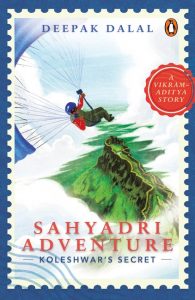
Far out in the Sahyadris rises a mountain called Koleshwar. Amidst its caves and rumbling streams lie many secrets, secrets that Anirudh discovers when he wakes from a strange dream. Vikram, Aditya, Chitra and Anirudh are now tasked with trying to make sense of his dream. How does Anirudh inexplicably recognize not just every contour and ridge of the lush, monsooned hills but also know every minute detail of the vanished Fort of Mumbai? Will this group of budding adventurers decode the forgotten legacy, buried in the ancient slopes of the Sahyadris, before tips goes over the edge?
Journey to the Sahyadris in the concluding instalment of this riveting tale where history meets adventure in one of the most beautiful locales of India.
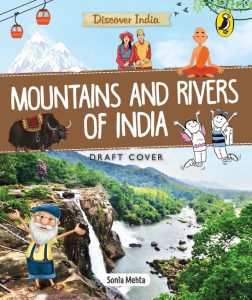
Discover India: Mountains and Rivers of India
Discover India: Mountains and Rivers of India || Sonia Mehta
Ages: 8+ years
Did you know the Himalayas are a series of four parallel mountain belts?
Where does the Siwalik range get its name from?
Did you know the Western Ghats are listed by UNESCO as a biodiversity hotspot?
What is the name of the famous dam on Sutlej River?
There are a million incredible things to discover about India–from its land, people, food, festivals, to culture and a whole lot more! Daadu Dolma makes it even more fun for Mishki and Pushka in this book by telling them interesting facts about India’s majestic mountains and mighty rivers.
Join them as they explore the highest peaks, discover fascinating wildlife and look for the sources of rivers. This is a journey you don’t want to miss!
Mountains and Rivers of India is part of the Discover India series of books that contain lots of fun facts and engaging activities. Through these books, delve into the history, culture, food, festivals, wildlife and monuments of India, and find out what makes this diverse nation such a fascinating place to be.
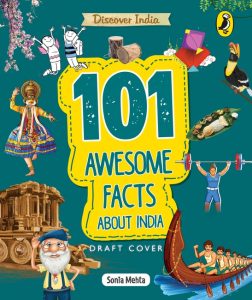
Discover India: 101 Awesome Facts about India
Discover India: 101 Awesome Facts about India || Sonia Mehta
Ages: 8+ years
Ever seen a desert made of salt?
Did you know the Himalayas are said to grow taller by two inches every year?
Which ancient fort has the second longest wall in the world encircling it?
Did you know that chess was invented in India thousands of years ago?
There are a million incredible things to discover about India–from its land, people, food, festivals to culture and a whole lot more! Daadu Dolma makes it even more fun for Mishki and Pushka in this book by telling them 101 awesome facts about India.
Join them as they traverse through time to learn about India’s land and water, foot-tapping music, snippets about lesser-known tribes, interesting people and celebrations. This is a journey you don’t want to miss!
101 Awesome Facts about India is part of the Discover India series of books that contain lots of fun facts and engaging activities. Through these books, delve into the history, culture, food, festivals, wildlife and monuments of India, and find out what makes this diverse nation such a fascinating place to be.
Journey to the Edge of the Earth: True Adventure of Naval Officer Abhilash Tomy
Journey to the Edge of the Earth: True Adventure of Naval Officer Abhilash Tomy || Joeanna Rebello Fernandes
Travel far and wide with an Indian sailor and his endless love for the sea!
Imagine an infinite blue ocean and somewhere in the middle of it, tossed by wind and wave-a single boat. In it a solitary sailor.
This is the gritty, glorious and true adventure of Commander Abhilash Tomy, a former officer of the Indian Navy, who in 2012 set off on the journey of a lifetime. Without once stopping by land, he circumnavigated the world alone for 151 days, encountering deathly perils on choppy waters! No other Indian had sailed like this before. When he finally returned to India, Abhilash was awarded the Kirti Chakra for his heroism.
Dive right into this rousing tale of a real-life hero whose ambition, courage, and determination to circle the world on his little boat, will fire up your imagination. And as you travel with Abhilash across the ocean, learn about famous ships and sailors, legends and maps, winds and currents, and a score and more fascinating stories about our world of water.
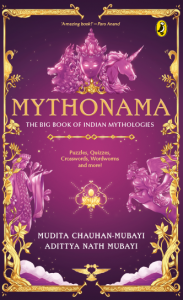
Mythonama: The Big Book of Indian Mythologies
Mythonama: The Big Book of Indian Mythologies || Mudita Chauhan-Mubayi, Adittya Nath Mubayi
Ages: 10+ years
A thunderbolt of bone, a discus of sun dust
A menagerie of beastly deities and divine beasts
Shape-shifting shenanigans, cosmic miracles
Dive into myths and legends from the Avesta, Quran, Mahabharata, Bible and more. Meet immortal beings and magical creatures like Kag Bhushundi, Girimekhala and Bahubali in anecdotes, fables, quizzes and crosswords.
Unlock this vault of timeless treasures, brimming with creation myths, supernatural twins, sacred plants and wondrous weapons. Even the Potterverse and Star Wars appear in this perfect primer on Indian myths.
Brought to life by the popular quizmaker-author duo, Mythonama is a fascinating narrative blending engaging text, fantastical illustrations and immersive activities.
At the end of each year we sit with our long TBR and it inevitably fills us with dread. We’re disappointed in ourselves- our expectations and our abilities that have failed them. From assignments to work to countless hours just spent on Instagram, we realise we’ve lost all the time we had genuinely kept aside for reading.
But all’s not lost. Here’s a new year, a endless to be read piles of books looking at us longingly from the shelves in our study. Which one will we finally pick? Which one of them will encourage our reading psyche instead of discouraging it? Will we finally complete it? Will we be able to pick another after this one ends?
All of these answers lie in the future and what we read today predicts what we’ll read tomorrow. So we’re here to say – lean on us and these recommendations. They’re a warm hug in winter, a kind smile in the form of a book. They will take you in and make you feel right at home.
Go through a special list we’ve put together just for you and your gentle mind and have a wonderful time reading!
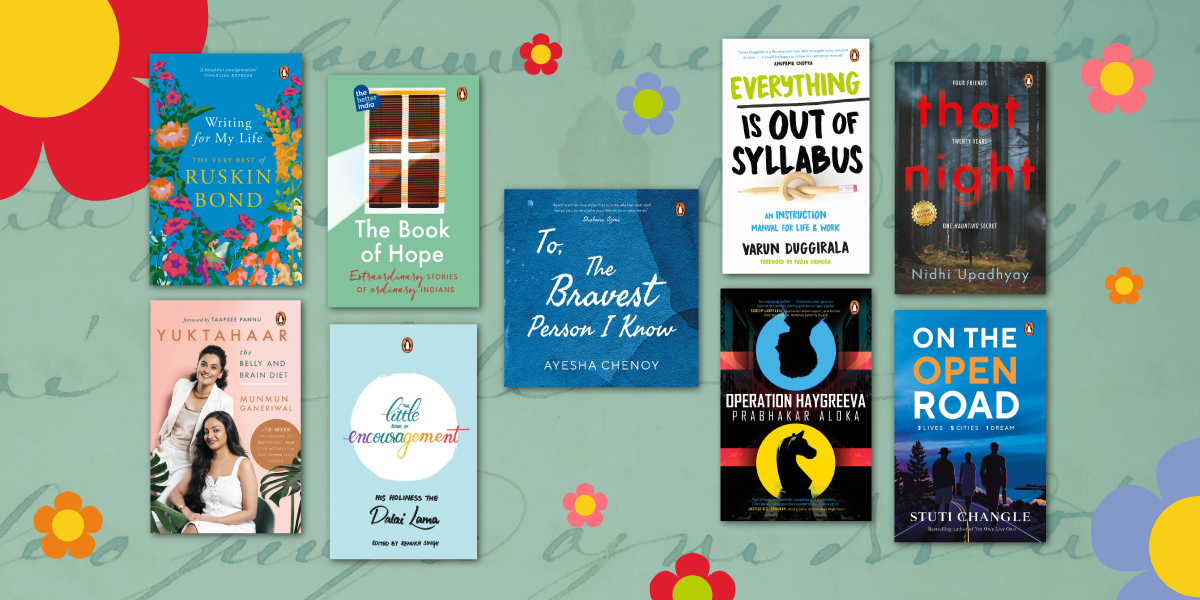
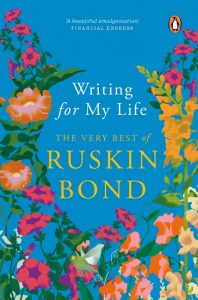
Writing for My Life || Ruskin Bond
Writing for My Life
by Ruskin Bond
From his most loved stories to poems, memoirs and essays, Writing for My Life opens a window to the myriad worlds of Ruskin Bond, India’s most loved author. Capturing dreams of childhood, anecdotes of Rusty and his friends, the Ripley-Bean mysteries, accounts of his life with his father and his adventures in Jersey and London among others, this book is full of beauty and joy-two things Ruskin’s writing is mostly known for.
With a comprehensive introduction, this is the perfect gift to all the ardent readers and lovers of Ruskin’s effervescent writing. A wide collection of carefully curated and beautifully designed stories, this book is a collector’s edition.
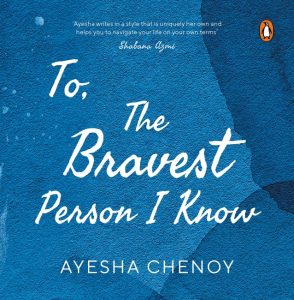
To The Bravest Person I Know || Ayesha Chenoy
To The Bravest Person I Know
by Ayesha Chenoy
From growing up with dysfunctional families to coming of age, from dealing with heartbreak, pain and grief to learning to accept and forgive, To, the Bravest Person I Know is your guide through every difficult situation. It is modern therapy delivered to you through a series of poems and a letter in verse that runs as a footnote from the beginning to the end of the book.
The poems explore the whole construct of ‘normal’, of that which was created to make people feel less normal if they don’t fit in, to make them feel ‘abnormal’. The book tells us that depression is normal, as is fear; feeling insecure is normal, as is hurting people. And bravery is about facing all of this-it’s about facing everything life throws at you every day.
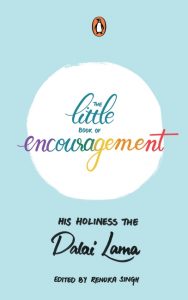
The Little Book of Encouragement || His Holiness The Dalai Lama
The Little Book of Encouragement
by His Holiness The Dalai Lama
His Holiness The Dalai Lama, a perennial source of inspiration, is one of the most eminent spiritual leaders in the world. Recipient of the Noble Peace Prize, His Holiness’s life and works have inspired millions of lives throughout the world. In this specially curated companion volume, His Holiness shares words of encouragement to deal with new realities in a pandemic stricken world.
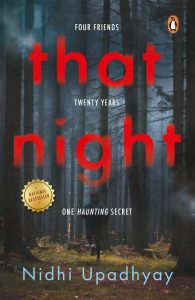
That Night || Nidhi Upadhyay
That Night
Nidhi Upadhyay
What happens when an innocent prank goes horribly wrong?
Natasha, Riya, Anjali and Katherine were best friends in college – each different from the other yet inseparable – until that night.
It was the night that began with a bottle of whisky and a game of Ouija but ended with the death of Sania, their unlikeable hostel mate. The friends vowed never to discuss that fateful night, a pact that had kept their friendship and guilt dormant for the last twenty years. But now, someone has begun to mess with them, threatening to reveal the truth that only Sania knew. Is it a hacker playing on their guilt or has Sania’s ghost really returned to avenge her death?
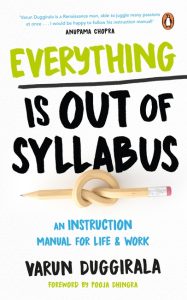
Everything Is Out of Syllabus || Varun Duggirala
Everything Is Out of Syllabus
An Instruction Manual for Life
by Varun Duggirala
Life seldom comes with an instruction manual or a guidebook. It’s often messy and unpredictable too. While our education may prepare us for situations covered within its set syllabus, most of life happens outside this realm and this leaves us grappling with questions around work, life and everything in between. Hence, this book.
Varun Duggirala has survived and thrived in a system that throws curveballs at us without the tools to actually overcome them. In Everything Is Out of Syllabus, he offers answers to important questions like:
What is the true meaning of success? How can one become more creative and think outside the box? Most importantly, he tells readers what are the skills one needs to master to live a more fulfilled life that is optimized for happiness.
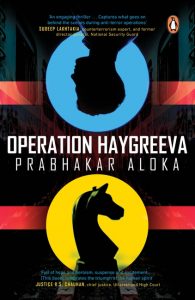
Operation Haygreeva by Prabhakar Aloka
Operation Haygreeva
Prabhakar Aloka
The C3 unit in the Intelligence Bureau is the node of the country’s counter-terrorism operations. At its discreet headquarters in New Delhi, intelligence officers work hard behind the scenes to thwart threats, keep track of targets and make sure the country is kept safe. When Mumbai becomes the victim of a series of horrific bomb blasts, Ravi Kumar, the chief of C3 known for his unorthodox but brilliant methods, is entrusted with the responsibility to neutralize the threat posed by a new terrorist organization called Lashkar-e-Hind.
Together with his three young recruits, Mihir, Jose and Cyrus, Ravi uncovers a plot that is much larger and threatens the very fabric of the country’s peace and stability. Through their network of agents, covert missions, tabs on the Hawala market and cultivation of contacts, they must tread carefully to protect the citizens of India. And they must do it all from the shadows, navigating the murky corridors of espionage and intelligence services.
Yuktahaar || Munmun Ganeriwal
Yuktahaar
by Munmun Ganeriwal
Have you ever wondered why diets just don’t seem to work? In Yuktahaar, celebrity nutritionist Munmun Ganeriwal argues that the reason why none of the diets in the past have seemed to work is because they focused on the wrong cause-you, the reader. While we may continue to have a fling with low carb, vegan, low fat diets and everything in between but a long-lasting solution may never be found if we do not shift our focus from ‘you’ to ‘them’-the human-gut microbiome connection.
In this book, Munmun gives an actionable 10-week holistic program that encourages a gut balancing lifestyle, consisting of season-wise meal plans, recipes, exercise routines, sleep hygiene tips, and yoga practice. The book also charts actress Taapsee Pannu’s phenomenal physical transformation while working with Munmun. With a focus on combining traditional, regional Indian foods with evidence-backed tips, Yuktahaar will transform your relationship with food and rebalance your gut for a leaner and healthier you.
On The Open Road || Stuti Changle
On The Open Road
by Stuti Changle
Myra wants to quit her job.
Kabir is looking to resign from the board.
Sandy just dropped out of college.
Discover yourself within these restless twenty-somethings as they stand on the cusp of making life-changing decisions. Battling their inner demons and societal taboos, they wish to live life on their own terms. Their passion brings them together and with nothing but Ramy’s travel blog as their guiding star, they set out on the open road to follow what they desire.
But their journey entails a devastating personal loss, an undying fear and a host of obstacles. Will they be able to realize their shared dream? Or will they succumb to the hardships on their road to freedom?
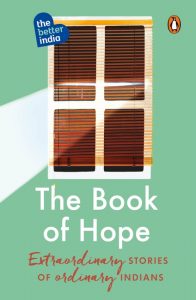
The Book of Hope || The Better India
The Book of Hope
by The Better India
The Book of Hope is perfect for a nation that refuses to give up. Curated by The Better India, these are stories of resolve, love, faith, entrepreneurship, and compassion that will uplift your spirit. These stories serve as a pick-me-up when you’re feeling down, or when you need a reminder that in the end, we’ll make it through.
This book is an archive of a nation’s collective goodness. Stories are what connect us and remind us that hope is always possible, and the lives of these ordinary Indians will surely inspire you.
Here’s our wholesome list of easy reads for you to begin with. Which will be one of your firsts this year?
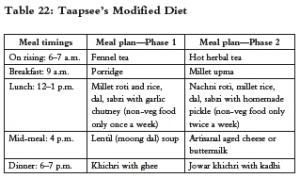
Indian actor Taapsee Pannu’s life revolves around these three words. To keep abreast with her work routine and maintain the energy to sustain an 18-hour workday, an award-winning nutritionist and a celebrated lifestyle consultant, Munmun Ganeriwal, offers her expertise by curating a 10-week diet plan for her. ‘Yuktahaar’ is a holistic programme that encourages a gut-balancing lifestyle, mainly consisting of food, exercise, sleep hygiene, and neural retraining.
That’s intriguing, right?
Now let’s read this expert from Yuktahaar: The Belly and Brain Diet and delve deep into the diet plan suggested by the author, Munmun Ganeriwal, to Taapsee Pannu.
*
Yuktahaar || Munmun Ganeriwal
Before I start working with my clients, apart from a few other things, I also ask them to note down their food intake, exercise details (if they are working out) and activities of daily living (referred to as ADLs), and send these details to me. This simple tool provides a great starting point from where both my client and I can take off on the TBBD journey together. On the day before our conversation, Taapsee too had shared her details with me, and this is how a general day in her life looked like.
Exercise Modifications
Exercise duration and frequency were reduced: This was new to me. I usually had to lecture people on why it is important that they move their butts. I was used to people asking me, ‘bees minute treadmill kiya toh weight loss toh hoga naa?’ or ‘sirf weekends par gym karu toh chalega naa?’. With Taapsee, it was the opposite. With around two hours of workout every single day, she was clearly over-exercising—a reflection of her go-getter attitude in life in general. But when it comes to exercise, more is not better. Exercising appropriately can lessen inflammation and damage done to your gut microbiome, but exercising too much can lead to inflammation and gut (hyper)permeability. The dose makes the poison! Taapsee often got heartburn in the middle of her workout sessions, and she was completely taken aback when I explained to her that the heartburn was exercise-induced.
Exercise structure was altered: There are three energy systems in our body—adenosine triphosphate–creatine phosphate or ATP–CP, anaerobic glycolysis and aerobic—that work simultaneously to fuel the body during exercise. However, depending on the exercise duration and intensity, one of the three systems predominates. Taapsee was working out pretty hard, but because her exercise sessions consisted of both squash or cardio (predominantly aerobic) and weight training (primarily anaerobic glycolysis) one after the other, she wasn’t reaping as much benefit as she should have been. An altered regime was planned for her, with aerobic and anaerobic activities alternating with each other. Doing so leads to better fuel utilization, enhanced muscle recovery and greater fat burn without spending hours and hours exercising. Additionally, a day of high intensity interval training or HIIT workout (10 seconds of maximum effort followed by a two-minute rest) that predominantly trains the ATP–CP system was introduced. Targeting each of our energy systems by different types of exercise is important, as it maximizes fitness benefits and results in a leaner, more toned body.
…
By the time the shoot of Rashmi Rocket commenced in November, Taapsee had gained 2.5 kilos of lean muscle mass, no easy feat by any means. Dressed like an athlete ready to face the camera, her pictures resembled those that had been shown to us as reference. The real test, though, came in December, when she had to shoot for the races in Ranchi. Then, apart from looking like an athlete, Taapsee also had to perform.
It was time to put the months of hard work to the test. The shoot finally began. Taapsee took to the starting block, the director called out ‘Action,’ and she exploded off the block. As she sprinted towards the finish line, I watched her, my heart filled with pride, and in my mind, I said, ‘Stop her if you can!’
**
Read Yuktahaar: The Belly and Brain Diet to understand the science of fitness and art of well-being.








 that he’d be triumphant. He emerged from his home at midnight, his beautiful colours lighting up the night sky. He’d crafted a coach with diamonds, which was drawn by a thousand white horses. He wore a rainbow cloak and a crown made of gems from the sea. Behind him was another coach filled with gold, silver, pearls and gifts for Lindu. He looked radiant as he left an indigo, purple, blue and pink trail across the sky on his way to Uko’s palace.
 ‘Lindu,’ he called out, ‘if you marry me, you will not have to follow me like a shadow. You will not have to travel the same path as the others. You can set out anytime you wish and rest when it pleases you. Would you like to be my bride?’ He bent down on his knees to ask for Lindu’s hand.