Leadership and Management. What comes to your mind when you think about these concepts?
We often read about being successful, but how often do we really think about making the people around us successful? That is exactly what Transform, Chandramouli Venkatesan’s latest and final book talks. It also aims at helping people navigate people management and how intricately it’s connected to being successful professionally, as well as flourishing socially.
The word ‘management’ often has a one-dimensional approach for a majority of people However, Chandramouli explains how it’s irrevocably connected with another aspect of success: good leadership. They are both different sides of the same coin. Managing is the art of impacting people while being involved directly, and leading is the art of impacting people without being directly involved. They are mutually inclusive and even though they can be executed independently, the best results can only be achieved when they are practiced simultaneously.
Catalyst||Chandramouli Venkatesan
In Catalyst, Chandramouli’s first novel, there was a great emphasis on career management and life management. It had crucial insights about the important strategies and decisions people take to move forward in their respective careers. Catalyst focused on helping people win where it matters- the second half of their careers. Moreover, it also took into account life management, and how success is not limited to professional boundaries. Excelling both personally and professionally is possible.
Get Better at Getting Better|| Chandramouli Venkatesan
Get Better at Getting better was the sequel and the second guide in this series, and eloquently talked about improving consistently. While it’s great to be good, you can always be better, and even hack the process of getting better. With a heavy emphasis on improving one’s skills, capabilities, judgements, communication, and decision-making abilities effectively, it talked about how to grow rapidly as a professional and remain relevant.
Getting Better Continuously, Career Management, and Life Management are three out of the four of the author’s pillars when it comes to effective management. They focus on bettering themselves to excel and have an inward approach. However, management and leadership are functions that involve people. Hence these three pillars and their success depend on the fourth and final concept: People Management.
Transform||Chandramouli Venkatesan
Transform, the ultimate guide to lead and manage, is an insightful and interactive read for anyone struggling or striving to be better at being a good leader and manager. By keeping leading and managing as pre-conditions instead of mutually exclusive alternatives, Transform puts into perspective the importance of being good at both. With revelations and key learnings in all four sections, it helps managers who aren’t leaders and leaders who are struggling to be good managers understand how the two are connected through their own experiences.
Transform stands out from the long list of books on people management by facilitating two-way communication instead of a jargon-rich monologue. With exercises to improve self-awareness and steps to create practical action plans, it also takes into account that different things can work for different people. People management is the pillar that supports the other three, and according to Chandramouli, “It is not important whether you are a leader or a manager, what is important is whether you are leading and managing.”
Renew the way you approach success at the workplace and in life and evolve into a more self-aware professional with Transform!
Do you crave nostalgia in this sultry weather? Chamor is our most heartfelt novel of 2021. This gritty novel, while offering the reader delightful glimpses of daily life in the two regions of southern India that form its setting, also brings them face to face with the less savoury and disturbing aspects of the human condition. The mostly lovable characters, who are at the mercy of a universe that does not discriminate between good and evil, cannot take anything for granted. Whether man, beast or bird, each must deal with their destiny according to their nature and instincts. Here’s an excerpt to give you a taste of this beautiful novel!
**
The car that my father drove was an old one—a grey Morris Minor. It looked weird to me, like a bug, but its colour reminded me of a certain grey, syrup-filled toffee that used to be a favourite of mine as well as of my school friends. The car had belonged to my father’s brother, who had arrived in it with a friend, but when they tried to drive it back to Kerala it would not go. Uncle did not care to have it returned to him, and between the mechanic, Raju, and my father, they managed to keep it running, though it could not be taken for long trips. As dinnertime approached, my mother would still be busy with her books, and Jency could be seen bustling about, clinking utensils in the kitchen as she hurried to finish making the last dish. With both of them wanting me out of the way, I would go looking for my father and find him lying on his wheeled plank under ‘the Morris’, as he called it, tinkering with its wires and nuts and bolts. The sound of wrenches and spanners being put aside is, in my memory, associated with the urgent cawing of crows and the plaintive cry of the cuckoo as late afternoon merged into the evening. Clouds of sparrows kept swooping in and bursting out of the thorny acacia shrubs that were their home, and a flock of tiny silverbills, with their distinctive, black-tipped tails that looked like wet paintbrushes to me, sat in a long row on an overhead cable, waiting for the right moment to dive together into their home, which too made for a pretty thorny dig—a jujube tree. A stout, old date palm inside the park thronged with colourful bee-eaters, the two needle-like feathers sticking straight out of their tails making them recognizable in flight, while species of parrots and other birds fought angrily for holes and hollows on the cycads and coral trees. Sadly, at this time, inside the houses, too, feelings ran high as students suffered corporal punishment over mere homework. I would have a brush with this medley of sights and sounds as I hung about my father, kicking my heels. Sometimes, I would lie beside him under the car, shining a torchlight up at its brown, metal underbody. After the job was done, I would be rewarded for my help with a ride around the block, at the end of which we stopped at Mr Nair’s thatched establishment. While my father waited at the wheel, I took the rupee note that he gave me and went inside the lantern-lit shop, which was reputed for its quality goods and hygienic tea stall. Jency and I were regulars there as it was the only shop near us that
sold our breakfast staple of Nendran bananas. As I entered, I found that there were no other customers, and Mr Nair and his wife were busy arranging the stock. Bhavani Auntie cast a glance outside, concerned that I had come alone until she saw my father, and fished out from her mixed candy jar the two specific ones I wanted—the round orange-flavoured coconut bonbon for Jency and the aforementioned grey confection for myself. As per the slip that I had handed in, Auntie gave me a slab of wax paper-wrapped burfi, which was for my mother, and some change. This indulgence was a rare thing, as my father was strictly against ‘putting rubbish in the mouth’.
**
Poignant and perceptive, Chamor will haunt you for a long time. Get your copy and explore vulnerability and honestly like never before!
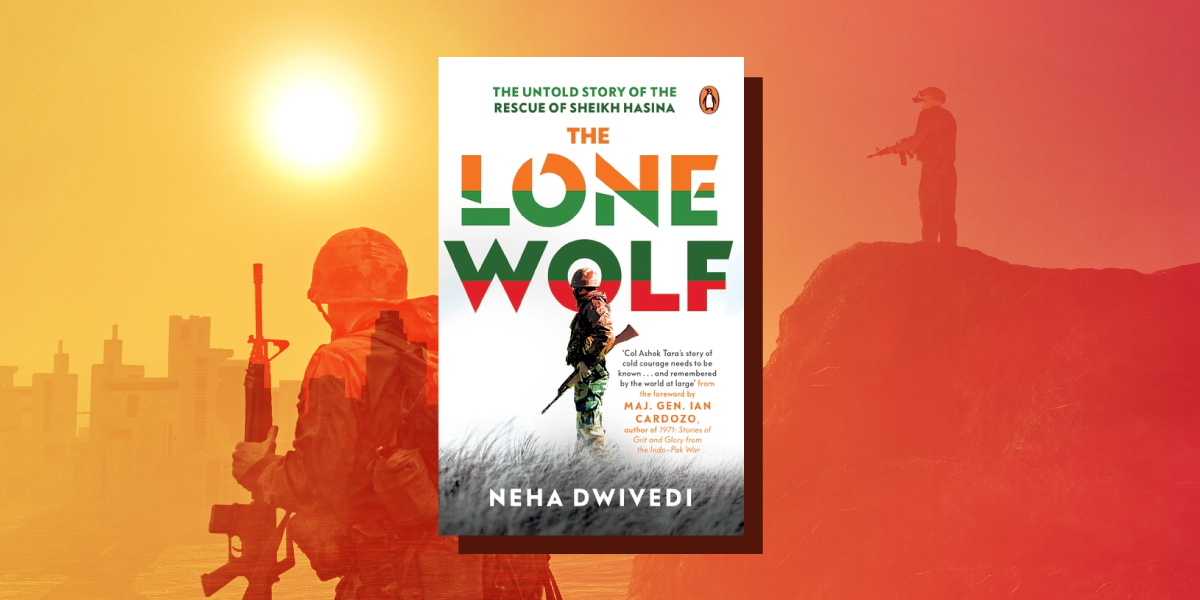
The Lone Wolf intersects Col Tara’s childhood and adolescence against the background of political tensions caused by linguistic hegemony in Pakistan. This eventually explodes into a full-fledged war that we now know as the Bangladesh Liberation War of 1971 and that India specifically remembers as the Indo-Pak War. On the very day that the war ended, Col Tara was at the centre of a high-profile hostage crisis. He was tasked to negotiate the release of Pakistani Army hostages, who were none other than the family of Sheikh Hasina.
Col Ashok Tara led the high-profile rescue mission as was his duty, but his tact and bravery are emblematic of India’s own diplomatic role in the conflict between East and West Pakistan. Neha Dwivedi’s book spotlights the side of war requiring strategy, a level of wit and composure that many rarely identify as a strength of the military.
The Lone Wolf || Neha Dwivedi
A childhood encounter formed the foundation for these skills. For Col Tara, The Lone Wolf is more than just a metaphor. At the young age of nine years old, Ashok Tara found himself face-to-face with a wolf, while walking through a forest ridge along the Yamuna. Back then the undergrowth was wilder and for Ashok and his brother Kirti, the walk to and from school was an adventure. On that fateful day, Ashok was all by himself. With a wild wolf standing in his path, the young Ashok Tara remembered the words of his grandfather, a former shikari:
. . . when confronted by an opponent, even if it’s a wild animal, stare at your opponent with a confident and stern expression. This show of courage will effectively deter them from launching an attack.
These words saved his life, not just on that day, but twenty years later, as he stood unarmed in front of a group of hostile Pakistani soldiers.
To read Col Ashok Tara’s story, get your own copy of The Lone Wolf from your nearest bookstore.
In the midst of the humdrum of daily life, we forget that this December is possible because of all the Decembers that came before this one. How 50 years ago, our brave heroes fought a war and kept us safe. So, today and forever, let’s not forget the people who form the spine of that flag. Let’s never forget the ones who leave their families to protect our borders, those who shed real blood from their bodies and who fight so bravely that they safeguard a nation of a billion people.
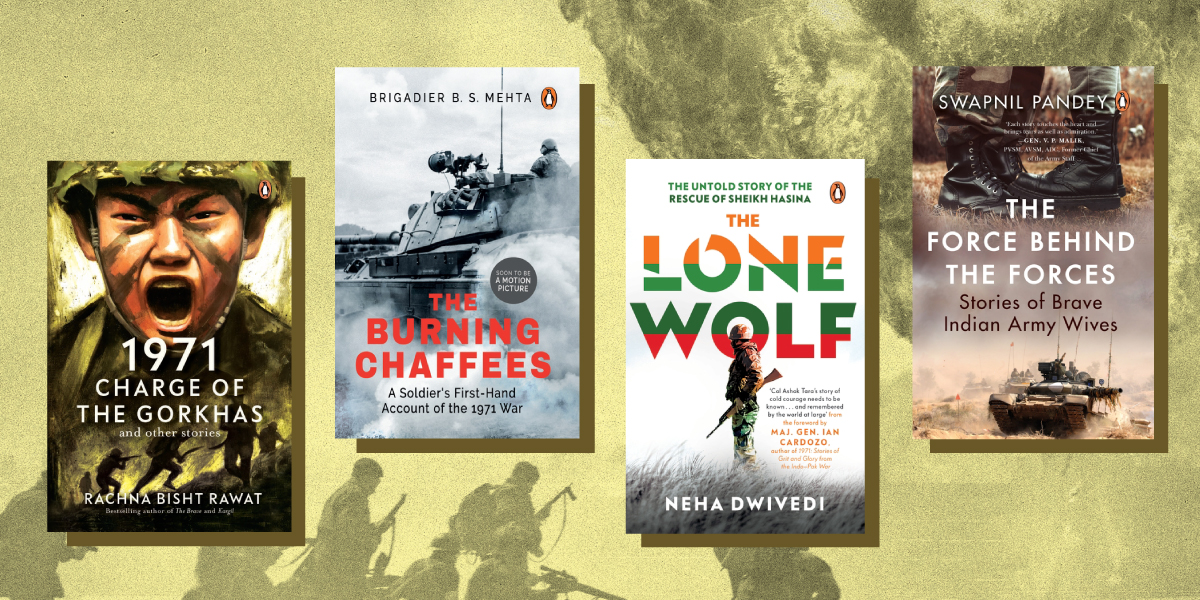
On the 50th anniversary of the Indo-Pak war, we bring to you four books to pay homage to the soldiers who fought that reality, the families they left behind and their stories of strength, resilience, and love for the country.
The Lone Wolf || Neha Dwiwedi
The Lone Wolf
The Untold Story of the Rescue of Sheikh Hasina
Neha Dwivedi
The Bangladesh Liberation War was nearing its bloody end when Colonel Ashok Tara, then a twenty-nine-year-old major, was assigned the task of rescuing Bangabandhu Sheikh Mujibur Rahman’s family which was being held hostage by the Pakistani Army. Ashok Tara, unarmed, entered the lion’s den, and negotiated with the hostile soldiers for the release of Bangladesh’s Father of the Nation and his family that included a young Sheikh Hasina. The Lone Wolf is Ashok Tara’s story, charting the course of his celebrated yet quiet life as a member of the armed forces.
The Burning Chaffees || B.S. Mehta
The Burning Chaffees
A Soldier’s First-Hand Account of the 1971 War
Balram Singh Mehta
In 1971, India waged a momentous war against Pakistan. But before all-out war, an even more significant tank battle was fought on 21 November 1971 by the C Squadron 45 Cavalry, which demolished the Pakistani General A.A.K. Niazi’s plans of victory and set the stage for the utter routing of the Pakistani Army.
This battle was a victory and a decisive one at that. It was a trumpet call to the rest of the world of India’s intent to stand up for human liberty and dignity in this war of liberation.
On 3 December 1971, Pakistan declared war. The rest is history.
The Burning Chaffees is a thrilling account of the pivotal battle of 21 November by Brigadier B.S. Mehta.
1971 || Rachna Bisht Rawat
1971
Charge of the Gorkhas and Other Stories
Rachna Bisht Rawat
Why do the Gorkha soldiers of 4/5 GR attack a heavily defended enemy post with just naked khukris in their hands?
Does Pakistan find out the real identity of the young pilot who, after having ejected from a burning plane, calls himself Flt Lt Mansoor Ali Khan?
Why is a twenty-one-year-old Sikh paratrooper being taught to jump off a stool in a deserted hangar at Dum Dum airport with a Packet aircraft waiting nearby?
1971 is a deeply researched collection of true stories of extraordinary human grit and courage that shows you a side to war that few military histories do.
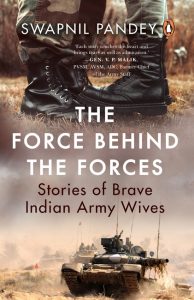
The Force Behind the Forces by Swapnil Pandey
The Force Behind the Forces Stories of Brave Indian Army Wives
Swapnil Pandey
Who continues to pay the costs of war long after our soldiers are gone?
There are many stories of courageous heroes at the borders, but how much do we know about the women standing strong behind them?
The Force behind the Forces is a collection of seven true stories of eternal love, courage and sacrifice. Written by an army wife, Swapnil Pandey, this book proves that bullets and bombs can only pierce the bodies of our soldiers, for their stories will live on in the hearts of these brave women forever, women who have dedicated their lives to the nation, without even a uniform to call their own.
These books and stories shall always honour the lives of those who fought for a cause that meant more to them than their own lives and remind us of the blood that was spent for us, lest we forget the bodies who shed it.
All of us have had awkward and uncanny encounters that almost always amount to nothing or make up for lukewarm, ‘only to be told at a party’ stories. Here’s something out of the ordinary, penned down by Vivaan Shah, the author of Living Hell and Midnight Freeway, that is definitely a treat for mystery lovers!
***
I flipped my phone around to five missed calls from the office once I got off the Sea Link. A high-alert police check-post was set up on the Worli sea-face, which I thought irregular given their general preference of time and place. Whether they were wrapping up for the night or starting the day I couldn’t rightly tell. Two armored cars stood tilted diagonally to the barricade, a squad of four RTO cops and two khaki-uniformed 2-star officers inspecting every vehicle that passed by, peering into the passenger seats and checking every number plate.
A navy blue police van, with its caged backdoor open, stood parked behind a hauled up-tempo and a scooterist without a helmet humoring one of the junior constables. From ahead, I saw this creature walk out of a bright red Honda city—thin, furtive, practically bent double with the way he was arching his shoulders. He sashayed right past the police ‘Dabba’ towards the barricade, his arms dangling from the pectoral girdle like strings of wire attached to an electricity pole—his head leftwards and right as he expanded his chest before the senior-most constable, clicking open his jeep door with one hand, and gently holding it out with the other.
He whistled out to a passing havaldar, one of those squeaky mawaali catcalls you’d hear out on Band Stand or in the Complex. He caught my eye not because he was particularly distinctive looking, but because he was the only one who stood a chance of distracting the officers while I crossed the check-post.
As I attempted delicately to steer on past the zig-zagging yellow barriers, one of the cops caught hold of my open window and stalled me before I could get the gear back into third. He had a sling-on sten gun hanging from his right shoulder, and a slight slouch defeating an otherwise pretty stiff posture. He looked first at my number plate and then at my fingers spread out over the wheel.
‘License and identification please!’ he asked, from behind a pair of the darkest aviators on the force. I keenly obliged, handing him the necessary particulars.
‘So…Pranav…?’ he asked, reading from my license. ‘What do you do?’
‘Lawyer.’ I said.
Tallying the information on my PAN card with my license, he leaned forward on the half-open window and lowered his aviators to initiate eye contact. I looked away as his elbows squeaked on the polish.
‘Come here.’ he wagged one of his index fingers at me.
‘What happened?’
‘Come here! What’s that smell?’
‘What smell?’
‘You been uhh….doing a bit of eh-eh?’ he clenched his fingers into a fist and stuck his thumb out to demonstrate the neck of a bottle. ‘Huh?’ he inquired, shaking his fist to elaborate on his half-hearted pantomime.
‘Ohh no-no! No! I don’t drink sir!’ I promised him.
He semi-circled the bonnet and got into the front seat displacing my briefcase to the back.
‘Excuse me, sir!’ I coughed.
He mumbled something out in Marathi on his walkie-talkie and placed his sub-machine gun under the seat by his feet.
‘You know what the penalty for drinking and driving is?’ he asked, turning towards me.
‘As a matter of fact, I do.’
‘Five to ten years!’ he spat.
‘For drinking? Since when?’ I laughed.
‘Yup! Those are regulations!’
Just then, a vague tapping at his window dulled his enthusiasm. It was the same creature from before beckoning assistance. The cop slouched in his seat on noticing him, raising up his collar to cover his face.
‘Get in the back!’ He swung his thumb around demandingly at him.
‘Who is this guy?’ I asked as the wastrel reached for the door just behind the cop.
‘No one. He’s a lizard.’
‘A what?’
I slowly started the car, it seemed I was taking them both for a little spin.
‘Pranav Paleja!’ I tipped a half-hearted salute at him from the rearview mirror. ‘Pleased to meet you.’
He nodded, looked aside and then out the window, neglecting to give me his name.
‘That’s Nadeem.’ The cop took the trouble to introduce us.
The guy in the backseat still didn’t acknowledge the name was his.
‘Take a U-turn.’ the cop instructed me. I did so at the approaching roundabout, without as much as flinching from the order.
‘Okay, let’s make this quick, how much we got?’
‘I’m sorry sir?’
‘How much cash you got?’
‘Well, actually sir…’ I said. ‘Absolutely nothing! At present, I’m broke! I spent all my money on the petrol!’
‘Hmmm…petrol huh?’ he murmured, putting on the A.C and rotating its knob till he was satisfied.
‘Sir…..’ I mumbled. ‘I’m sorry but I don’t usually use that!
‘Aaaaahhh!’ he exhaled, enjoying the soft fragrant breeze of the A.C.
‘Sirr….’
‘Let’s go for a ride!’ he barked, turning the A.C all the way up.
We skimmed past a redlight without him as much as noticing.
‘Take a left.’ he asked me to pull into a one-way.
‘It’s a no-entry.’
‘Doesn’t matter.’
The tyres squealed when I turned left and nearly grazed a stationery vehicle at the curve whose driver was mercifully missing. Two ATMs stood facing each other in the empty lane, one an Axis Bank Branch and the other an outlet of HDFC.
‘What about you Chipkali?’ he asked the guy seated at the back.
The guy just nodded his head. ‘I told you, I’m out!’
Turns out I had to pay his fine too, he had not a rupee to his name, not even the most rudimentary debit card of any sort. He promised he’d pay me back, but I had nothing more than his phone number to go on. I’d had only two pegs from the night before that were probably still swimming about in my system, but this Nadeem Chipkali had been on an all-night bender, emerging periodically out of every late-night dive this side of the Sea Link. We had to roam around Worli with the cop for around half an hour before we could collectively get him to settle on five thousand between us plus breakfast.
Once we paid him off, he took a ride with a passing patrol bike outside City Bakery, and that was the last we ever saw of him. Nadeem and I just stared at each other from the rear view mirror.
I pushed the front seat back to broaden leg space for him, but he didn’t budge from the backseat, half-expecting me perhaps to play driver to his esteemed rear-end. As I let go of the lever, something pointy and metallic cooled my hand from below the seat—a jagged touch of something entirely alien to my possessions—then came the ruffled cloth of a strap, and soon the rusty perforations constellated over a barrel.
Just as Nadeem finally creaked open the passenger seat door, which I in this revelation had disregarded to reach for, the muzzle of the stun gun stared me back in the face from below the folds of the floor mat.
We both looked at each other, our mouths agape, and our eyes bulging wide. I immediately reversed back to the signal and spun the steering wheel around furiously to cut across the three or four cars that swept by. From afar on Worli sea-face I could faintly perceive, some of the junior constables beginning to pick up the traffic cones and wheel out the metallic Mumbai Police barriers toward the pavement.
Scarcely had we made it to the second red light when, from a clearing in the traffic, we caught the remains of the barricade being speedily disbanded. By the time we were crossing the same spot we had been pulled over at, there wasn’t a cop in sight. We were stuck with the policeman’s submachine gun, which he had irretrievably forgotten, and had no means by which to return it, without of course being thought of as perhaps dangerously insane.
Written by Vivaan Shah
Midnight Freeway by Vivaan ShahLiving Hell by Vivaan Shah
It’s the most wonderful time of the year, and as your little ones celebrate this festive season, make the most of their time at home with our exclusive selection for December. Winter is all about spreading warmth and joy, and with our exclusive section of books for your bundles of joy, we are celebrating the essence of this season. From wholesome books such as You Are Simply Perfect that will help young teens and tweens to navigate through this tumultuous time, to inspiring reads such as Malhar in the Middle, we have the best December treats for your holiday heart!
Jealousy. Bullying. Anger. Anxiety. Body image issues. Selfies and social media addiction . . . Are you grappling with any of these?
Let’s be honest, juggling school, extra classes, home, friendships and new relationships can be hard. It’s difficult to find balance and tough not to get affected by the ‘happy’ content we see online. But what is genuine happiness vis-à-vis short-term pleasure? Are we even looking for it in the right place?
Written by a renowned psychologist, this beautifully illustrated book is divided into five parts that will help in easing everyday anxieties. Learn to make friends with yourself, your body, mind and feelings, and to deal with difficult emotions and situations.
You Are Simply Perfect! will equip you with life-changing tools to find contentment–in school and outside. Find your own quiet spaces inside this book with journal pages left for you to write and reflect.
The dangerous virus is making everything go into lockdown. But the village poacher trying to catch the pangolin Chumki has befriended. How will Chumki save the rare animal in these tough times?
Malhar wants to be a famous tabla player. But why do tabla players always sit to one side of the stage? Are they not important enough? Malhar wants answers–and he wants to sit in the middle!
This collection of 15 mini board books is more than just a set of adorable books for a child’s first library–they are also engaging learning tools! The format includes activities like stacking, sorting, counting, matching and identifying colours that encourage interactive learning of basic concepts and facilitate developmental skills in kids.
The box set comprises mini books with sturdy board pages and rounded corners that are perfect for tiny hands. With adorable illustrations and a modern design, this box set includes a variety of relevant topics like first words, animals, numbers, shapes, colours and more.
From adventures in the galaxy, hot air balloon ride, treasure hunt to helping the lion finds its way and much more, each maze provides hours of fun and learning. Amazing Mazes features full-color pages filled with different puzzles and mazes, along with search and find activities to keep little minds engaged. Designed to encourage logical thinking, sharpen hand-eye coordination, these activity-filled pages are sure to keep little puzzlers engaged.
Grab your pencils, trace the squiggly path and follow each amazing maze to a new discovery!
These books are for very young readers, aged five and above. The books work well for reading out loud to kids or for young readers just starting to read by themselves. Written by some of the best-known writers for children, and illustrated in exuberant colour by some of India’s most-loved illustrators, these stories are set largely in non-urban settings. Hawaldar Hook is the endearing mascot of the Hook Books. Each book includes short and fun language exercises at the end.
The vividly illustrated stories of Teejan Bai and Satyajit Ray in Lavanya Karthik’s Dreamers Series are inspiring for young kids. Karthik’s stories and artworks are perfectly synced with the high and low notes of Teejan Bai’s life and have captured the most significant shots of Satyajit Ray’s life. Both of them are acknowledged and appreciated for their unique talents.
Get your children hooked to the pages of the Dreamers Series and let them get inspired to hone their skills. Here’s a glimpse of the younger selves of Teejan Bai and Satyajit Ray.
Recognizable by the hOle at the top corner of each book, these chapter books are aimed at kids learning to read independently. They are full of fun stories, gorgeous illustrations and hOles!
The hOle books are early chapter books for children transitioning from picture books to longer books. The stories are contemporary, Indian and with protagonists who are the age of the potential readers, facing dilemmas and challenges which the readers would be familiar with.
Over the years, the hOle books have been shortlisted for or won every major book award in India and a couple internationally.
And That Is Why . . . Manipuri Myths Retold||L. Somi Roy
A collection of endearing and vibrant retellings of Manipuri myths told for the first time to the outside world! Discover twelve magical tales from Manipur, the mountain land in the northeast of India on the border with Myanmar. Passed down by learned scholars, balladeers and grandmothers over hundreds of years, these unknown myths and fables are enriched with beautifully rich paintings that will transport you to Manipur!
Have you heard of the king who sacrificed his flesh to keep his word to a pigeon? Or about the throne that gives anyone who sits on it the unique ability to dispense justice! And how about the sculptor who managed to make magnificent statues with no hands at all?
There’s something for everyone in this collection of tales of wisdom and wit!
From quarrels among gods and the follies of great sages to the benevolence of kings and the virtues of ordinary mortals, Sudha Murty spins fresh accounts of lesser-known stories in Indian mythology. Accompanied by fantastical illustrations and narrated in an unassuming fashion, The Sage with Two Horns is sure to delight fans of the beloved storyteller.
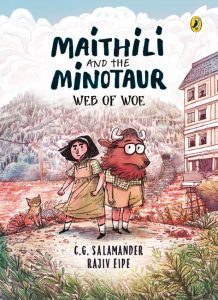
What if our world was a lot more? Filled with unknown creatures-some friendly, some scary.
An outcast to the world of humans, Maithili lives in the outskirts of a magical wilderness. But as she makes new friends in the realm of monsters, she must learn to be careful. Because some monsters are just like humans: mean, nasty and out for blood.
Perfect for fans of Hilda and Arthur and the Golden Rope, join Maithili and the Minotaur on their very first adventure in an outlandish world where nothing is as it seems.
The Very Glum Life of Tootoolu Toop||Stuti Agarwal
A delicious adventure set in Darjeeling about a young witch’s attempts at living a human life. For readers of Roald Dahl, Enid Blyton and David Walliams.
To every witch, wizard and glum,
I’m Tootoolu Toop, a ten-year-old, fully trained witch of the Oonoodiwaga tribe from the Darjeeling mountains. Like every other ordinary human who wants to live a life of magic, we witches and wizards want to experience the non-magical world too (I do for sure). For me, the ‘ordinary’ world is nothing short of an adventure. So I have left my tribe to live life as a glum.
This is my story.
Tootoolu is on the run. From her mundane life of stirring grasshopper’s legs into potions and her underground home where her tribe has been in hiding for 569 years. Will Tootoolu find what she’s looking for-best friends, books and a chance to be who she truly is?
What if your life depended on being able to tell a good story?
Schariar, King of Persia, would marry a woman every night only to chop off her head every morning. He had sentenced the clever Scherazade to the same fate. Determined to save herself and other women from this gruesome decree, Queen Scherazade begins telling him stories one night-of magic lamps and genies, of fishermen and caliphs, of treasure caves and strange potions.
Tales so wonderful that the one night turns into 1001 . . . But what will happen when Scherazade runs out of yarns to spin? Illustrated afresh, this tenth-anniversary edition offers tales from the Arabian Nights as told by the magical storyteller Scherazade. Narrated in an engaging, tongue-in-cheek style complete with vivid imagery, The Storyteller will keep you spellbound for days!
In the forests of central India, where teak meets sal and plateaus meet hills, natural history meets detective fiction in an inquisitive Ruddy Mongoose’s investigations. Join Naturalist Ruddy as he unearths some of nature’s most fascinating mysteries in this one-of-a-kind comic book set across India’s various natural habitats.
Learn more about lesser-known animals, insects and organisms of India, and how they interact with their environment!
Watch out for these wealth-eroding investment errors! Four of the most damaging myths that persist in Indian investing:
1. Allocating funds in investments such as gold in the erroneous belief that gold will help us protect our wealth.
‘If we consider returns from gold in each of the three decades separately over the last thirty years, we see that gold has underperformed the Sensex by a wide margin.’
Diamonds in the dust || Saurabh Mukherjea, Rakshit Ranjan, Salil Desai
2. Investing hard-earned money in real estate believing it will help you grow your wealth
‘ In the last five years, if one were to look at the return rate from real estate in metropolitan cities in India such as Mumbai, Delhi and Bengaluru, one would see that returns have been around 3–4 per cent per annum; i.e., house prices have at best kept pace with consumer inflation. ‘
3. Falling for the myth that debt mutual funds offer decent returns with low volatility
‘In spite of the repeated high-profile reverses suffered by prominent mutual fund houses who have high-risk, low-quality paper in their debt funds, the intermediary community continues to sell such products. ‘
4. Thinking you can time the stock market by timing the economic cycle, i can time the stock market on the belief that GDP growth drives the stock market!
‘More generally, across the world there tends to be low or no correlation between stock markets and GDP growth, implying that timing the stock market is not possible on a systematic basis.’
Did you just realize you’ve been making a few or all of these errors? Never fear, for the experts—-Saurabh Mukherjea, Rakshit Ranjan and Salil Desai, are here! Based on in-depth research conducted by the award-winning team at Marcellus Investment Managers, Diamonds in the Dust offers Indian savers a simple, yet highly effective, investment technique to identify clean, well-managed Indian companies that have consistently generated outsized returns for investors.
Inspired by the sincere words, here is a kaleidoscope collating the responses and a few stories from #KindnessMatters.
*
‘Kindness matters because this is the only way to live and let other live in peace.’
Lisa’s act of kindness was inspired by the personal experience of unwavering hospitality. Being an international student in Morocco, it wasn’t enough to simply know the textbook language. The locals teaching her the nuance in local dialects made a huge difference in bringing her closer to the community.
Returning to Switzerland, Lisa saw the refugees going through a similar plight. She then created the ‘voCHabular’ book and app, which succeeded not only in teaching the local language to refugees but also in creating a hybrid community of offline-online volunteers. Their work has now expanded to refugee awareness campaigns, food banks, and more around the borders of Europe.
Kindness, as proven by Lisa’s story in the chapter No Language Barrier, is what helps build trust with strangers.
‘Inner peace.’
It began with one family. Now when there’s a death in La Guajira, Sonia Bermúdez is the only one people can call.
Sixty-five-year-old Bermúdez’s story begins in 1996 when authorities informed her that there were no more spaces for unidentified victims of Colombia’s fifty-year-long conflict and drug-related violence. With neighbouring Venezuela’s political and economic crisis, Bermúdez’s focus has shifted to refugees who ran away from home but did not make it. Since municipal cemeteries are not free, the daily wage of a migrant labourer does not allow them to bury their dead with dignity.
To date, more than 300 Venezuelan refugees have been laid to rest in her cemetery, a 5.5-hectare land in Riohacha.
Sonia Bermúdez’s story in A Resting Place is a living example of how peace, if not found, can be built with one’s own hands.
‘So that the world is a better place for our kids.’
Not able to find the love and community they need, it’s not uncommon to find queer youths in Manipur, fall victim to addiction.
Sadam Hanjabam was one of them until a tragedy changed his life and set him on his current path. A core member of Ya-All, which means ‘revolution’ in Manipuri, Hanjabam is part of the collective creating queer-focused spaces, something he needed while closeted. Known as Meitram, the co-working, social space is more than just a location. Hanjabam and others are using his experience as a reference to integrate recovery and sex education programs for the youth.
Hanjabam wants the kids to have the support system he never had. Of Rainbows and Revolution shows how kindness, for the queer youth of Manipur, comes to the simple desire for a better future.
#KindnessMatters || Inspiring stories of empathy, compassion and kindness.
‘Kindness heals oneself and the world.’
In 2001, Bucharest’s mayor Traian Băsescu ordered all stray dogs to be killed. This was the moment that created Adăpostul Speranța. That night, the foundation rescued 300 dogs who would have otherwise been euthanized under the new orders. In 2020, twenty among those rescued dogs continue to live in, and because of, the shelter.
The shelter’s motto of Leave no dog behind inspires them to take care of every dog. Paraplegic and injured dogs, usually treated with despair, are taken care of by providing them with wheels and safe homes.
The kindness that the Speranța Foundation give their canine friends fuels more gifts of kindness from donations and volunteers. A New Lease of Life teaches us how one act of kindness can start a beautiful cycle of compassion, and save the lives of those who join it.
‘Our kindness towards others inspires them to be kind to everyone else.’
With COVID-19 enforcing lockdowns and restricting indoor dining in Barcelona, Faouzia Chati, the president of the Catalan Association of Moroccan Women, had to find alternative spaces for Ramadan prayers. It was then Father Peio Sanchez, Santa Ana’s rector, offered the Church’s open-air cloisters. This gesture of empathy encouraged many volunteers to come forward and cook the iftar (fast-breaking) meals for no less than Muslims, who were mostly homeless.
What started as a single act of kindness became the foundation for an inclusive community in the stone passages of Santa Ana. United by Religion echoes the tenet that is taught in all religions, across all languages: treat others as you want to be treated.
‘It makes me feel like a fellow human.’
At seventeen, Joséphine Yameogo did the unthinkable by refusing to marry the sixty-year-old groom chosen for her. Instead, she married a man of her own choice, facing banishment from her community. After becoming a mother of three, she picked up on the skills needed to become a mechanic and opened her own shop on the outskirts of the capital city.
Today, the Center Féminin d’Initiation et d’Enseignement aux Métiers (CFIAM) runs an organization helping girls and young women from disadvantaged backgrounds train in automotive electronics, bodywork, mechanics and more. For these women, technical education is a much-needed escape from coerced paths like forced marriage. They find it easier to be confident while seeking employment with such skills in hand and learn to establish financial security for themselves.
For young girls and women mentioned in Fixing Stereotypes, what the CFIAM did was not just about empowerment, but about emancipation. An act of kindness is the most important way to remind someone of their value as a human being.
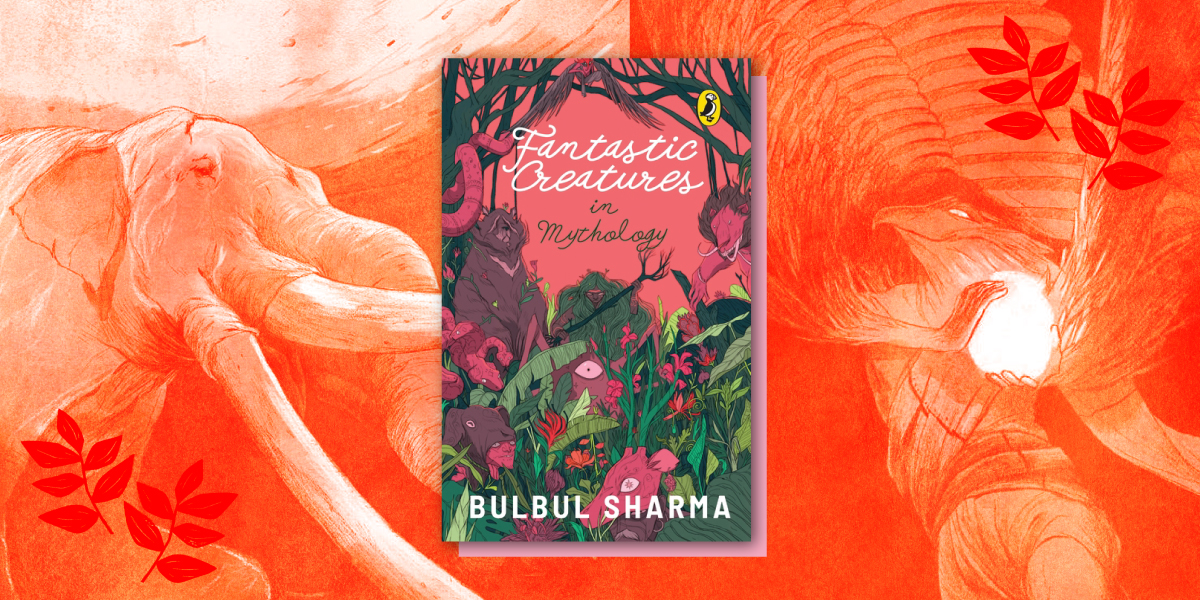
In her latest book, Fantastic Creatures in Mythology, Bulbul Sharma brings to us multiple stories of never-heard-of creatures like Jambavana and Airvata or unknown dimensions of the ones we already know of, like Jatayu and Narasimha.
Here is an excerpt from the book telling the story of Jambavana, the wisest bear in the world!
Fantastic Creatures in Mythology || Bulbul Sharma
‘When anyone asked Jambavana, the noble king of bears, his age, he would shut his eyes and think. He would smile and then continue, ‘Let’s see . . . I was present when Vamana, one of Lord Vishnu’s avatars, took three rounds of the three worlds in just three giant steps. Ah! I have even seen the golden glory of the blue-skinned Lord Krishna and heard him play his magical flute. Now that I am old, I wait here in this quiet, lonely place to serve Lord Rama.’
Jambavana was blessed from the day he was born, when Lord Brahma had yawned one morning and from his breath, this mighty bear had been created. When the king of bears was young, he was said to have had the strength of ten thousand lions. He was the strongest bear of all. In fact, he had made rounds of the earth at lightning speed several times. But now, hundreds of centuries had passed, and all the great bear did was live quietly in the forest and think about all the wonderful things he had seen in his long, long life.
One day, he looked far out to the seashore and noticed that all the monkeys and bears were running about, making a lot of noise. He knew why they were so agitated. The king of monkeys, Sugriva, in whose army Jambavana once served as a general, had told him that Rama, the prince of Ayodhya, was here looking for his wife, Sita.
Sugriva explained that the demon king of Lanka had kidnapped her and taken her away in his golden chariot. They had heard that she was somewhere in Lanka, but no one really knew where exactly she was being held prisoner. Sugriva had promised Rama that his entire army of monkeys and bears would help him rescue Sita. With folded hands, Hanuman, the cleverest and bravest of all the monkeys, sat at Rama’s feet. He was so keen to serve Lord Rama, but did not know what to do. Everyone gazed at the vast ocean that lay between
them and Ravana’s kingdom. Who could possibly cross this turbulent ocean? Which of them was strong enough to leap hundreds of feet through the air?
The waters were rough; the waves rose as tall as mountains and crashed down with a thunderous, deafening sound. Everyone gathered there knew that rakshasis guarded this ocean, and so, no one had been able to muster the courage to cross it until now. As the monkeys racked their brains, their leader Angada asked, ‘Which one of you brave monkeys will leap across the ocean, find Sita and bring her back?’ At first, there was complete silence and the monkey army did not even move. Then a few well-built monkeys stepped forward. They bowed their heads and one of them said, ‘We can jump very high, sir, and even though we are not really sure if we can cross this ocean, we are willing to try. We do not mind dying in the attempt. We want to serve Lord Rama and be loyal soldiers to our noble king.’ Meanwhile, Hanuman stood back quietly, looking out at the ocean. All he could see was an endless expanse of water and no land beyond it. Lanka seemed
like a dream! How could any ordinary monkey cross this ocean? It was an impossible task.
Whoever tried to leap across would just drown and never be found again. Hanuman sighed. His eyes filled with tears as he whispered to himself, ‘If only I could do something
to help rescue Ma Sita.’ All of a sudden, the noble king of bears, Jambavana, appeared and stood next to him. ‘Why do you stand here alone, Hanuman, with such sadness in your eyes?’ he asked in his deep voice. ‘I want to cross this ocean and find Ma Sita.
I want to serve my Lord Rama, but I don’t know how to. How can one leap across these unsafe waters? Look at those monstrous waves rising and falling like mad elephants on the run. How will I get across this cruel sea? Nobody can.’ Hanuman sighed, his eyes full
of regret.
Jambavana turned and looked at Hanuman. He took a deep breath, patted his back and said, ‘Listen to me, my son. Listen to me very carefully. I have lived a long life and I have seen things that you are not even aware of. Today, I am going to tell you something important.’ Hanuman lifted his head and looked at Jambavana.
With a solemn expression, the old bear said, ‘Hanuman, you are not aware of your great strength because of a curse cast upon you by an angry sage many years ago, when you were young. This curse made you forget everything. ‘You know that your mother, Anjana, was an apsara from the heavens, and your father, Vayu, was the god of wind. But have you forgotten that as a child you stole the very sun because you thought it was a ripe red fruit and you wanted to taste it?’ Jambavana’s eyes crinkled as he smiled.
He continued, ‘Do you know the great Lord Indra threw his thunderbolt at you, but your father saved you? Furious at Indra, he stopped the winds from blowing. Soon, every living creature on Earth gasped for breath, and finally, when Indra asked Vayu for forgiveness, he blessed you with eternal life. Brahma gave you a boon too and made you invincible. With Varuna’s blessing, water cannot harm you. With Agni’s boon, fi re cannot burn you. And your father, Vayu, made you faster than the wind!’
Hanuman looked at the wise bear with astonished eyes.
Jambavana slowly nodded and patted Hanuman. ‘Look within your heart, son of Vayu, and you will find that you are not an ordinary monkey but a unique creature with more strength, wisdom and courage than anyone of your kind. I am as old as the ancient hills and I have seen a number of great warriors, but you, Hanuman, will be the greatest
amongst them.’
As Hanuman heard the old bear speak, something stirred his mind, something he had long forgotten. Jambavana’s words were like magic, and they seemed to take him to a faraway place where he was once a monkey with amazing power and strength. Hanuman could feel himself changing! Fresh blood raced in his veins and his eyes sparkled with a new-found energy. He could feel his arms and legs becoming stronger.’
What do you think happens next in this story? Was Hanuman able to cross the waters and get to Lanka?
Read more of such interesting stories in Bulbul Sharma’s Fantastical Creatures of Mythology.
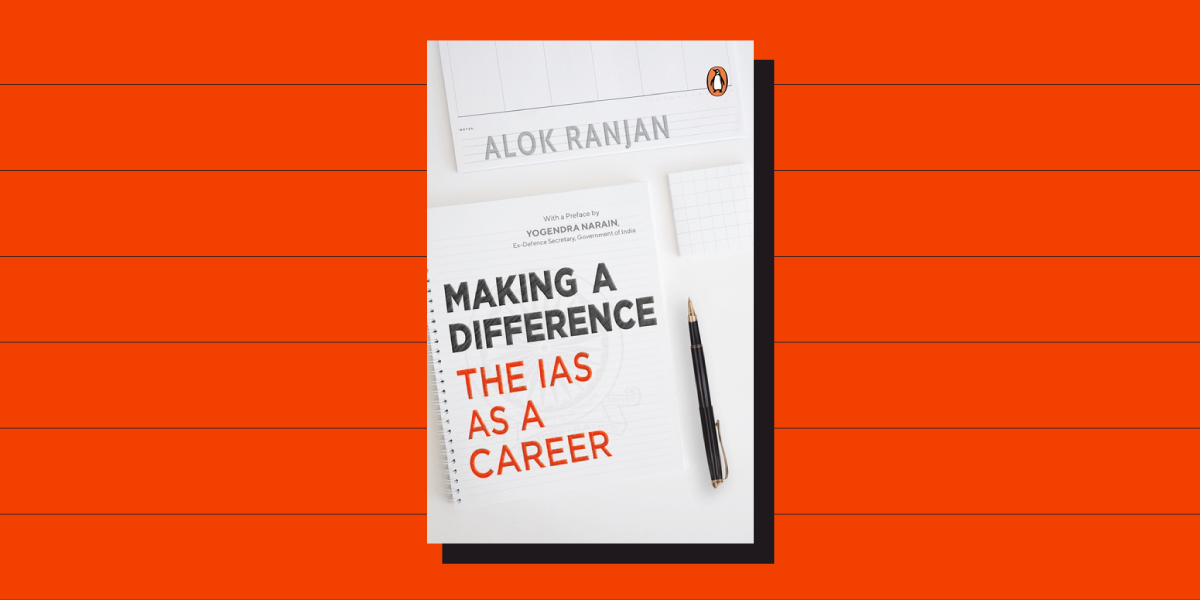
Here’s an excerpt from Making a Difference by a successful retired IAS officer, Alok Ranjan, who served with distinction in various assignments in the State Government as well as the Government of India.
*
Making a Difference || Alok Ranjan
Working with the State Government
A very revealing incident took place when I was the Principal Secretary Urban Development and the urban local body elections were to take place. They were thirteen posts of mayors and as per the act and rules, there was a clear roster system to determine which seat would be general, which reserved, which would go to women, etc. The CM wanted particular candidates to contest from specific municipal corporations and I was summoned by the CM Office and given the brief to prepare the roster accordingly. I explained that this is not possible as the rules and their interpretation was clear. The stratagem of taking legal opinion was then adopted by the CM Office and the Principal Secretary Law interpreted the rules differently which accommodated eight out of the thirteen proposed mayor candidates. I said that I did not agree with the opinion but if given in writing, I would abide by it. However, the CM was keen that at least three other proposed mayoral candidates should be accommodated in the roster. To my utter disbelief I was called and told by the CM Office in the presence of the Principal Secretary Law that for eight seats, the interpretation given by the law department should be used while for other three, my earlier interpretation should be employed. I had to show my dissent by saying that I could agree with an interpretation I felt was wrong if given in writing, but I had to be consistent and could not possibly choose different interpretations for different mayor seats. At my refusal, the officers present looked at me as they would at a goat about to be sacrificed and I realized that my goose was cooked and mentally began to prepare for my transfer. Imagine my surprise and amazement when the CM saw my point and agreed with it. It just shows that often the officers close to the CM try to be holier than the king. If they put up both sides of the picture to the CM they will invariably get to the right decision.
Secretariat working is all about files which are almost like living organisms having a life and energy of their own. A good Secretariat officer believes in not keeping files pending and he is proud to proclaim that his table is clear. However, this movement of files has little relation to actual decisions being taken and on closer examination, he will find that the files have been sent to law, finance or personnel departments for advice. The files move to and fro with volumes of noting which ensures that no accountability can be fixed on anyone at a later date. A close relative of this strategy is the formation of a committee to examine the matter which takes its own sweet time to give a voluminous report. Even developing a system of tracking files and prescribing maximum time limit for files to stay at a particular desk does not help.
The Principal Secretary of a department is expected to provide leadership to his team. He has to have the skill set to build the team which shares the objectives and goals of the department and works towards its fulfillment. The key task is to prepare the budget of the department, then release the budget to the field officers and monitor physical and financial progress. Above all, he has to assess the problems in his department, resolve them and achieve the required outcomes. Unfortunately, this does not often happen as the officers are more concerned about processes than giving results. Calling or attending a meeting becomes an end in itself and occupies the majority of the time of the secretaries and the heads of the departments. The job of a Principal Secretary is not only to assist in policy formulation but ensure implementation. Often we hear the rather unfair and incorrect statement that policies are good but implementation is poor. The reality is that policies are framed in the rooms of the Secretariat overlooking the harsh realities at the field level and a good policy must take into account how it can be executed…
To really play a transformational role, the officer must focus on results and outcomes but unfortunately, the officer is often more concerned about the process than delivering results. I have personally seen many brilliant officers mellow down in the Secretariat to the level of becoming ‘inaction wonders’. They disconnect themselves from the field and get mired in the rules and regulations with the results that the files become thicker, with no difference being made to the actual delivery of public services. For instance, if an officer is Secretary in the urban development department and is busy disposing of files while cities are full of garbage and filth rotting on the roads, then it implies that his working has no connection with the real issues confronting his department. Similarly, there is no purpose served by the Health Secretary clearing files on a daily basis if the quality of healthcare remains abysmally poor. Teachers remain absent from schools while the Secretary Education is busy issuing detailed guidelines and instructions which have a total disconnect with the realities in the field. This leads to discontentment amongst the people as they are receiving poor quality of public services. It is, thus, mandatory to make better outcomes the focus of each and every department and the performance of all the Secretariat, departments should be measured accordingly…
Working with the Government of India
The biggest attraction of a GOI posting is the international exposure. In simple language, it means the prospect of foreign travel and also a chance of a foreign posting. Ministries are categorized according to the avenues of foreign travel that they promise. That is why ministries like commerce are sought after and the competition to get into them is high. When the GOI officers meet each other, the common topic of conversation is the number of countries that an officer has visited. Some claim to have crossed the half-century mark whereas others make tall claims of having scored a century. I happened to go as JS Defence and defence was a ministry which had very few opportunities for foreign travel. If at all they travelled, it was mostly to Russia. Many of my colleagues looked sympathetically at me and said ‘could you not manage a better ministry? ’I was told that most officers avoid PHD ministries – personnel, home and defence – as they have the least chances of foreign travel. So, defence, despite being such an important strategic ministry, has few people opting for it. Within the ministries too there is intense competition for the international co-operation desk. A foreign posting or deputation to an international organization is highly coveted. This is despite the fact that these assignments do not give great opportunities for doing challenging work. Late T.S.R. Subramaniam who retired as Cabinet Secretary and had served in the state, center and in an international organization, had commented in his book that the maximum work is done in the districts, then the state government, then the GOI and finally the international organization where you have a lot of time on your hands. Still, the lure of the international posting is there.
The GOI concerns itself with policy formulation at the national level and is generally not involved in the implementation aspect, which is the responsibility of the state governments. In some departments like defence, external affairs and commerce, all the action is at the GOI level. There are, however, huge GOI bureaucracies dealing with subjects on the concurrent or the state lists. Sometimes, one wonders whether it is necessary at all. For example, the Ministry of Agriculture in the GOI has ten Joint Secretaries whereas agriculture is a state subject. There is a serious case for reduction in the size of certain ministries at the centre and also of clubbing several ministries together as it is strange that the Ministry of Agriculture is not involved with issues related to fertilizer, water or agriculture credit.
The ministries of such size at the GOI exist because of political reasons and also the bureaucratic culture of creating work to perpetuate work and justify itself. The major mechanisms for this are the centrally sponsored schemes where the major financial contribution (60 per cent or 75 per cent) is done by the centre and schemes are formulated at the GOI level with detailed guidelines. The problem arises as no two states are alike. The same schemes will succeed in one state but the conditions in other states will not favor its implementation. Thus, the states constantly argue that funds should be transferred to them and they be left free to design schemes. However, there is no denying that there is greater wisdom available at the GOI due to its knowledge about the best practices in the states, presence of experts and availability of international inputs. The GOI involves stakeholders, specialists and consultants in designing policy and the due diligence done is of a very high order. Yet, there cannot be a universal policy looking at the extreme variations between states. The solution, as usual, has to be in between…
To succeed in GOI, one needs to study the department in detail, understand crucial issues, articulate your viewpoint and have the ability to carry officers of other services and specialists along with you. It requires great qualities of leadership to set the goals and milestones for your departments and then lead the entire team towards fulfilling them. A dedicated officer will always find working in the Government of India to be a transformational opportunity.
**
For all IAS aspirants, Making a Difference will prove to be a book of great significance.