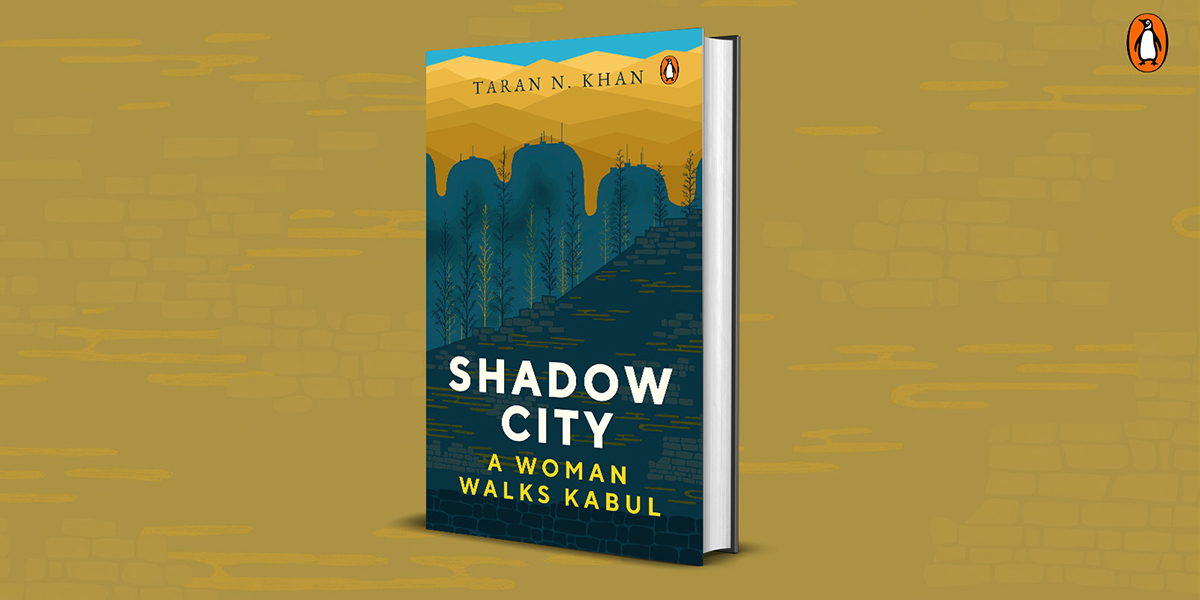
When Taran N. Khan first arrived in Kabul in the spring of 2006-five years after the Taliban government was overthrown-she found a city both familiar and unknown. Shadow City is an account of Khan’s expeditions around the city of Kabul, a personal and meditative portrait of a city we know primarily in terms of conflict.
Here’s an excerpt from the book:
—-
In the bluster and immensity of war—the one that began in 2001 and the ones before it—it is easy to forget that Kabul existed 3000 years ago. Years after I arrived, I read a description of the city that seemed to ring true. ‘Like some people, certain cities suffer from amnesia,’ it said. ‘Not that they have no past. Rather, this past, no matter how glorious it may have been, will have left so few reminders, so few architectural vestiges, so few visible traces, that it remains something obscure, if not completely invisible.’ In this ‘amnesiac city’, I found that walking offered a way to exhume history—a kind of bipedal archaeology—as well as an excavation of the present…
Exploring Kabul, I found, required the same principles that help in the reading of mystical Persian poetry, in the relationship between the zahir, or the overt, and the batin, the hidden or implied. This works on the tacit understanding that what is being said is an allegory for what is meant or intended. To talk of the moon, for instance, is to talk of the beloved; to talk of clouds across the moon is to talk of the pain of separated lovers; to talk of walls is to speak of exile. Such wandering leads through circuitous routes to wide vistas of understanding. Like walking through a small gate into a large garden. It is also a useful reminder that in this city, what is seen is often simply one aspect of the truth. What lies behind—the shadow city—is where layers are revealed…
Kabul is an island, or so it appears to the outsider standing on one of its nondescript, potholed streets. It deceives you with its high walls streaked with brown mud, punctuated by steel-topped gates. It hides behind the fine mist of dust that hangs over its streets and homes, so that the city appears as though from the other side of a soft curtain. Like a mirage, a place that is both near and far away…
Shadow City || Taran N. khan
A walk through the history of Kabul would begin where the city itself began—a settlement by a river, at the heart of which is a citadel. Inside the walls of this Bala Hissar, or High Fortress, was a city in itself, with barracks, homes and bazaars. Over time Kabul expanded along the southern bank of the river that flows between the Koh-e-Sher Darwaza and the Koh-e-Asmai. The remains of Kabul’s thick wall radiate over the sprawl of the Sher Darwaza; they are said to date back as far as the fifth century…
Kabul was captured by the Tajik rebel leader Habibullah Kalakani, who was derisively called Bacha-e-Saqao (son of the water carrier) because of his humble roots.16 Kalakani’s reign lasted only nine months. By October 1929, Amanullah’s cousin Nadir Khan had managed to retake Kabul. He was declared king and attempted to introduce more measured reforms. But he also met a bloody end and was assassinated while attending the graduation ceremony of a high school in Kabul. His son Zahir Shah took the throne in 1933. He was to be the last king of Afghanistan, ruling for forty years.
Through these political changes, Kabul continued to spread further on the north bank of the river, with the suburb of Shahr-e- Nau laid out in the 1930s. Its orderly grids of houses, surrounded by gardens and high walls, contrasted with the congested lanes of the Shahr-e-Kohna. Embassies and foreign missions of the nations that were establishing relations with Afghanistan through the 1940s were set up here, beside the residences of Kabul’s upper and middle classes.
Through the 1960s and 1970s, the capital grew steadily, due in part to migration by rural families from the provinces. Walking through its streets, it would have been possible to see houses and shops expanding the city’s edges, spreading to both sides of the Kohe-Asmai, climbing over the slopes of its hills. By the early 1970s, Kabul was the mostly peaceful capital of a small country, home to around half a million people. And then everything changed.
Part reportage and part reflection, Shadow City is an elegiac prose map of Kabul’s hidden spaces-and the cities that we carry within us.
Daydreamer Dev loves volcanoes…and daydreams of course!
Forever daydreaming-that’s Dev. Sitting in class or watching the clouds from the roof of Kwality Carpets, he floats off to places all over the world and has wonderful, bizarre adventures.
Mild-mannered schoolboy Dev is no stranger to survival in extreme environments. Classroom trances and home-made flights of fancy take him all over the place-what other kid could have visited Amazon rainforests, summited Mount Everest and crossed the Sahara? Along with the challenges of all this, he also needs to avoid the wrath of teachers and make Amma and Baba proud . . . Not so easy when your brain lives elsewhere!
**
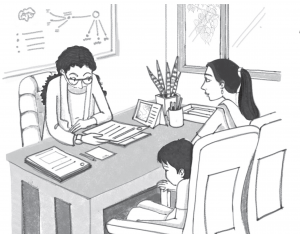
Dr Ira wore dark-rimmed glasses and had a soft, round face and a gentle voice. Dev could imagine her speaking calmly as the Titanic went down. She listened carefully to Amma and adjusted her glasses to read the two pages supplied by Dev’s headmaster. Dev imagined himself shrinking very steadily so that by the time she looked up, he would be gone.
‘Dev, what do you think about all this?’ Dev realized that he must still be visible. ‘Ma’am, I think it’s very bad that Mrs Kaur needs to write so many notes,’ Dev said. ‘Amma doesn’t like them, and Baba must spend his time lecturing me about concentration and teaching me the meaning of words like “lamentable” and “deplorable”.’
‘Would you be able to tell me about one of your daydreams, Dev?’
Dev told her about the time he hit a six off the final ball at Wankhede Stadium to win the match against Australia, and about riding on a dolphin.
The Astoundingly True Adventures of Daydreamer Dev || Ken Spillman (Author), Suvidha Mistry (Illustrator)
He was launching into another story when she interrupted.
‘Do you have some good friends, Dev?’
Surprised that she wanted to talk about his friends, he told her about Vihaan, Adil and the best of friends ever, OP—Omprakash, as only Mrs Kaur preferred to call him.
Dr Ira asked more questions and looked over his school reports. Eventually, she sat back and looked as squarely at Amma as a round-faced woman could manage.
‘It would be valuable if I could spend some time with Dev alone on another occasion. Would that be all right, Dev?’ Dr Ira paused and when Dev did not say no, she went on. ‘Let’s be clear—daydreams are normal. But recently, there has been some good research on what is called “maladaptive daydreaming”. This is when fantasy tends to takeover. And when fantasy takes over, it can get in the way of everyday things, such as education, or the jobs people do.’
Amma was like a sculpture. She was sitting bolt upright with her head tilted and her lips squeezed together.
‘Dev seems well adjusted socially,’ Dr Ira said.
‘And he’s managing at school. But Mr Bannerji and the school counsellor believe he is gifted and might do very much better.’
The sculpture beside Dev became Amma again.
She nodded vigorously. Dr Ira leant forward.
‘I’d like to explore this a little. Maladaptive daydreamers tend to imagine worlds and stories as relief in times of stress or boredom. In Dev’s case, I suspect it is boredom. But the ability to daydream so vividly that you experience a sense of presence in an imagined environment can be addictive. I can work with Dev to help him develop some strategies to manage it.’
The word ‘maladaptive’ came as a relief.
Evolution was all about adaptation. Dr Ira probably thought Dev needed to adapt, to evolve.
At least he wasn’t going to have an operation or an electric shock.
‘It will be quite painless, young man,’
Dr Ira assured, as if reading his thoughts. ‘Think about it like this. Active volcanoes don’t erupt every day. In fact, most of them very rarely erupt. Your daydreams can rumble away in the background and that’s healthy. We can try to limit unwanted eruptions that affect your education. Does that make sense?’
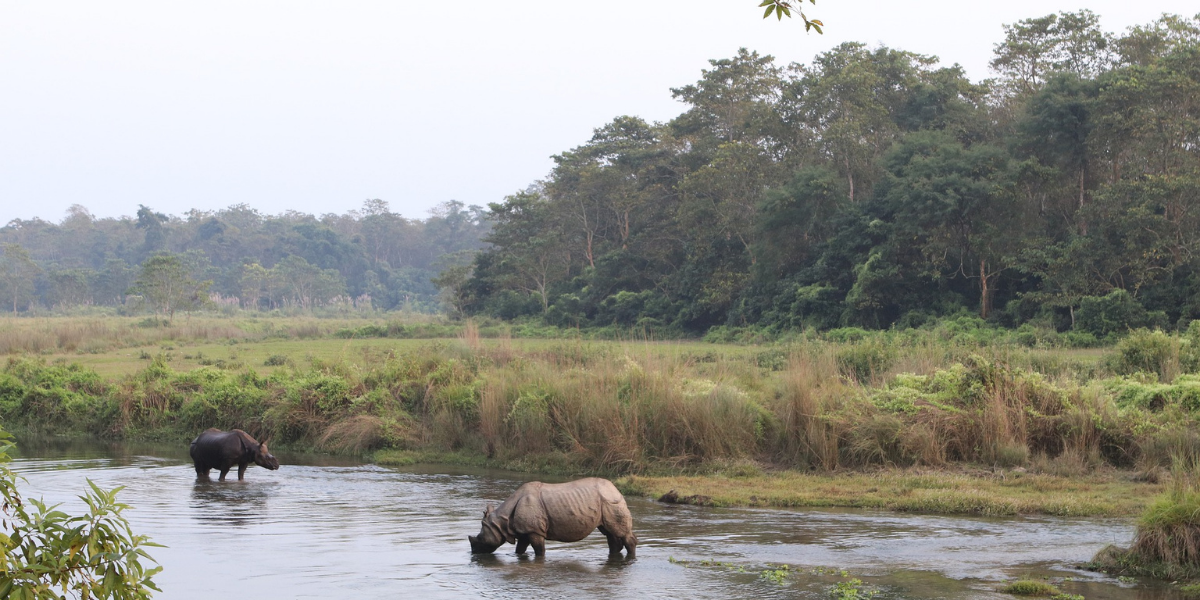
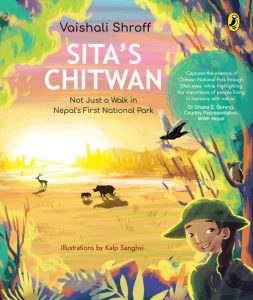
As big as 1,78,000 football fields, Nepal’s first protected national park is home to over 550 species of birds; awe-inspiring animals, such as greater one-horned rhinoceroses, Bengal tigers, clouded leopards; and a confident, brave girl called Sita.
Sita dreams of being a nature guide like her baba. With a spring in her step and a group of eager tourists, she unravels the secrets of the forest. But when she wanders astray and comes face to face with a mamma rhino, will this eight-year-old be able to listen to the stillness of the jungle?
Join Sita in Chitwan National Park, a magnificent UNESCO World Heritage Site!
**
There were no female nature guides in Nepal until one woman challenged herself to do something that no woman had.
Meet Doma Paudel, the first female nature guide in Chitwan.
Sita: Hi Doma! I am sure everyone is excited to learn that there is a real-life me! Tell me more about yourself, Doma.
Doma: I was twenty-three years old when I became the first female nature guide in Chitwan, Nepal in 2007. In 2012, I founded Nepal Dynamic Eco Tours to promote sustainable ecotourism. I support wildlife victims and conduct awareness programs on forest conservation. There is always something that keeps me busy.
Siuta’s Chitwan || Vaishali Shroff (Author), Kalp Sanghvi (Illustrator)
Sita: Wow! You wear many hats, Doma! My baba inspired me to become a nature guide. Who inspired you?
Doma: My family’s house in Sauraha is along the border of CNP. Elephants destroyed our bamboo and grass house a few times. Rhinos, deer and wild boars ate our crops. Once, a sloth bear attacked my father. Coming from a poor family, it was hard to recover from these losses. In 2004, we lost our beloved mother to an unexpected rhino attack; she had gone to the forest to collect firewood for the house. But I still love animals and forests.
My mother treated me no different than my brothers. She always encouraged me to follow my heart and step out to do something for society. In school, I was part of the Green Club and participated in plantation and garbage collection events. That’s where my journey to be a nature guide began and I never looked back.
Sita: Did you have to undergo special training to become a nature guide?
Doma: I received training from lots of places including the National Trust of Nature Conservation. I learnt the history of Nepal and Chitwan National Park, the protected areas, all about animal behaviour, safety rules, hospitality, culture, responsible tourism and a lot more!
I was the only female among twenty-five male guides. No one wanted to go with me into the forest because they thought I was not strong enough to protect tourists and other guides from wild animals. But I did not give up. On the first three-day walk I was assigned, a rhino charged at us. I used all my knowledge and training to protect my guests from the rhino. Since that day, everyone knows me as ‘the one who is not afraid’!
Sita: That’s incredible! I once saved a tourist from a rhino attack too! What does a day in the life of Doma Paudel look like?
Doma: A nature guide’s life is full of excitement, adventure, challenges and risks. In peak season, I am at my office by 6 a.m., planning safaris and tours for our tourists over cups of tea. My guides and I show Chitwan’s beauty and wildlife to our tourists and the last safari ends by 5.30 p.m. At 6 p.m., all of us get together to share our day’s encounters and stories. No two days in the forest are the same and that’s the most exciting part of my job. When there are no tourists, I organize events to raise awareness on conservation efforts and the participation of women in conservation among our communities and schools. We also visit other national parks to constantly update ourselves.
Sita: What do you love about your job?
Doma: I love that I get to be in the midst of nature and wildlife all the time. I learn something new about the forest every day. Just like you, I love meeting new people from different parts of the world, Sita. It’s a very special feeling to know that you have taken more and more people closer to nature and made them feel more empathetic towards nature and its biodiversity. I am an ambassador of nature and proud to have inspired many women to become nature guides and make families believe that it’s not just a man’s job. And I don’t miss a chance to meditate in the forest—it’s the best place to do so!
Sita: Thank you, Doma. You inspire me to not give up on my dream!
In this fascinating book, Hisila Yami traces her journey from being a young Nepali student of architecture in Delhi in the early eighties to becoming a Maoist revolutionary engaging in guerrilla warfare in Nepal. Yami was one of the two women leaders who were a part of the politburo of the Communist Party of Nepal (Maoist), which led the People’s War in the country that changed the course of its history forever.
Read on to take a glimpse into the remarkable life of a this incredible woman when she was just beginning to form her political opinions.
~
Hisila||Hisila Yami
I was eighteen years old when my future husband, BRB, asked me this question: ‘What is your aim in life?’ I had just finished a game of tennis and was standing in front of the tennis court at New Delhi’s School of Planning and Architecture (SPA) hostel. BRB, then twenty-three, had come to SPA for a master’s degree in architecture. He had completed a BArch (bachelor of architecture) degree from Chandigarh. I was then a second-year student of BArch at SPA. Apart from studies, I was enjoying several other pursuits: I was learning classical music at Mandi House, the centre of art and culture in Delhi, and transcendental meditation in Defence Colony. I remember having replied spontaneously: ‘Why have an aim in life? Let life flow freely.’ This was the level of my apolitical thinking.
Being in the heart of Delhi during the Emergency (1975–77) imposed by Indira Gandhi, we hardly felt its pangs as our elite college kept its distance from politics. We used to entertain ourselves with dances and special dinners on weekends. I was blissfully unaware that, under the Maintenance of Internal Security Act (MISA), many political activists were being hunted down. I had vaguely heard about the forceful sterilizations ordered by Sanjay Gandhi during that period. My peers and I were concerned, but only to a certain degree, when there was a drive to evict squatter settlements in an attempt to beautify Delhi.
During that time, I recollect the launch of a new fizzy drink called Double Seven (77), meant to commemorate the end of the Emergency in 1977. It was an Indian soft drink launched by the Janata Party in place of Coca-Cola, which we missed a lot. The Janata Party had come to power after the Congress, under the leadership of Indira Gandhi, lost the election. I remember my friends making fun of Prime Minister Morarji Desai for drinking his own urine as a form of medical therapy. They used to call it ‘Morarji Cola!’
Although my parents, Dharma Ratna Yami and Heera Devi Yami, were politically active in Nepal, I had little knowledge of politics. Being the youngest of seven children, I had had a pampered upbringing. Even when I lost my mother at the age of ten, I was never made to feel her absence because my sisters and brother took good care of me. Amongst them, Timila Yami, my second-eldest sister, stood out as she was the one who got me admitted to Central School (Kendriya Vidyalaya) on the Indian Institute of Technology (IIT) campus in Kanpur, which is where she was studying electrical engineering. At that time, I was twelve years old and joined the seventh grade. The year was 1971. Since I was a minor, it was with great difficulty that she got permission to put me up in the IIT girls’ hostel. All the girls there treated me like their little sister, possessively telling me to eat this and not that. They taught me the art of simple living. Indeed, I saw established scientists and engineers clad in simple kurta-suruwal and slippers. This was in great contrast to what I had seen in Kathmandu, where most of the people were overdressed. Alongside studies, I participated in sports, cultural activities and debates in school. During those days, I was bubbling with energy—a jack of all trades and a master of none.
I remember stumbling upon a magazine called Manushi while pursuing BArch in Delhi around 1979. It was an English feminist magazine edited by Madhu Kishwar and Ruth Vanita. Soon, I started attending their meetings. I think gender awareness seeped into my being at the IIT Kanpur girls’ hostel, where I saw many strong, intelligent women compete with men. Girls were allowed to visit the boys’ hostel and vice versa. The atmosphere on the campus was quite egalitarian. This was in contrast to the rest of Uttar Pradesh, which had a predominantly patriarchal setting. Maybe this was why I was drawn to Manushi. I wrote my first feminist article and letter for this magazine.
Influenced by Manushi, I wrote my first English poem:
Inside the Four Walls
Inside the four walls you will hear
Cracking of fire splinters
Scrubbing of utensils, floors
Crying, wailing of hungry babies
Followed by hushing.
Inside the four walls you will hear
Thuds, jerks, beatings
And growling of male voice
A faint voice pleading
Moaning, sighing and dying.
Who knows what goes on inside the four walls!
Inside the wall of a ‘secure home’ she is to fall.
. . . except those martyrs unheard and unsung.
Pleading from societal graves their daughters to waken!
Even though the politics of gender began to make sense to me, I was not yet politically sensitive. I was not even aware of the reason behind the India–Pakistan war of 1971. All I knew was that when the siren sounded, we had to make sure all lights were switched off and the entire area was pitch-black. This was to prevent Pakistani warplanes from spotting us.
I remember listening to a speech by Indira Gandhi in 1975. Her helicopter had landed on the grounds of IIT Kanpur amid great anticipation. Around the same time, I had overheard some students in the IIT hostel whispering about the presence of laal bhaiyas which, I later learnt, meant Naxalites. I had heard them talking about Mao Zedong and the Naxalite movement. The lower clerical staff and radical students fondly remembered the leftist professor A.P. Shukla who used to fight for their rights on campus. He used to say that IIT was a white elephant, where students from all over India came to study for a government-subsidized fee but after graduation went off to serve the cause of American imperialism. I was told that Professor Shukla had been imprisoned and tortured during the Emergency.
Every summer, we used to go back home to Kathmandu. I remember asking my father one day in 1972, when I was thirteen years old: ‘Father, who do you like, Indira Gandhi or Mao Zedong?’ Instead of answering my question, he said, ‘Do not ask such questions.’ That put an end to my political inquiry for the time being. Looking back, I realized that none of us was introduced to politics during his lifetime. At that time, King Birendra ruled Nepal with absolute power but under the disguise of a party-less Panchayat system. Perhaps my father’s loyalties towards the monarch prevented him from answering my question.
This book is not a defence of Ayurveda. A sound, scientific framework of healthcare that has saved countless lives over 5000 years does not need defenders. It needs champions, and to be given wings. In a world that needs Ayurveda more than ever, Dr G.G. Gangadharan, who has been researching both the theory and the practice for the past thirty-five years, shows in his book the logic behind the science.
Let us take a look into some essential tips from this book, so that you can find the secret to greater happiness through balance and long-lasting health.
~
Ayurveda||Dr G.G. Gangadharan
The plant that the West calls Rauwolfia serpentina is known in Ayurveda as ‘sarpagandha’. Ayurveda has been using it for centuries for the treatment of high blood pressure without any side-effects. Modern scientists have researched this plant and identified a master molecule named reserpine. They extracted it
from the plant, synthesized it in a laboratory and used it to make medicines that would reduce blood pressure. The medicine achieved this objective, but also caused side-effects that included depression and suicidal tendencies.* After many fatal incidents, the medicine had to be retracted from the market.
There’s a larger story behind this phenomenon—what I call the ‘Sarpagandha Syndrome’. To understand this story, we need to know how nature works and how Ayurveda has moulded itself to fit into nature’s contours.
Nature, Wholeness and the Dynamic Equilibrium
We know that nature abhors a vacuum. Let’s also acknowledge that nature abhors the lack of wholeness. At every point in time since the formation of our planet, every life form and substance found in nature has remained in a state of dynamic equilibrium— within itself and also with respect to its environment. If there is a momentary imbalance in that—for instance, if an unstable isotope is created—nature quickly restores the substance to its whole and natural state.
Meanwhile, nature uses chemistry to change biology over vast periods of time, so that every life form continuously evolves to a higher level of resilience.
Since nature sets such exacting standards for itself, is there any wonder that Ayurveda trusts it implicitly? By extension, Ayurveda trusts every plant and human body to be whole and complete. In the human body, this dynamic equilibrium is maintained by, among other phenomena, homeostasis; Claude Bernard, the father of experimental physiology, called this self-regulating ability the milieu interior. Since the human body and other natural life forms are designed this way, any imbalance in the human body—that manifests as a disease—can be addressed by using the restorative power of nature.
When we take a step back and look at the entire universe, we realize that nature is awe-inspiring. We realize that every life form is a microcosm of the entire universe. Since humans tend to be self-obsessed, let us rewrite that sentence as follows: The human body is a microcosm of the entire universe. The matter of the universe is in the human body and what is in the human body is in the universe. After all, astronomy tells us that the atoms that make up our body were produced inside a star. We share chemistry with the universe and, therefore, everything we find in it is potentially therapeutic for us.
So for the vaidya—the practitioner of Ayurveda—our planet is a boundless pharmacy. This makes the vaidya a bridge connecting the whole nature with the whole human being.
We will now look at how Ayurveda embraces the wholeness of the plant while also treating the human being in its entirety. In simpler terms, Ayurveda does not reduce a plant to its constituent bio-molecules. Nor does it reduce the human being to a set of ailing organs. Life is undoubtedly enabled by molecules and organs, but life is experienced in its entirety. Therefore, the processes that nurture and preserve life must be wholesome.
The first sign that Ayurveda is wholesome is the fact that its medicines do not cause side-effects if used appropriately.
No Side-Effects
Yes, Ayurvedic medicines cause no side-effects. The brazenness of this claim is made apparent by the fact that many allopathic medicines have a list of side-effects that’s longer than the list of chemicals used to make them. Despite painstaking research that can last years—including clinical trials on various life forms and multiple iterations of development—allopathic medicines have been unable to shrug off the bane of unwanted externalities. Take antibiotics, for example—every generation of antibiotics is made stronger so as to vanquish newer generations of more resilient superbugs. This also means that every new generation of antibiotics takes a stronger toll on the human body, with the side effects becoming starker. In such a dynamic domain, Ayurveda continues to use medicines free of side-effects, conceptualized and created many centuries ago. How has Ayurveda achieved this?
Well, Ayurveda studies plants in their entirety. Roots, stems, bark, flowers, fruits and leaves are understood—as constituent yet interconnected parts of the plant—and the therapeutic value of each part is understood. That done, Ayurveda identifies the best way to extract the plant’s essence for human use.
Any part of any plant has hundreds of types of bio-molecules, such as alkaloids and saponins. In many cases, only one bio-molecule among these is capable of acting as the master molecule that combats the ailment. While allopathy will isolate, extract and synthesize this bio-molecule, Ayurveda will extract the
entire part because it believes that the other bio-molecules in the plant negate the side-effects caused by just one of them.
This throws new light on the Sarpagandha Syndrome mentioned earlier. The plant sarpagandha behaves like a team, whereas reserpine behaves like the star player of that team, who is completely lost without his teammates.
The long and short of it is that Ayurveda trusts nature’s design to be more holistic than its counterpart, the human design, and by embracing nature’s holism, it manages to do away with potential side-effects.
Having said that, let’s make another statement that, which at first glance, may appear contradictory: We don’t take all parts of the plant or even everything within a single part of the plant.
All we are saying is that molecular-level selection of matter leads to problems. So, in Ayurveda, the vaidya removes those parts of the plant that are neither necessary for treatment, nor easily ingested by the human body. Through well-considered extraction methodologies, the physician makes the therapeutic qualities of the plant accessible to humans.
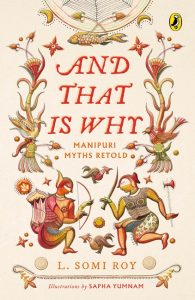
L. Somi Roy is here with a collection of endearing and vibrant retellings of Manipuri myths told for the first time ever to the outside world! Do we know why man gets wrinkles and a stoop?
Here’s why! Scroll down for a short extract from one of the 12 fascinating tales from Manipur passed on by balladeers and grandmothers over hundreds and hundreds of years!
‘O Paobirai, my ancestor! Your grandchild humbly offers you a basket of rice and a human every day. Please accept my offering.’
*
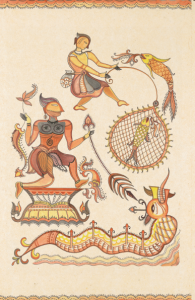
Finally, it was Man’s turn. Now, Man was very lazy and tardy and so he came very late to the gathering. He did not know what lifespans each of the animals, birds, fishes and insects had requested. As he came into the presence of his creator, Soraren looked at the latecomer with annoyance. Man said nervously, ‘Lord of the Sky, my Creator, I humbly request that my kind and I may live for fifty years. Please grant us a lifespan of fifty years.’
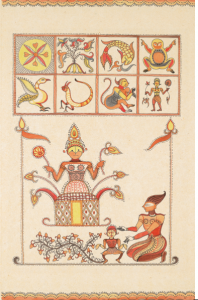
And That is Why || L. Somi Roy (Author), Sapha Yumnam (Illustrator)
Very well,’ said Soraren in an irritable voice. ‘Your wish is granted. You, Man, shall have a lifespan of fifty years. And it is just as well since you are late and the last to come and I have only fifty years left to give out.’
And Man gratefully took the last remaining fifty years and hurriedly went along his way. And that is why, Dear Punctual One, you must never be lazy and always be on time.
After all the living beings had received their lifespans, they set out on their journey back to their holes and burrows and nests and houses on Earth. On the way, Man met Monkey and Elephant. Man asked them, ‘Monkey and Elephant, how many years did each of you ask for and how many were you granted?’
They replied, ‘We both asked for a lifespan of a hundred years each and it was granted. How many years did you ask for?’
Soraren, who was also known as the Eternal Creator, lived in great happiness with the other mighty beings and together they knew no pain or sorrow or even illness or death
Hearing their reply, Man did not answer but started to cry instead. He wept loudly and large drops of tears rolled down his cheeks and snot ran from his nose. It was all really quite awkward, Dear Embarrassed One.
Seeing the very wet and messy and unhappy state Man was in, Monkey and Elephant did not know whether to be sorry or embarrassed for him. Finally, they asked, ‘Man, why are you crying?’
Man burbled through his tears, ‘I thought the Creator was angry with me since I was late. I was afraid. So, I did not ask for many years. I asked only for fifty years. And I got the last fifty years the Eternal Creator had left. And now I will have to die before you both.’ Saying this, Man sobbed all the more. He bawled even more loudly than before, if that was possible.
Monkey and Elephant rolled their eyes and looked at each other and said, ‘Do not cry any more, Man. We will each give you twenty-five years from our lifespans. This way, you will have one hundred years altogether to live.’ For, as everybody knows, Dear Arithmetical One, fifty and twenty-five and twenty-five make one hundred.
Man happily agreed. He wiped away his tears and Elephant helped him blow his nose with his long trunk. ‘Oh, thank you, Monkey and Elephant!’ said Man through his tears. ‘Let us go to the Eternal Creator. Let us tell him what we have spoken about and request him to give his approval to our arrangement.’
So according to the elders, Soraren decided that he would give all the living beings a lifespan each
Monkey and Elephant agreed. Together with Man, they went back to Soraren and told him everything. Upon hearing their words, Soraren thought in silence. ‘Very well,’ he spoke at last. ‘If this is what you have all agreed upon, I will allow it. And I have no more years to hand out. Man will now live for one hundred years. For, as everybody knows, fifty and twenty-five and twenty-five make one hundred. But this lazy and tardy creature called Man must never forget the generosity and kindness of Monkey and Elephant. He must be reminded in the future, for all his tomorrows, and for all generations to come till the end of time, that the lifespan I had granted him was fifty years but that he received twenty-five years from Monkey and twenty-five years from Elephant.’
Soraren then looked at Man and declared, ‘Man, here’s the thing. You shall keep your looks and stand upright as I have made you for the fifty years that I first granted you. But once you cross the age of fifty and start to live the twenty-five years you have received from Monkey, your skin will wrinkle and fold like Monkey’s so that you may never forget you are living his years. And once you cross the age of seventy-five and start to live the twenty-five years you have received from Elephant, your back will bend and you will stoop like Elephant so that you may never forget you are living his years. Let this be so.’
And that is why, Dear Curious One, once Man has lived his fifty years, he gets wrinkles like the Monkey, and once he has lived seventy-five years, he gets a stoop like the Elephant.
Sarbpreet Singh left the shores of his homeland, Sikkim, and went to America in his early twenties. When he learned about the lives of the Gurus, the trials and tribulations they faced, and the glorious story of the Sikh Empire, he felt his spirit soar like it never had before. Following his interest, in The Story of the Sikhs, he penned down the rich historical context that defined the foundational principles which guided Sikhs during the era of each Guru.
Here’s an excerpt from his book about Guru Nanak, who spent his entire life fighting injustice, superstition and ritualism, passing of the torch to Guru Angad.
*
The Story of the Sikhs || Sarbpreet Singh
One winter’s night, during heavy rainfall, a part of the wall of the Guru’s house collapsed. The commotion woke up the household, including both of his sons. Several of the Guru’s most devout Sikhs also gathered, many sleepily rubbing their eyes, shivering under the coarse shawls they had tossed around their shoulders to ward off the rain and the cold. The Guru decreed that the wall be fixed immediately!
There was much hemming and hawing and shuffling of feet. Some wondered privately if the Guru was going senile. Finally his sons mustered the courage to speak. ‘It is past midnight father and bitterly cold. Please go back to bed. In the morning we will engage a mason and labourers and take care of this.’ The Guru merely looked at the group and said, ‘Why do I need masons and labourers when I have all of you?’ Everyone breathed a sigh of relief when Lehna stepped up, inwardly laughing at his foolishness. After all, what was the need to repair the wall at once?
Lehna got to work under the watchful eye of his master as the rest of the Sikhs, including Sri Chand and Lakhmi Das, returned to their warm beds. Lehna diligently rebuilt a large section of the wall and found the Guru looking over his shoulder as he worked. ‘It is crooked Lehna,’ said the Guru. Without a moment’s hesitation Lehna tore down the wall and started again. This time the Guru let him build it and examined it critically when it was finished. ‘You built it in the wrong spot Lehna! You are going to have to move the wall.’ Uncomplaining, Lehna threw down the wall and started to build it for the third time.
It was dawn by then and the Sikhs began to wake up. Some gathered around Guru Nanak’s house watching Lehna work. Finally, when the wall was completed, the Guru once again expressed dissatisfaction and commanded Lehna to tear it down yet again. Some of the Sikhs began to titter. The Guru’s sons mocked Lehna, calling him a fool for obeying such unreasonable orders. Lehna went back to his work unperturbed.
Lehna continued to serve his master for three more years in this manner. Guru Nanak grew increasingly fond of Lehna and spent a lot of time instructing him. The Guru’s sons had grown jealous of Lehna’s deepening relationship with their father and began to openly express their dislike for him. The Guru, sensing the depth of the animosity, decided to send Lehna away to Khadur. Of course, his disciple left with no hesitation and started to live a disciplined life of prayer and meditation in his hometown, garnering great respect from the locals. Although he was distraught at being separated from his master, he never complained, certain that Guru Nanak must have had a reason for sending him away…
Finally came the fateful day when the Guru assembled everyone on the banks of the Ravi and formally anointed Angad as his successor.
14 June 1539 was a warm summer’s day in Punjab. A strange scene unfolded on the banks of the river Ravi, which flows by the town of Kartarpur. Guru Nanak was surrounded by his family and his beloved Sikhs, but he was doing something most unusual, even disconcerting. Surely unbefitting an elderly patriarch whose followers loved him and respected him like none other, Guru Nanak rose from his seat—the Guru’s seat—and to it he led Angad, who looked embarrassed and nonplussed. Guru Nanak, with a reassuring smile, gestured towards the Guru’s seat and bid Angad to sit. Angad looked reluctant, but being the most obedient of his master’s followers, he gingerly lowered himself into the seat. To the assembly’s astonishment, Guru Nanak reverently placed an offering of five paise or pennies and a coconut before his disciple and prostrated himself before him. The assembly gasped audibly. The Guru rose and turned to Bhai Buddha, another of his beloved disciples, a solemn man, who had been known as ‘Buddha’ or the wise old man, since he was a precocious lad! Bhai Buddha, on the Guru’s command, anointed Bhai Lehna’s forehead with a Tilak or saffron mark, signifying royalty. The torch had been passed. Visibly and dramatically. The humblest of Guru Nanak’s disciples, Bhai Lehna, now known as Guru Angad, was now his successor.
**
Now that you have had a glimpse of the life of Guru Nanak, who had paved the path of spirituality for many, read in detail more about other Sikh Gurus in Sarbpreet Singh’s The Story of the Sikhs.
The onset of monsoon brings all the book aficionados to the window on balmy mornings, letting them enjoy the whiff of their freshly brewed coffee mixed with the sweet breeze. Nestled in the porch, when the rain makes you feel grey, curl up in a corner with a book or two or maybe six (you may find that, like a chip or a cookie, you can’t stop after one). So, taking care of your moods to suit the light drizzles, heavy showers, and oh-when-will-it-rain-again days, we bring to you our latest releases that are sure to lighten your heart, brighten your days, and enrich your soul.
Are you now ready to rekindle the romance with books this monsoon season?
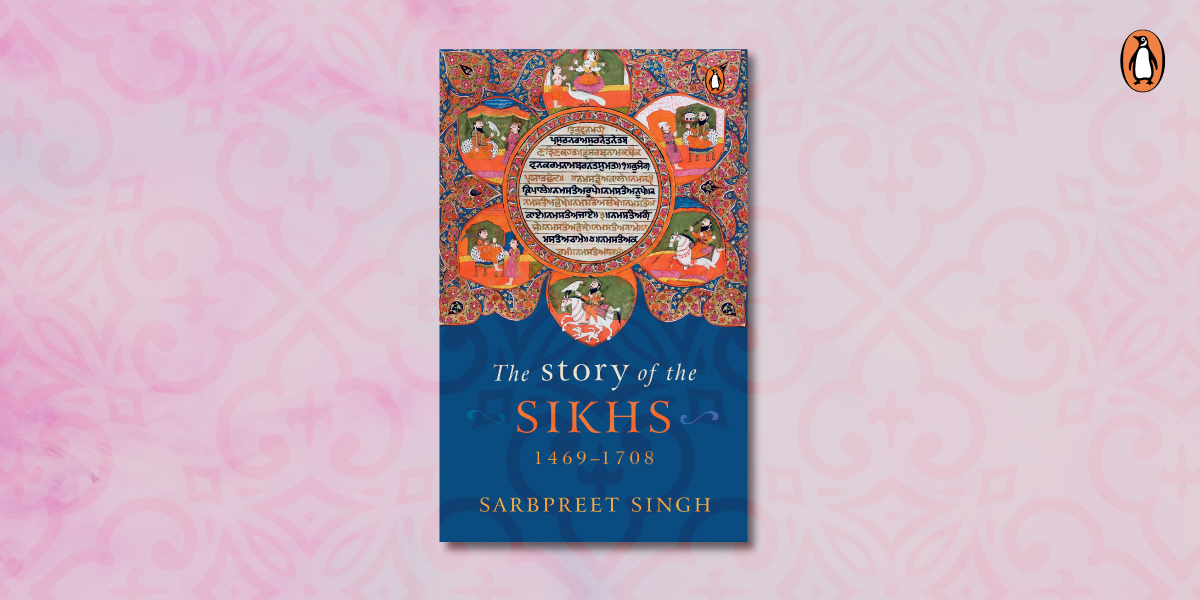
The Story of the Sikhs
The Story of The Sikhs || Sarbpreet Singh
In The Story of the Sikhs, author Sarbpreet Singh helps us reimagine the lives of the Sikh Gurus through a rich narrative that that intricately weaves in selections from the Guru Granth Sahib, the Dasam Granth and epic Braj poetry.
Starting from the birth of the first guru, Guru Nanak, the book charts the lives of the ten Gurus. Through carefully curated stories, the book does not just show the egalitarian ideals and compassionate worldview that have come to define the faith, but also sheds light on the historical context that defined the foundational principles which guided Sikhs during the era of each Guru.
Sarbpreet has deliberately approached this retelling as a storyteller rather than as a student of history in an attempt to make the work accessible and engaging. Immersive and expansive, The Story of the Sikhs is a tour de force that weaves a multi-dimensional tapestry of narrative and poetry.
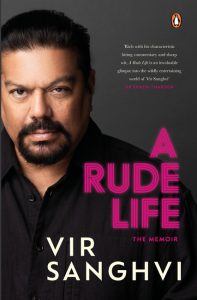
A Rude Life
A Rude Life || Vir Sanghvi
Vir Sanghvi, in A Rude Life, turns his dispassionate observer’s gaze on himself, and in taut prose tells us about all that he’s experienced, and nothing more for he’s still a private man. He unhurriedly recounts memories from his childhood and college years, moving on to give us an understanding of how he wrote his biggest stories, while giving us an insider’s view into the politics and glamour of that time.
This is an explosively entertaining memoir that details one of the most eventful careers in Indian journalism. Studded with a cast of unforgettable characters like Morarji Desai, Giani Zail Singh, Amitabh Bachchan, Dhirubhai Ambani and a host of other prominent political and cultural figures, A Rude Life is a delicious read.
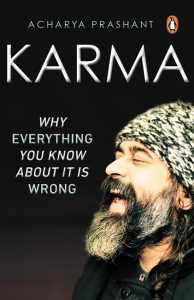
Karma
Karma || Acharya Prashant
The meaning of ‘Karma’ stands distorted by centuries of misplaced fictionalization. Karma remains a disquieting enigma to the few who refuse to accept compromised notions. This book is for them.
If to live rightly is to act rightly, what then is right action? This has tormented us since ages. The scriptures answer this, but without stooping from their cryptic heights. Nor do they advise how their ancient words apply to the present. Acharya Prashant’s work provides the missing link. He imparts clarity, leaving nothing to conjecture or belief.
Acharya Prashant demolishes ubiquitous beliefs and outdated notions to reveal some simple truths. When we ask, ‘What to do?’, the book handholds us into ‘Who is the doer? What does he want from the deed?’ This shift provides the solutions, and finally the dissolution of the question.
By My Own Rules
By My Own Rules || Ma Anand Sheela
Irrepressible, honest, bold and charming, very few can claim to have lived life on their own terms as Ma Anand Sheela has. Yet controversy continues to follow her. Whether it is her portrayal in Wild Wild Country or the Osho International Foundation’s take on the Netflix series, a wide spectrum of opinions has cloaked for too long the real Sheela Birnstiel. In the 1980s, she was the personal secretary of Bhagwan Shree Rajneesh and managed the Rajneesh commune in Wasco County, Oregon, USA. She was eventually sentenced to prison, served her time and walked out in three years.
Today, she runs homes for the disabled and the elderly in Switzerland. Almost three decades later, she is still in love with Bhagwan and his teachings. From rebuilding her life from scratch in Switzerland to an interview with Karan Johar on her grand return to India, she is adored and vilified by the world at the same time. In her memoirs, By My Own Rules, Ma Anand Sheela bares all-her life, her lessons, her beliefs, her inspiration and what makes her live life on her own terms.
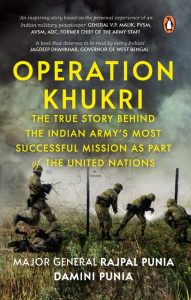
Operation Khukri
Operation Khukri || Major General Rajpal Punia, Damini Punia
This is the true story behind the Indian Army’s Most Successful Mission as part of the United Nations. The year was 2000. Sierra Leone, in West Africa, had been ravaged by years of civil strife. With the intervention of the United Nations, two companies of the Indian Army were deployed in Kailahun as part of a United Nations peacekeeping mission.
Soon, the peaceful mission turned into a war-like standoff between Major Punia’s company and the Revolutionary United Front (RUF) rebels in Kailahun, with the Indian peacekeepers cordoned off for seventy-five days without supplies. The only way home was by laying down their weapons.
Operation Khukri was one of Indian Army’s most successful international missions, and this book is a first-hand account by Major Rajpal Punia, who, after three months of impasse and failed diplomacy, orchestrated the operation, surviving the ambush of the RUF in a prolonged jungle warfare twice, and returning with all 233 soldiers standing tall.
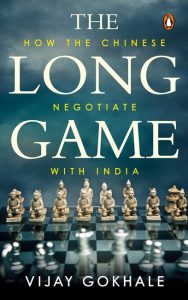
The Long Game
The Long Game || Vijay Gokhale
India’s relations with the People’s Republic of China have captured the popular imagination ever since the 1950s but have rarely merited a detailed understanding of the issues. Individual episodes tend to arouse lively debate, which often dissipates without a deeper exploration of the factors that shaped the outcomes. This book explores the dynamics of negotiation between the two countries, from the early years after Independence until the current times, through the prism of six historical and recent events in the India-China relationship. The purpose is to identify the strategy, tactics and tools that China employs in its diplomatic negotiations with India, and the learnings for India from its past dealings with China that may prove helpful in future negotiations with the country.
A Begum and A Rani
A Begum and A Rani || Rudrangshu Mukherjee
Exploring the lives of two remarkable women who chose to enter a field of activity which, in the middle of the nineteenth century, was seen a male domain, this book brings to light how unusual circumstances catapulted Begum Hazrat Mahal of Awadh and Rani Lakshmibai of Jhansi into the rebellion of 1857. Both of them sacrificed their lives trying to overthrow the British rule, which they considered to be alien and oppressive. Their resistance and their deaths are heroic and poignant.
The book captures the different trajectories of their lives and their struggles. In different but adjacent geographies these two women, both married into royal houses, decided to uphold traditions of ruling and culture that their husbands had established. These traditions had been subverted by the policies of Lord Dalhousie who had annexed both Awadh and Jhansi. While noting these similarities, it should be highlighted that Awadh was a large and sprawling kingdom with a long history whereas Jhansi was a small principality.
The rani and the begum never met, even though they were embroiled in the same struggle. It is the rebellion of 1857-58 that provides the context, which makes these two outstanding women feature in the same narrative. This book tells the story of two women in a rebellion.
The afterlives of the begum and the rani took on very different hues. The rani was made a nationalist icon: a woman on horseback with a raised sword, who died in battle. The begum was a relatively forgotten figure who did not get her due place in the roll call of honour. Revisiting the revolt of 1857 from a unique perspective and looking at their afterlives, the myths, this book attempts to set the record straight.
Looking at the revolt of 1857 from a different perspective, A Begum & A Rani is an act of retrieval.
Khwabnama
Khwabnama || Akhtaruzzaman Elias
Bengal in the 1940s. Having overcome the famine and the revolt of the sharecroppers, Bengal’s peasants are uniting. Work is scarce and wages are low. There is barely any food to be had. The proposal for the formation of Pakistan, the elections of 1946, and communal riots are rewriting the contours of history furiously. Amidst all this, in an unnamed village, a familiar corporeal spirit plunges into knee-deep mud. This is Tamiz’s father, the man in possession of Khwabnama.
At first glance, Khwabnama is the tale of a harmless young farmhand who becomes a sharecropper and dreams of a future that has everything to do with the land that he cultivates and the soil that he tills. The fabric of his dreams, though, have as much to do with the history of
the land as its future, and as much to do with memories as with hope.
In this magnum opus, which documents the Tebhaga movement, wherein peasants demanded two-thirds of the harvest they produced on the land owned by zamindars, Akhtaruzzaman Elias has created an extraordinary tale of magical realism, blending memory with reality, legend with history and the struggle of marginalized people with the stories of their ancestors.
A Passage North
A Passage North || Anuk Arudpragasam
A Passage North begins with a message from out of the blue: a telephone call informing Krishan that his grandmother’s caretaker, Rani, has died under unexpected circumstances-found at the bottom of a well in her village in the north, her neck broken by the fall. The news arrives on the heels of an email from Anjum, an impassioned yet aloof activist Krishnan fell in love with years before while living in Delhi, stirring old memories and desires from a world he left behind.
As Krishan makes the long journey by train from Colombo into the war-torn Northern Province for Rani’s funeral, so begins an astonishing passage into the innermost reaches of a country. At once a powerful meditation on absence and longing, as well as an unsparing account of the legacy of Sri Lanka’s thirty-year civil war, this procession to a pyre ‘at the end of the earth’ lays bare the imprints of an island’s past and the unattainable distances between who we are and what we seek.
Written with precision and grace, Anuk Arudpragasam’s masterful novel is an attempt to come to terms with life in the wake of devastation, and a poignant memorial for those lost and those still alive.
The Incomparable Festival
The Incomparable Festival || Mir Yar Ali “Jan Sahib”
The Incomparable Festival (Musaddas Tahniyat-e-Jashn-e-Benazir) by Mir Yar Ali (whose pen name was Jan Sahib) is a little known but sumptuous masterpiece of Indo-Islamic literary culture, presented here for the first time in English translation. The long poem, written in rhyming sestet stanzas, is about the royal festival popularly called jashn-e-benazir(the incomparable festival), inaugurated in 1866 by the Nawab Kalb-e-Ali Khan (r. 1865-87) with the aim of promoting art, culture and trade in his kingdom at Rampur in northern India. The task of commemorating the sights and wonders of the festival was given to the hugely popular writer of rekhti verse, the tart and playful sub-genre of the ghazal, reflecting popular women’s speech, of which Jan Sahib is one of the last practitioners.
Structured as an ode to the nawab, the poem is a world-album depicting various classes on the cusp of social upheaval. They include the elite, distinguished artists and commoners, brought together at the festivities, blurring the distinction between poetry, history and biography, and between poetic convention and social description. The book is a veritable archive of the legendary khayal singers, percussionists, and instrumentalists, courtesans, boy-dancers, poets, storytellers (dastango) and reciters of elegies (marsiyago). But, above all, the poem gives voice to the ‘lowest’ denizens of the marketplace by bringing to light their culinary tastes, artisanal products, religious rituals and beliefs, and savoury idioms, thereby focusing on identities of caste and gender in early modern society.
This Penguin Classics edition will be of interest not just to the Urdu and Hindi literary historian, but to specialists and readers interested in the histories of music, dance, and the performative arts, as well as scholars of gender and sexuality in South Asia. Lovers of Urdu poetry will find in it a forgotten masterpiece.
Savarkar
Savarkar || Vikram Sampath
Decades after his death, Vinayak Damodar Savarkar continues to uniquely influence India’s political scenario. An optimistic advocate of Hindu-Muslim unity in his treatise on the 1857 War of Independence, what was it that transformed him into a proponent of ‘Hindutva’? A former president of the All-India Hindu Mahasabha, Savarkar was a severe critic of the Congress’s appeasement politics. After Gandhi’s murder, Savarkar was charged as a co-conspirator in the assassination. While he was acquitted by the court, Savarkar is still alleged to have played a role in Gandhi’s assassination, a topic that is often discussed and debated.
In this concluding volume of the Savarkar series, exploring a vast range of original archival documents from across India and outside it, in English and several Indian languages, historian Vikram Sampath brings to light the life and works of Vinayak Damodar Savarkar, one of the most contentious political thinkers and leaders of the twentieth century.
Strictly at Work
Strictly At Work || Sudha Nair
Simi works in marketing at a furniture company. Ranvir is an analyst at a finance startup.While their desks happen to be on the same floor at Bizworks, a swanky co-working space in Bangalore, their paths aren’t meant to cross. But as circumstances bring them together again and again, they find it harder to deny the spark between them.
In a live-in relationship with his girlfriend, Ranvir doesn’t expect to have feelings for someone else. And while Simi’s family pushes for the perfect arranged match for her, she knows she doesn’t love the man her parents want her to marry.
When their personal lives clash with their attraction at work, Simi and Ranvir must decide if they want to remain just co-workers or mean more to each other.
Harsh Realities
Harsh Realities || Harsh Mariwala, Ram Charan
Breaking away from the shackles of family-run Bombay Oils Industries Ltd, Harsh Mariwala founded Marico in 1987. Today, the homegrown Marico is a leading international FMCG giant which recorded an annual turnover of over Rs 8000 crore last year. Their products, like Parachute, Nihar Naturals, Saffola, Set Wet, Livon and Mediker, are market leaders in their categories. This is the story of grit, gumption and growth, and of the core values of trust, transparency and innovation which have brought the company to its current stature. Co-authored by leading management thinker and guru Ram Charan, Harsh Realities is a much-awaited business book by an innovative and clear-headed leader who built a highly professional, competitive business from the ground up.
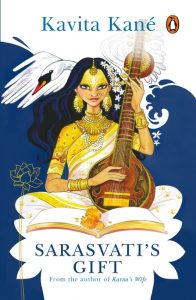
Sarasvati’s Gift
Sarasvati’s Gift || Kavita Kane
Sarasvati, the feminine force worshipped as the goddess of learning, is a household name, yet we barely know much about the goddess. She is known as a lost river and seen as a singular goddess, never as part of a couple, such as Shiva-Parvati or Lakshmi-Narayan. In Sarasvati’s Gift, Kavita Kane brings to light Sarasvati’s story-the goddess of art, music and knowledge-told in the voices of nameless celestials, powerful gods and lesser mortals. The book explores her relationship with her Creator, Brahma, and their unusual marriage-a union of fiercely independent minds and the most non-conforming, unconventional of the Triumvirate couples. As these peripheral figures and silent catalysts take centre stage, we get a glimpse of an extraordinary woman and her remarkable story, obscured and buried under myths and legends.
Brand Activism
Brand Activism || Philip Kotler, Christian Sarkar
What happens when businesses and their customers don’t share the same values? Or, for that matter, when employees of a company don’t share the same values as their executives? Welcome to the world of Brand Activism.
Companies no longer have a choice. Brand Activism consists of business efforts to promote, impede, or direct social, political, economic, and/or environmental reform or stasis with the desire to promote or impede improvements in society. It is driven by a fundamental concern for the biggest and most urgent problems facing society.
Brand Activism: From Purpose to Action is about how progressive businesses are taking stands to create a better world.
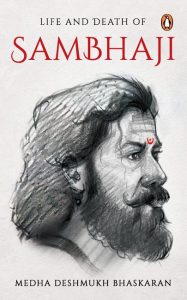
Life and Death of Sambhaji
Life and Death of Sambhaji || Medha Deshmukh Bhaskaran
It begins to dawn on the nine-year-old Sambhaji that his father has fled from the clutches of the Mughal badshah Aurangzeb and left him behind. He must now find his way back home with the help of strangers . . .
Under the shadow of an illustrious father, Sambhaji finds himself thrust into the Maratha-Mughal conflict from a tender age. His mistakes cost him dearly and when his father suddenly dies and he becomes the chhatrapati, it is as if he has inherited a crown of thorns.
In the nine years that follow, he faces a constant battle-internally, as palace intrigues simmer to kill him, and externally, as Aurangzeb descends on the Deccan with full military force.
Even Chhatrapati Shivaji had never faced a full-blown Mughal aggression.
Will he be able to protect the Maratha nation and Swaraj that was his father’s dream? Will he prove to be a worthy son to his father-in life as well as in death?
History has been unfair to Sambhaji, but it can’t deny that he inspired a generation of Maratha warriors, who eventually ensured the end of Aurangzeb’s jihad.
Asoca
Asoca || Irwin Allan Sealy
Asoca-often spelled Ashoka-was hailed as Ashoka the Great, the emperor who ruled most of the Indian Subcontinent and was pivotal in the spread of Buddhism from India to other parts of Asia in the third century BC.
But his life as emperor was not always led by non-violence. History has it that he masterminded one of the biggest and deadliest wars ever fought, and it was the insurmountable grief he experienced at the sight of the people dying and dead on the battleground that made him turn to Buddhism and take a vow of ahimsa.
Who was the man, and who was the king? What were his demons, and what gave him strength? This historical novel, drawn from research and portrayed with energy and complexity, transports the reader to the era of the Mauryan dynasty with atmospheric vividness and insight. Epic in scope and Shakespearean in drama, Asoca: A Sutra leaves the reader breathless with the full-bodied richness of Sealy’s prose, his trademark whimsy and his imaginative modern reconstruction of that enigmatic and brilliant ruler of the Indian subcontinent.
Brands, in what they show, tell, feel, smell and taste like, say a lot. Our five senses play a significant role in the recognition of a brand and how it is received by the audience. Sandeep Dayal tells how brain sciences can help brand ambassadors and brand theatres of operations engage the human senses. It would be right to say that all the cognitive brand marketers must note the finer nuances for branding that this book offers.
Let us read this extract from his book to understand that when designing and executing brand experiences, it is important to think of a plan for each sense, or at least consider its impact on them.
*
Right Between the Ears || Sandeep Dayal
Most real-world brands have a ‘theatre of operations’ and ‘ambassadors’. They go to market through retail stores and/or a salesforce.
Sergio Zyman was the chief marketing officer of the Coca-Cola Company when they sponsored the Summer Olympics in Atlanta in 1996. Years later, I was Sergio’s chief marketing officer in his consulting company. Sergio told me that at the time when he ran the sponsorship for the Olympics, he had his teams build a thick binder called the ‘Red Book’, which was a detailed playbook for everything that Coke would do at the games. How and where Coke would be seen, who would do and say what and when, what it all meant and how it fit together in a single brand mosaic.
The Olympics would be Coke’s theatre of operation. Anyone with the red Coke shirt would be a brand ambassador, and every moment would be choreographed according to the Red Book.
When consumers step into a brand’s theatre of operations or interact with its brand ambassadors, there is an opportunity to build immersive experiences for them by engaging their five senses. The strongest brand experiences, as we learnt before, are those that are associated with other prior experiences. They are recalled more easily and better than others, last longer and feel more important to the brain. When marketers weave their brands with the human senses, they create even more associations with the experience, making it easier to recall. That’s why immersive sensory brand experiences make deep impressions on our brains.
If you walk down the Magnificent Mile in Chicago, even if you have never done that before, you can recognize the Burberry store with its trademark black-and-brown tartan cross hatches from blocks away with no help at all. The store design itself makes a statement about the brand. As you step inside, you can smell it.
During spring and summer, Zaluti scent machines diffuse the spring crocus scent and during autumn and winter, a special autumn scent. You look around and see that the wall colors are neutral with darker accents and furniture. That is deliberately orchestrated to bring to mind Burberry’s classic trench coat or tartan.
The personal shopper who greets you leaves an impression with how they look and sound, and how they gently direct you to where you want to go in the store. Every one of those sensations embody the Burberry brand.
The brand theatre of operations does not end with the store. Burberry also live-streams its runway shows, to share the excitement of decloaking new fashions as they happen with its fans worldwide, and lets them buy select new products online with its ‘see now, buy now strategy’.
Even brands like Away, Glossier, Farmer’s Dog, Made In Cookware, Lively Intimates and Everlane, which started out as pure online brands, have opened exciting stores on Lafayette Street in New York. They realized that bringing people to a brick-and-mortar store was the best way to create immersive experiences for customers—and that is what many consumers want. Virtual companies like Facebook and Google have opportunities to expand their brand theatre of operations into the real world with events and sponsorships.
**
Read Sandeep Dayal’s Right Between the Ears to get insights into the fascinating world of branding and hold on to the anchors in the age of hyper-competition by understanding why people make the choices they do and how to keep a brand relevant.
In her timely masterpiece Unmasked, Paro Anand writes of despair, courage and hope. Through eighteen short stories, she introduces us to characters who feel familiar and their stories intimate.
Here’s a glimpse into the author’s mind as she delves into the subject that inspired the book.
~
Unmasked||Paro Anand
Remember the song from the TV series – Orange is the New Black? Could well reflect our lives right now. Trapped, trapped, trapped…
For me, as for many, the pandemic has been a test, a trial and in some cases, a triumph.
So how did it change me as a writer? For one, I realised that I probably can never be a writer who hides away for long periods to write in glorious isolation. No. I need the excitement of beating hearts around me. I need the furious curiosity of young minds shooting questions and testing me to the limit. I need the fear I feel that teenagers will reject me and my work and words outright. I need to hear the twang and slang of young people to get their voices and language spot on. Otherwise, I am just an old-ish aunty pretending to be groovy. (see, there’s one word that is a dead giveaway.) I realised that social distancing just isn’t my thing.
So pandemic time around, where do I go, as a writer? Where do I find the life force to draw my words from?
And of course, there is only one answer. Virtually. It meant thinking, not out of the box – but differently inside the box, or the four walls of your room. To write about the outside people while being kept away from them.
For a while, I was totally trapped into inaction. And I am a writer who writes compulsively. Every day. yes, every single day. But with the world closing in on itself – and a sudden load of housework – I found myself distanced from my work. If I don’t write, the creativity tap shuts off, the muscle atrophies. Pulling myself out of ditches of real despair wasn’t easy, but it was greatly helped by the excitement mounting in my personal life. I had grandchildren coming. Three of them! The anticipation spurred me on to writing two picture books – Babies in my Heart (Dil Mein Bacha Hai ji – in Hindi) and RooRoo.
Both books are published by Ektara who had also given me a fellowship just prior to the pandemic. While having the fellowship was great – I mean, to be paid to sit home and write is every writer’s dream, but it also meant that there was tremendous pressure.
While the distractions of Nani and Dadi hood were wonderful, I was being eaten up by the need to write. Especially to write the kind of brutally honest young adult reality fiction that I am better known for and love. I need to write this genre like I need to breathe. The world was choking because of the pandemic and so was I.
There was a brutal reality taking place right outside and I wasn’t being able to come to grips with it in my writing. I realised it was because of two things that I was stuck. Firstly, I need to let a feeling, a thought ‘cook’ for a while before I can jump in. the second is the I always have a need to empower my young reader to do better, be better. Not in a moralizing way, but simply because, through my interactions, I have come to sincerely believe that if anyone can make a difference, it is young people.
But in this locked down world, how were children or anyone going to do any better when we were all trying to save our own arses?
My own children, soon to be parents, meanwhile, just pressed on. My daughter becoming very involved in relief programs for the Dharavi slums and that is what unlocked and unmasked my creative flow. The image of the high-rise, high-end flats of Mumbai with the world of shanties and chawls at their feet. Yet each was bound by a common enemy and it was coming to get us all. No one, no matter how rich or powerful was being left untouched. The help was flowing both ways, no matter who you were. There was a one-ness to the world even though we were socially distanced as never before.
It was when my three grandsons were actually safely home that I had this ah ha moment that – simply – life goes on.
I started to write stories on the pandemic – nineteen of them to signify COVID’S 19. Because of my staunch belief in young people, I placed a young girl’s poem as chapter 1. It is called “What would you do?” and it asks, no, demands positive action. The poem came from a young girl who was part of a virtual writer’s workshop I was conducting.
The stories all reflect the connectedness of us all.
The funny thing was, I was working on the manuscript during the first wave. As my agent tied up with Penguin RandomHouse and work began in earnest, the editor on the book disagreed with the title. She and the marketing team felt that, because the book was still some months away, the pandemic would be a bad memory that no one would want to remember. So we had to elude to it, but not have the dreaded word in the title. She, in fact, came up with the lovely title, Unmasked, hoping that’s how we would all be. But…well, we know that is one big BUT. With at least 3 waves.
I had my 19 stories of horror and hope and going in my mind. The way different people were responding and coping and stepping up, or going into hiding. Priya Kuriyan, the illustrator too, didn’t merely illustrate the stories, she depicted her own visions of the times. The cover, I just love for the way it ties the two worlds of the stories together. The sheer variety of experience made the subject of each story easy. And that’s when it struck me….well there is a surprise ending to the book that will make each copy of it unique and different.
Because everything in this moment in history is different pandemic time around. And though it is something we may never want to remember, this is a time that we will never be able to forget.