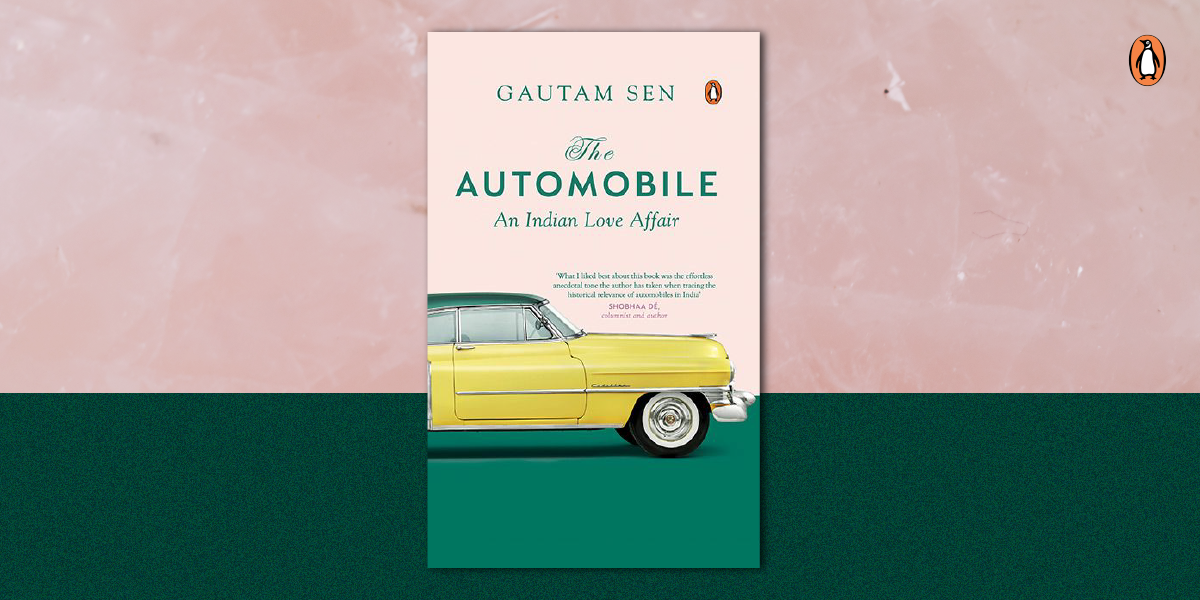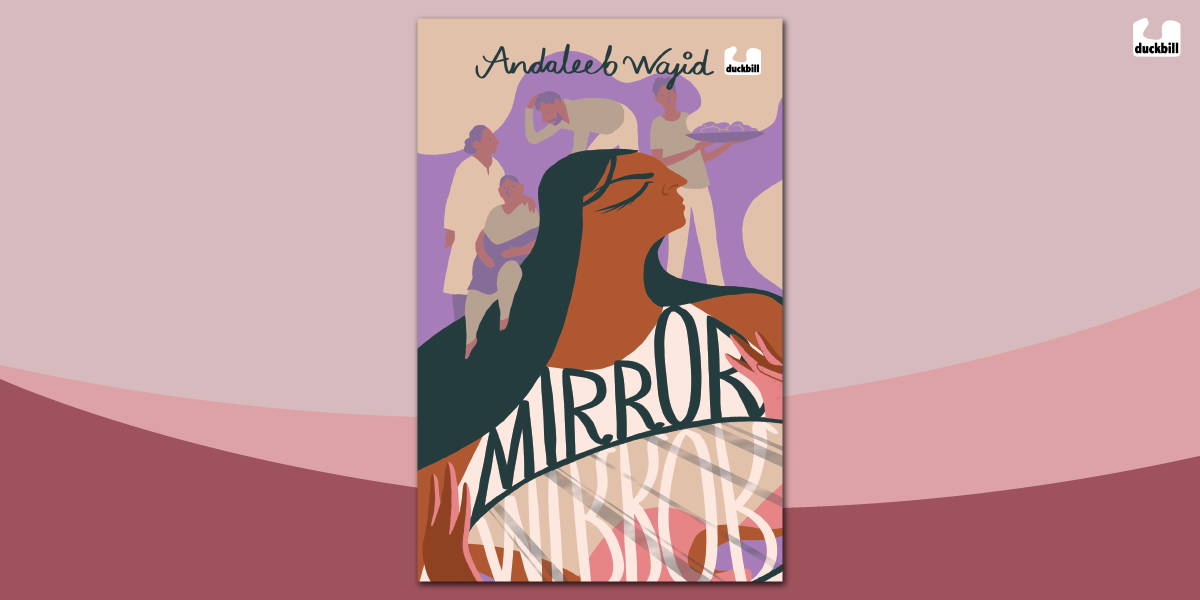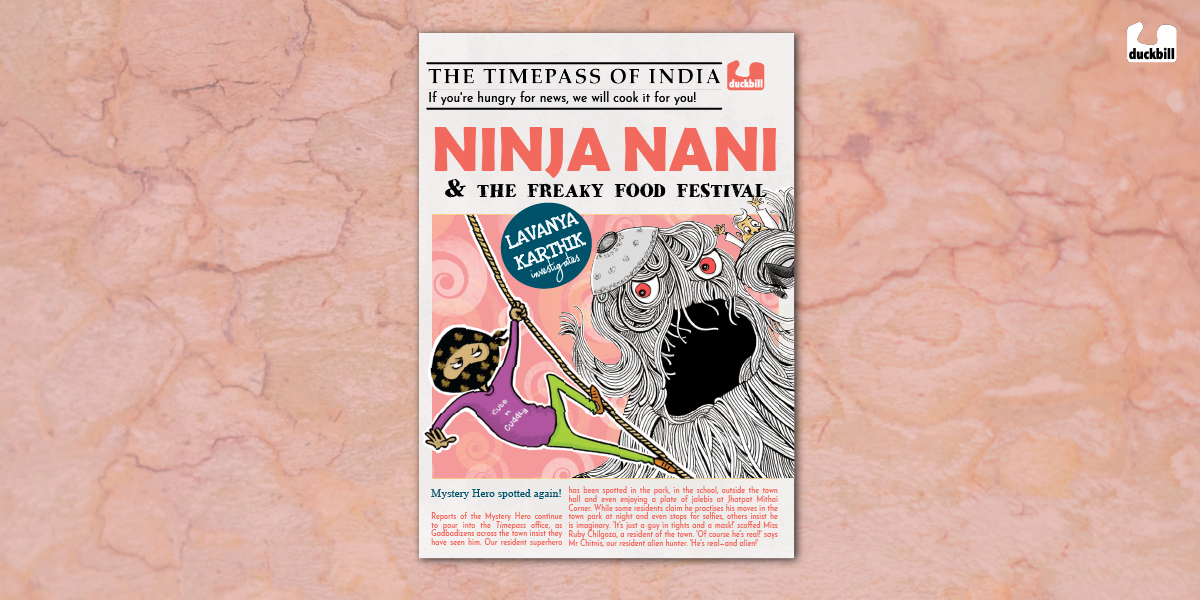
So the stage is set, the curtain about to rise. Tomorrow, Sarasavi Bookshop at One Galle Face will be launching my first book in 5 years. I don’t know really know why, but there’s something of a feeding frenzy going on. Old aunties in kaftans and dangling earrings are jostling for pole position, rising from their covid-stricken beds, throwing caution and turmeric to the winds. I have explained to everyone that there’s a pandemic on, and please, they mustn’t feel the need to humour me by turning up.
‘How could we not?’ they say in incredulous tones. ‘We simply HAVE to be there for you!’
And who am I to spurn such loyalty? Though it’s something of a toss-up whether they’re there for me, or because they’re fed up having sat at home socially isolated all year. Or perhaps they’re coming for the bubbly that’s going to be served, in plastic cups. (Never spoil an Auntie, has always been my motto.)
In the middle of all this chaos, Colombo Fashion Week rings up.
‘Is it true you’re launching your book on the last night of fashion week?’ they ask sternly. Obviously I have committed some grave social faux pas, though I do not know quite what. (In the normal way of things, Ashok Ferrey knows as much about fashion as Mother Theresa does about disco dancing.)
‘Yes,’ I reply tremulously. ‘But it’s an early show, 4.30 – 6 pm.’
‘So that’s OK then,’ they reply. ‘Because we’ll be requiring you on stage to recite the opening poem. At 7.30 sharp.’
‘But I’ll be tired,’ I bleat.
The Unmarriageable Man || Ashok Ferrey
‘You? Tired?’ They curl their upper lip. (Colombo Fashion Week does a very good curled upper lip.)
‘Don’t be late. Wardrobe will be in touch to let you know which designer you’re wearing.’
It seems that I have to recite the alternate lines of a song, with the amazing Julius Mitchell singing, and on keyboards.
I think to myself: It’s a good thing Ashok Ferrey isn’t going to be the one singing. Otherwise it really will be the last night of Colombo Fashion Week. Forever.
Management consulting is seen as a glamorous profession. But behind the mystique are the consultants who put in extraordinary effort, cultivate great problem-solving skills and display fine personal attributes to capture the attention and respect of their clients.
The Mind of a Consultant opens up that world to the readers through the story of Samantha Thomas, a character modelled on many excellent consultants, who gives us a glimpse of what goes on inside the mind of a consultant.
Here is an excerpt from when Samanta is an intern and learns the three critical rules of working as a consultant.
‘Is the presentation ready?’ Hamid was unapologetic in his question.
It was 2 a.m. Samanta had been working for more than eighteen hours straight on the presentation for the client leadership team that was to be presented the next day. She was expected to be part of the presenting team alongside Hamid, the project manager and partner who owned the account. Hamid was six years her senior and from the same institute she was attending. He was highly respected by his colleagues and the project team members looked to him for guidance.
She thought back over the past few weeks, remembering the first day she had arrived at Pinnacle for her internship. It was like a dream come true. Her first official day as an intern at Pinnacle. She, along with thirty-five fellow interns from some of the best management institutes in the world, had been participating in the internship orientation. Two of the senior partners and a few engagement managers who could make it were part of the two-day programme.
While partners spoke about the culture and the attributes of great consultants, the engagement managers were more operational. They spoke about the tools and the support that were available to interns. They shared Pinnacle’s knowledge base, along with templates for ppts and Excel sheets, which were life-savers for the interns when they started out.
At the end of the second day, the interns were provided with laptops and their project assignments. Samanta was assigned to a large organization-transformation project in the retail industry. The organization was exploring strategies to enhance growth and increase efficiency amid changing industry dynamics. Her project manager for the assignment was Hamid. At the time, Hamid was participating in more than half a dozen similar assignments worldwide. He was always up to date on the latest happenings in the industry and often considered an expert in the field.
The first time Samanta and Raghav, a fellow intern, met Hamid to work on the project, he came across as passionate and knowledgeable. It was obvious that he was an accomplished consultant.
‘I want you guys to challenge me,’ he told them. ‘it’s important that you get a head start and not waste time doing things that don’t matter to this project.’
He gave them presentations and materials to read, a brief on the client requirements and the names of some resources in the firm that he thought could be helpful.
‘Get ready to fly out tomorrow to meet the client,’ he said. ‘We’re having meetings with some of the key management team members before doing a few store visits to understand their set-up. You need to be up to speed on everything that we know about the client by then.’
One thing Samanta learnt from Day One was that consulting constantly needed one to learn and travel. That was the best part about being at Pinnacle. It treated its team members as star talent, and believed that its people could figure out a way to deliver on even the toughest assignments.
Samanta and Raghav spent their time leading up to their trip reading more on the retail industry in general and the company in particular. Pinnacle had some wonderful case studies and industry knowledge available that they found helpful. There were different terminology and business metrics that Samanta and Raghav had never encountered before, but Hamid encouraged them to learn all of it, and learn it well.
‘You don’t want to be seen as novices. You should be able to ask and understand questions in areas that are relevant even to the CEO.’
The following day, Samanta, Raghav and Hamid started on their trip to see the client. Samanta had been told that she was lucky to be doing her first project with Hamid, so she took advantage of the uninterrupted cab drive to ask him questions. there was one in particular she couldn’t help asking.
‘How did you earn so much respect from your peers?’
Hamid raised his eyebrow at her, a smile on his face. Samanta shifted uncomfortably in her seat. She was probably the first intern to ever ask him that.
Hamid gave a short laugh at her discomfort before answering. ‘How do you think, Sammy? And you too, Raghav.’ Samanta thought for a moment. There were several possible reasons, or, more likely, a combination of several of them.
Raghav chimed in first. ‘Maybe hard work? or domain knowledge?’
Samanta nodded. She had been thinking along the same lines. She added her own thoughts. ‘I would think project-management expertise would have something to do with it. Is that part of the reason?’
Hamid nodded and smiled. ‘All of those are correct, but there are three main rules I live by in this firm.’ he held up his fingers as he counted them off.
‘Rule 1: strive for knowledge.
‘Rule 2: build your best coalition.
‘Rule 3: Always be ahead of the client.
‘Each of these is critical when working as a consultant.’
—
The Mind of a Consultant hands you all the tools necessary to build a successful professional career in an easy-to-understand manner.
What happens when two distinct regal cultures come together in the hands of a lady who is both a wonderful conversationalist and a wonderful cook?
The Rana name has been synonymous with the history and culture of Nepal for centuries. The beautiful palaces of Nepal were known not only for their glamour and architecture but also for their royal feasts. The recipes of the food served were closely guarded by the cooks of the palaces and a lucky few who inherited them from earlier generations. Rohini Rana has collected and documented the recipes precious to each Rana prime minister’s family.
Showcasing magnificent food from the palaces, this luxurious and beautifully illustrated cookbook attempts to preserve these recipes for future generations, and posterity, while also giving quaint snippets of the history and unique cultural practices that shaped the creation and ingestion of this delightful cuisine. Read on for some of these very interesting gastronomic glimpses.
1-Fascinating and often contradictory customs existed side side by side especially when it came to non-vegetarian food
Certain meats were totally taboo and never crossed the thresholds of the bhanchas (kitchens) of the Bajais’ dominated realms. Pork was considered unhealthy and not partaken of inside the palace kitchens or dining hall. However, the wild boar held a prestigious position in all joyous occasions.
The interesting overlap of military and culinary history is evinced in the unlikely influence of Awadhi cuisine brought about by Nepalese help granted to the British during the 1857 War of Independence.
The local cuisine was influenced to a certain extent by the khansamas (cooks) brought in from Mughal India after the loot of Lucknow during Jung Bahadur’s time. Since then the Khansamas and the Nepalese Bajaes and ‘Bajais’ (Bhramin men and women worked in tandem, though in separate kitchens, perfecting a style of fusion cuisine that has become famous being unique in its Rana flavor.
An oft-overlooked description from the Ramayana became the basis for the tradition of a truly grand feast of 84 dishes which is the mainstay of most Rana ceremonies even today
The main ceremony, which totally involves and rotates around food is the Chaurasi Byanjan. This ceremony is still a must during Pasni (rice feeding of a child), Bartamand (sacred thread Ritual) and Biyah (wedding). This tradition goes back to the epical story of the Ramayan and the wedding celebration of Sita’s marriage to Ram where King Janak is supposed to have served 84 Chaurasi (varieties of food) at the banquet.
This strange (but strangely reasonable) taboo on what is probably one of the most commonly eaten poultry.
The only bird that did not reach their ornate platters was the common chicken, because it pecked at dirt and droppings so was not considered hygienic. With the waning of shikar trips and shikaris the chicken finally found its way to the cooking pot, although in a separate kitchen.
Breakfast may be the most important meal of the day around the world, but the Ranas certainly bucked tradition in this regard.
Coming to the meal patterns of the Rana households, breakfast was not common if taken at all. Lunch was the main meal usually had at 10 am in the traditional ‘junar ko bhancha’ or room adjoining the kitchen.
Despite the Ranas’ progressive social reforms in many ways, caste rigidity dominated the culinary department.
The Ranas were extremely orthodox in their eating habits and never partook of rice cooked by any other than a Brahmin or someone of the same caste as themselves. There are many interesting stories of Jung Bahadur creating quite a few faux pas at Queen Victoria’s dining table because of his fastidiousness.}
Rice seemed to have a very special role even amidst the plethora of Rana dishes considering it had to be eaten in a specified room!
Dinner was usually at 6 or 7 pm served in the rooms upstairs with a variety of rotis, cheura meat and vegetables. If rice was being served, it had to be partaken of in the junar ko bhancha again
It all started with a big cosmic blast. Or did it? Refresh your facts with this excerpt from Shruthi Rao’s How We Know What We Know and immerse yourself in a world of fun facts about the world, its origins and all the awe-inspiring details of how everything works.
~
What is the Big Bang? The sound you hear when you burst a big balloon?
Umm, no. The Big Bang Theory is an attempt to explain what happened at the beginning of our universe.
Wait. Our universe had a beginning? Didn’t it always exist?
That’s what scientists thought too, till a few decades ago. But research and studies suggest that there was indeed a beginning. A point. Before that point, there was nothing. And after that point, the universe came into existence.
Scientists think that the universe came out of a singularity—an infinitely small, infinitely dense, infinitely hot point. What exactly is this, though? If the universe was born from this singularity, where did the singularity come from? Why did it appear?
We don’t know that. Yet.
But how do we know that this is what happened?
The story began about a 100 years ago, with Georges Lemaître of Belgium. Though he was an officer of the church, he was fascinated by physics and he studied Albert Einstein’s theories of space and time and gravitation. He concluded that if Einstein’s theories were right, it meant that the galaxies in the universe are moving away from each other. Lemaître said this proved that the universe is not just static and unmoving, as everybody previously thought. It was expanding.
How We Know What We Know||Shruthi Rao
It was a theory, and though Lemaître had come up with it on the basis of an established theory, scientists needed other proof before they could accept it. But Lemaître didn’t have any data to support this idea.
Meanwhile, American astronomer Henrietta Leavitt came up with a way to calculate how far away stars are from Earth. Using her work, astronomer Edwin Hubble looked through his telescope and calculated the distances of various stars from Earth. He concluded that things in the universe were moving away from Earth. Not just that, things that were farther away from Earth were moving away faster than things close to Earth. This could only mean one thing. The universe is indeed expanding. Georges Lemaître was right.
Okay. The universe is expanding. But how does that prove there was a Big Bang?
If the universe is expanding, it must have expanded from some point. Think of the expanding universe as a movie. The galaxies are moving outwards, away from each other. Now run that movie backwards. You can imagine it as the galaxies rushing towards each other. So then, all the galaxies must meet at some point. At this point, all the matter of the universe must have been contained in a very small space, that is, the singularity.
The moment at which this singularity started expanding is the Big Bang.
But where was the proof?
Decades later, in 1965, two scientists, Arno Allan Penzias and Robert Woodrow Wilson, were trying to measure radio signals in the empty space between galaxies. They used a giant horn-shaped antenna, called the Holmdel Horn Antenna, in their observatory at Bell Labs in New Jersey, USA. But as they tried to take measurements, an annoying noise kept interfering, like static on a radio.
Where was this noise coming from?
They pointed the antenna towards New York City. No, it wasn’t city noise.
They took measurements of the noise all through the year. No, it didn’t change with the seasons.
Could the noise be from a nuclear test that had taken place a while ago? It couldn’t be. If it was, the noise should have decreased year by year.
Then what was it?
Perhaps it was just the pigeons roosting in the antenna? They chased away the pigeons, and scooped up and cleaned the droppings. But the noise still remained.
Then they learnt about the scientist Robert Dicke, a professor at Princeton University. Dicke had been thinking about the Big Bang. His opinion was that if the Big Bang was true, there should be some kind of matter remaining from the explosion. And most probably, he said, this would be a kind of low-level background radiation throughout the universe.
Dicke wanted to try and find it. But it turned out that it was exactly what Penzias and Wilson had already found! The hum they had encountered was this very radiation resulting from the Big Bang!
Penzias and Wilson got the Nobel Prize for this discovery, because it proved that the Big Bang Theory was true.
Researchers all over the world are still taking better measurements of this noise, and are finding more things to think about.
~
Exciting trivia awaits you in How We Know What We Know.
Dr Mohan is one of the few practicing doctors in India who have contributed to research, education and charity in such a large measure. His book, Making Excellence a Habit documents the fundamentals of what makes a person achieve meaningful success. While hard work, passion and focus emerge as winning lessons, delicate and tender learnings from Dr Mohan’s life, such as empathy or spirituality, are not forgotten.
Here is an interview with the man himself on his proudest moments, people that inspire him, and his writing a book!
When you look back, what are some of your proudest moments?
Establishing the largest chain of diabetes centers in the world, and the sustained growth and development of the Madras Diabetes Research Foundation as well as our Education Academy and the charitable clinics that we run are some of the proudest and most fulfilling moments of my life.
When I started working with my father in 1971, there was not a single private hospital or centre dedicated to diabetes in the country. Today, diabetes has become a much sought-after specialty and everybody wants to practice diabetes. This, I think, is largely a reflection of the 50 years of our work which went into building up the specialty of diabetes. Perhaps, my greatest satisfaction is that, without any formal Government or University backing or support we have been able to contribute a large chunk of the diabetes research done in India and our work has helped to place India on the world map of diabetes research. Looking back, these are very satisfying indeed.
Who are some of the people that inspire you?
I have several people who have inspired me in different ways. Firstly, my spiritual Guru, Bhagawan Sri Sathya Sai Baba, for, it was He who demonstrated to the world that it is possible to offer world class health care for the poor, completely free of cost. My father Prof. M. Viswanathan was my mentor and it was he who brought me into this field of diabetology. My wife, Dr. Rema Mohan was a very strong-willed person, who battled cancer while contributing extensively to her field, diabetic retinopathy. In the medical field, Dr. Venkatswamy, the founder of Aravind Eye Hospital and Dr.S.S. Badrinath, the founder of Sankara Nethralaya inspired me a lot, as did Dr. Anji Reddy, Chairman of Dr. Reddy’s Laboratories and Dr.N.K.Ganguly, the Director General of the Indian Council of Medical Research.
Will you write a second book?
I would definitely like to write a second book if I can find the time to do it.
How did you manage to write a book alongside your busy schedule?
I would say that it was my passion to write and to inspire youngsters which kept me going. Although it did take some time, I am happy I was able to eventually complete it.
If you could give advice to an inspiring writer, what would it be?
My advice to aspiring writers would be to tell their stories with as much human interest as possible as people love to hear stories that are told well. There should also be a message for the readers, particularly for youngsters who should get inspired to achieve excellence in whatever they do. Whichever the type of book that the writer is attempting to write, he or she should spend enough time thinking about it and to see how it will be useful to society.
Making Excellence a Habit is a behind-the-scenes account of a person honoured internationally for delivering path-breaking care to hundreds of thousands of people with diabetes.
As days get longer and warmer, we find ourselves cooped up in our homes, avoiding the scorching heat and that deadly virus no one should name. But time indoors doesn’t have to feel like a chore necessarily, thanks to our age-old friends—books.
Here’s a list of refreshing reads to keep you engrossed and entertained through the long, sunny days of April.
**
Queen of Fire
Devika Rangachari
Queen of Fire || Devika Rangachari
Lakshmibai, the widowed queen of Jhansi, is determined to protect her son’s right to his father’s throne and safeguard the welfare of her kingdom. Faced with machinations to take over Jhansi, at a time when all of India is rising up against the British, she has to prove her valour and sagacity time and again. But will this be enough to save all that she values?
In this gripping novel, award-winning historical novelist Devika Rangachari brings to vivid life the interior life of this nineteenth-century queen, thrust into a position she does not desire but must assume, and of her son, who is cowed by the challenges he has to face but determined to live up to his mother’s courage.
Satyajit Ray in 100 Anecdotes
Arthy Muthanna Singh, Mamta Nainy
Satyajit Ray in 100 Anecdotes || Arthy Muthanna Singh, Mamta Nainy
Tracing his magnificent life with 100 little-known and inspiring incidents as well as unusual trivia, this collectible edition pays homage to the maestro on his 100th birth anniversary.
A master filmmaker, a remarkable auteur, a writer par excellence and an artist of immense reach and range, Satyajit Ray was an indefinable genius. This book is a classic tribute that celebrates his many accomplishments across literature, music, art and more.
Another Dozen Stories
Satyajit Ray
Another Dozen Stories || Satyajit Ray
Another Dozen Stories brings to you the magical, bizarre, spooky and sometimes astonishing worlds created by Satyajit Ray, featuring an extraordinary bunch of characters!
While ‘The McKenzie Fruit’ trails a humble man trying to leave his mark in history, ‘Worthless’ is a moving story about a seemingly hapless character not quite able to win the confidence of his family. Meet Professor Hijibijbij, the eccentric scientist bent on creating living replicas of peculiar creatures and follow Master Angshuman into a nail-biting and unexpected adventure on the sets of his very first film. This collection includes twelve hair-raising stories that will leave you asking for more!
Jamlo Walks
Samina Mishra
Jamlo Walks || Samina Mishra
It is day 7 of the lockdown and everyone says the skies are blue again. Jamlo walks. She looks straight at the road ahead. It is long.
The world has stood still. The streets lie empty and schools are closed. All work has dried up and people keep whispering the word ‘corona’ all the time. Jamlo walks down a long and hot road, alongside hundreds of other men and women and children whom Tara sees on TV. Jamlo walks as Rahul watches the streets turn quiet.
Jamlo walks and walks in a world that needs to be kind and just and equal. A world where all lives are seen as important.
Sita’s Chitwan
Vaishali Shroff
Sita’s Chitwan || Vaishali Shroff
As big as 1,78,000 football fields, Nepal’s first protected national park is home to over 550 species of birds; awe-inspiring animals, such as greater one-horned rhinoceroses, Bengal tigers, clouded leopards; and a confident, brave girl called Sita.
Sita dreams of being a nature guide like her baba. With a spring in her step and a group of eager tourists, she unravels the secrets of the forest. But when she wanders astray and comes face to face with a mamma rhino, will this eight-year-old be able to listen to the stillness of the jungle?
The Astoundingly True Adventures of Daydreamer Dev
Ken Spillman
The Astoundingly True Adventures of Daydreamer Dev || Ken Spillman
Forever daydreaming-that’s Dev. Sitting in class or watching the clouds from the roof of Kwality Carpets, he floats off to places all over the world and has wonderful, bizarre adventures.
Mild-mannered schoolboy Dev is no stranger to survival in extreme environments. Classroom trances and home-made flights of fancy take him all over the place-what other kid could have visited Amazon rainforests, summited Mount Everest and crossed the Sahara? Along with the challenges of all this, he also needs to avoid the wrath of teachers and make Amma and Baba proud . . . Not so easy when your brain lives elsewhere!
The Bournvita Quiz Contest Quiz Collector’s Edition, Vol. 1
Derek O’Brien
The Bournvita Quiz Contest Quiz Collector’s Edition || Derek O’Brien
The award-winning Bournvita Quiz Contest started as a radio programme in 1972, then shifted to television in the 1990s. Since 1994, it has been hosted by Asia’s best-known quizmaster, Derek O’Brien, in his inimitable style, and it holds the record for being the longest-running knowledge game show on Indian television.
This definitive edition comprises a selection of the best Q & As from this iconic children’s show. Featuring 1000 questions, carefully curated from the exhaustive twenty-year-old archives, this book is dotted with heartening anecdotes, fun trivia and thoughtful essays by people who worked on this much-loved show.
The Bournvita Quiz Contest Quiz Collector’s Edition, Vol. 2
Derek O’Brien
The Bournvita Quiz Contest Quiz Collector’s Edition || Derek O’Brien
Which Nobel laureate wrote articles under the name Gul Makai?
Hilsa is the national fish of which neighbouring country of India?
In which organ of the human body would you find the aqueous humour?
With fun Q&As carefully curated from the exhaustive twenty-year-old archives, this definitive book is a treat for all quiz aficionados who can choose from an array of fifty sections including:
Art and Culture
Science
Politics
Mythology
Books and Authors
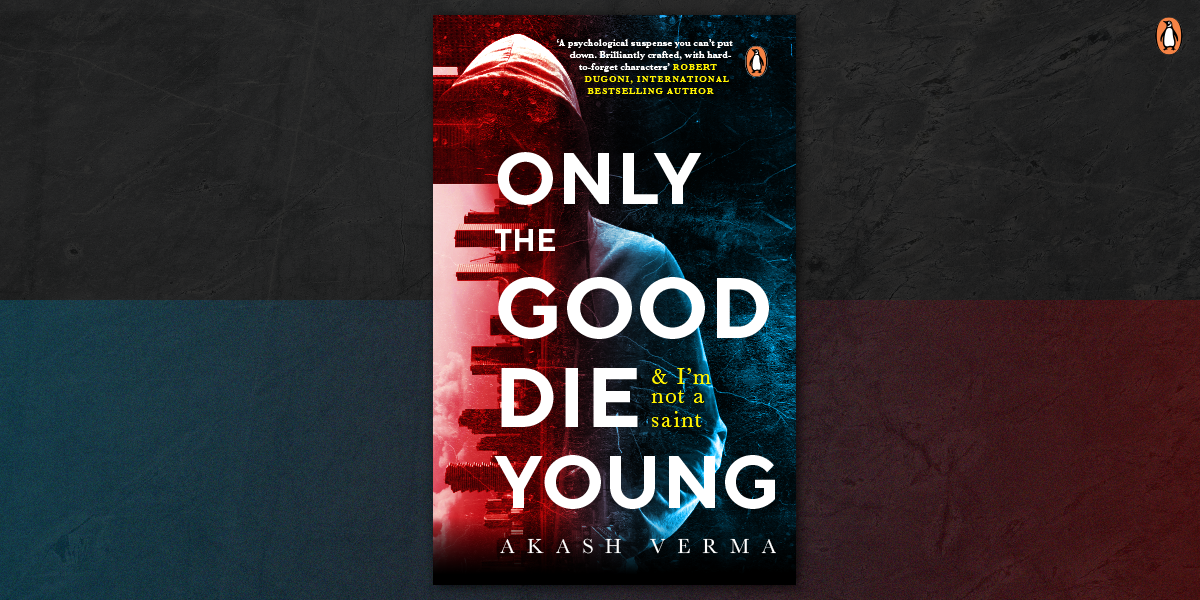
Sometimes when you’re desperate to leave the past behind, the past is eager to catch up!
Anuradha leaves Gurgaon when Dhruv chooses his family over her. She thinks that chapter of her life has ended, and starts afresh in Mumbai. But strangely, it seems her past is trying to catch up. Dhruv suddenly comes back into her life. Even as they try to figure out their relationship, horrible things start happening to people they know. Together, Anuradha and Dhruv need to find out who it is that cannot bear to see them together. Who is carrying out these shocking crimes? Are they really soulmates cursed to stay apart, or is there some karmic debt they have to repay?
Read on for a look at the psychological aftermath of an extra-marital affair
Only The Good Die Young | Akash Verma
Mumbai has unnerved me every single time I’ve set foot here in the last few months. It wasn’t like this before. It used to be like any other city. Just that I frequented it more as my advertising agency, C&M, is headquartered here. But now, since you have been here for about a year, coming to this city has never been the same. Work still brings me here—a couple of times a month at least—for a sales review or a client meeting. But every time I am here, I feel like running to you first, clasping you to my chest and not letting you go. Yes, that’s what I still feel, Anuradha, after pushing you so far away from my life. The first few months after you left were tough—to come to work each day with you not being in office; to live without you in Gurgaon; not hearing your voice; and not feeling your touch. Despite having Shalini and the kids back in my life, there was this one large gash in my heart. However hard I tried, it refused to heal. It stayed there, untended and bleeding. My head feels heavy with the weight of a sack inside it.. ‘“Don’t do it!” didn’t we warn you?’ the pebbles inside the sack which rests in my head scream in unison. ‘You can’t love two people at the same time.’ ‘I didn’t do it knowingly. It wasn’t in my control,’ I protest. ‘Oh, come on! Liar, liar, pants on fire!’ squeals one. ‘You had a rock-solid marriage, a lovely family. Didn’t you know what you were getting into?’ ‘I know. All my fault. I thought I could handle it. I loved them both, you know. I just couldn’t stop.’ One of the pebbles has a throaty voice. It’s smaller than the rest. ‘Look where this “love” has led you to. No one’s happy. Neither Shalini, nor you and I guess not even Anuradha.’ ‘Well, who knows?’ I say. ‘Maybe she has found someone. Why “maybe”? I am sure she has someone in her life by now. She is young, beautiful, successful . . . she can easily be happy. Don’t you think so?’ The pebble glances at me, scrutinizing me. ‘Yes . . . maybe. Will you be happy if she has found someone?’ I clear my throat, ‘Why not? Yes.’ ‘Sure?’ I nod. ‘Yes. I will be happy as long as she is.’ ‘Do you want to meet her?’ the pebbles chorus. ‘No. It’s over, isn’t it? Why would I want that?’ ‘Ah, come on,’ one of them says. ‘It’s what you want the most. To meet her. Isn’t it?’ I fumble for an appropriate answer. Unsuccessful. I go quiet, then. The plane has landed. I get out of the airport and spot the driver holding a placard with my name on it. I purse my lips and force a smile; a familiar weakness sweeps over me. He signals to me to wait and hurries off to get the car when I nod. I glance at the passengers leaving the airport, people gathered around the arrival gate, greeting incoming passengers: relatives and friends. I wish you too were here, waiting for me, Anuradha . . .Such feelings seem even more unreal after the way our relationship ended. But then how is one supposed to conceal one’s true feelings from oneself? How can I hide that I love you? Even after you lied to me. Even after I promised my wife, Shalini, that our affair happened in the heat of the moment and was well over. How can my feelings for you ever cease to exist? Maybe I really am the asshole that the people I love think me to be. Shalini and you. Maybe I don’t deserve love from either of you. My relationship with my wife will never go back to what it was. I have done enough to scar it and I don’t know if those scars will ever fully disappear. ‘We have struck a compromise for our children, Dhruv,’ was what Shalini told me at the dinner table one day when the kids were asleep. ‘It can never be the same again,’ she had said. Shalini is a headstrong, self-made woman who sticks to her word in her personal life as much as she does when treating her patients.
Anirban Mahapatra’s COVID-19 is a meticulous dive into the pandemic that changed the 21st century world. In this excerpt, he delves into what the future could look like, and what kind of a situation we’re likely to have on our hands in the near future:
~
Envisioning what the future holds in store is like imagining what dry land is like while in a storm in the middle of the ocean. Even in the best of times, predicting the future is a risky enterprise. A devastating pandemic of this scale and severity imposes additional challenges because we have no reference point in the modern era for something like this. Off-the-cuff comments may be forgotten but writing tends to stick around and haunt the writer. If you’re too certain with your pronouncements, you’re almost certain to be wrong. If you’re too vague, no one will read what you have to say.
We are only coming to terms with the direct fallout of the pandemic, but what will be the ramifications for long-term health and planning? What will be the implications for travel, for immigration and for commerce? Will countries continue to look inward once the pandemic is over?
Certain aspects of human life and society have changed due to the immediate effects of the pandemic. It is possible, therefore, to make short-term predictions. What will happen five, ten, or fifteen years down the road because of the ongoing, cataclysmic event and our responses to it are more difficult to say.
Will there be more public interest in interest in infectious diseases and medicine? Will it become a field that attracts more of the brightest minds as engineering, information technology, finance and business management have in preceding decades? Will physicians take up more active roles in framing public policy? Will economists stress-test catastrophic economic events of this nature?
Human societies are designed to maximize connections. Over the course of a day, most of us have dozens of close interactions with other people. The design of cities, buildings, jobs, transportation and commerce keeps the human need for connection in mind more than the rare threat of a disease that spreads by human-to- human interaction.
COVID-19||Anirban Mahapatra
What can we say looking at the past? Based on a study of the H1N1 influenza pandemic of 1918, the historian Nancy Bristow writes, ‘If history is any guide, not much will change in the wake of the COVID-19 pandemic.’4 Yet, it is impossible to use history as guide, because the world has changed immensely in a century. In 1918, viruses had not been characterized. Colonial powers ruled the world and were in the middle of World War I. Commercial airline travel was non-existent. There was no Internet to allow the lay public to read research articles immediately and view daily statistics on illness and death.
… We can assume that the pandemic will irrevocably change some business practices. There will be more people working from home permanently and less business travel to meet clients and for conferences. Technological solutions that were embraced perhaps with a bit of trepidation during the pandemic will become wider habits.
Distancing is challenging in factories, warehouses, prisons, airplanes, dormitories and ships where space is maximized. Due to a premium being put on space in cities and the density of population, buildings have grown vertically. Property values have risen globally since the Great Recession. Gentrification had led to a return to economically disadvantaged areas. It is possible that there will be a reshaping of how urban spaces are used, with more people now moving outward instead of flocking to New York, Mumbai or London. But the experience of Hong Kong, Taiwan and Tokyo in the first year of the pandemic has demonstrated that even within densely populated cities, measures can be taken to keep infections low. There may be a reshaping of urban societies, but it is still too early to tell. People tend to go where there are economic opportunities.
More broadly, will humans finally address the pressing problems of the day which the pandemic brought into stark relief?
Problems of inequality, poor access to healthcare and economic opportunities, and lack of equal rights are prevalent globally.
The pandemic allows humans to face difficult challenges that we have been ignoring, instead of denying or downplaying them. It gives us a chance to reframe priorities and reimagine society.
As humans we tend to focus on immediate problems. Our ancestors were good at hiding from tigers and other dangerous animals, finding caves to sleep in when it was raining, and building a fire when it was cold. Longer-term planning for problems does not come easily. This is applicable to both people individually and to us as a species.
… We keep asking ourselves, ‘When will the pandemic end?’ But we can’t mark the end as the date when it is over only for those of us who are privileged. We know that the biological pandemic will end one day. What we must also ensure is that there is an end to the social one.
~
COVID-19 is an excellent and insightful read. Anyone can read this book, and everyone should read this book.
Writer – politician Muthuvel Karunanidhi is amongst the most important political leaders India has ever seen. In Karunanidhi: A Life, author A.S. Panneerselvan tells the story of the man who became a metaphor for modern Tamil Nadu, where language, empowerment, self-respect, art, literary forms and films coalesced to lend a unique vibrancy to politics.
Here is an excerpt from the chapter titled, The Absence of Adolescence.
Karunanidhi A Life || A.S. Panneerselvan
Like many underprivileged children, karunanidhi’s life moved straight to adulthood from childhood, bypassing the phase of indulgent adolescence. The politicization that began with the anti-Hindi agitation and exposure to the literature of the Self- Respect Movement propelled karunanidhi into becoming an activist right from his days in the second form. The police excesses and the custodial deaths of two anti-Hindi agitators, Thalamuthu and natarajan, had a profound impact on the young karunanidhi.
The late 1930s witnessed varied crises for all the political players: the imperial government was getting ready for the Second World War; the great Depression and its fallout was taking its toll; Mahatma gandhi’s supremacy was challenged within the Congress by the election of Subhas Chandra Bose as the party president for the second time; and the Left was emerging as a distinct political force with its leaders gaining a hold over decision-making in both the Congress as well as other popular fronts. There was also a shift in Dravidian politics with the leadership moving from the wealthy section among the non-Brahmins to Periyar and Annadurai.
The twists and turns of the Left’s mobilization need elaboration in order to understand how, despite its revolutionary aura, karunanidhi remained with the Dravidian Movement’s social reform agenda. in his essay, in the January–March 1984 issue of The Marxist, E.M.S. namboodiripad points out that when the Congress Socialist Party was formed in 1934, the Communist Party of india initially branded it as Social Fascist. With the Comintern’s change of policy towards the politics of the Popular Front, the indian communists’ relationship to the inC witnessed a reversal. The communists joined the Congress Socialist Party (CSP), which worked as the left wing of the Congress. Once they had joined, the Communist Party of india (CPi) accepted the CSP demand for the Constituent Assembly, which it had denounced two years before.1
in July 1937, the first kerala unit of the CPi was founded at a clandestine meeting in Calicut. The five persons present at the meeting were E.M.S. namboodiripad, krishna Pillai, n.C. Sekhar, k. Damodaran and S.V. ghate. The first four were members of the CSP in kerala; ghate was a CPi Central Committee member, who had come from Madras. Contacts between the CSP in kerala and the CPi had begun in 1935, when P. Sundarayya (Central Committee member of CPi, based in Madras at the time) met with EMS and krishna Pillai. Sundarayya and ghate visited kerala several times and met with the CSP leaders there. The contacts were facilitated through the national meetings of the Congress, CSP and All india kisan Sabha.
in 1936–1937, the cooperation between socialists and communists reached its peak. At the second congress of the CSP, held in Meerut in January 1936, a thesis was adopted which declared that there was a need to build ‘a united indian Socialist Party based on Marxism-Leninism’. in kerala the communists won control over the CSP, and for a brief period controlled the Congress there.2
While the Congress in kerala had a distinct leftward tilt, in Tamil nadu it was virtually under the conservative leadership of stalwarts such as C. Rajagopalachari and S. Satyamurti.
Thiruvarur became a microcosm of the play of these multiple forces. Smitten by Periyar’s radicalism and Annadurai’s eloquence, karunanidhi began devouring the entire oeuvre of Dravidian literature. Periyar had already published the Tamil version of The Communist Manifesto in 1937; a number of serious political publications were being published from various parts of the state. Periyar’s Kudiarasu (The Republic) was the key vehicle for dissemination as well as articulating new ideas and planning political mobilization towards an egalitarian society.3
While Muthuvelar and Anjugam were rejoicing at their son’s tireless learning, little did they realize what he was reading about. Textbooks were last on karunanidhi’s reading list. The extensive literature in politics was revelatory for young karunanidhi. For the first time, he realized that he too had two priceless possessions—his oratory and his pen. His first public speech was a clear pointer. it was a school competition. And karunanidhi decided to make a mark. He looked at some of the redeeming features of the so-called villains within Hindu mythology. karunanidhi spoke at length about the friendship between karna and Duryodhana—a friendship that cut across both caste and class.
The speech was well-received, and the teachers developed a new respect for their wayward student. But, what they did not know was the effort that went behind this oratory. karunanidhi worked on the text of the speech for nearly a week; rehearsed the speech frequently before the mirror; changed the words, similes and metaphors to get the rhythm that would alter the art of public speaking in Tamil forever.
He also created his own publication—Maanavanesan (Friend of students). A handwritten fortnightly of eight pages in demy size that dealt with a range of issues—from questioning orthodoxy to exploring the poetics of early Tamil. He and his friends would make about fifty copies of the magazine and circulate it for a modest fee that managed to just cover the cost of the paper. Years later, when i met him at Murasoli along with Kungumam editor Paavai Chandran for a short interview for the Illustrated Weekly of India, karunanidhi said the handwritten journal was a great learning experience. ‘We could not afford to make any spelling mistakes or grammatical errors. A single mistake meant rewriting fifty copies. The sheer labour of correcting made me write a very clean first draft, without any corrections or overwriting,’ he recalled. He also took pains to mail a copy of the magazine to the leaders of the Self-Respect Movement.
But not all of karunanidhi’s icons were happy with the handwritten magazine. Bharathidasan, the well-known poet and a life-long supporter of the Dravidian Movement and karunanidhi, called it a waste of time and effort. He told karunanidhi: ‘The madness of expecting changes from handwritten publications can only be compared to the madness in thinking that development will happen due to spinning charkhas.’
Muthuvel Karunanidhi was ardent as a social reformer and unrelenting as an opposition leader. To read more about him, his life and his work, get your copy of Karunanidhi: A Life.
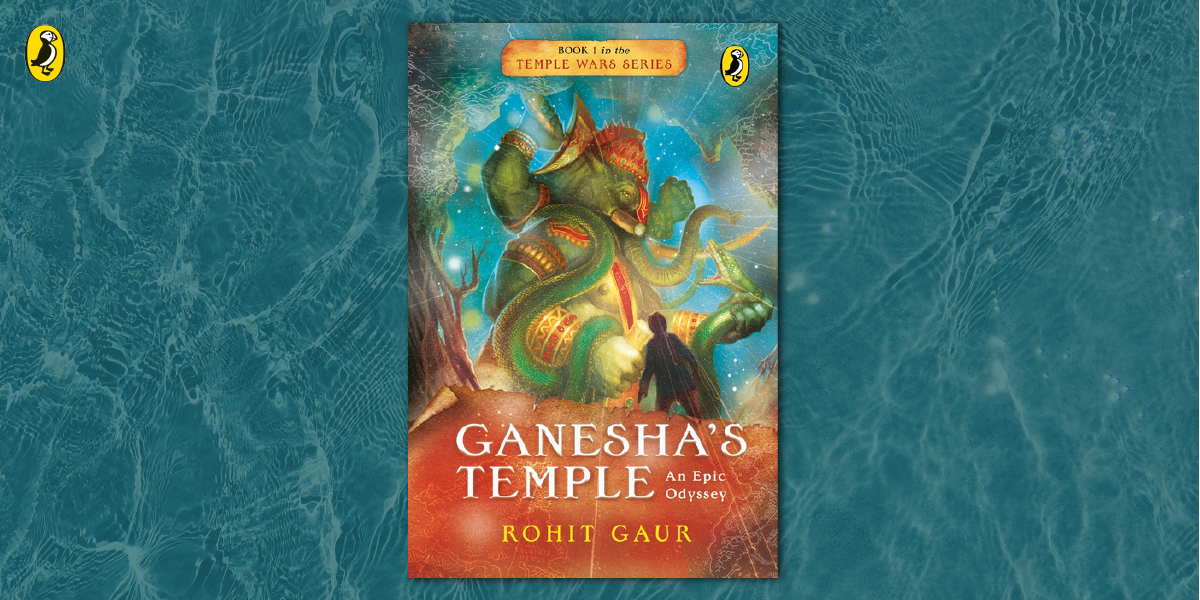
Not a lot is going right for Taran Sharma. First, he stole his annoying brother’s necklace and ran off into the night. Then, his family got taken hostage by spindly creatures of the dead. And to top it all, he’s just been charged with a mission by Lord Ganesha himself! Now, in order to rescue his family from the hands of the preta, he has to undertake a journey more fantastical than he can begin to comprehend.
As Taran embarks on an epic voyage that may lead to disastrous consequence, he realizes that having faith, especially in himself, might be harder than he was led to believe.
Dive into a riveting adventure to the Veiled Lands, replete with evil Naga armies, mythical creatures and a supervillain who will stop at nothing to reach the elusive Gateway of Moksha in Ganesha’s Temple.
**
Ganesha closed his eyes and raised all four of his hands. Particles of light appeared from thin air. They formed images in the centre of the room, and then began shimmering, swirling into new images. Taran saw human figures eating, dozing, bathing, riding horses.
‘Many thousands of years ago, gods and goddesses ruled happily over a vast world called the Veiled Lands. It was a spiritual world filled with an energy that forms the spiritual core of all life. We call this prana.’
Ganesha focused his kind, brown gaze on Taran.
‘The Veiled Lands are very simply an old earth, and its beings as old as this world itself. They have seen endless cycles of destruction and rebirth, existing far longer than you can imagine.
Ganesha’s Temple || Rohit Gaur
‘In the Veiled Lands, through prana, came the first beings of light and dark—a duality exists wherever life forms. Dyaus the Sky Father and Prithvi the Earth Mother created Shiva, Brahma and Vishnu, as well as many other devas like Surya, Agni, Indra, Varuna. These devas went on to create spirits and magical creatures, who lived peacefully together. Some devas turned into asuras, who are demons and titans. I could go on for years if I had to narrate the lives of every single deva and asura.’ Ganesha waved his hand as though turning a page in a book.
From the light particles over Ganesha’s head, new images appeared. One of the figures, snake-like and menacing, was pictured standing over a fallen deva, a staff raised above his head. Taran stared in fascination.
‘Vritra,’ Ganesha said soberly. ‘Once a deva, Vritra grew ambitious and power-hungry and sought to conquer his brethren. He attempted to overthrow the peaceful order, dominate the other devas and asuras, and rule the Veiled Lands by himself.
‘His rebellion was unsuccessful and the other devas, pitying their brother for his vanity, vowed to exile him from the Veiled Lands. They decided to create a parallel world for asuras like him, which lacked all prana. They had to combine all their powers in order to create such a world, and that powerful spell also created the Bare Lands—the world you now inhabit, Taran.