Publish with Us

Follow Penguin

Follow Penguinsters

Follow Penguin Swadesh

An eclectic reading list for all kinds of young readers

Nothing says new year like a dazzling list of books brimming with enchanting stories of lands far and near. In the spirit of new beginnings, we are back with a diverse list of books for young readers. We hope that you’ll find something here for your child that they would cherish and hold dear for a long time to come.


Murder in Melucha

Aditi Krishnakumar

front cover of Murder in Melucha
Murder in Melucha || Aditi Krishnakumar


In Melucha, children’s alphabet books teach that H is for hemlock, so it is no particular surprise when someone is found murdered. But in a city where everyone has devious and twisted motives, and dire plans, it is not easy for Meenakshi and Kalban to find the murderer.

In this sequel to the acclaimed The Magicians of Madh, Aditi Krishnakumar pulls off another delightful romp, full of mystery, humour and hilarious predicaments.


Concrete Rose

Angie Thomas

front cover of Concrete Rose
Concrete Rose || Angie Thomas


With his King Lord dad in prison and his mom working two jobs, seventeen-year-old Maverick Carter helps the only way he knows how: slinging drugs. Life’s not perfect, but he’s got everything under control. Until he finds out he’s a father…

Suddenly it’s not so easy to deal drugs and finish school with a baby dependent on him for everything. So when he’s offered the chance to go straight, he takes it. But when King Lord blood runs through your veins, you don’t get to just walk away.

From international phenomenon Angie Thomas comes a hard-hitting return to Garden Heights with the story of Maverick Carter, Starr’s father, set seventeen years before the events of the award-winning The Hate U Give.


Shyamchi Aai

Sane Guruji, Shanta Gokhale (tr.)

front cover of Shyamchi Aai
Shyamchi Aai || Sane Guruji, Shanta Gokhale (tr.)


The evening prayers in the ashram are over. Cowbells tinkle sweetly in the distance. The residents of the ashram sit in a circle, their eyes fixed on Shyam, who has promised them a story as sweet as lemon syrup. And so Shyam begins.

While on some evenings he tells them of his boyhood days, surrounded by the abundant beauty of the Konkan, on others he recalls growing up poor, embarrassed by the state of his family’s affairs. But at the heart of each story is his Aai-her words and lessons. He reminisces of the day his mother showed him the importance of honesty and the time she went hungry just so her children could eat a full meal.

Narrated over the course of forty-two nights, Shyamchi Aai is a poignant story of Shyam and Aai, a mother with an unbreakable spirit. This evergreen classic, now translated by the incomparable Shanta Gokhale, is an account of a life of poverty, hard work, sacrifice and love.


When the World Went Dark

Jane De Suza

front cover of When the World Went Dark
When the World Went Dark || Jane De Suza


To help Swara, you’d have to dive into her world during the lockdown. Feel the almost-nine-year-old’s heart break as she loses her favourite person ever, Pitter Paati. Swara pursues clues to find her, but stumbles upon a crime instead. Vexpectedly, no one believes her.

Will Swara and her annoying friends from the detective squad find the Ruth of the Matter in time?

Told with humour and sparkle, this compassionate story is about finding light in the darkest times of our lives. It packs in an intriguing mystery and even a good belly laugh.


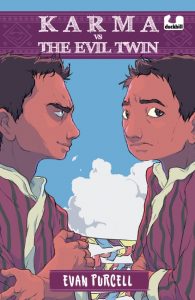
Karma Vs The Evil Twin

Evan Purcell

front cover of Karma vs the Evil Twin
Karma vs the Evil Twin || Evan Purcell


Everyone in Jakar knows that Karma has always defended his village from monsters. But suddenly his friends and neighbours are angry with him and accusing him of crimes he knows he didn’t commit.

Karma suspects he has a doppelgänger who is terrorizing the town, but no one believes him. His friends Chimmi and Dawa and even his mother do not seem to trust him.

But with every monster in Bhutan suddenly turning up in Jakar, will he be able to stop his adversary in time?

The third book in the Karma Tandin, Monster Hunter series, set in Bhutan, is a rollicking adventure that will keep you riveted till the very end!


Sometimes Mama, Sometimes Papa

Nandini Nayar

front cover of Sometimes Mama, Sometimes Papa
Sometimes Mama, Sometimes Papa || Nandini Nayar


When Keya’s parents stopped living together, unusual things happened.
Keya became the only girl in her class with two homes.
‘Where will you live?’
‘Who will you live with?’
‘Sometimes Mama,’ Keya said, ‘sometimes Papa!’

This heart-warming story with comforting pictures reassures young readers that parents, whether alone or together, are always there for them.


 How We Know What We Know

Shruthi Rao

front cover of How We Know What We Know
How We Know What We Know || Shruthi Rao


There are millions of facts that we know about the world around us – that the earth is round, that birds migrate and that dinosaurs once roamed the planet. But how do we know what we know? Regaling us with tales of remarkable men and women who didn’t rest until they got the answers they sought, Shruthi Rao chronicles the stories behind the discoveries and inventions we take for granted today. This book, in fifty marvellous accounts, tells us of the sense of mystery and wonder that propel scientists to go after solutions to the puzzling problems of the world around us.


All things start-up: A conversation with Sanjeev Aggarwal and T.N. Hari

The journey of a business-from a small start-up to a large company ready for an initial public offering (IPO)-is fraught with pitfalls and landmines. To scale a company, one needs to do more than just expand distribution and ramp up revenue. From Pony to Unicorn lucidly describes the X-to-10X journey that every start-up aspiring to become a unicorn has to go through. The book effortlessly narrates the fundamental principles behind scaling.

Today, we are in conversation with the authors of the book, Sanjeev Aggarwal and T.N. Hari, who are both veterans in the start-up spectrum and have years of experience in guiding emerging businesses to reach their maximum potential.


Questions for Sanjeev Aggarwal:


1.     How was your experience of writing From Pony to Unicorn

Educational, as I was able to reflect on my learnings.


2.     In what ways would you say that the start-up ecosystem in India has changed in the past ten years? 

The level of founder ambition has reached a new high.


3.     Which factor, according to you, works most efficiently in helping a start-up scale sustainably?

Navigating inflection points with thought.


4.     Which sector in the start-up domain remains the least explored? Why do you think that’s the case? 

Agri-tech! The market is large and highly intermediated. 


5.     As book publishers, we cannot help but ask you about your favourite books that you’d like to recommend to our readers? 

How Will You Measure Your Life by Clayton Christensen


Questions for T.N. Hari


1. What propelled you to pen From Pony to Unicorn?

front cover of From Pony to Unicorn
From Pony to Unicorn || Sanjeev Aggarwal, T.N. Hari

Sanjeev and I have been through the scale journey multiple times and have seen several small startups go on to become large companies from very close quarters. The urge to share our learning and insights with the next generation of entrepreneurs who are trying to build sustainable businesses was what motivated us to write this book.


2. Which is your most favourite section of the book? 

‘The Human Capital’ section is my personal favourite for the simple reason that this is a topic close to my heart.


3. What kind of books do you enjoy reading? Are there any that you’d like to recommend to our readers?

I don’t particularly read too many management books. Six best books I read in 2020 are as follows:

  • Where will Man Take Us? by Atul Jalan (Atul writes better than Harari and Kurzweil put together)
  • Indica – A deep natural history of the Indian subcontinent by Pranay Lal
  • The Liberation of Sita by Volga
  • The Palace of Illusions by Chitra Banerjee Divakaruni
  • Fermat’s Last Theorem by Simon Singh)
  • Shackleton’s Way by Margot Morrell and Stephanie Capparell


4. If you could describe the current start-up ecosystem in India in one word, what would it be and why?

Vibrant


5. According to you, which is the one skill that an HR professional must necessarily possess?

A deep understanding of human psychology.

The real cost of COVID-19

By now it is more than evident that the pandemic was different for the rich and the poor. Arun Kumar’s stellar research in his book Indian Economy’s Greatest Crisis  helps us understand the real cost of the pandemic and those who have had to bear it.

~

The Plight of Labour and Migrants

…The pandemic has brought into the open the terrible plight of the unorganized sector and its workers. They are the marginalized in society and policy seldom caters to their issues. They could not cope with the lockdown and now continue to suffer even with the lockdown eased under business pressure. …Without adequate testing, a large number of people will get infected as lockdown is eased. For herd immunity, if 60 per cent get the disease and develop immunity, 5 per cent of those infected will be serious, requiring hospitalization. That would be 4 crore people and most of them will be workers forced to go to their place of work. The poor are malnourished and don’t have the resources to get tested or get proper medical treatment. Even if only 2 per cent die, and this number will be larger if India’s weak medical system fails, 1.6 crore people will die—and most of them will be the poor.


Uncivil Conditions That the Urban Poor Live In

… Why was our medical system so weak and testing inadequate even months after it became clear in March that the disease would spread? It is a reflection of a political system and an executive that has hardly ever prioritized the welfare of the vast majority of the people it is supposed to serve. They are the residual, or the one’s marginalized in policymaking. If some benefits trickle down to them, that is well and good. If the poor rise above a given poverty line, the system claims it an ‘achievement’. The elite make it out that the poor ought to be grateful for the gains they have made since Independence.

The ‘achievement’ hides the uncivil conditions in which the poor live, especially in urban areas, and this now stands exposed thanks to the pandemic. They live in cramped and unhygienic slums, with little access to clean water and sanitary conditions. How are they to observe the lockdown and practise physical distancing? They live cheek by jowl and share toilets and water tankers. They have little savings, so they have to earn and spend on a day-to-day basis. With the pandemic, their earnings have stopped and they have turned destitute—this highlights the precariousness of their lives. One shock and they slip below the poverty line; one major illness in the family and they fall below the imaginary poverty line (Kumar, 2013). They had always been poor, but for policymakers, ‘progress’ was that they had jumped above the poverty line (APL).


Cause of the Mass Migration

…Industry and ruling elites capitalize on the poor working and living conditions of labour to lead their own comfortable lifestyle and make higher profits. Consequently, neither the state nor businesses grant workers their rights. For instance, a large number of workers do not get a minimum wage, social security or protective gear at worksites. They mostly have no employment security; often their wages are not paid in time; muster rolls are fudged; and there is little entitlement to leave. Given their low wages, they are forced to live in uncivilized conditions in slums. Water is scarce, and drinking water more so. Access to clean toilets is limited and disease can spread rapidly. There is a lack of civic amenities such as sewage. Their children are often deprived of schools and playgrounds.

front cover Indian Economy's Greatest Crisis - excerpt
Indian Economy’s Greatest Crisis||Arun Kumar

Now, using COVID-19 as an excuse, state after state has reduced even what little security was available to workers, by eliminating or diluting various laws to favour businesses. In Uttar Pradesh, at least fourteen of the Acts have been changed, such as the Minimum Wages Act, 1948, the Industrial Disputes Act, 1947, and the Payment of Bonus Act, 1965. It’s the same thing in Madhya Pradesh and Punjab. The plea is that this is needed to revive economic activity. The chief minister of Madhya Pradesh has said that this will lead to new investment in the state (Singh, 2020).

…In India, workers are characterized as either organized or unorganized. Those in the former category work in larger businesses and have some formal rights (which are being diluted) but, often, they find it difficult to have them enforced. Increasingly the big and medium businesses are employing contract labour provided by labour contractors from the unorganized sector, rather than permanent workers. Businesses pay contractors, who then pay the labourers part of the money they receive. So businesses claim that they are paying the minimum wage but the workers aren’t getting it.

In a scenario where even the minimum wage is inadequate for a worker to lead a dignified life, what chance do those receiving even lesser stand to lead a civilized existence?

Businessmen who now talk of livelihood have never shown such concern for the workers in the past. They have paid low wages to earn big profits. How else, at such a low level of per capita income, could India have had the fourth largest number of billionaires in the world? Clearly, most of the gains of development over the past seventy-five years, more specifically since 1991, have been cornered by businessmen. They have made money not only in white but also huge sums in black (Kumar, 1999).

Businesses have manipulated policy in their favour—before 1991, by resorting to crony capitalism, and since then by bending policy in their favour, curtailing workers’ rights and pressurizing the government to weaken its support to the marginalized sections on the plea that the markets be allowed to function. Now using COVID-19 as the shield, workers’ rights are being further curtailed. No wonder, then, that the country collects only about 6 per cent of the GDP as direct taxes despite huge disparities. The burden of taxation falls on the indirect taxes, such as GST and customs duty, paid by everyone, including the marginalized.

The lesson to be learnt from the pandemic is that India has not been able to cope with it because of the adverse living conditions of the majority of its people, namely the poor. Now labour laws are being diluted (such as increased working hours and reduced wages), which means a worsening of their living conditions (Kumar, 2020g). This will ensure that the country will flounder again when the next pandemic strikes. The tragedy is that India is today headed towards societal breakdown for short-term gains of some sections of society. But it appears that a rethinking of the prevailing ruling ideology always comes at a heavy cost.

~

Indian Economy’s Greatest Crisis  is a detailed and insightful work examining the various fault lines of the Indian social fabric and how they’ve been affected by the pandemic.

On writing and politcs: A chat with author Vinay Sitapti

How long was the research process for the book?

This took me three years. But I was also teaching during this period.


Why this subject in particular?

I am a child of the 1990s, and the two biggest political trends of that decade was liberalisation and the rise of the BJP. My first book, on P.V. Narasimha Rao, was a response to this first political trend. This book was motivated by the second trend — the political rise of Hindu nationalism — that I remember from my childhood.


What has been the most rewarding experience about writing this book?

Front cover of Jugalbandi
Jugalbandi || Vinay Sitapati

While writing the book, I immersed myself in the world of Hindu nationalism — talking to people, reading books and articles, going through archives — over its 100 year period. Then suddenly I began to see patterns and trends, for instance their 100 year focus on organisational unity. It was almost as if my vision had suddenly changed from blurred to focussed.


Any criticism experienced? How about any encouraging instances/incidents?

The most encouraging feeling is that even though the topic is so polarising, the book has not been slotted as ‘left’ or ‘right’. The book has not provoked anger, rather I think it has spurred understanding. That’s a lovely feeling. It means that scholarship, if done right, can bring people together. There have of course been criticisms — that I have been unduly harsh on Vajpayee for instance. I only request that the reader looks at my evidence and asks whether my conclusions flow from it.


What should we look forward from you, next?

I haven’t yet decided on what next. But I enjoyed not just the popular reception to Jugalbandi, but also the process of writing it. So whatever else I work on next must not just be interesting to the reader, it should be interesting to me.

**

The Pokhran tests: An under-recognised success story under Vajpayee’s leadership

Former Prime Minister of India and member of the Bharatiya Janata Party (BJP), Atal Bihari Vajpayee was an understated politician of the kind not often seen in contemporary times. His patriotism was uncompromising, forged out of the paradoxes in his life: a sensitive poet who summoned nerves of steel to conduct the Pokhran-II nuclear tests. In Vajpayee, an intimate memoir of the consummate leader, we get a detailed look into the behind-the-scenes of the Pokhran tests, a glorious albeit controversial turning point in the history of India.

**

Vajpayee’s rationale for conducting nuclear tests in 1998:

‘Hiroshima and Nagasaki had deeply affected him. He wrote a poem, ‘Hiroshima Ki Peeda’, where he talked of waking up in the middle of the night and wondering how the scientists who had made those powerful atomic weapons slept after hearing about the destruction caused by their creations. Did they not for a moment regret what they had done? If they had a sense of remorse, then time would not judge them. But if they did not, then history would never forgive them. Vajpayee’s poem and his decision to go ahead with the test are not contradictory. He came to the conclusion that if India had to live in peace in its neighbourhood, credible nuclear deterrence was essential. Nuclear weapons prevent wars, was his constant refrain.’


‘The second, seemingly contradictory, line of thinking behind the tests was his deeply held view that India was destined to be a great power. Possession of nuclear weapons, in the world we inhabited, was the minimum entry criterion for that club. Japan and Germany, whose recent economic successes did not guarantee them the status of a great power, underscored this idea. Vajpayee’s belief in India was immeasurable, and while he did not say it, his body language that day seemed to indicate that he was happy to be an important instrument in that quest. An insecure nation could not be a great power—this was the powerful motivation that drove this decision to test.’


The volatile international reaction that followed:

‘The initial American reactions seemed too understated, but not for long. Clinton reacted angrily in public. He said that India’s action ‘not only threatens the stability of the region, it directly challenges the firm international consensus to stop proliferation of weapons of mass destruction’.’


‘The Japanese reaction was expected, as it was the only country to have been at the receiving end of nuclear weapons. It froze all aid, which, unlike in the case of the US, was a substantial amount, in excess of US$1 billion.’


‘The Germans also announced a moratorium on aid, which, at US$300 million, was far above American levels. China’s initial reaction was subdued, probably because they were aware of Indian ire at the Sino–Pak cooperation. In fact, to our surprise, Russia’s language was stronger; Boris Yeltsin said that he was disappointed and felt let down.’


Vajpayee addresses the Parliament about the controversial decision and its significance for India:

front cover of Vajpayee
Vajpayee || Shakti Sinha

‘India had demonstrated its nuclear capability in 1974, and Vajpayee reminded the members of Parliament that Indira Gandhi, speaking on the nuclear issue, had told Parliament in 1968 that ‘we shall be guided entirely by self-enlightenment and considerations of our national security’. He complimented all governments since 1974 for safeguarding India’s nuclear option by not signing the CTBT, despite the mounting international pressure.’


‘He situated his decision to test in the context of the India’s deteriorating security environment due to missile and nuclear proliferation in its neighbourhood. The increase in the number of nuclear weapons and the deployment of sophisticated delivery systems could not be ignored. Worse, India faced terrorism, militancy and clandestine war. In the absence of any movement towards disarmament, and keeping in mind the needs of national security, the difficult decision to test had to be taken.’


‘Taking his argument further, Vajpayee made it clear that India did not seek the status of a Nuclear Weapons State from anybody because it was already one. This was a reality, and with this added strength came added responsibilities. India’s nuclear weapons were not to be used for aggression or for mounting threats to other countries. Rather, Vajpayee explained, they were weapons of self-defence, which would prevent India from being subject to nuclear threats or coercion in the future. India did not intend to engage in an arms race.’


** 


Five crucial and unforgettable lessons from Sri M

In an interview with The Daily Guardian, Sri M said ‘Fiction is not meant to preach lessons but since there is no fiction without a factual core, readers are sure to be influenced.’

He wasn’t wrong. The stories from his book The Homecoming gave us several valuable lessons to take away, even if that might not have been the intention.


  1. Death of a builder

While the story resounds with deep irony, it is also a call to awareness of how intricately human lives and nature are entangled. Now more than ever we have started to live our lives as though nothing outside of our immediate need and greed exists, but in 2020 should have taught us anything, it is that we cannot continue to live in isolation if we want the planet to survive. The story is a beautiful take on a silkworm on its way to metamorphose into a moth before its untimely destruction by harvesters to make silk for the clothes of deities and people who have no time for the actual producer of this silk, or any care for its life.


  1. The Porter
Front cover The Homecoming
The Homecoming||Sri M

Krishna is a porter who doesn’t covet other people’s wealth, but circumstances drive him to make an exception. But the story is brutal. He asks for God’s forgiveness in case he doesn’t something wrong, but that forgiveness is not granted, and any wealth Krishna was hoping to gain comes at an enormous price. Perhaps the lesson is that there should be no exceptions to one’s integrity. After all, we can never know the true nature of the exception we are making.


  1. The Thief

Sambu, the thief, has the strangest encounter with an old woman, and his life is changed forever. Driven to thieving by dire circumstances and the urgent compulsion to feed his family, Sambu is given a new chance at life. We have the transformative capacity of changing other people’s lives for the better; those who need help can in fact be given a new chance at life if we’re willing to share our privileges with them.


  1. The Dimwitted Genius

While Kitcchu does not do well in school, and does not seem to have the aptitude the rest of his classmates do, there is something special about him. He soars in Mathematics and music, and none of his teachers can explain why. In a narrative about a higher secret mission, Sri M once again raises a more direct and urgent flag about the environmental impact humans have on the planet. In some ways, his story has a bleaker underline – the human footprint on the planet is so irreparably destructive, that perhaps only a long-winded miracle can save us now.


  1. The Homecoming

When Shivanna mysteriously disappears, his parents’ lives are thrown in a tailspin. But it is soon discovered that Shivanna has left of his own accord, searching for the spiritual Truth that he has read about in the scriptures. He travels from Madikeri to Haridwar, but ends up finding his truth much closer to home than expected. Introspection helps us stay rooted in our pursuits. While journeys across lands may seem necessary, we most often end up chasing after empty illusions. More often than not, what we seek lies closer to home, waiting to be found.

Lord Krishna’s fatal encounter with the hunter Jara

As the Mahabharata war wages on, it shows no mercy and takes no prisoners. Death and destruction abound.

In the midst of a world rendered unrecognizable by the lust for power, malice and the machinations of war stand Bhishma, contemplating the immeasurable death he sees around himself as a man who cannot die, Draupadi, above and beyond the chaos and yet at the very centre of it, trying to protect her husbands at any cost, wondering whom to trust, and Arjuna, beloved, conflicted and melancholic in equal measure, uncertain of the ultimate cost of the war he is intent on winning. The Dharma Forest is a magnificent first novel in a trilogy filled with complex characters, conflicted loyalties and erotic jealousies from India’s most beloved epic.

Here’s an intriguing excerpt from the book.

**

By the time the arrowhead left the bow’s frontal arch, Jara was already filled with regret. He could have been more patient; he could have not abandoned his aspiration for non-violence; he could have not surrendered to who he truly was—one who loved to hunt and kill. All the while as the arrow travelled, Jara noticed that the trees had stopped swaying and the winds ceased their frenzied moves. Every falling twig was now audible, each drop of dew hit the grounds with a crackle. Up from the trees, the leaves began to abandon their tenuous bonds with the branches, frogs scampered around their puddles nervously and birds in the skies circled anxiously, like expectant fathers at the hour of birth. The forest stilled itself in anticipation. And the evening sky had acquired a darkness that Jara had rarely seen. The world was now brimming over with portents that not even the darkest oracles could fathom. And then, all too suddenly, he heard the arrow land with a thud and tear into some flesh which, ironically, brought about a semblance of normalcy to that moment thanks to the iron laws of cause and effect which had now seemingly prevailed. His arrow, as always, had found its mark, and Jara sighed in relief—finally!—as if some long nursed revenge had eventually found its release. From afar, he could see a pool of blood begin to flow and wet the grounds, and a voice in his head told him that an hour of sacrament was near.

Jara ran towards his mark, past the small ponds and the trees, to inspect the animal that lay there. Even as he hurried, he prayed that he may find an injured deer and not a dead one. To assuage his guilt, he told himself that he would bandage the animal and let it go. The flute’s melancholic song, meanwhile, had come to a stop. From the skies a roar broke out and boomed through the trees and branches, which had already shed their leaves, as if an untimely winter had arrived. Jara found himself running through a corridor of yellow and green when he heard the forests echo three times.

Jayaa, Jayaa, Jayaa…


front cover of The Dharma Forest
The Dharma Forest || Keerthik Sasidharan


Before he could make sense of it all, he had arrived at a spot where blood seeped freely into the earth. And there he found a man with many arms—was this a God who had lost his way, Jara asked himself in wonder and fear; his complexion was as dark as the blue nights of Jara’s dreams, and from his feet, blood trickled steadily. Jara’s arrow had sliced away the ankle of his foot. Instead of pain and horror, however, this injured otherworldly person sat there in silence, with his eyes closed, as if he was meditating. And then, perhaps stirred by Jara’s presence, he opened his eyes and smiled at him. A generous and beatific smile that took Jara by surprise, for he had expected to be on the receiving end of anger and abuse. Overwhelmed by grief and guilt on having hurt somebody, Jara bowed to this injured being and for reasons unknown to him, tears welled up in his eyes. He bent down to touch this being’s feet, out of concern and in regret, as if to make amends for this gratuitous injury. When Jara looked up again, the many arms on his body were no longer there. He was just another ordinary man, even though his presence exuded a form of gentleness and beauty of the kind that Jara had never thought possible in another human. Perhaps, Jara tried to reason, it was another trick played by the forest. Then, this kindly one spoke, ‘Jara, my dear friend. I hope it wasn’t too difficult for you to find me.’

Jara looked at him again, only to recognize an intuition froth within him that his wanderings through the forest which had lasted for weeks, had now come to an end. The man’s presence—despite the blood and agony all around—filled Jara with a kind of peace that he had not experienced in a long while. Then, even as he bled to death, the man said with an easy contentment: ‘I am Devaki’s son, Rukmini’s husband, and Arjuna’s friend. I am also known as Krishna of the Yadavas.’

He paused to let silence enter between them and then said to Jara, ‘I have waited for you my whole life.’

**

Some books we cannot wait to get our hands on in 2021

This year has been nothing short of a rollercoaster ride for all of us. With the pandemic reinforcing our belief in books’ magical ability to take us to better worlds, it’s only natural that we are now looking forward to glorious new books releasing in 2021. So here’s a list we hope you’ll enjoy going through as much as we enjoyed curating it for you.


Unfinished

Priyanka Chopra Jonas

front cover of Unfinished
Unfinished || Priyanka Chopra Jonas


A book that is warm, funny, sassy, inspiring, bold and rebellious. Just like Priyanka herself. Unfinished takes readers from Priyanka’s childhood in India before being sent away to boarding school; through her formative teenage years in the US; to her return to India, where she unexpectedly won the beauty pageants that launched her acting career. From her dual-continent career as an actor and producer to her work as a UNICEF Goodwill Ambassador, from losing her beloved father to cancer to marrying Nick Jonas, Priyanka Chopra Jonas’s story will inspire a generation around the world to gather their courage, embrace their ambition and commit to the hard work of following their dreams.


The Good Girls

Sonia Faleiro

front cover of The Good Girls
The Good Girls || Sonia Faleiro


From the acclaimed author of Beautiful Thing comes a book that investigates the truth behind the death of two teenage girls.

In the summer of 2014, India woke up to the news of two teenage girls found hanging from a tree in Katra, a village in Uttar Pradesh. A photo found its way into the digital world, jolting the nation. An arduous investigation followed and arrests were made.

Sonia Faleiro lays bare the heart-breaking truth of what happened that night through the voices of the girls’ families, those who saw them last, and the legal and medical officials who were on the case. The reality that the book illuminates, wrapped in pressures of caste, gender, technology and teenage desire, proves to be more complicated and just as devastating.


Unscripted: Conversations on Life and Cinema

Vidhu Vinod Chopra and Abhijat Joshi

front cover of Unscripted
Unscripted || Vidhu Vinod Chopra, Abhijat Joshi


Vidhu Vinod Chopra has blazed a trail in Hindi cinema over the last thirty years. From someone who once released his student’s film incomplete because he ran out of money and film stock, he now has the distinction of heading one of the biggest production houses in India. Not only is he a film-maker par excellence, he has also nurtured some of the brightest talents in the Hindi film industry, director Raju Hirani, composer Shantanu Moitra, actor Vidya Balan and scriptwriter Abhijat Joshi, to name just a few.

In Unscripted, Vidhu speaks to Abhijat Joshi about his exceptional journey. Consistently brilliant, outrageous and illumination, this is a peek into the mind, method and madness of one of contemporary Hindi cinema’s brightest directors.


Platform Scale for a Post-Pandemic World

Sangeet Paul Choudary

Front cover of Platform Scale Economy
Platform Scale Economy || Sangeet Paul Choudary

A comprehensive and thoroughly updated edition for the post-pandemic world, this is a guide for entrepreneurs, innovators and educators looking to understand and implement the inner workings of highly scalable platform business models. The pandemic has accelerated the developments on which Big Tech was supposed to be regulated. Data access, privacy and usage laws are being revisited to counter the pandemic through contact tracing and other surveillance mechanisms. The pandemic has reinforced the importance of the platform economy. In the 2020s, we will see the platform economy gain further strength as the post-pandemic world uncovers new value pools for platforms to exploit. This book provides a compelling framework for building platforms, networks and marketplaces. 


How to Avoid a Climate Disaster

Bill Gates

front cover of How to Avoid a Climate Disaster
How to Avoid a Climate Disaster || Bill Gates


Bill Gates has spent a decade investigating the causes and effects of climate change. With the help of experts in the fields of physics, chemistry, biology, engineering, political science, and finance, he has focused on what must be done in order to stop the planet’s slide toward certain environmental disaster. In this book, he not only explains why we need to work toward net-zero emissions of greenhouse gases, but also details what we need to do to achieve this profoundly important goal.

He gives us a clear-eyed description of the challenges we face. Drawing on his understanding of innovation and what it takes to get new ideas into the market, he describes the areas in which technology is already helping to reduce emissions, where and how the current technology can be made to function more effectively, where breakthrough technologies are needed, and who is working on these essential innovations. Finally, he lays out a concrete, practical plan for achieving the goal of zero emissions-suggesting not only policies that governments should adopt, but what we as individuals can do to keep our government, our employers, and ourselves accountable in this crucial enterprise.


Klara And The Sun

Kazuo Ishiguro 

front cover of Klara and the Sun
Klara and the Sun || Kazuo Ishiguro


From the bestselling and Booker Prize winning author of Never Let me Go and The Remains of the Day, a stunning new novel – his first since winning the Nobel Prize in Literature – that asks, what does it mean to love? A thrilling feat of world-building, a novel of exquisite tenderness and impeccable restraint, Klara and the Sun is a magnificent achievement, and an international literary event.


First Person Singular

Haruki Murakami 

front cover of First Person Singular
First Person Singular || Haruki Murakami


A mind-bending new collection of short stories from the beloved, internationally acclaimed, Haruki Murakami.

The eight masterly stories in this new collection are all told in the first person by a classic Murakami narrator. From nostalgic memories of youth, meditations on music, and an ardent love of baseball to dreamlike scenarios and invented jazz albums, together these stories challenge the boundaries between our minds and the exterior world. Occasionally, a narrator who may or may not be Murakami himself is present. Is it memoir or fiction? The reader decides.


Which of these reads are you most excited about?


Phoolsunghi: The importance of the first ever translation from Bhojpuri to English

Phoolsunghi (1977) is arguably the most loved of all Bhojpuri literary works. A historical novel, it traverses a period of ninety years in colonial India, roughly between 1840s and 1931.


Pandey Kapil’s translated version – The first ever translation of a Bhojpuri novel into English – transports readers to a forgotten world filled with mujras and mehfils, court cases and counterfeit currency, and the crashing waves of the River Saryu.

Here we understand what the translation truly means for the community, through a note from the book.


Drawing upon his experience as the series editor for People’s Linguistic Survey of India (2012), G.N. Devy concluded that ‘Bhojpuri has not only stayed alive . . . in the whole world, Bhojpuri is the most rapidly developing language.’ According to various estimates, there are close to 200 million Bhojpuri speakers living in India and overseas. While the majority of them live in Poorvanchal—a geographical unit comprising parts of Bihar and Uttar Pradesh—a sizeable Bhojpuri-speaking population lives in Jharkhand, Madhya Pradesh, Chhattisgarh and Nepal. Further, as a result of ‘girmitiya’ or indentured migration during the colonial period (1832–1914), the language is also spoken extensively in Fiji, Mauritius, Suriname, South Africa and parts of the Caribbean. The word Bhojpuri derives its name from Bhojpur, an ancient feudatory located near Arrah in Bihar. The feudatory, in turn, derives its name from Bhoj, the ancient king from Ujjain (Malwa) whose descendants ruled the province.


Literary Bhojpuri claims a fairly old ancestry. It has been suggested that the earliest literary specimen with Bhojpuri expressions date back to the medieval devotional compositions of the Nath sect. The tradition of writing in Bhojpuri begins with Kabir (fifteenth century)—often considered the ‘Adi Kavi’ or the first poet of Bhojpuri— and includes the devotional compositions of saint-poets such as Dharamdas (sixteenth century), Dharni Das (seventeenth century), Shiv Narayan (eighteenth century), Dariya Sahib (eighteenth century), Lakshmi Sakhi (eighteenth century) and Bulakidas (eighteenth century). By late nineteenth century, Bhojpuri had produced its first literary prose. According to George Abraham Grierson, Ravidutt Shukla’s play ‘Devakshar Charitra’ (1884) is the earliest recorded specimens of literary prose in Bhojpuri. A year later, in 1885, a Banaras based wrestler, Teg Ali, published Badmash Darpan, Bhojpuri’s first published work. Yet, a literary culture, so long and diverse, remains largely neglected. If one was to draw a list of factors that may have led to this neglect, two causes stand out: the perception that Bhojpuri is a folk language, spoken by illiterate villagers, and the near absence of its interaction with the other literary cultures, through translations or otherwise. Hopefully, the present translation will change some of that.


For close to seven decades, Pandey Kapil championed the cause of Bhojpuri with an indefatigable zeal—leading literary associations, editing periodicals and bearing with grace the burden of being a Bhojpuri author, consigned to anonymity outside the Bhojpuri belt. Get your copy of Phoolsunghi now!

Why design thinking is need of the hour?

Creative problem-solving is at the heart of innovation, and some of the world’s most innovative companies are very systematic in following this approach. Pioneered by IDEO and Stanford d.school, design thinking is one such approach that draws inspiration from the realm of product design. This book attempts to offer a practitioner’s perspective on how the tenets, methods and discipline of design thinking can be applied across a range of domains, including to everyday problems, and help us become expert problem-solvers through the use of the appropriate toolsets, skill sets and mindsets.

Here’s an excerpt from the book which elucidates why design thinking deserves to be adopted more seriously and pervasively.

**

Whether you are buying a product or hiring a service, at the end of the day you are consuming an experience, and in this experience economy, a lot more of your senses are involved. The traditional products have become more like services, and services have become experiences. In today’s marketplace, customers are shifting from passive consumption to active participation. Memorable experiences are not scripted by leaders or marketing departments but are delivered at the moment of truth by the customer-facing executives. And such experiences must be crafted and delivered with the same precision as the products. We are all seeking authentic experiences and even the most mundane task can be made into a cherishable experience. Such authentic experiences often take shape by allowing for spontaneity, and, paradoxically, this spontaneity must be designed beforehand, and technology is only a small part of that desirable experience.

Do you wonder why people spend such huge amounts to attend TED Talks, when all of these are available for free on the Internet? Because people want to ‘experience’ being in the company of thinkers and doers and get inspired. That is the same reason that thousands of Indians queue up every summer to watch Indian Premier League matches in their cities. Many of them travel across cities, stand in lines for well over four hours, often in scorching heat, when they could have watched their favourite players from the comfort of their living rooms. They seek genuine experiences, and they are ready to pay anything, risk anything to seek that involvement.

front cover of Design Your Thinking
Design Your Thinking || Pavan Soni


People, rich and poor, are going beyond amassing stuff to seeking experiences, and that is visible among a wide cross section in India and in several other emerging economies. Abhijit Banerjee, co-recipient of the 2019 Nobel Prize in Economics, notes, ‘Generally, it is clear that things that make life less boring are a priority for the poor.’6 He offers a counterintuitive explanation of why the poor spend more on festivities, marriages and other social functions, even if they are often deprived of material goods, such as televisions, bicycles or radios. Another explanation is to do with social equity and collateral, but equally, there is the desire to seek an experience and make life less boring.

Is it possible to infuse experience through design in the most commoditized and undifferentiated products? Yes, and the Indian watch brand Titan has made an empire doing so.

In December 1987, when Titan opened its first retail outlet at Bangalore’s Safina Plaza, watches were perceived as functional products, dominated by HMT Watches and Allwyn Watches and a few international brands whose watches were smuggled into the country. It was Titan that made us think about watches as pieces of adornment and even collectables. (The same was done later for jewellery, accessories, perfumes and, more recently, sarees.) Since its formative days, Titan has paid special attention to how its watches are displayed and to the overall buying experience. Notwithstanding the award-winning designs of its watches, the company’s focus has largely been on designing the buying and gifting experiences. Not just these, Titan has also invested in the product repair experience, setting up repair centres within showrooms to win customers’ trust.

On how Titan went about improving customer experience, Bhaskar Bhat, the company’s former MD, notes, ‘Formalising an informal sector and transforming it for the benefit of the consumer is what we have done best. We are sort of bringing order from disorder. We create elevating experiences for the customers.’7 As Titan demonstrates, designing experiences could be an enduring competitive advantage.

**


error: Content is protected !!