Publish with Us

Follow Penguin

Follow Penguinsters

Follow Penguin Swadesh

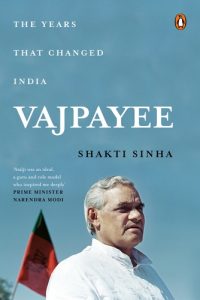
Prem Prakash watched history unfold, time and again

Having worked as a journalist for several years, Prem Prakash was witness to the turning tides of history. Read an excerpt from the account of his outstanding career and the historic moments he was a part of:


The twelfth of June 1975 was like any other summer day in Delhi— hot and humid with frequent power failures adding to the discomfort. Then there was a bolt from the blue. Suddenly, teleprinters in the newsrooms of media offices began clattering out a news alert from Allahabad. The verdict had been delivered on a lawsuit filed by the opposition’s defeated candidate, Raj Narain, against Mrs Gandhi’s election to Parliament in 1971. It was announced by Justice Jagmohan Lal Sinha. Prime Minister Indira Gandhi’s victory from Raebareli had been set aside by the Allahabad High Court following an election petition alleging malpractices and corruption.

Congress was stunned. Journalists rushed to the prime minister’s house. I was there too, along with Surinder, my colleague. Large crowds had gathered to support Mrs Gandhi, while senior Congress leaders went in and out of the house. Mrs Gandhi did not come out. The court barred Mrs Gandhi from holding elected office for six years, but it stayed the execution of the verdict to give her time to appeal against the judgment, if she chose. The media was as stunned as the government. Several were of the opinion that she should resign. By now, however, it was clear that she would put up a fight and go into appeal at the Supreme Court.

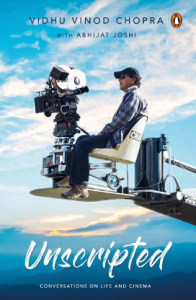
front cover Reporting India
Reporting India||Prem Prakash

After Indira Gandhi’s comprehensive victory in the 1971 Lok Sabha election, her rival, Raj Narain, had challenged the election result in the Allahabad High Court. The case had dragged on. Raj Narain insisted there were corrupt practices, but in fact there were none, except that one of Mrs Gandhi’s confidants, Yashpal Kapoor, whom I had known from Panditji’s time, was just as powerful as he used to be. This indicated that the bureaucracy believed that she hadn’t given up as yet. Raj Narain—the ‘joker in the pack’, as he was known—was elated at the verdict and demanded her resignation.

Yashpal Kapoor’s resignation came a few hours after the election was called, and he had already begun participating in the election campaign while employed by the foreign office of the government, something that the law does not permit. This was at best a technical or bureaucratic irregularity.

The case had already been argued and judgment was due towards the end of May. But the judge delayed it for some unknown reason. It was alleged that some Congressmen approached him to try and influence him in Indira Gandhi’s favour, making things worse for her. The judge was clearly peeved at this approach by the people whom he considered Mrs Gandhi’s agents.

Justice Jagmohan Lal Sinha had been avoiding public appearances for quite some time. He stayed home and called his stenographer to dictate his judgment. To guard against leakage, the judge insisted that his stenographer stay in his house. The day the dictation was completed, he asked the stenographer to disappear. That was 11 June 1975.

These are all known facts. The judgment was to be announced the next day, 12 June. Everybody across the nation was waiting. The judge arrived in court at 10 a.m., and within five minutes he allowed the petition.

The news spread like wildfire all over India and beyond. A news flash said that the court had allowed Raj Narain’s petition and found Mrs Gandhi guilty of corrupt practices. The judge then read out the judgment pronouncing Mrs Gandhi guilty on the basis of a simple technical error. It was like pronouncing a death sentence on someone for jaywalking.

Mrs Gandhi brushed aside all hints at possible corrupt practices by officials around her. At some point, when confronted with a question at a press conference as to why she was not taking steps against corruption, she had replied that corruption was a universal phenomenon. That sent a message down the line to the corrupt bureaucracy that it was okay to indulge in such practices so long as you did not get caught with your hands in the till.

After the Allahabad judgment, Mrs Gandhi was expected to resign. But she stood firm and said she would not do so, not till she went to appeal to the Supreme Court. The opposition took to the streets to protest at her challenging the judgment. This, to my mind, was totally unfair. You cannot prevent a person from exercising all their legal options. Demonstrations by the opposition, primarily led by the Jana Sangh, were not that big. These also did not resonate with the people, as by and large everyone felt that Mrs Gandhi had every right to go in for appeal.

…The Supreme Court, in its judgment on 24 June 1975, upheld the Allahabad High Court judgment, adding that Mrs Gandhi could continue as prime minister for six months and attend Parliament but not vote there. Subsequently, on 7 November 1975 (during the Emergency), the Supreme Court overturned Mrs Gandhi’s conviction in the Allahabad judgment.

Obviously, during those six months, following the Supreme Court’s conditional stay order, the prime minister’s office would be occupied by a person who was not really authorized to be there because of the Allahabad High Court order. At least this was the sensible way of looking at it—if the prime minister was disqualified she ought to resign, as the opposition insisted while holding their demonstrations.

The unrest was beginning to affect the country’s stability. The government had come to a virtual standstill, and many bureaucrats felt they were carrying out the orders of an illegal government.

Reporting India is an invaluable work, showing an intimate understanding of events we have only read about, from someone who was a part of those times.

Moving with the curve

‘Pessimism can become a self-fulfilling prophesy.’

-Martin Reeves and Jack Fuller


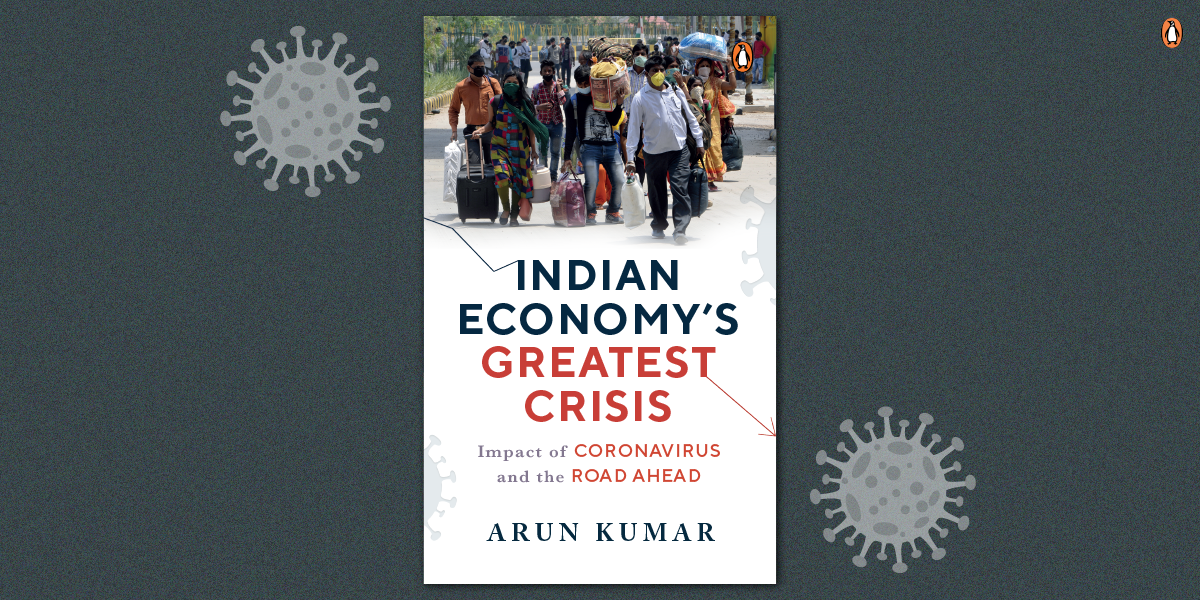
Coronavirus: Leadership and Recovery is a forward-looking work. It navigates the pandemic with innovative insights that can help businesses move ahead of crisis management at a time when imagination has become extremely crucial to problem solving. For a glimpse into the book, here is an excerpt:

~

As the coronavirus continues its march around the world, governments have turned to proven public health measures, such as social distancing, to physically disrupt the contagion. Yet doing so has severed the flow of goods and people, has stalled economies, and is in the process of delivering a global recession. Economic contagion has spread as fast as the disease itself.

This didn’t look plausible even in early March. As the virus began to spread, politicians, policy makers, and markets, informed by the pattern of historical outbreaks, looked on while the early (and thus more effective and less costly) window for social distancing closed. Now, much farther along the disease trajectory, the economic costs are much higher, and predicting the path ahead has become nearly impossible, as multiple dimensions of the crisis are unprecedented and unknowable.

Front cover - coronavirus leadership and recovery
Coronavirus: Leadership and Recovery|| Harvard Business Review

The window for social distancing—the only known approach to effectively addressing the disease—is short. In Hubei province it was missed, but the rest of China made sure not to miss it. In Italy the window was missed, and then the rest of Europe missed it too. In the United States, which was constrained by insufficient testing, the early window was also missed. As the disease proliferates, social-distancing measures will have to be enacted more broadly and for longer to achieve the same effect, choking economic activity in the process.

Another wave of infections remains a real possibility, meaning even countries that acted relatively quickly are still at risk every time they nudge their economies back to work. Indeed, we have seen resurgence of the virus in Singapore and Hong Kong. In that sense, only history will tell if their early and aggressive responses paid off.

Another wave of infections remains a real possibility, meaning even countries that acted relatively quickly are still at risk every time they nudge their economies back to work. Indeed, we have seen resurgence of the virus in Singapore and Hong Kong. In that sense, only history will tell if their early and aggressive responses paid off.

… However, we think examining various scenarios still adds value in this environment of limited visibility. The idea of “crisis management” requires no explanation right now. Something unexpected and significant happens, and our first instincts are to defend against—and later to understand and manage—the disturbance to the status quo. The crisis is an unpredictable enemy to be tamed for the purpose of restoring normality.

But we may not be able to return to our familiar precrisis reality. Pandemics, wars, and other social crises often create new attitudes, needs, and behaviors, which need to be managed. We believe that imagination—the capacity to create, evolve, and exploit mental models of things

or situations that don’t yet exist—is the crucial factor in seizing and creating new opportunities, and finding new paths to growth.

Imagination is also one of the hardest things to keep alive under pressure.

… In other words, renewal and adaptive strategies give way to classical planning-based strategies and then to visionary and shaping strategies, which require imagination.

…In a crisis, we likely won’t have immediate answers, and we therefore need to employ good questions. The most natural questions in a crisis tend to be passive, for example, “What will happen to us?” However, the possibility of shaping events to our advantage only arises if we ask active questions, such as “How can we create new options?” Creativity involves reaching beyond precedents and known alternatives to ask questions that prompt the exploration of fresh ideas and approaches.

~

Positing the power of creative imagination at the forefront, this book explicates the economic impact of the pandemic and tackles the fallout from its chokehold over businesses and economies.

The road to scale: challenges and prescriptions for success

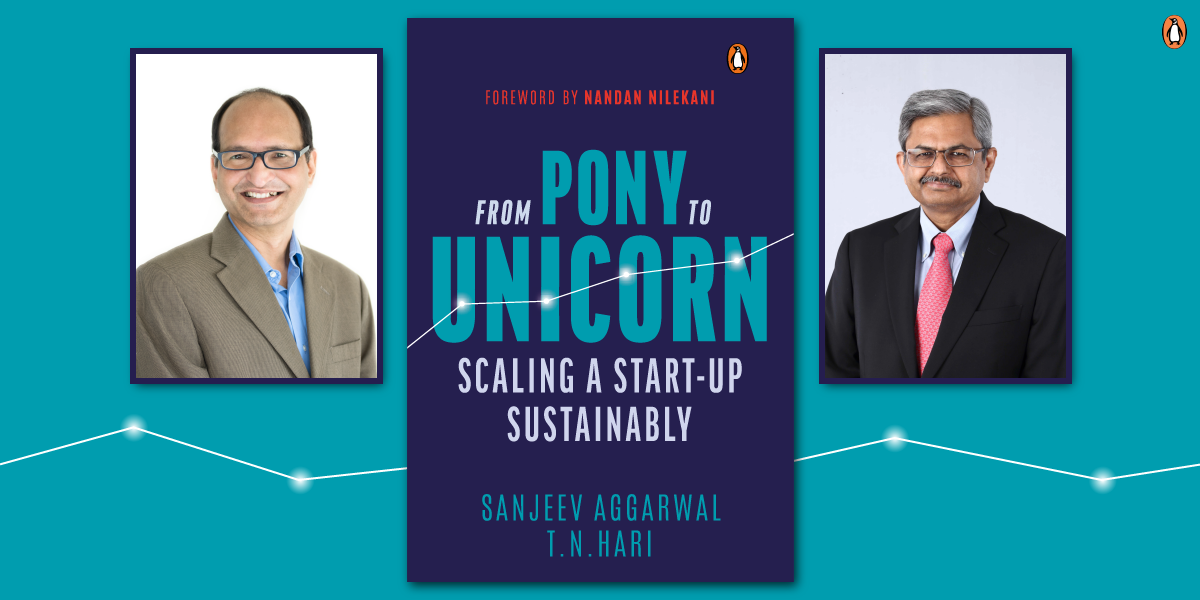
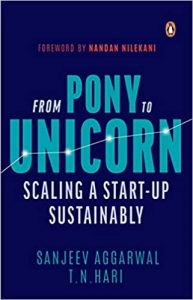
From Pony to Unicorn lucidly describes the X-to-10X journey that every start-up aspiring to become a unicorn has to go through. The book effortlessly narrates the fundamental principles behind scaling. Guaranteed to make for a very interesting read, the book will be useful to entrepreneurs, leaders and investors involved in scaling start-ups. Here is an excerpt from the book From Pony To Unicorn:


In his epochal book, Small Is Beautiful, Ernst Friedrich Schumacher says, ‘even today, we are generally told that gigantic organizations are inescapably necessary; but when we look closely we can notice that as soon as great size has been created there is often a strenuous attempt to attain smallness within bigness.’ Big companies have tried to act small to preserve innovation. Extreme proportions, whether for a life form or an organization, is not natural. It is only in science fiction that one comes across animals the size of Godzilla. The network of blood vessels and nerves and the bone structures needed to support a life form of this size don’t exist in the real world. Even large organizations need intricate structures, speedy communication channels, an extremely strong foundation and flawless management. From time to time, a few organizations defy all odds and make it really big until a small start-up somewhere ends up disrupting them. However, the quest for scale is never-ending. One of the most enduring human pursuits throughout history has been to create things on a grand scale. Whether it was building mammoth pyramids in Egypt or connecting the mediterranean with the red sea through the Suez, or laying undersea cables across the Atlantic, the attraction for grandeur and scale has been incessant. Despite the obsessive and timeless allure of scale, the failure rate has been high. Failure to scale can be because of many reasons, some of which are quite universal and pervasive. They show up in almost every scaling scenario. An understanding of these reasons can be very helpful. It does not guarantee success but can raise the odds in favour of success appreciably. There are also unique challenges in every scaling scenario. You need to deal with these like you would deal with any ‘first time’ problem. Tolstoy’s quote from Anna Karenina is beautiful and sublime, but there are underlying nuances and variations in its meaning. It is the sheer variety and number of nuances that make universal prescriptions for success and scaling, as much as for happiness, almost impossible and often meaningless. This applies as much to start-ups as to families. The closest universal prescription for success was from Arthur Rubinstein, who once said, ‘there is no formula for success, except perhaps an unconditional acceptance of life and what it brings.’ Insights and prescriptions make sense only to individuals who recognize deeply that lessons and wisdom are meaningless in the absence of context, and there is no wisdom or prescription that can’t be challenged. However, given a clear context, an insight drawn from similar contexts can be very powerful, create those ‘Aha!’ moments and help you rapidly overcome the hurdle that is holding you back. Steve Blank, a highly respected author on entrepreneurship in Silicon Valley, in an interview with Kevin Ready published by Forbes magazine, defines a start-up as a ‘temporary organization designed to search for a repeatable and scalable business model’. Eric Ries, a successful American entrepreneur and prolific author, in his seminal book The Lean Start-up, defines a start-up as an organization that is dedicated to creating something new under conditions of extreme uncertainty. He further adds, ‘this is just as true for one person in a garage as it is for a group of seasoned professionals in a Fortune 500 boardroom. What they have in common is a mission to penetrate that fog of uncertainty to discover a successful path to a sustainable business.’


 

From Pony To Unicorn
By Sanjeev Aggarwal || T. N. Hari

This is a reasonably accurate description of what every start-up sets out to do. However, it is a bit too broad and would include many organizations, such as research laboratories and Fortune 100 companies that wouldn’t be considered start-ups. Therefore, let’s narrow this down by adding three other unambiguous filters before an organization dedicated to creating something new under conditions of extreme uncertainty can be called a start-up: a) the founder/s should still be active; b) it should be funded by venture capital (vc); and c) it should still be a private company. if these filters are applied, companies like Amazon, Google, Flipkart, Uber and Lyft would fail to qualify as start-ups, while Bigbasket, Doordash, Rubrick, Dunzo, Paytm and Swiggy would all qualify. While founder/s being active and the start-up not yet being a public company are understandable filters, the additional filter of the organization being VC-funded is relevant because that helps exclude mom-and-pop businesses that don’t have the same appetite for scaling as VC-funded start-ups.


Geoffrey West in his seminal book Scale, published by Penguin Press in May 2017, points out that scaling laws, whether for organizations, organisms or cities, are consequences of the optimization of network structures that sustain these various systems, resulting from the continuous feedback mechanisms inherent in natural selection and survival of the fittest. There is compelling evidence, even though there are the rare exceptions, that scaling of organizations follows certain power laws. He also points out that after growing rapidly in their youth, almost all companies end up floating on top of the ripples of the stock market with their metaphorical noses just above the surface. This is a precarious situation because they can drown in the next wave, and they are even more vulnerable if they can’t deal with the uncertainties of the markets and their own finances. While it is important to be optimistic and believe that by doing the right things your start-up could deftly navigate through the labyrinth of challenges, it is equally important to have the wisdom to understand that scale, especially extreme scale, is truly an exception and nature has stacked all the odds against it!

Raja Rao’s Gandhi – A life in words

In many ways, Raja Rao changed the way Mahatma Gandhi is read and written about. Get a glimpse into the processes of his writing through Makarand R. Paranjape’s introduction to Mahatma Gandhi: The Great Indian Way: 


In the symposium on Raja Rao on 24 March 1997, I had spoken on his forthcoming book The Great Indian Way: A Life of Mahatma Gandhi. This was a marvellous retelling of Bapu’s life in the form of a modern purana. Rao had called it ‘an experiment in honesty’, adding that the ‘Pauranic style, therefore, is the only style an Indian can use’.

The publisher was Kapil Malhotra of Vision Books, who in 1996 had published The Meaning of India. Malhotra had inherited one-half of what used to be Dina Nath Malhotra’s Hind Pocket Books, India’s first paperback imprint. Malhotra, believing in Rao’s genius, had also published The Chessmaster and His Moves in 1988. That book had won Rao the coveted Neustadt Prize. The manuscript was part of a veritable treasure trove of unpublished material that some of us, who were close to Rao, had been fortunate to be able to see. But there were many more such unpublished works, which I had seen at the Harry Ransom Humanities Research Center, where Rao’s papers now rested.

front cover The Great Indian Way
Mahatma Gandhi: The Great Indian Way||Raja Rao

After the Chessmaster, Malhotra published On the Ganga Ghat (1989) too. It was a unique collection of short stories with the common theme and location of Varanasi. It was clear that we were in the midst of a quiet Raja Rao efflorescence. It would culminate in his being posthumously awarded India’s second-highest civilian honour, the Padma Vibhushan, in 2007, ten years after the prestigious Sahitya Akademi Fellowship mentioned earlier.

What was so special about Rao’s book, yet another of the hundreds written on Gandhi? Why had Mulk Raj Anand called it ‘Among the most authentic accounts of the Mahatma’s life and work’? It was this question that I had tried to answer in my presentation on Rao in the symposium in 1997.

The clue came from Rao himself. ‘Facts of course are there,’ he says in the preface, ‘but facts are shrill.’ Facts, in other words, do not tell the whole truth: ‘They have a way of saying more than they mean, and disbelievingly so. The silences and the symbols are omitted, and meaning taken out of breath and performance.’

What else do we have other than facts? It is, as Rao says, the ‘rasa, flavour, to makes facts melt into life’. The Indian experience is complex and multi-layered, requiring a special style to express it, even in modern times: ‘the Indian experience is such a palimpsest, layer behind layer of tradition and myth and custom go to make such an existence: gesture is ritual, and each act a statement in terms of philosophy, superstition, historical or linguistic provincialism, caste originality, or merely a personal one, and yet it’s all a whole, it’s India.’

Rao, next, makes a very bold statement: ‘Thus to face honesty against an Indian event, an Indian life, one’s expression has to be epic in style or to lie.’ Facts alone cannot tell the Indian story, nor can myths, rituals, or fables by themselves. The two must be combined in a unique manner. That was Rao’s reinvented pauranic style. Not in the manner of the old puranas, with— from the point of modern history—their unverifiable material. Nor the contemporary histories which were slaves to facts. But a unique combination of both.

This is what I called ‘seeing with three eyes’. The first eye sees only facts. The second espies the fable behind and around the fact. It is only the third eye, the eye of wisdom, that can combine both to see into the depths of things, their secret significance and meaning.

This special way of seeing is what Rao calls ‘fact against custom, history against time . . . geography against space.’ In his book on the Mahatma, this is precisely what Rao accomplishes, making ‘life larger than it seems, and its small impurities and accidents and parts, must perforce be transmuted into equations where the mighty becomes normal, and the normal in its turn becoming myth. Prose and poetry thus flow into one another, the personal and the impersonal, making the drama altogether noble and simple.’

An important feature of traditional Indian society, which persists to this very day, is its enormously rich and varied method of chronicling and celebrating life. In rural society, for instance, even humble craftspersons like weavers, potters, blacksmiths and wood workers have a specially designated bhiksha vritti jati, a group of mendicant performers, to record and disseminate their deeds. Thus, all our communities have their own jati puranas or community histories. Likewise, each village, each region, each state has its own legends, songs and stories. All these go into making up our rich narrative traditions.

Raja Rao, as he himself has often reiterated, belongs very much to this pauranic tradition. He has performed his duty as a writer as faithfully and sincerely as our ancient poets, who have told the stories of gods and demons, heroes and villains, apsaras and princesses, sages and mendicants with such zealous relish. A key and recurring figure in Raja Rao’s works is one of the greatest men of our times, Mahatma Gandhi. This book is Rao’s retelling of and tribute to Gandhi’s extraordinary life.

~

Through Mahatma Gandhi: The Great Indian Way, Raja Rao changed the rules of biography writing. The book paints a holistic and in-depth picture of a man who was larger than life.

The cost of freedom – Hamid Ansari’s battle for survival

Betrayed by his friends, Hamid Ansari found himself labelled a spy by Pakistani authorities. He battled for his innocence, surviving brutal interrogation sessions and long periods of confinement. This is an important read for anyone who wishes to understand the exact machinations of the event, and how state power can irreparably alter individual lives. Here is an extract:

It was not as cold as one would have expected on 19 September 2014. Zeenat waited with her mother at the bus stop for her trip to Karak. Her mother blessed her and wished her a safe journey. ‘Be careful, Zeenat. While Fauzia needs you, your family needs you more. May Allah bring you success.’

Zeenat reached Karak and went to Atta-ur-Rahman’s residence. She paid him and he told her exactly what had happened. He mentioned Abdullah Khattak, who was to receive Hamid in Kohat and help him rescue Fiza.

With all honesty, he said that he didn’t know why and how Hamid was picked up but that he had informed Fiza’s father and that is who must have informed the authorities. ‘It could be Abdullah too, you never know,’ he added.

… Since Kohat was an hour away from Karak, she immediately took the bus there and called up Abdullah on the way, introducing herself as a journalist from Lahore, saying she wanted to meet regarding a story. He readily agreed.

They met at the bus stop and went to a dhaba nearby. Zeenat told him why she was there—to track a story about an Indian called Hamid Ansari, who had been written about in the papers. He looked worried and asked her how she knew that he was Hamid’s contact. She told him that she was following up with the family back home and they had a few numbers.

‘How did they get my number?’ He knew very well that he could be in trouble.

Zeenat figured out that he was nervous. ‘Abdullah, consider me a friend. You did what was right so you have nothing to worry about. I am just trying to join the dots. How did he manage to enter our country and what was he up to?’ she said.

Her words calmed his nerves and he told her, ‘Imagine, he thought he could just enter our country and take one of our girls from here. I made sure that didn’t happen.’

Front cover Hamid
Hamid||Hamid Ansari, Geeta Mohan

‘Good. But was she not going to be a victim of wani?’ she asked while she took out her notepad.

He nodded, embarrassed, but went on, ‘Zeenat, whatever may be the case, he shouldn’t have thought that he would get away with it. I did what I thought was right.’

… He told her about Hamid’s plans, how he had connected with him, and of Palwasha Hotel, where he was taken. He also narrated the entire episode of his arrest. Zeenat listened intently and took notes, occasionally interrupting him for details such as the address of the hotel, time of arrival, last call, etc.

…They parted ways. It was evening. But Zeenat knew what she had to do next. She went straight to Palwasha Hotel and asked the boy at the reception to call the manager. A while later, a young man stepped out.

Zeenat asked them about the Indian who had come there on 14 November 2012. The manager looked shocked but feigned ignorance. Zeenat gave him a knowing look and flashed her press card. ‘I am here to do a story and I know everything. So please share whatever information you have. Where is your guest register? Show it to me.’

He hesitated and said, ‘We are a small establishment and don’t want any trouble. Please don’t put this in the paper. We don’t want people thinking we allow shady people or terrorists in. We don’t know who or where the man was from but we did have him here around that time. He was picked up by the agencies, I think.’

She understood their concern and assured them that she was only trying to find out some details. He pulled out the register and showed it to her.

She went to the entries for 2012 and sifted through them to reach November. When she reached 13 November, she saw that the next page was for 15 November. She looked carefully and ran her fingers through the binding of the register to see the remnants of a torn page.

She looked up at the manager questioningly. He understood what she was asking and said, ‘Well, the cops had come to inquire about the man and a few days later some other officers came and tore the page out. They instructed me not to breathe a word to anyone.’

…The man was a hotel manager in a small town. He was straight in his ways and didn’t mince words. He looked down and then turned around and left, before returning with a sheet of paper in his hand.

‘I didn’t throw it away since I didn’t trust the men. In case someone else came asking for him from the agency then I would have had no proof, that is why I saved this paper. Here it is.’ He gave it to Zeenat.

She saw the paper and noticed the name of one guest registered as Hamza. The manager pointed at it and said that that was the guy. Zeenat felt that Hamid obviously must not have revealed his real name. ‘Who was here with him?’ she asked.

The younger boy who stood beside the manager said, ‘I was here that night. There was a local man called Abdullah who had booked the room in advance. This other man looked like an outsider. A city boy from Lahore or Karachi. He checked in and left immediately after. He never returned. Only cops came in late that night to collect his belongings.’

‘Where was he taken?’
The manager replied, ‘Kohat police station.’


Hamid is a tale of survival, resilience and a relentless battle against the faceless power of the state.

Test Your Attention!

Our world today is filled with distractions that demand our attention every few seconds. The constant messages, notifications and pop-ups have a huge impact on our physical and mental health, making it difficult for us to concentrate on any task. In such a fast-paced world, attention is our most important resource. But we are largely unaware of the key role it plays in shaping our everyday lives.

Here is an interesting test, excerpted from How to Improve Concentration, by memory experts Aditi and Sudhir Singhal, and digital wellness coach Bala Kishore, to ascertain your level of attention.

**

In order to complete the test quickly, you must first go through the questions carefully. It’s a very simple test. Your aim should be to complete it as fast as possible.

Let’s start:


  1. Without looking at your shirt, count the number of buttons on it.
  2. How many zeroes are there in the number 10000000000086?
  3. Circle this instruction.
  4. How many ‘/’ are there in the following pattern?

\\\////\\\\////\\//\////\//\//

  1. Count the letter W in the group of letters given below:

WMMWMMWMWWMWWMWWMM MMWMMMWMWWWWWWMWM MWMWWMMWWMMWWWMWMW MWWWMWWMMMWMWMWMW

  1. Calculate the answer: 7 – 4 × 2 + 3
  2. Count the number of vowels in the sentences given below:
    • Observation is a skill that takes time to hone.
    • Keep practising, even if you think you will never

improve your concentration.

  1. Draw a star on the upper-right corner of this page.
  2. Convert these four numbers—6, 10, 13, 5—into letters using the coding given below and write the letters in the reverse order.

1=A, 2=B, 3=C, and so on.

  1. Now that you have finished reading all the questions carefully, do only question 4.

SOLUTION

front cover of How to Improve Concentration
How to Improve Concentration || Sudhir and Aditi Singhal, Bala Kishore


If you solved all the ten questions, we are sure the last one made you laugh. Just because you did not pay attention to the instructions given at the outset (‘In order to complete the test quickly, you must first go through the questions carefully’) you unnecessarily spent so much time and energy on tasks that weren’t even required.

In case you read and followed the instructions carefully, and solved just question 4 to get the answer ‘18’, then congratulations! You did have your attention focused solely on the test.


Jump into a reading hOle with hOle books!

A Short History of the hOle Books by Sayoni Basu, creator of the hOle books

front cover Chumki and The Elephants
Chumki and The Elephants || Lesley D. Biswas


When Duckbill was starting, and we were doing a systematic market survey to see what the obvious gaps were in the different kinds of Indian books for children being published, it was easy to spot that one gaping hOle was early chapter books for children. There were lots of internationally published ones, from the UK and US, but a dearth of locally published ones. There were many Indian picture books, and many storybooks, but there was a jump in level between them so that there was no smooth, natural transition We wanted a distinctive identity for the early chapter book series—one of the joys of series publishing is that one can think seriously long term—and the best identity is always through design, so we turned to Gunjan Ahlawat. He said he had always wanted to do books with a hole in them, and so the hOle books were born.


front cover The Clockwala's Clues
The Clockwala’s Clues || Varsha Seshan


The hOles on each page have been a great source of joy. For editors, it is fun to come up with concepts where hOles could be incorporated into the story. For illustrators, it was fun to make characters jump from one page to another through the hOle or transform hOles into elements of an illustration. We were very clear that the stories would be contemporary, Indian, and with protagonists who were the age of the potential readers (so about seven till nine), facing dilemmas and challenges which the readers would be familiar with. And while the first few books were commissioned and the series ideas carefully explained to the authors, very soon, we started getting manuscripts which were labelled ‘hOle books’, showing that people had started identifying the central characteristics themselves. Over the years, the hOle books have been shortlisted for or won every major book award in India. Several authors have written mini series within-series, such as the adventures of Petu, Timmi, Maya, Peanut and Chumki, who have appeared in two or more books.


front cover the chirmi chasers
The Chirmi Chasers || Arefa Tehsin


We are really thrilled that there are now twenty-five books in the series. Series publishing is the backbone of children’s books all around the world—and it makes us really happy that this series has sustained itself and taken on new dimensions and is known and loved by so many people. It is truly a moment to celebrate.


The fine art of balance – Deanne Panday’s guide to a wholesome life

Deanne Panday tackles all facets of modern life in her new book, from home-cooked food and finances to spirituality and joy, nudging us towards a holistic approach to wellness. Here is a glimpse into her insights on climate change:

~

The COVID-19 pandemic changed the way we experience life in so many ways. One of the most drastic impacts was on the environment when half the world was forced to stay home, and reduce movement and travel. All those days, I woke up to a clear, blue sky instead of the smoggy, unclear one I’ve gotten used to in the years I’ve lived in Mumbai. With no vehicles on the streets and polluting industries shut, people were able to breathe probably the cleanest air of their lives. It’s a pity it took a life-threatening virus to steer us to a way of life we should anyway strive for.

Our reckless and ignorant attitude towards the environment has brought us where we are today. We are all guilty of willingly choosing the things that convenience us, no matter how much it endangers others. As long as it doesn’t harm us, as long as our needs are met, we’re ready to turn a blind eye to the destruction we leave in our wake. I see children learning about various subjects in school and then spending more hours gaining more knowledge, but yet not enough to change their lives in a way that they can reduce pollution in their surroundings and work to reverse it.

According to the National Green Tribunal, more than 60 per cent of sewage generated by urban India is untreated and enters water bodies, such as rivers, making the water in them unfit for consumption.1 We somehow think that whatever we throw away will be cleaned by someone else. It’s an ignorant attitude, and we need to raise our children to be responsible for their own actions. Littering, even if it is a small packet of single-use plastic, doesn’t do any immediate harm, but this attitude is part of the reason we are the fifth most polluted country in the world. People blame it on several things, but it’s never themselves. The power to reverse ecological damage lies with the people, but we often forget the responsibilities that accompany that power.

Front cover balance
Balance||Deanne Panday

I learnt a lot more about our impact on the environment when I took up an online course offered by Harvard University  during the lockdown. I discovered just how badly we have abused our planet without realizing that we have abused ourselves in the process. Working out regularly and eating healthy can mean very little when the air we breathe is of poor quality. We are all partly responsible for that unbreathable air. By not taking care of the environment, we are endangering the lives of our children and our grandchildren. If you’re as old as I am, think back to your childhood. Wasn’t the environment much cleaner then? In just thirty to forty years—barely a blip when we consider the age of the Earth—we have damaged our planet to such a grave extent that we, along with other living creatures, are all struggling to live. If just a few decades can do this, imagine how bad it will be in the next couple of decades. I shudder at the thought.

That is why I decided to include this chapter in my book. Turning a blind eye towards climate change does not make you immune to it. I hope better awareness will help you take a step towards a better life for yourself and the coming generations.

…While governments need to bring out drastic changes in policy to go green, on an individual level there is a lot we can do too. After all, when a toxic environment can affect our health so badly, how can we not make changes to our lifestyles? We can all contribute in the simplest ways, whether it is by walking or hopping on to a bicycle instead of taking the car to places that are close to us. Not only will this result in more exercise, but it will also ensure the air we breathe is cleaner.

A clean environment is one of the vital foods of a balanced life. As we work internally and externally on making ourselves happier and our lives more fulfilled, we also have to be mindful that our existence doesn’t impact the world adversely. After all, all that we do today affects our children’s and grandchildren’s lives in the future. I don’t want my loved ones to struggle to breathe clean air because of our ignorance and mistakes. Do you?

… I strongly believe that once our mindset changes, everything else will follow. In school and college, we’re taught about finance, science and history, yet spreading knowledge about the environment is overlooked and treated as less significant. We are raising our children to be intelligent enough to hold top rankings in prestigious universities around the world but ignorant of how the world is inhabited, polluted and taken for granted. For every action, there is an equal and opposite reaction. It’s time we inculcate respect for the planet in our lives rather than just our test papers and studies, and understand that every negative action of ours has an equal or more drastic effect on our planet. Climate change is more real than ever now. It is time to act.

~

Balance focuses on thirteen key elements that we all need for a happier, healthier life. It is customized to our benefit, and also serves as a guide to managing the deteriorative aspects of our life – anger, stress and dissatisfaction.

Lessons on temporality from the last days of the Buddha

The one certainty in life, the one appointment which each of us will just have to face, is the one for which we do the least to prepare-death.

Preparing for Death explores the questions that have puzzled humanity from the very beginning as evinced by the rituals, texts and philosophies that surround death. From the lives and last days of the Buddha, Ramakrishna Paramahamsa, Ramana Maharshi, Gandhiji, Vinoba; from our religious texts and teachings of great meditation masters; from santhara to sannyas , Arun Shourie explores all  these, for their  views on how to prepare oneself for the end.

Perhaps some of the most lucid and stark discussions as to the nature and inevitability of death exist in the teachings of the Buddha. With a lyrical look at the final discourses of the Buddha, Shourie offers guidelines on how to live so that one prepares oneself to face death with equanimity.


  1. Worldly troubles plague even the Perfect Ones

‘Ananda, I am now old,’ the Buddha says, ‘worn out, venerable, one who has traversed life’s path, I have reached the term of life, which is eighty . . .’ And pain is a constant blight: ‘It is only when the Tathagata withdraws his attention from outward signs, and by the cessation of certain feelings, enters into the signless concentration of mind, that his body knows comfort.


  1. Both in life, and in the preparation for death it is wise to withdraw the need for outside support, to removes one’s dependence on another’s existence and to find refuge within oneself

Therefore, Ananda, dwell with yourselves as your own island, with yourselves as your own refuge, with no other refuge; dwell with the Dhamma as your refuge, with no other refuge That is why, the Buddha counsels, it is well for a monk—and surely, for each of us—‘to review, from time to time, his own faults . . . another’s faults . . . his own attainments . . . another’s attainments’. And to dissolve by mindfulness the obsessions and ill-intentions that arise.


  1. A certain purity of thought and intention allows one to face death with equanimity.

And the Buddha draws a lesson from Devadatta’s fall, a lesson apt for the way we live our lives. Devadatta went to perdition, the Buddha says, because he had been overpowered by thoughts of gain and loss, of fame and obscurity, of honour and infamy; because he had been consumed by evil intentions and poisoned by evil friendship.


  1. Death invariably seems something that happens to other, so the first acceptance of the temporality of all things-including oneself

Ananda, have I not told you before: All those things that are dear and pleasant to us must suffer change, separation and alteration? So how could this be possible? Whatever is born, become, compounded, is liable to decay—that it should not decay is impossible.


  1. The idea of ‘preparing for death’ also encompasses an acceptance that there are no guarantees, no certainties as to when and where the final moment will occur. Thus our lives itself are ordered in a way that one is, by necessity-preparing for death.

As the Buddhist teachers say, even though we see death every other day, our general attitude is, ‘Yes, yes, I know I will die. But I won’t be dying this year, certainly not this week. In any case, not today.’ The Buddha placed great emphasis on reversing this complacence. He wanted us to always bear in mind: death is certain, but its manner, place, time are absolutely uncertain. He wanted us to internalize these facts, and order our lives accordingly.


  1. Death ultimately subsumes all possessions both material and immaterial.

Each of the ones now lying on the pyre or on those wretched rails had come empty-handed, each is going empty-handed. The assets they had acquired, the honours they had won, the services they had performed, the high positions they had held—none of these could save them, nor was any possession or honour accompanying them.


  1. Death is inescapable, even for the enlightened who have freed themselves from all material fetters, even for the Tathagata himself.

Even in the case of those Bhikkhus who are arahants, whose taints are destroyed, who have lived the holy life, done what had to be done, laid down the burden, reached their own goal, utterly destroyed the fetters of existence, and are completely liberated through final knowledge: even for them this body is subject to breaking up, subject to being laid down.


  1. Preparing for death is in itself a discipline-as the Buddha’s address to his monks at Vesali before departing for his final pilgrimage suggests.

Ripe I am in years. My life-span’s determined.Now I go from you, having made myself my refuge. Monks, be untiring, mindful, disciplined,Guarding your minds with well-collected thought. He who, tireless, keeps to law and discipline, Leaving birth behind will put an end to woe.

Learning to prepare for death

The one certainty in life, the one appointment which each of us will just have to face, is the one for which we do the least to prepare-death.

Preparing
Preparing For Death

Preparing for Death explores the questions that have puzzled humanity from the very beginning as evinced by the rituals, texts and philosophies that surround death. From the lives and last days of the Buddha, Ramakrishna Paramahamsa, Ramana Maharshi, Gandhiji, Vinoba; from our religious texts and teachings of great meditation masters; from santhara to sannyas, Arun Shourie explores all  these, for their  views on how to prepare oneself for the end, and to face death with equanimity.


But to get back to the incidents. They are a consolation, they put our difficulties in perspective: if even the Buddha had to contend with such mundane troubles, who are we to complain? In any case, even the most fleeting glimpse of these great souls has always bewitched me. On occasion, therefore, I have included longish extracts from contemporary accounts: we see them in their natural habitat, so to say; we hear them talk, we see how they spent their day, what they ate, sometimes even what they lookedlike. Our Adit is forty-four now, but he is small for his age— bound as he is to his wheelchair, he weighs just about 112 lbs; and so I was astonished out of my wits when I read in Pyarelal’s The Last Phase, that when, just a few days before he was assassinated, Gandhiji was weighed, he was just 109 lbs. A man of a mere 109 lbs—‘a little man,’ as British commentators used to call him, all of 5’4’’—had brought down the imperial fortress. So, I have included extracts that have details which I hope will entrance the reader too. But there is another reason also. At first glance the extracts from diaries and the rest will seem far removed from the subject of this book—death. And yet, one of the exercises for the reader is to always keep asking what that seemingly irrelevant detail or event—the equanimity with which the Buddha bears calumny, for instance—tells us about how the personages attained the way they died.

Final lessons

In our present context, reading about their last days is especially instructive. And it is natural to seek lessons from their dying. Indeed, as we shall see, when their end came, the Buddha, Sri Ramakrishna, Sri Ramana deliberately kept their disciples and even lay followers close by so that the latter may learn the final lessons from their life, that is, from their dying. The Buddha had asked a disciple to fold the cloth in four and spread it on the ground between two sal trees. He lay down. He sent for the disciples. As they stood around him, one of the most revered Tibetan monks of the last century, Pabonka Rinpoche, told the thousands who had gathered to hear him—the Buddha pulled away his upper garment so that they could see his body—‘It is only rarely that anyone gets the chance to see the body of a Tathagata.’ And the Buddha said to them, ‘This too. You too’—this happens to Buddha too; it will happen to you too. So, to the last years and days of a few great men, and one woman who was ‘ordinary’ enough that she could have been our mother. What happened in the last few months and days? What choices had they to make? What painful decisions had relatives, disciples and associates to make? Did they slide into death or did the ‘delusion of reprieve’ alternate with despair? How did doctors respond? Were they of one mind, or did their diagnoses differ? Would new treatments show improvement? Would the improvement last, or would the hopes it had triggered be dashed in a few days?

  • Most important for our subsequent discussion, in those final days:
  • What could they no longer control?
  • Over what did they retain control?
  • What had prepared them for the control that they retained till the end?
  • What stages did their bodies pass through, and their minds, before they eventually died? What decisions did they have to take on the way? That such and thus medical procedure must not be undertaken—in one instance an injection, in another amputation. To take at least water or not even that? For such are the decisions that we will have to take, in some instances to enforce on those looking after us in those final days.
error: Content is protected !!