Publish with Us

Follow Penguin

Follow Penguinsters

Follow Penguin Swadesh

Preserving the ‘magic’: Maintaining long-lasting friendships

Friendships and sustainable, in-depth human bonds are crucial for survival and individual fulfillment. But like any relationship, friendships also need care and emotional investment for sustenance and strength.

In his latest book The Magic of Friendships, motivational speaker Shubha Vilas explores, in a straightforward, anecdotal manner, some accessible advice on how to sustain strong and magical friendships in your life. We take a look:

**

Growing as an individual

‘Unless we work on our bad attitude and develop the right attitude and mindset, genuine friendship will always elude us.’

The Magic of Friendships || Shubha Vilas
Symbiotic and mutualistic dynamic

‘[A symbiotic relationship] should ideally not be developed with the intention of deriving gains from the other person, but should be born of compassion and empathy towards one another.’

Putting friends at the centre of our lives

‘Friendship begins when we get rid of our self-centred mindset. As long as we remain at the centre of our lives, making good friends is out of the question. […] As long as we are focused on serving our own needs, interests and concerns, there is no time or desire to focus on the needs, interests and concerns of another person.’

Be your own friend first

‘To be a friend to another person, you first need to be a friend to yourself. Before you take on the responsibility of a friendship, you first need to take responsibility for your own self. The responsibility for changing ‘me’

Invest time and effort

‘[Deep friendships] cannot be developed overnight. They need patient nursing, which requires time.’

—-

In these challenging, socially-distanced times, it is more important than ever to keep your friends close. The Magic of Friendships is a testament to the fact that those friendship goals are way more attainable than you think!

Nine glimpses into the making of an Indian army officer from The Kargil Girl

1994, twenty-year-old Gunjan Saxena boards a train to Mysore to appear for the selection process of the fourth Short Service Commission (for women) pilot course. Seventy-four weeks of back-breaking training later, she passes out of the Air Force Academy in Dundigal as Pilot Officer Gunjan Saxena.

On 3 May 1999, as the Kargil war begins, the time comes for Saxena to prove her mettle. From airdropping vital supplies to Indian troops in the Dras and Batalik regions and casualty evacuation from the midst of the ongoing battle, to meticulously informing her seniors of enemy positions and even narrowly escaping a Pakistani rocket missile during one of her sorties, Saxena fearlessly discharges her duties, earning herself the moniker ‘The Kargil Girl’.

The Kargil Girl || Gunjan Saxena, Kiran Nirvan


This is her inspiring story, in her words. Read on for some fascinating insights into the meticulous training and strategic testing that goes into the making of an officer of the Indian Defence Forces.


Testing involves almost superhuman levels of co-ordination and dexterity
‘Using one’s peripheral vision, one had to press the buttons on an adjacent panel as they lit up. A red and green light on the screen had to be switched off using one’s left hand. All this had to be done quickly and simultaneously.’


The psychological tests to determine the mental strength of people who will lead in battle form a major chunk of the SSB exam—the Word Association Test (WAT), the Thematic Appreciation Test (TAT), the Self-Description (SD) test and the Situation Reaction Test (SRT).
‘These might just sound like acronyms to many, but for defence aspirants, these are the devils that stand at the gates of any SSB centre, ready to peek into the darkest corners of their minds and reveal their true, hidden selves.’


There is almost no margin for error in even a single applicant-as the strength of the chain is only as much as that of the weakest link.
‘The rate of error has to be zero—one wrong selection and an entire platoon, battalion or even a division may suffer. Someone can be denied for being too young, too old, for having flat feet, anxiety, phobias and so on.’

There are several levels of testing and training that must be passed before one becomes a commissioned army officer
‘Getting recommended was only the beginning. The path to glory was strewn with obstacles, ones that would almost break me.’


Training commences with ordeals designed to engender the highest levels of fitness
‘Introductions began with us—the first-termers—in high-plank position. Some of us couldn’t even remain in the position for thirty seconds. Whenever one of us fell flat on the floor, the others were asked by the seniors to do more push-ups.’


A lack of preparation is simply not an option in the Indian military.
‘I spent the night thinking about what had gone wrong. I knew the answer, but I was not quite ready to accept it—not until the next day, when I finally told the CFI that it was the result of my lack of preparation. A long lecture followed, a lecture that shook me nice and proper, and I decided to pull up my socks after the incident.’


Every possible emergency is thrown at one out of the blue to test your ability to handle difficult situations instantly.
‘In the absence of rudders, which control the nose of the helicopter, it becomes difficult to balance the flight. I had never imagined Group Captain Sapre would ask me to perform this emergency procedure.’


The intense course culminates in a passing out parade that requires even greater levels of rigorous preparation!
‘Exhausted from the morning parade practice, we would hardly be left with any energy to go for it again in the afternoons. The scorching heat of peak summer, mixed with the heat reflected from a metalled parade ground, would leave us drenched in sweat.’


And despite all of this-the brave cadets who undergo this have no regrets in doing their duty.
‘Indian military is one place that is free from any gender bias or discrimination. If I could spend the rest of my life in uniform serving in the armed forces, I would willingly do so.’

Helmets, flutes and an adventure of our own!

We are all set to witness an AWESOME FRIENDLY EPIC adventure that our AWESOME friend Greg Heffley has invited us on.

But first, we need to get to know our companions! Scroll down below to meet ROLAND THE KIND, who really, really wants an adventure of his own!

*

Once upon a time in a land far away there lived a boy named Roland. And Roland was a very good boy.
Back then school hadn’t been invented yet so most kids worked on their family farms all day.
But Roland’s parents thought it was important for their son to get an education and to learn to play an instrument. So he spent his days inside, reading books and practicing the flute.
Awesome Friendly Adventure || Jeff Kinney
Roland didn’t like practicing the flute very much but he never complained because he wanted to be a good son.
It was a dangerous time when ogres and giants roamed the land. So Roland’s parents liked him to stay indoors where it was safe, especially after dark.
Roland had never even been outside his village. He wished he could go on adventures like his grandpa Bampy the Brave who used to fight monsters and search for treasure.
But Bampy was never the same after he got back from his adventures. And Roland knew that was because Bampy didn’t always wear his helmet and he got hit on the head a few too many times.
Roland promised his parents that if he went on an adventure he’d ALWAYS wear a helmet and he’d make good choices. But they said he’d be much safer staying at home and practicing his flute.
So the only thing Roland could do was read stories about Bampy and imagine what it would be like to have adventures of his OWN.
*


Will Roland the Kind get to have an AWESOME ADVENTURE of his own?

Quality vs quantity

Do you have numerous friends on social media, but hardly any in real life?
Do you find that your relationships don’t last?

Sustaining quality friendships and bonds have become even more important in today’s times. The warmth and companionship that a good friend can provide is unmatched.

In The Magic of Friendships, Shubha Vilas discusses, in a simple and straight-forward manner, what is missing in our friendships today and the various scenarios that prevent people from making and maintaining good friends. Find an excerpt below that explores the need for quality and strength of the friendship over the number of friends.


**


Friendships Should Bring Joy

Blood relationships are formed when you share DNA, the substance of the body. Friendship is formed when you share the substance of the mind.

Most people today form friendships due to circumstances. These are called ‘circumstantial friendships’. Though some of them may end up becoming genuinely deep bonds, usually, they do not cross the first level of friendship. Now you may think, ‘What is Level 1 of friendship? How many levels does friendship have?’ Let me introduce you to the various levels of friendship before we take this conversation ahead. I will start with an example. Kamla was a smart and talented girl. It was no wonder she was popular in college. She also knew what made people happy: a little bit of kindness and a few words of appreciation. She used these generously in her dealings with everyone, and people were drawn towards her. Her life was busy, what with so many invitations and so many friends wanting her company all the time. She was always surrounded by people. Life felt like it could not have been better or happier for Kamla.


The Magic of Friendships || Shubha Vilas

One day, she woke very excited: they were celebrating Friendship Day in college. She had given a lot of thought to the matter of whom she wanted to give gifts to. She had many friends to choose from and she didn’t want anyone to feel left out. But she couldn’t possibly give gifts to each and every friend she had! So she finally settled on two people she had recently befriended. Of course, she was as excited about receiving gifts as she was about giving them. However, she was not prepared for what happened next.

She sought out both her friends, as she had planned, and gave them their gifts. They laughed and smiled as they chatted, but they did not give anything to her. She waited all day for gifts to come her way. She had imagined friends falling all over her, showering gifts on her. But nothing like that happened. In fact, she was the only girl in class who did not receive a single gift! She was in such shock that she went home in tears. How was it that a girl who was the life of every party did not receive a single present? Did she not smile and hug her friends often enough? Did she not call them regularly to chat with them? Did she not attend their parties when they invited her? All this and yet, no one thought of her as a friend? It was too much for her to bear.

Her family consoled her, but her mother pointed out that perhaps, in her effort to be a friend to everyone, she had not been a true friend to anyone; in an attempt to win a large number of friends, she had undermined the importance of building quality friendships. Kamla understood her mother’s words, but what could she do now?

**

Which of your friends are you remembering today? Do drop them a (virtual) hug in the comments below!

Will love find a way?

Right from childhood, Sahil and Ayra have been very different from each other. While Sahil is careless, carefree, ‘new money’ and ‘the brat’, Ayra is sensitive, reserved, shy and not easy to talk to. And that is probably what attracts Sahil to her. Their story progresses slowly and delicately, and things gradually take on a love-tinged hue.

Find an excerpt below that gives a glimpse into how Sahil and Ayra’s relationship blooms.

**

The earthy smell of damp soil filled the void between us. Semi-drenched, we took shelter in the nearest shop and I gave her the scarlet silk scarf that I had bought from the store earlier that evening—my first ever present to her. ‘Happy birthday!’ I wished her again as she placed the scarf around her neck. It complimented her skin and she looked lovely. Yes, I did curse myself for not being able to give her the pair of earrings, which were waiting for us at the restaurant but this was no way less. Like us, many other people pushed themselves under a tiny shelter and so she had to come closer to me. We spoke in whispers and marvelled at the rain. as the rain clouds started to disperse, people moved away and so did she. after around half an hour later, the rain finally stopped. It was time for us to part ways as I had to go to attend college the next day in another city and she had to get back home in time because that evening she was to be home alone. I offered to arrange a ride for her to go back home but she preferred to take an uber instead after she dropped me at the airport.

‘I hope I didn’t hurt you,’ she revisited the topic one last time as we were about to say goodbye to each other at the airport. There were so many people around going in and out of the place. I didn’t want to go in; I wanted to talk to her all night that night but I knew that we both had to go. It was getting dark already and a sudden worry around her safety crept into my head.

‘No!’ I said shaking my head. I was amazed that she felt the way she did because if someone had to be sorry it had to be me. Meeting her that day and then going away made me realize that I did not want to go back. all this was so new to me—the meeting and the parting all happening at such short notice. I wanted to know her more and ask her everything that she had to tell me. I knew that it was all so sudden and also kind of rushed. But you cannot control your feelings—I felt embarrassed by my feelings despite being aware that they were as genuine as they can be. She had touched my heart with her genuineness and I smiled at her to tell her that it was all good—nothing that she ever said could have hurt me.

To You, With Love || Shravya Bhinder

She gave me a warm smile in return and moved her tongue over her lips while she framed her thoughts into a sentence. In a grave, low voice—the kind that one uses with kids to make them understand very important matters of life—she told me, ‘Sometimes I feel that intelligent people are so full of doubts nowadays while fools are full of themselves and overly confident. If intelligent people do not follow their dreams and only fools do, the world will be a circus for the next generation. Think about it.’ With these words, she gently kissed my right cheek making me the happiest man at the airport at that time and murmured a soft goodbye. She walked away not looking back at me even once as I stood there almost melting under the cold breeze.

She was broken but pure magic. Her understanding of things made life so much simpler. Her presence was what I had been looking for in my life and by then I knew that as well.

When I reached home that night, I decided to work on my book as soon as I was done with the assignment from college. I will have to accept that I did struggle a lot trying to brush aside the memories of the gentle goodbye kiss, which took me by surprise. It was all happening very quickly and I wondered if I was living in some parallel universe. She was too good to be true and we had known each other for only a few weeks, yet it felt as if we had known one another for decades, and if you look at it, we really did. Her entry in my life made something click, like when a key clicks inside a lock and you know that you have found the right one.

**

A beautiful story about how true love triumphs over all odds that life throws its way, To You, With Love is sure to tug at your heartstrings.

Insights into elephant conservation in India

From the Green Revolution to the National Action Plan on Climate Change, Unearthed: An Environmental History of Independent India chronicles the country’s historical movements and significant green missions since 1947. Interspersed with lots of trivia, tales of eco-heroes and humorous cartoons, this easy-to-read account uncovers the story of a past with the hope that we will rewrite India’s future.

Read below an excerpt from the book:


Elephants are the world’s largest land animals and they need a large area to live freely—not just a forest, but entire landscapes or ranges with paths they can use to walk from one place to another in search of food and water. After all, their needs are also big. An adult Asian elephant can eat more than 100 kilograms of food and drink more than 100 litres of water in a day. Just one forest is not enough to meet these needs. That’s why they walk hundreds of kilometres every year, allowing forests along their way to regenerate in time for them to return several months later. In the first few decades after Independence, India was on a development drive. Land was cleared to grow crops, natural forests were replaced by plantations or mined to support industry, rivers were dammed, roads were built, factories, power transmission lines and railway lines were set up in more places and the human population began to explode. No one really thought about leaving room for elephants. As their habitats were lost to development, cases of human-elephant conflict began to rise. Among the most common forms of this conflict was crop-raiding. Hungry elephants found an easy supply of food in farmlands. So, they ransacked crops worth a lot of money and sometimes ended up injuring and killing villagers. In retaliation, angry villagers slaughtered elephants by poisoning or electrocuting them.

States found themselves struggling endlessly with this mammoth problem. Finally, in 1989, the central government set up a task force to look into the details of the problems being reported by different states. Among other things, the task force found that elephants had disappeared from many places in which they were once found. It also noted that the wildlife reserves set aside during Project Tiger  in 1973 were woefully inadequate for elephants. Conserving elephants meant that India needed to think big. In 1992, the government launched Project Elephant to save its gentle giants.

Saving Elephant Habitats

The task force had identified landscapes inhabited by elephants across India. These included the forest habitats of elephants, as well as corridors or routes they used to walk from one forest to another in search of food and water. One of the first strategies of Project Elephant was to set aside forests in different landscapes as elephant reserves, fortified with plant varieties that could serve as food. It also sought to secure the corridors connecting these reserves to each other. The idea was to limit the need for elephants to venture into surrounding human habitats for food and water. In 2001, Singhbhum in Jharkhand was officially declared the first elephant reserve of India. Sprawling over thousands of square kilometres across three south-eastern districts of the state, the reserve was part of an elephant range that also included other reserves in West Bengal, Odisha and Chhattisgarh. Today, elephant reserves cover more than 65,000 square kilometres of forest land spread across eleven elephant ranges in different states in north-western, north-eastern, central and southern India. Meanwhile, more than 100 elephant corridors have been identified throughout the country with the help of the Wildlife Trust of India (WTI). Unfortunately, less than 30% of elephant reserves and corridors fall within legally protected areas of India. This has made it easy for land in elephant ranges to be diverted for everything from mining and agriculture to building tourist resorts and constructing roads. More than 60% of elephant corridors have a national or state highway passing through them while about twenty of them have railway lines. Hundreds of elephants have been killed in train accidents over the years. One of the worst accidents took place in 2013, when a passenger train passing through the Chapramari Forest in northern West Bengal failed to apply brakes on time and rammed into a herd of elephants that were foraging near and on the tracks. Five adult elephants and two calves were killed while ten elephants were injured. Various measures have been tried to prevent train accidents. These include reducing train speeds in elephant corridors and activating early warning systems. For example, in Tamil Nadu, sensors mounted on poles along the railway track monitor elephant movement. If an elephant sets off a sensor, a text message is sent to the railway staff and the animals are chased away. Railways have also experimented with some creative solutions such as devices that produce the buzzing sound of honeybees to keep elephants at bay. Long-term solutions include building overpasses or underpasses as safe crossing points for elephants, raising the railway track, or removing tracks from accident-prone areas.

A shrinking range, intersected by an ever-growing number of human settlements, farmlands, plantations, roads and railway lines, remains the biggest threat for elephants and a major reason behind human-elephant conflicts.


Get your copy of Unearthed: The Environmental History of Independent India here

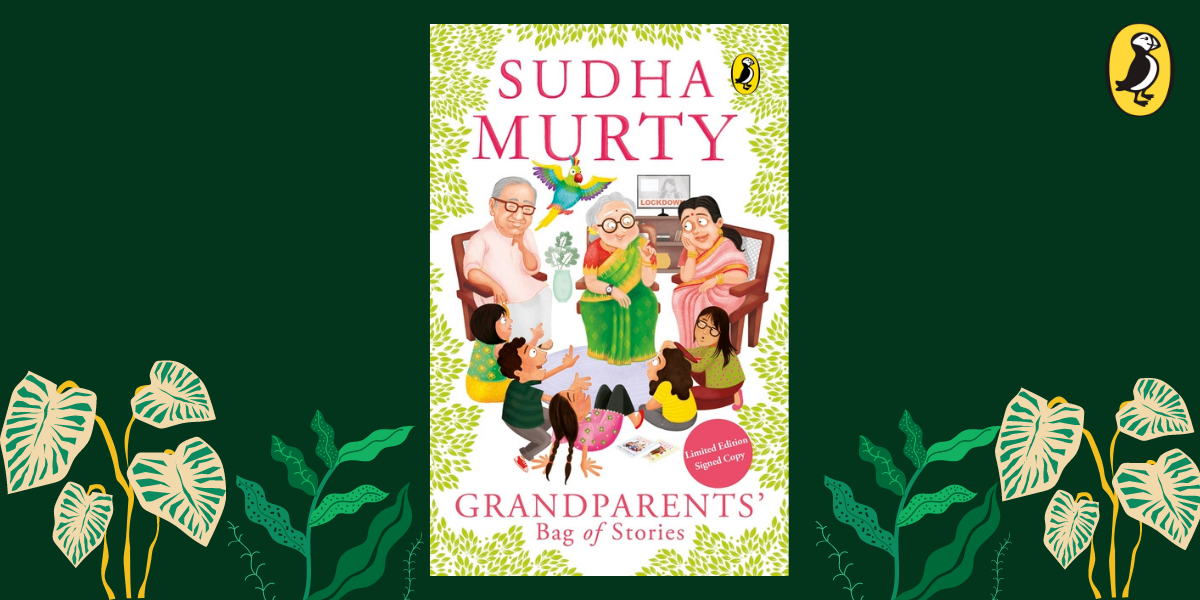
Celebrate 70 years of the legendary Sudha Murty with these words of wisdom

There’s nothing like a book that touches your heart and stirs your soul. Coming across such books is often followed by a joyous realisation that we have, perhaps due to sheer serendipity, chanced upon a writer we would keep going back to.

Today, we are celebrating 70 years of Sudha Murty by revisiting some of our favourite quotes by the writer, whose words deeply resonate with us and to whose books we often turn to for comfort and wisdom.


Three Thousand Stitches || Sudha Murty


‘We all lose a few battles in our lives, but we can win the war.’
―Three Thousand Stitches: Ordinary People, Extraordinary Lives


The Day I Stopped Drinking Milk || Sudha Murty


‘I realized then that only diseases and not honesty and integrity are passed down to the next generation through genes.’

―The Day I Stopped Drinking Milk: Life Lessons from Here and There


How I Taught My Grandmother to Read and Other Stories || Sudha Murty


‘Doing what you like is freedom, liking what you do is happiness.’
―How I Taught My Grandmother to Read and Other Stories


Wise and Otherwise || Sudha Murty


‘Life is an exam where the syllabus is unknown and question papers are not set. Nor are there model answer papers.’
―Wise and Otherwise


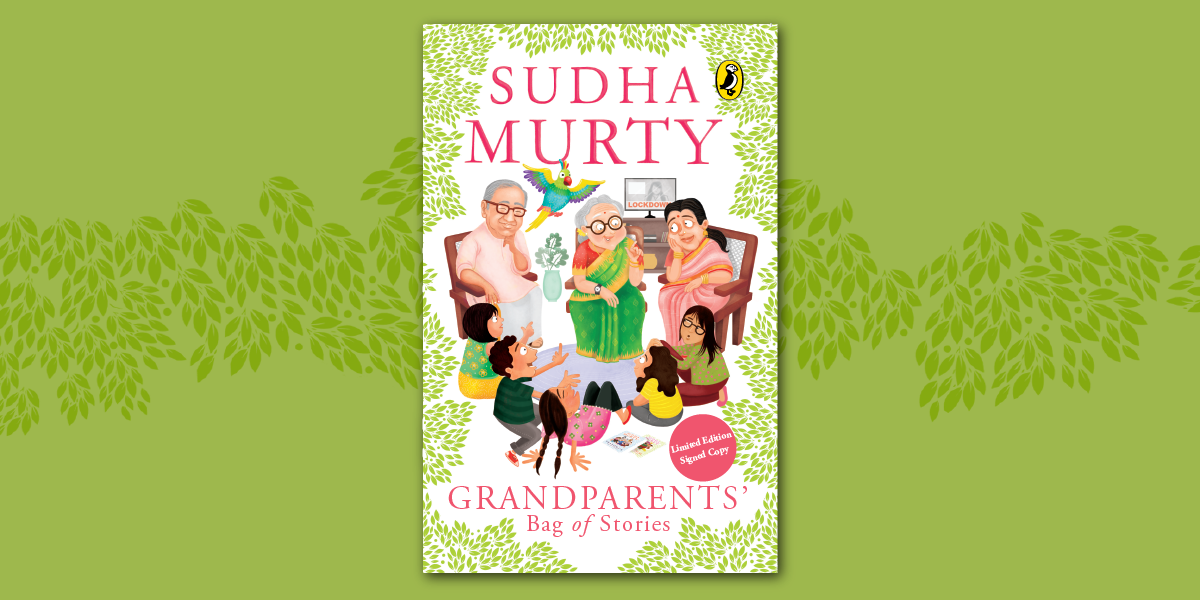
Grandma’s Bag of Stories || Sudha Murty


‘We should always have some aim in life which we must try to achieve while being of help to others.’
―Grandma’s Bag of Stories


House of Cards || Sudha Murty


‘Every woman values her freedom to choose— much more than her husband’s money or position.’;
― House of Cards


~


We have a feeling these quotes would make you wish you could delve further into the brilliance of Murty’s elegant prose. To discover more such gems by her, you can simply visit here.

Srishti Chaudhary on being a young author, her 90s nostalgia and more!

Who/what inspired Tara Taneja?

The first characteristic that I gave Tara was that she’s great at Maths, and that’s very funny, because I’m not, and it’s like projecting my fantasy of being a maths whiz onto my character. I had this image in my mind of this super sharp, entrepreneurial girl, one of those people you can’t pull one over. She’s always on her feet, boys her age are afraid to mess with her, and all of this stems out of the fact that she’s always felt put down by her cousins and her uncle, so she’s always trying to over-prove herself. It’s justa. mixture of some things I wished I was, some things I am, and also a synthesis of different people I have met in my life.


What is it like being a young author in India today?

I am not sure, because I actually don’t meet that many writers my age. To me it is a way of life and I can’t imagine not doing it. It’s really nice as well because I think India is a country hungry for stories, but also full of them, so I feel like a middleman trying to capture these stories and narrating them. The not-so-nice part is that there is a huge expectation on writers to have a huge following, so I feel many writers focus on that, being ‘authorpreneurs’ which is a bit of a ridiculous term- as a writer, one’s job is to write a good story, everything else should be secondary.


Your first book, Once Upon a Curfew, was set during the Emergency, while Lallan Sweets is set in the 90s. Is the element of nostalgia deliberate and where does it come from?

Once upon a Curfew was a bit more serious because it was a severe, dangerous time. There were great challenges, and it needed a lot of research because it’s so far in the past for me. 90s, however, was a much more fun time- there was all this foreign culture coming in after 1991, candies and food that people before never dreamt of. There was more to watch than Doordarshan, this great Bollywood era of Shah Rukh Khan and Yashraj and the feeling that love conquers all- I think it was a very fun and optimistic time, unencumbered by the limitless possibilities that technology offers, rendering an innocence to the time. I grew up in the nineties, and simply sought to capture my childhood by making it a setting for Lallan Sweets.

Lallan Sweets || Srishti Chaudhary

Lallan Sweets also talks about themes of family and traditions. What do those words mean to you – as an individual and as an author?

Family of course is the most enriching part of being human- there are these four or five humans around you who drive you absolutely nuts, but at the same time are crazy about you. Nobody else in the world is more annoying and more loving, and that is the dichotomy of family- they are there for you all the time (even when you don’t want). Traditions are nice and fun, if taken lightly; if you ask me, traditions are meant to be flouted, just like rules are meant to be broken. Traditions stop being important the moment they curtail someone’s freedom. Lallan Sweets shows that a traditional magic ingredient may be passed down for generations- but in the end, it’s what you make of the journey that counts.


What was the process of writing Lallan Sweets like and what kind of research did you do for it?

I had to find out about different cities since the story goes across Mathura, Agra, Bareilly, Delhi, Chandigarh and Ludhiana. The most fun part was creating my own little small town, Siyaka, which was a mixture of several small towns I have seen, but mostly a manifestation of my own childhood memories, which although was in a big city, yet my world was very small, so it had the feeling of a small town. Since it’s set in the 90s I got to revisit the pop culture of the time, which was honestly so fun- going back to Hum Paanch, Filmi Chakkar, Shaktimaan- all these series we used to watch. The games were different, past times had nothing to do with a screen- research was super fun because it was going back to an old me, like a friend I had forgotten about.


What advice do you have for other young authors aspiring to break out in the publishing space today?

Just to focus on writing a good story, make your friends read it, get sound feedback, and pitch like there is no tomorrow. Never ever be afraid of rejection- I go by the philosophy ‘fail faster, succeed sooner’ 🙂

Celebrate the spirit of Independence with your young ones!

This Independence Day, we recommend some immersive reads to help children understand our country, its triumphs and its struggles. Here are our top three picks for the curious minds. Read on!


Constitution of India for Children
The Constitution of India for Children || Subhadra Sen Gupta

Which language is our Constitution written in?

Were women a part of the team that drafted the Constitution?

Why do political parties have symbols next to their names?

What is the official language of India?

An essential handbook for every student and denizen of India, here is a compendium of knowledge that serves as an insightful introduction to the most important document of Independent India.


10 Indian Women Who Were the First to do What They Did


10 Indian Women Who Were the First to Do What They Did || Shruthi Rao

This book tells the stories of ten Indian women who were pioneers in diverse fields. While their stories and challenges are different, what is common is that they all opened up the way for all women to achieve their dreams. Shruthi Rao writes absorbing tales of the lives, times and societies that these women lived and worked in.


The Puffin History of India (Volumes 1 and 2)


The Puffin History of India (Volumes 1) || Roshen Dalal

Pick up these books for a rollercoaster ride through centuries of our country’s history! They pack in exciting trivia, numerous maps and illustrations that provide a breathtaking overview of Indian history. Ideal for students and young readers, this amazing reference guide helps to bring the past to life like never before.

The Puffin History of India (Volumes 2) || Roshen Dalal
error: Content is protected !!