Publish with Us

Follow Penguin

Follow Penguinsters

Follow Penguin Swadesh

Should You Dance When You’re Pregnant? – An Excerpt from ‘Amma Mia’

Is my baby not well?

When can I introduce my baby to solid foods?

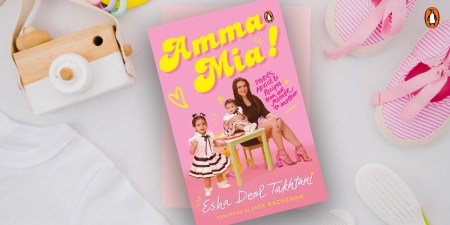
Becoming a new mother can be an exciting yet overwhelming time. No matter how prepared you are, there will always be many confusing moments, opinions and a whole lot of drama! And just like any other new mom, Esha Deol Takhtani was faced with many such questions soon after the birth of her two daughters-Radhya and Miraya.

Packed with advice, tips, stories and easy and delicious recipes for toddlers, Amma Mia reflects the personal journey of one woman’s transformation into a mother. Informative and easy to follow, this book will help new mothers navigate the ups and downs of raising a healthy toddler and make their child fall in love with food.

Read an excerpt from the book below:


When she[Hema Malini] was five months pregnant, my mother was shooting for two films—Satte Pe Satta and Razia Sultan. In the song, ‘Dukki Pe Dukki Ho’, you can clearly see her bump. That’s me in there! And for Razia Sultan, she had to ride a horse while pregnant. She tells me that I’m restless and energetic because she was physically active during her nine months. She also danced onstage during her pregnancy. You must remember that she was doing this during the 1980s, when it was radical for a woman to be so active while pregnant.


My mother is a superwoman like that, who has always broken the rules and stereotypes of what women should be like. She has always inspired me to push the limits. In fact, I will never forget what she told me when I was pregnant. She said, ‘You’re not sick that you need to rest all the time. You’re simply pregnant. After delivery, your body is at its most elastic and flexible. You can mould it into any shape you want.’


And so I followed her advice unconditionally. I performed the dance ballet, Ramayana, on stage; I worked on a short film called Cakewalk; I wrote this book during my second pregnancy; and I had many other projects in the pipeline.


Channelling your inner creativity is a great way to enrich your nine months because the energy and positivity will most certainly be transferred to your child. That being said, no two pregnancies are alike. If you have complications or have been advised rest by your gynaecologist, do so. Be cautious. Don’t be silly or impulsive. From the day you know you’re pregnant, you must be careful. There will be many people with all sorts of advice during this time but pay heed to only one person: your gynaecologist.


For more tips and tricks, check out Amma Mia by Esha Deol Takhtani.

7 Asian Women who Fearlessly Pursued their Dreams

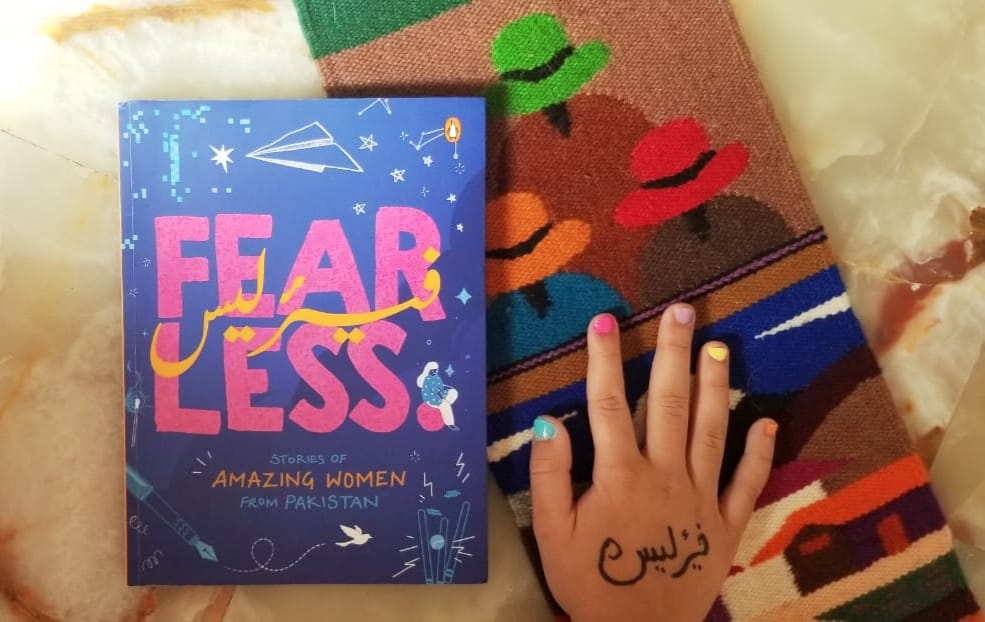
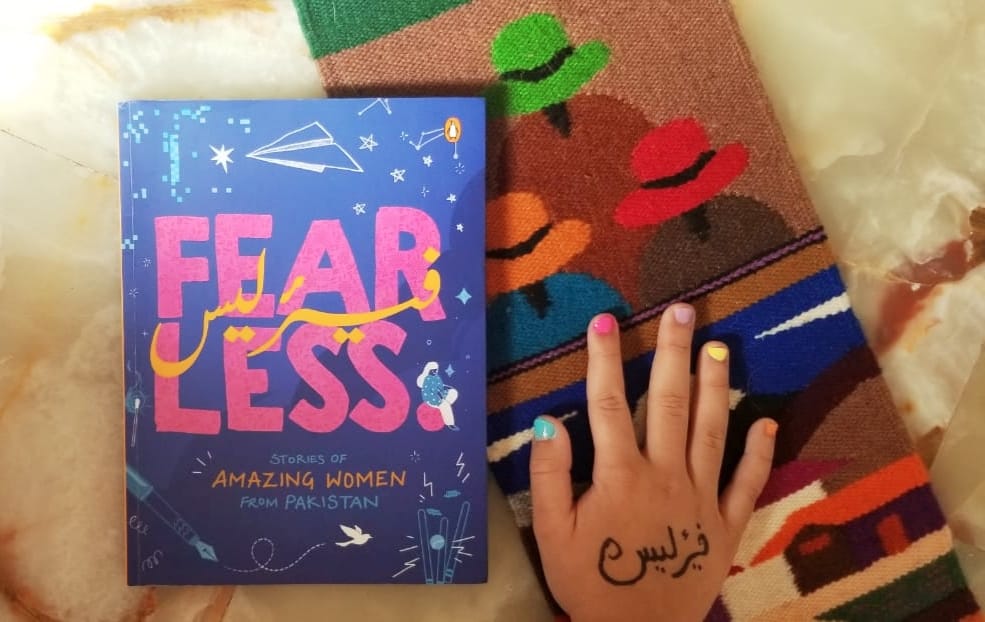
Through the ages strong, inspirational women and girls have risen in response to uncertainty and injustice. Fearless chronicles the journeys and stories of such amazing and strong women – demonstrating that one girl can change everything.

If you were looking to be inspired today, read about these 7 asian women who fearlessly pursued their dreams:

Shukria Khanum

Shukria Khanum was a female aviator – one of the first of her kind in Pakistan. She obtained a commercial pilot’s license despite women not being allowed to fly commercial planes at the time. She subsequently became a flight instructor  because she never gave up on her dream!.

Majida Rizvi

She was the first ever female judge of a Pakistani High Court and had a reputation for integrity and impartiality. Even after retirement Majida has continued to fight for gender equality and human rights in Pakistan.

Shamim Ara

Shamim began her career as an actress and subsequently became one of Pakistan’s leading ladies. But her true talent was producing and directing. She mastered what was at the time the male dominated area of cinema and she changed how women were portrayed in Pakistani cinema.

Zubeida Mustafa

Zubeida was an influential journalist at a time where there were very few women involved in the profession. She worked for Pakistan’s most influential and circulated daily, Dawn. Her stellar writing quality and persistence led her to a long and successful career in journalism.

Ameena Saiyid Obe

Ameena pursued her love of books by starting her own publishing company, Saiyid Books as well as working as Managing Director of Oxford University Press in Pakistan where she grew the company exponentially. She also cofounded the Karachi Literature Festival and is lauded for promoting the love of reading in Pakistan.

Shahida Malik

Shahida was the first high-ranking two-star female general in the Pakistani Army. Although she faced challenges and opposition from her male colleagues, she did not let it stop her and she went on to serve as the Deputy Commander and Inspector General of the Pakistan Army Medical Corps.

Quratulain Bakhtiari

Quratulain is a community activist, educationist and Nobel Peace Prize Nominee. She has worked extensively with refugees and her efforts have led to the establishment of thousands of schools.


These are but a few examples of the tenacity and strength displayed by women in overcoming challenges and pursuing their dreams. You can read further about these women and many more in Fearless

From picture books to Hook Books: Why your child needs Hook Books!

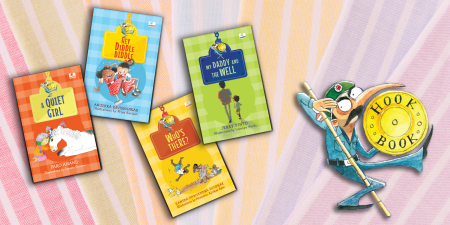
The Hook Books are early chapter books for very young readers, aged five and above (for being read to) and six and above (for reading independently). Written by award-winning and most-loved writers for children, and illustrated in exuberant colour by some of India’s best illustrators, these stories are set largely in non-urban settings.

Why Hook Books? Sayoni Basu, editor of the Hook Books explains why you and your child should be reading these.

Who’s There? || Hansda Sowvendra Shekhar, Anupama Ajinkya Apte

It is an accepted fact that every child reads at a different pace. Reading levels and grade targets and lexile levels work up to a point, but children’s actual reading abilities vary widely within these levels and frequently fall outside them on either side. This is especially true in India in the case of books in English—English might be the first, second or third language, and is introduced at different ages.

The challenge for authors and publishers is to therefore create books which can work for wide age groups. Books which are both simple and complex: with a vocabulary that works for kids of five and six, who are graduating from picture books to books with more words, yet with a story that would interest a reader who may be a lot older.

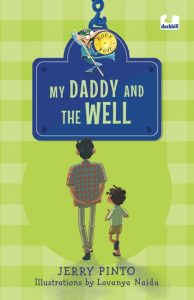
My Daddy and the Well || Jerry Pinto, Lavanya Naidu (Illustrator)

This was one of our goals in the Hook Book series.

The longer we work in children’s publishing, the more clearly we realise the impossibility of linking age group to reading ability. So we wanted to create books that satisfy the metro parents’ desire to fast-forward their child’s reading achievements, and yet allow children the pleasure of reading well-written stories that appeal to them.

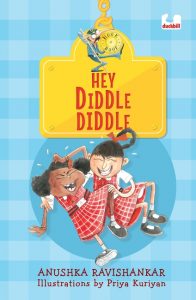
Hey Diddle Diddle || Anushka Ravishankar, Priya Kuriyan (Illustrator)

The second goal we set ourselves is to have a diversity of experiences in these books. Many of our readers live in cities and are in many ways deracinated. Living within an urban bubble and interacting only with other children like themselves, it is easy for them to lose touch with the the fact that despite belonging to the same country, we are diverse in the way we look, the way we live, the religious practices we follow, and social habits. So one of our goals in this series was also to try to bring together stories of small towns from different parts of the country. This is done subtly, through the names of the characters and the lives that are depicted and through visuals. There is no explicit mention or discussion, but it brings the lives of people who are ‘different’ into the world of the reader.

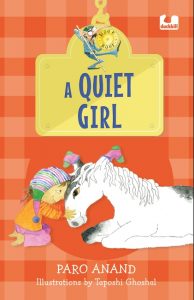
A Quiet Girl || Paro Anand, Toposhi Ghoshal (Illustrator)

The third goal is an educational value addition. We strongly believe that reading should be for pleasure and pleasure only, but we are sadly aware that a lot of the world does not share this view. And because we want our books to sell, we have given in to market pressure and created one exercise for each book. These exercises are carefully chosen to fit in with what children learn at school, so parents and teachers will be happy. But we also wanted to make these as enjoyable as possible for the child. And instead of quizzing kids about what is in the book, we use the story as a starting point for the child to explore the nuances of language and its usage.

So the Hook Books tick many boxes: they are attractive, well-written, fun to read, and are also educational, diverse and carefully crafted. We hope they will be an exciting and groundbreaking new series in the Indian children’s market.


It’s not a book, it’s a hook!

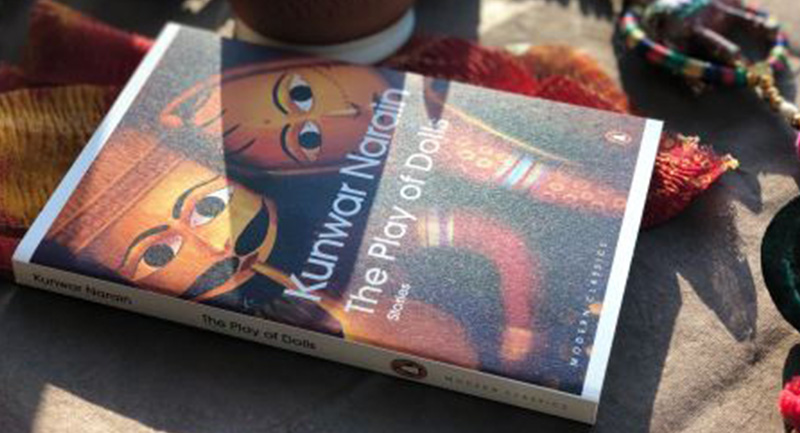
The Play of Dolls- An Excerpt

Kunwar Narain’s unusual short stories broke new ground and rejuvenated the genre when they appeared on the Indian literary landscape in 1971. Half a century later, in vivid English translation for the first time, they seem just as far-reaching: sometimes in the novelty of their insight, sometimes in their transcendence, sometimes in the world views they together uncover.

Read an excerpt from the short story ‘The Court of Public Opinion’ below:

Sadiq Miyan managed to keep his motives in check at first, but then they went awry. A completely new bicycle, stood completely unclaimed—without even a lock to guard it! He glanced around once, then ran his hand over the bike’s glittering handle, as if caressing the mane of a magnificent Arabian horse. He couldn’t hold back any longer, and jumped on the bike. No one objected, nor noticed; and, well, what could the poor bike say either? He pushed down on the pedal lightly. The youthful cycle was ready to take off with him right away. The people nearby came and went by as usual, just as before.

Sadiq Miyan spurred the bicycle on, and it began to fly like the wind. It was his now.

But, alas, what an awful stroke of bad luck! An endless herd of buffaloes came along, straying right into the middle of the road. Sadiq Miyan lost control and collided with one of the stoutest in the bunch—head-on. What could he do, the poor guy? He hit the ground—his own injury less, the cycle’s, more. Bent and broken, the wheel went from being hoop-shaped to heap-like. The handle, twisted backwards, gazed at the seat, and the mudguard took on a look as if it were not a part of the bike but of the buffalo. The buffalo stood in stunned silence; Sadiq Miyan glanced nervously at the crippled bike. What could he do? He’d really landed himself in a strange sort of trouble. It crossed his mind to abandon the bike and make a run for it. After all, it was only the bike that was broken—nothing wrong with his legs!

But in the meantime, a crowd began to gather all around him, as was only natural. Running just then would have meant getting himself in more trouble. Two, four, six . . .dozens of women, men and children began surrounding him. In the middle lay the mangled bike; with the buffalo, chewing cud, on one side, and Sadiq Miyan, head reeling, on the other.

At first, the people pitied the bike that was now a mess, then their hearts were kindled with compassion for Sadiq Miyan, and finally, they got angry at the buffalo. Because there was clear evidence before them of what happens when one locks horns with a buffalo, they decided to tackle the herdboy instead. It was because of him that the hazard of something like a buffalo had sprung up in the middle of the road, and someone upright like a Sadiq Miyan had become the victim of that hazard.

By consensus, it was decided that they should fix the herdboy properly, right then and there. But Sadiq Miyan objected: in his view, it was more important to fix the bicycle first—and the herdboy should be made to do that. Everyone agreed.

The crowd lifted the bike tenderly and delivered it to a nearby cycle hospital with great care, where its wounds were treated for a cost of ten rupees. But when the herdboy was told to cough up the money, he expressed his inability to do so, and asked how on earth was he supposed to come up with ten rupees when he hadn’t even ten paise to his name then?

Confronted by this new problem, an extraordinary debate took place among the ordinary folk assembled there; so many arguments all at once that it was practically impossible to make out any argument clearly. Nevertheless, one solution somehow seemed to survive intact: whatever the herdboy was wearing should be sold to cover the penalty cost of the repairs.

This too was easier said than done, because the herdboy had nothing but a dhoti around his waist and a lathi in his hand. Even if both these items were taken, it wouldn’t be enough.

Anyhow, after the cycle had recovered, it was agreed that Sadiq Miyan and the cycle should be considered free from the whole dust-up. This was deemed incontestable not only in the eyes of the public, but also in the eyes of the luckless bicycle mechanic, who now, having taken the entire burden of Sadiq Miyan’s ten-rupee misadventure on his own head, was an eager prosecutor of the blameworthy herdboy. As for the public, it was surely commendable that not a single person there was willing to step back until final justice had been delivered, no matter what.

Some wise guy then repeated the suggestion that, if it satisfied the cycle mechanic, the herdboy could also be handily fixed, with a flogging worth ten rupees! But nobody paid much mind to this idiocy, though the herdboy was entirely willing to go along. Everyone’s attention was stuck on the intricate problem at hand: how could they wring ten rupees from the herdboy in his present condition?

One gentleman, who had perhaps trained as a lawyer, or was capable of being a lawyer, came up with a novel proposal: by selling that same buffalo which had given rise to all this mess, the cost of the fine could be recovered. The idea wasn’t unreasonable, and his submission was accepted.

The buffalo again became the centre of attention. For five minutes, the people waited. But where would they find a ready buyer for a thing as big as a buffalo? A buffalo isn’t some wad of paan, a bidi or a cigarette that can be purchased along the road, tucked in one’s pocket, and hung along with the pocket on a peg on some wall back home. It was a matter of responsibility, which could go as far as spelling fortune or disaster for one’s offspring. Second, who had the cash on hand worth a buffalo at this time? As a result, this attempt at justice proved unsuccessful as well.

Around now, everyone was sorely feeling the need for some kind of mastermind in the crowd. A few sights fell on one particular gentleman, and remained on him. He certainly looked like a wiseacre—though some others pegged him as a daydreaming wiseass. They held a vote; and it was decided that he was indeed a wiseacre, not a wiseass, though he himself kept claiming to be nothing less than a prophet.


What will happen next? You’ll have to read The Play of Dolls to find out!

Tête-à-Tête with Arjun Nath

What was your latest “OK Boomer” moment?

This is a tricky one because I’m nearly old enough to be considered a Boomer myself! I was attending a wedding recently and an older gentleman — within a few minutes of meeting me for the first time ever — asked why I wasn’t married yet. When I asked him why he felt I should be married, he said: Vedon mein likha hai ki yeh tumhara dharma hai. Really? So being happy with your highly personal life choices is a big no-no, but preaching a 3000-year-old sacred text at a complete stranger about the ‘right’ way to live their life is somehow fine? OK Boomer.
 

Any tips on bridging the generation gap with parents?

It’s a big subject and I’m nowhere near qualified enough to be handing out tips on it. But in my experience, parents are nosy as hell. I mean, aside from being the ones with the money, that’s basically their one defining trait. It comes from fear. They don’t want to control your life, they want to know that you’re safe. So throw them a bone once in a while. Let them know when you’ll be out late, and who your friends are. Share any one meal with them every day. It’s no big deal and it’ll make your life much easier.


Any personal #litAF friendship stories you still cherish?

I made a friend when I was at a drug rehab 10 years ago. For the sake of anonymity, let’s call her by the oddly specific name Kajal Sheth. Because she lives in London and I in Delhi, we’ve met only a handful of times since. And because I dread speaking on the phone (to anyone), we are sometimes not in touch for months at a stretch. This is a frustrating, often hurtful, situation for her. And yet, no matter how many calls I don’t take or texts I don’t respond to, she’s always there for me when I need her to be. Gehna’s baby, in the book, is named Sitara after Kajal’s daughter.


Who do you relate more to: Eram or Gehna?

At a circumstantial level, Eram. He had, like myself, a father with Parkinson’s. He also enjoys games of chance, and strives to be better than he is. Gehna is more of a manic pixie — overly sensitive, bipolar, spontaneous, and self-absorbed, and I am none of those things.


Rom-coms or Thrillers?

Thrillers. Rom-coms are a guilty pleasure, and they have this annoying habit of sneaking up on you and stabbing you right in the heart.


Favourite sports movie?

That’s an impossible question. How to narrow it down to just one? Sports movies, even the badly made ones, always make me cry. Probably something to do with the winning-against-all-odds trope that hits deep. In English, Seabiscuit. Closer to home, Lagaan.


What’s the story behind the title [“Not All Those Who Wander”]?

JRR Tolkien, in the Lord of the Rings trilogy, wrote a poem that starts with the couplet: All that is gold does not glitter / Not all those who wander are lost. I borrowed from it for the title of the book, partly as tribute to the literary master craftsman and partly because feeling LOST is such a common experience for teenagers.

What food are you craving right now?

Sev Puri. I am always craving sev puri — even while eating it! Indian street food is the best street food, Chaat is the best Indian street food, and sev puri is the best Indian chaat street food.


Be honest – how many drafts did it take for Not All Those Who Wander to take shape?

I’ll be honest — one draft. I take no pride in that fact. A famous author, I forget who, was asked a similar question in The Paris Review. She (or possibly he) said that there are two kinds of writers. One: those who just put words on a page willy-nilly until the first draft is done and then work out the kinks in the rewrite. Two: those who are constitutionally incapable of moving onto the next sentence until the preceding one is polished and perfect. I’m the latter sort. It takes me a long time to finish a first draft but when I’m done, it’s done.


Any procrastination tactics you employed while writing the novel?

Yes. Netflix, the Internet, and examining the contents of my belly button. Getting anything done without a deadline, a boss, and irate clients is no easy task. The only thing that works is a driving need to see where the story goes.


What’s your typing speed?

Tap…tap…taptaptaptaptaptaptap…taptap………………………………………………………………………………………………………………………………………………………………………………………………………tap.


What’s the last book you read?

George RR Martin’s A Dance with Dragons. Each year I re-read the entire series in the hope that this, finally, will be the year he finishes Book VI, The Winds of Winter. But he never does. I’ve never been more cross with a person in my whole life. He’s probably watching Netflix. Finish the damn book, GEORGE!


Favourite chat slang?

Not a huge fan of chat slang, tbh. All that “wer R u *smh *idk” business drives me up the wall. But I have of late become a rabid emoji user. My favourite is the rolling-your-eyes yellow face. So useful!


What has been your best 3 AM idea?

To cash-out of a poker game. I know you probably meant to ask what has been my best 3 AM story idea, but I’m re-interpreting the question. Cashing out of a poker game is the best idea at any time, and especially at 3 AM. Go home. Get some sleep. Do NOT try to calculate how many meals you can afford for the rest of the month.


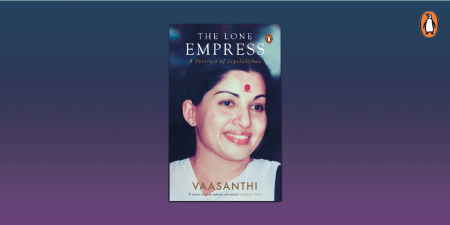
An Insight into the Life of The Lone Empress, Jayalalithaa

The Lone Empress is the journey of a proud Ammu to an indefatigable Rossappu Amma. Despite her immense popularity, she felt lonely and vulnerable in personal life after her mother – Veda (popularly known as Sandhya) and her mentor – MGR, passed away. The book tells the story of how a charismatic and talented woman steered through a male-dominated film industry, developed a loyal political fan base without the support of her party seniors, and stood her ground even when sentenced to four years in jail.

Here are a few excerpts that reveal some of the characteristics of her fiery personality.

She was an honour roll student

‘Look closer, you will find J. Jayalalithaa’s name printed in bold white letters, on the annual roll of honour, as the recipient of the Best Outgoing Student Rolling Shield for the year 1964. The school’s Centenary Celebrations (2009) special souvenir carries a photo of a young Jayalalithaa in her school uniform proudly posing with the shield.’ 

She was more than a pretty face

‘The AIADMK’s party conference was being organised on a huge scale and the town people thronged to hear the star speaker who to give her maiden political speech, one that she herself had prepared. MGR was present, too, drawing hordes of men and women, most of them film fans. The town square was a sea of humanity and the theme of Jayalalithaa’s speech was, “Pennin perumai” (woman’s greatness). The public, expecting only to see a pretty face, were in for a big surprise. Jayalalithaa’s speech was fiery and impressive, an instant success. She had arrived, barely having left, as it were, the starting the block.’ 

She honoured MGR at his death ceremony in her own way

‘Jayalalithaa did not shed a tear. She did not wail. She stunned the onlookers and mourners by standing in vigil for two days – thirteen long hours on the first day and eight hours on the second. Because of her enormous will power, she was not exhausted physically, but she experienced the mental and physical torture from other sources. Several women from Janaki’s side stood near her and began stamping on her feet and pinching her to drive her away. But she stood undaunted, swallowing the humiliation, her pride keeping her firmly where she has taken position.’ 

Jail changed her

‘She was in jail for twenty-eight days; and on coming out she appeared to have been hardened rather than chastened. It must have been a traumatic period for her, proud and used to sophistication, like a queen whose feet had never touched the earth and whose head had never felt the heat of the blazing sun. But the jail wardens were struck and deeply touched by the dignity with which she had conducted herself. She hardly spoke to any of them. She spent her time reading books. She later described in graphic detail how she had suffered in the bandicoot-infested jail.’ 

Victory was her goal

‘As long as she lived, victory was her goal. “V” was her symbol. “Naalai namathe”, tomorrow is ours, was her mantra. Now, there is no tomorrow. The Supreme Court waited till her death to release the verdict. She remained “not guilty” till her last breath, innocent, fully acquitted of all charges. She dies in office as the chief minister. She was the victor even in death.’ 


Grab a copy of The Lone Empress to read the dramatic turn of events and the struggles that made Jayalalithaa such a controversial figure.

The Curious Case of Havaldar Hook – An Interview


Havaldar Hook is the endearing mascot of the Hook Books, a new series for early readers for ages 5 and up. To get to know him better, we posed some questions and he very merrily indulged, with honesty and humour.


Q: You are a humble havaldar, but you now have a series named after you. How do you feel?


A: I’m not ‘a’ havaldar, my name is Havaldar, because my father thought that I would grow up and become a policeman. But I wanted to become a teacher. So I’m very happy that there is a such a fun series in my name. I love books.


Q: But, HH, you wear a police uniform. 


A: I wear the uniform because it makes my father happy. I believe that it’s all about one’s parents.


Q: You have asked a lot of questions at the end of the book. Do you believe all books should be educational? Can’t children just read for fun?


A: I’ll tell you a secret. The questions are not for the children. They are for the adults. Heh heh heh.  The children will be happy with the marvellous stories and illustrations. So I thought, let’s give the parents and teachers something to be happy about. Still, I made sure that the questions are not like textbook questions, so children can have fun with them too.


Q: If you could give our readers one piece of advice what would it be?


A: Never let your parents decide what you should do in life. Also, if your parents give you a silly name, you can change it officially. Sadly, no one told me this, so I’m stuck with the name Havaldar. It makes me very sad, because most children run away when they hear the words: ‘Havaldar is coming!’


Q: One slightly personal question:  how did your nose come to match your surname: Hook?


A: (preens in pride.) The Raja of Naakpur bestowed the surname Hook on my great-great grandfather in honour of this nose! All the Hooks in history since then have proudly sported this nose. The Raja had just come back from London, otherwise we’d probably have been called the Aakadas.


Q: Finally, Havaldarji, what would you like to change your first name to?


*Havaldar Hook went silent and thoughtful at this point and we are still waiting for an answer to this question.


Here are the Hook Books


Get Your Young Ones Hooked onto these Books

This March, introduce your child to Hawaldar Hook, do fun activities with the Econuts, celebrate your natural hair and more with these new books:

Hook Books


Hey Diddle Diddle
Who’s There?
A Quiet Girl
My Daddy and the Well


It’s not a book, it’s a hook!

The Hook Books are early chapter books for very young readers, aged five and above (for being read to) and six and above (for reading independently). Written by award-winning and most-loved writers for children, and illustrated in exuberant colour by some of India’s best illustrators, these stories are set largely in non-urban settings. Hawaldar Hook is the mascot of the Hook Books.

My Daddy and the Well
As a child in Goa, Daddy used to jump in a well, to water the bananas. Years later, the bananas are gone. But the
pump is there, the well is there, Daddy is there … SPLASH!

Who’s There?
The cats are mewing in panic. Strange voices are calling from the attic. Who’s there??

A Quiet Girl
Puja smiles and smiles, and does not speak. She spends all her time with the foal, Takbak. But Takbak is going to be
sold! What will Pooja do without her best friend?

Hey Diddle Diddle
A horse may be able to jump over the moon. Can a cow do it? Hey diddle diddle.


Econuts Value Pack

This series of story-and-activity books features the adventures of Dewy, Woosh, Petals, Pebbles and Waggy, who call themselves the Econuts because they’re simply nuts about ecology and the environment! As the Econuts solve mysteries and find solutions to problems, the reader gets in on the action by solving puzzles and word games.

I Hate my Curly Hair

I tug till my head’s black and blue!
But nothing can tame
This wild, curly mane!

Curly haired girl does everything she can to straighten her stubborn curls-after all, everywhere she looks she sees heroines with smooth, silky hair. Then one day, a bigger bully comes along and everything changes! A humorous tale of self-acceptance. And of hair, lots and lots of glorious curly hair!


The Torchbearers

Like any bored eleven-year old with an imagination, Prem Tripathi makes fantastic wishes. And he has been bored a lot since his father dragged him to a monsoon-lashed Mumbai on some mysterious project. Prem wishes it would stop being so hot. He wishes for a genie, a dragon and some superpowers.

The one thing Prem doesn’t wish for is an adventure to bring back the fading gods. A prophecy from the lips of Brahma himself foretells that the gods’ only hope lies in those who will harness the mysterious power of the Vedas. Now, Prem encounters gods in danger of oblivion, demons seeking immortality, and humans caught in the cosmic crossfire. But, along the way, he also discovers who he truly is: a Torchbearer.

Can The Torchbearers save the Gods and humanity from a future devoid of love, hope, and faith?


The Girl Who Stole an Elephant

Chaya usually has an answer for everything. But stealing the Queen’s jewels, even for the best of reasons, is not something she can talk her way out of. So she makes her great escape on the back of a gorgeous, stolen elephant and leads her friends on a noisy, fraught, joyous adventure through the jungle where revolution is stirring and leeches lurk. Will stealing these jewels be the beginning or the end of everything for the intrepid gang?

The Best of Tenali

Vijayanagara, ruled by the benevolent King Krishnadevaraya, is home to the wittiest court jester alive, Tenali Raman. Join the charming Tenali, shrewd Rajguru, silly Tingary and Tenali’s pet cat Sundari on their many adventures that include chasing a flying machine that goes berserk, rewriting the Mahabharata and outwitting an evil puppeteer. Packed with stories of wit, wisdom and hilarious antics, this comic-book omnibus with ten rollicking Tenali tales is sure to take you on a journey that is the stuff of legends!

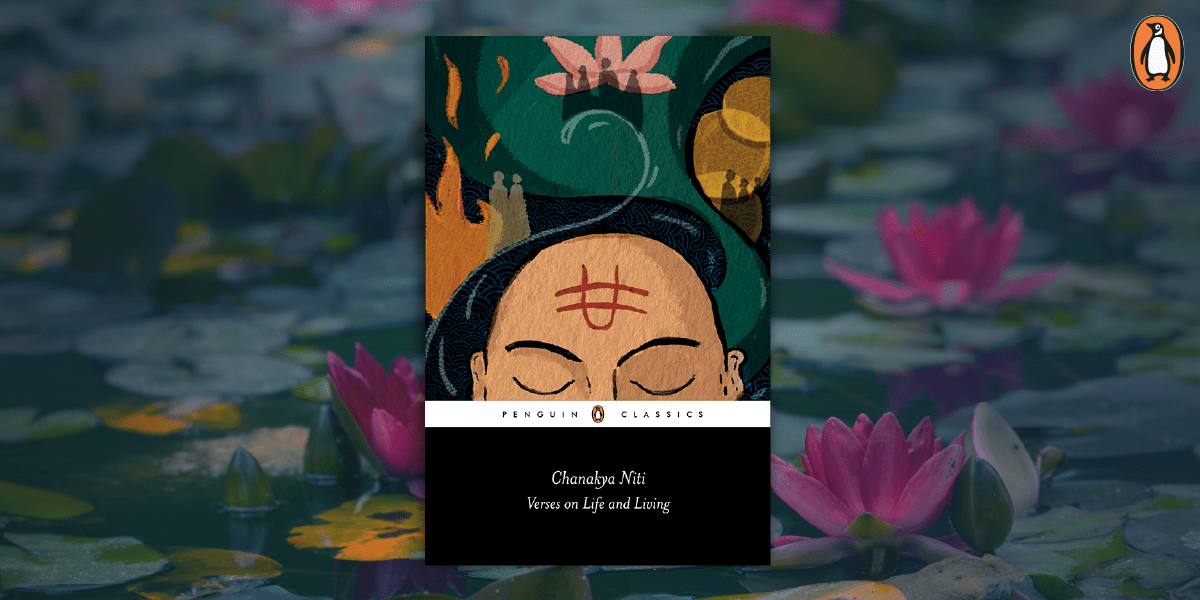
Channel the Worldly Wisdom of Chanakya

The names Kautilya and Chanakya, representing the same personage, are an integral part of history from the period when Mauryan Emperor Chandragupta reigned over India. Kautilya is well known as the author of the seminal Indian treatise on politics, administration, diplomacy and war called Arthashastra. But it is the vast collection of aphoristic sayings in Sanskrit attributed to Chanakya, and therefore called Chanakya Niti, that have remained relevant and memorable over the centuries.

What is that wisdom which has enabled Chanakya’s verses of observation and advice to keep the place of honour in the oral tradition of India even as these have been lauded across the world in various translations?

Chanakya lures us in with one of his introductory verses:

With perusal of these precepts,

the best of men will understand

the famous teachings on true duty,

 on good and bad, on what to do or not.


Read on for 7 nuggets of worldly wisdom from Chanakya Niti


  1. Chanakya warns against errors of judgement in choosing that which offers immediate succour over learning and values that may carry one through life and beyond.

One who discards the permanent,

and pursues just the transient—

the first values are by him destroyed,

the second perish in any case.

  1. The wise one who rose above his poverty and physical appearance to make himself indispensible to the ruler reminds us to see value in all things.

Nectar seek, even from poison,

gold even from excrement,

knowledge even from one base,

and the girl that is a gem, even from a family low.

  1. Experienced in the ways of the world, Chanakya exhorts man to speak in a measured way and reveal only what is necessary and conceal that which is yet incomplete.

Some work considered in the mind,

when speaking do not public make,

just think about it privately,

till it is indeed accomplished.

  1. Befriending one who has revealed his base nature can lead man down the road of misery. Being a keen observer of virtue, Chanakya reiterates the importance of keeping good company.

Wicked, and badly behaved,

he lives ill, casts evil looks—

one who makes of such a person

a friend will soon get destroyed.

  1. Pouring his enlightened self into a verse that is as simple as it is deep, Chanakya shares a core fact of existence in a way that equalizes all distinction.

Which family is free of faults,

which person has not suffered disease,

who has not faced adversity,

whose happiness is permanent?

  1. Mature and learned as he was, the great teacher Chanakya shares a lesson in moderation.

For beauty great was Sita seized,

Ravana slain for too much pride,

   for giving too much was Bali bound—

 as such, always, excess avoid.

  1. In an unforgettable verse that showcases him as the shrewd master of politics, Chanakya hints at the perils of walking the straight line in a crooked world.

Too upright, straight, one should not be,

go to the forest and there see:

straight trees cut down repeatedly,

while standing stays the crooked tree.


It is perhaps his ability to dig into the depth of human nature and tease out the knotted truths of human behaviour that has kept Chanakya alive for Modern India to engage with.

Haksar writes, ‘Overall, it is both their meaning and their style that has made the Chanakya verses so memorable for so long.’

Translated from the original Sanskrit by A.N.D. Haksar, read Chanakya Niti for more wisdom!

Reach for the Stars! – An excerpt from ‘Fearless’

Inspirational women from all over the world have held their own in the face of discrimination, inequality and injustice. These women have been politicians, lawyers, activists, artists and more – with the common goal of raising their voices and fighting for the greater good no matter their nationality, race or religion.

Fearless explores this notion by collating a variety of stories focused on the inspirational women of Pakistan and the strength they have displayed in their own lives.

You can read an example of one such story, about the life astronaut Namira Salim below:

Namira Salim was a quiet, meditative child whose head was quite literally in the stars. It was her dream to become an astronaut but for a little girl from Pakistan, this seemed an impossible fantasy.

Namira was obsessed with the night sky and never asked for her parents for anything— except to be sent into space! ‘I was literally born with the dream of going to space. And the unshaken belief that I would.’

Her parents caved and got Namira her first telescope at the age of 14—she never looked down again as her sights were firmly set on her goal! She was part of the pioneering astronomy society in Pakistan and would spend hours gazing at the stars. Her family moved to the UAE and Namira eagerly participated in star-gazing parties in the desert. She met David McNaughton, one of the first people in the world to go into space, here and became his mentee.

As a college student studying International Relations and later as a resident of Monaco, Namira continued to be deeply absorbed by and involved in space-related activities, even launching a range of ‘space true’ jewelry under a private artistic label called A Soul Affair.

A recognized polar explorer, Namira was the first Pakistani to reach the North Pole in April 2007 and the South Pole in January 2008. She is also the first Asian to skydive (tandem) over Mount Everest in 2008 and the only Pakistani in Virgin’s Galactic commercial space liner, an opportunity he was shortlisted for as a future astronaut out of 1,44,000 applications to travel into space.

However, Namira wasn’t about to just sit around waiting for the first commercial flight to take off! She decided to get qualified officially by completing her training in the US and became the first Pakistani to do so. She also founded Space Trust, a non-profit initiative that promotes space as the New Frontier for Peace, via novel peace initiatives to inspire change and encourage dialogue.


You can read more about Namira and other stories about inspirational and incredible women like her in Fearless – grab your copy today!

error: Content is protected !!