




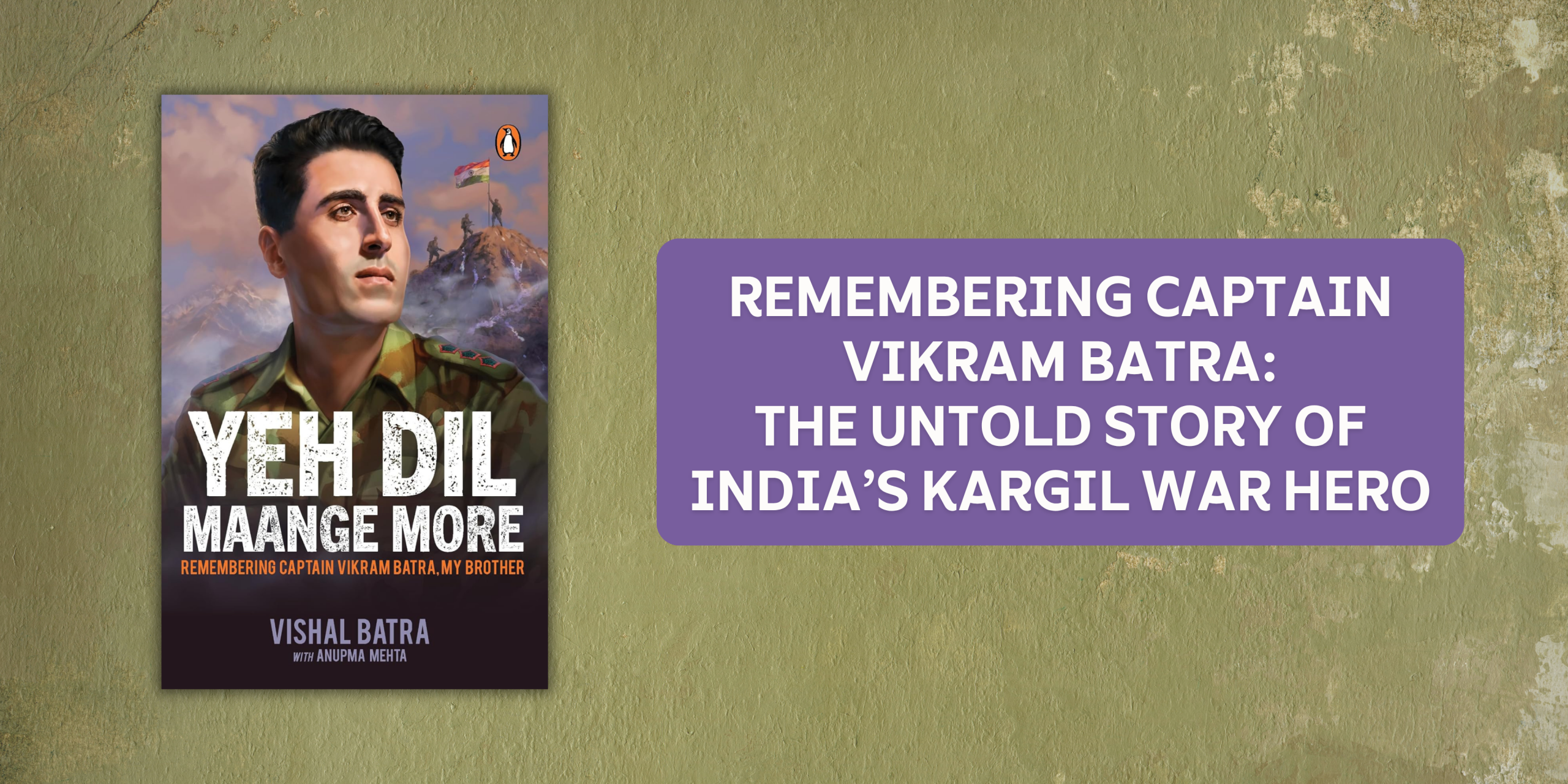
In Yeh Dil Maange More, Anupma Mehta and Vishal Batra bring us closer to the man behind the legend—Captain Vikram Batra, remembered not only as a Param Vir Chakra awardee and Kargil hero, but as a beloved son, brother and friend.
***
‘Hello, Brother’—these words are still ringing in my ears more than twenty-five years after they were uttered as I recollect my last physical encounter with Vikram. And even today, I can feel the warm squeeze of his bear hug as his arms encircled my shoulders, oozing the warmth and collegiality that defined our relationship from the time we emerged together from our mother’s womb. His embrace was tighter than usual, perhaps a premonition that there would never be another.
Vikram was on his way to Sopore, in the Baramulla district of Jammu and Kashmir, where he was posted immediately prior to the outbreak of the Kargil War in the summer of 1999. During his tenure at Sopore, we kept hearing intermittent and disturbing news of the escalating war with India’s perennial foe, Pakistan, at Kargil. His unit, 13 Jammu and Kashmir Rifles, was scheduled to travel to Shahjahanpur, Uttar Pradesh, where an advance party had already set up base. However, soon thereafter, the entire unit was instructed by the army authorities to prepare to move to Dras, Ladakh, in anticipation of the mounting hostilities at Kargil.
On the day of our final meeting, Vikram was still a lieutenant, not yet having been promoted to the rank of captain. As I looked at him, soaking in his warm and compelling presence, I realized that though Vikram had been commissioned in the army just fifteen months ago at the age of twenty-three, he already seemed to have matured much beyond his twenty-four years, while still holding only his first rank and occupying his first posting as a soldier.
Our meeting occurred just at the conclusion of Vikram’s commando’s course before he was slated to report at Shahjahanpur along with his unit. The course, offered at the Commando Training School at Belgaum, Karnataka, which has to be mandatorily completed by all infantry soldiers in the army, signifies one of the toughest training regimens in the world. The thirty-five-day programme, focused on honing the mental and physical endurance of soldiers, is aimed at inculcating in them advanced skills such as close-quarter battle, demolition, deep-sea diving, survival techniques and weapon handling. After completing the course, soldiers become members of their respective unit’s Ghatak Platoon, serving as elite first responders in combat situations. For visual reference, the 1991 Hindi action movie Prahaar, starring Nana Patekar and Madhuri Dixit, graphically elucidates the participants’ actual experiences during the course.
My meeting with Vikram at the railway station at New Delhi, almost a déjà vu of our teenage memories of the movie, thus acquired an even deeper significance. The completion of his commando’s course, characterized by the rigorous and back-breaking training that he had undergone, symbolized a radical transformation in his persona. My mischievous and carefree childhood mate, though still radiating guts and gall, had clearly evolved into a maturer, stronger yet calmer individual, ready to face head-on every challenge that life would lay down in his path.
The course, lasting from 27 January to 7 March 1999, had obviously had a seminal effect on Vikram’s personality. What, however, remains irrevocably etched in my memory is the emergence of a tall, thin and totally bald man from the train, like all the other commandos who were mandated to shave their heads while being enrolled in the course. The moment and the date, 9 March 1999, have a profound connotation in my life, as that was eventually the last time I saw Vikram alive, with that image remaining perpetually ingrained in my consciousness.
I was at the time posted in Delhi, working for a well known finance company, when Vikram messaged me that he would meet me while passing through the Hazrat Nizamuddin station in New Delhi on his way back to join his unit at Sopore. He deboarded at the station from the Goa Express around 7.30 a.m. I was eagerly waiting to pick him up in my cousin Sunny’s brand-new Maruti 800, having, in fact, just completed my driving lessons. The number plate of the car, carrying the number, UAW4359, is also clearly engraved in my mind. Since we used to exchange letters often, Vikram knew that I was learning to drive, and I was impatient to show off my driving skills as I reached the station. But my elation soon turned to utter bewilderment, watching more than 150 identically dressed bald commandos emerging from the train, which was then the only means of transport for the army personnel returning after concluding their course.
I was trying desperately to spot Vikram from among the maze of similar-looking men wearing similar outfits, when I felt a large hand patting me on my back. I turned around to see a chikna, ganja, thin guy, vaguely looking like my brother. ‘What happened to you, Man?’ was my befuddled question. Notwithstanding his thin visage, the glow on his face was undimmed and our constantly positive vibes ensconced us as we hugged each other, our silence exuding emotions louder than any words.