Publish with Us

Follow Penguin

Follow Penguinsters

Follow Penguin Swadesh

Moving with the curve

‘Pessimism can become a self-fulfilling prophesy.’

-Martin Reeves and Jack Fuller


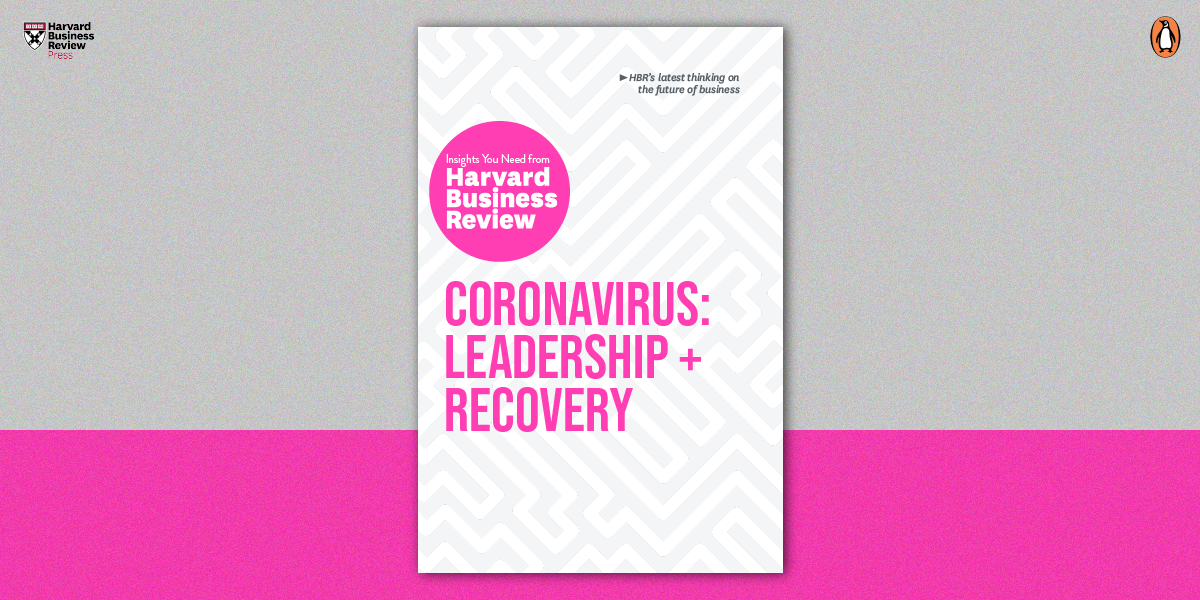
Coronavirus: Leadership and Recovery is a forward-looking work. It navigates the pandemic with innovative insights that can help businesses move ahead of crisis management at a time when imagination has become extremely crucial to problem solving. For a glimpse into the book, here is an excerpt:

~

As the coronavirus continues its march around the world, governments have turned to proven public health measures, such as social distancing, to physically disrupt the contagion. Yet doing so has severed the flow of goods and people, has stalled economies, and is in the process of delivering a global recession. Economic contagion has spread as fast as the disease itself.

This didn’t look plausible even in early March. As the virus began to spread, politicians, policy makers, and markets, informed by the pattern of historical outbreaks, looked on while the early (and thus more effective and less costly) window for social distancing closed. Now, much farther along the disease trajectory, the economic costs are much higher, and predicting the path ahead has become nearly impossible, as multiple dimensions of the crisis are unprecedented and unknowable.

Front cover - coronavirus leadership and recovery
Coronavirus: Leadership and Recovery|| Harvard Business Review

The window for social distancing—the only known approach to effectively addressing the disease—is short. In Hubei province it was missed, but the rest of China made sure not to miss it. In Italy the window was missed, and then the rest of Europe missed it too. In the United States, which was constrained by insufficient testing, the early window was also missed. As the disease proliferates, social-distancing measures will have to be enacted more broadly and for longer to achieve the same effect, choking economic activity in the process.

Another wave of infections remains a real possibility, meaning even countries that acted relatively quickly are still at risk every time they nudge their economies back to work. Indeed, we have seen resurgence of the virus in Singapore and Hong Kong. In that sense, only history will tell if their early and aggressive responses paid off.

Another wave of infections remains a real possibility, meaning even countries that acted relatively quickly are still at risk every time they nudge their economies back to work. Indeed, we have seen resurgence of the virus in Singapore and Hong Kong. In that sense, only history will tell if their early and aggressive responses paid off.

… However, we think examining various scenarios still adds value in this environment of limited visibility. The idea of “crisis management” requires no explanation right now. Something unexpected and significant happens, and our first instincts are to defend against—and later to understand and manage—the disturbance to the status quo. The crisis is an unpredictable enemy to be tamed for the purpose of restoring normality.

But we may not be able to return to our familiar precrisis reality. Pandemics, wars, and other social crises often create new attitudes, needs, and behaviors, which need to be managed. We believe that imagination—the capacity to create, evolve, and exploit mental models of things

or situations that don’t yet exist—is the crucial factor in seizing and creating new opportunities, and finding new paths to growth.

Imagination is also one of the hardest things to keep alive under pressure.

… In other words, renewal and adaptive strategies give way to classical planning-based strategies and then to visionary and shaping strategies, which require imagination.

…In a crisis, we likely won’t have immediate answers, and we therefore need to employ good questions. The most natural questions in a crisis tend to be passive, for example, “What will happen to us?” However, the possibility of shaping events to our advantage only arises if we ask active questions, such as “How can we create new options?” Creativity involves reaching beyond precedents and known alternatives to ask questions that prompt the exploration of fresh ideas and approaches.

~

Positing the power of creative imagination at the forefront, this book explicates the economic impact of the pandemic and tackles the fallout from its chokehold over businesses and economies.

The cost of freedom – Hamid Ansari’s battle for survival

Betrayed by his friends, Hamid Ansari found himself labelled a spy by Pakistani authorities. He battled for his innocence, surviving brutal interrogation sessions and long periods of confinement. This is an important read for anyone who wishes to understand the exact machinations of the event, and how state power can irreparably alter individual lives. Here is an extract:

It was not as cold as one would have expected on 19 September 2014. Zeenat waited with her mother at the bus stop for her trip to Karak. Her mother blessed her and wished her a safe journey. ‘Be careful, Zeenat. While Fauzia needs you, your family needs you more. May Allah bring you success.’

Zeenat reached Karak and went to Atta-ur-Rahman’s residence. She paid him and he told her exactly what had happened. He mentioned Abdullah Khattak, who was to receive Hamid in Kohat and help him rescue Fiza.

With all honesty, he said that he didn’t know why and how Hamid was picked up but that he had informed Fiza’s father and that is who must have informed the authorities. ‘It could be Abdullah too, you never know,’ he added.

… Since Kohat was an hour away from Karak, she immediately took the bus there and called up Abdullah on the way, introducing herself as a journalist from Lahore, saying she wanted to meet regarding a story. He readily agreed.

They met at the bus stop and went to a dhaba nearby. Zeenat told him why she was there—to track a story about an Indian called Hamid Ansari, who had been written about in the papers. He looked worried and asked her how she knew that he was Hamid’s contact. She told him that she was following up with the family back home and they had a few numbers.

‘How did they get my number?’ He knew very well that he could be in trouble.

Zeenat figured out that he was nervous. ‘Abdullah, consider me a friend. You did what was right so you have nothing to worry about. I am just trying to join the dots. How did he manage to enter our country and what was he up to?’ she said.

Her words calmed his nerves and he told her, ‘Imagine, he thought he could just enter our country and take one of our girls from here. I made sure that didn’t happen.’

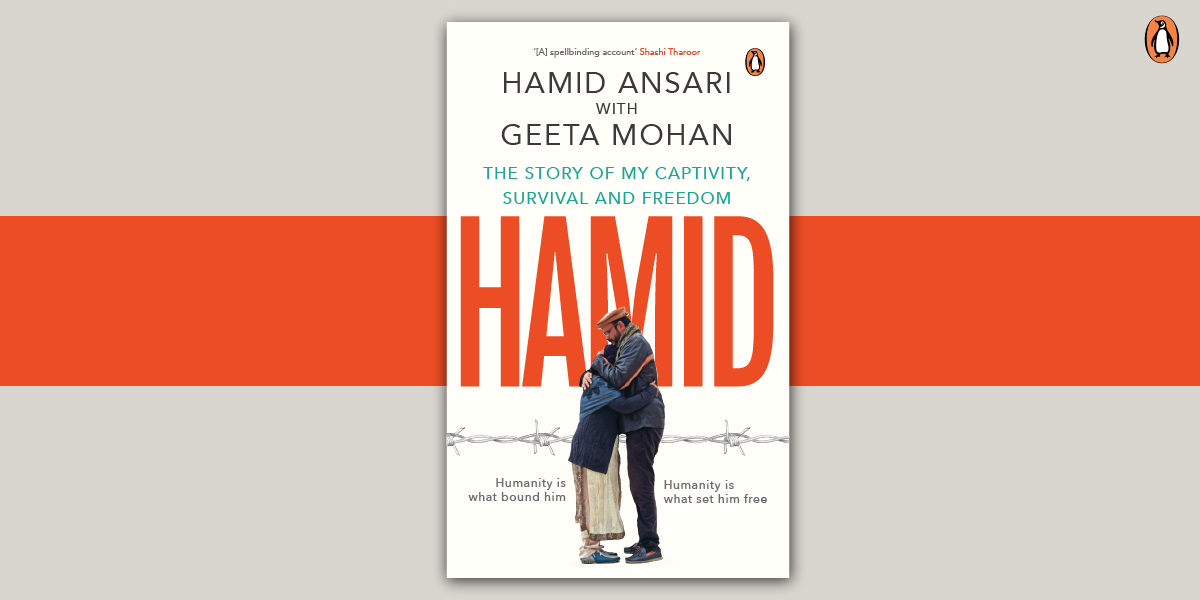
Front cover Hamid
Hamid||Hamid Ansari, Geeta Mohan

‘Good. But was she not going to be a victim of wani?’ she asked while she took out her notepad.

He nodded, embarrassed, but went on, ‘Zeenat, whatever may be the case, he shouldn’t have thought that he would get away with it. I did what I thought was right.’

… He told her about Hamid’s plans, how he had connected with him, and of Palwasha Hotel, where he was taken. He also narrated the entire episode of his arrest. Zeenat listened intently and took notes, occasionally interrupting him for details such as the address of the hotel, time of arrival, last call, etc.

…They parted ways. It was evening. But Zeenat knew what she had to do next. She went straight to Palwasha Hotel and asked the boy at the reception to call the manager. A while later, a young man stepped out.

Zeenat asked them about the Indian who had come there on 14 November 2012. The manager looked shocked but feigned ignorance. Zeenat gave him a knowing look and flashed her press card. ‘I am here to do a story and I know everything. So please share whatever information you have. Where is your guest register? Show it to me.’

He hesitated and said, ‘We are a small establishment and don’t want any trouble. Please don’t put this in the paper. We don’t want people thinking we allow shady people or terrorists in. We don’t know who or where the man was from but we did have him here around that time. He was picked up by the agencies, I think.’

She understood their concern and assured them that she was only trying to find out some details. He pulled out the register and showed it to her.

She went to the entries for 2012 and sifted through them to reach November. When she reached 13 November, she saw that the next page was for 15 November. She looked carefully and ran her fingers through the binding of the register to see the remnants of a torn page.

She looked up at the manager questioningly. He understood what she was asking and said, ‘Well, the cops had come to inquire about the man and a few days later some other officers came and tore the page out. They instructed me not to breathe a word to anyone.’

…The man was a hotel manager in a small town. He was straight in his ways and didn’t mince words. He looked down and then turned around and left, before returning with a sheet of paper in his hand.

‘I didn’t throw it away since I didn’t trust the men. In case someone else came asking for him from the agency then I would have had no proof, that is why I saved this paper. Here it is.’ He gave it to Zeenat.

She saw the paper and noticed the name of one guest registered as Hamza. The manager pointed at it and said that that was the guy. Zeenat felt that Hamid obviously must not have revealed his real name. ‘Who was here with him?’ she asked.

The younger boy who stood beside the manager said, ‘I was here that night. There was a local man called Abdullah who had booked the room in advance. This other man looked like an outsider. A city boy from Lahore or Karachi. He checked in and left immediately after. He never returned. Only cops came in late that night to collect his belongings.’

‘Where was he taken?’
The manager replied, ‘Kohat police station.’


Hamid is a tale of survival, resilience and a relentless battle against the faceless power of the state.

The story of the Leogryphs of Kangla by Wangam Somorjit

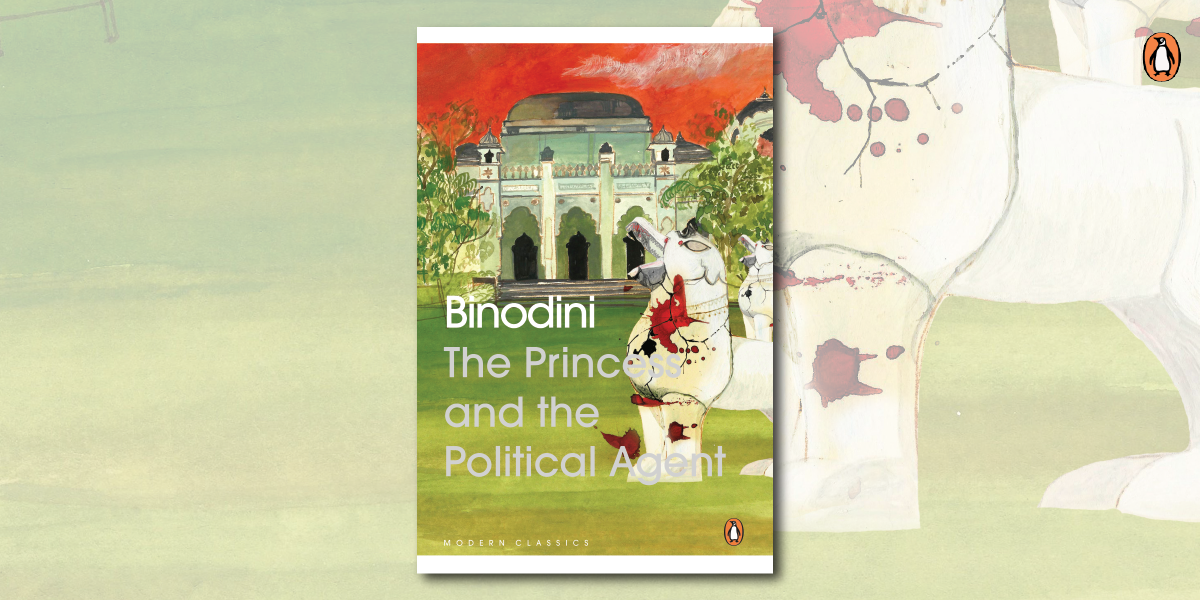
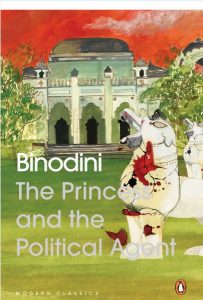
The cover art of Binodini’s “The Princess and the Political Agent” by Shruti Mahajan of Penguin Random House India features, bloody and broken, the leogryphs called the Kangla Sha that stand today in Kangla Fort in Imphal. In the back, a little anachronistically, is painted the palace in Manipur, built for Binodini’s father Maharaja Churachand, himself a major presence in his daughter’s historical novel. It represents the new order in Manipur under the eponymous Political Agent after the Anglo-Manipuri War of 1891. The beasts themselves represent the destruction of the sovereignty of Manipur in the fort where the Princess spent her childhood and youth – and the setting of Binodini’s tales of love, rivalries, and intrigues. Here is the little-known story of these chimerical beasts of Kangla Fort.

Somi Roy, translator.

Today, one hundred and seventy-six years ago, on the 24th of July, 1844, Maharaja Narasingh of Manipur inaugurated the two giant leogryphs that stood guard at Kangla Fort in the heart of Imphal. About fifty years later, they were destroyed by British cannon fire.

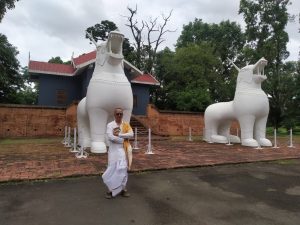
Known as the Kangla Sha, the pair of mythical lionesque beasts was made of brick and stood eighteen feet tall. They guarded the entrance to the fort’s inner citadel called the Uttra. The citadel was the innermost enclosure housing the royal residences in the heart of the Kangla, the double moated palace fort of the kings of Manipur. The Meiteis called these guardian beasts Nongsha, literally Heavenly Beasts, retronymically translated as lions which they resembled. They became known as Kangla Sha after the Anglo-Manipuri War of 1891.

The first pair of these leogryphs was constructed by Maharaja Chourjit in 1804. They were Manipuri adaptations of the splendid Burmese mythical beasts called chinthe that guard the entrance of the pagodas of Burma. Ties between Manipur and the glorious and more powerful Burmese kingdoms of Ava, Shan and Mon Burmese – matrimonial alliances, wars, tributes and so on – were well established by the middle of the 18th century. As one of several Manipuri princes who stayed with the Burmese king in the 1760s, Chourjit would have seen the Burmese chinthe in front of their pagodas.

The powerful court of Ava had made remonstrance with the kings of Manipur for profusely gilding and decorating their palaces with royal Burmese emblems and multistage roof buildings. It was looked upon as evidence of the rise of the kings of Manipur. So in 1819 the Burmese invaded Manipur, destroyed the Kangla Fort, and occupied the kingdom for the next seven years.

Kangla Fort was not only the abode of the kings of Manipur but also the symbol of their ancestral roots back to Pakhangba, founder of the Ningthouja dynasty that still exists today. The citadel’s hall was also sometimes referred as the House of Pakhangba, as he was crowned here as the first Meitei king in 33 CE according to the Court Chronicles of Manipur.

For nearly 20 years after Manipur was regained from the Burmese, Kangla remained an abandoned old palace. The monarch after the Burmese expulsion, Maharaja Gambhir Singh, reigned from his capital at Langthabal, eight kilometres from Imphal down the Burma Road. At this time, Manipur was acknowledged as an independent power by the Burmese and the British in the Treaty of Yandabo of 1826.  In 1844, Gambhir Singh’s cousin and comrade-at-arms in repelling the Burmese, Regent Narasingh became the king of Manipur and moved the capital back to Kangla. He reconstructed the pair of leogryphs in front of the citadel in Kangla upon the ruins of the old foundation of the previous leogryphs of 1804. The court chronicle of Manipur records that the construction of the two new leogryphs began on June 2, 1844. The Maharaja inaugurated the statues, dedicating them to the royal deity Shri Shri Govindajee on July 24, 1844.

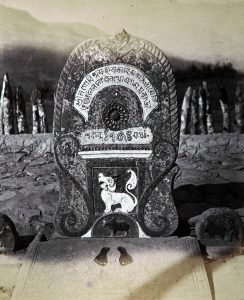
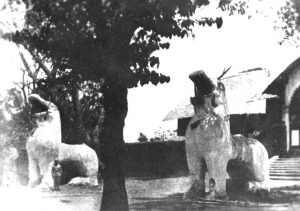
No pictorial representations of the first leogryphs of 1804 exist nor do we know what happened to them after the Burmese destroyed Kangla Fort in 1819. The leogryphs rebuilt in 1844 stood guard at the foot of the citadel, facing west towards the fort’s main entrance, the western gate of the Kangla Fort. They were made of brick, and painted white. They crouched upon their hind legs and stood upright on their forelegs. The tails curled back towards their spines. Their mouths opened wide. The two bifurcated horns, adorning their heads unlike the leogryphs of East and Southeast Asia, were derived from the sangai or the brow-antlered deer (Rucervus eldii eldii) of Manipur. The chimerical beasts bear similarity to the antlered dragon boats of Manipur and to the coat-of-arms of Gambhir Singh engraved above his footprints on the stone he erected at Kohima (now in Nagaland) in commemoration of his victory over the northern tribes in 1833. Therefore, we can surmise that the Manipuri adaptation of the Burmese chinthe was already an addition to the religious and state iconography even before the leogryphs raised by Narasingh.

Leogryph used in the 1833 as commemorative stone in Kohima


The leogryphs built in 1844 were destroyed in 1891 after the Anglo-Manipuri War that year. In the events leading up to the outbreak of the war in March, five British representatives had been taken prisoner by the king of Manipur, tried in military court, and executed for their crime for invading the palace of Manipur. The execution of the British men took place in front of these leogryphs and their blood was smeared over the mouths of the two statues. In this, Manipuris saw the fulfillment of an ancient prophecy in Manipur that white men’s heads would fall in front of the beasts. After British retaliation in battle, the Manipuris were defeated and the British occupied Kangla Fort in April 1891.

On June 20, 1891, the Kangla leogryphs were destroyed by cannon fire upon the order of General H. Collett, the commander of the British army, as retribution, symbolic political vengeance, and display of imperial power and dominance.

The British occupied Kangla Fort as a British reserve until their departure in 1947. When young prince Churachand was installed as the new king by the British in 1891, a new palace of Manipur, commonly known as Chonga Bon, was constructed in 1908 about two kilometres away. The fort remained closed to the Manipuri public. Newly independent India succeeded to the Kangla and the fort was occupied by the Indian paramilitary forces. Manipur acceded to the Indian Union in 1949 and in 2004 Kangla Fort was returned to the people of Manipur after a series of public agitations. In 2007 two replicas of Kangla Sha were reconstructed on the original site where they had stood before being destroyed by the British on July 20, 1891.


Wangam Somorjit is the author of The Chronology of Meitei Monarchs (2010), the first edited version of the Court Chronicle of Manipur with corresponding CE dates; and Manipur: The Forgotten Nation of South-East Asia (2016), an anthology of publications from different countries of the region.


The Princess and the Political Agent || Binodini Devi (Author), L. Somi Roy (Translator)
error: Content is protected !!