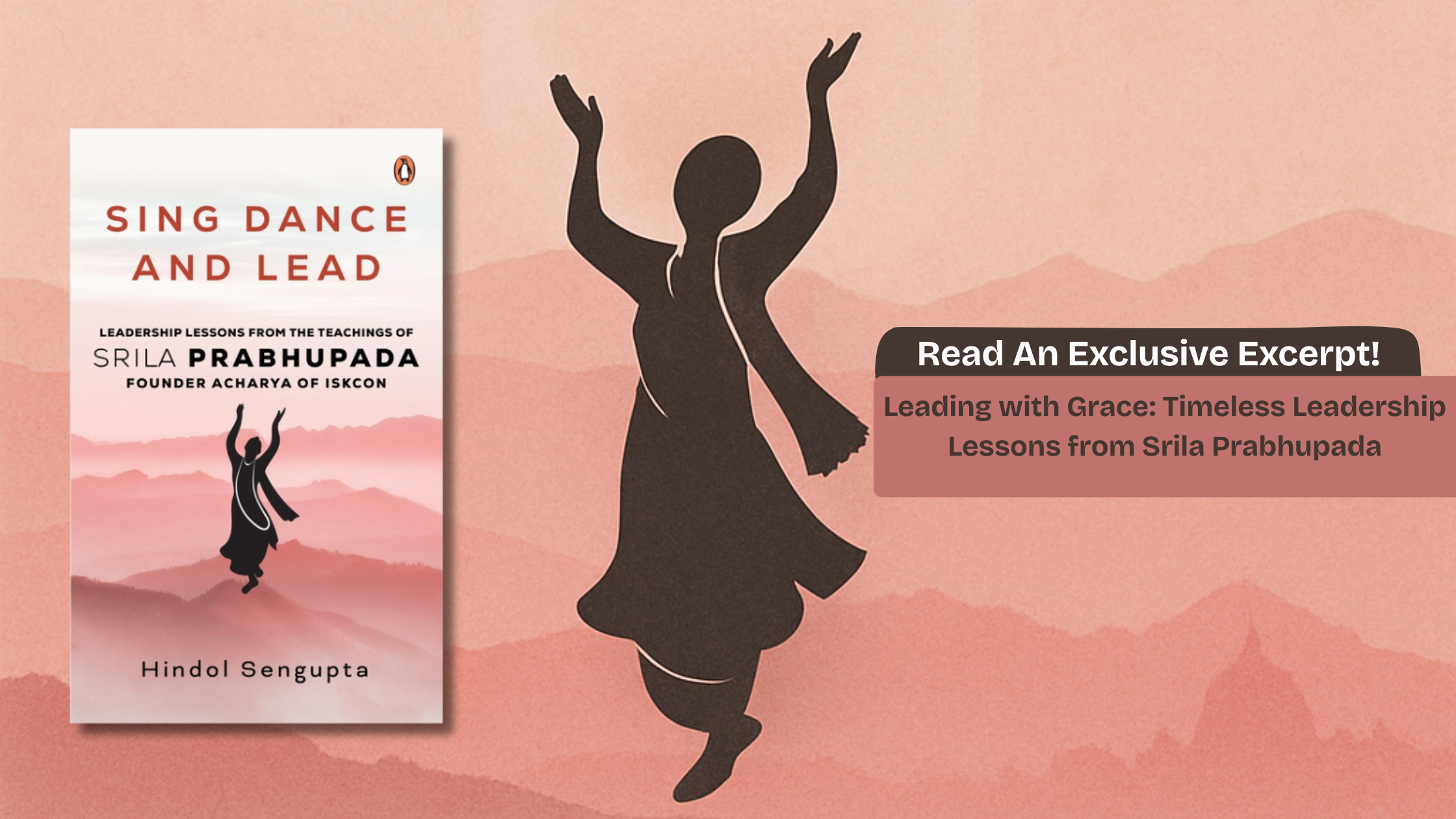
Read an exclusive excerpt below on how Srila Prabhupada’s timeless teachings echo the modern principle of servant leadership.
The ‘Prabhu’ Principle
When I was a schoolboy and travelling on a class excursion to Mayapur, the birthplace of Chaitanya Mahaprabhu, the fifteenth-century singing and dancing Vaishanava Hindu preacher, I remember being intrigued by the fact that everyone I met, especially the tonsured monks, had ‘Das’ as their surname. This was a common Bengali surname, and it amused me that all the monks, each of them, even the ones very obviously not Indian, were supposedly Bengali! What a curious coincidence!
Chaitanya Mahaprabhu and their guru Srila Prabhupada were Bengalis, but not all his disciples were. They carried the name ‘das’ because it meant ‘servant’, the one who serves. It also means one who serves God, one who is the servant of the Almighty. So why were all these monks called ‘das’ or ‘dasa’ (in southern India)? Because embedded in their spiritual philosophy is an idea—the one that management students may have learnt from the scholar Robert Kiefner Greenleaf, but in fact, sourced from the Vaishnavite Hindu thought.
Greenleaf (1904–90) worked for years with AT&T and brought four decades of research related to people, management and behaviour into his theory of ‘servant leadership’. After his long years of study and practical experience, Greenleaf became wary and disillusioned with what he saw as the authoritarian style of American leadership, what in today’s tech we would call the ‘bro culture’. He began to see the futility of all that aggression and ruthlessness in search of utopian ideals of productivity and pursuit of pure profit.
Greenleaf wrote a definitive treatise on what he argued was a different path or style of leadership. He was inspired to do so, in part, by reading German-Swiss writer Herman Hesse’s book on the early life of the Buddha, called, after the young prince’s pre-ascetic name, Siddhartha.

Greenleaf noted:
The idea of the servant as leader came out of reading The idea of the servant as leader came out of reading Hermann Hesse’s Journey to the East. In this story, we see a band of men on a mythical journey . . . The central figure of the story is Leo, who accompanies the party as the servant who does their menial chores, but who also sustains them with his spirit and his song. He is a person of extraordinary presence. All goes well until Leo disappears. Then the group falls into disarray and the journey is abandoned. They cannot make it without the servant Leo. The narrator, one of the party, after some years of wandering, finds Leo and is taken into the Order that had sponsored the journey. There he discovers that Leo, whom he had known first as servant, was in fact the titular head of the Order, its guiding spirit, a great and noble leader.
Greenleaf argued that leadership and the role of the leader needed to be reimagined and cast afresh with different values and virtues.
A fresh, critical look is being taken at the issues of power and authority, and people are beginning to learn, however haltingly, to relate to one another in less coercive and more creatively supporting ways. A new moral principle is emerging, which holds that the only authority deserving one’s allegiance is that which is freely and knowingly granted by the led to the leader in response to, and in proportion to, the clearly evident servant stature of the leader. Those who choose to follow this principle will not casually accept the authority of existing institutions. Rather, they will freely respond only to individuals who are chosen as leaders because they are proven and trusted as servants. To the extent that this principle prevails in the future, the only truly viable institutions will be those that are predominantly servant-led.
In the world of management in 1970, when Greenleaf proposed his theory, this was radical fare. The idea was not to portray dynamism as the route to inspirational leadership, but instead, devoted service. The more a leader can demonstrate devoted service and be an authentic ‘servant’, the more people would be inspired to willingly give their acceptance to be led by this person. Only a true servant can be a real leader, argued Greenleaf, who also founded the Greenleaf Centre for Servant Leadership.
Greenleaf’s seminal text Servant Leadership: A Journey Into the Nature of Legitimate Power and Greatness came out in the late 1970s. He said that there ought to be a filter for the ‘best test’ for institutions and leaders where the questions to ask were, ‘Do those served grow as persons? Do they, while being served, become healthier, wiser, freer, more autonomous, and more likely to become servants? And, what is the effect on the least privileged in society? Will they benefit or at least not be further deprived?’
In The Servant as Leader (1970), Greenleaf propounded the
following principles:
• ‘The servant-leader is servant first . . . Putting people first . . . That person is sharply different from the one who is leader first, perhaps because of the need to assuage an unusual power drive . .’
• ‘The very essence of leadership [is] going out ahead to show the way . . . The leader ventures to say, ‘I will go; come with me!’ while knowing that the path is uncertain, even dangerous.’
• ‘ . . . clearly stating and restating the overarching purpose . . . [to] dream great dreams.’
• ‘Stewardship . . . [to] elicit trust.’
• ‘Only a true natural servant automatically responds to any problem by listening first.’
• ‘ . . . uses power ethically, with persuasion as the preferred mode.’
• ‘ . . . seeks consensus in group decisions.’
• ‘The art of withdrawal . . . reflection and silence.’
• ‘ . . . accepts and empathizes . . . requires a tolerance of imperfection.’
• ‘Foresight . . . a sense for the unknowable and [being] able to foresee the unforeseeable . . . ’
• ‘Awareness and perception’: Leaders understand the reality that confronts them and act accordingly.
• ‘Conceptualizing . . . to state and adjust goals, to evaluate, to analyze [sic], and forsee [sic] the contingencies along the way.’
• ‘Healing . . . between servant leader and [those] led is the understanding that the search for wholeness is something they share.’
• ‘Community . . . [when] the liability of each for the other, and all for the one, is unlimited . . . It is a requirement of love.’
Srila Prabhupada propagated that service is the only authentic path to true leadership, but he did not claim it to be his original idea. He credited it to the Bhagavad Gita (BG) and the Srimad
Bhagavatam (SG). In chapter 2, verse 41, Krishna tells Arjuna on the battlefield of Kurukshetra,
vyavasāyātmikā buddhir ekeha kuru-nandana
bahu-śhākhā hyanantāśh cha buddhayo ’vyavasāyinām
***
Get your copy of Sing Dance and Lead on Amazon or wherever books are sold.