Publish with Us

Follow Penguin

Follow Penguinsters

Follow Penguin Swadesh

From Ithaca to Mumbai: How Winter the Dog Helped Heal a Lost Adult – An Excerpt

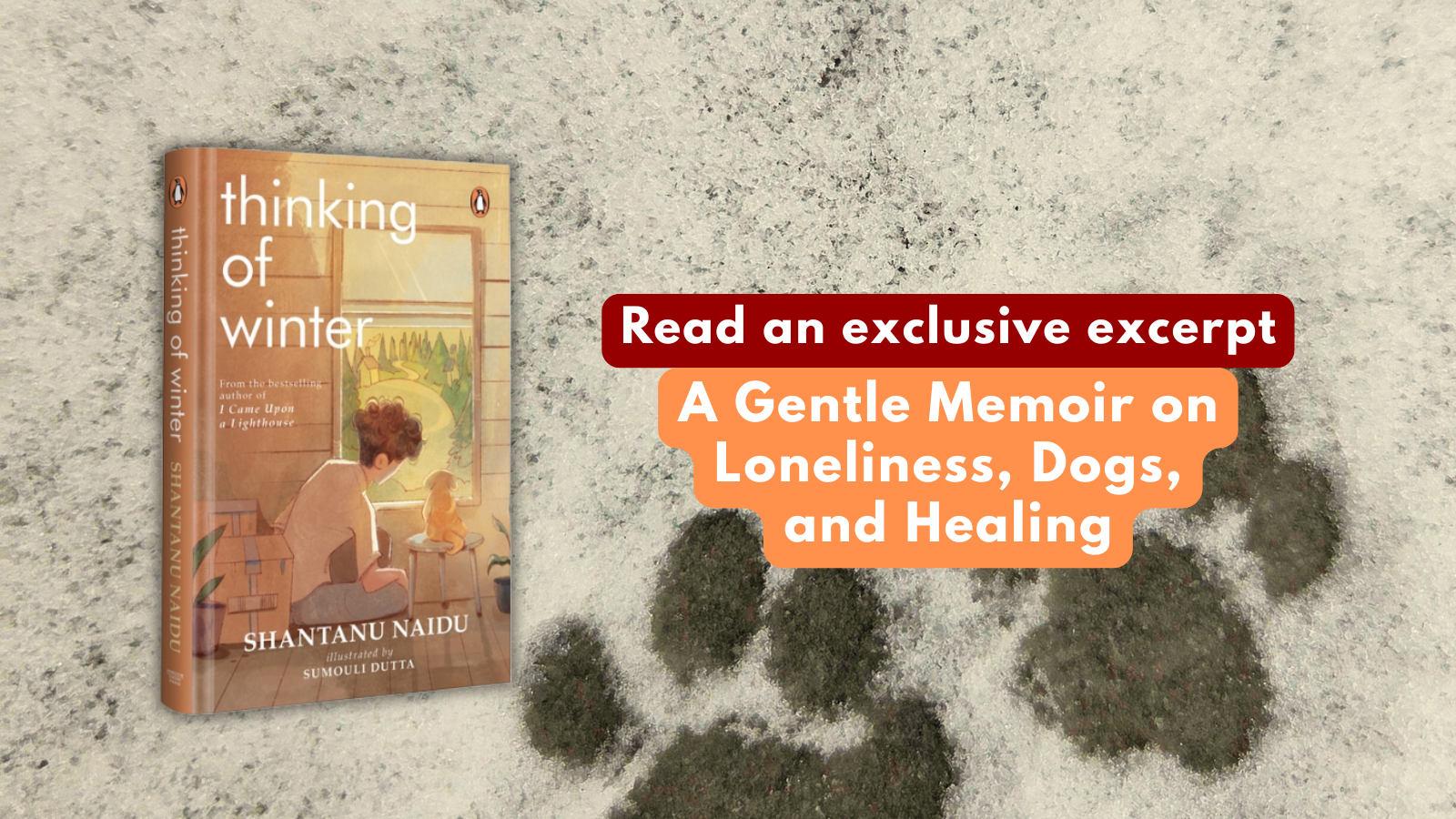
In Thinking of Winter, Shantanu Naidu reflects on isolation, responsibility, and the small, life-altering choices we make in moments of despair. The following excerpt captures the quiet transformation that begins when Winter enters his life.
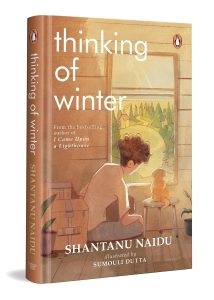
 

Front cover Thinking of Winter
Know more!


***


People do selfish things when they are lonely. I don’t know if that justifies it, but I did them too.

In the eighth month of university, all the love letters posted abroad were spent, all the attempts to make friends had failed, and all that there was to do at the end of every day at Cornell, was to look in the mirror in disbelief: This was not how I thought it would be.

I would like to believe that a lot of smaller breakdowns over a longer period of time lead to a single moment that brings you to your knees and makes you give up once and for all. It can be losing your keys, or a phone call that wasn’t picked up, or missing the last bus home.

But what did ‘giving up’ even mean? There was a library of answers to that question. I, however, chose the most selfish one.

His name, was Winter.

Let’s be abundantly clear. Bad dogs do not exist. This is a blanket rule. There are no bad dogs, and we could, of course, delve deeper into unpacking this and talk about bad parenting and other reasons for some dear souls come to have behaviours that make them seem like bad boys, but for now, we’re just going to establish the inexistence of bad dogs.

I am in favour and support of a very large community of human beings who greet every dog with ‘whoozagoodboy’’ and sure enough the answer is and always should be, hesagoodboy.

But not Winter, no. A few million times during this story I will remind you with sweet frustration that I simply do not know what it was: genetics, soul, character or maybe something beyond our limited understanding of the world. But I do not know what was wrong with Winter.

Winter was a golden retriever, a runtof-the-litter puppy in a far-off town called Moravia while I studied in Ithaca. Forsakenness had me ride there, claim him one night in the fall of 2016, and bring him home a month later with the only friend I had: a Taiwanese introvert called Wen-Ko.

In the first week of Winter in my student apartment, while I contemplated daily whether I was even remotely capable of taking care of another life, Winter was busy stuffing himself in every gap that could be defined as one, even the ones that barely qualified. The only way to find him was to spot an absolute bushy butt sticking out of one place or the other. Some days easy to spot, some days laying still, waiting to be discovered, or worse, rescued.

As the urine stains on the carpet began to stay as contemporary art forms, depending on how hard you squinted, me and Wen would sit amidst them, saying very little but with the shared activity of looking at whatever Winter was up to in the room. Which, of course, was identifying gaps and stuffing himself in them.

Wen, a germophobe, who likes every aspect of her life in complete order, would watch in silence as Winter would create another pee spot next to her. Wen, the germophobe, would say nothing. As one loner to another, she accepted, in not so many words or any words, the reason why Winter was there in the first place. Her being there with us a was a strong nod in my direction saying, ‘If this is what will rescue you, I will support it.’

The Barron’s dog bible on golden retrievers that I had picked up in Boston instead of attending a job interview had me brace myself for what was to come after pee spots: poop on the carpet, furniture chewing, destroyed shoes, destroyed cables, lots of biting—unruly, unhinged, drunk puppy behaviour—and I was very ready for the damage. My roommate, on the other hand, was unaware, let alone prepared.

But it never happened.

Shoes stayed intact and the furniture unbothered. Cables right where I left them. Not a bark or a whimper. Nor a bite or a scratch. And while I waited patiently, anticipatingly almost, for Winter’s standard puppy phase, he seemed to have missed the memo.


***


Get a copy of Thinking of Winter from Amazon or wherever books are sold.
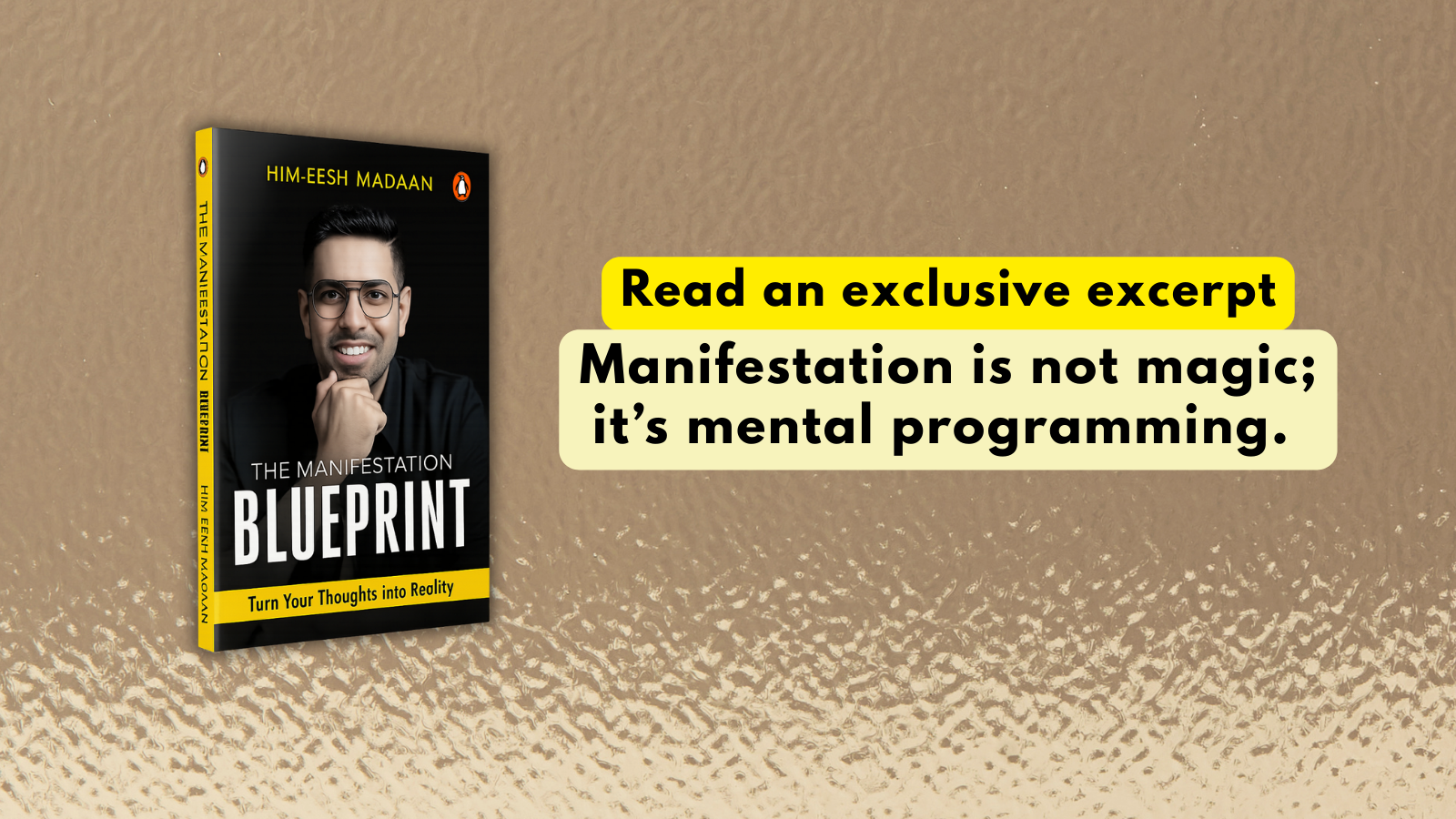
How a WhatsApp Vision Board Turned Impossible Dreams into Reality

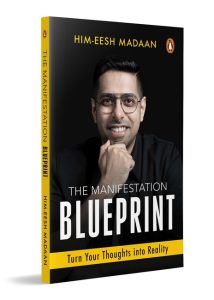
In The Manifestation Blueprint, Himeesh Madan doesn’t speak from theory – he writes from lived experience. In this excerpt, he opens up about the moment everything began to change.


Front cover The Manifestation Blueprint
Know more


***

On 25 December 2018, I was reflecting on the previous year. I had been working hard for the last few years but had not been able to create much financial progress in my life. During this introspection, I unearthed some magical elements that had influenced my life positively but had remained under-utilized. Now, as the new year approached, I started writing down all my aspirations
with renewed hope and determination. They weren’t just ‘New Year’s Goals’—I named them my ‘New Life Goals’!

As 1 January 2019 dawned, I made a WhatsApp group with myself. I downloaded a few images from the Internet and even edited some of them to suit my purpose. These were the images of objects and places that seemed out of my reach at that time, but I dared to make them my goals.

This part of my life is personal and could lead to judgment, but in this book, I want to be 100 per cent transparent with you as I believe that my journey, filled with a touch of madness and a step-by-step approach, can inspire and help you lead the life you desire.

One of my aspirations was to buy two Apple watches—one for me, one for my wife—and a MacBook for my work. So, I downloaded an image of a couple wearing Apple watches and sent it to my WhatsApp group along with the photo of a MacBook.

Another dream involved owning a Mercedes—not for external validation, but for deeply personal reasons related to a childhood experience. So, I even photoshopped a picture of a Mercedes car alongside us.

I also envisioned the type of house where my family would live and found an image on the Internet that matched my vision. Anyone can call this act as ‘foolish’. It won’t be wrong in saying, ‘If you don’t have money to buy an Apple watch, you don’t dream to own a luxury car or a house.’

And yes, as a coach and trainer, I aspired to deliver TED talks too.

My childhood was marked by financial hardships, and I never believed I’d have the opportunity to travel outside of India. However, my wife, Gunjan, came from a family that travelled to some parts of the country annually. I photoshopped an image to place me and my wife in front of Sydney’s Opera House.

As I was never able to go to college because of financial constraints, my wife and I wanted to contribute to the education of others. Hence, we resolved to fund the education of at least 100 students. My other goals included freedom to work from anywhere, a nice office for my team, a fit body, and many more.

Now, let me share the results.

I was able to achieve 100 per cent of my goals using the fundamentals I am going to discuss in this book.

Even the goals which were 100x of my financial worth, even the goals which sounded impossible to many—I was able to achieve them all.

2019: We got Apple watches and my MacBook.
2020: We moved to a nice office.
2021: We moved to a beautiful house and bought a Mercedes.
2022: I delivered my first TED talk and worked from Goa for a fortnight.
2023: We funded the education of 100 students, took a ‘one-way’ flight to Australia, visited the Oprah House, clicked the exact same picture as I had photoshopped and worked from Australia for a month. In 2024, we worked from the US for a month, and then in 2025, visited four new countries.


***

Get your copy from Amazon or wherever books are sold!

Ask the Monk: ‘Doesn’t spirituality demand blind faith?’

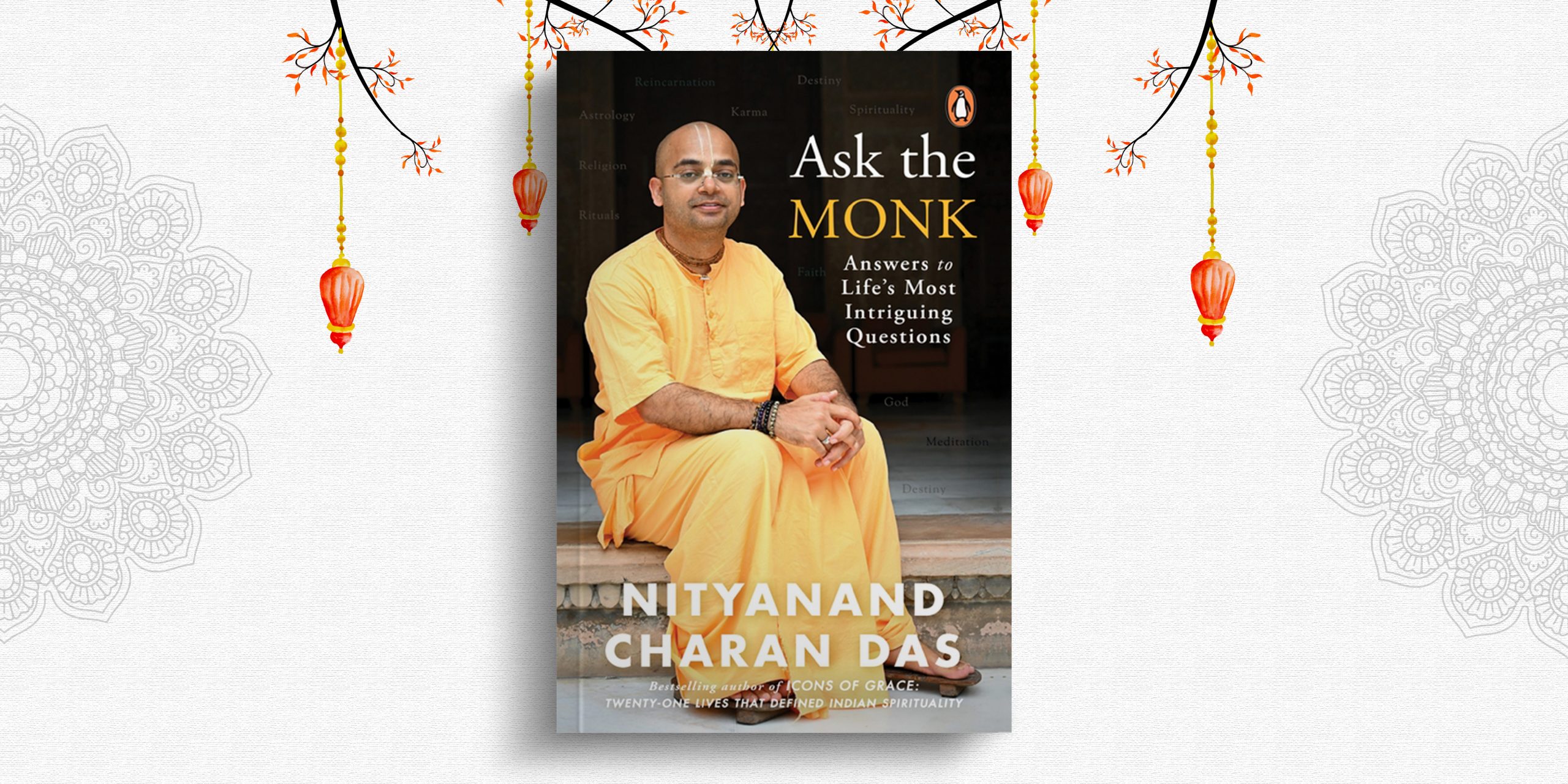
In Ask the Monk, celebrated monk Nityanand Charan Das lucidly answers over seventy frequently asked questions—by young and old alike—on topics such as karma, religion versus spirituality, mind, God, destiny, the purpose of life, suffering, rituals, religion, wars and so on.

Have questions? Intrigued to know more?

Read this excerpt from Ask the Monk​ and find out the answer to a very critical question—doesn’t spirituality demand blind faith?

​*

Ask the Monk
Ask the Monk || Nityanand Charan Das

No. Spirituality does not ask for blind faith, but ‘reasonable faith.’

Reasonable faith means, ‘I hear something. So let me try it. If it does not work, I can always give it up’.

Blind faith means, I hear something and straightway reject it without verifying.

Blind acceptance is bad, but blind rejection is equally bad. In fact, it is worse because we might miss out on a rare diamond, considering it to be a broken piece of glass.

And this reasonable faith is not something new. If we carefully examine, we will find that we have been applying it in every aspect of life. In fact, our life starts with reasonable faith. When we are born, we do not know who our father is. We hear from our mother and we trust her. Now if we talk about blind faith, then isn’t this also blind faith because we were not there earlier? Not at all. This is called reasonable faith. Now if we want, we can do DNA testing to verify it. 

When we get into a cab, we never check whether the driver has a license and knows how to drive. We have faith that he will take us to our destination.

We go to hotels and restaurants after hearing the food at a particular place is good. We go and try and then conclude based on our findings. We believe that the food is not infected, although chances are that it could be. But we have faith.

So the point is that we cannot move even an inch forward without this faith, else we will live in constant fear and go insane. 

The best way to move forward is to have a certain degree of faith in everything despite it all. It’s reasonable, since we cannot keep checking everything. 

The same logic applies to spiritual life as well. We can hear from the right authority and move forward thinking, ‘If someone is teaching something, let me try and apply it in my life and test the authenticity.’

Sometimes some people reject the spiritual truths as bogus or illogical, saying they are students of science. However, they are not scientific at all because science also says that before we accept or reject a theory, it must go through six steps; aim, apparatus, theory, observation, calculation and conclusion. Only when we have tested do we have the right to decide whether it’s real or not.

Thus, just like we apply reasonable faith to everything in life without immediately rejecting it, spiritual life must not be an exception. We can apply the principles mentioned in the scriptures and see if they work. If they do not, give them up. But giving up without trying is totally unscientific and illogical. 

The proof of pudding is in eating.

When we experiment based on what we hear, we get realizations and those realizations increase our faith. Spiritual life requires the same logic of faith that we apply everywhere else in our life.

**

Get your copy of Ask the Monk​ from your nearest bookstore or via Amazon.

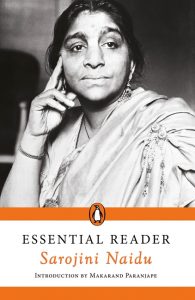
Why is reading about Sarojini Naidu essential?

Sarojini Naidu kept the beacon fire of national life aflame. Naidu played an important role in the independence movement by showcasing her oratory skills. With her revolutionary ideas and constant efforts to speak for the rights of women, she made her place in everyone’s hearts. To date, Sarojini Naidu remains to be an inspiration for men and women all around the world.


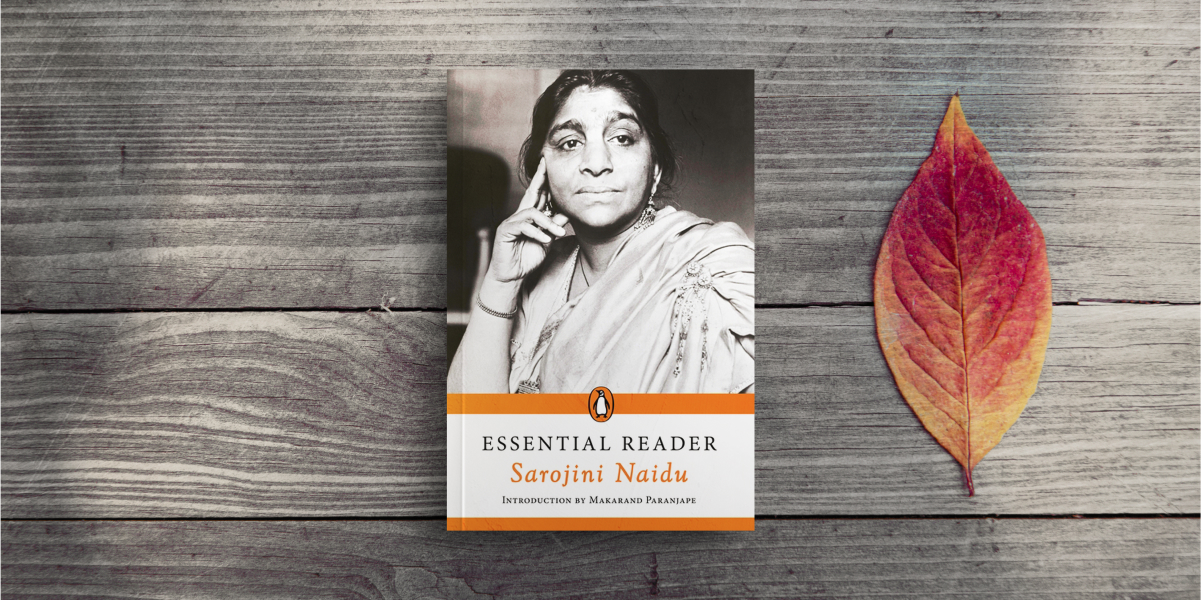
Find out why is reading about Sarojini Naidu essential with this extract from her speech given in Essential Reader: Sarojini Naidu.

cover of Essential Reader: Sarojini Naidu
Essential Reader: Sarojini Naidu || Sarojini Naidu

We often hear, not without a taunt, that the education of girls during the last three generations has been a failure. It could not but be so, it would have been strange if it had not been so. It could not be fruitful because it went away from our traditions and ideals. Our educationists are now awake to the fact that education should and can only be on national lines. We have produced exceptional women and brilliant women, too, not because of the present system of education but in spite of it.

If we want to reconstruct our educational system, it must be along a course which would continue to preserve the best traditions of the East and West. Our standard of education of Indian women should be a normal average. Not that one of our women should be pointed out with admiration as a wonderful and brilliant woman for her culture and attainments, but rather people should point out with horror at an illiterate woman in India.

Only this morning I was reading in one of your daily papers of what Lord Haldane recently said in connection with the granting of voting rights to the women of England. He said that the day is not very distant when people in England would wonder at their refusal to grant the parliamentary rights to women just as they now wonder as to how people kept slaves in the past. I think that time would also soon come to India when we too would wonder how we could keep out women in ignorance.

Remember that woman does not merely keep the hearth-fire of your homes burning, but she keeps also the beacon fire of national life aflame. It is she who keeps the soldier-heart in time of battle and the priest-heart at the time of peace (cheers). The power of self-surrender and self-realization had been the typical characteristics of Indian womanhood. This dual capacity of the personal and impersonal in her relation to man had always marked the Indian women. In this institution, too, I find manifest that spirit of self-surrender, joyous self-surrender, and self-realization. These are the qualities that make Indian women great and these are the qualities that l am glad to find in this Vidyalaya.

Today, we who dream dreams of the coming women of India have our hopes centered round institutions like this (cheers), institutions like that of Professor Karve at Poona, nor the institutions that only slavishly imitate men’s college but the institutions that would send forth to the world women not merely brought up and fed in the dry pages of lifeless books but rather women trained in the beauties and necessities of life. These women would go forth not bearing the burden of dead knowledge but culture transmuted in the services of humanity.

The historic significance of this crowd gathered here today lies not in its number for I have addressed crowds five times larger than this; but its significance lies in the presence of the very large number of women that are gathered here. Their presence here is the indication of the coming comradeship between men and women in India. The old partition between Mardana and Zenana is broken down forever. It is in the comradeship of sexes that future India shall come out man and woman working hand in hand and supplementing each other.

Friends, tomorrow again, I shall fare forth as a singing wanderer with my two bundles of hopes and dreams but never, never shall I forget this institution of yours which is destined to take its legitimate place in the history of the regeneration of India with the promise, the guarantee, almost the realization of the high ideal that it stands for.

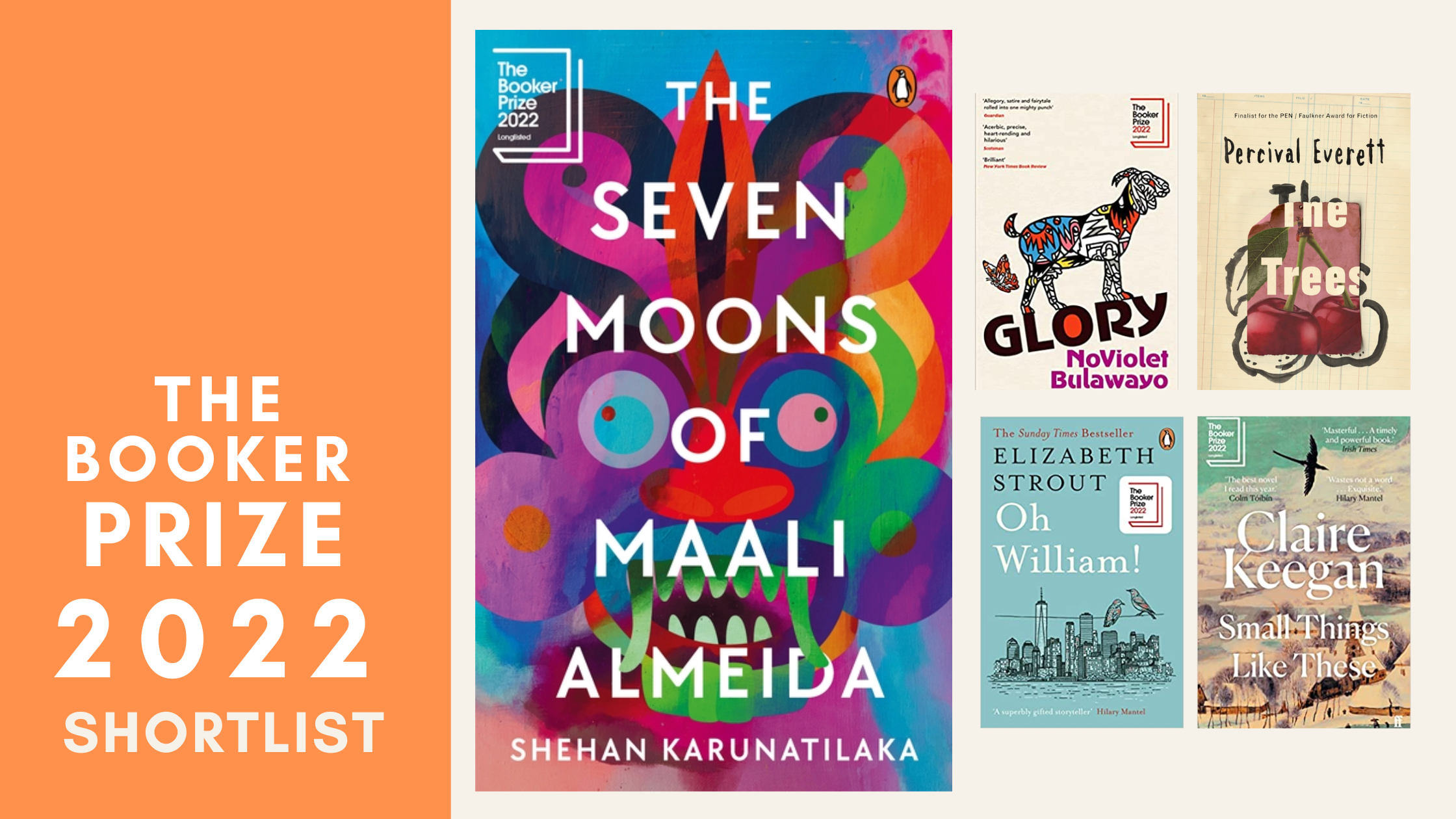
5 out of 6 books from Penguin are in the run for The Booker Prize 2022!

We have just been updated that we have 5 out of 6 books from Penguin have been shortlisted for The Booker Prize 2022! The winner will be announced at the Roundhouse in London on October 17, 2022. Stay tuned! 

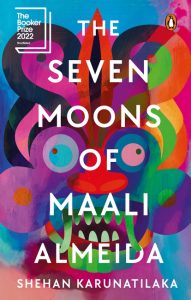
The Seven Moons of Maali Almeida by Shehan Karunatilaka

Booker Prize 2022!
Buy Now!


Booker Prize 2022 shortlist

Colombo, 1990. Maali Almeida, war photographer, gambler and closet gay, has woken up dead in what seems like a celestial visa office. His dismembered body is sinking in the Beira Lake and he has no idea who killed him. At a time when scores are settled by death squads, suicide bombers and hired goons, the list of suspects is depressingly long, as the ghouls and ghosts who cluster around him can attest. But even in the afterlife, time is running out for Maali. He has seven moons to try and contact the man and woman he loves most and lead them to a hidden cache of photos that will rock Sri Lanka. Ten years after his prizewinning novel Chinaman established him as one of Sri Lanka’s foremost authors, Karunatilaka is back with a rip-roaring epic, full of mordant wit and disturbing truths.


Small Things Like These by Claire Keegan

Booker Prize 2022 shortlist
Buy Now!

Booker Prize 2022 shortlist

It is 1985, in an Irish town. During the weeks leading up to Christmas, Bill Furlong, a coal and timber merchant, faces into his busiest season. As he does the rounds, he feels the past rising up to meet him – and encounters the complicit silences of a people controlled by the Church.

The long-awaited new work from the author of FosterSmall Things Like These is an unforgettable story of hope, quiet heroism and tenderness.


Glory by NoViolet Bulawayo

Booker Prize 2022 shortlist
Buy Now!

Booker Prize 2022 shortlist

Glory is an energy burst, an exhilarating joyride. It is the story of an uprising, told by a bold, vivid chorus of animal voices that helps us see our human world more clearly. It tells the story of a country seemingly trapped in a cycle as old as time. And yet, as it unveils the myriad tricks required to uphold the illusion of absolute power, it reminds us that the glory of tyranny only lasts as long as its victims are willing to let it. History can be stopped in a moment. With the return of a long-lost daughter, a #freefairncredibleelection, a turning tide — even a single bullet.


Oh William! by Elizabeth Strout

Booker Prize 2022 shortlist
Buy Now!

Booker Prize 2022 shortlist

Oh William! captures the joy and sorrow of watching children grow up and start families of their own; of discovering family secrets, late in life, that alter everything we think we know about those closest to us; and the way people live and love, against all odds. At the heart of this story is the unforgettable, indomitable voice of Lucy Barton, who once again offers a profound, lasting reflection on the mystery of existence. ‘This is the way of life,’ Lucy says. ‘The many things we do not know until it is too late.’


The Trees by Percival Everett 

Booker Prize 2022 shortlist
Buy Now!

Booker Prize 2022 shortlist

An uncanny literary thriller addressing the painful legacy of lynching in the US, by the author of TelephonePercival Everett’s The Trees is a page-turner that opens with a series of brutal murders in the rural town of Money, Mississippi. The murders present a puzzle, for at each crime scene there is a second dead body: that of a man who resembles Emmett Till. As the bodies pile up, the MBI detectives seek answers from a local root doctor who has been documenting every lynching in the country for years, uncovering a history that refuses to be buried. In this bold, provocative book, Everett takes direct aim at racism and police violence, and does so in a fast-paced style that ensures the reader can’t look away. The Trees is an enormously powerful novel of lasting importance from an author with his finger on America’s pulse.

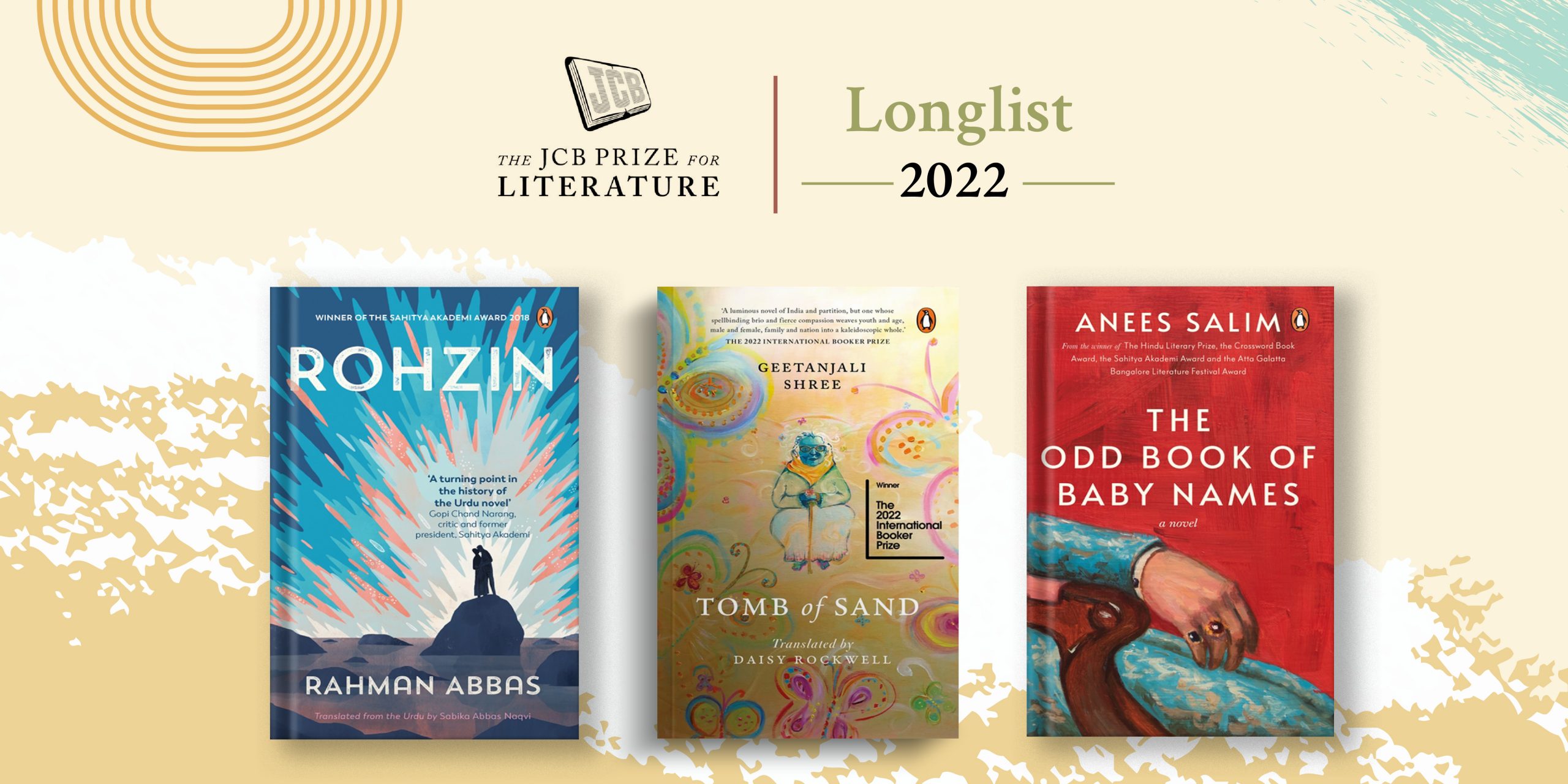
Must read JCB Prize for Literature Longlist 

The JCB Prize for Literature has just unveiled its 2022 Longlist and we have three books in the run. Shortlist to be announced on 7th October 2022. Stay Tuned! 


Tomb of Sand by Geetanjali Shree, Daisy Rockwell

Tomb of sand JCB Prize for Literature Longlist 
Buy now!

JCB Prize for Literature Longlist 

In northern India, an eighty-year-old woman slips into a deep depression after the death of her husband, and then resurfaces to gain a new lease on life. Her determination to fly in the face of convention – including striking up a friendship with a transgender person – confuses her bohemian daughter, who is used to thinking of herself as the more ‘modern’ of the two.

To her family’s consternation, Ma insists on travelling to Pakistan, simultaneously confronting the unresolved trauma of her teenage experiences of Partition, and re-evaluating what it means to be a mother, a daughter, a woman, a feminist.

Rather than respond to tragedy with seriousness, Geetanjali Shree’s playful tone and exuberant wordplay results in a book that is engaging, funny, and utterly original, at the same time as being an urgent and timely protest against the destructive impact of borders and boundaries, whether between religions, countries, or genders.


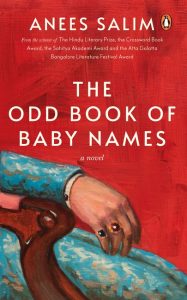
The Odd Book of Baby Names by Anees Salim

The odd book of baby names JCB Prize for Literature Longlist 
Buy Now!

JCB Prize for Literature Longlist 

Can a life be like a jigsaw puzzle, pieces waiting to be conjoined? Like a game of hide-and-seek? Like playing statues? Can memories have colour? Can the sins of the father survive his descendants?
In a family – is it a family if they don’t know it? – that does not rely on the weakness of memory runs a strange register of names. The odd book of baby names has been custom-made on palace stationery for the patriarch, an eccentric king, one of the last kings of India, who dutifully records in it the name of his every offspring. As he bitterly draws his final breaths, eight of his one hundred rumoured children trace the savage lies of their father and reckon with the burdens of their lineage.
Layered with multiple perspectives and cadences, each tale recounted in sharp, tantalizing vignettes, this is a rich tapestry of narratives and a kaleidoscopic journey into the dysfunctional heart of the Indian family. Written with the lightness of comedy and the seriousness of tragedy, the playfulness of an inventive riddle and the intellectual heft of a philosophical undertaking, The Odd Book of Baby Names is Salim’s most ambitious novel yet.


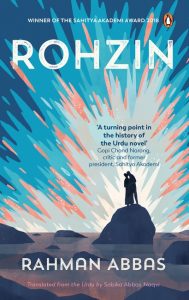
Rohzin by Rahman Abbas

Rohzin
Buy Now!

JCB Prize for Literature Longlist 

Mumbai was almost submerged on the fatal noon of 26 July 2005, when the merciless downpour and cloudburst had spread utter darkness and horror in the heart of the city. River Mithi was inundated, and the sea was furious. At this hour of torturous gloom, Rohzin begins declaring in the first line that it was the last day in the life of two lovers, Asrar and Hina.

The arc of the novel studies various aspects of human emotions, especially love, longing and sexuality as sublime expressions. The emotions are examined, so is love as well as the absence of it, through a gamut of characters and their interrelated lives: Asrar’s relationship with his teacher, Ms Jamila, a prostitute named Shanti and, later, with Hina; Hina’s classmate Vidhi’s relations with her lover and others; Hina’s father Yusuf’s love for Aymal; Vanu’s indulgence in prostitutes.

Rohzin dwells on the plane of an imagination that takes readers on a unique journey across the city of Mumbai, a highly intriguing character in its own right.

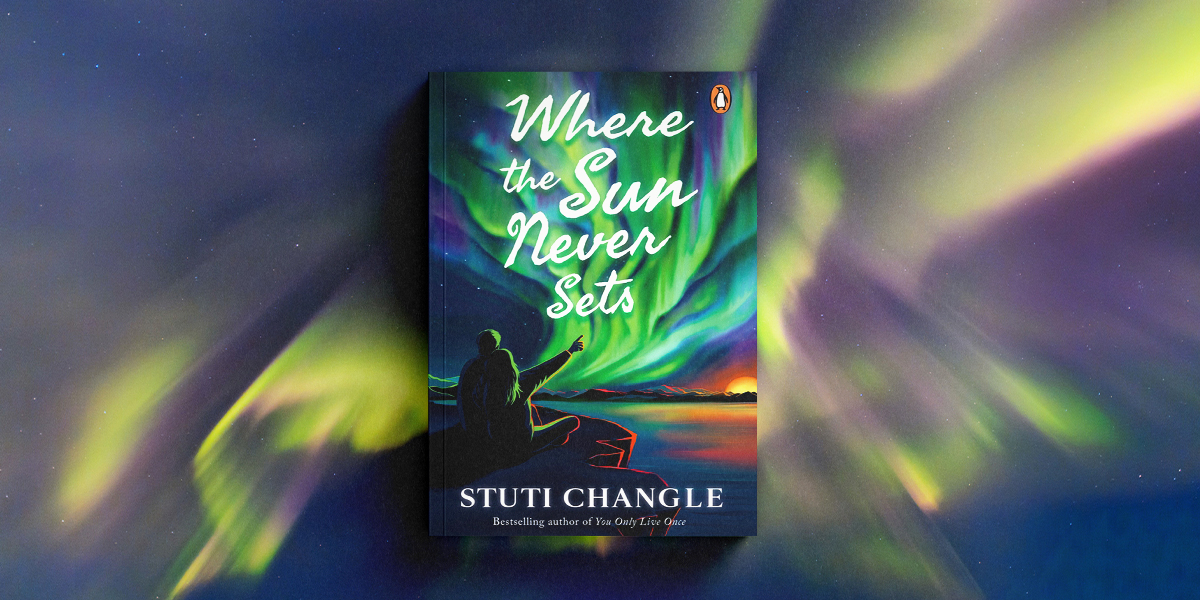
Where the Sun Never Sets: About a day in the lockdown

Many things in life come unexpected, as did the COVID-19 pandemic. The highs of life suddenly turn into lows and everyday events seem to become hard to deal with. During such phases, the present time slows down and one goes back to thinking about their past. As clichéd as it may sound, one eventually finds the light at the end of the tunnel.

During a similar time, Stuti Changle’s protagonist in Where the Sun Never Sets, comes to terms with her past that she has been running away from. Read an excerpt from the book to get a glimpse of Changle’s protagonist’s thoughts penned down in her diary.

*

Where the Sun Never Sets
Where the Sun Never Sets || Stuti Changle

Today felt just like every day is going to feel in my lockdown life.

Once upon a time, it rained for hours, just like it rained today, heavily, unendingly, unstoppably. Rain might wash the physical world, but with it, washed-out memories resurface. Rains deepen the colours of your surroundings as if you’ve unknowingly switched to 4K HD mode. It also deepens the colours in your mind, unlocking the deepest of desires.

Rain is powerful indeed. And what does rain remind you of? The rain reminded me of the onion fritters Mom would deep fry until they were golden and crisp. The mere thought lit up my face, filling my mouth with water. I closed my eyes for a moment, imagining the crisp fritters between my teeth, chewing them with a crunch. Nishit, my ex-boyfriend, would often give me company. He would also tell me that peacocks teach you to dance your sorrows away in the rain.

The rain also reminded me of masala chai, the kind my landlady prepares in Gurgaon, with ginger, lemongrass and basil leaves added in generous amounts. She is the kind of bitch who calls you up to catch up and when you do so, she gives you a list of things you need to get repaired at your own expense.

She keeps reminding me that I am an orphan and it’s her responsibility to bully me to make me stronger. She believes that my parents would have done the same. She also feels that my elder sister is a bitch to have abandoned me. When I am engaged in bitter conversations with her, masala tea is my guru who preaches finding goodness in everything.

I requested Shyamala Aunty to prepare masala tea and fritters in the morning. I gave her very specific instructions. These days of lockdown have to be the perfect time for me to finish the movie script.

But where to start? Why can’t you talk, my diary?

I entered my attic-style bedroom to start writing the script. I had asked Shyamala Aunty to set up my desk in front of the huge window that overlooks the beautiful Mussoorie hills. It’s going to be a long lockdown after all.

I watched some YouTube videos by Tibetan Zen masters. They say that one must prepare well before a new project. Some changes are necessary while some are not as important. But the room where you engage in creative work has to be organized.

Considering the lockdown situation, all I can say is that it is one of the most unpredictable times. Of course, things will change sooner or later. They must. That’s the hope, and we hang on to it.

But I don’t know how much peace organizing my room will bring me when the world is in chaos.

‘Relax. Focus. Concentrate. Yes. Harder,’ I told myself. ‘Write a few words at a time. Bricks build

castles. And castles stand for ages and inspire people for many years to come,’ I murmured.

I sat at my desk wondering if all the days were going to be the same here. You watch the sunrise. The sunset. Sunrise. Sunset. Yet you feel you’re stationary. ‘The sunrise. The sunset,’ I murmured as I had still not written a single word. I put my pen aside.

‘Time never really moves here. That’s the beauty of time in small towns,’ Shyamala Aunty said, breaking my reverie. I hadn’t realized she had entered the room. She sneaks in whenever she likes, and I have hated it since my teenage years.

She continued to mop the floor with a magic mop, even as its engineering was beyond her comprehension. It reminded me of my arguments with Dad, who often said, ‘It is important for everyone to understand mathematics to be able to lead a good life.’

I would always tell him, ‘It is not important to understand an airplane’s engineering to be able to travel in it. You could be a layman and still live a happy life.’

**

To know what happens next, get a copy of Where the Sun Never Sets from your nearest bookstores or online.

A rocky start to Ruskin Bond’s writing journey

You must have read several stories by Ruskin Bond, but have you read a story about how he began his literary journey in London?

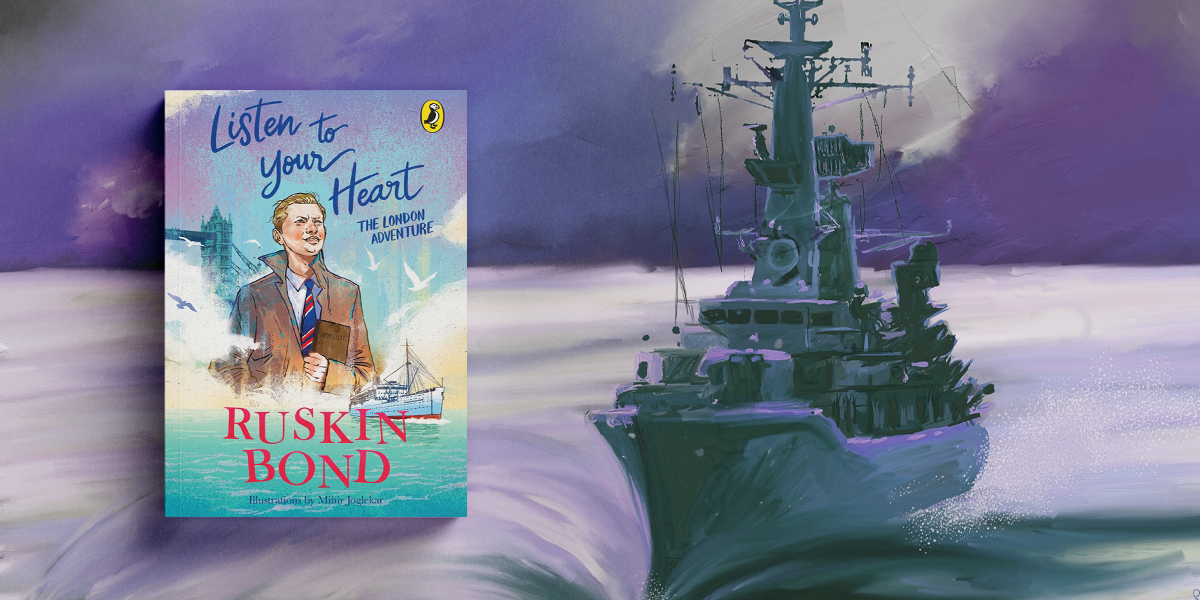
Ruskin Bond’s latest release, Listen to Your Heart, captures memorable experiences from young Ruskin’s life and is an inspiration for aspiring young writers, a meditation on embracing fears, and seizing every opportunity. Read this excerpt from the book to get a glimpse.

*

Listen to Your Heart: The London Adventure
Listen to Your Heart: The London Adventure || Ruskin Bond

The first draft of my journal had been doing the rounds of a few London publishers, and coming back with polite comments and regrets. The post was usually delivered around lunchtime, and whenever there was a thud on the floor of the front door, my cousins would look up from their meal with a knowing grin, as if to say, ‘Poor Ruskin, nobody wants his masterpiece.’

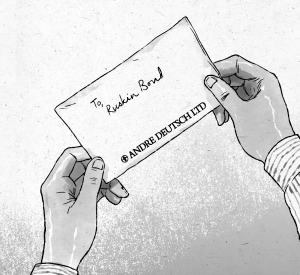
But along with the third or fourth flop of the returned manuscript came a letter from the editor at André Deutsch Ltd, a new publisher who was making a name and a reputation with some offbeat publications. The editor who wrote to me was called Diana Athill, and she wrote a very sympathetic letter, saying how much she liked the book and promising to reconsider it if I would consider turning it into a work of fiction, a full-fledged novel.
As a writer, I have always been ready to learn and to please those who encourage good writing, and I wrote back saying I would do as suggested.

There was no one with whom I could share this good news—my uncle and cousins would have considered it just another polite rejection. So I went out for one of my lonely walks along the seafront, and confided my hopes and dreams in the waves as they came crashing against the sea wall. That island only came to life for me when it was blowing a gale. I loved leaning against the wind, feeling the rain stinging my face, and listening to the roar of the angry sea as the tide came in.

As I walked alone down that rain-lashed pier, I knew I was going to be a writer—a good one— and that no one could stop me. The wind and the rain were allies; they were a part of me, and they would be a part of my work. But it was to be a few months before I could launch out on my own, and during that time, I worked on the novel, pleased my employers and got on with my relatives as best as I could. My aunt never bothered me; in fact, she rather liked having me around. The youngest of my cousins was a friendly little chap; the other two rather resented me. Whenever I had the opportunity, I went to the cinema, and one of the films released at the time was Jean Renoir’s The River, based on the novel by Rumer Godden. This beautiful film made me so homesick that I went to see it several times, wallowing in the atmosphere of an India, a lot like the India l had known. The ‘river’, and its eternal flow became a part of my story too, especially the part where Kishen and Rusty cross the Ganga on the way back to their homes. And back in India, a young filmmaker called Satyajit Ray saw The River and realised that a film could also be a poem, and went about making his own cinematic poetry.
With some help from my employers, I had acquired a baby portable typewriter, priced at £19, and I was going along quite merrily, working on the novel and keeping up my journal.  But then disaster struck.

**

Inquisitive to know what happens next?

Get a copy of Ruskin Bond’s Listen to Your Heart from your nearest bookstore or online.

We’re only human: But what does it imply?

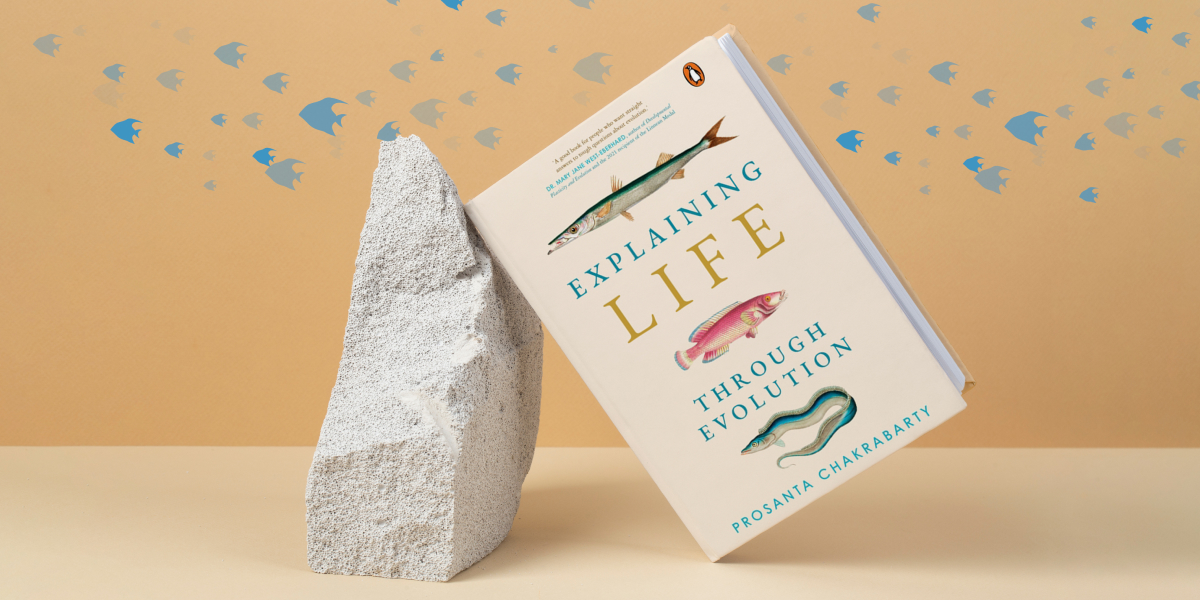
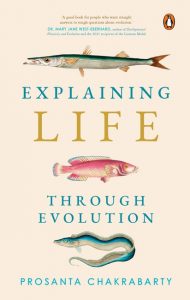
As living, breathing, and thriving humans, we often believe a common pretense: we are the most superior form of life. Sometimes people refer to organisms, especially humans, as ‘perfectly designed’, but our aquatic ancestors had to twist and stretch and rework what they already had. You can’t get to the perfect solution for being a human from that fishy starting point! 

Read this humbling excerpt from Prosanta Chakrabarty’s latest release, Explaining Life Through Evolution to know more about the human origin!

Explaining Life Through Evolution Book Cover
Explaining Life Through Evolution||Prosanta Chakrabarty

“Your body is a disaster. I don’t care if you look like Padma Lakshmi or Michael Jordan. We are all hunks of water-logged flesh, hanging off of sticks of collagen and calcium, made up of teeming pockets of bacteria that are held together by strings of blood all covered in an oily skin bag. We are frail naked apes with giant lollipop heads with exposed and vulnerable dangly bits that are so ill-equipped for life that we get tired after standing up still for ten minutes.  

Why? Again, we are literally fish out of water. 

We are taught to think we humans are perfect: no less than the pinnacle of evolution. Hogwash. The only thing we got going for us are our big brains, and we use those brains just enough to think we are better than everything else and to build things to make us feel important but that will also destroy the planet and ultimately ourselves—time for some humility. 

It isn’t all bad. We do have the advantage of getting more oxygen directly from the air than from water (which has a lot less oxygen), but gas exchange is more difficult through lungs than with gills. But we mess that up too by using the same tubing for breathing as for feeding, and we have just a little piece of flappy tissue (the epiglottis) to keep food from going down the wrong pipe. And that never fails— (choke, choke) right.  I’d rather have the body of a crappie (the fish) than our crappy bodies. 

We can see in our bodies the evolutionary connections we have with more recent ancestors too. We still have the remnants of a tail (which is just an extension of the spine) as the coccyx; and we get goosebumps to raise non-existent fur on our bodies (which we lost in becoming ‘naked’ apes). Yes, we had hairy ancestors with tails, but no, not from monkeys. Unlike a common popular myth, we did not evolve from monkeys. We share a common ancestor with monkeys that led to both tailed monkeys and to the tail-less great apes (of which we are one).” 

Evolution isn’t as linear as we think it to be. If you’re keen to know about the complex history of evolution, and how we came to be, get your copy of Explaining Life Through Evolution now! 

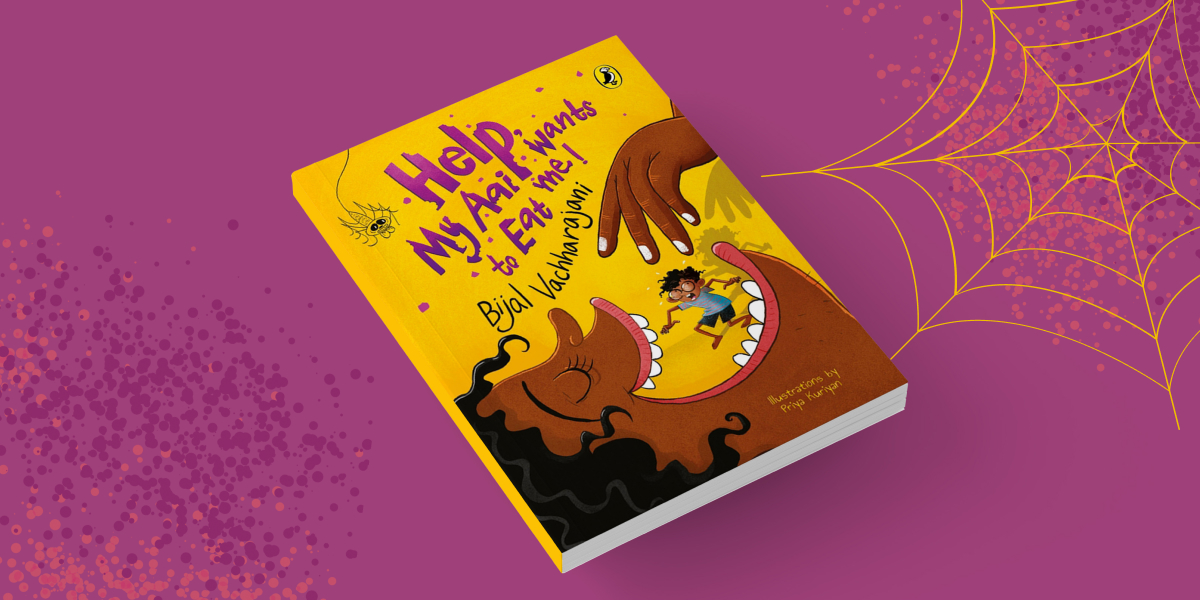
Help! Avi is in danger (or is he?)

Children are imaginative and curious, which is what makes them so different from adults who almost always lead a mundane life. But what happens when a child’s brain is over-imaginative and borderline paranoid? Meet Avi, the protagonist of Help! My Aai Wants to Eat Me, who is convinced that is Aai is keen on gobbling him up, after watching a documentary that fills his mind with wild ideas. Read an excerpt from the book to find out what happened, below! 

“All in all, not Avi’s favourite day. 

Until it was time for environmental science a.k.a. EVS—a subject Avi LOVED.  

Avi’s favourite subject, EVS

He loved it as much as figs love wasps (so much so that they let the wasp pollinate the fruit and die inside them—‘till death do us part’, just like in the movies that Baba and the Maushis watched and loved). 

He loved it more than birdwatchers loved the forest owlet, which had been believed to be extinct for 113 years until it was rediscovered right here in Maharashtra—the same state that Avi lived in! 

Avi loved it more than . . . well, it was his favourite subject. Unlike HJ who loved maths and art and always got 24 out of 25 marks in them. And today was EVS Film Day! Which meant they all got to watch a wildlife film instead of studying. Avi settled down next to HJ, his knees aching from having stood for thirty-four minutes outside the classroom. ‘Arre, how will I play cricket today?’ 

‘Yeah?’ asked HJ. ‘That bad?’ ‘Shhh . . .’ Kshama hissed like a snake and glared at the two boys. ‘Do you want to spend another class outside?’ 

Avi bit back a retort—Kshama was the class monitor and could easily report him and then he would have to miss EVS Film Day. He had already seen films about climate change, about a tigress called Machli, and one about ghost crabs! 

Miss Mankad

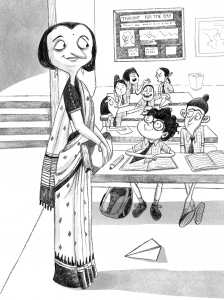
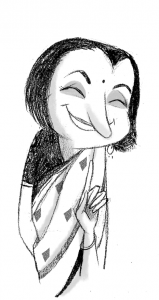
Miss Mankad, who taught EVS, walked into class. Every time Avi looked at his favourite teacher, he was reminded of a meerkat—an upright spine, broad head and large, bright eyes. Except, unlike meerkats, she was six feet and one inch tall. Clearly, she did a great job of teaching, given that Avi knew more facts about the natural world than his herd of classmates put together. 

Miss Mankad shut off all the lights and Avi and Kshama closed all the curtains, turning the room into a dark den, perfect for watching a film. Even more perfect, it was about bears! Avi watched open-mouthed as jamun-like bear cubs wrestled on the screen, a mama sloth bear battled with a tiger (and won) while defending her cubs, and then . . . 

SOMETHING HORRIBLE HAPPENED. 

SOMETHING TERRIBLE. HORRIBLE. 

DISGUSTING. EEUCHY. 

Even worse than the day Avi was having. Another mama bear ate up her second-born cub. 

A terrified Avi

At first, Avi thought she was licking the bear cub. But no. She just gobbled the cub up. Slurp. The baby was gone. Back into her tummy. Where he had lived for so long. Avi’s eyes widened. He gripped his pencil box tightly. What just happened? Did she . . . Really? No, that could NOT have happened. He squinted in the dark to see his classmates’ expressions. He couldn’t make out much, but did Kshama also look horrified? Or was that just her usual expression?” 

Curious about what happens next?  

Get your copy of Help! My Aai Wants to Eat Me to find out! 


Illustration credits: Priya Kurian


error: Content is protected !!