

Publish with Us

Follow Penguin

Follow Penguinsters

Follow Penguin Swadesh

Meet Anita from Fatima Bhutto’s ‘The Runaways’

Anita Rose lives in a concrete block in one of Karachi’s biggest slums, languishing in poverty with her mother and older brother. Determined to escape her stifling circumstances, she struggles to educate herself, scribbling down English words-gleaned from watching TV or taught by her elderly neighbour-in her most prized possession: a glossy red notebook. All the while she is aware that a larger destiny awaits her.
Here is an excerpt from Fatima Bhutto’s new book, The Runaways, that will introduce us to Anita Rose.


The moon hangs low in the night.
Anita Rose Joseph closes her eyes. She opens them.
The stars are drowned by Karachi’s endless curls of dirt and smog, the glow of the terminal, and the floodlights mounted to blind the road leading towards Jinnah International Airport.
Anita Rose keeps her gaze down, away from the towering billboards advertising Gulf Airlines and skin- lightening creams. ‘Max Fairness for Max Confidence,’ a purple- and-black advertisement promises over the smiling face of a
famously fair cricketer. She walks alongside the queued- up Pajeros and Toyotas, impatiently and pointlessly honking, climbing the long slope to the departure terminal.
Under the cover of darkness, before the floodlights bleed into dawn, a mynah bird, with its yellow banditbeak and orange eyes cut through its coarse black plumage, sings.
Anita lifts her eyes for a moment, looking for the lonely bird. But in the early hours of the morning she can see nothing in the dark, empty sky, not even the dacoit dressed up as a mynah bird. The moon carries only the heaviness of the city, suspended in the charcoal sky.
Anita pulls her dupatta tighter around her face. She closes her eyes, irritated by the blinding floodlights, and opens them, breathing slowly, reminding herself of what she must do.
She holds her passport and red notebook tight against her chest and exhales deeply. Aside from a small bag with a necessary change of clothing and some make- up, she has no other luggage.
Ahead, a Pajero inches forward; it brakes at the checkpoint manned by armed commandos. A Ranger with a submachine gun strapped to his chest walks towards the Pajero, but no one gets out of the car. The front window rolls down, letting out a blast of English pop music as a driver relays the name of a VIP. Anita moves slowly, not wanting to draw attention to herself. She stops just before she reaches the jeep and waits for it to pass.
Even with the loud music, the rumble of the running engine and the sound of the commandos circling the car, lifting the bonnet, opening the back, searching it for explosives, Anita Rose can still hear the mynah bird.
On Netty Jetty, overlooking the mangroves that crawl thin just before the Arabian Sea, kites swarm the sky like a thick cover of clouds, waiting for lovers to throw chunks of meat to them – or if the lovers cannot afford the bloody parcels sold on the bridge, then small doughy balls of bread. In the chaos of Karachi’s congested traffic, surrounded by barefoot boys promising in their high- pitched voices that your dreams will come true if you feed the hungry, Anita always felt protected by the soar of kites. And though she is almost certain that the mynah she hears so late at night is all alone, she is also almost certain that it has come to walk her safely through the airport, with its yellow feet and bandit- beak, and out of this city forever.
The Pajero’s engine is still running and the fumes from its exhaust choke the air around Anita. Coughing into her
palm, she doesn’t hear the VIP’s name, but she can see the silhouette of a young woman, voluminous hair held back by sunglasses, perched on the crown of her head. The VIP presses a button and her window begins to open. No one lowers the music; it plays at full volume, percussion and thumping bass. As the VIP moves, a piece of jewellery reflects everywhere, a thousand rays of iridescent light.
The Ranger with the Heckler & Koch cranes his neck to see through the narrow slit. As salam alaikum, he salutes the VIP briskly.
Anita looks behind her, there’s no one there. No one has followed her here.
As the Pajero raises its windows, muffling the music, and begins its climb towards the terminal, and before airport security can see her, Anita traces the shadow of a cross along the hollow of her clavicle. No one has noticed she has gone. No one except the birds.
Anita Rose lifts the thumb that drew the sign of the holy cross to her lips and closes her eyes for a kiss.

This city will take your heart, Osama had told her. You don’t know what Karachi does to people like us. Take your heart, do you hear?
Anita had not understood the rage in his voice then. She had not understood that he was angry for her, long before anyone had hurt her. Anita didn’t like it when she didn’t understand Osama. No matter her age, those moments made her feel just as puny and small as she had been the first time she knocked on his gunmetal door, all those years ago.
It was late at night and Anita had snuck out of her mother’s suffocating home to be with him, with Osama comrade sahib. Her only ally. Her one true friend. The evening was perfumed by champa flowers that bloomed amongst the garbage in Machar Colony and that summer, just before the monsoons, the scent of the white flowers was so strong Anita could no longer smell the sea.
‘How do I protect myself?’ she had asked him. Osama ran his hand through his dishevelled silver hair. He lifted his spirit and drank the medicinal liquid slowly, before placing the glass smudged with his fingerprints on his knee and leaning forward, so close that Anita could count the fine grooves of his iris, the lines that cut and coloured the warm brown of his eyes.
‘You take their heart,’ he whispered, even though no one could hear them on the roof – not the trees that wilted in the summer heat, not the constellation of yellowand-white flowers that bloomed in the rain. ‘Anita Rose,’ Osama caught himself on her name, ‘promise me: you take theirs first.’


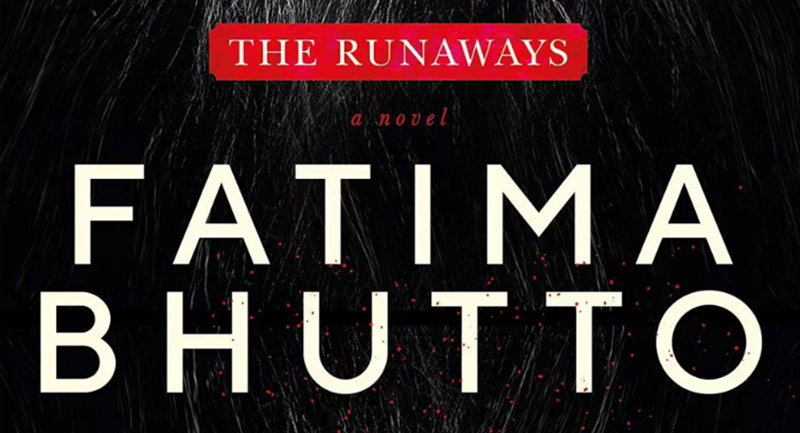
The Runaways is an explosive new novel that asks difficult questions about modern identity in a world on fire.

Meet Monty from Fatima Bhutto’s ‘The Runaways’

On one side of Karachi lives Monty, whose father owns half the city. But Monty wants more than fast cars and easy girls. When the rebellious Layla joins his school, he knows his life will never be the same again…
Here is an excerpt from Fatima Bhutto’s The Runaways that will introduce you to Monty!


During the summer, Papa spent about two weeks with the family in their Sloane Street flat, before work called and
he had to return to Pakistan or China or Saudi Arabia for meetings. Even though he spent his evenings having drinks with business associates or else on conference calls, pacing through the park with his earphones connected to his phone, disturbing the birds, it was the most time Monty and his father spent together in any given year.
When Monty was ten, Papa had taken him to Windsor Park and driven through the animals with the radio on Kiss FM, humming along to all the summer hits while Monty cowered in the back seat as lions and baboons circled the car. ‘Sit up, Monty,’ his father ordered, ‘look at the beasts! It’s like being on safari in Africa!’
Monty could see them just fine from where he sat, glued against the door of their rented car so that the animals couldn’t see his head in the window, but he would attempt a straightening- up, first making sure that his seatbelt was secure.
‘Can you see the lions? Can you see them from there?’
Yes, Monty would assure Papa, yes – you could see them a mile away, you could smell their muddy, earthy, dirty- skin scent even with the windows closed.
‘Be brave, beta,’ his father eventually snapped, ruining their father– son day without stopping to consider that Monty was being brave. He had been using his reserve tank of brave to get through the safari park where animal roamed free all day.
The next summer they didn’t go back to Windsor, but to Centre Court at Wimbledon. Monty watched Roger Federer play. He had nurtured a feverish crush on Anna Kournikova, with her short white skirts and tanned, endless legs, but she no longer played, not at Wimbledon at least. The sun – rare for London – had given Monty a migraine and he spent the day trying to hide it from his parents, who drank Pimm’s – even Mummy, because Papa told her there was no alcohol in it – and ate strawberries and cream like real English people.
Everything Monty knew about culture he had learned in London. Watching plays in the West End, eating fine food in Mayfair, watching his father buy tailored suits on Savile Row and feeling not pride, but confidence, when he saw his father step out of a dressing room in expensive cloth cut to his precise measurements. Akbar Ahmed stood with his arms spread akimbo, like the Rio Jesus, while a whitehaired English tailor adjusted his cuffs, stepping back admiringly, before bending to his knees to attend to the fall of the elegant charcoal- black silk trousers.
When he was eighteen, Papa said, he would bring Monty to Anderson & Sheppard for his first bespoke suit. Until then, Monty had to study and work hard and make his father proud. The rewards would follow – nothing could be denied to a man who faced his responsibilities head- on. Nothing could be denied to a man who upheld the honour of his family’s name.
This summer, the summer Monty turned seventeen, Akbar Ahmed couldn’t find the time to spend with his son. There was no boating in Regent’s Park, no steaks at The Wolseley, no strawberries and no Pimm’s. I’m busy, was all Papa said, can’t make it. Tomorrow, day after, at the weekend.
But Monty had walked by Ladurée, behind Harrods, and seen Papa sitting outside under a pale- green umbrella, sipping an espresso by himself, just watching the world go by. He hadn’t looked very busy then. Monty paused, standing on Brompton Road, and wondered whether he should approach his father, whether he should walk across the street and join him, sitting down for a coffee, but Papa looked so happy, so content, sitting at his table alone that Monty bowed his head so his father wouldn’t see him and walked back home without saying anything.


The Runaways is an explosive new novel that asks difficult questions about modern identity in a world on fire.

Meet Sunny from Fatima Bhutto’s ‘The Runaways’

Far away in Portsmouth, Sunny fits in nowhere. It is only when he meets his charismatic, suntanned cousin Oz-whose smile makes Sunny feel found-that that he realizes his true purpose.
Here is an excerpt from Fatima Bhutto’s The Runaways that will introduce you to Monty!


Cricket had been the early love of Sunny’s life. It was a gentleman’s game, a slow, elegant sport that cultivated not only stamina in a player, but also subtle perception. But when his modest athletic scholarship to the University of Portsmouth came in, it was on the strength of his boxing, not his fast bowling, that Sunny had been selected.
Whatever his own personal failures, Sulaiman Jamil had always cheered his son’s successes. Sunny’s victories couldn’t come fast enough. First, a Bachelor’s degree from a marvellous university, next a beautiful job in a booming industry, then an office in the city, a Jaguar, a warm and loving wife, some children. Mixed- race, Hindu, Muslim, Sulaiman Jamil didn’t mind.
That was all Sunny ever heard at home.
Be someone else. Do something else. Be better. Fit in more, try more, work hard. Don’t get stuck in a dead- end job, don’t marry the first lady who comes your way, don’t be a slave all your life. Pa repeated his mantras, smoothing down his soft brown hair, its colour fading with age, absenting himself from his life’s own failures, transmuting his personal traumas into general advice.
I only want you to be happy, he told his son repeatedly. What father can rest until he sees his boy settled?
It made Sunny laugh, coming home from running in the park to see his pa sitting at the kitchen table, the acceptance letter with the second- class stamp propped up before him. The first time that he’d done right by him, it felt like. He would major in business studies for Pa too; he would have preferred Islamic history or even sports therapy, but there was no money in that, no future, Pa said. And a future was all a man really ever had.
‘My boy,’ his widowed pa, Sulaiman Jamil, sang softly when he held the thin acceptance letter in his hands. Sunny had left the envelope with the second- class stamp on the kitchen counter for his father to see. It was one of the few times he had sought his approval. ‘What a thing you’ve done . . . what a marvellous thing you’ve done . . .’ As though Pa knew all about the place, as if he’d got in himself. He hadn’t gone to university, only a polytechnic back in the old country, but his parents couldn’t afford it and, after a year, Pa was forced to drop out. It was a story he told Sunny over and over, embellishing the drama of his life with extra details in every telling.
It had been the first of his life’s tragedies.

‘Look at you now,’ Sulaiman Jamil smiled at his young son. This was the moral of the story: Sulaiman Jamil had fought the karma of his life to build something new, something better for his precious child, his only boy. ‘We did all right, didn’t we?’
Sunny nodded at his pa.
‘You and me, the two of us? We did good, didn’t we?’ Standing at the kitchen counter, Sunny watched his
father’s eyes fill with tears. He bowed his head and nodded once more.
‘You have a home, you have a city, a country even – a place in the world.’ Sulaiman Jamil’s voice broke with emotion. ‘You have a father who loves you. What more could your poor papa have given you?’
Just a moment ago, holding his University of Portsmouth John Doe acceptance letter, they were happy. Sunny was happy. He felt it. But it was gone now. Happiness didn’t hold. Nothing lasted very long for Sunny Jamil.
‘Nothing,’ Sunny mumbled, reaching out his arm to squeeze his old pa’s shoulder, massaging him for a moment, before leaning forward to embrace him. His pa. His protector, his defender. ‘I’ve got everything I need.’


The Runaways is an explosive new novel that asks difficult questions about modern identity in a world on fire.

error: Content is protected !!