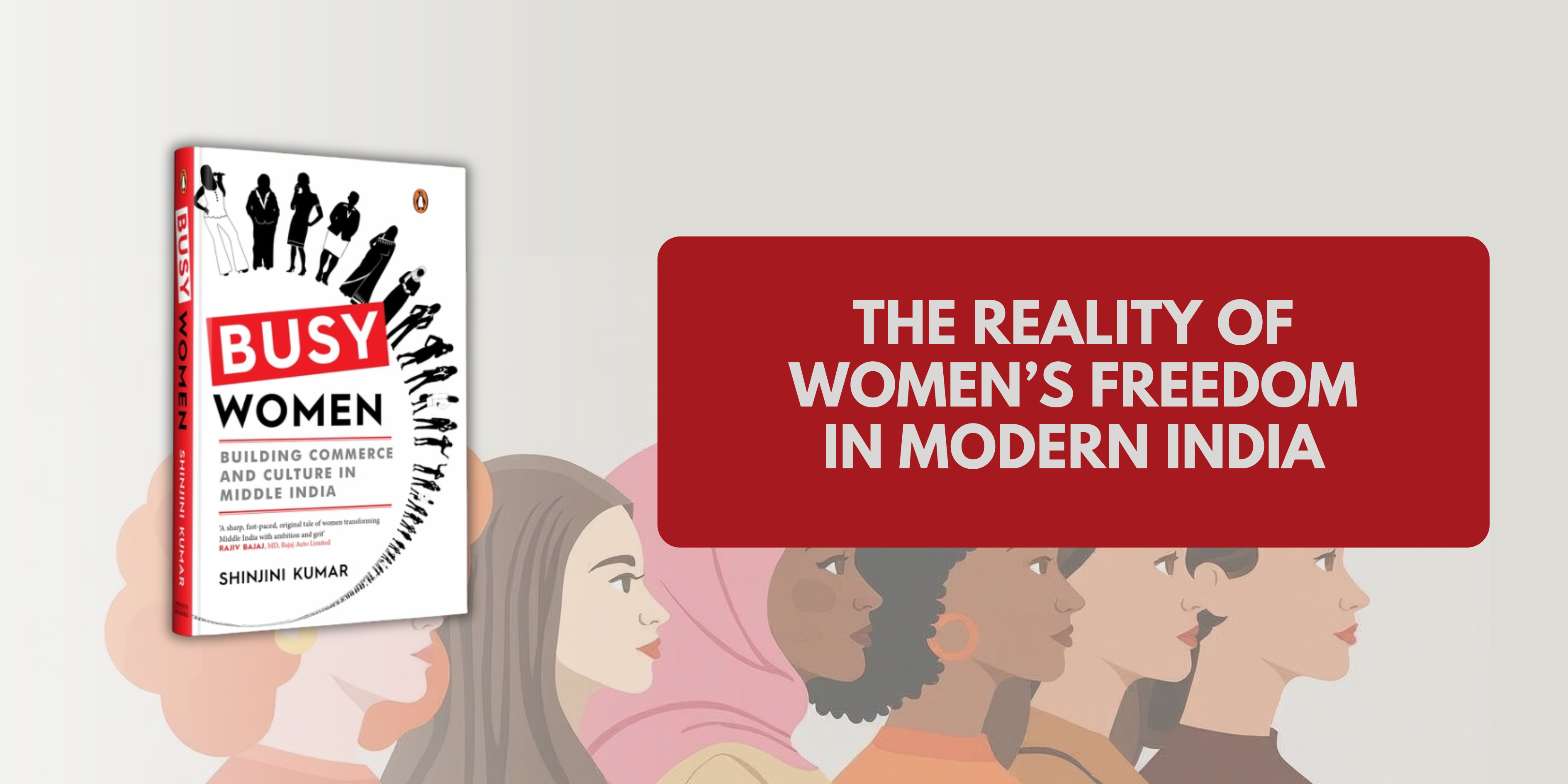
Are women free to fly, or are they still tethered by family, marriage and expectations? In Busy Women, Shinjini Kumar explores ambition, work, migration and the quiet constraints shaping women’s lives today.
***
Why Bother About Women?
Neena Gupta is an actress in art and mainstream cinema and a television producer and director. She gained a cult following in the nineties as a talented artist and a single mother; more recently, she made a stunning comeback in mainstream cinema and broke Instagram, saying it as it is. Neena told me once that a woman is like a cow tethered with a rope that keeps her within the perimeter of the family. The man, on the other hand, is like a bird, who can freely go anywhere.
It is not the kind of parable that I like to hear. Women younger than me like to hear it even less. You look at her and think: ‘What is she talking about? She has lived on her terms and is still doing it. She has got it all. Why would others not be able to do it?’ So, I want to prove her wrong. I want to prove that gender is not a barrier to a determined woman, and that she can do everything that a man can, including flying like a bird.
I am looking for the women who are indeed flying. And if ind them. But I also find the truth of Neena’s parable. Women’s lives are indeed circumscribed differently from those of men. For one thing, they rarely choose the space they get to live in. A small percentage of women, like me or Neena, leave their parental homes for education or work, and set up their own homes. For the large majority, leaving home is a given. But where they will end up for the rest of their lives is dependent on who they marry. Even if she finds education, work and money, decisions relating to her body, childbearing, career and asset ownership are often not her own. She may still be able to make a meaningful life for herself and her family, but the tether is firmly in place.
In more elite families, the frequent hypocrisy of raising daughters like a ‘papa ki pari’ (Dad’s fairy) and then giving them away with a dowry, while the business or property is inherited by the son(s) is a tiny bit less common than before, but certainly not gone away. The simple fact of marital dislocation has tremendous implications for the woman and the community. For the community, these implications are mostly positive. In a crude sense, it matches the free labour supply for household work, childbirth and eldercare with the demand. In more refined ways, there are extremely positive externalities to women becoming vectors of care and culture by being mobile. For the woman, they can be positive, disruptive or debilitating, depending on the combination of circumstances. T he question for me was whether the contribution of women within and outside home is being recognized and understood, or undermined and broad-brushed under age-old stereotypes?
This is an interesting but often overlooked fact. Men migrate for work. With rare exceptions, they follow professional opportunities and networks that are expected to help them in their quest of work, job, career, money. On the other hand, almost all women who move places, do so for marriage. Which means that they leave their networks and do not seize the professional opportunities best suited to them. Of course, they can get lucky. But more often than not, despite all the love and affection, they encounter a phase of darkness and confusion, before they begin to assess opportunities available to them in their new habitat.
This geographical constraint is accompanied by another unfortunate constraint, that of physical safety. The fact that women are not safe, for the most part, in most places and at most times, affects their lives in general and work life in particular. In addition, their life stages are very different from those experienced by their brothers and husbands. Even coming from the same backgrounds and families, women go through more disruption in work at early stages. Do all these constraints stop the women? Has greater access to education and skills allowed women to take advantage of opportunities in a growing economy? And what is this opportunity here and now after three decades of economic liberalization? Is the physical infrastructure generating advantage for Middle India and its residents, men and women? If so, what does it mean for migration and creation of many more urban centres with thriving urban culture across the country?
I started my travels with these questions and an open mind. Making my way through thirty cities over three years, I made friends, drank nimbu paani, ate dosas, wore sarees, took selfies, laughed, sweated, walked on pavements and promenades and collected personal histories of the soaring women, the tethered women and the women in between!
***
Get a copy from Amazon or wherever books are sold!