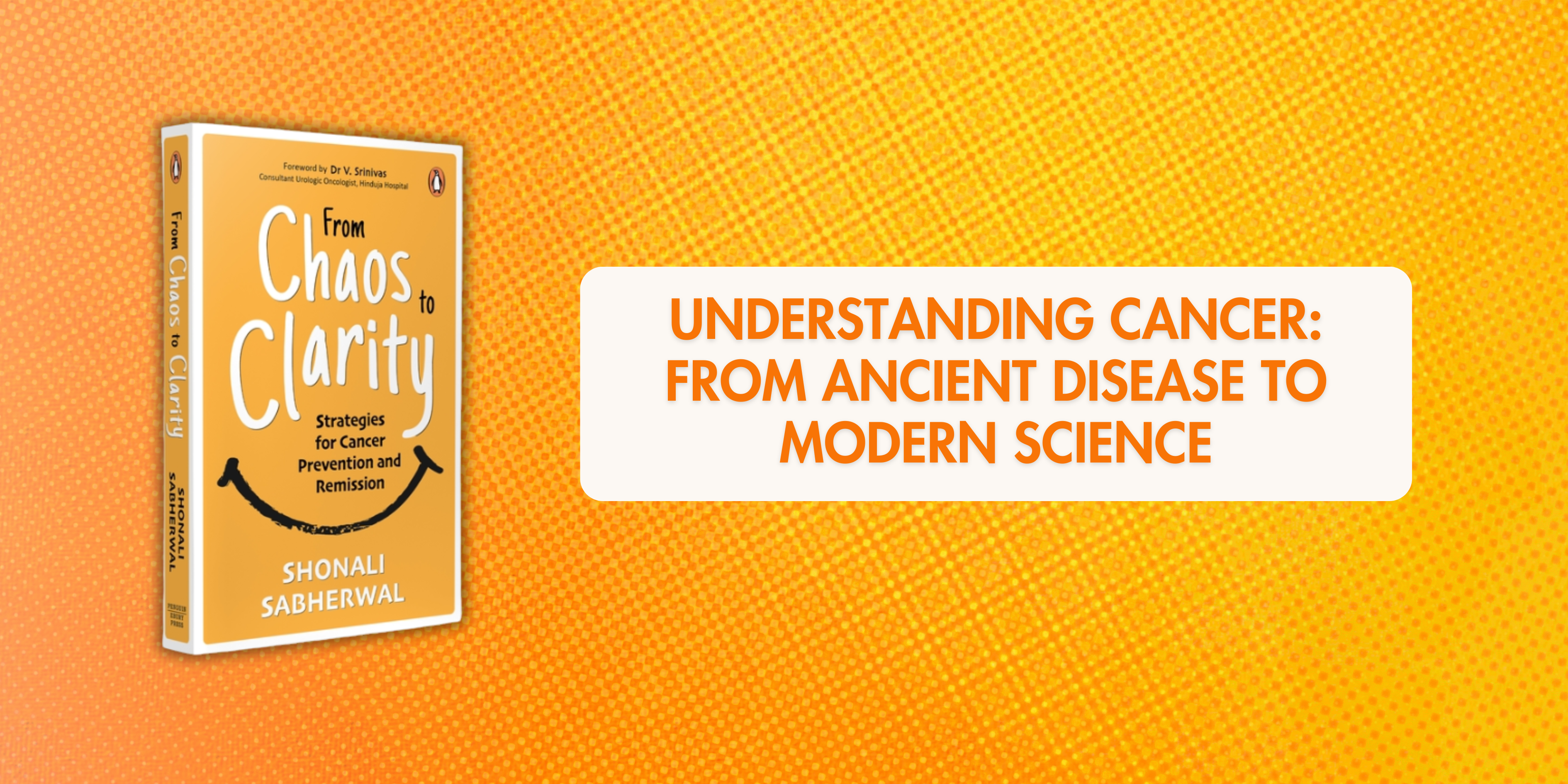
In From Chaos to Clarity, nutritionist Shonali Sabherwal unpacks cancer not as an external invader, but as a complex, evolving disease rooted within our own cells – offering a fresh, holistic perspective on prevention, treatment and healing.

***
The History and Nature of Cancer
Cancer is a prehistoric disease, one recognized since the time of the ancient Egyptians. It has walked this earth at least as long as we have, as an ever-present adversary. Its longevity makes it unique amongst maladies that have come and gone. Smallpox and the Black Death once devastated the world, but largely disappeared from the modern pantheon of health concerns. But cancer? Cancer was there in the beginning. It was there in the middle. And it’s here now, worse than ever.
Despite several thousand years of advancing medical knowledge, cancer still ravages us. It was likely rare in ancient times because it was associated with ageing, and life expectancy was low. Since people were dying young from famine, pestilence and war, cancer was not a big concern. The Greek physician Hippocrates (ca. 460 –ca. 370 ), who is often called the father of modern medicine, may have appropriately named our ancient foe using the word karkinos, meaning ‘crab’. This is a surprisingly astute and accurate description of cancer. Examined microscopically, cancer extends multiple spicules (a spikelike tendril) out of the main body to grab tenaciously onto adjacent tissue. Like the miniature versions of its namesake, cancer distinguishes itself from other deadly diseases by its ability to scuttle around the body from one location to another. A cut on your thigh does not metastasize into a cut on your head, but a cancer in your lung can easily become a cancer in your liver.
Cancers are divided into benign and malignant varieties. Benign cancers grow but don’t metastasize and are not deadly. It is the ability to move and spread, or metastasize, that is responsible for the majority of cancer deaths. For example, malignant tumours are a type of tumour that carries with it the volition of growing bigger as they are cancerous. The key difference between a malignant tumour and a benign (non-cancerous) tumour is its harmful nature—its tendency to grow uncontrollably and invade or damage other organs. For instance, in colon cancer, a tumour on the colon may exert pressure on the rectum or surrounding organs by increasing in size.
There are many types of cancer (breast, colorectal, prostate, lung, myeloma, etc.) which are generally named from the cell of origin. There are likely as many types of cancers as types of cells in the body. These cancers continue growing without limit and have the ability to leave the site of origin to reestablish at a distant site.
All cancers are derived from normal cells. Breast cancer originates from normal breast cells. Prostate cancer originates from normal prostate cells. Skin cancer originates from normal skin cells. This is a particularly vexing and unusual characteristic—it originally derives from ourselves. Cancer is not a foreign invader; it’s an internal uprising. The war on cancer is a war on ourselves.
Is the cell your answer for unlocking the mystery of cancer? The answer to that is yes, it is.
In his book The Song of the Cell, Siddhartha Mukherjee has explained that cancer cells don’t build anew; they hijack or, more accurately, the cells that are fittest for survival, growth and metastasis are naturally selected. The genes and proteins that cells use to generate the building blocks required for growth are appropriated from the genes and cells that a developing embryo uses to fuel its fierce burst of expansion during the first days of life. The pathways used by the cancer cell to move across vast bodily spaces are commandeered from those that allow inherently mobile cells in the body to move. The genes that enable unfettered cell division are distorted, mutated versions of genes that allow cell division in normal cells. Cancer, in short, is cell biology visualized in a pathological mirror.
This is technically a departure from a healthy normal condition. Let’s first understand that no outside force has done this to you. It is your internal milieu that goes awry to manifest a cancer.
Over the last hundred years, our understanding of cancer has undergone three major paradigm shifts. First, we considered cancer a disease of excessive growth. That’s certainly true, but this did not explain why cancer was growing. Next, we considered cancer a disease of accumulated genetic mutations that caused excessive growth. Also, certainly true, but this did not explain why these genetic mutations were accumulating. Most recently, a completely new understanding of cancer has emerged.
Cancer is, improbably, a disease unlike any other we’ve ever faced. It is not an infection. It is not an autoimmune disease. It is not a vascular disease. It is not a disease of toxins. Cancer is originally derived from our own cells but develops into an alien species. From the paradigm of understanding, new drugs have been developed that threaten, for the first time, to end this war in the trenches.
This then begs us to answer the question: Do the cells shape the cancer destiny? And, I would answer yes to this as well. So, in my little view of what makes us ‘us’, I can say that we are mind and matter. The mind and matter (our physical body) have a deep connection to our flow of consciousness. Our physical body has microorganisms and cells.
***
Get a copy from Amazon or wherever books are sold!