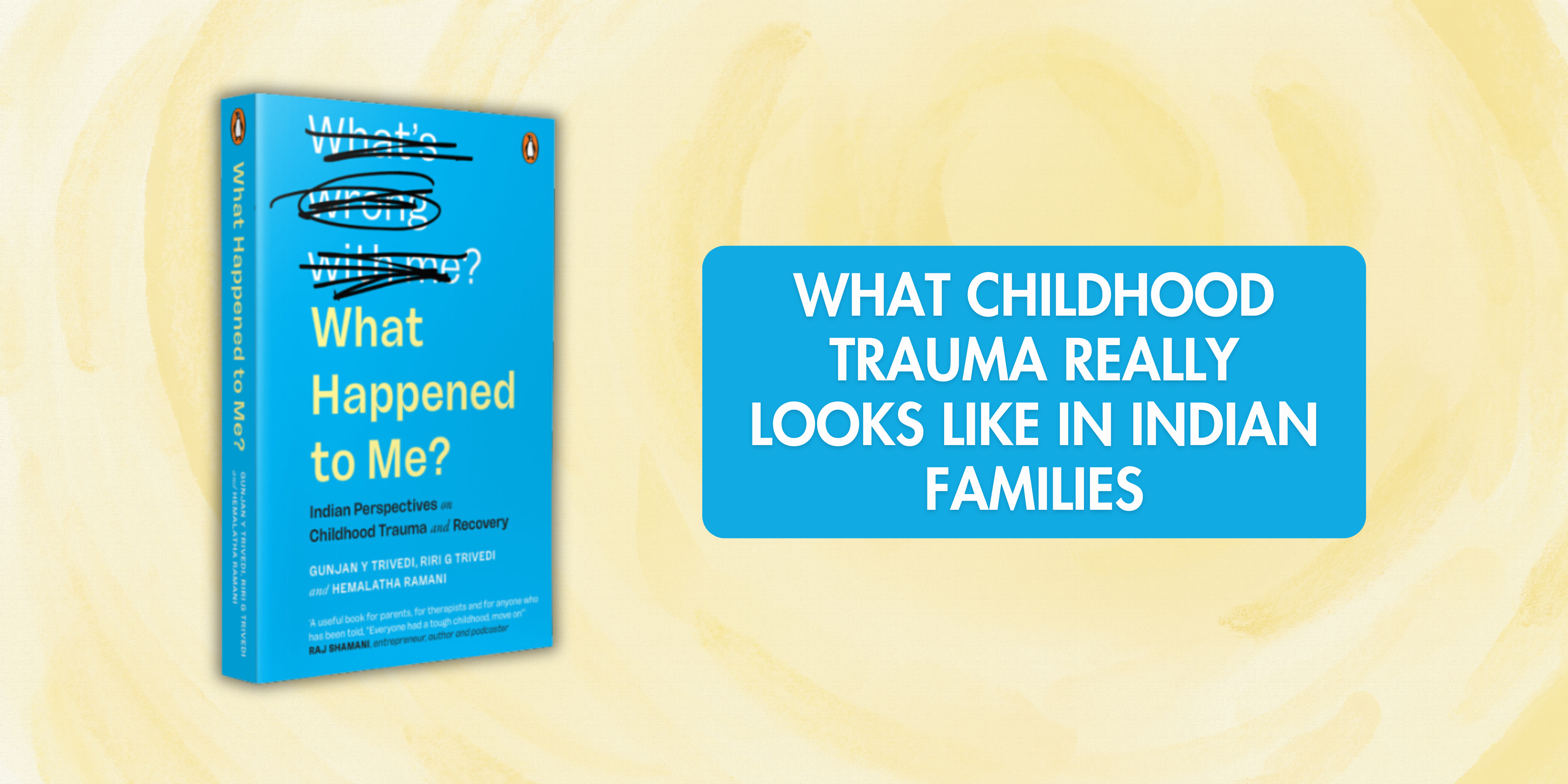
In What Happened to Me? vs What’s Wrong with Me?, Gunjan Y. Trivedi, Riri G. Trivedi, and Hemalatha Ramani explore how childhood experiences silently shape adult mental health, relationships, and our sense of self—urging us to replace self-blame with self-understanding.
***
‘I Am Still Hiding Behind the Sofa’
As a child, Anant remembers hiding behind the sofa and covering his ears to block out his parents’ shouting. To him, as a little boy, the fights were terrifying. He watched his father hit his mother, smash plates and constantly threaten to leave. He sat frozen, afraid his father might turn on him next. When things were supposedly ‘calm’, the cold silent treatment would last for days, filling the whole house with heavy tension.
Unfortunately, the violence wasn’t limited to only between his parents. Anant’s mother often hit him too, sometimes for small mistakes, sometimes for no clear reason at all. He remembers feeling confused and hurt, never knowing or understanding what would set her off. Alongside the fear, there was neglect. He often felt invisible; his needs and feelings didn’t seem to matter to anyone.
One memory continued to haunt him even in adulthood. He remembered his mother locking herself in a room and threatening to kill herself. He could hear her crying and shouting from behind the door, while his father banged on it, pleading with her not to do anything. Even as a child, Anant felt a sickening mix of fear, anger and helplessness, always left wondering if he was somehow to blame.
That fear and confusion never really left him. As he grew up, Anant became anxious and hyper-alert, always on edge about upsetting people. In relationships, one moment he would hold on tightly and the next, he would be dismissive and push them away.
His fear of abandonment triggered anger at anyone who got too close. Arguments could turn into explosive outbursts he felt he had no control over, leaving him drowning in guilt and shame afterwards.
Inside, he felt empty, as if something were broken or missing within him. His moods swung between deep sadness, anger and numbness. Even small setbacks felt overwhelming. He struggled with trusting anyone, convinced they’d eventually hurt or leave him.
When he finally sought psychiatric help, he poured out these confusing, intermeshed, painful memories. The psychiatrist listened carefully and explained that he was living with major depressive disorder and borderline personality disorder. The labels stung, but they helped him make sense of the constant low feelings, fear of abandonment, emotional mood swings and the deep ache he’d carried since he was that little boy, waiting for the next fight to start. He was convinced that there was something wrong with him and the labels also confirmed this belief.
Anant’s story is not rare. Every day, at Wellness Space, we hear stories like his. They highlight to us the normalization in many families of childhood traumas, of abuse, violence.
The question we, parents, family and adults, need to ask ourselves, is: Are we okay with our behaviour towards our children? Or do we need to understand the long-term implications and ramifications of our behaviour?
Types of Childhood Trauma—Indian Perspective These painful experiences that children go through from birth to eighteen years are known as Adverse Childhood Experiences (ACEs). Witnessing domestic violence, like Anant did, seems more common than what we would have liked to believe. Other more commonly seen ACEs include being directly abused or neglected. Decades of global research show these early experiences can shape us for life, leading to mental health struggles, chronic illnesses and difficulties in forming healthy relationships.
But in India, there’s very little research on ACEs and even less awareness or sensitivity. Unfortunately, as a culture, we’ve often accepted beatings and harsh punishments as an essential part of disciplining, even praising that style of parenting. Many parents genuinely believe they cannot raise good children without hitting or threatening them, because that is how they themselves were raised and they believe they have turned out just fine!
Ironically, even parents who realize how much they have been impacted by such harsh disciplining methods, often struggle to break the cycle. They want to do better but when they’re stressed or triggered, their old wounds take over. Their trauma hijacks their good intentions and they end up repeating the very behaviours they once hated in their own parents.
Dr Vincent Felitti’s landmark ACE study highlighted earlier opened our eyes to how ten types of childhood trauma can have lifelong mental and physical health effects. As we talked to hundreds of individuals, we realized the original ten categories used by Felitti to measure ACEs needed to be modified to be applicable in the Indian cultural context. For example, the global questionnaire has ‘Parental Divorce or Separation’ as a trauma element, but in India, parents often stay together despite constant conflict, due to social pressures, or for the sake of the children, which is equally or more damaging than divorce or separation. Keeping this context in mind, we added four further categories—parents fighting, peer bullying, peer rejection and socio-economic position—to the original Felitti questionnaire, making it fourteen categories. This addition was made only after the required validation process and was later published in year 2025 in the Asian Journal of Psychiatry.