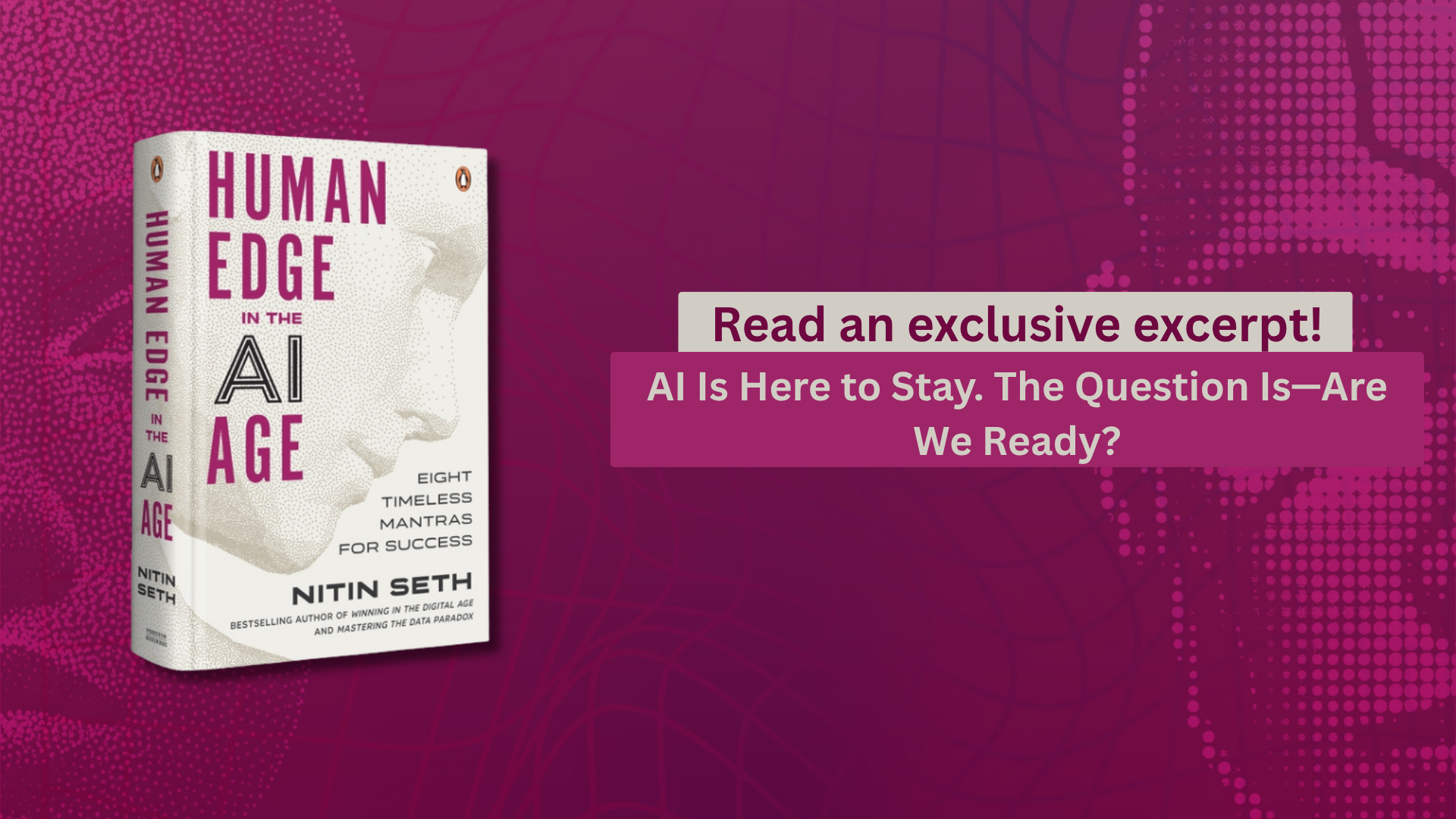
In this excerpt from Human Edge in the AI Age, Nitin Seth explores the unstoppable rise of Artificial Intelligence—and why rediscovering our uniquely human strengths may be the only way to thrive in this new era.
AI IS REDEFINING EVERY ASPECT OF LIFE AND BUSINESS
The Irresistible March of the AI Age Nothing else in the world . . . not all the armies . . . is so powerful as an idea whose time has come. —Victor Hugo, French author, poet and politician
AI’s time has come. It is all around us. It is unavoidable. AI might have sounded like pure science fiction, synonymous with futuristic robots or sci-fi movies a decade ago. It felt distant, something reserved for advanced research labs or tech giants. But here we are, on the cusp of a new era, where AI is woven seamlessly into the fabric of our daily lives. From the way we communicate, work and shop to the devices in our homes, cars and even our pockets—AI is everywhere, empowering us like never before.
Today, AI isn’t just a concept of the future; it is an undeniable force shaping our world. Whether we are asking virtual assistants for weather updates, relying on smart devices to adjust the lighting in our homes, navigating traffic with real-time insights or even having AI draft a business email—AI is present, indispensable and, quite frankly, extraordinary!
While AI has been brewing in the labs of tech giants and researchers, the advent of Gen AI has been an enormous leap forward in the history of AI. Unlike earlier forms of AI, which primarily relied on structured datasets and rule-based programming, Gen AI comes with a transformative ability to harness the data of the world and generate content, learn, adapt, create and evolve in real-time. It has shifted the narrative, transforming AI from a reactive tool into a proactive asset, ushering in a wave of innovation that feels limitless.
AI’s meteoric rise is no accident. While it has exploded on the scene quite recently, witnessing near-blinding adoption rates across all industries, it wasn’t possible without multiple waves of technology developments and business model innovations that have happened in the past.
Multiple waves of innovation leading to the AI age.
In my previous book, Winning in the Digital Age, I defined the digital age as a wide-ranging set of technology trends that have evolved over time. Each wave of technological evolution—whether it was the rise of the internet, the surge of mobile technology or the advancement of machine learning—has layered another block onto the foundation of AI as we know it. Business model innovations, too, have played a crucial role, as companies worldwide have eagerly embraced AI to enhance everything from operations to customer engagement. The AI we have today isn’t a standalone invention, but a culmination of countless innovations and relentless progress, each breakthrough building on the last until AI became an unstoppable force. Let’s look at the multiple waves of innovations that brought us to the AI of today.
It all started with the transition from physical to digital.1 Digital truly took off in the 1970s, when the world moved to digital with the explosive growth of computers and the availability of compute power. This era saw innovations like mainframe computers, by companies like IBM, and the development of the microprocessor by Intel, laying the groundwork for personal computing. These early advancements in computing and processing power created the essential foundation for AI, enabling the complex calculations and data processing that AI relies on today.
The next major wave arrived with the internet in the late 1990s, ushering in the dotcom boom. Companies like Amazon and eBay transformed retail by moving commerce online, shifting businesses from brick-and-mortar to e-commerce and online services, and redefining customer interactions and operations. Then in the late 2000s, social, mobile, analytics and cloud (SMAC) technologies emerged, reshaping interactions through social media platforms like Facebook, while the iPhone heralded the smartphone revolution, ushering an era of any-time, anywhere access to information, transforming the way people connect, work, shop and entertain themselves. Cloud services like Amazon web services (AWS) offered scalable infrastructure and big data analytics provided real-time insights. This internet and e-commerce boom are the predominant contributors to the rapid expansion of the amount of digital data, which became essential for training AI and improving machine learning methods.
Following the SMAC wave, the digital ecosystem era emerged, characterized by interconnected platforms like Apple’s App Store or Alibaba’s marketplace. These ecosystems enabled new business models and transformed industries and customer engagement. For example, companies like Netflix and Uber emerged that built new digital-first business models, which have led to the creation of new industries. These digital ecosystems also created a connected network where AI could be deployed widely, enabling companies to build AI-powered solutions that work across different platforms and services.
The early 2020s saw the advent of AI, built on a foundation of powerful new technologies like advanced computing, vast data availability and cloud infrastructure. This era also saw the rise of other new technologies like blockchain, the internet of things (IoT) and quantum computing. While blockchain enabled significant innovations like Decentralized Finance (DeFi) and transparent supply chains, IoT made connected smart homes and industrial machines a possibility. Quantum computing has now opened doors to solving problems beyond the reach of classical computing.
Today all these cutting-edge technologies are converging, opening up newer and greater possibilities for innovation. Their convergence is setting up the stage for new forms of intelligence and interconnected solutions that are not only making our lives easier but are capable of tackling long-prevailing real-world problems. However, amongst all these new technologies, AI has exploded exponentially in recent times. Let’s delve deeper into what made this possible.
Gen AI, the inflection point of the AI wave
The tipping point for AI came with the advent of Gen AI, which literally exploded on the scene, capturing the public imagination. The advent of Gen AI brought the powerful ability to generate rather than merely analyse or predict. This leap has been enabled by access to vast amounts of global data, advancements in algorithms and significant enhancements in computing power. These factors have empowered systems to learn from extensive datasets and perform highly complex calculations, enabling the creation of innovative content and solutions across a broad range of applications. It has unleashed the true transformative power of AI, catapulting it into not just the most groundbreaking technological breakthroughs of the digital age but perhaps in the history of human evolution.
The advent of Gen AI didn’t just open new doors, it broke down the walls that kept AI confined to the labs of researchers and big techs. With the power to create, not merely analyse, Gen AI has triggered a shift towards accessibility and versatility, making AI a tool for everyone, not just specialists. Let’s see how.
Expansion and democratization of AI
Over the past decade, due to data availability and quality, AI’s application was limited. Early AI implementations in healthcare, for example, focused on tasks like detecting anomalies in medical images, such as identifying tumours in X-rays. AI systems required large, high-quality datasets to perform well, which were often difficult to collect and curate. This limited AI to isolated cases, like image recognition in radiology and prevented broader integration in solutions like diagnosis or personalized treatments. The lack of deep and high-quality datasets also restricted AI in other fields. The advent of Gen AI has transformed this paradigm in two major ways. First, it has led to the expansion of AI. As I mentioned, AI needed big, high-quality datasets to work effectively, which was hard to get to and hence really limited what it could do. Gen AI’s large language models (LLMs) are trained on vast, diverse datasets sourced from the internet, literally the data of the world. This gives Gen AI the ability to provide reasonably accurate initial responses (often 40–60 per cent) to nearly any question. This breakthrough means AI’s dependence on data as a starting point has been significantly reduced. Since these models are built on a massive pool of existing knowledge, they excel at recognizing patterns and relationships, enabling them to generate accurate responses across a wide range of topics. This means we no longer need to build AI models from scratch. Instead, we can leverage these pre-trained models and fine-tune them for specific applications, dramatically lowering the effort and time required for developing AI solutions.
Second, tools such as ChatGPT have democratized AI, making it accessible to people without technical expertise. These tools have simplified AI interaction through easy-to-use interfaces that respond to natural language prompts, removing the need for coding or specialized knowledge. This accessibility allows even the nontechnical users to leverage AI for tasks that required a decent level of expertise in the past. Now, individuals from all backgrounds can use AI interactively for tasks like creating art, drafting essays, generating recommendations or even writing codes. For instance, a small business owner can produce custom marketing materials with simple prompts, and a remote teacher can design tailored lesson plans without extensive resources. This evolution has made AI versatile and practical for everyone, regardless of background or expertise. While we discuss the remarkable capabilities of ChatGPT, it wouldn’t be fair to not acknowledge the role of OpenAI in bringing the advancements of Gen AI from the realm of scientists to the masses. So let me take you through their journey and their role in democratization of AI.
***
Get your copy of Human Edge in the AI Age on Amazon or wherever books are sold.