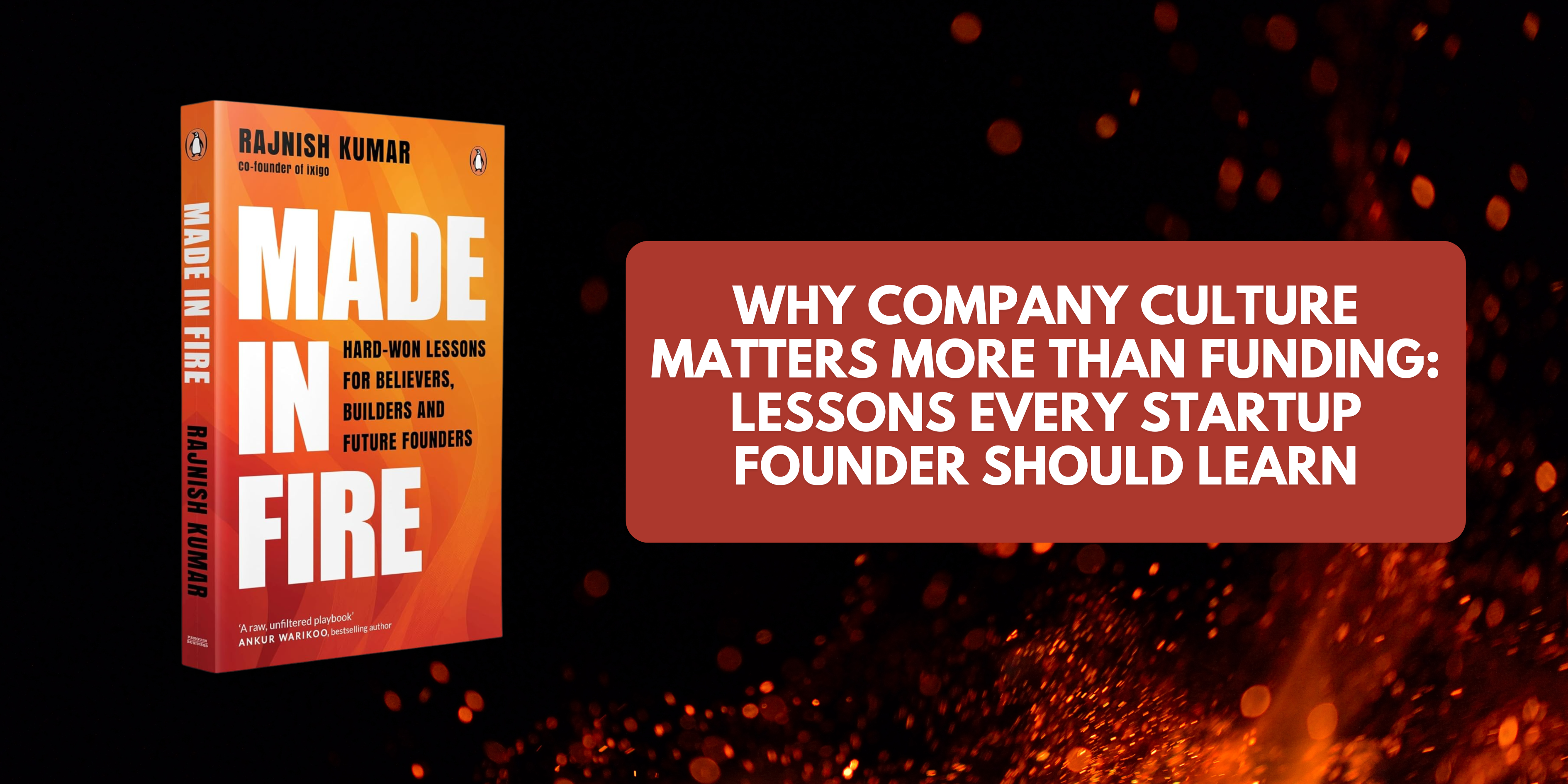
What if the real reason startups fail isn’t a lack of funding, talent or product-market fit? In Made in Fire, Rajnish Kumar makes a compelling case that culture – the invisible force behind every company—is often the deciding factor between survival and collapse.

***
Let’s talk about the elephant in the room that nobody sees: culture.
It’s the invisible force that can make or break your start-up faster than any funding round or product launch.
You can have a killer idea, a rockstar team and investors lining up to back you. Still, I’ve seen start-ups with all the right ingredients collapse. Not because the product failed, but because the culture did.
Here’s the truth:
Culture isn’t what you put on posters or perks. It’s how decisions are made when you’re not in the room.
It’s not your ping-pong table or casual Fridays. It’s the DNA of your company. It’s how people behave under pressure. It’s the difference between ‘that’s not my job’ and ‘how can I help?’
And here’s the kicker: as a founder, you’re shaping your culture, whether you realize it or not. Every hiring, every decision, every crisis sets a precedent. The only question is whether you’re doing it intentionally.
Culture isn’t something you design in a boardroom. It happens when you’re real, when you’re authentic.
At ixigo, we didn’t sit down to write a culture playbook. Our culture emerged in the fire of two crises: the 2008 financial meltdown and the COVID-19 pandemic. Those trials, when survival itself was in doubt, became the forge that defined who we are. They taught us empathy, resilience and the power of staying true to our values, even when the world felt like it was falling apart.
Culture is not a nice-to-have. It is your secret weapon.
It’s what keeps your best people from leaving when times get brutal. It’s what sparks the 2 a.m. breakthroughs that change your trajectory.
So here’s your wake-up call. Treat culture with the same obsession you treat your product. Because in the end, your culture is your company.
And like every story, it starts with the first few people you let in.
Culture Starts with Your First Believers
Culture doesn’t begin with posters on the wall or values written in a handbook. It begins with people: the very first ones you bring on board. Before founders can shape a culture, they need the right believers to shape it with.
Your earliest hires don’t just execute your vision; they cocreate your company’s DNA. If they’re missionaries, driven by belief and purpose, culture compounds. If they’re mercenaries, driven by pay cheque and title, culture corrodes.
The maths is brutal. In a five-person start-up where everyone is aligned and passionate, the energy feels like sixteen people working. Add just one person who’s misaligned, and that same team suddenly feels like two. That’s how fragile culture is at the start.
This is why choosing your first believers is the most important cultural decision you’ll ever make.
Skills can be taught. Belief cannot be faked.
I understood how real that was only when our own belief was tested for the first time.
The Day the Music Died: The 2008 Financial Crisis
It was supposed to be our big break. We had just signed a term sheet with a marquee investor. The beers were flowing, the office buzzing with anticipation. In 24 hours, we would finally have the wings to compete in the big leagues.
Then the phone rang.
‘Guys, Lehman Brothers just collapsed in the US,’ the investor’s voice crackled over the line.
My stomach dropped. I didn’t need to hear more. The deal was gone. The global financial crisis, which had felt like a storm far offshore, had just made landfall on our doorstep.
‘Okay, fuck,’ I muttered to Aloke Bajpai, my co-founder. ‘What do we do now?’
That night, we slammed the brakes on every expense. The grand plans we’d been dreaming of evaporated in an instant. But the real dilemma came as dawn broke: Do we keep this from the team and buy time? Or do we tell them the truth and risk panic?
By morning, we decided there was no point sugarcoating it. We gathered everyone in the office. Our hearts pounded as we spoke.
‘Guys . . . we don’t have the money to pay salaries for everyone. We may have to let go of half the team.’
The silence that followed was suffocating. You could hear a pin drop. In that moment, the room was suspended between disbelief and fear, every face staring back, waiting for what would come next.