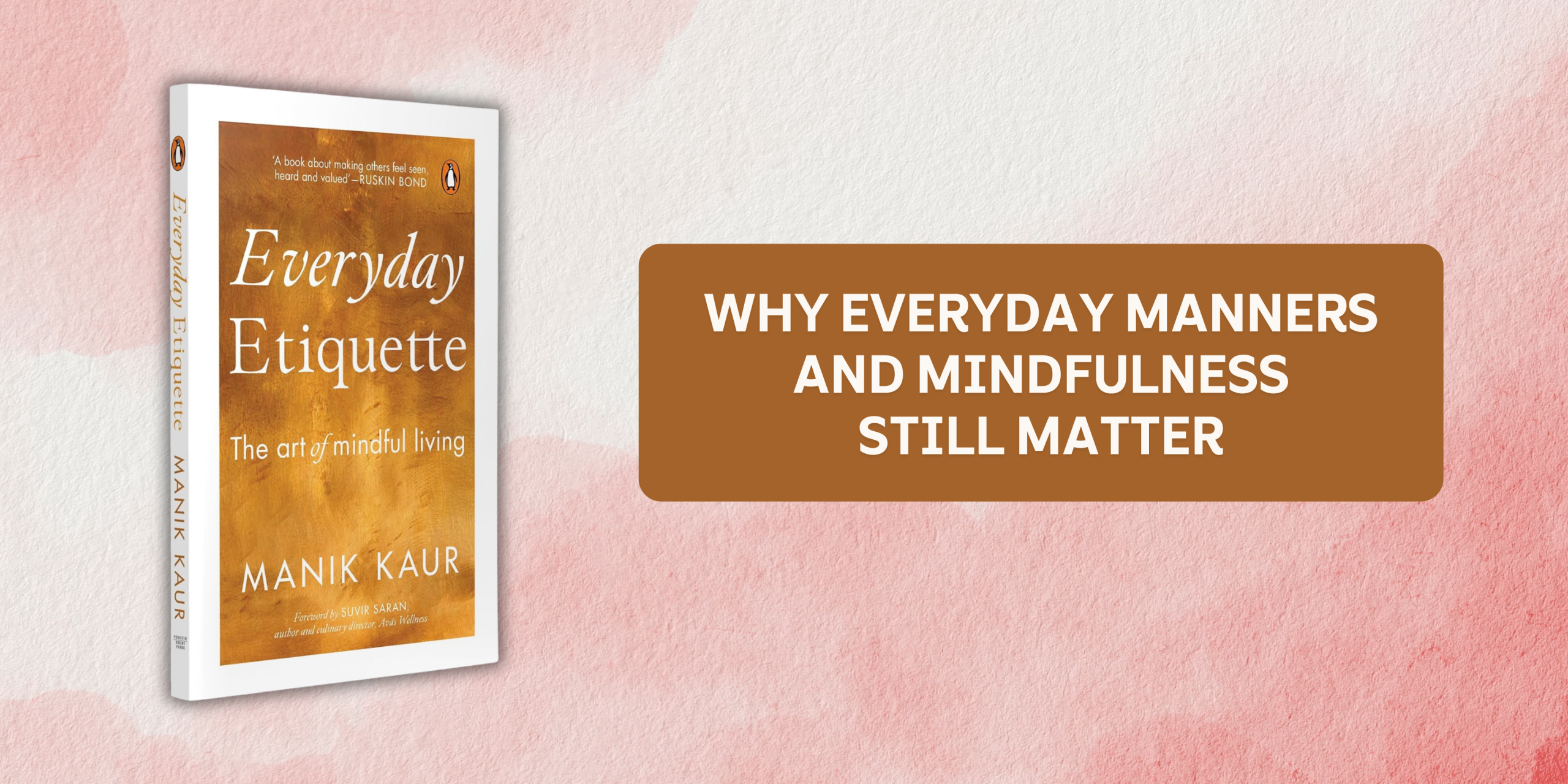
In Everyday Etiquette: The Art of Mindful Living, Manik Kaur challenges the idea that etiquette is about rigid rules and social status, and instead reclaims it as something far more meaningful: mindfulness in action.

***
Busting Myths and Reclaiming the Lost Art of Grace
Say the word ‘etiquette’ and most people immediately think:
‘Too old-fashioned.’
‘Too elite.’
‘Too stiff for the real world.’
It conjures up images of girls in white gloves balancing books on their heads or men learning to hold cutlery like weapons of social status. A concept tucked away in drawing rooms, wedding invites or five-star hotel lobbies.
But let me tell you a secret: the most powerful form of etiquette doesn’t need a ballroom.
It shows up in the simplest moments—when you respond to a junior’s email with kindness, when you greet your house help with eye contact or when you let someone finish speaking before jumping in with your point.
True etiquette is not a performance. It’s presence.
Real-Life Moment: When a Junior Taught Me a Lesson
Years ago, during a corporate workshop in Delhi, I met a young HR assistant from a Tier 2 city. She was quiet, observant and barely spoke during the session. But at lunch, when I couldn’t find a spoon at the buffet, she walked up, offered hers and said, ‘Ma’am, you speak so kindly about mindfulness. I just thought you shouldn’t have to go searching.’
It was such a simple gesture—yet it told me everything about her upbringing, self-awareness and emotional intelligence. No expensive course, no finishing school. Just real values, practised quietly, without an audience.
That, to me, is etiquette in its purest form.
A few months later, I witnessed another moment that said even more about human awareness—this time, at the Delhi airport.
It was a busy morning flight. The check-in queue was long, and everyone was buried in their phones or staring at their boarding passes. Ahead of me stood a young man in jeans and a plain T-shirt.
A few steps behind us, an elderly lady struggled with her luggage trolley. Most passengers noticed but conveniently looked away. Before I could move, the young man quietly stepped aside, gestured for her to come ahead and helped lift her bag onto the conveyor. No fanfare, no performative smile—just a quiet act of presence.
She thanked him softly; he nodded, almost embarrassed by the attention. The line moved on.
But in that instant, I was reminded that refinement isn’t about status or fashion—it’s about sensitivity. That one small act of awareness spoke louder than any perfectly crafted selfpresentation.
Because grace doesn’t shout. It simply notices and acts.
The Real Definition: Mindfulness in Action
Forget what you’ve been told. Etiquette isn’t about being prim and proper. It’s about being aware—of your surroundings, your words, your timing and your impact.
It reveals itself in how you speak—not in volume but in clarity and warmth. In how you listen—not waiting for your turn to reply but genuinely holding space for someone else’s words. In the energy you carry into a room—composed, considerate and present. In the simple act of looking up from your phone when someone is speaking to you.
Try this simple experiment: say, ‘Hi’ to someone. You’ll almost always get a cheerful, ‘Hi! How are you?’ in return. But before you can answer, their gaze will have drifted elsewhere. The question was never meant to invite an answer; it was just a polite reflex. We’ve reduced genuine connection to a social cue. No one seems to be interested in the real, descriptive answer. Everyone seems to just expect the short and standard, ‘I’m fine’ or ‘I’m good/great!’ Don’t you agree?
Real listening requires more than ears; it requires presence. It means holding space for someone else’s words, even if it’s for thirty seconds, without mentally preparing your next line or glancing at a screen. Because when you listen with full attention, you’re silently saying, ‘You matter.’
In the simplest of terms, etiquette is how we say, without words: ‘I see you. You matter.’